Head-to-head test
EcoFlow DELTA Pro Ultra X vs Anker SOLIX C300 DC
This is a category mismatch, not a contest: a 298.7-lb, $7,999 whole-home system against a 6.2-lb, $200 DC charger, and the only thing that decides it is whether your gear ends in a wall plug or a USB-C cable.
Full profiles: EcoFlow DELTA Pro Ultra X → · Anker SOLIX C300 DC →

Written by Gunner GustafsonUpdated
Whole-Home Backup Tester, Station Arena Test Desk
Spec deltas
One of these weighs 298.7 lbs and gets bolted into a utility room; the other weighs 6.2 lbs and rides in a laptop bag. The EcoFlow DELTA Pro Ultra X is a $7,999 whole-home backup system with a 12,000W inverter and 12,288Wh of storage. The Anker SOLIX C300 DC is a $200 DC brick with 288Wh and no AC outlet at all. They are not the same kind of product, and treating this as a head-to-head does you no favors.
Run the specs and the DELTA wins everything, including the one you'd least expect. At 19 cents per lifetime kilowatt-hour against the Anker's 23, the $7,999 machine is actually the cheaper energy. But that number is a homeowner's argument, not a traveler's, and it only pays off if you'll cycle 12kWh on the regular.
So the real question isn't which is better. It's which job you have. If your gear plugs into a wall, the C300 is out before watt-hours enter the conversation. If your gear charges over USB-C or 12V, the DELTA's 12,288Wh is 298 pounds of irrelevance. For the reader actually choosing between these two, that fork settles it, and for a big group in the middle, the answer is neither.
What the Numbers Reveal
Each conclusion stated first — the numbers behind it on one line, the full analysis below.
cost / lifetime kWh
That math only pays out if you actually pull those kilowatt-hours. Charge phones and a laptop off a 12,288Wh pack and you'll retire before you cycle it enough to bank the difference; the per-kWh win is real on paper and unreachable in a backpack.
DELTA Pro Ultra X: $0.19 per lifetime kWh vs SOLIX C300 DC: $0.23DELTA lifetime output 43,008 kWh vs C300 864 kWhDELTA capacity 12,288Wh vs C300 288Wh
Why it mattersIf you're not running loads that need a house-sized battery, the DELTA's better cost-per-kWh is a number you'll never actually collect.
continuous output
The DELTA's 12,000W is inverter output behind wall outlets a traveler never touches; on the DC side people actually carry, four USB-C ports, two USB-A, and a 12V socketB2, the little unit is the faster charger, at 6.2 lbs against 298.7.
C300 DC USB-C maxes at 140W vs DELTA Pro Ultra X USB-C at 100WDELTA Pro Ultra X: 12,000W behind AC outlets; C300 DC: DC-only, no AC outletC300 DC weight 6.2 lbs vs DELTA 298.7 lbs
Why it mattersA device-charging buyer gives up nothing real by skipping the DELTA; on their own metric the C300 is the better tool.
That makes this a fork, not a spec race. If your gear ends in a two-prong plug, the C300 is disqualified before capacity matters; if it ends in USB-C or 12V, the DELTA's 12,288Wh and 12,000W inverter are answering a question you didn't ask.
C300 DC has no AC outlets, DC-only with no inverterEngine fails the C300 in Weekend Camping, 8-Hour Blackout, Remote Workday and Van Life because the appliances never plug inDELTA Pro Ultra X carries a 12,000W inverter behind 4 AC outlets
Why it mattersSort your gear into AC or DC first; that single split decides this matchup before any other number does.
The specific dimensions that decide these two units — everything else is a tie.
Portability & Form Factor
Selected because: The defining split is 298.7 lbs bolted in place against 6.2 lbs in a bag, one you install and one you pack.
weight
Weight decides this before a single watt-hour does. The DELTA Pro Ultra X is 298.7 lbs, a two-person lift on a good day and a semi-permanent appliance once it's placed. You don't take it camping; you move in around it. The C300 DC is 6.2 lbs, the difference between a machine you own and a machine you carry.
That's why the scenarios split so cleanly. The DELTA has the energy for a powered weekend but can't get to the campsite; the C300 can ride along in a daypack but has nothing to plug the lights into. Portability isn't a tiebreaker here. It's the category line.
What the Specs Don't Tell You
Selected because: The C300 DC has no AC outlet and no listed UPS; the DELTA lists a UPS rated no worse than 10ms and weighs 298.7 lbs. The catches, not the capacity, decide who this is for.
rated cycles
One spec ends most of this argument: the C300 DC has no AC outlets. Its 300W is a DC total across USB and a 12V socket, so anything with a wall plug, a fridge, a box fan, a coffee maker, never runs, at any wattage. That's the design, not a flaw, but it's the design that tells a lot of readers to stop here.
The DELTA answers the specs the C300 leaves blank, and one is a genuine advantage: it lists a UPS mode rated no worse than 10ms, quick enough on paper for a desktop or a router to ride through an outage without rebooting. The C300 lists none, so anything on it drops the instant the power does. Worth knowing which of your devices hate that.
Your Life, Your Pick
Selected because: Across everyday loads the C300 clears nothing that needs a wall plug, and two scenarios leave both units out, the mismatch made concrete.
The engine runs a spread of everyday loads, and the pattern is blunt: the C300 clears nothing that needs an AC outlet, and it's never a capacity problem. In the 8-Hour Blackout it's the missing wall plug, not missing watt-hours; the DELTA finishes that one with 8,800Wh to spare.
The honest rows are the two the engine gives to neither. A powered weekend needs about 2,100Wh through real outlets and a tailgate about 670Wh; the DELTA has both easily but weighs 298.7 lbs and stays home, while the C300 travels but can't plug anything in. When both units whiff on the same ordinary job, that's the page telling you the buyer you might be isn't served by either.
Lifetime Value
Selected because: The counterintuitive part: at $0.19 per lifetime kWh against $0.23, the $7,999 unit is the cheaper energy, if you ever use it.
cost / lifetime kWh
Here's the counterintuitive part, and it's real: the $7,999 DELTA is the cheaper energy of the two. Nineteen cents per lifetime kilowatt-hour against the Anker's twenty-three, because a 12,288Wh pack rated for at least 3,500 cycles spreads its price over 43,008 kilowatt-hours of output. The sticker screams premium; the per-unit math quietly doesn't.
The catch is whether you'll ever collect it. The C300 banks 864 lifetime kilowatt-hours because it's a 288Wh unit, plenty for its job, nowhere near enough to make cost-per-kWh the deciding lens. Buy the DELTA to trickle-charge devices and you're paying $1,600 a warranty year to leave most of it unused. The value is genuine only at the scale the DELTA is built for.
PowerScore Breakdown
Selected because: Our bench scores the DELTA at 12,800 against the C300's 1,610, roughly eight times the machine, useful only if you need that much machine.
overall power score
Our bench puts the DELTA at 12,800 and the C300 at 1,610, call it eight times the machine. That gap is exactly what you'd expect between a 12,000W whole-home inverter and a 300W DC charger, and it's exactly as useful as the load you actually plan to run.
A number like that tempts you to buy the better one. Resist it. Eight times the machine is eight times the machine you have to place, power, and pay for; if your evening is a phone, a laptop, and a fan, the score you want is the one that fits in a bag.
Strengths & trade-offs
EcoFlow DELTA Pro Ultra X
Strengths
- +Larger battery capacity
- +Higher AC output
- +Longer warranty
- +Faster solar charging
Trade-offs
- –Substantially more expensive (+$7,799) than the SOLIX C300 DC.
- –Significantly heavier (+292.5 lbs), making it harder to move.
- –Very heavy unit that may be difficult for one person to lift.
Anker SOLIX C300 DC
Strengths
- +Costs $7,799 less
- +Lighter by 292.5 lb
Trade-offs
- –Weaker inverter (-11,700W) limits appliance compatibility.
- –Sealed capacity — the DELTA Pro Ultra X can add batteries to grow past 288Wh; this one can't.
Will It Power Your Gear?
Scenario math and per-appliance runtimes, modeled from the spec record.
Scenario verdicts
We ran the math on seven real-world scenarios. Here's which unit survives your actual life.
SCN-01 · 2 nights · needs 2,100Wh
Weekend Camping
Two nights off-grid with essential comfort
Neither unit
Neither one powers a weekend, for opposite reasons. The DELTA Pro Ultra X has the energy for it several times over but weighs 298.7 lbs and isn't leaving the house. The SOLIX C300 DC will happily ride along at 6.2 lbs, but the lights and box fan here need a wall outlet it doesn't have. One can't come; the other can't plug in.
Battery budget usedlower = more headroom
LOAD Phone Charger 15W×6h · LED Lights 40W×8h · Box Fan 75W×14h · CPAP Machine 40W×16h
SCN-02 · 8 hours · needs 1,645Wh
8-Hour Blackout
Keep the essentials running through a night without power
DELTA Pro Ultra X
The DELTA Pro Ultra X owns this one. The load needs about 1,645Wh through real outlets, and it finishes with 8,800Wh to spare while listing a UPS mode that hands over in no worse than 10ms. The SOLIX C300 DC sits it out entirely, no AC outlet means the fridge and router never plug in, whatever the battery holds.
Battery budget usedlower = more headroom
LOAD Fridge 150W×8h · Router + Modem 20W×8h · LED Lights (4 bulbs) 40W×6h · Phone Charger 15W×3h
SCN-03 · 8 hours · needs 320Wh
CPAP Overnight
Sleep therapy without interruption — the #1 medical use case
DELTA Pro Ultra X
The DELTA Pro Ultra X covers the night with 10,125Wh untouched, but the real story is the SOLIX C300 DC. A 12V CPAP will actually start on it, then run out: 245Wh usable against the roughly 320Wh a night needs leaves it about 75Wh short, dying near dawn. A wall-plug CPAP won't start at all. Match the plug before you count the watt-hours.
Battery budget usedlower = more headroom
LOAD CPAP Machine 40W×8h
SCN-04 · 8 hours · needs 910Wh
Remote Workday
Full work day off-grid without power anxiety
DELTA Pro Ultra X
The SOLIX C300 DC has no AC outlets, so the external monitor and router + modem in this scenario never plug in — it's a DC station for USB and 12V gear, and no wattage figure changes that. The DELTA Pro Ultra X handles this scenario with 9,535Wh to spare.
Battery budget usedlower = more headroom
LOAD Laptop 60W×8h · External Monitor 30W×8h · Router + Modem 20W×8h · Phone Charger 15W×2h
SCN-05 · 4 hours · needs 670Wh
Tailgate Party
Game day power for the crew
Neither unit
Neither gives you a powered game day: the DELTA Pro Ultra X has the energy but doesn't travel, and the SOLIX C300 DC has no AC outlets, so the blender and led tv in this scenario never plug in — it's a DC station for USB and 12V gear, and no wattage figure changes that. One can't go; the other can't finish.
Battery budget usedlower = more headroom
LOAD Blender 400W×0.5h · LED TV (55") 80W×4h · Bluetooth Speaker 15W×4h · Phone Charger (×3) 45W×2h
SCN-06 · 24 hours · needs 4,685Wh
Van Life Daily
A full day of mobile living — the ultimate endurance test
DELTA Pro Ultra X
The SOLIX C300 DC has no AC outlets, so the mini-fridge, led lights and the rest in this scenario never plug in — it's a DC station for USB and 12V gear, and no wattage figure changes that. The DELTA Pro Ultra X handles this scenario with 5,760Wh to spare.
Battery budget usedlower = more headroom
LOAD Mini-Fridge 150W×24h · Laptop 60W×4h · Phone Charger 15W×3h · LED Lights 40W×5h · Fan 75W×8h
SCN-07 · an afternoon · needs 100Wh
Afternoon Off-Grid
Phones and a speaker at the park, beach, or campsite — the small-unit job description
Either unit
This row is here for the SOLIX C300 DC's class of job: phones and a speaker, 100Wh across an afternoon. Both cover it — the SOLIX C300 DC finishes at 41% used, and the DELTA Pro Ultra X barely notices it. For this job the DELTA Pro Ultra X's extra capacity is dead weight, not headroom; at 6.2 lbs the SOLIX C300 DC is the one you'll be glad you brought.
Battery budget usedlower = more headroom
LOAD Phone Charger (×2) 30W×2h · Bluetooth Speaker 10W×4h
The Load Test
RUNTIME = (Wh × 0.85) ÷ LOAD
None of the scenarios above exactly yours? Build it. Toggle what you'd plug in; both units are tested against the combined draw.
Essentials
Comfort & Convenience
High-Draw Appliances
Test duration
8h
Continuous draw
205W
Projected runtime
Only the DELTA Pro Ultra X can run this load — the SOLIX C300 DC has no AC outlets for the wall-plug gear in it.
$7,999 list · direct from EcoFlow
Planning for more than this? Describe your whole setup and get it sized →
Modeled from the spec record — same math as the tables below. Methodology
Runtime by appliance
Real-world runtime estimates for common appliances, modeled at 85% inverter efficiency.¹
Essentials
The basics you need runningscale 0–696.3hComfort & Convenience
Makes off-grid life actually enjoyablescale 0–139.3hHigh-Draw Appliances
These reveal the real limitsscale 0–10.4h¹ Runtime = (capacity × 0.85) ÷ appliance watts. Within each group, all bars share one time scale (the group's longest runtime), so lengths are comparable across appliances; identical runtimes collapse into a single blue/orange bar. Actual runtime varies with battery age, temperature, and simultaneous loads — see methodology.
Conclusion
August 30, 2026
Verdict: the Anker SOLIX C300 DC
On raw capability and even cost-per-kilowatt-hour the DELTA Pro Ultra X wins walking away: 12,288Wh, a real 12,000W inverter, and 19 cents per lifetime kWh against the Anker's 23. But that's the wrong scoreboard. The DELTA is a 298.7-lb appliance you install and never move; the SOLIX C300 DC is a 6.2-lb brick with no AC outlet at all. Almost nobody cross-shops these honestly, and for the reader who somehow is, the C300 is the one you can actually buy, carry, and use for the job most people who land here really have. Take the C300 for devices and travel. If your need is genuinely whole-home backup, price a proper DELTA Pro Ultra X install and stop comparing it to a power bank. And if you just want to run a cooler and some lights at a campsite, neither of these is your unit.
Editor-assigned confidence, based on cited owner research and spec analysis.
List prices as of August 30, 2026. The links below open EcoFlow's and Anker's current prices.
Sold on Amazon · today’s price is on the listing
or check the DELTA Pro Ultra X price$7,999.00 list
Written by Gunner Gustafson, Whole-Home Backup Tester · Station Arena Test Desk · Updated August 30, 2026
Black Friday · 38 days out
Price to beat:DELTA Pro Ultra X $7,999
We have never seen it discounted, so any real cut would be a first.
Measured Data
Benchmark scores and the full spec record, side by side.
Benchmark scores
Not rated for both units (minimum threshold unmet): Home Backup, Food Truck, Apartment Balcony, Camping.
Full specifications
ᵈ Derived: price ÷ rated capacity. See the data behind our comparisons →
Comparison ToolAdd more power stations, side by sideOpen Tool →How these numbers are produced
Numeric verification
Every figure on this page traces to our spec database or arithmetic on it — no estimated numbers.
Owner claims
Statements about owner experience are cited to published reviews — see Sources & Research Notes below.
Runtime model
Runtime = (rated capacity × 0.85 inverter efficiency) ÷ device wattage. Solar recharge estimates assume panels deliver 70% of rated output. Cold weather, battery age, and stacked loads reduce real-world results.
Power Score
Computed from 14 published spec dimensions, weighted per use-case bench. Higher is better; a unit must meet a bench's minimum threshold to be rated.
See the full weight table and data sourcing on our methodology page →Class ranking (the star rating)
Each unit's star score is a category ranking, not customer reviews — no buyer opinions feed it. We score every station on size-independent quality (value, output, portability, endurance, ports, warranty, and more), then percentile-rank it against the other units in its capacity class, so a class-leading compact unit and a class-leading whole-home unit can both earn 5★. Here, DELTA Pro Ultra X rates 4.3/5 (61st percentile of 29 Whole-Home / Off-Grid-class units), and SOLIX C300 DC rates 4.4/5 (65th percentile of 24 Personal-class units).
How the class ranking is computed →Test Notes & Caveats
Hidden gotchas and advantages we spotted that you won't find on the product page.
298.7 lbs Doesn't Move
This is a two-person, bent-knees lift, and once it's placed you're not repositioning it on a whim. It's a semi-permanent appliance, not a grab-and-go box. Plan the spot before it arrives: near the panel, on the ground floor, somewhere it can live. The C300 DC, for contrast, is a 6.2-lb pickup with one hand.
SOLIX C300 DC: No AC Outlets At All
The SOLIX C300 DC's 300W is a DC port total — USB and 12V — not an inverter rating. Anything with a wall plug (a fridge, a TV, a coffee maker, most fans and lamps) never plugs in, at any wattage. That's the design, not a defect: it buys weight, silence, and efficiency for phone, laptop, camera, and 12V-CPAP loads. The DELTA Pro Ultra X carries a real inverter behind 2 AC outlets, so it plays in both worlds. Decide which side of that line your gear lives on before weighing anything else on this page.
SOLIX C300 DC: Fixed Capacity
The SOLIX C300 DC is sealed at 288Wh — fine if that covers you, but it's the ceiling. By contrast the DELTA Pro Ultra X can add expansion batteries, though the first thing it has over the SOLIX C300 DC is its own 12,288Wh base — expansion is the step after that, for the buyer who would outgrow 12,288Wh as well.
Only One of These Rides Through an Outage
The DELTA Pro Ultra X lists a UPS mode rated no worse than 10ms, quick enough on paper that a desktop or router shouldn't notice the grid dropping. The C300 DC lists no UPS at all, so anything plugged into it blinks out the instant the power does. If you're protecting a PC or a network you care about, that's the difference between a hiccup and a hard reboot.
Warranty: 5 Years vs 3
The DELTA Pro Ultra X is covered for 5 years against the SOLIX C300 DC's 3 years. The cheaper SOLIX C300 DC does buy more warranty per dollar (15 years per $1,000 against 0.6), but that is a statement about price, not about coverage — if a fault appears in year 4, only one of these is still covered. An underrated factor if you're keeping this unit for years.
The C300's Fan Is an Unknown
Here's the honest catch on the smaller unit: Anker doesn't publish a noise figure for it, so there's no number to hold it to. EcoFlow lists the DELTA at a spec-sheet 30dB, a best-case floor, not a measured bedroom result. If you're buying for a quiet room, treat the DELTA's number as the only published one on the table and hunt for hands-on reports of the C300 before you commit.
Full record above — the Test Desk pick is the SOLIX C300 DC.
Check SOLIX C300 DC price →or check the DELTA Pro Ultra X priceOwnership Analysis
What happens after you buy — true cost of ownership, brand trust, and growth potential.
Lifetime value
Service lifeyears at one full cycle per day
Lifetime energy delivered
Cost per delivered kWh
│ warranty ends · Reaching the cycle rating means ~80% capacity remains — degraded, not dead.
Analyst note
The SOLIX C300 DC is cheaper to buy, but the DELTA Pro Ultra X is cheaper to own. At $0.19/kWh over its lifetime vs $0.23/kWh, the DELTA Pro Ultra X's higher cycle life and capacity make each dollar go further over the years.
Brand trust
EcoFlow
Ecosystem
The biggest catalog in portable power, a dozen-plus models across the DELTA Pro, DELTA 3, and RIVER 3 lines, plus solar and smart-home panels. The DELTA Pro Ultra X sits at the very top: a whole-home platform, not a line-wide feature.
Support
US-based phone, email, and chat, and genuinely polarized, plenty of hassle-free prepaid-label replacements, but also reports of long waits and refurb units sent against new claims. Buying through Costco or Amazon gives you a stronger return backstop.
Community
The largest community in the space, a roughly 31K-member subreddit, active Facebook groups, and an official forum. Easy to find someone who's already solved your problem.
App experience
Rated 4.6/5 iOS (~8,400 ratings) · 4.2/5 Android (~17,000 ratings)
Unique strength
Fastest-charging tech (X-Stream), the deepest ecosystem, and the most aggressive release cadence. At the top of the range, the Ultra platform stacks batteries and inverters into true whole-home backup.
Worth knowing
EcoFlow floated subscription paywalls for advanced app features in early 2025 before community backlash paused the plan, and it offers no out-of-warranty parts or service. Worth factoring for a unit you'll keep many years.
Anker
Ecosystem
A tighter lineup, seven or eight SOLIX stations across the compact C-series and flagship F-series, plus the X1 home system. Smaller than EcoFlow's, but coherent.
Support
US-based, and riding Anker's strong consumer-electronics reputation, though SOLIX-specific service is trending down: more AI-driven first responses and clunky return logistics on heavy units. Less of a concern for something as light as the C300.
Community
Moderate but growing, active Anker and SOLIX subreddits, boosted by the parent brand's sheer name recognition.
App experience
Rated 4.5/5 iOS (~1,100 ratings) · 4.3/5 Android
Unique strength
Parent-brand trust from Anker's electronics dominance and InfiniPower cells built for long cycle life. Anker's real value sweet spot is its mid-size and larger units on a dollars-per-watt-hour basis.
Worth knowing
Firmware updates have removed features without warning, and the expansion ecosystem is smaller than EcoFlow's, though the C300 DC is a sealed, fixed unit anyway, so expansion isn't part of its story.
Analyst note
EcoFlow is the bigger, faster-moving ecosystem with the deeper bench of models and community; Anker trades on parent-brand trust and strong per-watt-hour value in its larger units. But for these two specific products, brand is a footnote. A whole-home installation and a 6.2-lb DC charger get chosen on what they physically are, long before you get to who backs them.
Growth path
DELTA Pro Ultra X
EXPANDABLESupports EcoFlow expansion batteries, so you can add capacity later without replacing the base unit — useful if your needs may climb past 12,288Wh.
Accepts up to 10,000W of solar. Enough for a serious multi-panel array.
Adequate ports for most setups, but heavy users may want a power strip.
Expansion batteries are EcoFlow-specific. You're investing in the EcoFlow ecosystem.
SOLIX C300 DC
FIXED CAPACITYFixed at 288Wh, with no expansion — so size it for your needs up front rather than planning to add capacity later.
Accepts up to 100W of solar. Limited to a single portable panel.
Adequate ports for most setups, but heavy users may want a power strip.
Realistic full solar rechargeat 70% of rated panel output — see methodology
Analyst note
The SOLIX C300 DC is sealed at 288Wh, which is fine if that covers you. The DELTA Pro Ultra X starts at 12,288Wh and can grow beyond it with EcoFlow expansion batteries — real headroom the SOLIX C300 DC doesn't have if your needs climb toward partial-home backup.
What Owners Report
Patterns from published owner reports and long-term reviews — every claim cited to its source below.
EcoFlow DELTA Pro Ultra X
Long-term owner data is thin, and that's the honest headline: the DELTA Pro Ultra X is a brand-new CES 2026 flagshipA4, so what exists is reviewer and manufacturer coverage rather than years of field reportsA0. That coverage describes 12kW of continuous output at 120/240V, enough to carry a whole panel including a 5-ton AC, with surge handling to 45kWA1, LFP storage that scales from 12.288kWh to as much as 184.32kWhA2, and EV-grade cells under constant BMS oversight with solar input up to 10kWA3. Impressive on paper; just don't mistake a spec sheet for a track record yet.
“Base config delivers 12kW continuous at 120/240V — enough to power every circuit including a 5-ton AC — scaling to 12-36kW with surge handling to 45kW via Adaptive Start.”
Sources
ecoflow.com · outboundpower.com · bobvila.com · thesolarlab.com
Anker SOLIX C300 DC
The C300 DC has real field history, and it's good. Owners praise how much a 6.2-lb brick swallows, enough to top up a phone and a laptop several times over, run a fan for hours, or feed a small light rigB3. Reviewers frame it exactly as designed: a DC-focused charger for travelers, with app control and solar support, not a machine for AC appliancesB4. The sleeper feature is the two-way USB-C, PD 3.1 refills the pack to about 80% in an hourB2, so it turns around fast between days out.
“A 288Wh unit that ditches the heavy AC inverter to focus on DC power, keeping it very light at about 6.2 lbs.”
Sources
the-gadgeteer.com · forbes.com · androidpolice.com · batteryessence.com · bestbuy.com · campingsolar.us
Sources & Research Notes
Every owner claim in this report is traceable to a published source. The bracketed references above resolve here.
Recurring owner themes
- Whole-home 12kW output, massive scalability (to 184kWh), EV-grade LFP, 10kW solar, and fast install are the standout features. [DELTA Pro Ultra X · 3 entries]
- Light DC-only design (no AC inverter), fast USB-C charging, and good port selection for device charging are the highlights. [SOLIX C300 DC · 3 entries]
- A1
“Base config delivers 12kW continuous at 120/240V — enough to power every circuit including a 5-ton AC — scaling to 12-36kW with surge handling to 45kW via Adaptive Start.”
ecoflow.com / outboundpower.com — DELTA Pro Ultra X review · 2026 · [positive]
- A2
“Base 12.288kWh of LFP storage (6,144Wh x 2), expandable to 61.44kWh with one inverter and up to 184.32kWh with three inverters and thirty batteries.”
ecoflow.com / outboundpower.com — DELTA Pro Ultra X · 2026 · [positive]
- A3
“EV-grade full-tab LFP cells with a multi-layer safety architecture and 24/7 BMS oversight; solar charging up to 10kW.”
ecoflow.com / bobvila.com — DELTA Pro Ultra X review · 2026 · [positive]
- A4
“A quick-connect design cuts installation time and cost by up to 80%, ready in about 7 days; a CES 2026 Innovation Award Honoree at a $7,999 base price.”
ecoflow.com / thesolarlab.com — DELTA Pro Ultra X review · 2026 · [positive]
- B1
“A 288Wh unit that ditches the heavy AC inverter to focus on DC power, keeping it very light at about 6.2 lbs.”
the-gadgeteer.com / forbes.com — SOLIX C300 DC review · 2026 · [positive]
- B2
“Offers 2 USB-A and 4 USB-C ports plus a 12V car socket; two-way USB-C with PD 3.1 recharges the unit to 80% in about 1 hour.”
androidpolice.com / batteryessence.com — SOLIX C300 DC review · 2026 · [positive]
- B3
“Owners praise its portability and capacity — enough to charge a phone and laptop several times, run a fan for hours, or power a small light setup.”
bestbuy.com owner reviews — SOLIX C300 DC / C300X · 2026 · [positive]
- B4
“A DC-focused design with app integration and solar support — best for modern travelers charging devices, not running AC appliances.”
androidpolice.com / campingsolar.us — SOLIX C300 DC review · 2026 · [mixed]
Research compiled August 30, 2026.
What Owners Actually Report
Drawn from 15 comments on independent review channels — not from retailer reviews, which skew to the first week of ownership. Each line is our summary of one commenter's claim, linked to the original. We record what they said, including where it contradicts the spec sheet.
EcoFlow DELTA Pro Ultra X
11 claims from 7 comments · 2 from owners · 0 with figures
- Shipping
- 1 · 100% negative
- Build quality
- 2 · 82% negative
- Price & value
- 3 · 100% negative
- Solar input
- 2 · 48% negative
- Expandability
- 2 · 0% negative
What owners complain about
Ordered a DPUX at launch and was shipped a plain DPU battery instead; returned it.
Shippingowner9 agreedsource →
Refuses to use the included DC isolator rotary switch over arc-fault fire risk; uses own breakers.
Build qualityowner1 agreedsource →
Believes EcoFlow relabeled the DPU battery as DPUX and raised the price.
Price & value9 agreedsource →
What owners praise
Says it is the exception among portables that is not solar-input limited, at a much higher price.
Solar input6 agreedsource →
An excellent whole-home backup alternative to a traditional generator.
Other4 agreedsource →
Adding batteries or a second inverter is plug-and-stack versus bus bars, fuses and conduit.
Expandability5 agreedsource →
Anker SOLIX C300 DC
12 claims from 8 comments · 10 from owners · 5 with figures
- Solar input
- 4 · 100% negative
- Runtime
- 2 · 0% negative
- Charging
- 2 · 39% negative
- Other
- 1 · 0% negative
- Size & weight
- 1 · 0% negative
What owners complain about
28V input ceiling blocks a 25.6V LiFePO4 bank, which can reach 29.2V fully charged.
Solar inputmeasuredowner4 agreedsource →
Says the C300 DC has no pass-through charging and just cycles between 98% and 100%.
Charging7 agreedsource →
DC5521 plugs with poor tolerances have heated up at 5A; wishes it used XT60 throughout.
Build qualityownersource →
What owners praise
BiPAP with heated hose and humidifier at 80% used 47% of the 288Wh pack over 5 hours of sleep.
Runtimemeasuredowner5 agreedsource →
Can be charged over USB-C at up to 140W, which he thinks is fantastic.
Chargingmeasuredownersource →
His favorite unit: small, transportable, very efficient on 12V and charges well off solar.
Otherownersource →
Claims are weighted by how specific they are, whether the commenter owns the unit, and how many readers agreed. Comments that mention a product under a rival's review count for more, because the commenter had no reason to be there. This is what buyers report, not our test results — for measurements we ran ourselves, see the methodology.
Who Should Buy Which
Buy the DELTA Pro Ultra X if you…
- →Homeowners planning real backup, the person who wants to ride out a multi-day outage running the fridge, the well pump, and the furnace, not just charge a phone. The DELTA delivers 12kW at 120/240V and, per reviewers, can carry a whole panel including a 5-ton ACA1.
- →Anyone who expects their needs to climb. The base 12,288Wh scales to as much as 184.32kWh with added inverters and batteriesA2, so it's the rare unit you grow into rather than replace.
- →Buyers who need outage ride-through for sensitive gear: it lists a UPS mode rated no worse than 10ms, enough on paper for a desktop or router to stay up when the grid drops.
Buy the SOLIX C300 DC if you…
- →Travelers and remote workers who charge devices, not appliances, phones, a laptop at up to 140W over USB-C, a camera, a 12V cooler. At 6.2 lbs it disappears into a bagB1.
- →The phones-and-a-speaker afternoon: for a 100Wh day the C300 finishes at 41% used, and the DELTA's extra capacity is just weight you carried for nothing.
- →Anyone who wants a fast turnaround between trips, the two-way USB-C tops the pack back to about 80% in an hourB2.
If neither fits
The biggest group of all: anyone who wants to run ordinary wall-plug gear away from home, a cooler, a box fan, a few lights at a campsite, tailgate, or short blackout, but doesn't need whole-home backup. The DELTA is overkill you can't carry, and the C300 has no AC outlet to plug into. What you actually want is a mid-size AC portable power station, something with a real inverter you can still lift into a car. Shop that category and skip both of these.
The Bottom Line
Don't let the price tags fool you into thinking this is David and Goliath. It's two different tools: a 298.7-lb, $7,999 home-backup system and a 6.2-lb, $200 DC charger that answer completely different questions. Sort your gear into AC or DC first and the matchup decides itself, wall-plug appliances point to the DELTA, USB and 12V devices to the Anker, and there's very little honest overlap in between.
For the reader actually torn between these two, take the C300 DC: it's the one you can carry, afford, and use for the job most people who land here really have, and it charges devices faster than the flagship does. If your need is genuinely whole-home backup, stop comparing it to a power bank and go price a proper DELTA Pro Ultra X install. And if you just want to run a cooler and some lights at a campsite, close both tabs, neither of these is your unit.
Frequently Asked Questions
Answers drawn from the spec record and cited owner research.
Can the Anker SOLIX C300 DC run a CPAP overnight?
Only a 12V or USB-powered CPAP, and even then it comes up short. A full night draws about 320Wh; the C300 has roughly 245Wh usable, so it covers about 76% of the night before it dies. A standard AC CPAP won't run at all, because the C300 has no AC outlet. The DELTA Pro Ultra X covers the same night with 10,125Wh to spare, but that's a lot of machine to park next to your bed.
Why is the DELTA Pro Ultra X cheaper per kilowatt-hour if it costs $7,999?
Because cost-per-kWh spreads the price across everything the battery will ever deliver. The DELTA's $7,999 divided over 43,008 lifetime kilowatt-hours works out to 19 cents; the C300's $200 over 864 kilowatt-hours is 23 cents. The catch: you only earn that rate by actually cycling a 12,288Wh pack, which a device-charging owner never will.
Can the DELTA Pro Ultra X go camping or tailgating?
Not realistically. It weighs 298.7 lbs and is built to sit in one place as a semi-permanent appliance, which is why the engine calls both the Weekend Camping and Tailgate Party scenarios a wash: it has the energy but can't travel. If you want power at a campsite, this is the wrong tool no matter how big the battery is.
Does the Anker C300 DC have any AC outlets?
No. It's DC-only, with no inverter. Its 300W rating is a total across USB ports and a 12V car socket, not a wall-outlet spec. Anything with a two-prong plug never runs on it, at any wattage. If your gear plugs into the wall, the C300 is off your list before anything else.
Which one should I get for backup during a power outage?
The DELTA, and it isn't close. It clears an 8-hour blackout with 8,800Wh to spare and lists a UPS mode rated no worse than 10ms, so sensitive gear rides through the cutover. The C300 can't back up anything with a wall plug. But if backup just means keeping phones and a USB router alive for a few hours, that's a far cheaper problem than a $7,999 system.
Where to buy

EcoFlow DELTA Pro Ultra X
$7,999.00
$7,999.00 · direct from EcoFlow
Last checked 16 days ago. Prices move — check before you buy.
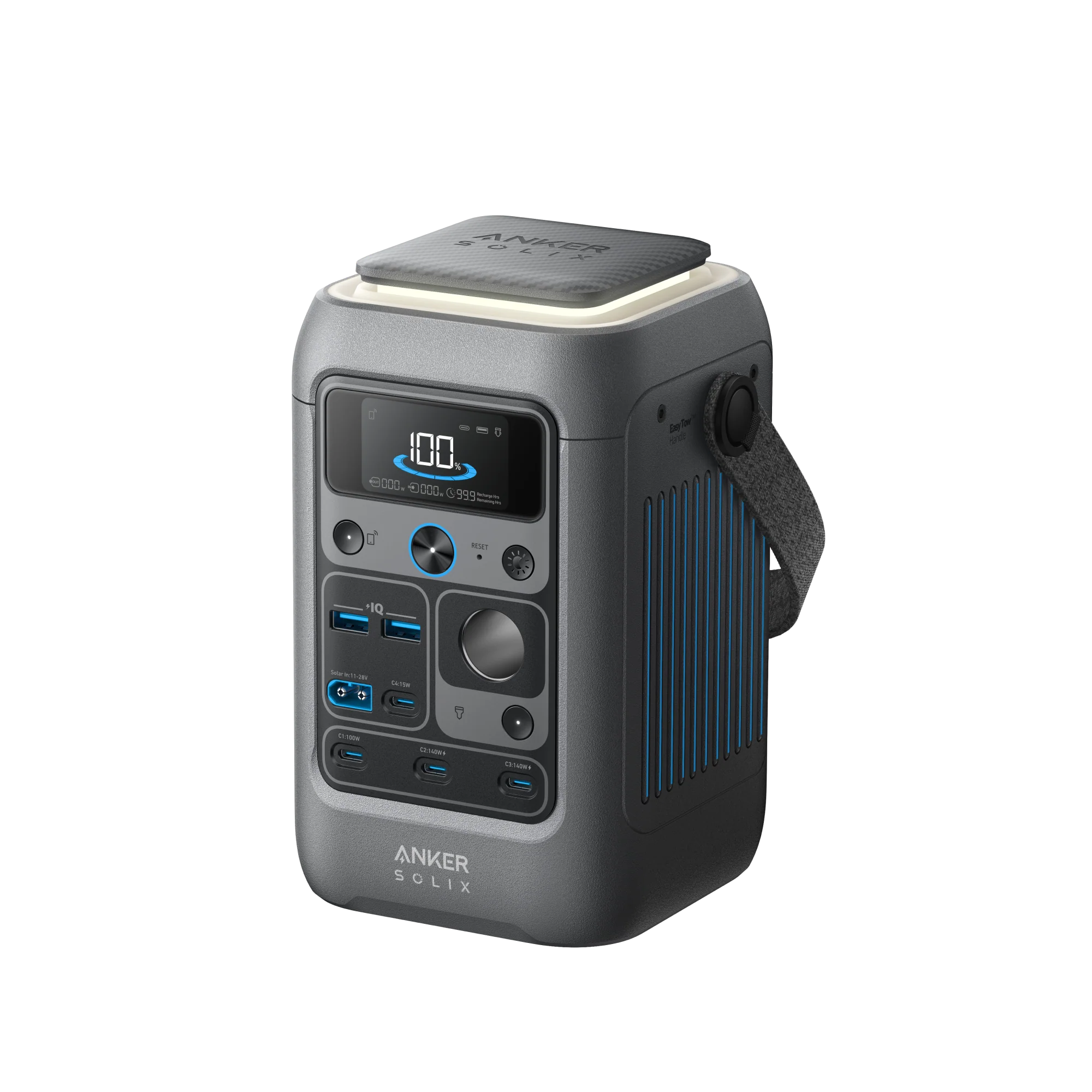
Anker SOLIX C300 DCPick
Sold on Amazon · today’s price is on the listing
Prices may vary by retailer and are subject to change.