Head-to-head test
EcoFlow DELTA Pro Ultra vs EcoFlow RIVER 3 PLUS
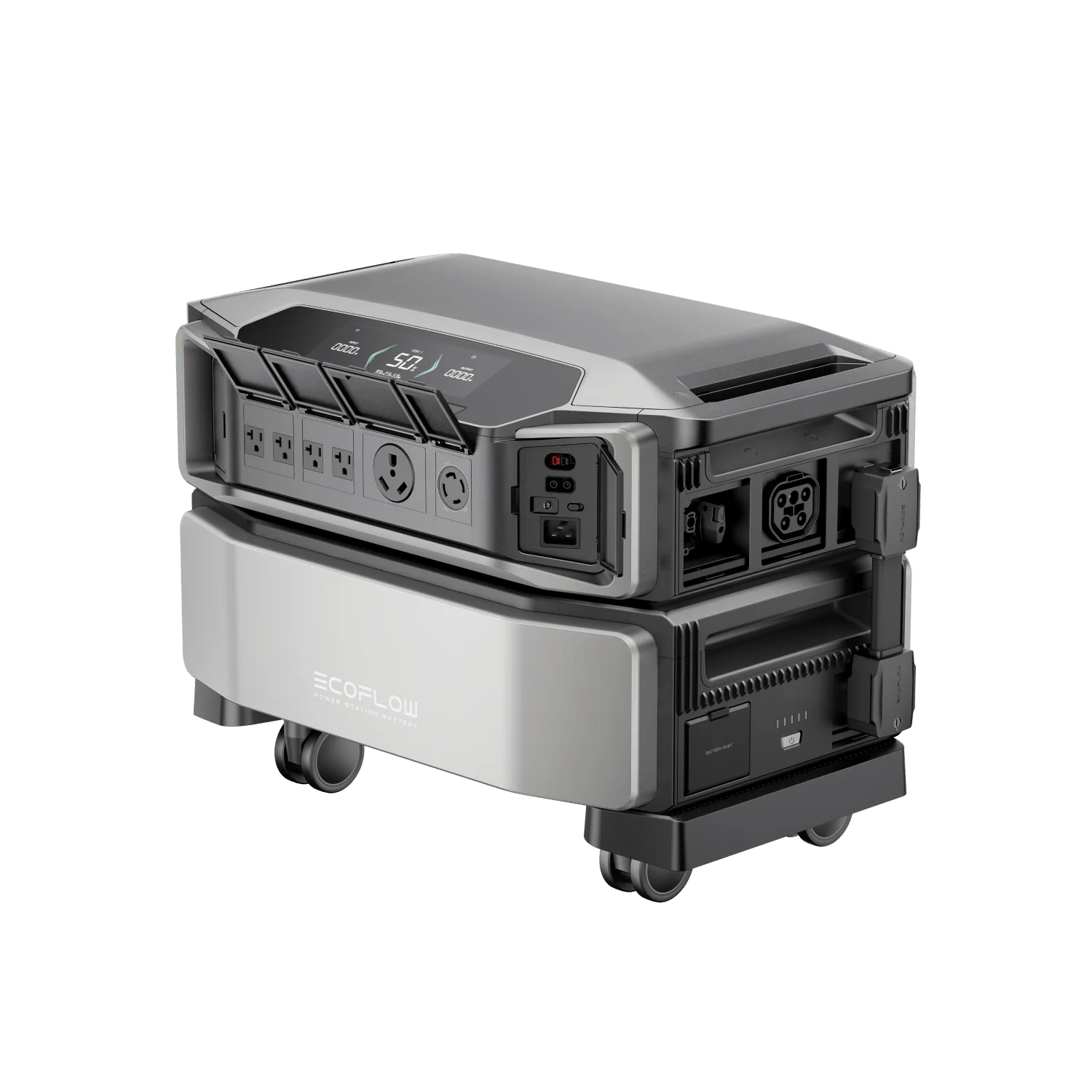
One of these is furniture and the other is luggage: 181.8 lbs you install once against 10.4 lbs you carry to the car, and the only question on this page is which of those two problems you actually have.
Full profiles: EcoFlow DELTA Pro Ultra → · EcoFlow RIVER 3 PLUS →

Written by Gunner GustafsonUpdated
Whole-Home Backup Tester, Station Arena Test Desk
$4,199.00 · direct from EcoFlow
Last checked 1 day ago. Prices move — check before you buy.

$299.00 · direct from EcoFlow
Last checked 1 day ago. Prices move — check before you buy.
Spec deltas
The DELTA Pro Ultra wins every scenario on this page, and that fact should not move you. It holds 6,144Wh against the RIVER 3 PLUS's 286Wh, so the sweep was settled before the first row rendered. What the table can't tell you is that one of these gets installed and the other gets carried.
The prices say it louder. $4,199 against $259. Nobody cross-shops those two numbers by accident, which means you're almost certainly here to settle one of two questions: whether the cheap one stretches to cover a real outage, or whether the expensive one is overkill for a weekend. The answers are no, and usually.
So treat this as a fork rather than a contest. The scenario table hands the DELTA six wins, including a tailgate it finishes having spent 13% of itself. Read those rows as capacity arithmetic, then go read the weight row, because that's the one that decides it.
What the Numbers Reveal
Each conclusion stated first — the numbers behind it on one line, the full analysis below.
weight
The DELTA's tailgate win means it covered a 670Wh afternoon and kept 4,552Wh in reserve. That's a measurement of how much bigger it is, not a recommendation for a parking lot. The two scenarios that most reward being carried are precisely the two where a win column tells you least.
The DELTA Pro Ultra wins all six scenarios, including Weekend Camping (2,100Wh needed) and Tailgate Party (670Wh needed)The DELTA Pro Ultra weighs 181.8 lbs; the RIVER 3 PLUS weighs 10.4 lbsOn Tailgate Party the DELTA finishes with 4,552Wh spare, having used 13% of itself
Why it mattersIf your use case is camping or tailgating, ignore who won those rows and buy on weight.
At 729Wh usable it clears exactly two of the six loads: the 320Wh CPAP night and the 670Wh tailgate. The 910Wh workday, the 1,645Wh blackout, the 2,100Wh weekend and the 4,685Wh van day all stay out of reach. The expansion battery converts it from failing everything to covering one night and one afternoon. That's worth having, and it is not backup.
RIVER 3 PLUS: 286Wh nameplate, 243Wh usable under the page's flat 0.85 derate, and it fails all six scenariosIts closest miss is the 320Wh CPAP night, 77Wh shortThe record puts it at 572Wh with the EB300 pack or 858Wh with the EB600B1
Why it mattersIf you came here hoping the cheap unit scales into outage duty, it doesn't. Buy it for the overnight it genuinely covers, or skip both and size for the blackout.
rated cycles
The row below it has the same blind spot. Cost per lifetime kWh is cost per Wh divided by cycles, so the DELTA's $0.19 against the RIVER's $0.30 is a claim about cell value, not about your electricity. It reads as cheaper to own and it means cheaper per kilowatt-hour, on the assumption you'll actually draw 6,144Wh at a stretch.
The lifetime table gives the DELTA 9.6 years of daily use and the RIVER 8.2Capacities are 6,144Wh and 286Wh; cycle counts are 3,500 and 3,000Cost per lifetime kWh is $0.19 against $0.30, from $0.65/Wh and $0.91/Wh
Why it mattersDon't let cheaper to own argue you into the big unit. It's cheaper per kWh you may never pull.
You are not buying a nicer box at the top of this page. You're buying 6,144Wh and 7,200W of output. The port your laptop plugs into and the noise the thing makes while it charges are the same on both, and those are the two features people actually notice week to week.
Both units carry a 100W maximum USB-C outputBoth units are specified at 30 dBAThe write-ups reach past that on both sides: sub-30dB called remarkable on the RIVERB2, and a claim the DELTA runs silent below 2,000WA3
Why it mattersIf your load list ends at a laptop and a phone, the identical port costs $259 and you can stop reading here.
The specific dimensions that decide these two units — everything else is a tie.
Your Life, Your Pick
Selected because: All six scenarios go to the DELTA Pro Ultra, and two of them are testing something our model cannot see.
Our six scenarios have no category for a unit that gets installed. Weekend Camping and Tailgate Party both assume the box arrived under its own power, and their scoring rewards the lighter unit, so a wired 181.8 lb appliance can sweep the whole table while being the wrong thing to own. Take those two rows as capacity checks and nothing more.
The row worth staring at is Van Life Daily. It asks for 4,685Wh, and the DELTA finishes at 90% used with 537Wh left. That's the largest system on this page reaching the end of one ordinary off-grid day with very little in hand. The RIVER's shortfalls run from 77Wh on the CPAP night to 4,442Wh on the van day, and only the first of those is close enough to argue about.
Portability & Form Factor
Selected because: 181.8 lbs against 10.4 lbs is the real decision, and it isn't close in either direction.
weight
10.4 lbs is a one-hand carry to the car and back. 181.8 lbs is a decision about where the thing lives for the next decade, and the spec sheet gives that as a system figure with no per-box weight behind it, so don't plan a lift around it. Plan a location.
This is also why losing every scenario doesn't embarrass the RIVER. It loses all six on capacity and wins the one nobody scored: it's the unit that comes with you.
Growth Path
Selected because: Both units take expansion batteries, but only one of them expands into a different category.
solar input
Both units accept expansion batteries, and that's where the similarity stops. The RIVER's growth is another small box beside itB1. The DELTA's is a wiring diagram and an array: its solar input tops out at 5,600W against the RIVER's 200W, and 5,600W of panel is not something you unroll at a campsite.
One caution on the DELTA's ceiling. The write-ups behind this page describe more than one build size, and one of them times a full charge against two batteriesA3 while the configuration recorded here is 6,144Wh. So treat any headline system-capacity number as marketing until it's on paper. Get the battery count, the total capacity and the inverter configuration written on your quote before you pay for any of it.
Lifetime Value
Selected because: The table calls the $4,199 unit cheaper to own at $0.19 per lifetime kWh, which is true and easy to misread.
cost / lifetime kWh
$0.19 per lifetime kWh against $0.30 is real arithmetic and a poor reason to buy. It is cost per Wh divided by cycles and nothing more: $0.65/Wh over 3,500 cycles against $0.91/Wh over 3,000. Nothing in that calculation knows whether you will ever draw a full 6,144Wh.
If you want one ownership number, cost per warranty year is the less flattering one: $400 a year for the DELTA against $52 for the RIVER, which is simply each price spread across the years the brand will stand behind it, 10 and 5.
What the Specs Don't Tell You
Selected because: Weight and transfer time are where a system total and a zero both need reading twice.
rated cycles
Two of the cards below need translating. The weight card reads 181.8 lbs as a two-person lift, but that figure is a system total and no per-box weight is published behind it, so it tells you the install is heavy without telling you how many hands one carry takes.
The other is transfer time. The DELTA's is listed as 0ms and the RIVER's as 10ms, and a zero in this dataset is about as likely to mean nobody published a figure as it is to mean somebody measured none. Both are quick enough that a desktop and a router ride through the handover. Neither number should move a purchase.
Strengths & trade-offs
EcoFlow DELTA Pro Ultra
Strengths
- +Larger battery capacity
- +Higher AC output
- +Longer warranty
- +Faster solar charging
Trade-offs
- –Substantially more expensive (+$3,940) than the RIVER 3 PLUS.
- –Significantly heavier (+171.4 lbs), making it harder to move.
- –Very heavy unit that may be difficult for one person to lift.
EcoFlow RIVER 3 PLUS
Strengths
- +Costs $3,940 less
- +Lighter by 171.4 lb
Trade-offs
- –Weaker inverter (-6,600W) limits appliance compatibility.
Will It Power Your Gear?
Scenario math and per-appliance runtimes, modeled from the spec record.
Scenario verdicts
We ran the math on seven real-world scenarios. Here's which unit survives your actual life.
SCN-01 · 2 nights · needs 2,100Wh
Weekend Camping
Two nights off-grid with essential comfort
Neither unit
The RIVER brings 243Wh to a 2,100Wh weekend and finishes 1,857Wh short. That gap doesn't close by being careful with the lights. The DELTA takes the row on 40% of itself and never gets near the edge.
Battery budget usedlower = more headroom
LOAD Phone Charger 15W×6h · LED Lights 40W×8h · Box Fan 75W×14h · CPAP Machine 40W×16h
SCN-02 · 8 hours · needs 1,645Wh
8-Hour Blackout
Keep the essentials running through a night without power
DELTA Pro Ultra
1,645Wh across eight hours is the whole test, and the RIVER arrives with 243Wh, so it's 1,402Wh short well before the halfway mark. The DELTA spends 31% and keeps 3,577Wh back, enough that the eight-hour framing stops being the interesting question.
Battery budget usedlower = more headroom
LOAD Fridge 150W×8h · Router + Modem 20W×8h · LED Lights (4 bulbs) 40W×6h · Phone Charger 15W×3h
SCN-03 · 8 hours · needs 320Wh
CPAP Overnight
Sleep therapy without interruption — the #1 medical use case
DELTA Pro Ultra
This is the closest the RIVER comes all page: 320Wh needed against 243Wh usable, a 77Wh miss. Close enough to be genuinely annoying, and a miss on an overnight load is a miss at the wrong end of the night. The DELTA covers the same load on 6% of its capacity, which is a lot of appliance to park beside a bed.
Battery budget usedlower = more headroom
LOAD CPAP Machine 40W×8h
SCN-04 · 8 hours · needs 910Wh
Remote Workday
Full work day off-grid without power anxiety
DELTA Pro Ultra
A 910Wh workday leaves the RIVER 667Wh short, which is most of the day rather than the tail of it. The DELTA runs the same day on 17% and still holds 4,312Wh, so the question for the big unit was never whether it lasts.
Battery budget usedlower = more headroom
LOAD Laptop 60W×8h · External Monitor 30W×8h · Router + Modem 20W×8h · Phone Charger 15W×2h
SCN-05 · 4 hours · needs 670Wh
Tailgate Party
Game day power for the crew
Neither unit
670Wh for an afternoon, and the RIVER is 427Wh short of it. The DELTA covers the row on 13% and packs up with 4,552Wh unused. Winning this one costs it nothing, which is exactly why the result can't tell you much.
Battery budget usedlower = more headroom
LOAD Blender 400W×0.5h · LED TV (55") 80W×4h · Bluetooth Speaker 15W×4h · Phone Charger (×3) 45W×2h
SCN-06 · 24 hours · needs 4,685Wh
Van Life Daily
A full day of mobile living — the ultimate endurance test
DELTA Pro Ultra
The one row where the DELTA sweats. A 4,685Wh day leaves it at 90% used with 537Wh in hand, a thin margin for a system this size on an ordinary day rather than a hard one. The RIVER is 4,442Wh short here, the widest gap on the page, and no amount of careful loading closes it.
Battery budget usedlower = more headroom
LOAD Mini-Fridge 150W×24h · Laptop 60W×4h · Phone Charger 15W×3h · LED Lights 40W×5h · Fan 75W×8h
SCN-07 · an afternoon · needs 100Wh
Afternoon Off-Grid
Phones and a speaker at the park, beach, or campsite — the small-unit job description
Either unit
This row is here for the RIVER 3 PLUS's class of job: phones and a speaker, 100Wh across an afternoon. Both cover it — the RIVER 3 PLUS finishes at 41% used, and the DELTA Pro Ultra barely notices it. For this job the DELTA Pro Ultra's extra capacity is dead weight, not headroom; take the RIVER 3 PLUS at 10.4 lbs and leave the rest at home.
Battery budget usedlower = more headroom
LOAD Phone Charger (×2) 30W×2h · Bluetooth Speaker 10W×4h
The Load Test
RUNTIME = (Wh × 0.85) ÷ LOAD
None of the scenarios above exactly yours? Build it. Toggle what you'd plug in; both units are tested against the combined draw.
Essentials
Comfort & Convenience
High-Draw Appliances
Test duration
8h
Continuous draw
205W
Projected runtime
For this load: DELTA Pro Ultra runs 25.5h vs 1.2h.
$4,199 list · direct from EcoFlow
Modeled from the spec record — same math as the tables below. Methodology
Runtime by appliance
Real-world runtime estimates for common appliances, modeled at 85% inverter efficiency.¹
Essentials
The basics you need runningscale 0–348.2hComfort & Convenience
Makes off-grid life actually enjoyablescale 0–69.6hHigh-Draw Appliances
These reveal the real limitsscale 0–5.2h¹ Runtime = (capacity × 0.85) ÷ appliance watts. Within each group, all bars share one time scale (the group's longest runtime), so lengths are comparable across appliances; identical runtimes collapse into a single blue/orange bar. Actual runtime varies with battery age, temperature, and simultaneous loads — see methodology.
Conclusion
August 9, 2026
Verdict: the DELTA Pro Ultra, on Power Score margin
This is a tie because they aren't in the same fight, not because they're equally good. The DELTA Pro Ultra wins all six scenarios below and costs $4,199. The RIVER 3 PLUS loses all six and costs $259. That sweep is a statement about 6,144Wh against 286Wh, and it tells you nothing about which box belongs in your life. The decision rule is short. If you have a fixed spot, motors on your load list, and the patience to place 181.8 lbs exactly once, the DELTA is the only unit here that does the job. If you're powering a laptop and a couple of lights somewhere you drove to, the RIVER does that job at 10.4 lbs and the DELTA is $4,199 of capacity you will never cycle.
Editor-assigned confidence, based on cited owner research and spec analysis.
Written by Gunner Gustafson, Whole-Home Backup Tester · Station Arena Test Desk · Updated August 9, 2026
Measured Data
Benchmark scores and the full spec record, side by side.
Benchmark scores
Not rated for both units (minimum threshold unmet): UPS, Home Backup, CPAP, Solar Generator, Tailgating, Food Truck, Apartment Balcony, Camping.
Full specifications
ᵈ Derived: price ÷ rated capacity. See the data behind our comparisons →
Comparison ToolAdd more power stations, side by sideOpen Tool →How these numbers are produced
Numeric verification
Every figure on this page traces to our spec database or arithmetic on it — no estimated numbers.
Owner claims
Statements about owner experience are cited to published reviews — see Sources & Research Notes below.
Runtime model
Runtime = (rated capacity × 0.85 inverter efficiency) ÷ device wattage. Solar recharge estimates assume panels deliver 70% of rated output. Cold weather, battery age, and stacked loads reduce real-world results.
Power Score
Computed from 14 published spec dimensions, weighted per use-case bench. Higher is better; a unit must meet a bench's minimum threshold to be rated.
See the full weight table and data sourcing on our methodology page →Class ranking (the star rating)
Each unit's star score is a category ranking, not customer reviews — no buyer opinions feed it. We score every station on size-independent quality (value, output, portability, endurance, ports, warranty, and more), then percentile-rank it against the other units in its capacity class, so a class-leading compact unit and a class-leading whole-home unit can both earn 5★. Here, DELTA Pro Ultra rates 4.9/5 (93rd percentile of 16 Home Backup-class units), and RIVER 3 PLUS rates 5.0/5 (99th percentile of 22 Personal-class units).
How the class ranking is computed →Test Notes & Caveats
Hidden gotchas and advantages we spotted that you won't find on the product page.
181.8 lbs Is a Location, Not a Lift
That number is the whole system, and no per-box weight is published behind it, so don't plan the move around it. Plan the spot instead: near the panel, off the floor if the floor ever floods, somewhere you can still get a hand behind it once a year. Once it's placed it's an appliance. The 10.4 lb RIVER is the one you carry.
Surge Power: Ratio and Ceiling Disagree
The RIVER 3 PLUS holds the higher surge-to-continuous ratio (2× vs 1.5×), but the DELTA Pro Ultra holds the higher absolute surge ceiling — 10,800W against 1,200W. These measure different things. The ratio says how much headroom an inverter keeps above its own rating; the ceiling says how big a startup spike it can actually swallow. A motor draws a number of watts at switch-on, not a multiple of someone else's rating, so on raw starting ability the DELTA Pro Ultra is the stronger unit here — while the RIVER 3 PLUS is the one running further below its own limit at steady state.
Transfer Time: Read the Zero Carefully
The DELTA's switchover is listed as 0ms and the RIVER's as 10ms. A zero in this data means either no measurable gap or no published figure, and nothing here tells you which, so don't buy on the difference. Both are quick enough that a desktop and a router ride through the handover. If you're protecting something genuinely intolerant of a gap, get the number in writing from the manufacturer rather than from a spec table.
Warranty: 10 Years vs 5
The DELTA Pro Ultra is covered for 10 years against the RIVER 3 PLUS's 5 years. The cheaper RIVER 3 PLUS does buy more warranty per dollar (19.3 years per $1,000 against 2.4), but that is a statement about price, not about coverage — if a fault appears in year 6, only one of these is still covered. An underrated factor if you're keeping this unit for years.
Ownership Analysis
What happens after you buy — true cost of ownership, brand trust, and growth potential.
Lifetime value
Service lifeyears at one full cycle per day
Lifetime energy delivered
Cost per delivered kWh
│ warranty ends · Reaching the cycle rating means ~80% capacity remains — degraded, not dead.
Analyst note
The RIVER 3 PLUS is cheaper to buy, but the DELTA Pro Ultra is cheaper to own. At $0.2/kWh over its lifetime vs $0.3/kWh, the DELTA Pro Ultra's higher cycle life and capacity make each dollar go further over the years.
Growth path
DELTA Pro Ultra
EXPANDABLESupports EcoFlow expansion batteries, so you can add capacity later without replacing the base unit — useful if your needs may climb past 6,144Wh.
Accepts up to 5,600W of solar. Enough for a serious multi-panel array.
Adequate ports for most setups, but heavy users may want a power strip.
Expansion batteries are EcoFlow-specific. You're investing in the EcoFlow ecosystem.
RIVER 3 PLUS
EXPANDABLESupports EcoFlow expansion batteries, so you can add capacity later without replacing the base unit — useful if your needs may climb past 286Wh.
Accepts up to 200W of solar. Limited to a single portable panel.
Adequate ports for most setups, but heavy users may want a power strip.
Expansion batteries are EcoFlow-specific. You're investing in the EcoFlow ecosystem.
Realistic full solar rechargeat 70% of rated panel output — see methodology
Analyst note
Both expand, but the DELTA Pro Ultra's higher solar ceiling (5,600W vs 200W) gives it the stronger off-grid growth path — more panels can feed a bigger bank as it grows.
What Owners Report
Patterns from published owner reports and long-term reviews — every claim cited to its source below.
EcoFlow DELTA Pro Ultra
The field record on the DELTA Pro Ultra is thin in the way that mattersA1A2A3A4. Every entry is positive, and only the Home Depot review set reads like people who own one: quick setup, strong solar input, good app monitoring, and a 7,200W inverter they report running a 3-ton central ACA4. The rest restate the sheet, including 6,144Wh per battery with a 10,800W surgeA1 and LFP rated past 3,500 cycles to 80%A2.
Two entries need a warning label. One times a full charge at 8,800W against two batteriesA3, which is not the single-battery configuration this page is built on, so don't carry that charge time across. The same entry claims the unit runs at 0 dB below 2,000WA3 against the 30 dBA it carries on the spec record. Both ledgers here reach for quieter language than the specs support.
“6,144Wh per battery with 7,200W continuous output (10.8kW surge), expandable to 90kWh across a system for a household — over 30 days of essential backup.”
Sources
ecoflow.com · homedepot.com · autoboosting.com · ecogadgethub.com
EcoFlow RIVER 3 PLUS
There are no owners in the RIVER 3 PLUS record, only reviewers: every entry traces to a review siteB1B2B3B4. What they give you is 10.4 lbs and genuine portability, with brief runs at a coffee maker or a microwaveB3, sub-30dB quietB2, and 3,000-cycle LFPB4. Useful, and none of it is a long-term ownership reportB1B2B3B4.
Two things to correct as you read it. The lead entry's yardstick is the previous-generation RIVER 3 rather than anything on this page, praising twice the inverter and twice the solar of that unitB1, which is a generational note and not a comparison to a 7,200W system. And it puts solar input at 220W where our spec record says 200WB1. Size your panels to 200W.
“286Wh base, expandable to 572Wh (EB300) or 858Wh (EB600), with a genuine 600W inverter (1,200W X-Boost) and 220W solar input — twice the inverter and solar of the base RIVER 3.”
Sources
ecoflow.com · bestgeneratorsolar.com · thepowerpick.com · storagereview.com · phonearena.com · greenreviewshub.com
Sources & Research Notes
Every owner claim in this report is traceable to a published source. The bracketed references above resolve here.
Recurring owner themes
- Whole-home scale (to 90kWh), 7,200W output, online UPS, silent operation under load, and industry-fast charging are the standout features. [DELTA Pro Ultra · 2 entries]
- Expandable capacity, doubled inverter and solar over the base RIVER 3, remarkable sub-30dB quiet, and light weight are the praise. [RIVER 3 PLUS · 3 entries]
- A1
“6,144Wh per battery with 7,200W continuous output (10.8kW surge), expandable to 90kWh across a system for a household — over 30 days of essential backup.”
ecoflow.com / homedepot.com — DELTA Pro Ultra · 2026 · [positive]
- A2
“LFP chemistry rated for over 3,500 cycles to 80% (10+ years of use).”
ecoflow.com / autoboosting.com — DELTA Pro Ultra review · 2026 · [positive]
- A3
“Industry-fast 8,800W charging tops up two batteries in about 2 hours; an online UPS protects sensitive electronics round the clock, and it runs at 0 dB (silent) for draws under 2,000W.”
ecoflow.com / ecogadgethub.com — DELTA Pro Ultra review · 2026 · [positive]
- A4
“Owners call it a powerful, easy-to-use whole-home backup with quick setup, strong solar input, and good app monitoring; its 7,200W inverter can power a 3-ton central AC.”
homedepot.com owner reviews — DELTA Pro Ultra · 2026 · [positive]
- B1
“286Wh base, expandable to 572Wh (EB300) or 858Wh (EB600), with a genuine 600W inverter (1,200W X-Boost) and 220W solar input — twice the inverter and solar of the base RIVER 3.”
ecoflow.com / bestgeneratorsolar.com — RIVER 3 Plus review · 2026 · [positive]
- B2
“Sub-30dB operation is genuinely remarkable — quieter than a library and than most refrigerators.”
thepowerpick.com — RIVER 3 Plus review · 2026 · [positive]
- B3
“Weighs about 10.4 lbs and is highly portable; a small-format station that grows with you, able to briefly run a coffee maker, microwave, or space heater.”
storagereview.com / phonearena.com — RIVER 3 Plus review · 2026 · [positive]
- B4
“LiFePO4 rated for 3,000 charge cycles — around 10 years of everyday use before capacity drops to 80%.”
greenreviewshub.com / bestgeneratorsolar.com — RIVER 3 Plus review · 2026 · [positive]
Research compiled August 9, 2026.
What Owners Actually Report
Drawn from 110 comments on independent review channels — not from retailer reviews, which skew to the first week of ownership. Each line is our summary of one commenter's claim, linked to the original. We record what they said, including where it contradicts the spec sheet.
EcoFlow DELTA Pro Ultra
144 claims from 88 comments · 100 from owners · 35 with figures
- Price & value
- 22 · 18% negative
- Runtime
- 16 · 0% negative
- Expandability
- 17 · 16% negative
- Charging
- 11 · 4% negative
- Other
- 18 · 19% negative
What owners complain about
A second battery bought separately adds $1900, roughly doubling the cost.
Expandabilitymeasuredowner5 agreedsource →
After firmware updates max solar charging dropped from 7kW to 3.5kW.
App & firmwaremeasuredowner5 agreedsource →
Still charges at 7kW from a generator, so the cap looks solar-specific.
Solar inputmeasuredowner5 agreedsource →
What owners praise
Charges at 6000W from a gas generator, hitting 100% in a little over 3 hours with some sun.
Chargingmeasuredowner36 agreedsource →
Costco deal gave him the DPU with two batteries, 12kWh, for $4,500.
Price & valuemeasuredowner53 agreedsource →
Delivered with batteries manufactured less than 90 days earlier.
Shippingmeasuredowner53 agreedsource →
EcoFlow RIVER 3 PLUS
50 claims from 22 comments · 44 from owners · 14 with figures
- UPS switchover
- 7 · 48% negative
- Price & value
- 4 · 0% negative
- App & firmware
- 7 · 54% negative
- Inverter & surge
- 4 · 43% negative
- Expandability
- 3 · 0% negative
What owners complain about
River 3 Plus overloaded with error 502 on a hotpot drawing only 345W of its 600W rating.
Inverter & surgemeasuredowner9 agreedsource →
Testing gave only 85-87% of the rated 286Wh through AC before the unit hit 0%.
Runtimemeasuredownersource →
AC outputs kept shutting off, dropping from hours to every 15 minutes.
UPS switchovermeasuredownersource →
What owners praise
10ms cutover means his modem, router and computer never blip.
UPS switchovermeasuredowner34 agreedsource →
Bought it for $219 at Costco plus a $58 100W folding panel.
Price & valuemeasuredowner43 agreedsource →
With X-Boost on, the same 600W hotpot runs and boils water, so the feature has a real use case.
Othermeasuredowner9 agreedsource →
Claims are weighted by how specific they are, whether the commenter owns the unit, and how many readers agreed. Comments that mention a product under a rival's review count for more, because the commenter had no reason to be there. This is what buyers report, not our test results — for measurements we ran ourselves, see the methodology.
Who Should Buy Which
Buy the DELTA Pro Ultra if you…
- →You already know the spot: a utility room, a garage wall, a basement corner, and the plan is to wire it in and leave it. 181.8 lbs stops being a problem the moment it stops being luggage.
- →Your load list has motors on it. 7,200W continuous with a 10,800W surge ceiling is what starts a pump or a compressor, and owners report the inverter carrying a 3-ton central ACA4.
- →You're building toward solar and you mean it. 5,600W of input is an installed array rather than four folding panels, and it's the strongest single reason on this page to accept the size.
- →You expect to still own it in a decade. It's covered for 10 years against the RIVER's 5, and rated past 3,500 cycles to 80%A2.
Buy the RIVER 3 PLUS if you…
- →Everything you plug in has a USB-C cable or a wall wart. You get the same 100W USB-C output the $4,199 unit has, for $259, in a box you lift with one hand.
- →You want a CPAP covered and you'll buy the battery to do it. On its own it's 77Wh short of the 320Wh night. With the larger expansion pack it reaches 858WhB1 and that night stops being a question.
- →You drive to where you use it and carry it the last stretch on foot. Weekend trips, a work table in the yard, folding panels on a picnic bench: 200W of solar input matches the panels you'd actually bring.
- →You want a first power station without a $4,199 conversation. 3,000 cycles at $259 is a low-risk way to find out what you really run.
If neither fits
Look at the two rows in the middle of the table: the 910Wh remote workday and the 1,645Wh blackout. Neither unit is the right answer to either one. The RIVER can't reach them even with its biggest pack, since 858Wh is 729Wh usable under the same flat 0.85 derateB1, and answering a single 1,645Wh evening with a 181.8 lb, $4,199 installed system is a lot of building for one bad night. If that's your night, close this tab and shop the middle of the range: a portable sized to clear 1,645Wh in one go, at a weight one person can move.
The Bottom Line
These two don't compete, and pretending they do is how people overspend. The scenario table hands the DELTA Pro Ultra all six rows because it holds 6,144Wh against 286Wh, and that outcome was fixed before anything was scored. What no row can grade is that one of these is installed and the other is carried.
So answer the only question that matters. If there's a spot on your wall and motors on your load list, the DELTA is the unit here that does the job, and 181.8 lbs stops mattering the day it's placed. If you're driving somewhere with a laptop and a couple of lights, take the RIVER, put the difference into panels, and remember that the identical 100W USB-C port was never the thing you were being asked to pay $4,199 for.
Frequently Asked Questions
Answers drawn from the spec record and cited owner research.
Can the RIVER 3 Plus run a CPAP overnight?
Not on its own. Our CPAP scenario needs 320Wh and the base unit delivers 243Wh usable, leaving it 77Wh short. That's close, and it's still the wrong side of the line. With the larger expansion battery it reaches 858Wh, which clears the night with room to spare. The DELTA Pro Ultra spends 6% of itself on the same load.
Is the DELTA Pro Ultra overkill for camping?
For a trip you carry anything to, yes. It wins our Weekend Camping row because it holds 6,144Wh against a 2,100Wh load, but it weighs 181.8 lbs and that scenario has no way to score weight against a 10.4 lb unit. When the win comes from a capacity gap that large, the win column is measuring the wrong thing.
How much can the DELTA Pro Ultra expand to?
Get that in writing before you buy, because it depends entirely on the build you're quoted. The write-ups behind this page don't all describe the same configuration, and one of them times charging against two batteries while the unit recorded here is 6,144Wh. Ask for battery count, total capacity and inverter configuration on the quote, and treat any headline system number as marketing until it's on the paperwork.
Which one is actually cheaper to own?
Per kilowatt-hour of lifetime energy, the DELTA at $0.19 against the RIVER's $0.30. But that figure is cost per Wh divided by cycle count, so it describes cell value rather than anything you'll pay. Measured per year of warranty coverage it flips hard: $400 against $52.
Can I use the RIVER 3 Plus for home backup?
For a desk, not a house. It holds 243Wh usable and our 8-hour blackout scenario needs 1,645Wh, so it comes up 1,402Wh short. Expanded to 858Wh it still misses that load. Backup for a home starts a category above this unit.
Where to buy
EcoFlow DELTA Pro Ultra
$4,199.00
$4,199.00 · direct from EcoFlow
Last checked 1 day ago. Prices move — check before you buy.
EcoFlow RIVER 3 PLUS
$299.00
$299.00 · direct from EcoFlow
Last checked 1 day ago. Prices move — check before you buy.
Prices may vary by retailer and are subject to change.