Head-to-head test
EcoFlow DELTA Pro 3 vs EcoFlow RIVER 2
The Pro 3 wins nearly every scenario this page tests, which is the least interesting fact on it — the real question is whether your outage is backpack-sized or garage-sized, because guessing wrong costs you either $2,590 or a night without power.
Full profiles: EcoFlow DELTA Pro 3 → · EcoFlow RIVER 2 →

Written by Gunner GustafsonUpdated
Whole-Home Backup Tester, Station Arena Test Desk
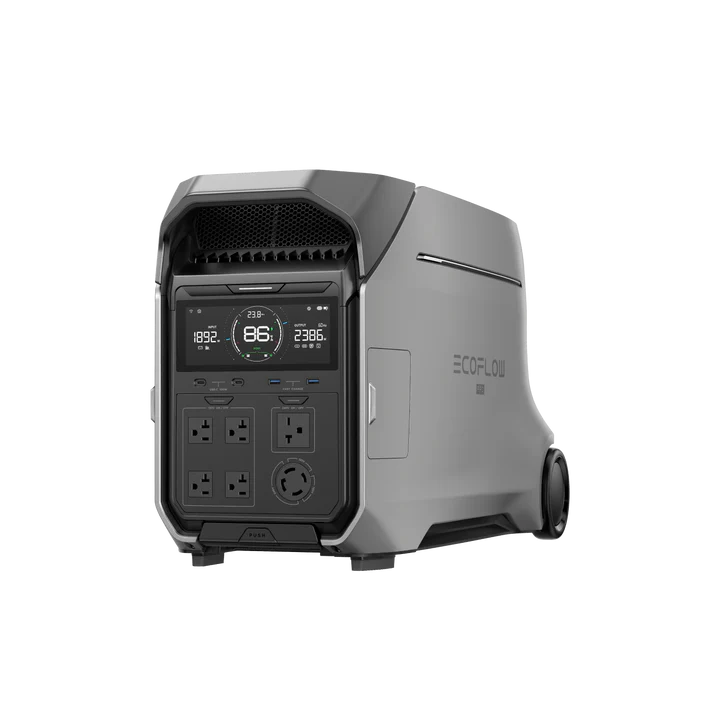
$2,799.00 · direct from EcoFlow
Last checked 1 day ago. Prices move — check before you buy.
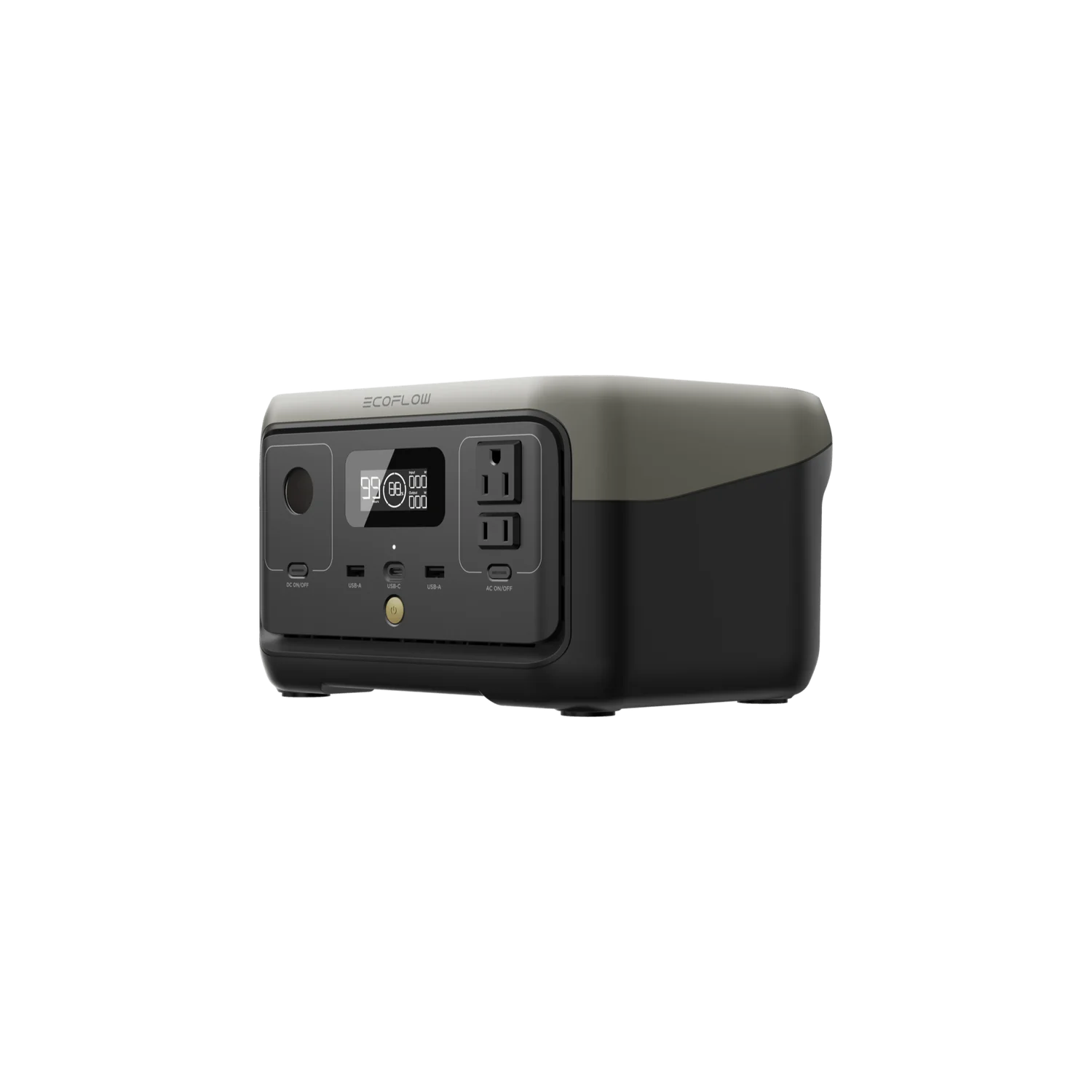
$209.00 · direct from EcoFlow
Last checked 20 days ago. Prices move — check before you buy.
Spec deltas
The DELTA Pro 3 fully covers five of the six loads this site tests — weekend camping, an 8-hour blackout, CPAP overnight, a remote workday, a tailgate. The RIVER 2 fully covers zero of them. That's not really a verdict on the RIVER 2; none of those six scenarios was ever sized for a 256Wh battery, and holding it to that bar is a bit like grading a bicycle on towing capacity.
That's the real subject of this page: not which unit is better, but which size problem you actually have. At $209 and 7.8 lbs, the RIVER 2 is built to keep phones, a laptop, and small gear alive through a day trip or a short outage — not to run a campsite or a blackout end to end. It was never entered in that race.
The Pro 3 is a different proposition entirely. At $2,799 — $2,590 more than the RIVER 2's $209 — and 112.4 lbs, it's dual-voltage, expandable toward 48kWhA1, and built to be installed, not packed. Working out which of those two products you actually need, before comparing their specs line by line, is most of this decision.
What the Numbers Reveal
Each conclusion stated first — the numbers behind it on one line, the full analysis below.
continuous output
Only a tailgate's simultaneous peak draw beats even that proportionally strong 600W ceiling — everywhere else, the RIVER 2 starts the job fine and just doesn't have the Wh to finish it.
RIVER 2 needs 147%-2,153% of its usable capacity across all six tested scenariosRIVER 2 can still power the peak draw in 5 of 6 scenariosRIVER 2 fails to power the peak draw only at Tailgate PartyRIVER 2 surge ratio is 600W/300W = 2.0x vs the Pro 3's 6000W/4000W = 1.5x
Why it mattersIf you're sizing a small unit for a trip, count hours of use, not watts of gear — except for a tailgate crowd, where the peak draw itself can beat it before the battery even gets low.
Pair that with running 20 decibels louder than the alternative, two feet from your head all night, and the RIVER 2 is on the wrong side of both CPAP-relevant specs at once — capacity and noise point the same direction here.
CPAP Overnight needs 320WhRIVER 2 usable capacity is about 217.6Wh (256Wh x 85%)RIVER 2 cannot handle CPAP Overnight (p2CanHandle: false)RIVER 2 is rated 50dB vs the Pro 3's 30dB
Why it mattersAnyone shopping this pair for CPAP backup should treat it as Pro-3-or-nothing — the RIVER 2 doesn't get you through the night even before the fan noise is a factor.
weight
At 112.4 lbs, the Pro 3 is a two-person lift that tends to get placed once — a garage, a mechanical closet, a van build — and its dual-voltage output and 48kWh expansion pathA1 only pay off if you actually build toward them. The RIVER 2, at 7.8 lbs, is the one you actually grab on the way out the door.
Pro 3 costs $2,799 vs RIVER 2's $209 — a $2,590 gapPro 3 weighs 112.4 lbs vs RIVER 2's 7.8 lbs — 14.4x heavierPro 3 is dual-voltage 120V/240V and expandable toward 48kWhA1RIVER 2 has no expansion path at all (fixed 256Wh)
Why it mattersAnyone buying 'more, just in case' should price the case first: $2,590 and a permanent parking spot for the unit is a real commitment, not a bigger version of a $209 impulse buy.
Full-time van life is the scenario where the Pro 3's real answer isn't its 4,096Wh nameplate, it's the expansion pathA1 — you're budgeting for a second battery (or serious daily solar) before you leave the driveway, not buying a single bigger box.
Van Life Daily needs 4,685Wh a dayThat's 135% of the Pro 3's usable capacity — the Pro 3 alone covers about 74% of it (100÷135)That's 2,153% of the RIVER 2's usable capacity — not remotely closePro 3 is expandable toward 48kWh via EcoFlow add-on batteriesA1
Why it mattersAnyone sizing power for full-time off-grid daily use shouldn't expect single-charge coverage from either unit as tested — budget for the Pro 3 plus expansion from day one.
The specific dimensions that decide these two units — everything else is a tie.
Your Life, Your Pick
Selected because: The RIVER 2 fails to fully cover every one of the six tested loads on capacity, while still starting the load in five of six — the number to watch is hours, not watts.
Six scenarios, one pattern: the Pro 3 finishes five of them, the RIVER 2 finishes none. That's not really a power study — the RIVER 2 wasn't built to run a full weekend of camping or an 8-hour blackout by itself, so watching it come up short there tells you less about the unit than about which of these six nights is actually yours.
The one interesting failure is Tailgate Party, where the RIVER 2 can't even start the load — everywhere else it runs out of energy before it runs out of muscle. And Van Life Daily is the one scenario where the Pro 3 doesn't finish either: full-time off-grid living asks for more than either unit delivers solo.
Portability & Form Factor
Selected because: 7.8 lbs and 112.4 lbs are two different relationships with a battery: one rides in a backpack, one gets installed.
weight
112.4 lbs and 7.8 lbs aren't two points on the same scale, they're two different verbs. You carry the RIVER 2; you park the Pro 3. A dolly or a second set of hands is the honest answer for moving the Pro 3 anywhere, while the RIVER 2 clips onto a shoulder strap and disappears into a trunk.
That difference decides more than comfort. A unit this heavy isn't something you reposition mid-trip because the outlet's on the wrong side of the room, and it isn't going in a tailgate trunk next to the cooler. The RIVER 2 is built to move with you through the day; the Pro 3 is built to stay where you put it.
Growth Path
Selected because: The RIVER 2 is sealed at 256Wh for good, while the Pro 3's real ceiling is a further purchase — the figure that actually decides whether either unit alone is enough.
solar input
The RIVER 2's growth path is that there isn't one — 256Wh is the whole unit, forever. That's an honest tradeoff, not a flaw: it's what keeps it at 7.8 lbs and $209. The Pro 3's headroom is real (EcoFlow sells expansion batteries toward 48kWhA1), but it's a future purchase, not something included in today's price.
Van Life Daily is where that distinction actually bites: even the Pro 3 alone falls short of a full day's off-grid draw. The honest read is that 'the Pro 3 can grow' is the real answer to that scenario, not 'the Pro 3 is big enough' — price the expansion battery, or a serious solar refill, before you assume the base unit covers you.
Lifetime Value
Selected because: $0.15 versus $0.25 per lifetime kWh only matters if you're drawing kilowatt-hours at Pro-3 scale in the first place.
cost / lifetime kWh
The Pro 3's lower cost per lifetime kWh looks like a lopsided win, and mechanically it is — but it's the wrong number to lead a small-load buyer with. A bigger battery almost always amortizes better per kWh; that's arithmetic, not an endorsement of buying more capacity than you'll draw.
This section is the argument for a heavy-use decision, not a small-capacity one. If you're actually going to draw serious energy over the unit's life — daily use, partial-home backup — the Pro 3's cost curve wins outright. If you're topping off phones and a laptop a few times a week, this section doesn't really apply to you.
What the Specs Don't Tell You
Selected because: Noise, UPS speed, and surge ratio are the fine print that separates a $209 device from a $2,799 one beyond raw capacity.
rated cycles
Three of the seven flags here are just 'info' — noise, UPS speed, and warranty math worth knowing but not deciding anything by themselves. The one that actually surprises is surge ratio: the RIVER 2's inverter has proportionally more headroom (2.0x) than the Pro 3's (1.5x), so its limits are almost always about stored energy, not delivered power.
The weight flag is worth taking seriously before you buy, not after: 112.4 lbs is a two-person lift, and that fact alone should end the 'which one is more portable' conversation. The RIVER 2's fixed 256Wh, by contrast, isn't really a flaw here — it's the tradeoff that keeps it small enough to carry.
Strengths & trade-offs
EcoFlow DELTA Pro 3
Strengths
- +Larger battery capacity
- +Higher AC output
- +Faster solar charging
- +Rated for 4,000 charge cycles — much longer battery lifespan
Trade-offs
- –Substantially more expensive (+$2,590) than the RIVER 2.
- –Significantly heavier (+104.6 lbs), making it harder to move.
- –Very heavy unit that may be difficult for one person to lift.
EcoFlow RIVER 2
Strengths
- +Costs $2,590 less
- +Lighter by 104.6 lb
Trade-offs
- –Weaker inverter (-3,700W) limits appliance compatibility.
- –Sealed capacity — the DELTA Pro 3 can add batteries to grow past 256Wh; this one can't.
- –Shorter-lived battery — rated for 3,000 charge cycles vs the DELTA Pro 3's 4,000, so it wears out sooner.
Will It Power Your Gear?
Scenario math and per-appliance runtimes, modeled from the spec record.
Scenario verdicts
We ran the math on seven real-world scenarios. Here's which unit survives your actual life.
SCN-01 · 2 nights · needs 2,100Wh
Weekend Camping
Two nights off-grid with essential comfort
Neither unit
Neither gives you a powered weekend: the DELTA Pro 3 has the energy but doesn't travel, and the RIVER 2 covers about 10% of the 2,100Wh. One can't go; the other can't finish.
Battery budget usedlower = more headroom
LOAD Phone Charger 15W×6h · LED Lights 40W×8h · Box Fan 75W×14h · CPAP Machine 40W×16h
SCN-02 · 8 hours · needs 1,645Wh
8-Hour Blackout
Keep the essentials running through a night without power
DELTA Pro 3
The RIVER 2 doesn't finish — 218Wh usable against the 1,645Wh this needs leaves it 1,427Wh short, about 13% of the scenario covered. The DELTA Pro 3 covers it with 1,837Wh to spare.
Battery budget usedlower = more headroom
LOAD Fridge 150W×8h · Router + Modem 20W×8h · LED Lights (4 bulbs) 40W×6h · Phone Charger 15W×3h
SCN-03 · 8 hours · needs 320Wh
CPAP Overnight
Sleep therapy without interruption — the #1 medical use case
DELTA Pro 3
The RIVER 2 needs 147% of what it can actually deliver to finish this one — it isn't close — and it does it running 20 decibels louder than the Pro 3, two feet from your head, all night. For CPAP backup, this pair only has one honest answer.
Battery budget usedlower = more headroom
LOAD CPAP Machine 40W×8h
SCN-04 · 8 hours · needs 910Wh
Remote Workday
Full work day off-grid without power anxiety
DELTA Pro 3
The RIVER 2 doesn't finish — 218Wh usable against the 910Wh this needs leaves it 692Wh short, about 24% of the scenario covered. The DELTA Pro 3 covers it with 2,572Wh to spare.
Battery budget usedlower = more headroom
LOAD Laptop 60W×8h · External Monitor 30W×8h · Router + Modem 20W×8h · Phone Charger 15W×2h
SCN-05 · 4 hours · needs 670Wh
Tailgate Party
Game day power for the crew
Neither unit
This is the one load where the RIVER 2 doesn't just run low, it can't start the peak draw at all. Everywhere else on this page its problem is stamina, not strength.
Battery budget usedlower = more headroom
LOAD Blender 400W×0.5h · LED TV (55") 80W×4h · Bluetooth Speaker 15W×4h · Phone Charger (×3) 45W×2h
SCN-06 · 24 hours · needs 4,685Wh
Van Life Daily
A full day of mobile living — the ultimate endurance test
Neither unit
The only scenario that defeats both units — even the Pro 3 covers only about three-quarters of a full day's off-grid draw on one charge. Real full-time van life needs the Pro 3's expansion path, not just the Pro 3.
Battery budget usedlower = more headroom
LOAD Mini-Fridge 150W×24h · Laptop 60W×4h · Phone Charger 15W×3h · LED Lights 40W×5h · Fan 75W×8h
SCN-07 · an afternoon · needs 100Wh
Afternoon Off-Grid
Phones and a speaker at the park, beach, or campsite — the small-unit job description
Either unit
This row is here for the RIVER 2's class of job: phones and a speaker, 100Wh across an afternoon. Both cover it — the RIVER 2 finishes at 46% used, and the DELTA Pro 3 barely notices it. For this job the DELTA Pro 3's extra capacity is dead weight, not headroom; take the RIVER 2 at 7.8 lbs and leave the rest at home.
Battery budget usedlower = more headroom
LOAD Phone Charger (×2) 30W×2h · Bluetooth Speaker 10W×4h
The Load Test
RUNTIME = (Wh × 0.85) ÷ LOAD
None of the scenarios above exactly yours? Build it. Toggle what you'd plug in; both units are tested against the combined draw.
Essentials
Comfort & Convenience
High-Draw Appliances
Test duration
8h
Continuous draw
205W
Projected runtime
For this load: DELTA Pro 3 runs 17h vs 1.1h.
$2,799 list · direct from EcoFlow
Modeled from the spec record — same math as the tables below. Methodology
Runtime by appliance
Real-world runtime estimates for common appliances, modeled at 85% inverter efficiency.¹
Essentials
The basics you need runningscale 0–232.1hComfort & Convenience
Makes off-grid life actually enjoyablescale 0–46.4hHigh-Draw Appliances
These reveal the real limitsscale 0–3.5h¹ Runtime = (capacity × 0.85) ÷ appliance watts. Within each group, all bars share one time scale (the group's longest runtime), so lengths are comparable across appliances; identical runtimes collapse into a single blue/orange bar. Actual runtime varies with battery age, temperature, and simultaneous loads — see methodology.
Conclusion
August 1, 2026
Verdict: the DELTA Pro 3, on Power Score margin
Take the DELTA Pro 3 if any tested load here is actually yours: an 8-hour blackout, a full night on CPAP, a weekend of camping, or a remote workday — it clears all of them with capacity to spare, while the RIVER 2 can't finish any of them on stored energy alone. Take the RIVER 2 instead if what you actually need is smaller than that — a laptop and a phone through a day trip, a fan and some light for a few hours — because paying $2,799 and hauling 112.4 lbs to solve a problem the $209, 7.8-lb unit already solves is the wrong kind of overkill. The Pro 3 wins this comparison on the numbers; it is not automatically the winner of your actual weekend.
Editor-assigned confidence, based on cited owner research and spec analysis.
List prices as of August 1, 2026. The links below open EcoFlow's current price.
$2,799.00 · direct from EcoFlow
Last checked 1 day ago. Prices move — check before you buy.
or check the RIVER 2 price$209.00 list
Written by Gunner Gustafson, Whole-Home Backup Tester · Station Arena Test Desk · Updated August 1, 2026
Measured Data
Benchmark scores and the full spec record, side by side.
Benchmark scores
Not rated for both units (minimum threshold unmet): RV Living, Home Backup, CPAP, Solar Generator, Tailgating, Food Truck, Apartment Balcony, Camping.
Full specifications
ᵈ Derived: price ÷ rated capacity. See the data behind our comparisons →
Comparison ToolAdd more power stations, side by sideOpen Tool →How these numbers are produced
Numeric verification
Every figure on this page traces to our spec database or arithmetic on it — no estimated numbers.
Owner claims
Statements about owner experience are cited to published reviews — see Sources & Research Notes below.
Runtime model
Runtime = (rated capacity × 0.85 inverter efficiency) ÷ device wattage. Solar recharge estimates assume panels deliver 70% of rated output. Cold weather, battery age, and stacked loads reduce real-world results.
Power Score
Computed from 14 published spec dimensions, weighted per use-case bench. Higher is better; a unit must meet a bench's minimum threshold to be rated.
See the full weight table and data sourcing on our methodology page →Class ranking (the star rating)
Each unit's star score is a category ranking, not customer reviews — no buyer opinions feed it. We score every station on size-independent quality (value, output, portability, endurance, ports, warranty, and more), then percentile-rank it against the other units in its capacity class, so a class-leading compact unit and a class-leading whole-home unit can both earn 5★. Here, DELTA Pro 3 rates 4.0/5 (40th percentile of 16 Home Backup-class units), and RIVER 2 rates 3.9/5 (33rd percentile of 22 Personal-class units).
How the class ranking is computed →Test Notes & Caveats
Hidden gotchas and advantages we spotted that you won't find on the product page.
112.4 lbs Means a Parking Spot, Not a Packing List
This isn't a backpack unit. Moving it takes two hands and bent knees at minimum, a dolly more realistically — so decide where it lives before you buy it, because that decision is basically permanent.
Fixed at 256Wh Is the Deal, Not a Downside
The RIVER 2 was never going to grow — that's what keeps it at 7.8 lbs and $209. If you're already planning to outgrow it, you're pricing the wrong unit; the real question is whether 256Wh covers you today, not whether it can expand later.
The RIVER 2's Inverter Isn't the Weak Link
600W surge on a 300W rating is a 2.0x headroom ratio — proportionally higher than the Pro 3's 1.5x (6,000W on 4,000W). The RIVER 2's limits show up in how long it runs, almost never in what it can start.
UPS Switchover: ≤10ms vs ≤30ms
Both list a UPS mode, at different rated speeds. The DELTA Pro 3 is rated ≤10ms — quick enough on paper that desktop PCs and routers should ride through, treating that as the rating it is. The RIVER 2 is rated ≤30ms — a transfer this long is one many desktops will NOT ride through, so plan on reboots for sensitive gear. If a computer with unsaved work is the thing being protected, the stated class is worth the attention; nothing here is a lab result.
Warranty: No Difference
Both units carry the same 5-year warranty, so coverage isn't a tiebreaker here. Worth saying because the per-dollar framing can suggest otherwise: the RIVER 2 works out at 23.9 years of cover per $1,000 spent against the DELTA Pro 3's 1.8, but that spread is the price gap, not the terms.
Battery Lifespan in Real Years
The DELTA Pro 3 is rated for 4,000 cycles vs 3,000. In real life: at daily use, that's 11 vs 8.2 years. At weekend use (twice a week), it's 38 vs 29 years. One caution reading years across different sizes: a cycle is 4,096Wh on the DELTA Pro 3 and 256Wh on the RIVER 2, so count lifetime energy — roughly 16,384 kWh against 768 kWh over the rated life. After hitting the cycle limit, the battery doesn't die — it drops to ~80% of original capacity, which is still very usable.
RIVER 2: Noise Level Not Disclosed
The DELTA Pro 3 publishes its noise level (30dB); the RIVER 2 doesn't publish one. That isn't evidence the RIVER 2 is louder — it means there's no figure to hold it to, and no way to compare the two on this without hearing them. If you're buying for a bedroom, a CPAP, or an apartment, treat the DELTA Pro 3's 30dB as the only published number on the table — a spec-sheet figure, not a measurement — and look for hands-on reports of the RIVER 2 before deciding.
Full record above — the Test Desk pick is the DELTA Pro 3.
Check DELTA Pro 3 price →or check the RIVER 2 priceOwnership Analysis
What happens after you buy — true cost of ownership, brand trust, and growth potential.
Lifetime value
Service lifeyears at one full cycle per day
Lifetime energy delivered
Cost per delivered kWh
│ warranty ends · Reaching the cycle rating means ~80% capacity remains — degraded, not dead.
Analyst note
The RIVER 2 is cheaper to buy, but the DELTA Pro 3 is cheaper to own. At $0.17/kWh over its lifetime vs $0.27/kWh, the DELTA Pro 3's higher cycle life and capacity make each dollar go further over the years.
Delivers each lifetime kWh for $0.10 less — check the DELTA Pro 3 price →
Growth path
DELTA Pro 3
EXPANDABLESupports EcoFlow expansion batteries, so you can add capacity later without replacing the base unit — useful if your needs may climb past 4,096Wh.
Accepts up to 2,000W of solar. Enough for a serious multi-panel array.
Generous port selection supports complex multi-device setups.
Expansion batteries are EcoFlow-specific. You're investing in the EcoFlow ecosystem.
RIVER 2
FIXED CAPACITYFixed at 256Wh, with no expansion — so size it for your needs up front rather than planning to add capacity later.
Accepts up to 110W of solar. Limited to a single portable panel.
Limited ports. You'll likely need a power strip or splitter.
Realistic full solar rechargeat 70% of rated panel output — see methodology
Analyst note
The RIVER 2 is sealed at 256Wh, which is fine if that covers you. The DELTA Pro 3 starts at 4,096Wh and can grow beyond it with EcoFlow expansion batteries — real headroom the RIVER 2 doesn't have if your needs climb toward partial-home backup.
What Owners Report
Patterns from published owner reports and long-term reviews — every claim cited to its source below.
EcoFlow DELTA Pro 3
What's out there on the Pro 3 comes mostly from established review sites and retailer coverage rather than a long owner communityA1A4 — it's a newer flagship, so that's expected. What exists is consistently positive: reviewers call it a gold-standard whole-home backup unitA4, point to the 4,000+ cycle LiFePO4 pack and IP65 battery rating as durability signsA2, and flag the charge speed as a real feature rather than a spec-sheet number — 0-80% in about 50 minutes on high-power inputA3. No pattern of hardware complaints shows up yet in this coverage.
“4,096Wh LFP battery with 4,000W continuous AC output (6,000W with X-Boost) and dual-voltage 120V/240V, expandable to 48kWh.”
Sources
ecoflow.com · amazon.com · homedepot.com · thepowerpick.com · outboundpower.com · techradar.com · thesolarlab.com
EcoFlow RIVER 2
The RIVER 2's coverage is mostly comparative — reviewed against its own successor, the RIVER 3, rather than in isolationB1B2B3. The throughline is that it's a proven, popular budget platform sharing the RIVER 3's core hardware and roughly 60-minute fast chargingB2, but owners report it runs noticeably louder under load than the newer modelB1, and reviewers note it skips the RIVER 3's waterproofing and faster UPS switchingB3. For strictly indoor, budget-first use it still holds upB3 — just don't expect the newest refinements.
“Shares the same core platform as the RIVER 3 — 300W output, LiFePO4 chemistry, and roughly 60-minute fast charging — and remains a popular, proven budget small-format unit.”
Sources
backuppowerhub.com · ecoflow.com · versus.com
Sources & Research Notes
Every owner claim in this report is traceable to a published source. The bracketed references above resolve here.
Recurring owner themes
- Huge 4,096Wh LFP capacity, 4,000W dual-voltage output, very fast charging, and big expandability are the standout praise; it's heavy at ~113 lbs. [DELTA Pro 3 · 2 entries]
- The RIVER 2 is the older, cheaper unit on the same core platform — reasonable for budget indoor use but louder and less refined than the RIVER 3. [RIVER 2 · 2 entries]
- A1
“4,096Wh LFP battery with 4,000W continuous AC output (6,000W with X-Boost) and dual-voltage 120V/240V, expandable to 48kWh.”
ecoflow.com / amazon.com — DELTA Pro 3 · 2026 · [positive]
- A2
“LiFePO4 rated for 4,000+ cycles to 80% (10+ years), with an IP65 battery rating.”
homedepot.com / thepowerpick.com — DELTA Pro 3 review · 2026 · [positive]
- A3
“Multi-charge technology reaches 0-80% in about 50 minutes using up to 7,000W input, with a full charge in roughly 90 minutes; up to 2,600W solar.”
outboundpower.com / techradar.com — DELTA Pro 3 review · 2026 · [positive]
- A4
“Weighs about 113.5 lbs; reviewers call it a gold-standard whole-home backup unit for 2026.”
techradar.com / thesolarlab.com — DELTA Pro 3 review · 2026 · [positive]
- B1
“The RIVER 2's spec data doesn't include a specific dB rating, and owner reports suggest it's noticeably louder under load than the newer RIVER 3.”
backuppowerhub.com — EcoFlow RIVER 2 vs RIVER 3 · 2026 · [negative]
- B2
“Shares the same core platform as the RIVER 3 — 300W output, LiFePO4 chemistry, and roughly 60-minute fast charging — and remains a popular, proven budget small-format unit.”
ecoflow.com / versus.com — RIVER 2 vs RIVER 3 · 2026 · [positive]
- B3
“For strictly indoor use where every dollar counts, the RIVER 2 is still a reasonable choice — but it lacks the RIVER 3's refinements like waterproofing, faster UPS, and quieter operation.”
backuppowerhub.com — RIVER 2 vs RIVER 3 recommendation · 2026 · [mixed]
Research compiled August 1, 2026.
What Owners Actually Report
Drawn from 77 comments on independent review channels — not from retailer reviews, which skew to the first week of ownership. Each line is our summary of one commenter's claim, linked to the original. We record what they said, including where it contradicts the spec sheet.
EcoFlow DELTA Pro 3
74 claims from 50 comments · 50 from owners · 22 with figures
- Charging
- 8 · 30% negative
- Runtime
- 7 · 0% negative
- Price & value
- 11 · 3% negative
- Expandability
- 7 · 97% negative
- Warranty & support
- 8 · 69% negative
What owners complain about
His DP3 can only charge from an external 120V source while outputting 240V.
Chargingowner7 agreedsource →
At almost 120 lb he would not call the DP3 portable.
Size & weightmeasuredowner3 agreedsource →
Regrets buying the DP3 over the F3800 because it lacks 240V passthrough.
Expandabilityowner4 agreedsource →
What owners praise
Recharges in about 70 minutes at 3400W from a 240V generator inlet.
Chargingmeasuredowner57 agreedsource →
Ran lights, fans, modem, fridge and a 1300W air conditioner through a 5-day hurricane outage.
Runtimemeasuredowner30 agreedsource →
Costco sells a DELTA Pro 3 twin pack at $4,999, dropping to $4,499 on sale.
Price & valuemeasuredowner6 agreedsource →
EcoFlow RIVER 2
37 claims from 27 comments · 30 from owners · 11 with figures
- Runtime
- 10 · 38% negative
- Price & value
- 5 · 20% negative
- Solar input
- 3 · 3% negative
- App & firmware
- 3 · 39% negative
- Durability
- 2 · 100% negative
What owners complain about
Used as a DC UPS it averaged well over 10W to deliver 5W to a cable modem.
Idle drainmeasuredowner6 agreedsource →
Display reads 0W output until roughly 15W is drawn; a 2W night light shows nothing.
App & firmwaremeasuredowner2 agreedsource →
His River 2 and Glacier both died blinking and non-functional just after warranty expired.
Durabilityowner4 agreedsource →
What owners praise
RIVER 2 pulled 120W from a 100W third-party panel over four days in a van.
Solar inputmeasuredowner15 agreedsource →
Ran router, PoE switch, NAS, modem and a NUC through two outages, cameras up about 2 hours.
Runtimemeasuredowner4 agreedsource →
River 2 plus a 100W panel is exactly the emergency-only setup he wanted and works great.
Price & valueowner31 agreedsource →
Claims are weighted by how specific they are, whether the commenter owns the unit, and how many readers agreed. Comments that mention a product under a rival's review count for more, because the commenter had no reason to be there. This is what buyers report, not our test results — for measurements we ran ourselves, see the methodology.
Who Should Buy Which
Buy the DELTA Pro 3 if you…
- →Anyone who needs to actually finish an 8-hour blackout, not just start it — the Pro 3 clears every tested load except a full off-grid day.
- →Van or RV builds planning a permanent power system, since the dual-voltage output and expansion pathA1 are built for an installation, not a weekend.
- →CPAP users who want zero doubt about finishing the night — 9% of usable capacity used, nothing to calculate.
Buy the RIVER 2 if you…
- →Day trips and short outages where the gear is a laptop, a phone, and maybe a fan — not a fridge or a full house circuit.
- →Anyone who wants to actually carry the unit — 7.8 lbs goes in a backpack, not on a dolly.
- →Budget-conscious buyers who don't want to pay for capacity they'll never draw — at $209, cost-per-kWh isn't the metric that matters to them.
If neither fits
Full-time van-lifers and off-gridders whose daily draw runs anywhere near 4,685Wh shouldn't buy either unit expecting single-charge coverage — the RIVER 2 isn't in the conversation, and even the Pro 3 alone covers only about three-quarters of that day. Budget for the Pro 3 plus an expansion battery, or serious daily solar, from the start, not as an afterthought.
The Bottom Line
The DELTA Pro 3 finishes five of the six loads this page tests; the RIVER 2 finishes none of them, and it was never supposed to. That's the whole comparison in one sentence, and it's also why a straight 'which one is better' question is the wrong question to bring to this pair.
Ask instead what your actual outage or trip needs. If the answer involves a CPAP through the night, an 8-hour blackout, or a full weekend of camping, the Pro 3 is the only one of these two that finishes the job — buy it and stop comparing. If the answer is a laptop, a phone, and a few hours of daylight, the RIVER 2 already does that at a fraction of the price and weight, and the Pro 3's extra cost and bulk are solving a problem you don't have. Figure out which night you're actually buying for, and this decision makes itself.
Frequently Asked Questions
Answers drawn from the spec record and cited owner research.
Can the EcoFlow RIVER 2 run a CPAP all night?
Not reliably on this data — a full night's CPAP draw needs about 147% of what the RIVER 2 can deliver, so it runs out before morning. The DELTA Pro 3 uses just 9% of its capacity for the same load. If CPAP backup is the main job, size up.
Is the EcoFlow DELTA Pro 3 worth it over the RIVER 2?
Only if you actually need what it does: it finishes five of six tested loads outright, the RIVER 2 finishes none, and its cost per lifetime kWh runs about 40% lower ($0.15 vs $0.25). But it costs $2,590 more and weighs over 14 times as much, so it's only worth it if your actual use case draws that much power in the first place.
How much does the EcoFlow DELTA Pro 3 weigh?
112.4 lbs — heavy enough that moving it is a two-person job or a dolly job, not a one-hand carry. That's part of why it's usually installed once, in a garage, mechanical room, or van build, rather than packed for a trip.
Can the EcoFlow RIVER 2 power a full weekend of camping?
Not by itself — the tested Weekend Camping load needs about 965% of what the RIVER 2 can deliver, so it's built for topping off small devices on a trip, not running the whole campsite. The DELTA Pro 3 uses just 60% of its capacity for the same load, with room to spare.
What's the difference between the EcoFlow DELTA Pro 3 and RIVER 2?
Roughly 16 times the capacity (4,096Wh vs 256Wh), nearly 13 times the price ($2,799 vs $209), and about 14 times the weight (112.4 lbs vs 7.8 lbs) — these aren't really competing products, they're different classes built for different jobs. The RIVER 2 is a grab-and-go accessory; the Pro 3 is a small home-power installation.
Where to buy
EcoFlow DELTA Pro 3Pick
$2,799.00
$2,799.00 · direct from EcoFlow
Last checked 1 day ago. Prices move — check before you buy.
EcoFlow RIVER 2
$209.00
$209.00 · direct from EcoFlow
Last checked 20 days ago. Prices move — check before you buy.
Prices may vary by retailer and are subject to change.