Head-to-head test
EcoFlow DELTA Pro 3 vs BLUETTI Apex 300 + 2×B300K
The Apex 300 stores twice the energy, but it now costs $900 more, and the DELTA Pro 3 weighs 101 lbs less and refills in about an hour where the Apex, twice the battery, can't even pull its rated charge rate. Buy on capacity or buy on price and livability.
Full profiles: EcoFlow DELTA Pro 3 → · BLUETTI Apex 300 + 2×B300K →
Looking for a different matchup? EcoFlow DELTA Pro 3 vs BLUETTI Apex 300

Written by Gunner GustafsonUpdated
Whole-Home Backup Tester, Station Arena Test Desk
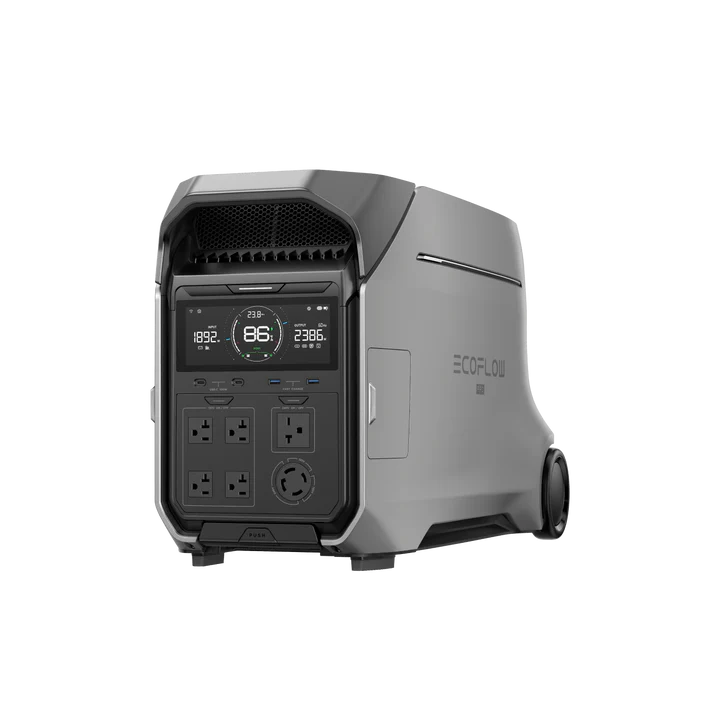
$2,799.00 · direct from EcoFlow
Last checked 1 day ago. Prices move — check before you buy.

$3,699.00 · direct from BLUETTI
Last checked 1 day ago. Prices move — check before you buy.
Spec deltas
The Apex 300 holds 8,294Wh for $3,699. The DELTA Pro 3 holds 4,096Wh for $2,799. Twice the battery, but now $900 more expensive. On raw energy-per-dollar the Apex still leads, about 2.24 Wh per dollar against 1.71; on the price tag, the DP3 wins by a mile.
Then you try to live with it. The Apex weighs 213.9 lbs against the DP3's 112.4, runs at 45dB against 30dB, and, despite holding twice as much, owners report it won't accept anywhere near its rated charge rateB2. The DELTA Pro 3's whole identity is the opposite: light for the class, quiet, and one of the fastest-recharging units in the category.
So this isn't a capacity contest, it's a values contest. The Apex is more energy per dollar and it sweeps the scenarios — but it now costs $900 more. The DP3 is half the weight, half the noise, refills before the Apex has warmed up, and it's the cheaper unit. Decide which of those two lists is your list.
What the Numbers Reveal
Each conclusion stated first — the numbers behind it on one line, the full analysis below.
It's worse than slow. In this two-B300K config, owners report the paired batteries fill out of sync and Bluetti support calls the capped input 'normal'B1B3. The DP3 has twice the recharge and half the capacity to refill, so in a rolling multi-day outage it's ready again first.
DELTA Pro 3 recharges from empty to most of the way full in about 50 minutesApex 300 holds 8,294Wh but owners report it won't pull past a fraction of its rated chargeB1B2
Why it mattersAnyone whose real fear is back-to-back outage days should weigh the DP3's fast, reliable refill above the Apex's bigger but slower-to-fill bank.
weight
Pair that with the noise gap, 30dB against 45dB, and the DP3 is the one you can put in a living space and reposition as needed, while the Apex is a 213.9 lb fixture you set down once and route your life around.
Apex 300 weighs 213.9 lbsDELTA Pro 3 weighs 112.4 lbs
Why it mattersIf the unit shares your space or ever has to move, the DP3's weight and quiet matter more daily than the Apex's extra capacity ever will.
Typical price
The two now pull apart: the Apex wins cost per lifetime kWh ($0.13 against $0.15) and energy per dollar, while the DP3 wins the up-front price ($2,799 against $3,699) and cost per warranty year ($480 against $740). The DP3's 4,000 cycles against 3,500 is a horizon no owner reaches, so it never cashes in either way.
Apex 300 costs $3,699 and delivers about $0.13 per lifetime kWhDELTA Pro 3 costs $2,799 and delivers about $0.15 per lifetime kWh
Why it mattersValue now depends on how you measure it: cheapest energy per stored kWh points to the Apex, lowest money out of pocket points to the DP3.
The specific dimensions that decide these two units — everything else is a tie.
Lifetime Value
Selected because: Apex leads energy-per-dollar; DP3 now leads up-front price — a genuine split.
cost / lifetime kWh
On money, it's now a split decision. The Apex still delivers cheaper energy per lifetime kWh — about $0.13 against the DP3's $0.15, because its price spreads across twice the capacity — but it's no longer cheaper to buy. At $3,699 it costs $900 more than the $2,799 DP3, and cost per warranty year has flipped to the DP3's favor, about $480 against $740.
The DELTA Pro 3's cycle rating, 4,000 against 3,500, is still a horizon no owner reaches, so it never cashes in. But its price drop changes the whole frame: the Apex is the value pick only if you measure by energy per stored kWh, while the DP3 is the value pick on money actually spent. Neither owns the cost argument outright anymore.
Portability & Form Factor
Selected because: 101 lb and 15dB gaps plus recharge speed are the DP3's whole argument.
weight
This is the DP3's home turf, and it's not subtle. At 112.4 lbs it's 101 lbs lighter than the 213.9 lb Apex, quiet enough at 30dB to sit in a room where the Apex's 45dB would nag, and it recharges fast enough that a mid-day top-off is realistic rather than an all-afternoon project.
That last point is the one that reframes the whole matchup. Reviewers call the DP3 a gold-standard whole-home unitA4 partly because refilling it is quick and dependable, while Apex owners are still trying to get their unit to accept its rated chargeB2. Half the capacity is easy to forgive when you can put the energy back in an hour.
PowerScore Breakdown
Selected because: Surge ratio favors the Apex; continuous output is near-tied.
overall power score
Continuous output is close, 4,000W for the DP3 against 3,840W for the Apex, so neither runs away with the everyday load. Where they split is surge headroom: the Apex surges to 7,680W, a 2x ratio over its continuous rating, against the DP3's 6,000W and 1.5x.
That higher ratio is a decent proxy for inverter quality and startup margin. It means the Apex has more cushion to catch a compressor's inrush without tripping. It's one of the few performance columns where the heavier unit is also the technically stronger one.
Your Life, Your Pick
Selected because: Apex sweeps the contested scenarios on capacity.
Capacity decides the scenarios, and the Apex takes all the contested ones: Weekend Camping, the 8-Hour Blackout, Remote Workday, and Van Life Daily, the last of which the DP3 can't finish at all. CPAP and a tailgate are comfortable for both.
Read that with the recharge caveat firmly attached. The Apex wins these by storing more, not by doing anything the DP3 can't power. In a single-charge test the Apex's depth wins; in a refill-and-repeat outage, the DP3's speed narrows the gap fast.
Growth Path
Selected because: Both expand; recharge reliability shades the off-grid story toward the DP3.
solar input
Both expand, the Apex on Bluetti's stackable batteries to a large bank, the DP3 on EcoFlow's platform to 48kWh. Neither locks you out, so growth isn't the deciding factor it sometimes is.
The tiebreaker circles back to recharge. Adding capacity to a unit that already struggles to pull its rated input, as Apex owners reportB2B8, compounds the refill problem, while the DP3's fast, proven charging scales more gracefully as the bank grows.
Strengths & trade-offs
EcoFlow DELTA Pro 3
Strengths
- +Costs $900 less
- +Lighter by 101.5 lb
- +Higher AC output
Trade-offs
- –Very heavy unit that may be difficult for one person to lift.
- –Shorter-lived battery — rated for 4,000 charge cycles vs the Apex 300 + 2×B300K's 6,000, so it wears out sooner.
BLUETTI Apex 300 + 2×B300K
Strengths
- +Larger battery capacity
- +Faster solar charging
- +Rated for 6,000 charge cycles — much longer battery lifespan
Trade-offs
- –Substantially more expensive (+$900) than the DELTA Pro 3.
- –Significantly heavier (+101.5 lbs), making it harder to move.
- –Very heavy unit that may be difficult for one person to lift.
Will It Power Your Gear?
Scenario math and per-appliance runtimes, modeled from the spec record.
Scenario verdicts
We ran the math on six real-world scenarios. Here's which unit survives your actual life.
SCN-01 · 2 nights · needs 2,100Wh
Weekend Camping
Two nights off-grid with essential comfort
Neither unit
Scoring these two at a campsite is a category error: neither travels — the DELTA Pro 3 is 112.4 lbs and the Apex 300 + 2×B300K 213.9 lbs, and at those weights they roll off a truck bed if they go anywhere at all. The 2,100Wh here is trivial for either — it's the going that doesn't happen. If you need power away from the building, you're shopping the wrong class.
Battery budget usedlower = more headroom
LOAD Phone Charger 15W×6h · LED Lights 40W×8h · Box Fan 75W×14h · CPAP Machine 40W×16h
SCN-02 · 8 hours · needs 1,645Wh
8-Hour Blackout
Keep the essentials running through a night without power
Apex 300 + 2×B300K
The Apex clears a standard outage at 23% of capacity against the DP3's 47%, so it wins the single-charge test comfortably. Flip to a multi-day event, though, and the DP3's roughly one-hour refill starts closing the gap the Apex's slow charging opens.
Battery budget usedlower = more headroom
LOAD Fridge 150W×8h · Router + Modem 20W×8h · LED Lights (4 bulbs) 40W×6h · Phone Charger 15W×3h
SCN-03 · 8 hours · needs 320Wh
CPAP Overnight
Sleep therapy without interruption — the #1 medical use case
DELTA Pro 3
A CPAP is about 40W for eight hours, so both of these cover the night several times over — capacity isn't the question here, and the percentages are a formality. What matters is the box next to your pillow, and the only published difference is a rating: the DELTA Pro 3 is rated 30dB against the Apex 300 + 2×B300K's 45dB. Each is the maker's own published rating, and the makers do not measure the same way, some quoting a best case and some a figure under load, so neither number describes a 40W draw and the two are not really comparable. Treat them as a reason to look for hands-on reports before either one goes next to a bed, not as a difference you can count on hearing.
Battery budget usedlower = more headroom
LOAD CPAP Machine 40W×8h
SCN-04 · 8 hours · needs 910Wh
Remote Workday
Full work day off-grid without power anxiety
Apex 300 + 2×B300K
A day of laptops, monitors, and a router needs about 910Wh, and both handle it with ease, the Apex at 13% and the DP3 at 26%. Since neither breaks a sweat, decide on the desk-side realities instead: the DP3 is quieter at 30dB and far lighter to tuck under a table.
Battery budget usedlower = more headroom
LOAD Laptop 60W×8h · External Monitor 30W×8h · Router + Modem 20W×8h · Phone Charger 15W×2h
SCN-05 · 4 hours · needs 670Wh
Tailgate Party
Game day power for the crew
Neither unit
Scoring these two at a tailgate is a category error: neither travels — the DELTA Pro 3 is 112.4 lbs and the Apex 300 + 2×B300K 213.9 lbs, and at those weights they roll off a truck bed if they go anywhere at all. The 670Wh here is trivial for either — it's the going that doesn't happen. If you need power away from the building, you're shopping the wrong class.
Battery budget usedlower = more headroom
LOAD Blender 400W×0.5h · LED TV (55") 80W×4h · Bluetooth Speaker 15W×4h · Phone Charger (×3) 45W×2h
SCN-06 · 24 hours · needs 4,685Wh
Van Life Daily
A full day of mobile living — the ultimate endurance test
Apex 300 + 2×B300K
A full off-grid day runs about 4,685Wh. The Apex covers it at 66% of its bank; the DELTA Pro 3 needs more than it holds and taps out before the day ends. The Apex owns this on capacity, with the standing caveat that its slow recharge makes solar-only days a grind.
Battery budget usedlower = more headroom
LOAD Mini-Fridge 150W×24h · Laptop 60W×4h · Phone Charger 15W×3h · LED Lights 40W×5h · Fan 75W×8h
The Load Test
RUNTIME = (Wh × 0.85) ÷ LOAD
None of the scenarios above exactly yours? Build it. Toggle what you'd plug in; both units are tested against the combined draw.
Essentials
Comfort & Convenience
High-Draw Appliances
Test duration
8h
Continuous draw
205W
Projected runtime
For this load: Apex 300 + 2×B300K runs 34.4h vs 17h.
$3,699 list · direct from BLUETTI
Modeled from the spec record — same math as the tables below. Methodology
Runtime by appliance
Real-world runtime estimates for common appliances, modeled at 85% inverter efficiency.¹
Essentials
The basics you need runningscale 0–470hComfort & Convenience
Makes off-grid life actually enjoyablescale 0–94hHigh-Draw Appliances
These reveal the real limitsscale 0–7.1h¹ Runtime = (capacity × 0.85) ÷ appliance watts. Within each group, all bars share one time scale (the group's longest runtime), so lengths are comparable across appliances; identical runtimes collapse into a single blue/orange bar. Actual runtime varies with battery age, temperature, and simultaneous loads — see methodology.
Conclusion
July 16, 2026
Verdict: the BLUETTI Apex 300 + 2×B300K
This is now a genuine fork. For raw stored energy per dollar, the Apex 300 still leads: 8,294Wh against 4,096Wh, about 2.24 Wh per dollar against 1.71, and about $0.13 per lifetime kWh against $0.15. It also has the stronger surge ratio, 2x against 1.5x, and wins every contested scenario — Weekend Camping, the 8-Hour Blackout, Remote Workday, and Van Life Daily — on the back of that doubled capacity. But the price has swung hard: at $3,699 the Apex now costs $900 MORE than the $2,799 DELTA Pro 3, and it wins those scenarios only on the assumption you never move it and recharge slowly overnight. The DELTA Pro 3 is the more livable machine by a wide margin — 101 lbs lighter, 15dB quieter, and it refills in about an hour where Apex owners report they can't push the unit to even its rated charge rateB2 — and it now does all that for $900 less. If you genuinely need ~8kWh in a fixed install, the Apex's capacity is a real reason to pay the premium. For most buyers, the cheaper, lighter, faster-charging DP3 is the easier call.
Editor-assigned confidence, based on cited owner research and spec analysis.
List prices as of July 16, 2026. The links below open EcoFlow's and BLUETTI's current prices.
$3,699.00 · direct from BLUETTI
Last checked 1 day ago. Prices move — check before you buy.
or check the DELTA Pro 3 price$2,799.00 list
Written by Gunner Gustafson, Whole-Home Backup Tester · Station Arena Test Desk · Updated July 16, 2026
Measured Data
Benchmark scores and the full spec record, side by side.
Benchmark scores
Not rated for both units (minimum threshold unmet): RV Living, Solar Generator.
Full specifications
ᵈ Derived: price ÷ rated capacity. See the data behind our comparisons →
Comparison ToolAdd more power stations, side by sideOpen Tool →How these numbers are produced
Numeric verification
Every figure on this page traces to our spec database or arithmetic on it — no estimated numbers.
Owner claims
Statements about owner experience are cited to published reviews — see Sources & Research Notes below.
Runtime model
Runtime = (rated capacity × 0.85 inverter efficiency) ÷ device wattage. Solar recharge estimates assume panels deliver 70% of rated output. Cold weather, battery age, and stacked loads reduce real-world results.
Power Score
Computed from 14 published spec dimensions, weighted per use-case bench. Higher is better; a unit must meet a bench's minimum threshold to be rated.
See the full weight table and data sourcing on our methodology page →Class ranking (the star rating)
Each unit's star score is a category ranking, not customer reviews — no buyer opinions feed it. We score every station on size-independent quality (value, output, portability, endurance, ports, warranty, and more), then percentile-rank it against the other units in its capacity class, so a class-leading compact unit and a class-leading whole-home unit can both earn 5★. Here, DELTA Pro 3 rates 4.0/5 (40th percentile of 16 Home Backup-class units), and Apex 300 + 2×B300K rates 3.4/5 (7th percentile of 29 Whole-Home / Off-Grid-class units).
How the class ranking is computed →Test Notes & Caveats
Hidden gotchas and advantages we spotted that you won't find on the product page.
Nearly a 2-to-1 weight gap
The Apex 300 is 213.9 lbs, a two-person install that stays where you put it. The DELTA Pro 3 is 112.4 lbs, 101 lbs lighter, the difference between routing your life around the unit and moving it when you need to.
45dB against 30dB under load
The Apex runs at 45dB working hard, the DP3 at 30dB, a 15-decibel gap the ear registers as clearly louder. In a garage it's nothing; in a room you're sitting in during an outage, it's the DP3 you'll forget is running.
The Apex has more startup headroom
The Apex surges to 7,680W over a 3,840W continuous rating, a 2x ratio, against the DP3's 6,000W over 4,000W, or 1.5x. A higher surge-to-continuous ratio means more margin to catch a compressor's inrush without tripping, and here the heavier unit holds it.
Warranty: No Difference
Both units carry the same 5-year warranty, so coverage isn't a tiebreaker here. The Apex 300 + 2×B300K's figure is a maximum rather than a guarantee — it depends on buying direct from BLUETTI or registering the unit, since reseller purchases carry a shorter term. Worth saying because the per-dollar framing can suggest otherwise: the DELTA Pro 3 works out at 1.8 years of cover per $1,000 spent against the Apex 300 + 2×B300K's 1.4, but that spread is the price gap, not the terms.
Battery Lifespan in Real Years
The Apex 300 + 2×B300K is rated for 6,000 cycles vs 4,000. In real life: at daily use, that's 16.4 vs 11 years. At weekend use (twice a week), it's 58 vs 38 years. One caution reading years across different sizes: a cycle is 8,294Wh on the Apex 300 + 2×B300K and 4,096Wh on the DELTA Pro 3, so count lifetime energy — roughly 49,766 kWh against 16,384 kWh over the rated life. After hitting the cycle limit, the battery doesn't die — it drops to ~80% of original capacity, which is still very usable.
Full record above — the Test Desk pick is the Apex 300 + 2×B300K.
Check Apex 300 + 2×B300K price →or check the DELTA Pro 3 priceOwnership Analysis
What happens after you buy — true cost of ownership, brand trust, and growth potential.
Lifetime value
Service lifeyears at one full cycle per day
Lifetime energy delivered
Cost per delivered kWh
│ warranty ends · Reaching the cycle rating means ~80% capacity remains — degraded, not dead.
Analyst note
The DELTA Pro 3 is cheaper to buy, but the Apex 300 + 2×B300K is cheaper to own. At $0.07/kWh over its lifetime vs $0.17/kWh, the Apex 300 + 2×B300K's higher cycle life and capacity make each dollar go further over the years.
Delivers each lifetime kWh for $0.10 less — check the Apex 300 + 2×B300K price →
Brand trust
EcoFlow
Ecosystem
EcoFlow runs the deepest ecosystem in portable power and the fastest-charging tech in the category, with the most active release cadence.
Support
US-based support is polarized, some hassle-free prepaid replacements, some long waits and refurbished units; buying through Costco or Amazon adds a return safety net.
Community
Largest community in the space — Reddit r/Ecoflow_community (~31K members), multiple Facebook groups, and an official community forum
App experience
Rated 4.6/5 iOS (~8,400 ratings) · 4.2/5 Android (~17,000 ratings)
Unique strength
Fastest-charging technology (X-Stream), deepest product ecosystem, and most active innovation cadence. At the very top of the range, the DELTA Pro Ultra platform stacks batteries and inverters into whole-home backup — a flagship path, not a line-wide feature.
Worth knowing
The October 2025 DELTA Max 2000 recall for overheating is worth noting as a brand data point, and EcoFlow offers no parts or service out of warranty.
BLUETTI
Ecosystem
Bluetti offers the best capacity-per-dollar in the market across one of the broadest lineups, which is exactly what the Apex delivers here.
Support
Support is the brand's weakest trait and its most inconsistent, from smooth to multi-week silences; buying direct tends to produce better outcomes.
Community
Active and growing — Reddit r/bluetti has a dedicated community. Second-largest after EcoFlow in engagement.
App experience
Rated 4.5/5 iOS and Android — tied for best app experience in the category. V3.0 UI redesign was well-received.
Unique strength
Among the best capacity-to-price ratios available — several Elite and Apex units are the lowest $/Wh in the catalog. Widest product diversity including industry-firsts like sodium-ion cold-weather units and dual solar+alternator vehicle hubs. LFP across the rest of the range, though rated cycle life spans 2,500 (EB3A) to 6,000, and it varies WITHIN the Elite range rather than tracking it — the Elite 300 and Elite 200 V2 are rated 6,000 while the Elite 30 V2, Elite 10 Mini, Elite 320 and Elite 400 are rated 3,000+ and the Elite 100 V2 4,000+, so check the specific model. Dual-voltage (120V/240V) in flagships.
Worth knowing
The Apex is a 2025 launch with thin long-term data, documented charge-rate and solar quirks, and a design that puts some DC and USB ports on a separate paid accessory.
Analyst note
EcoFlow sells refinement and speed — and in this pairing, at the lower price; Bluetti sells raw capacity per dollar with rougher edges and shakier support. Whichever you pick, buy from a retailer with easy returns given both brands' polarized support records.
Growth path
DELTA Pro 3
EXPANDABLESupports EcoFlow expansion batteries, so you can add capacity later without replacing the base unit — useful if your needs may climb past 4,096Wh.
Accepts up to 2,000W of solar. Enough for a serious multi-panel array.
Generous port selection supports complex multi-device setups.
Expansion batteries are EcoFlow-specific. You're investing in the EcoFlow ecosystem.
Apex 300 + 2×B300K
EXPANDABLESupports BLUETTI expansion batteries, so you can add capacity later without replacing the base unit — useful if your needs may climb past 8,294Wh.
Accepts up to 2,400W of solar. Enough for a serious multi-panel array.
Generous port selection supports complex multi-device setups.
Expansion batteries are BLUETTI-specific. You're investing in the BLUETTI ecosystem.
Realistic full solar rechargeat 70% of rated panel output — see methodology
Analyst note
Both expand, so neither locks you out of growth — decide on capacity, price, and the rest, not the expansion checkbox.
What Owners Report
Patterns from published owner reports and long-term reviews — every claim cited to its source below.
EcoFlow DELTA Pro 3
Reviewers treat the DELTA Pro 3 as a gold-standard whole-home unit for 2026A4. The headline is its 4,096Wh LFP bank paired with 4,000W dual-voltage 120V/240V output, expandable to 48kWh, so it scales from a single box to a house systemA1. Its rated 4,000 cycles to 80% put it past a decade of service, with an IP65 battery rating for rough installsA2.
The trait owners return to is charge speed: EcoFlow's multi-charge tops it from empty to most of the way full in about 50 minutes and to a full charge in roughly an hour and a halfA3. Field coverage here skews positive and is still relatively thin, so treat the absence of complaints as limited data rather than a clean bill.
“4,096Wh LFP battery with 4,000W continuous AC output (6,000W with X-Boost) and dual-voltage 120V/240V, expandable to 48kWh.”
Sources
ecoflow.com · amazon.com · homedepot.com · thepowerpick.com · outboundpower.com · techradar.com · thesolarlab.com
BLUETTI Apex 300 + 2×B300K
The Apex's best owner story is value. One van-conversion owner priced a comparable DIY system, solar charger, split charger, shunt, inverter, and found the Apex came in at or below the parts totalB6, and a reviewer testing it with a B300K ran household essentials for more than a full day without rationingB16, helped by a lean 20W idle drawB15. For stored energy per dollar, owners rate it hard to beat.
The catch is charging and support. In this paired-battery setup, owners report the two packs fill out of sync and that the unit won't accept anywhere near its rated input, with Bluetti support calling it 'normal'B1B2B3, and RMA experiences run from smooth to multi-week silencesB4B11. It stores energy beautifully; putting it back and getting help are the weak links.
“For me the 240V output is great. I can stick it in the back of my PHEV and use the 240V output to charge at 3.3KW when I stop.”
Sources & Research Notes
Every owner claim in this report is traceable to a published source. The bracketed references above resolve here.
Recurring owner themes
- Huge 4,096Wh LFP capacity, 4,000W dual-voltage output, very fast charging, and big expandability are the standout praise; it's heavy at ~113 lbs. [DELTA Pro 3 · 2 entries]
- When multiple Apex 300 units (as in this 2x-B300K configuration) are charged together, owners report state-of-charge sync problems and solar input capped far below the advertised rating, which Bluetti support has called 'normal' behavior. [Apex 300 + 2×B300K · 3 entries]
- Customer/RMA support experience is inconsistent — some owners report smooth help, others describe multi-week delays and unresponsive tickets. [Apex 300 + 2×B300K · 2 entries]
- The base unit's 60V solar input ceiling and a firmware bug that drops solar detection (requiring an unplug/replug) are the two most-cited technical gripes among solar-focused owners. [Apex 300 + 2×B300K · 2 entries]
- Because the Apex 300 ships with no built-in DC/USB ports, owners and reviewers alike flag the mandatory ~$300 Hub D1 accessory as an unexpected added cost. [Apex 300 + 2×B300K · 2 entries]
- Despite being marketed as 'portable,' the unit's weight (~38kg/85lb base alone, more with B300K batteries) leads multiple sources to describe it as effectively a stationary/semi-permanent installation rather than something carried around. [Apex 300 + 2×B300K · 2 entries]
- A1
“4,096Wh LFP battery with 4,000W continuous AC output (6,000W with X-Boost) and dual-voltage 120V/240V, expandable to 48kWh.”
ecoflow.com / amazon.com — DELTA Pro 3 · 2026 · [positive]
- A2
“LiFePO4 rated for 4,000+ cycles to 80% (10+ years), with an IP65 battery rating.”
homedepot.com / thepowerpick.com — DELTA Pro 3 review · 2026 · [positive]
- A3
“Multi-charge technology reaches 0-80% in about 50 minutes using up to 7,000W input, with a full charge in roughly 90 minutes; up to 2,600W solar.”
outboundpower.com / techradar.com — DELTA Pro 3 review · 2026 · [positive]
- A4
“Weighs about 113.5 lbs; reviewers call it a gold-standard whole-home backup unit for 2026.”
techradar.com / thesolarlab.com — DELTA Pro 3 review · 2026 · [positive]
- B1
“When the units are charging from the grid they charge at different rates and not together... you may have one at 100% and one at 50%.”
DIY Solar Power Forum — thread 'Bluetti Apex 300 problems' · 2025-09 · [negative]
- B2
“I have requested a short video from Bluetti showing an APEX 300 actually charging more than 1200 watts. They have been unable to produce one.”
DIY Solar Power Forum — thread 'Bluetti Apex 300 problems' · 2025-09 · [negative]
- B3
“Bluetti support says this is normal... This makes them a bad choice for off grid applications.”
DIY Solar Power Forum — thread 'Bluetti Apex 300 problems' · 2025-09 · [negative]
- B4
“It has taken me 2 weeks of troubleshooting with them and a week to get an RMA approval... I have asked for updates with NO response 48 hours later.”
DIY Solar Power Forum — thread 'Apex 300 Support issues' · 2025-11 · [negative]
- B6
“It came in just shy of £1500... Pricing up a similar system from scratch with similar capacity, solar charger, split charger, smart shunt, inverter ect was all coming in at a similar if not slightly higher price.”
VW T6 Transporter Forum — thread 'Bluetti Apex 300' · 2025-07 · [positive]
- B8
“The 60V solar limit is the most common and vociferous complaint, with users calling it "misleading" and a "joke".”
BIKMAN TECH blog aggregating user/forum reports — 'Bluetti APEX 300 - Everything You Need to Know' · 2025-11 · [negative]
- B11
“Customer support is dangerously polarized. User experiences range from "great" and "helpful" to "notoriously non-existent" and "a disaster".”
BIKMAN TECH blog aggregating user/forum reports — 'Bluetti APEX 300 - Everything You Need to Know' · 2025-11 · [mixed]
- B15
“Efficient 20W AC idle drain extends runtime significantly during extended outages.”
Yanko Design — 'BLUETTI Apex 300 Review: The All-in-One Solar, Gas, and Battery Solution' · 2025-05 · [positive]
- B16
“With some portable power stations, I'd have to ration power more carefully, but with this system, I could run essentials for more than a full day if I needed to.”
Techspective — 'Bluetti Apex 300 with B300K Review' · 2025-09 · [positive]
Research compiled July 16, 2026.
Who Should Buy Which
Buy the DELTA Pro 3 if you…
- →You want to spend less: at $2,799 the DELTA Pro 3 now costs $900 less than the Apex, with a lower cost per warranty year too.
- →You want a unit you can move and live next to: 101 lbs lighter and 15dB quieter than the Apex, at 112.4 lbs and 30dB.
- →Fast, reliable recharge is a priority, a mid-day top-off in about an hour, especially for rolling multi-day outages.
Buy the Apex 300 + 2×B300K if you…
- →You genuinely need ~8kWh in a fixed install: twice the DP3's capacity, the best energy per dollar here (about 2.24 Wh per dollar), and about $0.13 per lifetime kWh — enough that its bigger battery is worth paying $900 more for.
- →You recharge overnight from the wall, so the Apex's slow, finicky charging never becomes your problem, and you value the deeper scenario reserve.
If neither fits
If you need genuine portability, something you carry rather than wheel or install, both are in the wrong class at 112 to 214 lbs. That buyer wants a 1,000 to 2,000Wh unit under 50 lbs and should look at the tier below these entirely.
The Bottom Line
The Apex 300 is the capacity play: twice the battery, the best energy per dollar here, cheaper per lifetime kWh, and a clean sweep of the contested scenarios. But it now costs $900 more than the DP3, so that case holds only if you genuinely need ~8kWh in a fixed install that refills overnight.
The DELTA Pro 3 is the better-engineered machine and now the cheaper one too, which for most buyers settles it. It's $900 less, 101 lbs lighter, 15dB quieter, and it recharges in an hour where Apex owners can't push their unit to its own rating. Need ~8kWh bolted in place, take the Bluetti. Want a unit you can move, live beside, refill fast — and spend less on — the EcoFlow is the pick.
Frequently Asked Questions
Answers drawn from the spec record and cited owner research.
Which holds more power, the DELTA Pro 3 or the Apex 300?
The Apex 300, by double: 8,294Wh against the DP3's 4,096Wh. It now costs more, though — $3,699 against $2,799 — so while it still wins stored energy per dollar (about 2.24 Wh per dollar against 1.71, and about $0.13 per lifetime kWh against $0.15), you pay $900 up front for that bigger bank.
Which recharges faster?
The DELTA Pro 3, and it's not close. Its multi-charge refills it from empty to most of the way full in about 50 minutes and to full in roughly 90 minutes, while Apex owners report they can't get their unit to accept even its rated charge rate. For back-to-back outage days, that speed is a real advantage.
Is the Apex 300 too heavy to move?
Effectively, yes, for one person. At 213.9 lbs it's a two-person install that stays put, 101 lbs heavier than the DP3's 112.4. If the unit needs to move between floors, rooms, or a vehicle, the DELTA Pro 3 is the practical choice.
Which is cheaper to own over time?
It depends how you measure. Per lifetime kWh the Apex 300 is still cheaper — about $0.13 against the DP3's $0.15 — because its price spreads over twice the capacity. But the DELTA Pro 3 is now far cheaper to buy ($2,799 against $3,699) and cheaper per warranty year ($480 against $740). The DP3's 4,000-cycle rating beats the Apex's 3,500, but that edge only pays off on a horizon no owner reaches.
Which is quieter for indoor use?
The DELTA Pro 3, at 30dB against the Apex's 45dB under load, a 15-decibel gap the ear reads as a clearly louder machine. For a unit running in a living space during an outage, the DP3 is the one you'll forget is on.
Brand matchup
EcoFlow vs BLUETTI: measured across every matchup →Where to buy
EcoFlow DELTA Pro 3
$2,799.00
$2,799.00 · direct from EcoFlow
Last checked 1 day ago. Prices move — check before you buy.
BLUETTI Apex 300 + 2×B300KPick
$3,699.00
$3,699.00 · direct from BLUETTI
Last checked 1 day ago. Prices move — check before you buy.
Prices may vary by retailer and are subject to change.