Head-to-head test
EcoFlow DELTA Pro 3 vs Anker SOLIX F3000
The DELTA Pro 3 asks $1,299 more for a third more battery, and it's the one with the smaller solar door to refill it through.
Full profiles: EcoFlow DELTA Pro 3 → · Anker SOLIX F3000 →

Written by Gunner GustafsonUpdated
Whole-Home Backup Tester, Station Arena Test Desk
Spec deltas
The Anker SOLIX F3000 is $1,500 and the EcoFlow DELTA Pro 3 is $2,799, and almost everything that normally justifies a gap that size is identical here. Both packs are rated for 4,000 cycles. Both carry up to five years of warranty. Both cap USB-C at 100W, both accept expansion batteries, and both start every load in our scenario set. The difference buys 1,024Wh of extra battery and very little else.
After that, the trade is 400W each way. The DELTA Pro 3 holds 400W more continuous output, 4,000W against 3,600W. The F3000 takes 400W more solar, 2,400W against 2,000W. One of those matters in the hour you run everything at once; the other matters every morning you spend waiting for the pack to come back. Which of those two hours you actually live in is most of this decision.
The honest catch on our pick: the DELTA Pro 3 is the higher-scoring of the two on our composite, and it's the right unit if your power cuts run into a second night. It finishes an eight-hour outage at 47% used with 1,837Wh still in the tank, where the F3000 lands at 63% used with 966Wh, roughly three-fifths of a repeat performance. That's a real reason to spend up. It's also the only one on this page.
What the Numbers Reveal
Each conclusion stated first — the numbers behind it on one line, the full analysis below.
Capacity
And the premium is buying headroom only. Both packs are rated for the same 4,000 cycles and the same five-year term, so the extra money isn't buying longer life or better coverage; it lands in lifetime cost as 17 cents a kilowatt-hour against 12. Both are absurdly cheap electricity. One is cheaper because the box cost less, not because the cells are any better.
DELTA Pro 3: 4,096Wh at $2,799SOLIX F3000: 3,072Wh at $1,500the F3000's whole pack works out to $0.49 per watt-hour
Why it mattersIf you can name the load that needs the extra 1,024Wh, pay for it. If you're buying it as insurance, you're paying roughly two and a half times the going rate for a claim you may never file.
Now drop it into the one scenario the DELTA Pro 3 wins. It takes the eight-hour blackout at 47% used with 1,837Wh left, which is a reserve argument, and a single-evening outage never needs a refill at all. The outage that justifies carrying reserve is the multi-day one, and that is precisely where you spend every sunny hour pushing through the narrower input.
DELTA Pro 3: 2,000W maximum solar input into a 4,096Wh packSOLIX F3000: 2,400W maximum solar input into a 3,072Wh pack
Why it mattersIf you own panels and you're buying for long grid failures, price the array before you price the battery. The reserve you're paying for is partly cancelled by the input you're giving up.
continuous output
The hands-on testing lands on the holding, not the startingB9B2. One reviewer pushed a Vitamix through the F3000 that trips 20A breakers elsewhere with no complaintB9; another found the unit shutting itself off when an air fryer and a microwave ran at the same time, and concluded that heavy loads want staggeringB2. That limit showed up in a kitchen, not on a spec sheet. Startup inrush isn't where this unit runs out. Simultaneous draw is, and the DELTA Pro 3's extra 400W of continuous output is the one figure on the page that answers it directly.
SOLIX F3000: 7,200W surge on 3,600W continuous, a 2x ratioDELTA Pro 3: 6,000W surge on 4,000W continuous, a 1.5x ratio
Why it mattersIf your plan has a fridge, a heater and a kettle all live at once, the DELTA Pro 3's sustained watts are worth more to you than the F3000's bigger surge number.
The only independent listening on this page belongs to the cheaper unit. One hands-on review calls the F3000 practically silent even under heavy loadB5, and quiet running plus low standby drain are the two things testers keep naming as its improvement over earlier SOLIX modelsB4B5. That's an ear rather than a meter, but it is one more data point than the published figure has.
the DELTA Pro 3 publishes a 30dB noise figure; the SOLIX F3000 publishes noneour DELTA Pro 3 file is mostly manufacturer and retailer spec materialA1A2A3 plus a single review-site verdictA4the F3000 file carries hands-on testing, including a measured 20.5W idle draw against Anker's own 25W claimB4
Why it mattersBedroom, nursery and CPAP buyers shouldn't read the 30dB as the documented-quiet option. Neither unit has a measurement; only one has somebody who listened.
The specific dimensions that decide these two units — everything else is a tie.
Lifetime Value
Selected because: Same 4,000 cycles and up to five years of warranty on both, so the $1,299 gap buys 1,024Wh of headroom and nothing else.
cost / lifetime kWh
Twelve cents a kilowatt-hour against seventeen, and both of those undercut what your utility sells you. The reason the F3000 wins here isn't better cells. The two packs carry the same 4,000-cycle rating, so the DELTA Pro 3 delivers more total lifetime energy over its life, 16,384kWh against 12,288, and still costs more per unit of it. The whole gap is the sticker.
Per year of warranty the same thing arrives from a different direction: $300 a year of cover on the F3000 against $560 on the DELTA Pro 3, for up to five years on both. If the coverage is equal, paying more per year of it has to be buying something else. It is, and it's 1,024Wh.
Your Life, Your Pick
Selected because: Six loads, and the split is the decision: the F3000 takes the two that travel, the DELTA Pro 3 takes the blackout, two are dead heats, and one beats them both.
The split is cleaner than the spec sheet suggests. Both scenarios that involve going somewhere, camping and the tailgate, go to the F3000, and not on capacity: the DELTA Pro 3 has more than enough watt-hours for either and simply isn't a thing you carry. The two mid-size loads are dead heats that neither unit notices. A CPAP asks about 9% of the DELTA Pro 3 and 12% of the F3000, which is a rounding error on both, and a remote workday is a wash down to the USB-C ceiling.
The blackout row is the one that should change somebody's mind, and it's worth reading for what's left rather than who survives. Both get through eight hours without strain. Only one of them wakes up with better than a repeat performance in the tank. Van Life Daily is the honest other end: 4,685Wh a day beats both, and the extra battery gets you 74% of the way instead of 56%. Closer is not covered.
What the Specs Don't Tell You
Selected because: Five cards fire. Two land against the DELTA Pro 3, one against the F3000, one is a wash, and the 10ms UPS class is the DELTA Pro 3's cleanest win.
The surge card is the one to read twice. The F3000 is the unit with the bigger startup ceiling, 7,200W against 6,000W, and it is also the unit with less sustained output, 3,600W against 4,000W. Buyers habitually shop the surge figure because it's the larger of the two, which gets the physics backwards: a motor startup is a moment, and a kitchen with two appliances live is an hour.
The UPS line is the DELTA Pro 3's cleanest win, and it deserves to be taken seriously without being oversold. Both numbers are rated classes rather than measured transfers, one at 10ms and one at 20ms, and routers and most electronics ride through either. A desktop with unsaved work and a fussy power supply is the single load where the faster class is worth money. Notice what the warranty card is doing while all this happens: firing only to tell you there's no difference.
Portability & Form Factor
Selected because: 112.4 lb against 91.5: one of these is sited once and the other still travels, which is why two of the six scenarios go to the Anker by default.
weight
Twenty-one pounds sounds like a detail until you're the one on the other end of it. At 91.5 lb the F3000 is a one-person move with effort. At 112.4 lb the DELTA Pro 3 is a two-person lift, and our record classes it as a unit you site rather than one that travels. That classification, not its capacity, is what hands the camping and tailgate rows to the cheaper box.
It cuts the other way for a house. A box that stays where you put it beside the panel is fine, and the DELTA Pro 3's weight stops being a cost the moment it stops moving. So ask how many times a year this thing will actually leave the room it lives in. If the honest answer is zero, stop counting pounds and go back to arguing about capacity.
Brand Trust
Selected because: Both service stories are pointed the wrong way, and return shipping on a 91.5 lb unit is not a hypothetical.
Both service stories are pointed the wrong way, which is a strange thing to have to say about the two biggest names on the shelf. EcoFlow's record is polarized and has stayed polarized: prepaid labels and quick swaps on one side, long waits and a refurbished unit against a new-product claim on the other, and no parts or service at all once the warranty lapses. Anker's problem is newer. The brand built its name on no-hassle replacements, and SOLIX service quality is drifting, with scripted AI agents and heavy-unit returns routed through hazmat shipping.
The ecosystem gap is the part that actually touches this purchase. Both units accept expansion batteries, so the checkbox is a tie, but EcoFlow's catalogue behind that socket is the deeper one and Anker's is smaller. If you're reasonably sure the base unit is the whole plan, that costs you nothing. If this is the first piece of something larger, it's the one argument for EcoFlow that isn't about this box at all.
Strengths & trade-offs
EcoFlow DELTA Pro 3
Strengths
- +Larger battery capacity
- +Higher AC output
- +Faster solar charging
Trade-offs
- –Substantially more expensive (+$1,299) than the SOLIX F3000.
- –Significantly heavier (+22 lbs), making it harder to move.
- –Very heavy unit that may be difficult for one person to lift.
Anker SOLIX F3000
Strengths
- +Costs $1,299 less
- +Lighter by 22 lb
Trade-offs
- –Very heavy unit that may be difficult for one person to lift.
Will It Power Your Gear?
Scenario math and per-appliance runtimes, modeled from the spec record.
Scenario verdicts
We ran the math on six real-world scenarios. Here's which unit survives your actual life.
SCN-01 · 2 nights · needs 2,100Wh
Weekend Camping
Two nights off-grid with essential comfort
SOLIX F3000
Two units that both cover the weekend, and only one of them is getting to the campsite. The F3000 takes the 2,100Wh down to 511Wh of usable reserve, tighter than the DELTA Pro 3's 1,382Wh but with no realistic competition, because at 112.4 lb the EcoFlow is a two-person load into a truck bed and the Anker is 91.5. Capacity was never the DELTA Pro 3's problem for a weekend. Arrival was.
Battery budget usedlower = more headroom
LOAD Phone Charger 15W×6h · LED Lights 40W×8h · Box Fan 75W×14h · CPAP Machine 40W×16h
SCN-02 · 8 hours · needs 1,645Wh
8-Hour Blackout
Keep the essentials running through a night without power
DELTA Pro 3
This is the row the DELTA Pro 3 is built for, and the only one it wins. Both units get through the night without noticing, so the question isn't survival, it's what's in the tank at dawn. The DELTA Pro 3 ends at 47% used with 1,837Wh left, better than a repeat night. The F3000 ends at 63% with 966Wh, roughly three-fifths of a second run. If your outages reliably end by morning, that gap is worth nothing to you. If they have ever run two days, it's worth the whole price difference.
Battery budget usedlower = more headroom
LOAD Fridge 150W×8h · Router + Modem 20W×8h · LED Lights (4 bulbs) 40W×6h · Phone Charger 15W×3h
SCN-03 · 8 hours · needs 320Wh
CPAP Overnight
Sleep therapy without interruption — the #1 medical use case
Either unit
A CPAP is about 40W for eight hours, so both of these cover the night several times over — capacity isn't the question here. What would separate them is fan noise, but SOLIX F3000 doesn't publish a figure, so there's nothing to hold it to. Buy on price, weight, and whether you can live with a fan you haven't heard.
Battery budget usedlower = more headroom
LOAD CPAP Machine 40W×8h
SCN-04 · 8 hours · needs 910Wh
Remote Workday
Full work day off-grid without power anxiety
Either unit
Both power your workstation all day without strain, and their USB-C output is a wash — pick on weight, ports, or price.
Battery budget usedlower = more headroom
LOAD Laptop 60W×8h · External Monitor 30W×8h · Router + Modem 20W×8h · Phone Charger 15W×2h
SCN-05 · 4 hours · needs 670Wh
Tailgate Party
Game day power for the crew
SOLIX F3000
670Wh is a nothing-burden for either of these, and both start the 400W peak without flinching. So it comes down to the tailgate itself, where 21 lb is the difference between one person walking it to the truck and two people scheduling it. The F3000 wins by showing up, with 1,941Wh still unused when the game ends. If the party is in your own driveway, ignore this row entirely.
Battery budget usedlower = more headroom
LOAD Blender 400W×0.5h · LED TV (55") 80W×4h · Bluetooth Speaker 15W×4h · Phone Charger (×3) 45W×2h
SCN-06 · 24 hours · needs 4,685Wh
Van Life Daily
A full day of mobile living — the ultimate endurance test
Neither unit
Neither unit covers a full van-life day, so read this row as sizing information rather than a verdict. 4,685Wh leaves the DELTA Pro 3 1,203Wh short, about 74% of the day, and the F3000 2,074Wh short, about 56%. Both get you most of the way, which is why this doesn't disqualify either of them, but if this is genuinely your daily load you're asking a portable box to do a fixed system's job. Plan the shortfall before you pick the unit.
Battery budget usedlower = more headroom
LOAD Mini-Fridge 150W×24h · Laptop 60W×4h · Phone Charger 15W×3h · LED Lights 40W×5h · Fan 75W×8h
The Load Test
RUNTIME = (Wh × 0.85) ÷ LOAD
None of the scenarios above exactly yours? Build it. Toggle what you'd plug in; both units are tested against the combined draw.
Essentials
Comfort & Convenience
High-Draw Appliances
Test duration
8h
Continuous draw
205W
Projected runtime
For this load: DELTA Pro 3 runs 17h vs 12.7h.
$2,799 list · direct from EcoFlow
Planning for more than this? Describe your whole setup and get it sized →
Modeled from the spec record — same math as the tables below. Methodology
Runtime by appliance
Real-world runtime estimates for common appliances, modeled at 85% inverter efficiency.¹
Essentials
The basics you need runningscale 0–232.1hComfort & Convenience
Makes off-grid life actually enjoyablescale 0–46.4hHigh-Draw Appliances
These reveal the real limitsscale 0–3.5h¹ Runtime = (capacity × 0.85) ÷ appliance watts. Within each group, all bars share one time scale (the group's longest runtime), so lengths are comparable across appliances; identical runtimes collapse into a single blue/orange bar. Actual runtime varies with battery age, temperature, and simultaneous loads — see methodology.
Conclusion
September 13, 2026
Verdict: the Anker SOLIX F3000
Buy the SOLIX F3000. It's $1,500 against the DELTA Pro 3's $2,799, and the $1,299 you keep buys nothing you're giving up: identical 4,000-cycle packs, the same five-year term, the same 100W USB-C ceiling, and both take expansion batteries later. What you actually surrender is 1,024Wh of reserve, 400W of continuous output, and a UPS transfer rated at the 10ms class instead of the 20ms one. What you gain besides the money is 21 lb off the lift, 400W more solar input, and a 7,200W surge ceiling. The DELTA Pro 3 earns its price in exactly one place: outages that run past a single evening, where it finishes an eight-hour night at 47% used with 1,837Wh in hand against the F3000's 63% and 966Wh. If that's your grid, pay for it without hesitating. If it isn't, the F3000 is the same class of machine for just over half the money.
Editor-assigned confidence, based on cited owner research and spec analysis.
List prices as of September 13, 2026. The links below open EcoFlow's and Anker's current prices.
Sold on Amazon · today’s price is on the listing
or check the DELTA Pro 3 price$2,799.00 list
Written by Gunner Gustafson, Whole-Home Backup Tester · Station Arena Test Desk · Updated September 13, 2026
Black Friday · 38 days out
Price to beat:DELTA Pro 3 $2,399
The lowest we have recorded. A Black Friday price above it is a sale this unit has already had.
Measured Data
Benchmark scores and the full spec record, side by side.
Benchmark scores
Not rated for both units (minimum threshold unmet): UPS.
Full specifications
ᵈ Derived: price ÷ rated capacity. See the data behind our comparisons →
Comparison ToolAdd more power stations, side by sideOpen Tool →How these numbers are produced
Numeric verification
Every figure on this page traces to our spec database or arithmetic on it — no estimated numbers.
Owner claims
Statements about owner experience are cited to published reviews — see Sources & Research Notes below.
Runtime model
Runtime = (rated capacity × 0.85 inverter efficiency) ÷ device wattage. Solar recharge estimates assume panels deliver 70% of rated output. Cold weather, battery age, and stacked loads reduce real-world results.
Power Score
Computed from 14 published spec dimensions, weighted per use-case bench. Higher is better; a unit must meet a bench's minimum threshold to be rated.
See the full weight table and data sourcing on our methodology page →Class ranking (the star rating)
Each unit's star score is a category ranking, not customer reviews — no buyer opinions feed it. We score every station on size-independent quality (value, output, portability, endurance, ports, warranty, and more), then percentile-rank it against the other units in its capacity class, so a class-leading compact unit and a class-leading whole-home unit can both earn 5★. Here, DELTA Pro 3 rates 3.9/5 (37th percentile of 20 Home Backup-class units), and SOLIX F3000 rates 4.8/5 (88th percentile of 26 Large-class units).
How the class ranking is computed →Test Notes & Caveats
Hidden gotchas and advantages we spotted that you won't find on the product page.
Weight: A Box You Site vs A Box That Travels
The 21 lb between them matters less than what it makes each unit. Our record classes the DELTA Pro 3 as stationary, meaning it goes where you put it and the next time it moves is when you sell it, and the F3000 as a unit that still travels. That one classification hands two of the six scenarios to the Anker without capacity entering the argument. Flip it around if this is going beside a panel and staying there: 112.4 lb is one awkward afternoon, then never again.
Surge Up, Continuous Down
One thing the ratio hides: the F3000's higher ceiling sits on a lower floor. It holds 3,600W continuous where the DELTA Pro 3 holds 4,000W, so the cheaper unit is the better starter and the weaker sustainer. Motor startup is a moment; a kitchen with two appliances live is an hour. If the loads you worry about are simultaneous rather than sudden, read the continuous column instead of this one.
UPS Switchover: ≤10ms vs ≤20ms
Both list a UPS mode, at different rated speeds. The DELTA Pro 3 is rated ≤10ms — quick enough on paper that desktop PCs and routers should ride through, treating that as the rating it is. The SOLIX F3000 is rated ≤20ms — fine on paper for routers and most electronics; the fussiest PC power supplies sit right at this line. If a computer with unsaved work is the thing being protected, the stated class is worth the attention; nothing here is a lab result.
Warranty: No Difference
Both units carry the same 5-year warranty, so coverage isn't a tiebreaker here. Worth saying because the per-dollar framing can suggest otherwise: the SOLIX F3000 works out at 3.3 years of cover per $1,000 spent against the DELTA Pro 3's 1.8, but that spread is the price gap, not the terms.
SOLIX F3000: Noise Level Not Disclosed
The DELTA Pro 3 publishes its noise level (30dB); the SOLIX F3000 doesn't publish one. That isn't evidence the SOLIX F3000 is louder — it means there's no figure to hold it to, and no way to compare the two on this without hearing them. If you're buying for a bedroom, a CPAP, or an apartment, treat the DELTA Pro 3's 30dB as the only published number on the table — a spec-sheet figure, not a measurement — and look for hands-on reports of the SOLIX F3000 before deciding.
Full record above — the Test Desk pick is the SOLIX F3000.
Check SOLIX F3000 price →or check the DELTA Pro 3 priceOwnership Analysis
What happens after you buy — true cost of ownership, brand trust, and growth potential.
Lifetime value
Service lifeyears at one full cycle per day
Lifetime energy delivered
Cost per delivered kWh
│ warranty ends · Reaching the cycle rating means ~80% capacity remains — degraded, not dead.
Analyst note
The SOLIX F3000 wins on both sticker price and long-term value. At $0.12/kWh over its lifetime, it's meaningfully cheaper to own. Clear value winner. One thing to know reading the table: both carry the same 4,000-cycle rating, so the lifetime rows are sticker price and capacity in disguise — the wear horizon is identical and decides nothing here.
Brand trust
EcoFlow
Ecosystem
The deepest catalogue in portable power, 12 to 15 models across the DELTA Pro, DELTA 3 and RIVER 3 lines, plus panels and smart home panels. If you expect to add pieces later, this is the larger box of pieces.
Support
US phone, email and chat, and a record that splits hard. Some claims end in a prepaid label and a quick swap; others end in long waits and a refurbished unit against a new-product claim. Buying through Costco or Amazon gives you a second safety net that EcoFlow's own process doesn't.
Community
Largest community in the space — Reddit r/Ecoflow_community (~31K members), multiple Facebook groups, and an official community forum
App experience
Rated 4.6/5 iOS (~8,400 ratings) · 4.2/5 Android (~17,000 ratings)
Unique strength
Fast charging and a genuinely deep upgrade path. At the top of the range the DELTA Pro Ultra platform stacks batteries and inverters into whole-home backup, which is a flagship route rather than something the whole line inherits.
Worth knowing
EcoFlow tested subscription paywalls on advanced app features in early 2025 and paused the plan after community pushback. Out of warranty there are no parts and no service, so the unit is on its own the day coverage ends.
Anker
Ecosystem
Seven or eight SOLIX stations across the compact C-series and flagship F-series, plus the X1 home system. Narrower than EcoFlow's, and the expansion range behind it is smaller too.
Support
US-based, and the trajectory is the story. Anker built its name on no-hassle replacements, and SOLIX service quality is trending down, with scripted AI agents and heavy-unit returns routed through hazmat shipping. Sending a 91.5 lb box back is not a padded envelope.
Community
Moderate — active Reddit (r/Anker, r/AnkerSOLIXCommunity) and growing. Benefits from Anker's massive consumer electronics brand awareness.
App experience
Rated 4.5/5 iOS (~1,100 ratings) · 4.3/5 Android
Unique strength
Parent-brand trust from Anker's consumer-electronics business, InfiniPower cells built for long cycle life, and the strongest dollars-per-watt-hour in the mid-size and larger classes. The F3000's price here isn't an outlier for this brand, it's the pattern.
Worth knowing
Firmware updates have removed features without warning, and support quality is drifting from a historically excellent level rather than starting low.
Analyst note
Two strong brands whose service stories both point the wrong way, from opposite directions: EcoFlow's has always been a coin flip and stayed one, Anker's was excellent and is slipping. Neither difference is big enough to decide this matchup by itself. The one that does touch the decision is depth. Both units accept expansion batteries, but EcoFlow's catalogue behind that socket is the bigger one, so if this purchase is the first piece of something larger rather than the whole plan, that's the argument for paying more.
Growth path
DELTA Pro 3
EXPANDABLESupports EcoFlow expansion batteries, so you can add capacity later without replacing the base unit — useful if your needs may climb past 4,096Wh.
Accepts up to 2,600W of solar. Enough for a serious multi-panel array.
Generous port selection supports complex multi-device setups.
Expansion batteries are EcoFlow-specific. You're investing in the EcoFlow ecosystem.
SOLIX F3000
EXPANDABLESupports Anker expansion batteries, so you can add capacity later without replacing the base unit — useful if your needs may climb past 3,072Wh.
Accepts up to 2,400W of solar. Enough for a serious multi-panel array.
Limited ports. You'll likely need a power strip or splitter.
Expansion batteries are Anker-specific. You're investing in the Anker ecosystem.
Realistic full solar rechargeat 70% of rated panel output — see methodology
Analyst note
Both expand, so neither locks you out of growth — decide on capacity, price, and the rest, not the expansion checkbox.
What Owners Report
Patterns from published owner reports and long-term reviews — every claim cited to its source below.
EcoFlow DELTA Pro 3
There is very little lived-in experience on the DELTA Pro 3 in our file, and that's worth saying plainly rather than papering over. What's here is mostly manufacturer and retailer spec material: the 4,096Wh LFP pack and its 4,000W outputA1, the 4,000-cycles-to-80% rating and IP65 batteryA2, a fast-charging claim sourced from review sites rather than ownersA3, and one review-site verdict calling it a gold-standard whole-home backup unitA4. Our own coverage note says as muchA0: established review sites and retailer reviews, not long-term ownersA0.
The practical consequence is narrow but real. Its weight is the only thing in the file anyone has physically reckoned with, and even that arrives second-handA4. If you want to know how this unit behaves in month eight, we can't tell you, and we couldn't find anyone who could.
“4,096Wh LFP battery with 4,000W continuous AC output (6,000W with X-Boost) and dual-voltage 120V/240V, expandable to 48kWh.”
Sources
ecoflow.com · amazon.com · homedepot.com · thepowerpick.com · outboundpower.com · techradar.com · thesolarlab.com
Anker SOLIX F3000
The F3000's file is the opposite: about a year of retail availability and several independent hands-on tests rather than spec regurgitationB0. The two things testers keep returning to are quiet running and low standby drainB4B5. One measured 20.5W of idle draw with only the inverter live, under Anker's own 25W figure, which means it can sit on standby for days without eating the packB4. Another describes it as practically silent even under heavy loadB5. Both are framed as the fix for earlier SOLIX units that struggled on exactly those two frontsB4B5.
The complaints are physical and consistent. The four AC outlets sit close enough together that one fat adapter blocks its neighboursB6, and Anker moved to a proprietary twist-lock AC charging plug that, with the unit standing upright, barely clears the undersideB7. Charging is genuinely quick: about two hours from empty on standard AC, about one with the TT-30 cableB3. On lifting, the accounts split honestly. Build quality gets praise, the handle doesn't wiggle, and one reviewer carried it alone after a two-hour drive to a family picnicB1; another says it "barely passed" the reviewer's own manual-lift testB8. Both are true, which is roughly what 91.5 lb feels like.
Two limits turned up in testing that the spec sheet doesn't flag. It shut itself off with an air fryer and a microwave running together, so simultaneous heavy loads want staggeringB2, and a Cybertruck charge failed outright because the outlet isn't groundedB10. Against that, it ran a Vitamix that pops 20A breakers elsewhere without complaintB9. Read the three together and you get a unit stronger than its rating on inrush and fussier than its rating on everything at once. One gap in our own research is worth naming: a customer-service complaint thread surfaced in search but returned a 403 and couldn't be verified, so it isn't counted here in either directionB0.
“Nothing feels cheap or loose — the handle doesn't wiggle and the wheels roll smoothly; the reviewer could lift it alone without straining after taking it to a family picnic two hours away.”
Sources
androidauthority.com · thesolarlab.com · cleantechnica.com
Sources & Research Notes
Every owner claim in this report is traceable to a published source. The bracketed references above resolve here.
Recurring owner themes
- Huge 4,096Wh LFP capacity, 4,000W dual-voltage output, very fast charging, and big expandability are the standout praise; it's heavy at ~113 lbs. [DELTA Pro 3 · 2 entries]
- Low idle draw and quiet operation are repeatedly cited as the biggest improvements over earlier Anker SOLIX models (F3800/F2600), which reviewers said struggled on both fronts. [SOLIX F3000 · 2 entries]
- Wheels and a deployable handle make the ~90 lb unit manageable to move, but reviewers still describe manually lifting it as a real effort. [SOLIX F3000 · 2 entries]
- Reviewers hit real-world output limits the spec sheet doesn't convey — simultaneous heavy appliance loads and ungrounded high-draw EV charging both triggered shutoffs/failures. [SOLIX F3000 · 2 entries]
- The outlet layout and the switch to a proprietary twist-lock AC charging plug are the most consistent physical-design complaints. [SOLIX F3000 · 2 entries]
- A1
“4,096Wh LFP battery with 4,000W continuous AC output (6,000W with X-Boost) and dual-voltage 120V/240V, expandable to 48kWh.”
ecoflow.com / amazon.com — DELTA Pro 3 · 2026 · [positive]
- A2
“LiFePO4 rated for 4,000+ cycles to 80% (10+ years), with an IP65 battery rating.”
homedepot.com / thepowerpick.com — DELTA Pro 3 review · 2026 · [positive]
- A3
“Multi-charge technology reaches 0-80% in about 50 minutes using up to 7,000W input, with a full charge in roughly 90 minutes; up to 2,600W solar.”
outboundpower.com / techradar.com — DELTA Pro 3 review · 2026 · [positive]
- A4
“Weighs about 113.5 lbs; reviewers call it a gold-standard whole-home backup unit for 2026.”
techradar.com / thesolarlab.com — DELTA Pro 3 review · 2026 · [positive]
- B1
“Nothing feels cheap or loose — the handle doesn't wiggle and the wheels roll smoothly; the reviewer could lift it alone without straining after taking it to a family picnic two hours away.”
androidauthority.com — Anker SOLIX F3000 review · 2025-08 · [positive]
- B2
“The battery will often turn itself off if you try to run an air fryer and a microwave at the same time, so simultaneous heavy loads need to be staggered rather than run together.”
androidauthority.com — Anker SOLIX F3000 review · 2025-08 · [mixed]
- B3
“Standard AC input charges 0-100% in about 2 hours; using the TT-30 cable cuts a full charge to about 1 hour.”
androidauthority.com — Anker SOLIX F3000 review · 2025-08 · [positive]
- B4
“Measured idle draw was 20.5W with only the inverter active — beating Anker's own 25W spec — so it can sit in standby for days without chewing through the battery.”
thesolarlab.com — Anker F3000 Review: Does It Finally Get It Right? · 2025 (exact date unknown) · [positive]
- B5
“Practically silent even under heavy loads — a marked improvement over earlier Anker models that struggled with fan noise.”
thesolarlab.com — Anker F3000 Review: Does It Finally Get It Right? · 2025 (exact date unknown) · [positive]
- B6
“The four standard AC outlets are a bit too close together — plugging in larger adapters or chargers can block the others.”
thesolarlab.com — Anker F3000 Review: Does It Finally Get It Right? · 2025 (exact date unknown) · [negative]
- B7
“Anker switched to a proprietary twist-lock AC charging plug; positioned upright, the bulky plug barely fits underneath the unit.”
thesolarlab.com — Anker F3000 Review: Does It Finally Get It Right? · 2025 (exact date unknown) · [negative]
- B8
“At 92 lbs the built-in wheels and extendable handle make it more portable, but it 'barely passed' the reviewer's own manual-lift test.”
thesolarlab.com — Anker F3000 Review: Does It Finally Get It Right? · 2025 (exact date unknown) · [mixed]
- B9
“Ran a high-power Vitamix blender that pops 20A breakers elsewhere without issue during testing.”
cleantechnica.com — Anker SOLIX F3000 Portable Power Station: CleanTechnica Tested · 2025-08 · [positive]
- B10
“Charging a Cybertruck from the F3000 was not successful because the outlet isn't grounded — a real-world limitation the spec sheet doesn't flag.”
cleantechnica.com — Anker SOLIX F3000 Portable Power Station: CleanTechnica Tested · 2025-08 · [negative]
Research compiled September 13, 2026.
What Owners Actually Report
Drawn from 74 comments on independent review channels — not from retailer reviews, which skew to the first week of ownership. Each line is our summary of one commenter's claim, linked to the original. We record what they said, including where it contradicts the spec sheet.
EcoFlow DELTA Pro 3
74 claims from 50 comments · 50 from owners · 22 with figures
- Charging
- 8 · 30% negative
- Runtime
- 7 · 0% negative
- Price & value
- 11 · 3% negative
- Expandability
- 7 · 97% negative
- Warranty & support
- 8 · 69% negative
What owners complain about
His DP3 can only charge from an external 120V source while outputting 240V.
Chargingowner7 agreedsource →
At almost 120 lb he would not call the DP3 portable.
Size & weightmeasuredowner3 agreedsource →
Regrets buying the DP3 over the F3800 because it lacks 240V passthrough.
Expandabilityowner4 agreedsource →
What owners praise
Recharges in about 70 minutes at 3400W from a 240V generator inlet.
Chargingmeasuredowner57 agreedsource →
Ran lights, fans, modem, fridge and a 1300W air conditioner through a 5-day hurricane outage.
Runtimemeasuredowner30 agreedsource →
Costco sells a DELTA Pro 3 twin pack at $4,999, dropping to $4,499 on sale.
Price & valuemeasuredowner6 agreedsource →
Anker SOLIX F3000
37 claims from 24 comments · 28 from owners · 8 with figures
- Runtime
- 4 · 0% negative
- Solar input
- 7 · 0% negative
- Other
- 6 · 14% negative
- Price & value
- 4 · 74% negative
- Build quality
- 4 · 0% negative
What owners complain about
Bought near $2000 at launch in a panel bundle; price has since fallen to about $1200.
Price & valuemeasuredowner115 agreedsource →
Bidirectional adapter caps output at 15A on one phase, effectively halving the F3000.
Inverter & surgemeasuredowner10 agreedsource →
On grid loss the bidirectional adapter shuts down, so backup is not automatic.
UPS switchoverowner10 agreedsource →
What owners praise
One F3000 on an inlet switch ran everything but 240V loads for 5 days on one tank of generator gas.
Runtimemeasuredowner122 agreedsource →
F3000 has been great with a 3600W inverter and 1600W solar input.
Solar inputowner7 agreedsource →
Replaced the AC200L with an F3000 for its 30A in and 30A out capability.
Otherowner5 agreedsource →
Claims are weighted by how specific they are, whether the commenter owns the unit, and how many readers agreed. Comments that mention a product under a rival's review count for more, because the commenter had no reason to be there. This is what buyers report, not our test results — for measurements we ran ourselves, see the methodology.
Who Should Buy Which
Buy the DELTA Pro 3 if you…
- →Your outages run into a second evening. Eight hours leaves the DELTA Pro 3 at 47% used with 1,837Wh in hand, better than a repeat night; the F3000 finishes the same night with roughly three-fifths of one. If your utility's bad days come in pairs, the extra battery is the product, not a feature of it.
- →You run several heavy things at once, fridge and heater and kettle all live. 4,000W of continuous output against 3,600W is the spec that covers that, and it's the exact limit hands-on testing hit on the F3000B2.
- →There's a desktop with unsaved work on the circuit. A transfer rated in the 10ms class instead of the 20ms one is the single place the price gap buys protection rather than capacity.
- →The unit will live in one spot beside the panel for the next decade. In that case 112.4 lb costs you one awkward afternoon and then nothing at all.
Buy the SOLIX F3000 if you…
- →You want the same class of machine for just over half the money and can't say out loud what you'd do with 1,024Wh more. If the answer is "nothing specific," this is your unit and the decision is already made.
- →It has to get to a campsite or a tailgate. 91.5 lb with 2,611Wh of usable energy covers a weekend's 2,100Wh with 511Wh spare, and the heavier unit's extra battery is no help whatsoever if it never gets into the truck.
- →You own panels, or you're about to. 2,400W of solar input into a 3,072Wh pack is the fastest off-grid turnaround on this page, and off-grid is where refill speed stops being a convenience.
- →You'll be sleeping near it. Neither maker has published a measurement worth trusting, but the F3000 is the one somebody has actually listened to under loadB5.
If neither fits
The van-lifer running 4,685Wh a day. Both units miss it, the DELTA Pro 3 by 1,203Wh and the F3000 by 2,074Wh, and topping up a portable box every day is a worse version of a job a fixed house system does well. Look at a rack-mount battery with a dedicated inverter/charger, or plan on two packs and the wiring to match, rather than buying the biggest suitcase on the shelf and hoping it stretches.
The Bottom Line
Take the SOLIX F3000. The same 4,000-cycle pack, the same five-year term, the same 100W USB-C ceiling, both expandable, every scenario on this page starting on both, for $1,299 less. The one thing you give up that a real buyer ever feels is reserve, and you feel it only on the night an outage runs past the first evening.
The number to leave with is $1.27. That's what an extra watt-hour costs inside the DELTA Pro 3, against $0.49 across the F3000's entire pack, and it's a rate that makes complete sense the moment you can name the load that needs it. Name the load and buy the EcoFlow without flinching. If you can't, the cheaper box is the same machine with a shorter tank, and the difference belongs in panels, where you'll actually see it.
Frequently Asked Questions
Answers drawn from the spec record and cited owner research.
Is the EcoFlow DELTA Pro 3 worth $1,299 more than the Anker SOLIX F3000?
Only if you can name the load. The money buys 1,024Wh of extra battery, 400W more continuous output and a faster rated UPS transfer, and it buys nothing else: the cycle ratings and warranty terms are the same on both units. If your outages run past a single night, or you run several heavy appliances simultaneously, that's worth paying for. If you're buying headroom you can't describe, you're paying roughly two and a half times the F3000's own rate per watt-hour for it.
Which is quieter, the DELTA Pro 3 or the SOLIX F3000?
Nobody knows, and the spec sheet will mislead you. EcoFlow publishes 30dB for the DELTA Pro 3 and Anker publishes nothing for the F3000, which makes the EcoFlow look like the documented-quiet one. It isn't: 30dB is a spec-sheet figure rather than a measurement, and numbers like it are normally quoted at the quiet end rather than under load. The only independent listening on record belongs to the F3000, described as practically silent even under heavy load. If a bedroom or a CPAP is why you're asking, go and find someone who has actually heard the one you're considering.
Will the Anker SOLIX F3000 start a fridge or an air conditioner?
It has the higher ceiling of the two, 7,200W of surge on 3,600W continuous, a 2x ratio that clears the usual rule of thumb for motor startups, which briefly pull two to three times their rated draw. The DELTA Pro 3 surges to 6,000W, so check the startup draw of the heaviest motor you own against that figure rather than assuming it trips. In testing the F3000 ran a Vitamix that pops 20A breakers elsewhere without complaint. Where it balked was two heavy appliances running at once, which is a sustained-output question rather than a startup one.
Can one person move either of these?
The F3000, with effort. It's 91.5 lb, and the hands-on accounts split between carrying it alone after a two-hour drive and "barely passing" a manual-lift test. The DELTA Pro 3 at 112.4 lb is a two-person lift, and our record treats it as a unit you install rather than one that travels. That 21 lb is why the camping and tailgate scenarios go to the Anker even though the EcoFlow has more than enough capacity for both.
Do I need an expansion battery for either one?
Not to make this choice. Both accept expansion batteries, so neither locks you out of growing later and the expansion checkbox decides nothing between them. What differs is the catalogue behind the socket: EcoFlow's expansion range is the deeper of the two and Anker's is smaller. Buy on capacity, weight and price, then expand if the day actually comes.
Where to buy
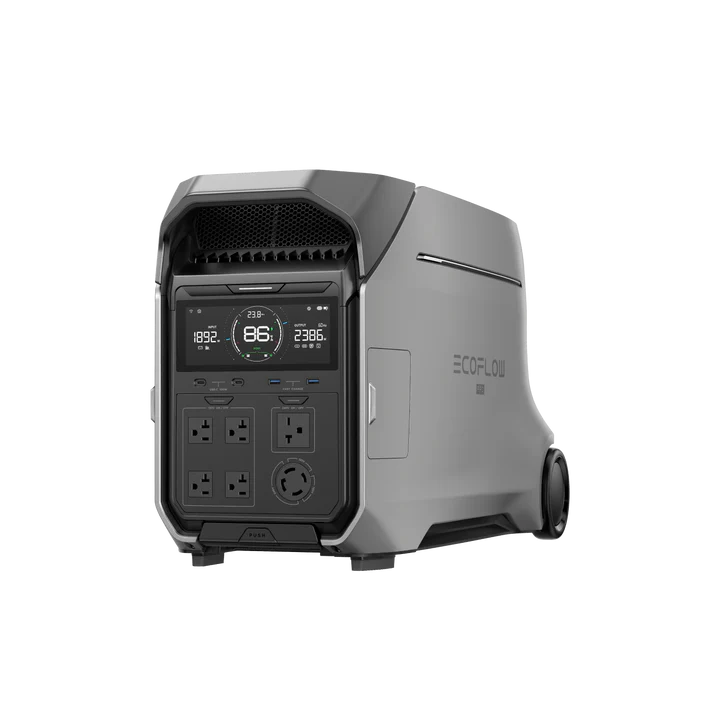
EcoFlow DELTA Pro 3
$2,799.00
$2,799.00 · direct from EcoFlow
Last checked 16 days ago. Prices move — check before you buy.
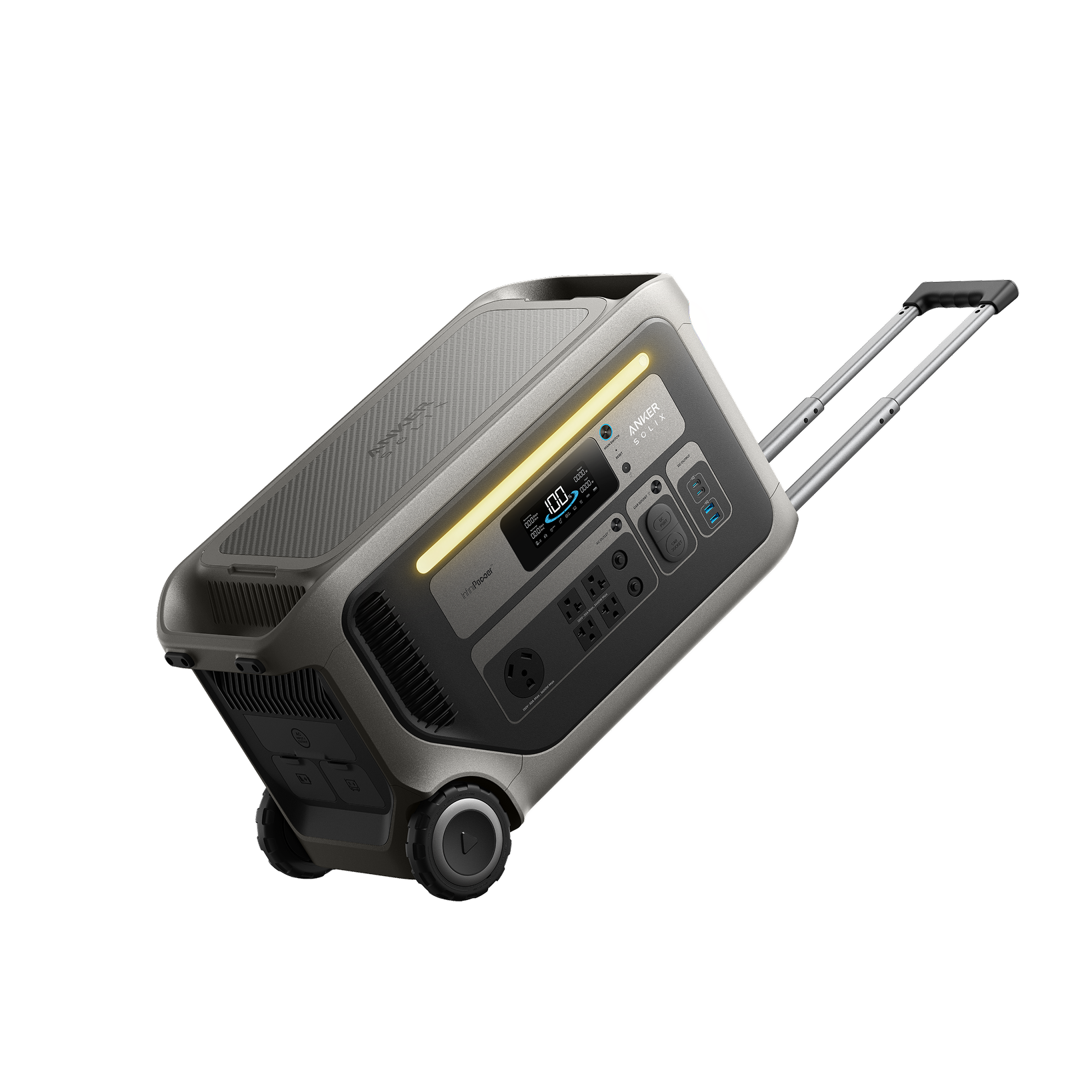
Anker SOLIX F3000Pick
Sold on Amazon · today’s price is on the listing
Prices may vary by retailer and are subject to change.