Head-to-head test
EcoFlow DELTA 3000 Gen4 vs Anker SOLIX S5000The DELTA 4 (3000) Can't Add a Battery. Will You Ever Need One?
The DELTA 4 (3000) is a sealed outage box you can carry, and the S5000 is the first piece of a home battery that lives in the garage. I'd buy the EcoFlow and keep the difference, unless you'll add batteries or something in the house runs on 240 V.
Full profiles: EcoFlow DELTA 3000 Gen4 → · Anker SOLIX S5000 →
Written by Gunner GustafsonUpdated
Whole-Home Backup Tester, Station Arena Test Desk
Spec deltas

Gunner’s take
Whole-Home Backup Tester
The DELTA 4 (3000) is the size it will always be.
It has no extra-battery portA6, so 3,072 Wh is its ceiling for good. The S5000 starts at 5,024 Wh and takes up to five more batteries of the same sizeB6. One of these is an outage box. The other is the first piece of a home battery.
At these prices, the S5000 is the cheaper battery per watt-hour.
EcoFlow lists the DELTA 4 (3000) at $1,699, and the S5000 sells for $2,500. The $801 between them buys 1,952 Wh more, which is only a deal if you use it. A fridge, a router and the lights through one night won't come close.
The S5000 also needs somewhere to live.
Anker rates it for non-habitable spaces, outside bedrooms and living areasB7, and it's a 97 lb cabinet on wheelsB11. The DELTA 4 (3000) is 57.3 lb with a handle at each endA7. The S5000 is on sale nowB20. EcoFlow put the DELTA 4 (3000) on sale on November 4 and ships it in early DecemberA10.
What the Numbers Reveal
Each conclusion stated first — the numbers behind it on one line, the full analysis below.
Capacity
966 Wh is 59% of a second night. In a storm that lasts days, the 3000 needs a refill every day because there's nothing to add to it. From a generator it refills fast, at up to 1,800 WA4, so a generator owner barely notices the ceiling. Without one, the ceiling is the first thing you hit.
DELTA 4 (3000): 3,072 Wh, no extra-battery portA6SOLIX S5000: 5,024 Wh, up to five BP5000 batteries of 5,024 Wh eachB68-Hour Blackout: 1,645 Wh needed; the 3000 finishes with 966 Wh left, the S5000 with 2,625 Wh
Why it mattersIf your outages end by morning, or a generator lives in the shed, the 3000's ceiling never bites.
Typical price
A cheap watt-hour is only cheap if you drain it. Every overnight job we run fits inside the 3000 with plenty left. The extra 1,952 Wh earns its keep on the second and third day of an outage, and on no ordinary night.
DELTA 4 (3000): $1,699 for 3,072 WhSOLIX S5000: $2,500 for 5,024 WhCPAP Overnight needs 320 Wh, Remote Workday 910 Wh, 8-Hour Blackout 1,645 Wh: the 3000 finishes all three with room left
Why it mattersPrice your longest realistic outage, not the battery. If it's one night, keep the $801.
weight
A garage on a summer afternoon can climb past that, and neither unit charges below freezingA9B8. A cabinet that weighs 97 lb waits out the weather where it stands. The 3000 gets picked up and carried somewhere it can charge.
SOLIX S5000: rated for non-habitable spaces, outside sleeping rooms and living areasB7SOLIX S5000: charges at 32 to 104°F, 97 lb on wheelsB8B11DELTA 4 (3000): charges at 32 to 113°F, 57.3 lb with a handle at each endA7A9
Why it mattersIf your garage swings hot or cold and there's nowhere else for a 97 lb cabinet, that's a vote for the box you can carry.
The specific dimensions that decide these two units — everything else is a tie.
Growth Path
Selected because: The DELTA 4 (3000) is sealed at 3,072 Wh, and the S5000 starts at 5,024 Wh and takes extra batteries.
solar input
The 3000 is finished the day it arrives. There's no battery port of any kindA6, so 3,072 Wh is the size you live with. For a fridge, a furnace blower and the router, that covers a night with plenty left. It stops covering it the year you decide the chest freezer and the sump pump belong on it too.
The S5000 is a starting point, and that's what the extra money buys. Its battery port takes up to five more batteries, 30,144 Wh in allB6. I wire houses for a living, and that's a system I'd park beside a subpanel and grow as the budget allows. Nobody needs it to keep one fridge cold.
Your Life, Your Pick
Selected because: Both finish everything but Van Life Daily; the S5000 finishes four rows with more in reserve.
Capacity only separates them on the second night. The eight-hour blackout takes 1,645 Wh. The 3000 finishes with 966 Wh left. The S5000 finishes with 2,625 Wh, 1.6 more nights before it needs a charge.
The weekend is tighter than it looks. Camping takes 2,100 Wh, and the 3000 finishes at 80% used with 511 Wh in hand. That works, with little room for a cold night. Van Life Daily needs 4,685 Wh and neither covers it alone: the S5000 comes up 415 Wh short, the 3000 2,074 Wh.
Portability & Form Factor
Selected because: 57.3 lb with a handle at each end against 97 lb on wheels.
weight
The 3000 goes where the outage is. At 57.3 lb with a handle at each endA7, it's a one-person lift into a hatchback or down the basement stairs. EcoFlow sells a folding cart for it separatelyA7.
The S5000 rolls once and stays. It's 97 lb on wheels, with a pull rod and a foot pedal for tipping it back onto themB11. A flat garage floor is easy. A porch step takes two people.
What the Specs Don't Tell You
Selected because: Only the S5000 has 240 V outlets, and it surges to 8,000 W against 7,200 W.
The S5000 has the outlet a well pump wants. Its L14-30R twist-lock carries 240 V split-phase, the two-leg supply a house panel runs on, at up to 4,500 WB3. The 3000 runs 3,600 W through 120 V outletsA2. A 240 V load doesn't run from it at all.
On surge, the two sit close. The S5000 peaks at 8,000 W and the 3000 at 7,200 W, so either starts a fridge or a sump pump. Both switch over in no more than 10 ms when the grid drops. EcoFlow says the 3000 doesn't support HIDA8, the USB signal that tells a computer it's on battery and should shut down cleanly.
Every port, labelled
What plugs in where, and how much it takes
EcoFlow DELTA 3000 Gen4
Front panel
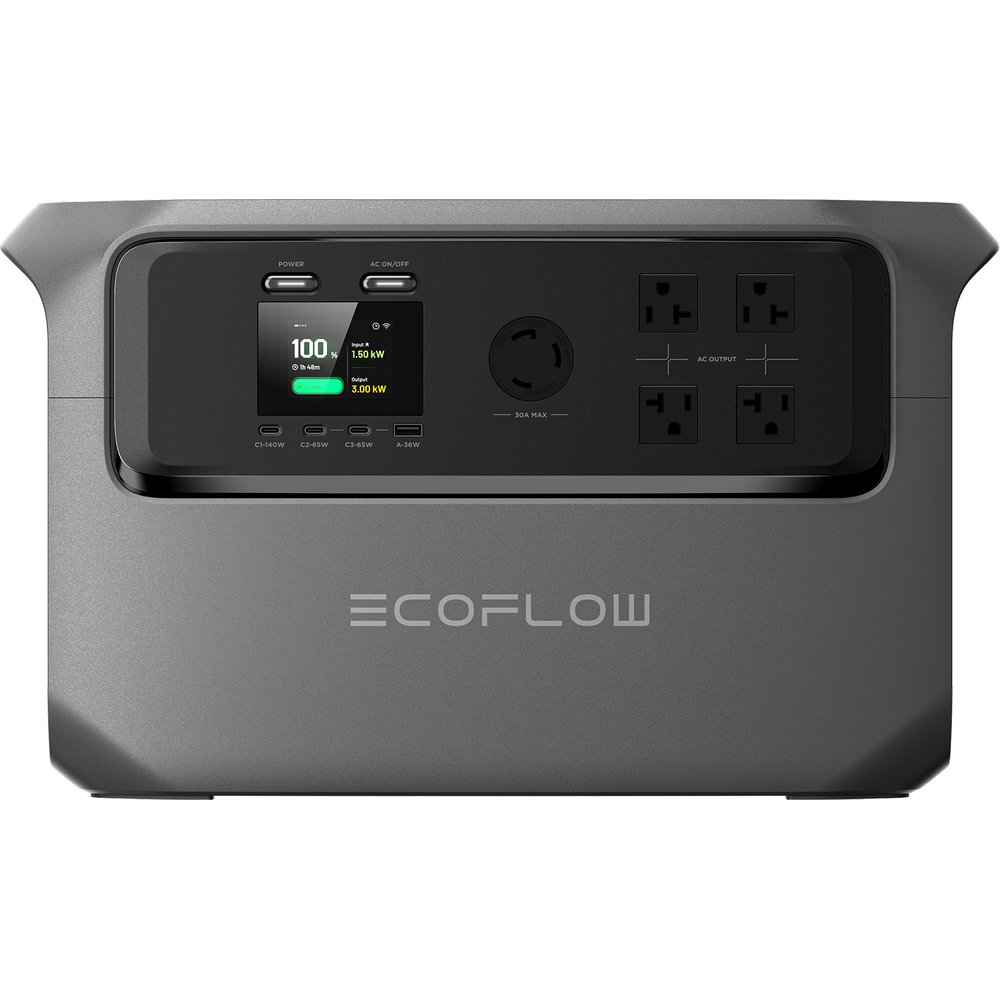
- 1USB-C · 140 WOutUp to 140 W (USB-PD up to 28 V at 5 A). The port for a laptop.
- 22× USB-C · 65 WOutUp to 65 W each. EcoFlow says these two and the USB-A share 16 W when two or more are in use at once.
- 3USB-A · 36 WOutUp to 36 W (5, 9 or 12 V at 3 A).
- 430 A twist-lockOutA three-slot twist-lock marked 30A MAX, rated 30 A at 120 V on the US unit.
- 54× 20 A outletsOutFour T-slot 120 V outlets rated 20 A each, sharing 3,600 W continuous and a 7,200 W surge.
Photo: EcoFlow · Product image, EcoFlow Japan store · numbers and labels are ours. Ratings from EcoFlow’s US spec table; outlet shapes read by us from EcoFlow’s picture, taken of the Japanese unit, which shares the US panel.
Input side
- 1Solar/DC in · 1,000 WIn11 to 60 V, up to 20 A, 1,000 W.
- 2AC in · 1,800 WIn100–120 V at 15 A. Charges at up to 1,800 W, which at 120 V is the whole of an ordinary 15 A circuit.
No battery port: the 3000 doesn’t take extra batteries.
Photo: EcoFlow · Product image, EcoFlow Japan store · numbers and labels are ours. Ratings from EcoFlow’s US spec table and the panel’s own printing.
Anker SOLIX S5000
Front panel
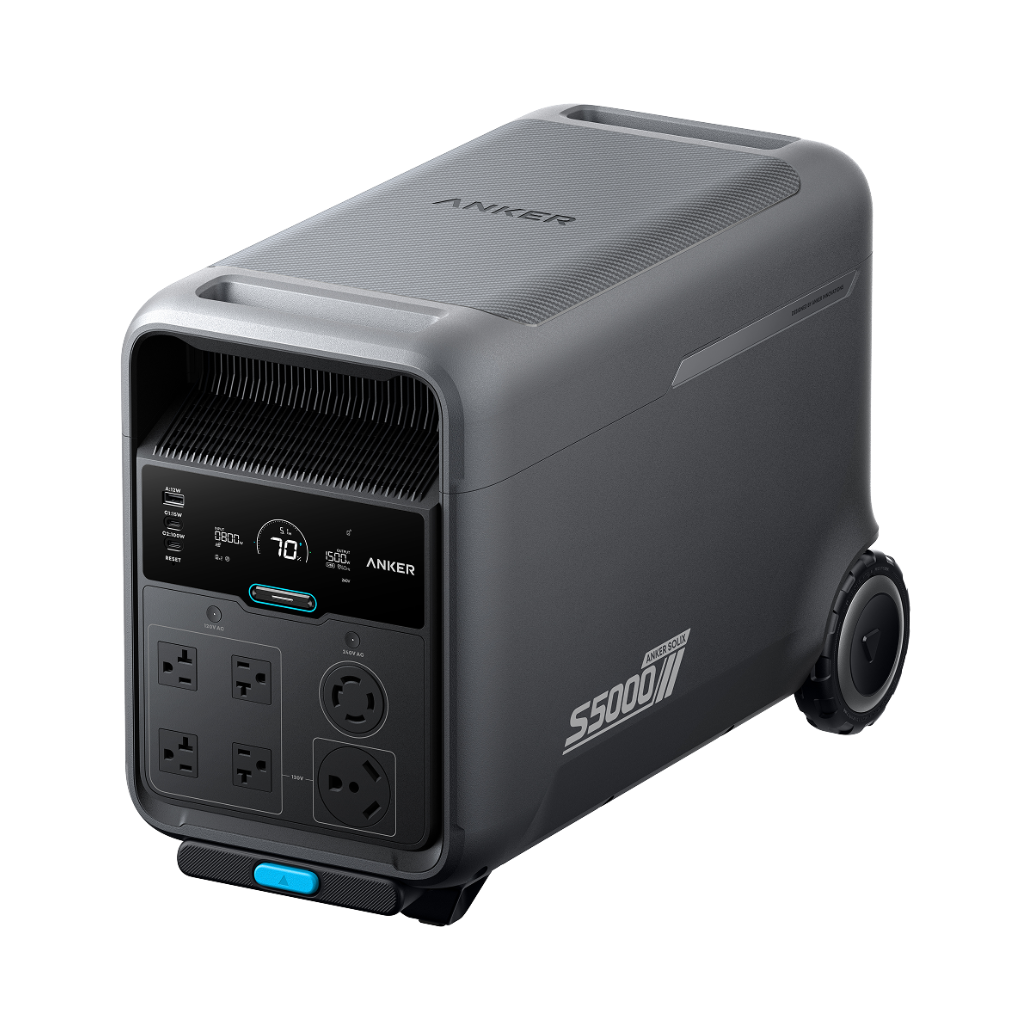
- 1USB-A · 12 WOutUp to 12 W. It shares 18 W with the 15 W USB-C port when both are in use.
- 2USB-C · 15 WOutPrinted C1: 5 V at 3 A, 15 W. A phone port, not a laptop port.
- 3USB-C · 100 WOutPrinted C2: up to 100 W (20 V at 5 A). The laptop port.
- 44× 20 A outletsOutFour NEMA 5-20R outlets, up to 2,400 W in all. All the outlets share 4,500 W.
- 5L14-30R · 240 VOutA 120/240 V twist-lock, up to 4,500 W: the plug for a transfer switch or a generator inlet box.
- 6TT-30R · 120 VOutA TT-30R RV outlet, up to 3,600 W at 120 V. The plug on a camper’s 30 A shore-power cord.
Also on the panel: a RESET hole under the USB ports, the main power button under the screen, and the 120V AC and 240V AC buttons above the outlets. No 12 V car socket.
Photo: Anker · Product image, Anker SOLIX store · numbers and labels are ours. USB ratings printed on Anker’s panel and in Anker’s S5000 spec table; outlet names and ratings from Anker’s S5000 page and store FAQ (ankersolix.com/s5000).
Rear panel
- 1Battery & generator portIn · OutAnker’s DC input and expansion battery port, under the cover marked with a battery and GEN. An Anker generator charges through it at up to 4,500 W.
- 2High-PV in · 2,000 WInUnder the PV PORT cover: 16 to 165 V at up to 17 A, 2,000 W.
- 3Low-PV/car in · 1,000 WInUnder the PV PORT cover: 11 to 60 V at up to 17 A, 1,000 W. Also the car-charging input. With the high-voltage input, 3,000 W of solar in all.
- 4AC in · 4,500 WInThe AC charging inlet: up to 1,800 W from a 120 V socket, or 4,500 W at 240 V.
The middle cover is unmarked in Anker’s picture and not named in its diagram.
Photo: Anker · Product image, Anker SOLIX S5000 page (Anker’s callout lines removed) · numbers and labels are ours. Port names from Anker’s numbered S5000 diagram; ratings from Anker’s S5000 spec table (ankersolix.com/s5000).
Strengths & trade-offs
EcoFlow DELTA 3000 Gen4
Strengths
- +Costs $801 less
- +Lighter by 39.7 lb
Trade-offs
- –Weaker inverter (-900W) limits appliance compatibility.
- –Sealed capacity — the SOLIX S5000 can add batteries to grow past 3,072Wh; this one can't.
Anker SOLIX S5000
Strengths
- +Larger battery capacity
- +Higher AC output
- +Faster solar charging
Trade-offs
- –Substantially more expensive (+$801) than the DELTA 3000 Gen4.
- –Significantly heavier (+39.7 lbs), making it harder to move.
- –Very heavy unit that may be difficult for one person to lift.
Will It Power Your Gear?
Scenario math and per-appliance runtimes, modeled from the spec record.
Scenario verdicts
We ran the math on six real-world scenarios. Here's which unit survives your actual life.
SCN-01 · 2 nights · needs 2,100Wh
Weekend Camping
Two nights off-grid with essential comfort
SOLIX S5000
The DELTA 3000 Gen4 finishes the weekend at 80% used with 511Wh in hand — one cold night or an extra device eats into that. The SOLIX S5000 finishes at 49% with 2,170Wh, real slack for the spontaneous stuff. If you camp in variable weather, that buffer is the difference between relaxing and watching the battery app.
Battery budget usedlower = more headroom
LOAD Phone Charger 15W×6h · LED Lights 40W×8h · Box Fan 75W×14h · CPAP Machine 40W×16h
SCN-02 · 8 hours · needs 1,645Wh
8-Hour Blackout
Keep the essentials running through a night without power
SOLIX S5000
Both get through the 1,645 Wh night. The S5000 wakes up with 2,625 Wh, enough for 1.6 more. The DELTA 4 (3000) wakes up with 966 Wh, 59% of another.
Battery budget usedlower = more headroom
LOAD Fridge 150W×8h · Router + Modem 20W×8h · LED Lights (4 bulbs) 40W×6h · Phone Charger 15W×3h
SCN-03 · 8 hours · needs 320Wh
CPAP Overnight
Sleep therapy without interruption — the #1 medical use case
Either unit
A 320 Wh night barely dents either one, so this is a draw. If it has to sit beside the bed, Anker rates the S5000 for spaces outside bedrooms.
Battery budget usedlower = more headroom
LOAD CPAP Machine 40W×8h
SCN-04 · 8 hours · needs 910Wh
Remote Workday
Full work day off-grid without power anxiety
SOLIX S5000
The SOLIX S5000 clears the workday at 21% used, banking 3,360Wh — late work, extra calls, or a second laptop charge without arithmetic. The DELTA 3000 Gen4 at 35% also finishes, with 1,701Wh of slack for the unplanned.
Battery budget usedlower = more headroom
LOAD Laptop 60W×8h · External Monitor 30W×8h · Router + Modem 20W×8h · Phone Charger 15W×2h
SCN-05 · 4 hours · needs 670Wh
Tailgate Party
Game day power for the crew
SOLIX S5000
Both handle game day; the SOLIX S5000 keeps more in reserve (16% used vs 26%). Tailgating is a light load, though, so the number you'll feel is weight: 57.3 lbs for the DELTA 3000 Gen4 against 97 lbs for the SOLIX S5000, from the trunk to the setup spot.
Battery budget usedlower = more headroom
LOAD Blender 400W×0.5h · LED TV (55") 80W×4h · Bluetooth Speaker 15W×4h · Phone Charger (×3) 45W×2h
SCN-06 · 24 hours · needs 4,685Wh
Van Life Daily
A full day of mobile living — the ultimate endurance test
Neither unit
Neither covers 4,685 Wh alone. The S5000 comes up 415 Wh short and can take another battery. The DELTA 4 (3000) comes up 2,074 Wh short and can't.
Battery budget usedlower = more headroom
LOAD Mini-Fridge 150W×24h · Laptop 60W×4h · Phone Charger 15W×3h · LED Lights 40W×5h · Fan 75W×8h
The Load Test
RUNTIME = (Wh × 0.85) ÷ LOAD
None of the scenarios above exactly yours? Build it. Toggle what you'd plug in; both units are tested against the combined draw.
Essentials
Comfort & Convenience
High-Draw Appliances
Test duration
8h
Continuous draw
205W
Projected runtime
For this load: SOLIX S5000 runs 20.8h vs 12.7h.
$2,499.99 list · direct from Anker
Planning for more than this? Describe your whole setup and get it sized →
Modeled from the spec record — same math as the tables below. Methodology
Runtime by appliance
Real-world runtime estimates for common appliances, modeled at 85% inverter efficiency.¹
Essentials
The basics you need runningscale 0–284.7hComfort & Convenience
Makes off-grid life actually enjoyablescale 0–56.9hHigh-Draw Appliances
These reveal the real limitsscale 0–4.3h¹ Runtime = (capacity × 0.85) ÷ appliance watts. Within each group, all bars share one time scale (the group's longest runtime), so lengths are comparable across appliances; identical runtimes collapse into a single blue/orange bar. Actual runtime varies with battery age, temperature, and simultaneous loads — see methodology.
Conclusion
November 4, 2026
Verdict: the EcoFlow DELTA 3000 Gen4
I'd buy the DELTA 4 (3000) if the job is getting a house through a night or two, and keep the difference. It holds 3,072 Wh at 57.3 lb, finishes every scenario the S5000 finishes, and costs $801 less. The S5000 is the bigger machine and the cheaper battery per watt-hour: 5,024 Wh, 4,500 W, 240 V and room for five more batteriesB6. That only pays off if you drain it, and it has to live in a garage or utility roomB7. If Anker takes the S5000 back up to its list priceB20, the EcoFlow's case gets firmer. If you know you'll add batteries or run a 240 V well pump, buy the Anker.
Editor-assigned confidence, based on cited owner research and spec analysis.
List prices as of November 4, 2026. The links below open EcoFlow's and Anker's current prices.
$1,699.00 · direct from EcoFlow
or check the SOLIX S5000 price$2,499.99 list
Written by Gunner Gustafson, Whole-Home Backup Tester · Station Arena Test Desk · Updated November 4, 2026
Measured Data
Benchmark scores and the full spec record, side by side.
Benchmark scores
Not rated for both units (minimum threshold unmet): UPS, RV Living, Tailgating, Apartment Balcony.
Full specifications
ᵈ Derived: price ÷ rated capacity. See the data behind our comparisons →
Comparison ToolAdd more power stations, side by sideOpen Tool →How these numbers are produced
Numeric verification
Every figure on this page traces to our spec database or arithmetic on it — no estimated numbers.
Owner claims
Statements about owner experience are cited to published reviews — see Sources & Research Notes below.
Runtime model
Runtime = (rated capacity × 0.85 inverter efficiency) ÷ device wattage. Solar recharge estimates assume panels deliver 70% of rated output. Cold weather, battery age, and stacked loads reduce real-world results.
Power Score
Computed from 14 published spec dimensions, weighted per use-case bench. Higher is better; a unit must meet a bench's minimum threshold to be rated.
See the full weight table and data sourcing on our methodology page →Class ranking (the star rating)
Each unit's star score is a category ranking, not customer reviews — no buyer opinions feed it. We score every station on size-independent quality (value, output, portability, endurance, ports, warranty, and more), then percentile-rank it against the other units in its capacity class, so a class-leading compact unit and a class-leading whole-home unit can both earn 5★. Here, DELTA 3000 Gen4 rates 4.8/5 (86th percentile of 29 Large-class units), and SOLIX S5000 rates 4.6/5 (76th percentile of 22 Home Backup-class units).
How the class ranking is computed →Test Notes & Caveats
Hidden gotchas and advantages we spotted that you won't find on the product page.
97 lb on Wheels, 57.3 lb on Handles
The SOLIX S5000 rolls on wheels with a pull rod and a foot pedal for tipping it back. Across a garage floor that's easy. Up a step it's a two-person job. The DELTA 4 (3000) is 39.7 lb lighter and carries by a handle at each end.
3,072 Wh Is the Ceiling
The DELTA 4 (3000) has no battery port, so the box you buy is the size you keep. The SOLIX S5000 starts 1,952 Wh higher and takes extra batteries on top. For a one-night outage box the ceiling never comes up. For a home system you plan to grow, it's the reason to pass.
Warranty: No Difference
Both units carry the same 5-year warranty, so coverage isn't a tiebreaker here. The DELTA 3000 Gen4's figure is a maximum rather than a guarantee — it depends on registering the unit in the EcoFlow app, which adds two years to a three-year standard term. Worth saying because the per-dollar framing can suggest otherwise: the DELTA 3000 Gen4 works out at 2.9 years of cover per $1,000 spent against the SOLIX S5000's 2, but that spread is the price gap, not the terms.
Full record above — the Test Desk pick is the DELTA 3000 Gen4.
Check DELTA 3000 Gen4 price →or check the SOLIX S5000 priceOwnership Analysis
What happens after you buy — true cost of ownership, brand trust, and growth potential.
Lifetime value
Service lifeyears at one full cycle per day
Lifetime energy delivered
Cost per delivered kWh
│ warranty ends · Reaching the cycle rating means ~80% capacity remains — degraded, not dead.
Analyst note
The DELTA 3000 Gen4 is cheaper to buy, but the SOLIX S5000 is cheaper to own. At $0.08/kWh over its lifetime vs $0.09/kWh, the SOLIX S5000's higher cycle life and capacity make each dollar go further over the years. One thing to know reading the table: both carry the same 6,000-cycle rating, so the lifetime rows are sticker price and capacity in disguise — the wear horizon is identical and decides nothing here.
Brand trust
EcoFlow
Ecosystem
Largest in portable power — 12-15 models across DELTA Pro, DELTA 3, and RIVER 3 series, plus solar panels and smart home panels
Support
US-based phone/email/chat support (1-800-368-8604). Experiences are polarized — many report hassle-free prepaid-label replacements, but others report long waits and refurbished units sent for new claims. Pro tip: buying from Costco or Amazon gives you a stronger return safety net.
Community
Largest community in the space — Reddit r/Ecoflow_community (~31K members), multiple Facebook groups, and an official community forum
App experience
Rated 4.6/5 iOS (~8,400 ratings) · 4.2/5 Android (~17,000 ratings)
Unique strength
Fastest-charging technology (X-Stream), deepest product ecosystem, and most active innovation cadence. At the top of the range sit two whole-home paths: the TITAN line, one 5 kWh unit that grows to 30 kWh, and the DELTA Pro Ultra platform, which stacks batteries and inverters further — flagship paths, not line-wide features.
Worth knowing
Tested subscription paywalls for advanced app features in early 2025 before community backlash paused the plan. No parts or service offered out of warranty.
Anker
Ecosystem
7-8 SOLIX portable power stations across C-series (compact) and F-series (flagship), plus the X1 home energy system
Support
US-based support. Historically known for incredible no-hassle replacements, but recent reports describe AI-driven support agents giving generic responses and complex return logistics for heavy units (hazmat shipping). The Anker brand reputation is still strong, but SOLIX-specific support quality is trending down.
Community
Moderate — active Reddit (r/Anker, r/AnkerSOLIXCommunity) and growing. Benefits from Anker's massive consumer electronics brand awareness.
App experience
Rated 4.5/5 iOS (~1,100 ratings) · 4.3/5 Android
Unique strength
Parent brand trust from Anker's consumer electronics dominance. InfiniPower technology for long cycle life. Strong $/Wh value in the mid-size and larger units — the S2000, F2600 and C1000 are among the better buys per watt-hour in the catalog.
Worth knowing
Support quality appears to be declining from its historically excellent level. Firmware updates have removed features without warning. Expansion ecosystem is smaller than EcoFlow's.
Analyst note
EcoFlow positions itself as a mid-to-premium brand with stronger support infrastructure, while Anker competes on value. The question is whether the EcoFlow ecosystem and support premium is worth it for your use case.
Growth path
DELTA 3000 Gen4
FIXED CAPACITYFixed at 3,072Wh — a sealed, complete system rather than a starting point. There's no expansion port, so that figure is the ceiling: check it against your longest unplugged stretch before you buy.
Accepts up to 1,000W of solar. Enough for a serious multi-panel array.
Adequate ports for most setups, but heavy users may want a power strip.
SOLIX S5000
EXPANDABLESupports Anker expansion batteries, so you can add capacity later without replacing the base unit — useful if your needs may climb past 5,024Wh.
Accepts up to 3,000W of solar. Enough for a serious multi-panel array.
Adequate ports for most setups, but heavy users may want a power strip.
Expansion batteries are Anker-specific. You're investing in the Anker ecosystem.
Realistic full solar rechargeat 70% of rated panel output — see methodology
Analyst note
The DELTA 3000 Gen4 is sealed at 3,072Wh, which is fine if that covers you. The SOLIX S5000 starts at 5,024Wh and can grow beyond it with Anker expansion batteries — real headroom the DELTA 3000 Gen4 doesn't have if your needs climb toward partial-home backup.
What Owners Report
Patterns from published owner reports and long-term reviews — every claim cited to its source below.
EcoFlow DELTA 3000 Gen4
Nobody in the US owns a DELTA 4 (3000) yet. EcoFlow put it on sale on November 4 and ships it in early DecemberA10, so everything here comes from EcoFlow: its US store page, plus our own arithmeticA1A4.
I'd want to test the wall charger on a real garage circuit. EcoFlow rates it at 1,800 W from the wall, which is 15 A at 120 V, the full rating of a whole 15 A circuitA4. I'd plug it in beside a running freezer and see which one gives first. I'd expect to end up turning the rate down in the appA4.
“Capacity 3,072 Wh, LFP (LiFePO4) cells. EcoFlow sells it as the DELTA 3000 Gen4; buyers and the press call the pair the DELTA 4.”
Sources
us.ecoflow.co · jp.ecoflow.co
Anker SOLIX S5000
Nobody has owned an S5000 long enough to report on it either. Anker opened sales on October 27B20, and every entry we have is Anker's own documentationB0.
On cycle life the two sit level. Anker quotes 6,000 cycles to 80% and 10,000 to 60%B12, and EcoFlow rates the DELTA 4 (3000) for 6,000 cyclesA9. Anker also quotes a full charge in 99 minutes when it's fed 4,300 WB17. From an ordinary 120 V outlet it takes 1,800 W, the same as the EcoFlowB4A4.
“5,024 Wh LiFePO4 pack rated 16 V, 314 Ah; the cell code IFpP72/175/208[5S] reads as five large prismatic cells in series.”
Sources
ankersolix.com
Sources & Research Notes
Every owner claim in this report is traceable to a published source. The bracketed references above resolve here.
Recurring owner themes
- Launch-day ledger: every entry is EcoFlow's own US store and documentation, or our labelled arithmetic. No owner or reviewer evidence exists yet. [DELTA 3000 Gen4 · 12 entries]
- No owner or reviewer reports exist yet: every entry is Anker documentation (rating label, product page, launch announcement), plus one of our own readings of the app and label drawing. [SOLIX S5000 · 20 entries]
- A1
“Capacity 3,072 Wh, LFP (LiFePO4) cells. EcoFlow sells it as the DELTA 3000 Gen4; buyers and the press call the pair the DELTA 4.”
EcoFlow US store, us.ecoflow.com/products/delta-3000-gen4 (spec table, features and FAQ, read 2026-11-04) · 2026-11-04 · [mixed]
- A2
“US unit: 120 V AC, 60 Hz; rated 3,600 W continuous with a 7,200 W surge. It supports X-Boost (EcoFlow refers to the manual for the US X-Boost figure); X-Boost is unavailable while the unit charges from the wall or runs in bypass.”
EcoFlow US store, us.ecoflow.com/products/delta-3000-gen4 (spec table, features and FAQ, read 2026-11-04) · 2026-11-04 · [mixed]
- A3
“AC outlets: 5 total, four rated 20 A max and one rated 30 A max (on EcoFlow's product images, four T-slot outlets and a three-slot twist-lock). USB-A: one port, 36 W max. USB-C: one at 140 W max and two at 65 W max; the two 65 W ports share circuitry with the USB-A, limited to 16 W total when used together. No 12 V car socket.”
EcoFlow US store, us.ecoflow.com/products/delta-3000-gen4 (spec table, features and FAQ, read 2026-11-04) · 2026-11-04 · [mixed]
- A4
“AC input 100–120 V, 15 A, 50/60 Hz; X-Stream charging up to 1,800 W from a US wall outlet. Our arithmetic: 1,800 W at 120 V is 15 A, the full rating of an ordinary 15 A circuit, so on a shared circuit you would set the charge rate lower in the EcoFlow app.”
EcoFlow US store, us.ecoflow.com/products/delta-3000-gen4 (spec table, features and FAQ, read 2026-11-04) · 2026-11-04 · [mixed]
- A5
“Solar: one input, 11–60 V DC at up to 20 A, 1,000 W (XT60i; an XT60i-to-LP60 cable is in the box). EcoFlow lists six charging methods; its 800 W Alternator Charger is limited to 500 W through the Solar/DC port.”
EcoFlow US store, us.ecoflow.com/products/delta-3000-gen4 (spec table, features and FAQ, read 2026-11-04) · 2026-11-04 · [mixed]
- A6
“No extra-battery port. EcoFlow lists expansion only for the DELTA 3800 Gen4 (two extra batteries through its expansion adapter); the 3000 is sealed at 3,072 Wh.”
EcoFlow US store, us.ecoflow.com/products/delta-3000-gen4 (spec table, features and FAQ, read 2026-11-04) · 2026-11-04 · [mixed]
- A7
“Weight 57.3 lb (26 kg); 16.77 × 11.36 × 12.09 in without handles, 18.76 in long with them. A handle at each end; EcoFlow sells a folding transport cart separately ($109 at launch, listed at $199). EcoFlow calls it the smallest and lightest portable power station in its class (3 kWh and 3,600 W).”
EcoFlow US store, us.ecoflow.com/products/delta-3000-gen4 (spec table, features and FAQ, read 2026-11-04) · 2026-11-04 · [mixed]
- A8
“Switches to backup within 10 ms when the grid drops; EcoFlow's FAQ says it does not support HID communication. Noise by EcoFlow's figures: 40 dB or less at up to 1,800 W, 50 dB or less at the full 3,600 W. IP20.”
EcoFlow US store, us.ecoflow.com/products/delta-3000-gen4 (spec table, features and FAQ, read 2026-11-04) · 2026-11-04 · [mixed]
- A9
“Rated for 6,000 cycles (EcoFlow: "15+ years"). Charges at 32–113°F (0–45°C), runs at 14–113°F (−10–45°C). Wi-Fi and Bluetooth with the EcoFlow app. Warranty: 3 years plus a 2-year extension when registered in the EcoFlow app.”
EcoFlow US store, us.ecoflow.com/products/delta-3000-gen4 (spec table, features and FAQ, read 2026-11-04) · 2026-11-04 · [mixed]
- A10
“On sale at us.ecoflow.com from November 4, 2026 at $1,699; EcoFlow says it ships in early December. Kit with two 160 W solar panels $2,299. EcoFlow also sells it in Japan, where it went on sale October 30 at ¥179,900.”
EcoFlow US store, us.ecoflow.com/products/delta-3000-gen4 (spec table, features and FAQ, read 2026-11-04) · 2026-11-04 · [mixed]
- B3
“Outlets: one L14-30R carrying 240 V split-phase at up to 4,500 W; one TT-30R RV outlet at 120 V, 30 A, 3,600 W; NEMA 5-20R household outlets at 120 V, 20 A, 2,400 W; USB-C 100 W, USB-C 15 W and USB-A 12 W.”
Anker rating label, model AS510 (certified 2026-09-15) · 2026-09-15 · [positive]
- B4
“AC charging up to 1,800 W from a 120 V outlet (15 A for under three hours, 12 A continuous), or up to 4,500 W from 240 V. The same AC port runs bypass mode, passing wall power through to the outlets.”
Anker rating label, model AS510 (certified 2026-09-15) · 2026-09-15 · [positive]
- B5
“Two solar inputs, 3,000 W together: 11–60 V at 17 A (1,000 W) and 16–165 V at 17 A (2,000 W).”
Anker rating label, model AS510 (certified 2026-09-15) · 2026-09-15 · [positive]
- B6
“Expands with up to five BP5000 expansion batteries (model AS5101A1-85), each 5,024 Wh, for 30,144 Wh in total. They join through a 400 V DC port rated 9,000 W in and 7,500 W out; each battery charges at up to 3,200 W and discharges at up to 3,000 W.”
Anker rating label, model AS510 (certified 2026-09-15) · 2026-09-15 · [positive]
- B7
“Rated for residential non-habitable spaces; holding more than 1 kWh, it belongs outside sleeping rooms and other living spaces.”
Anker rating label, model AS510 (certified 2026-09-15) · 2026-09-15 · [mixed]
- B8
“Charges at 0–40 °C (32–104 °F); runs at −20–40 °C (−4–104 °F).”
Anker rating label, model AS510 (certified 2026-09-15) · 2026-09-15 · [mixed]
- B11
“Net weight 97 lb; 10.6 × 22.0 × 15.2 in (W × D × H), on wheels with a pull rod and foot pedal.”
Anker SOLIX S5000 product page, ankersolix.com/s5000 (published 2026-10-09) · 2026-10-09 · [positive]
- B12
“Cycle life: 6,000 cycles to 80% capacity, 10,000 cycles to 60%; Anker estimates a 15-year lifespan at 1 to 2 cycles a day, with 5 years of product coverage.”
Anker SOLIX S5000 product page, ankersolix.com/s5000 (published 2026-10-09) · 2026-10-09 · [positive]
- B17
“Single-unit charging power 4,300 W; Anker quotes 0 to 100% in 99 minutes. AC input 1,800 W at 120 V or 4,500 W at 240 V.”
Anker SOLIX S5000 product page, ankersolix.com/s5000 (published 2026-10-09) · 2026-10-09 · [positive]
- B20
“Launch price $2,499.99 against an MSRP of $3,599.99; on sale October 27, 2026 at AnkerSOLIX.com and Amazon.”
Anker launch announcement, 2026-10-09 (EIN Presswire) · 2026-10-09 · [neutral]
Research compiled November 4, 2026.
Who Should Buy Which
Buy the DELTA 3000 Gen4 if you…
- →One night is the job. A fridge, a router and the lights, and the 3000 finishes the eight-hour blackout with 966 Wh left.
- →It has to travel. 57.3 lb with two handles, 39.7 lb lighter than the S5000.
- →You have no garage or utility room. Anker rates the S5000 for spaces outside living areasB7.
- →You'd rather keep $801 than pay for battery you won't drain.
Buy the SOLIX S5000 if you…
- →You're building toward whole-home backup. It takes up to five more batteriesB6.
- →Something runs on 240 V, like a deep well pump or a subpanel on a transfer switch.
- →You'll lean on solar for days. 3,000 W of input against 1,000 W.
- →You want it before December. The S5000 is on sale nowB20, and the DELTA 4 (3000) ships in early DecemberA10.
If neither fits
If the job is a CPAP and a phone, both are far more battery than you need. A CPAP night uses 320 Wh, about a tenth of the 3000. A much smaller station covers it for a fraction of the money.
The Bottom Line
If one night is the job, I'd buy the DELTA 4 (3000) and keep the difference. It finishes that night with 966 Wh to spare, goes back in the car when it's over, and doesn't need a garage.
If you're starting a home battery, buy the S5000 and give it the garage. It's the one that grows, it runs 240 V, and it's on sale nowB20.
Frequently Asked Questions
Answers drawn from the spec record and cited owner research.
How much does the EcoFlow DELTA 4 (3000) cost in the US?
EcoFlow lists it at $1,699 on its US store. It went on sale on November 4, 2026, and EcoFlow says it ships in early December. The Anker SOLIX S5000 sells for $2,500.
Can the DELTA 4 (3000) add an extra battery?
No. It has no extra-battery port, so 3,072 Wh is its limit. The SOLIX S5000 takes up to five extra batteries, for 30,144 Wh in all.
Can I keep the Anker SOLIX S5000 indoors?
Anker rates it for residential non-habitable spaces. Because it holds more than 1 kWh, it belongs outside bedrooms and other living spaces. A garage or utility room is the usual home.
Does the DELTA 4 (3000) have 240 V outlets?
No. Its five AC outlets run at 120 V: four 20 A outlets and one 30 A twist-lock. The SOLIX S5000 has an L14-30R outlet for 240 V split-phase power at up to 4,500 W.
Which one charges faster?
From a 120 V wall outlet they match at 1,800 W. The SOLIX S5000 also charges at up to 4,500 W from a 240 V outlet, and takes 3,000 W of solar against the DELTA 4 (3000)'s 1,000 W.
Where to buy
EcoFlow DELTA 3000 Gen4Pick
$1,699.00
$1,699.00 · direct from EcoFlow
Anker SOLIX S5000
$2,499.99
$2,499.99 · direct from Anker
Prices may vary by retailer and are subject to change.