Head-to-head test
EcoFlow DELTA 3 vs Anker SOLIX C800 Plus
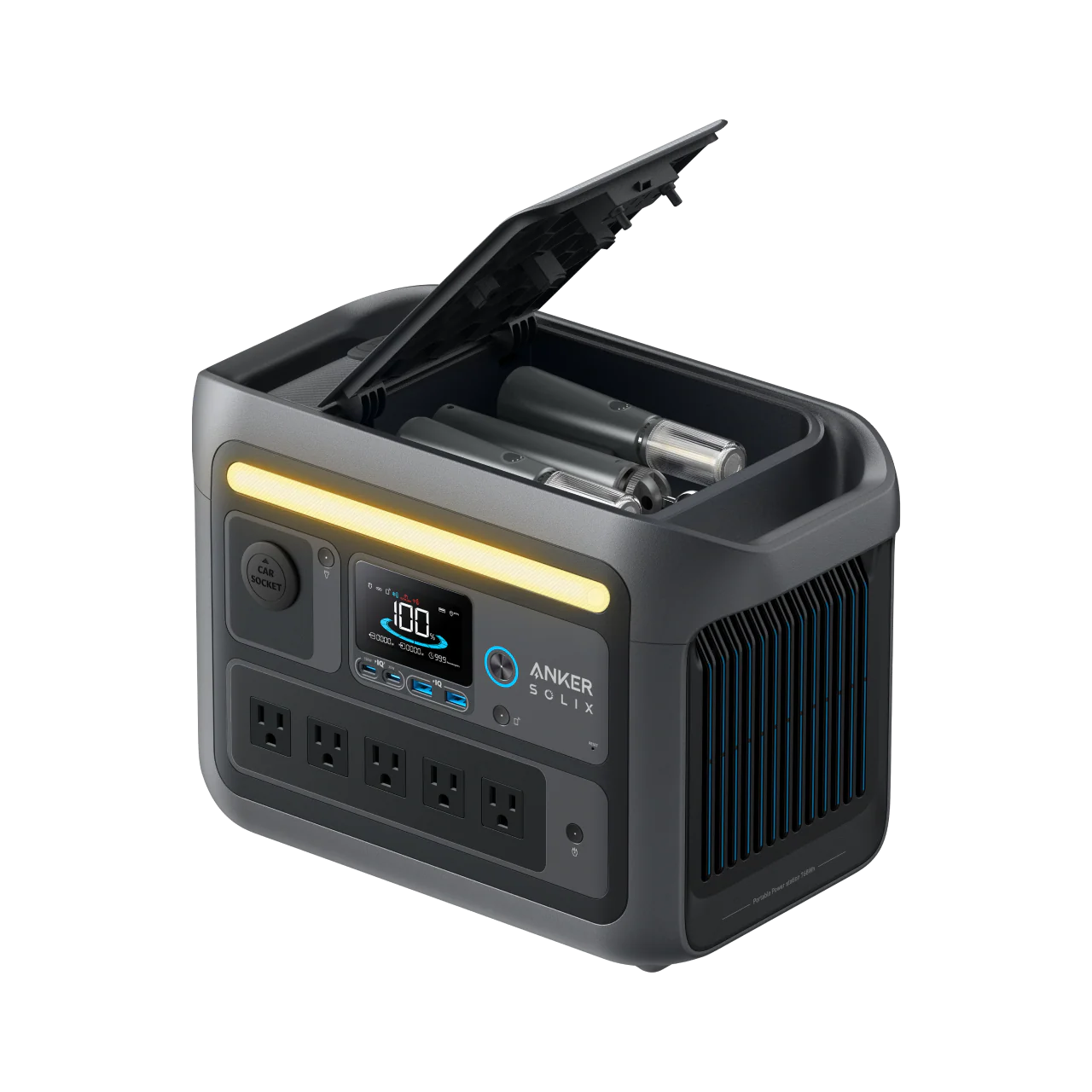
The C800 Plus asks $20 more for 256Wh less, which leaves it defending the gap with three pounds of saved weight and a built-in camping light.
Full profiles: EcoFlow DELTA 3 → · Anker SOLIX C800 Plus →

Written by Ian SchneiderUpdated
Solar & Off-Grid Tester, Station Arena Test Desk

$629.00 · direct from EcoFlow
Last checked 1 day ago. Prices move — check before you buy.
$649.00 · direct from Anker
Last checked 1 day ago. Prices move — check before you buy.
Spec deltas
Buy the DELTA 3. It's $629 against $649, it holds 1,024Wh against 768Wh, and it runs 1,800W continuous against 1,200W. The cheaper box is also the bigger and stronger one, which is not how these matchups usually go.
None of that makes the C800 Plus a bad unit. Reviewers who lived with it came away impressedB13, one found a fridge and freezer drew only 10% of the pack over eight hoursB6, and its retractable light pole means one fewer lantern in the gear binB14. It's simply being asked to justify $20 more for a third less battery, and nothing on its spec sheet does that.
The uncomfortable part is that the winner still isn't big enough for a lot of what people buy these for. Four of the six load profiles come back "neither." A camping weekend wants 2,100Wh and the DELTA 3 has 870Wh usable once the inverter takes its cut. If that's your list, the answer isn't on this page.
What the Numbers Reveal
Each conclusion stated first — the numbers behind it on one line, the full analysis below.
Capacity
Identical cycle life means there's no crossover date where the Anker catches up. Run both to their rated 3,000 cycles and the DELTA 3 delivers 3,072 kWh for $629 while the C800 Plus delivers 2,304 kWh for $649. Same lifespan, same warranty term, one of them just costs more per unit of everything, on day one and on the last day.
EcoFlow DELTA 3: $629 for 1,024WhAnker SOLIX C800 Plus: $649 for 768WhBoth rated 3,000 cycles and 5 years of warranty
Why it mattersIf value is why you opened this comparison, it's settled. Spend the rest of your attention on whether 1,024Wh is actually enough for you.
weight
Three pounds is nothing on a two-hand carry, and both of these come out of a trunk the same way. But 217Wh of usable energy is the difference between clearing a 670Wh tailgate and missing it by 17. The Anker's portability win is one you'll never feel. Its capacity loss is one you'll meet on a specific afternoon.
C800 Plus weighs 24 lbs; DELTA 3 weighs 27 lbsCapacities are 768Wh and 1,024WhUsable energy after the 85% inverter derate is 653Wh and 870WhThe Tailgate Party load draws 670Wh
Why it mattersAnyone choosing on "which is easier to haul" is optimizing the single axis where the difference doesn't register.
solar input
Off-grid, the constraint that bites is daily throughput, not capacity. The DELTA 3 banks 500W for every hour the sun cooperates while the C800 Plus caps at 300W no matter how much panel you bolt onB9. Across a three-day trip the DELTA 3 isn't 256Wh ahead. It's 256Wh ahead and refilling 67% faster, every morning.
DELTA 3 accepts 500W of solar input; C800 Plus accepts 300WCapacities are 1,024Wh and 768WhReviewers note the C800 Plus's 300W / 11-60V input isn't meant for large static panelsB9
Why it mattersIf you're pairing this with panels rather than a wall outlet, stop weighing capacity and weigh input.
continuous output
600W separates their continuous ratings, and 600W is exactly the band where kitchen appliances liveB10. Motors sharpen it further. A compressor that spikes well past its running draw is negotiating with 1,800W of headroom above rating on one unit and 400W on the other.
DELTA 3: 1,800W continuous, 3,600W surgeC800 Plus: 1,200W continuous, 1,600W surgeReviewers report kettles and some coffee machines are out of the C800 Plus's reachB10
Why it mattersIf anything on your list heats or spins, the 1,200W unit is the one that will eventually say no.
The specific dimensions that decide these two units — everything else is a tie.
Lifetime Value
Selected because: Both are rated 3,000 cycles and 5 years, so the $629-vs-$649 gap never amortizes away. It compounds into 18 cents a lifetime kilowatt-hour against 28.
cost / lifetime kWh
Eighteen cents a lifetime kilowatt-hour against twenty-eight. The arithmetic is unusually clean because nothing else differs: $629 spread over 3,072 kWh (1,024Wh times 3,000 cycles), and $649 spread over 2,304 kWh (768Wh times 3,000 cycles). Same cycle rating, same five-year term, different denominators.
That's the part that never washes out. When two units differ on cycle life you can at least argue the expensive one earns its premium back over a decade. These don't differ. The Anker starts more expensive per watt-hour and stays more expensive per watt-hour right up to the day both packs retire, which the spec sheet says is the same day.
Runtime: Will It Power Your Gear?
Selected because: The 256Wh spec gap becomes a 217Wh gap in real usable energy after inverter losses, 870Wh against 653Wh, and that's the number that decides which loads fit.
continuous output
Plan around 870Wh and 653Wh, not the numbers on the box. The standard 85% inverter derate turns a 256Wh spec gap into a 217Wh gap in energy you can actually spend, and everything downstream is decided there.
217Wh is where the tailgate lives. A 670Wh party load fits the DELTA 3 at 77% of its usable energy and misses the C800 Plus by 17Wh, which is the most irritating margin available: nothing you'd catch reading the box, just the party going quiet a little before the game does. The same shape repeats on the workday. A 910Wh day leaves the DELTA 3 40Wh short, close enough that a dimmer screen closes it, and the Anker 257Wh short, which no habit fixes.
What the Specs Don't Tell You
Selected because: Five cards fire on this pair and only one should move money: 3,600W of surge headroom against 1,600W.
rated cycles
Only one of these cards should touch your wallet, and it's inverter headroom. The DELTA 3 has 1,800W of room above its continuous rating before it hits 3,600W of surge; the C800 Plus has 400W. Every compressor, pump and power tool you own draws on that reserve at the instant it starts, and it's the one spec here that decides whether a device runs at all rather than how long it runs.
The UPS card reads 10ms against 20ms, and it deserves less weight than it looks like it deserves. A reviewer pulled the C800 Plus's wall plug mid-session and the monitor didn't so much as flickerB4, while the DELTA 3's 10ms handoff is documented on a sibling model that shares the spec rather than on this unitA2. Both are fast enough for a router or a CPAP. Neither number is worth $20. The warranty card is a straight tie at five years and 3,000 cycles, so all it really measures is what you paid for the coverage: $110 a year against $130.
Growth Path
Selected because: The DELTA 3 takes EcoFlow expansion batteries. The C800 Plus is sealed at 768Wh, so its 653Wh of usable energy is permanent.
solar input
The C800 Plus is sealed, so 768Wh is not a starting point, it's the whole story. Reviewers keep landing on that as its central limitation, both for heavy appliances and against 1,024Wh rivalsB5B10B12, and load lists have a way of growing in one direction only.
Here's the honest catch on our own pick. The DELTA 3's expansion batteries are a genuine advantage over a sealed box, but they're a separate purchase this page hasn't priced, and expansion is a reason to prefer the DELTA 3 at the margin rather than a plan for van life. A 4,685Wh daily draw against 870Wh usable isn't a gap you bolt your way across. If you already know you need 3,000Wh, buy 3,000Wh.
Brand Trust
Selected because: Different brands, so support is the natural tiebreak, and here both stories are wobbling in different directions rather than settling anything.
Neither badge settles this. EcoFlow brings the deepest catalogue in portable power, the expansion batteries this DELTA 3 would plug into, and a 31,000-member subreddit that will answer you at midnight. Anker brings a name you already trust from the cable in your bag and a genuinely strong per-watt-hour record in its bigger units, which makes the C800 Plus's pricing here the odd one out rather than the pattern.
On support, both stories are moving the wrong way by different routes. Anker's was famously no-hassle and is now described as AI-driven generic replies plus hazmat logistics on heavy returns; EcoFlow's has always been polarized, prepaid replacement labels for some buyers and long waits and refurbished units for others. The practical move is identical either way: buy from a retailer with a real returns desk. On a box in this price range, a second path back is worth more than either reputation.
Strengths & trade-offs
EcoFlow DELTA 3
Strengths
- +Costs $20 less
- +Larger battery capacity
- +Higher AC output
- +Faster solar charging
- +Rated for 4,000 charge cycles — much longer battery lifespan
Trade-offs
- –No major technical downsides compared to rival.
Anker SOLIX C800 Plus
Strengths
- +Lighter by 3 lb
Trade-offs
- –Weaker inverter (-600W) limits appliance compatibility.
- –Sealed capacity — the DELTA 3 can add batteries to grow past 768Wh; this one can't.
- –Shorter-lived battery — rated for 3,000 charge cycles vs the DELTA 3's 4,000, so it wears out sooner.
Will It Power Your Gear?
Scenario math and per-appliance runtimes, modeled from the spec record.
Scenario verdicts
We ran the math on six real-world scenarios. Here's which unit survives your actual life.
SCN-01 · 2 nights · needs 2,100Wh
Weekend Camping
Two nights off-grid with essential comfort
Neither unit
Neither one is a weekend. Against a 2,100Wh trip, the DELTA 3's 870Wh of usable energy covers about 41% and the Anker's 653Wh about 31%, so both of them need sun or an alternator before Saturday night. That's where the 500W solar ceiling against 300W does more for you than the 256Wh of extra capacity does.
Battery budget usedlower = more headroom
LOAD Phone Charger 15W×6h · LED Lights 40W×8h · Box Fan 75W×14h · CPAP Machine 40W×16h
SCN-02 · 8 hours · needs 1,645Wh
8-Hour Blackout
Keep the essentials running through a night without power
Neither unit
A 1,645Wh outage outlasts both. Spread across eight hours, the DELTA 3's 870Wh usable carries roughly four hours of that load and the Anker's 653Wh roughly three. Fine for a summer evening of fridge and lights, not a plan for a winter storm. If outages are why you're shopping, you want the next size up, and you want it expandable.
Battery budget usedlower = more headroom
LOAD Fridge 150W×8h · Router + Modem 20W×8h · LED Lights (4 bulbs) 40W×6h · Phone Charger 15W×3h
SCN-03 · 8 hours · needs 320Wh
CPAP Overnight
Sleep therapy without interruption — the #1 medical use case
DELTA 3
320Wh is the easiest ask on this list and both clear it comfortably. The DELTA 3 stretches to nearly three nights on a charge against the Anker's two (870Wh and 653Wh usable, divided by 320Wh), which is the difference between one covered night and a spare in reserve if the power is still out at breakfast. At this draw the fan matters more than the capacity does, and the 30dB and 45dB ratings point the same direction the third night does, for what unmatched test conditions are worth.
Battery budget usedlower = more headroom
LOAD CPAP Machine 40W×8h
SCN-04 · 8 hours · needs 910Wh
Remote Workday
Full work day off-grid without power anxiety
Neither unit
Neither finishes a 910Wh workday, but they miss by very different distances. The DELTA 3 falls 40Wh short of it on 870Wh usable, which one dimmed screen or one pre-charged laptop closes. The Anker falls 257Wh short, more than a quarter of the day, which isn't a habits problem.
Battery budget usedlower = more headroom
LOAD Laptop 60W×8h · External Monitor 30W×8h · Router + Modem 20W×8h · Phone Charger 15W×2h
SCN-05 · 4 hours · needs 670Wh
Tailgate Party
Game day power for the crew
DELTA 3
670Wh of tailgate against 653Wh of usable energy on the C800 Plus. It misses by 17 watt-hours, the cruelest possible margin: nothing you'd catch reading the box, just the party going quiet a little before the game does. The DELTA 3 covers the same load at 77% of its usable energy and finishes with something left over.
Battery budget usedlower = more headroom
LOAD Blender 400W×0.5h · LED TV (55") 80W×4h · Bluetooth Speaker 15W×4h · Phone Charger (×3) 45W×2h
SCN-06 · 24 hours · needs 4,685Wh
Van Life Daily
A full day of mobile living — the ultimate endurance test
Neither unit
4,685Wh a day is more than five times what the DELTA 3 can usefully hold and more than seven times the Anker's. Neither of these is a van battery, and choosing carefully between them doesn't change that. Go look at 3,000Wh-plus with proper expansion, and budget for the panels to keep it fed.
Battery budget usedlower = more headroom
LOAD Mini-Fridge 150W×24h · Laptop 60W×4h · Phone Charger 15W×3h · LED Lights 40W×5h · Fan 75W×8h
The Load Test
RUNTIME = (Wh × 0.85) ÷ LOAD
None of the scenarios above exactly yours? Build it. Toggle what you'd plug in; both units are tested against the combined draw.
Essentials
Comfort & Convenience
High-Draw Appliances
Test duration
8h
Continuous draw
205W
Projected runtime
For this load: DELTA 3 runs 4.2h vs 3.2h.
$629 list · direct from EcoFlow
Modeled from the spec record — same math as the tables below. Methodology
Runtime by appliance
Real-world runtime estimates for common appliances, modeled at 85% inverter efficiency.¹
Essentials
The basics you need runningscale 0–58hComfort & Convenience
Makes off-grid life actually enjoyablescale 0–11.6hHigh-Draw Appliances
These reveal the real limitsscale 0–0.9h¹ Runtime = (capacity × 0.85) ÷ appliance watts. Within each group, all bars share one time scale (the group's longest runtime), so lengths are comparable across appliances; identical runtimes collapse into a single blue/orange bar. Actual runtime varies with battery age, temperature, and simultaneous loads — see methodology.
Conclusion
August 9, 2026
Verdict: the DELTA 3
Take the DELTA 3. You pay $20 less and get 256Wh more battery, 600W more continuous output, 3,600W of surge against 1,600W, 200W more solar input, and the option to add capacity later. There is no offsetting loss except three pounds of carry weight and the C800 Plus's built-in light pole. Field data on the standard DELTA 3 is thin and leans on reviewers of sibling modelsA1A2, which is the only reason this isn't a 10; the spec sheet itself isn't ambiguous. One caveat applies to both: 870Wh of usable energy still doesn't carry a camping weekend or a full outage, so if that's your load list, buy up a class instead of choosing between these two.
Editor-assigned confidence, based on cited owner research and spec analysis.
List prices as of August 9, 2026. The links below open EcoFlow's and Anker's current prices.
$629.00 · direct from EcoFlow
Last checked 1 day ago. Prices move — check before you buy.
or check the SOLIX C800 Plus price$649.00 list
Written by Ian Schneider, Solar & Off-Grid Tester · Station Arena Test Desk · Updated August 9, 2026
Measured Data
Benchmark scores and the full spec record, side by side.
Benchmark scores
Not rated for both units (minimum threshold unmet): RV Living, Home Backup, Food Truck.
Full specifications
ᵈ Derived: price ÷ rated capacity. See the data behind our comparisons →
Comparison ToolAdd more power stations, side by sideOpen Tool →How these numbers are produced
Numeric verification
Every figure on this page traces to our spec database or arithmetic on it — no estimated numbers.
Owner claims
Statements about owner experience are cited to published reviews — see Sources & Research Notes below.
Runtime model
Runtime = (rated capacity × 0.85 inverter efficiency) ÷ device wattage. Solar recharge estimates assume panels deliver 70% of rated output. Cold weather, battery age, and stacked loads reduce real-world results.
Power Score
Computed from 14 published spec dimensions, weighted per use-case bench. Higher is better; a unit must meet a bench's minimum threshold to be rated.
See the full weight table and data sourcing on our methodology page →Class ranking (the star rating)
Each unit's star score is a category ranking, not customer reviews — no buyer opinions feed it. We score every station on size-independent quality (value, output, portability, endurance, ports, warranty, and more), then percentile-rank it against the other units in its capacity class, so a class-leading compact unit and a class-leading whole-home unit can both earn 5★. Here, DELTA 3 rates 4.4/5 (65th percentile of 27 Everyday-class units), and SOLIX C800 Plus rates 3.8/5 (32nd percentile of 20 Compact-class units).
How the class ranking is computed →Test Notes & Caveats
Hidden gotchas and advantages we spotted that you won't find on the product page.
30dB vs 45dB, measured who knows how
The rated figures are 30 dBA for the DELTA 3 and 45 dBA for the C800 Plus, but neither is published against a stated load, and 30 dBA is a common floor rating across this category rather than a measured result. Treat the direction as reliable and the size of the gap as unproven. If the unit is going in a bedroom, budget for the Anker being the one you hear, and don't let 15 points on paper carry a purchase on its own.
Sealed at 768Wh
What you buy is the ceiling. That only becomes a problem if you expect to outgrow it, but 768Wh is 653Wh once the inverter takes its cut, and load lists tend to grow in one direction. The DELTA 3 takes expansion batteries, which is a genuine advantage, with the caveat that those batteries cost money this page hasn't counted. If you already know you need 3,000Wh, buy 3,000Wh.
Startup headroom: 2.0x against 1.33x
The DELTA 3 doubles from 1,800W continuous to 3,600W peak. The C800 Plus goes 1,200W to 1,600W, a third above its rating. Motors don't consult your continuous number when they start, they consult the ceiling above it, and that reserve is where a fridge, a pump or a circular saw decides whether it spins up or trips out.
10ms against 20ms, and probably not your problem
Both switch quickly enough that a router keeps its session and a CPAP keeps its therapy. The 10ms rating is the better one and it's a fair tiebreak if you're plugging a desktop in with nothing else behind it. It is not a reason on its own to pay more.
Same five years, different divisor
Five years and 3,000 cycles on both, so the coverage itself is a dead tie. All this comparison really measures is what you paid to get it: $110 a year against $130. Worth knowing that EcoFlow offers no parts or service once those five years are up, which makes the cycle rating the number that governs the back half of ownership on either unit.
Battery Lifespan in Real Years
The DELTA 3 is rated for 4,000 cycles vs 3,000. In real life: at daily use, that's 11 vs 8.2 years. At weekend use (twice a week), it's 38 vs 29 years. One caution reading years across different sizes: a cycle is 1,024Wh on the DELTA 3 and 768Wh on the SOLIX C800 Plus, so count lifetime energy — roughly 4,096 kWh against 2,304 kWh over the rated life. After hitting the cycle limit, the battery doesn't die — it drops to ~80% of original capacity, which is still very usable.
Full record above — the Test Desk pick is the DELTA 3.
Check DELTA 3 price →or check the SOLIX C800 Plus priceOwnership Analysis
What happens after you buy — true cost of ownership, brand trust, and growth potential.
Lifetime value
Service lifeyears at one full cycle per day
Lifetime energy delivered
Cost per delivered kWh
│ warranty ends · Reaching the cycle rating means ~80% capacity remains — degraded, not dead.
Analyst note
The DELTA 3 wins on both sticker price and long-term value. At $0.15/kWh over its lifetime, it's meaningfully cheaper to own. Clear value winner.
Delivers each lifetime kWh for $0.13 less — check the DELTA 3 price →
Brand trust
EcoFlow
Ecosystem
The deepest catalogue in portable power, 12 to 15 models across DELTA Pro, DELTA 3 and RIVER 3, plus panels and smart home panels. That breadth is not abstract here: the expansion batteries the DELTA 3 grows into come out of it.
Support
US-based phone, email and chat. Experiences are genuinely polarized, with plenty of hassle-free prepaid-label replacements alongside long waits and refurbished units sent against new-unit claims. Buying through Costco or Amazon gives you a returns desk that doesn't depend on which experience you draw.
Community
The largest in the space. Roughly 31,000 members on r/Ecoflow_community, several Facebook groups, and an official forum, which is how you get an answer at 11pm on a Sunday.
App experience
Rated 4.6/5 iOS (~8,400 ratings) · 4.2/5 Android (~17,000 ratings)
Unique strength
X-Stream fast charging and the longest expansion ladder anyone offers, running all the way to 180kWh of modular capacity at the DELTA Pro Ultra X end of the range.
Worth knowing
The October 2025 DELTA Max 2000 recall for overheating and fire risk covered six incidents on a different product line, but it's a good reason to register whatever you buy. EcoFlow also floated a subscription paywall for advanced app features in early 2025 before backlash paused it, and offers no parts or service out of warranty.
Anker
Ecosystem
Seven or eight SOLIX stations across the compact C-series and flagship F-series, plus the X1 home energy system. A shorter ladder than EcoFlow's, and the C800 Plus doesn't climb it.
Support
US-based, and historically the best story in the category for no-hassle replacements. Recent reports describe AI-driven agents returning generic answers and awkward hazmat logistics on heavy returns, so it's slipping from a high starting point rather than from a bad one.
Community
Moderate and growing. r/Anker and r/AnkerSOLIXCommunity are active, and the brand benefits from Anker's enormous consumer-electronics name recognition even where the SOLIX-specific knowledge is thinner.
App experience
Rated 4.5/5 iOS (~1,100 ratings) · 4.3/5 Android
Unique strength
Parent-brand trust earned on charging gear, plus InfiniPower cell longevity. Anker's per-watt-hour value is genuinely strong in the mid and large units, which makes this particular pairing the exception rather than the rule.
Worth knowing
Firmware updates have removed features without warning, and the expansion ecosystem is smaller than EcoFlow's, which compounds the C800 Plus already being sealed.
Analyst note
Neither brand should change your mind here. EcoFlow gives you a bigger ladder and a much bigger forum; Anker gives you a name you already trust and a shorter one. On after-sale support the two are moving the wrong way by different routes, Anker falling from an excellent baseline and EcoFlow never having been consistent to begin with. If support is your deciding factor, the reliable move isn't picking a badge, it's buying from a retailer whose returns desk works regardless.
Growth path
DELTA 3
EXPANDABLESupports EcoFlow expansion batteries, so you can add capacity later without replacing the base unit — useful if your needs may climb past 1,024Wh.
Accepts up to 500W of solar. Suitable for a 1-2 panel setup.
Generous port selection supports complex multi-device setups.
Expansion batteries are EcoFlow-specific. You're investing in the EcoFlow ecosystem.
SOLIX C800 Plus
FIXED CAPACITYFixed at 768Wh, with no expansion — so size it for your needs up front rather than planning to add capacity later.
Accepts up to 300W of solar. Limited to a single portable panel.
Adequate ports for most setups, but heavy users may want a power strip.
Realistic full solar rechargeat 70% of rated panel output — see methodology
Analyst note
The SOLIX C800 Plus is sealed at 768Wh, which is fine if that covers you. The DELTA 3 starts at 1,024Wh and can grow beyond it with EcoFlow expansion batteries — though at this size expansion means longer runtimes on the same loads, not a path to home backup. More hours, not more house.
What Owners Report
Patterns from published owner reports and long-term reviews — every claim cited to its source below.
EcoFlow DELTA 3
Field data on the standard DELTA 3 is thin, and what exists comes from reviewers rather than long-term ownersA1A2. Most published testing covers the Plus, Max and Ultra variants, which differ in capacity and in fan behavior, so treat the sentiment here as preliminary rather than settled.
The one finding attributable to this exact unit is the quiet. Below about 200W the fans often don't spin at all, and at 500 to 800W testers put it at barely audible from three feetA1. The UPS behavior, a roughly 10ms handoff quick enough that routers don't reset and CPAP therapy doesn't break, was observed on the DELTA 3 Plus, which shares the 10ms ratingA2. Read that as likely for this model, not proven.
“At low loads (under 200W) the fans often stay completely off, making the Delta 3 effectively silent; under moderate load (500–800W) the fans are barely audible from three feet away.”
Sources
portablepowernerd.com · thesolarlab.com · outputreport.com
Anker SOLIX C800 Plus
The C800 Plus has more coverage and almost none of it from owners. Targeted searches surfaced no genuine owner threads for this variant, so the record is professional reviewsB1B11B13. Nobody has published a six-month report, and nobody has documented it running a CPAP, which is a gap rather than a clean bill of health.
What the reviewers do agree on is the fan. One found it impossible to ignore in a quiet house once the room passed 80F with about 1,030W flowingB1; another called it manageable at roughly arm's length during fast chargingB11. They also converge on the capacity ceiling: a fridge and freezer took 10% of the pack over eight hoursB6, comfortably within reach, while kettles and some coffee machines simply are notB10, and more than one reviewer flags 768Wh as thin against 1,024Wh competitionB5B12.
The light pole splits them cleanly. One review stopped packing separate lanterns after the first weekB14. Another called it over the top, and noted it took the plain C800's cable-storage cubby with it, leaving nowhere to stash the cordsB2B3. Both reactions are to the same feature, which tells you it's a taste question rather than a quality one.
“The pole light felt is a little over the top and unnecessary.”
Sources
dustinabbott.net
Sources & Research Notes
Every owner claim in this report is traceable to a published source. The bracketed references above resolve here.
Recurring owner themes
- Fan noise is consistently reported as noticeable during fast AC charging or high sustained wattage, though most reviewers call it 'manageable' rather than a dealbreaker. [SOLIX C800 Plus · 2 entries]
- The companion app is repeatedly praised for remote monitoring/control and firmware delivery, with no reviewers reporting connectivity or crash complaints. [SOLIX C800 Plus · 3 entries]
- 768Wh capacity is flagged by multiple reviewers as the unit's main limitation for heavy appliances and against same-price competitors, even though real-world light loads (fridge, gadgets) performed well. [SOLIX C800 Plus · 4 entries]
- The signature 'Plus' camping-light pole/torches are polarizing: some reviewers call the feature genuinely useful and a lantern-replacement, others call it an unnecessary gimmick that sacrifices the C800's cable-storage cubby. [SOLIX C800 Plus · 3 entries]
- A1
“At low loads (under 200W) the fans often stay completely off, making the Delta 3 effectively silent; under moderate load (500–800W) the fans are barely audible from three feet away.”
portablepowernerd.com — EcoFlow Delta 3 Tested: 2026 Hands-On Review; thesolarlab.com · 2026 · [positive]
- A2
“UPS switchover works as advertised — a power cut results in a ~10ms handoff, fast enough that routers don't reset, fridges don't skip a compressor cycle, and CPAP machines don't interrupt therapy.”
outputreport.com / thesolarlab.com — DELTA 3 line UPS testing (observed on DELTA 3 Plus, which shares the 10ms UPS spec) · 2026 · [positive]
- B1
“Once the temperature rose above 80F with a 1,030 average wattage, the fan noise was unavoidable and quite present in a quiet house.”
How-To Geek — 'Anker Solix C800 Plus Review: A Power Station Prepared to Illuminate Nighttime' · 2024-03 · [negative]
- B2
“The pole light felt is a little over the top and unnecessary.”
How-To Geek — 'Anker Solix C800 Plus Review: A Power Station Prepared to Illuminate Nighttime' · 2024-03 · [mixed]
- B3
“As it is, there's nowhere to keep the cords when not using them.”
How-To Geek — 'Anker Solix C800 Plus Review: A Power Station Prepared to Illuminate Nighttime' · 2024-03 · [negative]
- B4
“Unplugged the power supply to the C800 Plus to simulate a power outage. No reaction on the monitor, no flicker, just continued operating.”
DustinAbbott.net — 'Anker Solix C800 Plus Power Station Review' · 2024-03 · [positive]
- B5
“My lone concern on this front is whether or not the battery capacity is sufficient.”
DustinAbbott.net — 'Anker Solix C800 Plus Power Station Review' · 2024-03 · [mixed]
- B6
“I connected the Anker and in 8 hours, my frig/freezer used 10% of the power.”
The Gadgeteer — 'Anker SOLIX C800 Plus power station review' · 2024-04 · [positive]
- B7
“My other power stations do not have a companion phone app. But after the first trip, I saw how this feature would come in handy.”
The Gadgeteer — 'Anker SOLIX C800 Plus power station review' · 2024-04 · [positive]
- B9
“With a maximum solar input of 300W at 11-60V, it's not designed to be used with large static panels.”
MakeUseOf — 'Anker Solix C800 Plus Review: The Ultimate Emergency and Camping Companion' · 2024-05 · [mixed]
- B10
“it doesn't have the outright storage or power to tackle more heavy duty appliances like kettles or some coffee machines.”
Trusted Reviews — 'Anker SOLIX C800 Plus Review: A great camping companion' · 2024-04 · [negative]
- B11
“The fan does ramp up during fast charging, but the noise is manageable at roughly arm's length.”
The Power Pick — 'Anker SOLIX C800 Plus Review: Camping Lights Meet Serious Power' · 2026-02 · [mixed]
- B12
“The 768Wh capacity sits in an awkward middle ground. It is significantly less than the 1,024Wh offered by the EcoFlow DELTA 3 Plus at the same $649 price.”
The Power Pick — 'Anker SOLIX C800 Plus Review: Camping Lights Meet Serious Power' · 2026-02 · [negative]
- B13
“I've come away from my time with the Anker SOLIX C800 Plus extremely impressed.”
AndroidGuys — 'Anker SOLIX C800 Plus Power Station Review' · 2024-05 · [positive]
- B14
“We stopped packing separate lanterns after the first week, streamlining our camping setup noticeably.”
BackupPowerHub — 'Anker SOLIX C800 Plus Review: Best Mid-Range with Camping Lights' (45-day, 8-trip field test) · 2026 (article ~1 week old at time of research) · [positive]
- B15
“Through the app, you can easily install firmware updates that may include performance enhancements, bug fixes, or new functionalities.”
Greener Ideal — 'Anker SOLIX C800 Plus Portable Power Station Review' · 2024-08 · [positive]
Research compiled August 9, 2026.
Who Should Buy Which
Buy the DELTA 3 if you…
- →You want one box for the outage list and no second thoughts. 1,800W continuous covers a normal household emergency list, and 870Wh of usable energy runs a 320Wh CPAP night for nearly three nights.
- →You own panels or you're about to. 500W of input refills 1,024Wh in roughly two hours of good sun, and on day three of a trip that input number matters more than the capacity number does.
- →You suspect your load list is going to grow. It's the only one of the two that can follow you there.
- →You're deciding on value alone. 54 cents a watt-hour against 85 is the entire argument, and it doesn't get closer over 3,000 cycles.
Buy the SOLIX C800 Plus if you…
- →You camp, you're tired of packing lanterns, and the retractable light pole is a feature you'd genuinely use. One review stopped bringing separate lanterns after a weekB14, and it's the one thing on this page the DELTA 3 has no answer for.
- →Your loads are small and you know exactly what they are. A fridge and freezer drawing 10% of the pack over eight hoursB6 is well inside 653Wh of usable energy.
- →You're already living in Anker's app and want one more device in it. Reviewers consistently rate the app well for remote monitoring and firmware deliveryB7B15.
If neither fits
If your list is a camping weekend (2,100Wh), a full 8-hour outage (1,645Wh), or a van's daily draw (4,685Wh), neither of these is your box. The DELTA 3 wins this page and still covers only about 41% of that camping weekend on 870Wh of usable energy. Go up to the 2,000Wh-plus class, buy one that expands, and size the panels to match rather than buying the battery twice.
The Bottom Line
Take the DELTA 3. It costs less on the day you buy it and less per kilowatt-hour for every one of the 3,000 cycles that follow, and it's the bigger, stronger, faster-refilling box the whole way through. Nothing on the C800 Plus's sheet argues back except three pounds and a light pole, and only one of those is a real feature.
Buy the Anker if that light pole is the product to you and your loads are small and known. And if your list is a camping weekend or a real outage, close both tabs: the winner here still covers about 41% of a 2,100Wh weekend, and what you need is a bigger box, not a cheaper one.
Frequently Asked Questions
Answers drawn from the spec record and cited owner research.
Is the EcoFlow DELTA 3 or the Anker SOLIX C800 Plus the better buy?
The DELTA 3, and on paper it isn't close. It's $629 against $649 and holds 1,024Wh against 768Wh, so you pay $20 less for a third more battery, plus 1,800W of continuous output against 1,200W. The C800 Plus's case rests on being three pounds lighter and having a built-in camping light, which is a real feature but not a $20 one for most people.
Will the Anker SOLIX C800 Plus run a fridge overnight?
Yes, for a normal fridge. One reviewer's fridge and freezer drew 10% of the pack across eight hours, which leaves a lot of margin inside 653Wh of usable energy. What it won't do is heat things: reviewers report kettles and some coffee machines sit outside its 1,200W ceiling.
Which one is quieter?
The ratings are 30 dBA for the DELTA 3 and 45 dBA for the C800 Plus, but they aren't published against a stated common load, so trust the direction more than the size of the gap. Testing puts the DELTA 3's fans off entirely below about 200W and barely audible at 500 to 800W, while the C800 Plus's fan becomes hard to ignore in a warm room at around 1,030W and merely manageable during fast charging. Nobody has published a low-load or bedside noise report on the Anker, so its behavior at CPAP draw is genuinely unknown.
Can you add more capacity to either one later?
Only to the DELTA 3. It accepts EcoFlow expansion batteries, so 1,024Wh is a floor rather than a ceiling. The C800 Plus is sealed at 768Wh, and reviewers flag that capacity as its main limitation against 1,024Wh rivals. Worth knowing the expansion battery is a separate purchase this comparison doesn't price.
Is the C800 Plus camping light worth paying more for?
Only if it replaces gear you'd otherwise buy. It's a real feature and one review stopped packing lanterns because of it, but another called it unnecessary and pointed out it took over the cable-storage cubby, leaving nowhere for the cords. The same $20 buys 256Wh more battery on the DELTA 3, which is the trade you're actually making.
Where to buy
EcoFlow DELTA 3Pick
$629.00
$629.00 · direct from EcoFlow
Last checked 1 day ago. Prices move — check before you buy.
Anker SOLIX C800 Plus
$649.00
$649.00 · direct from Anker
Last checked 1 day ago. Prices move — check before you buy.
Prices may vary by retailer and are subject to change.