Head-to-head test
EcoFlow DELTA 3 Ultra Plus vs Anker SOLIX F3800
The SOLIX F3800 costs $401 more for 2,400W of extra continuous output and 768Wh of extra capacity — real advantages if your loads need them, but at nearly double the cost per lifetime kilowatt-hour for anyone whose loads don't.
Full profiles: EcoFlow DELTA 3 Ultra Plus → · Anker SOLIX F3800 →

Written by Gunner GustafsonUpdated
Whole-Home Backup Tester, Station Arena Test Desk

$1,599.00 · direct from EcoFlow
Last checked 1 day ago. Prices move — check before you buy.
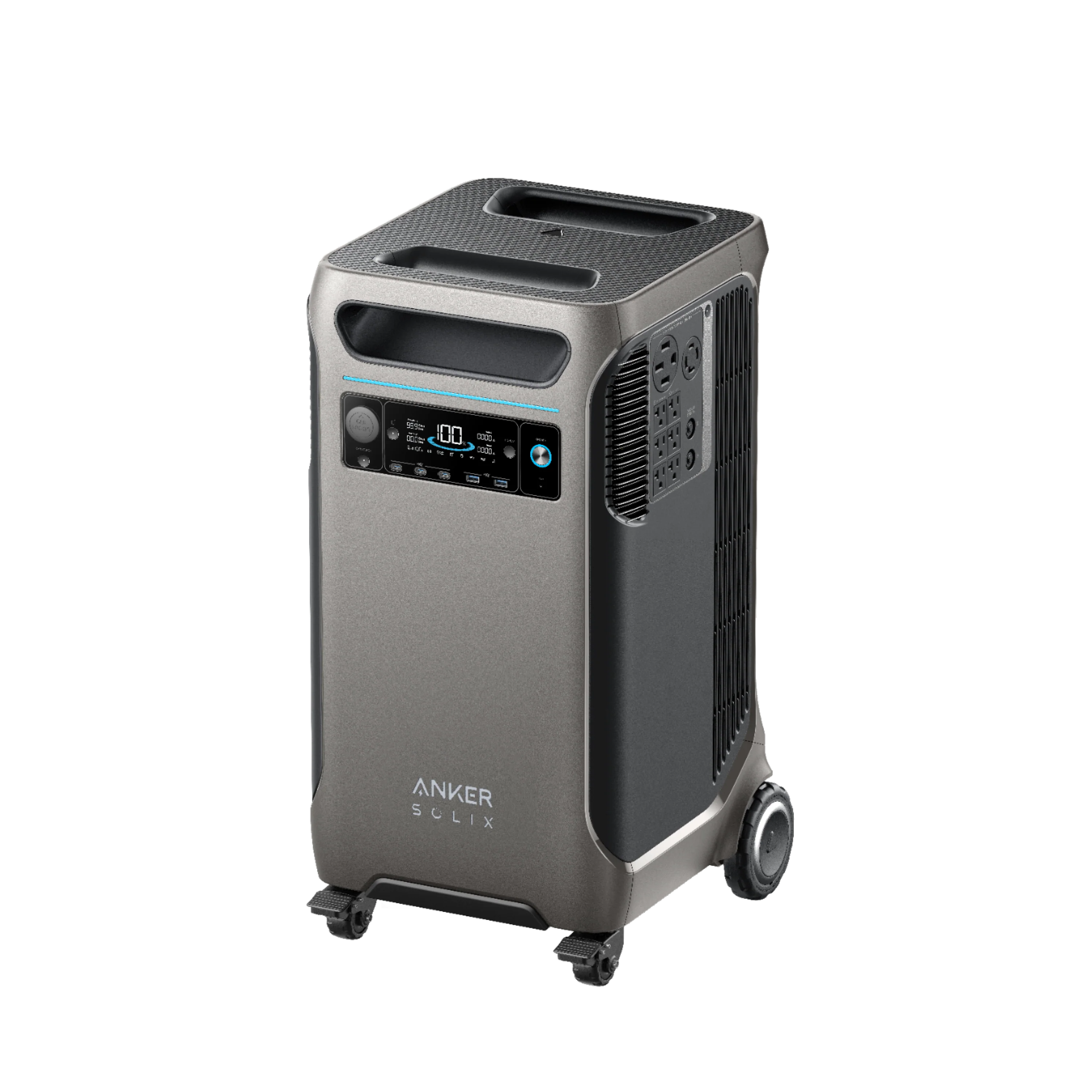
$2,199.99 · direct from Anker
Last checked 1 day ago. Prices move — check before you buy.
Spec deltas
The SOLIX F3800 costs $2,000 to the DELTA 3 Ultra Plus's $1,599 — a $401 gap — and it delivers real hardware for that money: 6,000W continuous output against 3,600W, and 3,840Wh of capacity against 3,072Wh.
None of that comes free on the ownership side. The DELTA 3 Ultra Plus costs 12 cents per lifetime kilowatt-hour to the F3800's 23 — nearly half — on a 4,000-cycle rating against the F3800's 3,000, and it does it at 77.2 lb against the F3800's 132.3 lb, 55.1 lb lighter.
The two split the six household scenarios roughly down the middle: the F3800 wins Weekend Camping and an 8-Hour Blackout on raw headroom, both units clear CPAP Overnight, a Remote Workday, and a Tailgate Party without strain, and neither one — despite the price gap — actually finishes a full Van Life Daily load.
What the Numbers Reveal
Each conclusion stated first — the numbers behind it on one line, the full analysis below.
rated cycles
12 cents against 23 cents per lifetime kilowatt-hour means the F3800 costs its owner almost double for every kilowatt-hour it ever delivers, and the DELTA 3 Ultra Plus gets there with 4,000 cycles against the F3800's 3,000, on a $401 lower ticket.
the DELTA 3 Ultra Plus costs $1,599 vs the F3800's $2,000the DELTA 3 Ultra Plus is rated for 4,000 cycles vs the F3800's 3,000cost per lifetime kWh is $0.12 for the DELTA 3 Ultra Plus vs $0.23 for the F3800
Why it mattersBuyers optimizing for total cost of ownership should take the DELTA 3 Ultra Plus outright; the F3800 needs a different reason to win.
continuous output
768Wh and 2,400W more mean the F3800 works less hard for the same job: 64% of capacity against 80% on a weekend trip, 50% against 63% on an 8-hour blackout. That headroom is exactly what the $401 buys, and it's real, not marketing.
the F3800 outputs 6,000W continuous vs the DELTA 3 Ultra Plus's 3,600Wthe F3800 holds 3,840Wh vs the DELTA 3 Ultra Plus's 3,072Whthe F3800 wins Weekend Camping and the 8-Hour Blackout, using 64% and 50% of its capacity against the DELTA 3 Ultra Plus's 80% and 63%
Why it mattersBuyers who plan to run something over 3,600W continuous — a larger AC unit, a table saw, a well pump — need the F3800's output; buyers whose loads stay under that ceiling are paying for headroom they won't use.
A compressor that needs 2x its running watts to start is exactly what the DELTA 3 Ultra Plus's 2x ratio is built for; the F3800's 1.5x ratio is thinner in relative terms even though its absolute surge number, 9,000W, is bigger. For starting a specific appliance near its rated draw, the smaller unit's inverter is proportionally the stronger one.
the DELTA 3 Ultra Plus surges to 7,200W on a 3,600W continuous rating — a 2x ratiothe F3800 surges to 9,000W on a 6,000W continuous rating — a 1.5x ratiofridge and AC compressors commonly surge 2-3x their rated draw at startup
Why it mattersBuyers starting a borderline-sized compressor should check the ratio, not just the surge number — the cheaper unit may have the better margin for that one appliance.
Capacity
179% versus 144% is a margin between two failures, not a winner. A real daily-cycle van-life setup needs to look past this pair entirely, to something in the DELTA Pro Ultra's capacity class or larger, not choose between these two on the strength of who fails less.
Van Life Daily needs 4,685Whthe DELTA 3 Ultra Plus would need 179% of its 3,072Wh capacitythe F3800 would need 144% of its 3,840Wh capacity
Why it mattersVan-lifers running a full daily load should rule out both of these units and size up; this pair is for weekend and blackout use, not daily off-grid living.
The specific dimensions that decide these two units — everything else is a tie.
What the Specs Don't Tell You
Selected because: Six gotchas fire here — weight, surge ratio, UPS speed, warranty value, cycle life, and noise disclosure — more surface area than most pairs.
rated cycles
Six gotchas fire on this pair, which is a lot of surface for two units this close in price tier. The clearest is weight: the F3800 weighs 132.3 lb against the DELTA 3 Ultra Plus's 77.2 lb, a 55.1-lb gap that puts the F3800 solidly in hand-truck territory while the DELTA 3 Ultra Plus is still a real lift but a manageable one.
The surge-ratio gotcha flags something the raw surge numbers hide: the DELTA 3 Ultra Plus's 7,200W surge is 2 times its 3,600W continuous rating, while the F3800's 9,000W surge is only 1.5 times its 6,000W rating. Bigger absolute number, thinner relative margin — worth knowing if you're starting a compressor near either unit's continuous ceiling. Add in the F3800's undisclosed noise rating, and the smaller EcoFlow is the one making fewer promises it can't back up with a number.
Lifetime Value
Selected because: The $401 price gap and the cost-per-kWh gap point the same direction, with no ledger caveat to soften it.
cost / lifetime kWh
$1,599 against $2,000 is already a $401 gap, and the ownership math widens it: 12 cents per lifetime kilowatt-hour for the DELTA 3 Ultra Plus against 23 cents for the F3800, and $300 per warranty-year against $540. Both carry a 5-year warranty, so the entire gap comes down to price and cycle count — 4,000 cycles for the DELTA 3 Ultra Plus against 3,000 for the F3800.
There's no ledger caveat to soften this one the way there sometimes is. The DELTA 3 Ultra Plus is cheaper to buy and cheaper to own on every figure here. The F3800's case has to be made entirely on capacity and output, not cost.
Your Life, Your Pick
Selected because: The F3800's capacity and output edge shows up as real headroom on two scenarios, and Van Life Daily is an honest tie of two failures.
The F3800 wins Weekend Camping and an 8-Hour Blackout by working less hard to do it: 64% of capacity against the DELTA 3 Ultra Plus's 80% on the camping trip, 50% against 63% on the blackout. CPAP Overnight, a Remote Workday, and a Tailgate Party are close enough to call for both, all under 35% of either unit's capacity.
Van Life Daily is the honest exception: neither unit finishes it. The DELTA 3 Ultra Plus would need 179% of its capacity, the F3800 144% — a smaller shortfall is still a shortfall. If a full daily off-grid cycle is the actual use case, this comparison is between the wrong two units.
Growth Path
Selected because: Unlike most EcoFlow-vs-Anker pairs, the solar ceiling actually favors the F3800 here — worth flagging plainly.
solar input
Both units expand with add-on batteries, and here the growth-path edge actually flips to the F3800: its 2,400W solar ceiling beats the DELTA 3 Ultra Plus's 1,600W, so a grown-out system refills faster off panels on the Anker side of this particular pair.
That's a real point in the F3800's favor, though the owner pattern on its solar input still applies — a restrictive DC input that several owners say pushes them toward Anker's own panelsB1B2B13B14. The DELTA 3 Ultra Plus's lower ceiling is at least a ceiling you can point any panel at without complaint.
Brand Trust
Selected because: Cross-brand pair, and the DELTA 3 Ultra Plus's build-quality reviews are strong enough to note against its short warranty.
Same brand matchup as most EcoFlow-vs-Anker pairs: a bigger EcoFlow ecosystem and community against a more mixed, if still strong, Anker reputation. On this specific unit, reviewers note the DELTA 3 Ultra Plus doesn't feel cheap — the shell, buttons, and AC cable are described as substantial and durableA8, and it takes a 0.2-meter drop with moisture resistance built inA14 — reassuring at $1,599 backed by only a 5-year warranty.
The F3800 doesn't have equivalent build-quality commentary in its own ledger, but it carries the same support caveat as other SOLIX comparisons: fast advance replacement for some owners, total silence for others after a large purchaseB9B8. Neither brand issue is large enough to move the verdict off the price-and-cost-to-own math above.
Strengths & trade-offs
EcoFlow DELTA 3 Ultra Plus
Strengths
- +Costs $401 less
- +Lighter by 58 lb
- +Rated for 4,000 charge cycles — much longer battery lifespan
Trade-offs
- –Weaker inverter (-2,400W) limits appliance compatibility.
Anker SOLIX F3800
Strengths
- +Larger battery capacity
- +Higher AC output
- +Faster solar charging
Trade-offs
- –Significantly heavier (+58 lbs), making it harder to move.
- –Very heavy unit that may be difficult for one person to lift.
- –Shorter-lived battery — rated for 3,000 charge cycles vs the DELTA 3 Ultra Plus's 4,000, so it wears out sooner.
Will It Power Your Gear?
Scenario math and per-appliance runtimes, modeled from the spec record.
Scenario verdicts
We ran the math on six real-world scenarios. Here's which unit survives your actual life.
SCN-01 · 2 nights · needs 2,100Wh
Weekend Camping
Two nights off-grid with essential comfort
DELTA 3 Ultra Plus
The F3800 wins this one on paper — 64% of capacity against the DELTA 3 Ultra Plus's 80% — but both finish the weekend with charge to spare. If the price gap bothers you more than the margin does, the DELTA 3 Ultra Plus still gets you through.
Battery budget usedlower = more headroom
LOAD Phone Charger 15W×6h · LED Lights 40W×8h · Box Fan 75W×14h · CPAP Machine 40W×16h
SCN-02 · 8 hours · needs 1,645Wh
8-Hour Blackout
Keep the essentials running through a night without power
SOLIX F3800
Both survive the night. The SOLIX F3800 finishes at 50% used with 1,619Wh left — 98% of a second night. The DELTA 3 Ultra Plus finishes at 63% with 966Wh, 59% of a second night. If your outages tend to run past one evening, that difference is the whole argument between them.
Battery budget usedlower = more headroom
LOAD Fridge 150W×8h · Router + Modem 20W×8h · LED Lights (4 bulbs) 40W×6h · Phone Charger 15W×3h
SCN-03 · 8 hours · needs 320Wh
CPAP Overnight
Sleep therapy without interruption — the #1 medical use case
Either unit
A CPAP is about 40W for eight hours, so both cover the night with room to spare and capacity decides nothing. Fan noise would — but SOLIX F3800 doesn't publish a figure, so there's nothing to hold it to. Buy on price, weight, and whether you can live with a fan you haven't heard.
Battery budget usedlower = more headroom
LOAD CPAP Machine 40W×8h
SCN-04 · 8 hours · needs 910Wh
Remote Workday
Full work day off-grid without power anxiety
Either unit
Both power your workstation all day without strain. At these utilization levels the real difference is USB-C for direct laptop charging — 140W on the DELTA 3 Ultra Plus against 100W — which beats the inverter for convenience and wastes less energy.
Battery budget usedlower = more headroom
LOAD Laptop 60W×8h · External Monitor 30W×8h · Router + Modem 20W×8h · Phone Charger 15W×2h
SCN-05 · 4 hours · needs 670Wh
Tailgate Party
Game day power for the crew
DELTA 3 Ultra Plus
The SOLIX F3800 at 132.3 lbs is not a take-along — it rolls off a truck bed if it travels at all, so this scenario belongs to the DELTA 3 Ultra Plus by default — and it earns it, covering the 670Wh with 1,941Wh to spare. Capacity was never the SOLIX F3800's problem here; getting to a tailgate was.
Battery budget usedlower = more headroom
LOAD Blender 400W×0.5h · LED TV (55") 80W×4h · Bluetooth Speaker 15W×4h · Phone Charger (×3) 45W×2h
SCN-06 · 24 hours · needs 4,685Wh
Van Life Daily
A full day of mobile living — the ultimate endurance test
Neither unit
Neither unit finishes a full van-life day. The DELTA 3 Ultra Plus would need 179% of its capacity, the F3800 144% — a smaller shortfall, still a shortfall. Break the tie on which one you already own a spare battery for, not on this scenario.
Battery budget usedlower = more headroom
LOAD Mini-Fridge 150W×24h · Laptop 60W×4h · Phone Charger 15W×3h · LED Lights 40W×5h · Fan 75W×8h
The Load Test
RUNTIME = (Wh × 0.85) ÷ LOAD
None of the scenarios above exactly yours? Build it. Toggle what you'd plug in; both units are tested against the combined draw.
Essentials
Comfort & Convenience
High-Draw Appliances
Test duration
8h
Continuous draw
205W
Projected runtime
For this load: SOLIX F3800 runs 15.9h vs 12.7h.
$1,999.99 list · direct from Anker
Modeled from the spec record — same math as the tables below. Methodology
Runtime by appliance
Real-world runtime estimates for common appliances, modeled at 85% inverter efficiency.¹
Essentials
The basics you need runningscale 0–217.6hComfort & Convenience
Makes off-grid life actually enjoyablescale 0–43.5hHigh-Draw Appliances
These reveal the real limitsscale 0–3.3h¹ Runtime = (capacity × 0.85) ÷ appliance watts. Within each group, all bars share one time scale (the group's longest runtime), so lengths are comparable across appliances; identical runtimes collapse into a single blue/orange bar. Actual runtime varies with battery age, temperature, and simultaneous loads — see methodology.
Conclusion
July 15, 2026
Verdict: the EcoFlow DELTA 3 Ultra Plus
The DELTA 3 Ultra Plus is $401 cheaper, costs roughly half as much per lifetime kilowatt-hour (12 cents vs 23 cents), is rated for more cycles (4,000 vs 3,000), and has the better relative surge margin for starting a compressor (2x vs 1.5x its continuous rating). The F3800 answers with real advantages — 2,400W more continuous output and 768Wh more capacity — which show up as genuine headroom on Weekend Camping and an 8-Hour Blackout, the two scenarios it wins outright. Take the F3800 if you specifically need over 3,600W continuous or the extra capacity margin; otherwise the DELTA 3 Ultra Plus is the better-value unit by a wide margin, and neither one is built for a full daily off-grid cycle regardless.
Editor-assigned confidence, based on cited owner research and spec analysis.
List prices as of July 15, 2026. The links below open EcoFlow's and Anker's current prices.
$1,599.00 · direct from EcoFlow
Last checked 1 day ago. Prices move — check before you buy.
or check the SOLIX F3800 price$2,199.99 list
Written by Gunner Gustafson, Whole-Home Backup Tester · Station Arena Test Desk · Updated July 15, 2026
Measured Data
Benchmark scores and the full spec record, side by side.
Benchmark scores
Not rated for both units (minimum threshold unmet): UPS, Tailgating.
Full specifications
ᵈ Derived: price ÷ rated capacity. See the data behind our comparisons →
Comparison ToolAdd more power stations, side by sideOpen Tool →How these numbers are produced
Numeric verification
Every figure on this page traces to our spec database or arithmetic on it — no estimated numbers.
Owner claims
Statements about owner experience are cited to published reviews — see Sources & Research Notes below.
Runtime model
Runtime = (rated capacity × 0.85 inverter efficiency) ÷ device wattage. Solar recharge estimates assume panels deliver 70% of rated output. Cold weather, battery age, and stacked loads reduce real-world results.
Power Score
Computed from 14 published spec dimensions, weighted per use-case bench. Higher is better; a unit must meet a bench's minimum threshold to be rated.
See the full weight table and data sourcing on our methodology page →Class ranking (the star rating)
Each unit's star score is a category ranking, not customer reviews — no buyer opinions feed it. We score every station on size-independent quality (value, output, portability, endurance, ports, warranty, and more), then percentile-rank it against the other units in its capacity class, so a class-leading compact unit and a class-leading whole-home unit can both earn 5★. Here, DELTA 3 Ultra Plus rates 4.9/5 (92nd percentile of 26 Large-class units), and SOLIX F3800 rates 4.7/5 (80th percentile of 16 Home Backup-class units).
How the class ranking is computed →Test Notes & Caveats
Hidden gotchas and advantages we spotted that you won't find on the product page.
Weight Reality Check
132.3 lb against 77.2 lb is a 55.1-lb gap. The F3800 needs a hand truck; the DELTA 3 Ultra Plus is still a real lift, just one person can manage it.
Surge Power: Inverter Quality Indicator
The DELTA 3 Ultra Plus surges to 2 times its continuous rating (7,200W on 3,600W); the F3800 surges to 1.5 times (9,000W on 6,000W). Bigger absolute number on the F3800, thinner relative margin — check the ratio against the specific appliance you're starting, not just the peak figure.
UPS Speed: line-interactive vs standby
10ms for the DELTA 3 Ultra Plus against up to 20ms for the F3800. Both are fast enough for most home electronics; neither is the true zero-gap online UPS you'd want for genuinely sensitive gear.
Warranty: No Difference
Both units carry the same 5-year warranty, so coverage isn't a tiebreaker here. Worth saying because the per-dollar framing can suggest otherwise: the DELTA 3 Ultra Plus works out at 3.1 years of cover per $1,000 spent against the SOLIX F3800's 2.5, but that spread is the price gap, not the terms.
Battery Lifespan in Real Years
4,000 cycles for the DELTA 3 Ultra Plus against 3,000 for the F3800 — on daily use that's roughly 11 years against 8.2 years before capacity fade sets in.
SOLIX F3800: Noise Level Not Disclosed
Anker doesn't publish a decibel rating. Owner reports put it near-silent at idle and around 50 to 60 decibels engaged, which is at least a data point even without an official number.
Full record above — the Test Desk pick is the DELTA 3 Ultra Plus.
Check DELTA 3 Ultra Plus price →or check the SOLIX F3800 priceOwnership Analysis
What happens after you buy — true cost of ownership, brand trust, and growth potential.
Lifetime value
Service lifeyears at one full cycle per day
Lifetime energy delivered
Cost per delivered kWh
│ warranty ends · Reaching the cycle rating means ~80% capacity remains — degraded, not dead.
Analyst note
The DELTA 3 Ultra Plus wins on both sticker price and long-term value. At $0.13/kWh over its lifetime, it's meaningfully cheaper to own. Clear value winner.
Brand trust
EcoFlow
Ecosystem
EcoFlow fields the broadest lineup here — DELTA Pro, DELTA 3, and RIVER 3 series alone total a dozen-plus models, backed by solar panels and smart home panels most competitors don't match.
Support
Phone, email, and chat support out of the US, with results that split down the middle — plenty of owners get a prepaid label and a fast replacement, others describe long waits or a refurbished unit sent back for a fresh claim. Buying through Costco or Amazon adds a return safety net worth having.
Community
The largest community in the category by a wide margin — tens of thousands active on Reddit alone, plus dedicated forums and Facebook groups.
App experience
Rated 4.6/5 iOS (~8,400 ratings) · 4.2/5 Android (~17,000 ratings)
Unique strength
X-Stream fast charging and the fastest innovation cadence in the category, with expansion headroom running all the way to 180kWh on the flagship line.
Worth knowing
An October 2025 recall on the unrelated DELTA Max 2000 over overheating risk is worth knowing as a brand-level data point. EcoFlow also tested a subscription paywall for app features in early 2025 before dropping it under community pushback.
Anker
Ecosystem
A tighter SOLIX lineup — 7 to 8 stations split across the compact C-series and flagship F-series, plus the X1 home energy system for buyers going bigger.
Support
Anker's reputation was built on hassle-free replacements, and some SOLIX owners still get that. Others describe generic AI-driven support responses and heavier return logistics for a unit this size — a real step down from the brand's history, even if the parent-brand reputation still carries weight.
Community
Smaller and newer than EcoFlow's, but growing, and it benefits from Anker's much larger footprint in consumer electronics generally.
App experience
Rated 4.5/5 iOS (~1,100 ratings) · 4.3/5 Android
Unique strength
InfiniPower cell technology aimed at long cycle life, and Gen 2 SOLIX pricing that undercuts most of the category on dollar-per-Wh — though this particular unit, at $2,000, isn't where that value shows up.
Worth knowing
Firmware updates have quietly dropped features on past units without warning, and the expansion ecosystem trails EcoFlow's in breadth.
Analyst note
EcoFlow's brand edge here is scale and speed; Anker's is a reputation it's not fully living up to on SOLIX right now. Neither is the deciding factor — the DELTA 3 Ultra Plus wins this matchup on price and cost-to-own well before brand trust enters the conversation.
Growth path
DELTA 3 Ultra Plus
EXPANDABLESupports EcoFlow expansion batteries, so you can add capacity later without replacing the base unit — useful if your needs may climb past 3,072Wh.
Accepts up to 1,600W of solar. Enough for a serious multi-panel array.
Generous port selection supports complex multi-device setups.
Expansion batteries are EcoFlow-specific. You're investing in the EcoFlow ecosystem.
SOLIX F3800
EXPANDABLESupports Anker expansion batteries, so you can add capacity later without replacing the base unit — useful if your needs may climb past 3,840Wh.
Accepts up to 2,400W of solar. Enough for a serious multi-panel array.
Generous port selection supports complex multi-device setups.
Expansion batteries are Anker-specific. You're investing in the Anker ecosystem.
Realistic full solar rechargeat 70% of rated panel output — see methodology
Analyst note
Both expand, but the SOLIX F3800's higher solar ceiling (2,400W vs 1,600W) gives it the stronger off-grid growth path — more panels can feed a bigger bank as it grows.
What Owners Report
Patterns from published owner reports and long-term reviews — every claim cited to its source below.
EcoFlow DELTA 3 Ultra Plus
Reviewers consistently single out how quiet the DELTA 3 Ultra Plus runs, even under real load — one comparing it directly to EcoFlow's own DELTA Pro Ultra and calling that comparison 'pretty amazing' for a unit this sizeA1A2, and another measuring it at under 25 decibels through sustained drawsA13. One reviewer worked a full eight-hour remote day — laptop, desktop workstation, monitors — and still had 40% of capacity left at the end of itA5.
Build quality reads as solid rather than budget: the shell, buttons, and AC cable are described as substantial, and the unit is rated for a 0.2-meter drop with moisture resistance for overnight dewA8A14. The complaints are practical, not structural — a screen that's hard to read in direct sun without cupping your hands over itA7, and a quirk where the 30A port always shuts off first if the unit is overloadedA3. Reviewers also flag that the $2,899 MSRP overstates the real cost; at the discounted street price around $1,599 to $1,599 — where this comparison prices it — the value case shifts sharply in its favorA10A11. Worth noting: this is a recent release, so the sourcing here is professional reviews rather than long-term owner reports — there's no forum-level data yet on 6-month reliability or cold-weather performance.
“even when you're pushing it hard, the DELTA 3 Ultra Plus runs much quieter than older EcoFlow models, like the DELTA 2 Max”
Sources
thesolarlab.com · postperspective.com · appleinsider.com · digitaltrends.com · storagereview.com
Anker SOLIX F3800
Support is the most polarizing thread in F3800 ownership reports: one owner got a fast advance replacement with no hassleB9, another says Anker went silent for weeks after they'd spent over $20,000 on the SOLIX lineB8. Noise follows a similar split — quiet at idle, climbing to 50-60 decibels engaged, with one reviewer's dry note that it's 'almost inaudible... until you try to lift it'B11, and occasional intermittent buzzing reported during heavy startup loadsB6B12.
The solar input remains the unit's most consistent complaint — owners describe the DC input as restrictive enough to push them toward Anker's own, pricier panels or a secondary charge controller just to use a generic arrayB1B2B13B14, and one owner backed the AC charge rate down from 1,800W to 600-800W after the cord ran hot at full rateB3. Against that, one owner ran a water pump and everything else they tried off a single outlet through a transfer switch with zero issuesB5, and called it cleaner than months of EcoFlow firmware problems on a prior unitB10.
“I have been using the F3800 for a couple weeks now, using only a single 120V outlet into a reliance transfer switch and it runs everything I throw at it including a water pump.”
Sources
diysolarforum.com · thesolarlab.com
Sources & Research Notes
Every owner claim in this report is traceable to a published source. The bracketed references above resolve here.
Recurring owner themes
- Professional reviewers consistently describe the fan noise as very quiet even under heavy load, comparable to EcoFlow's premium DELTA Pro Ultra line. [DELTA 3 Ultra Plus · 3 entries]
- Reviewers report solid UPS/pass-through charging performance with no noticeable switchover issues or output throttling tied to input wattage. [DELTA 3 Ultra Plus · 2 entries]
- The unit's high weight (~74 lbs) and premium MSRP are repeatedly flagged as drawbacks, though discounted street pricing is seen as making the value proposition much stronger. [DELTA 3 Ultra Plus · 3 entries]
- Build quality/durability is praised as substantial and non-fragile across multiple independent reviews. [DELTA 3 Ultra Plus · 2 entries]
- Owners consistently complain that the solar/DC input is restrictive, effectively locking users into pricier Anker-branded panels rather than generic arrays. [SOLIX F3800 · 4 entries]
- Fan/inverter noise is generally reported as quiet at idle but with occasional intermittent buzzing/rattling under load or fault conditions. [SOLIX F3800 · 3 entries]
- Anker support experiences are polarized — some owners report fast, responsive replacements while at least one reports being ignored after a major purchase. [SOLIX F3800 · 3 entries]
- A1
“even when you're pushing it hard, the DELTA 3 Ultra Plus runs much quieter than older EcoFlow models, like the DELTA 2 Max”
thesolarlab.com — EcoFlow DELTA 3 Ultra Plus Review: The Ultimate DELTA? · unknown · [positive]
- A2
“we'd probably say the noise it creates is similar to what you hear when you run the DELTA Pro Ultra, which is pretty amazing”
thesolarlab.com — EcoFlow DELTA 3 Ultra Plus Review: The Ultimate DELTA? · unknown · [positive]
- A3
“One weird thing we noticed was the fact that the unit always seems to shut down the 30A port first when you overload the unit”
thesolarlab.com — EcoFlow DELTA 3 Ultra Plus Review: The Ultimate DELTA? · unknown · [mixed]
- A5
“I was able to work remotely for an eight-hour day with 40% power left, which included running my laptop, desktop workstation and monitors”
postperspective.com — Review: EcoFlow Delta 3 Ultra Plus Portable Power Station · 2026-04 · [positive]
- A7
“while facing the sun, I had to employ the classic "cup hands cover" maneuver to get a clear look at the screen status”
appleinsider.com — EcoFlow Delta 3 Ultra Plus review: Premium, but solid power · 2025-11 · [mixed]
- A8
“It does not feel cheap or fragile. Everything from the outer shell case to the plastic buttons and the AC cable feels substantial and durable”
appleinsider.com — EcoFlow Delta 3 Ultra Plus review: Premium, but solid power · 2025-11 · [positive]
- A10
“Where it falls short is in price justification at its $2,899 MSRP”
digitaltrends.com — EcoFlow DELTA 3 Ultra Plus Review: Portability meets serious firepower · unknown (approx. 1 week old at capture) · [negative]
- A11
“At the heavily discounted street price of around $1,499–$1,599, the value equation shifts dramatically in the Ultra Plus's favor”
digitaltrends.com — EcoFlow DELTA 3 Ultra Plus Review: Portability meets serious firepower · unknown · [positive]
- A13
“Each unit operates quietly at under 25dB, remaining unobtrusive even during sustained loads”
storagereview.com — EcoFlow DELTA 3 Max Plus & Ultra Plus Review · 2025-09-30 · [positive]
- A14
“the Delta 3 Ultra Plus can withstand drops of up to 0.2m, and both models feature moisture resistance to mitigate risks from overnight dew”
storagereview.com — EcoFlow DELTA 3 Max Plus & Ultra Plus Review · 2025-09-30 · [positive]
- B1
“The solar input for charging is a pain, so much so that I'm only using it if there is no other way to charge the F3800.”
diysolarforum.com — 'Anker F3800 user reviews and opinions welcome' · 2024-07 · [negative]
- B2
“The limitations of the inputs make it very difficult to use solar panels other than Anker's panels, which are pricey for a "full up" config.”
diysolarforum.com — 'Anker F3800 user reviews and opinions welcome' · 2024-07 · [negative]
- B3
“if you charge the F3800 from a 120VAC wall outlet at full rate (1800 watts), the line cord gets very hot. I've backed off the charge rate to 600-800 watts.”
diysolarforum.com — 'Anker F3800 user reviews and opinions welcome' · 2024-07 · [negative]
- B5
“I have been using the F3800 for a couple weeks now, using only a single 120V outlet into a reliance transfer switch and it runs everything I throw at it including a water pump.”
diysolarforum.com — 'Anker F3800 user reviews and opinions welcome' · 2024-07 · [positive]
- B6
“I have 4 BP3800s and one of them made similar buzzing/rattling noise when a heavy AC load was starting up... only for around a second while inverter was ramping up.”
diysolarforum.com — 'Big issue with Anker Solix F3800 plus battery pack' · 2025-08 · [mixed]
- B8
“Anker support is ghosting me after I spent over 20k on their solix line and solar panels within a month... they are not answering/returning my calls or emails.”
diysolarforum.com — 'Big issue with Anker Solix F3800 plus battery pack' · 2025-08 · [negative]
- B9
“I've called them and submitted tickets via their portal, always very responsive. They've even done advanced replacement for me.”
diysolarforum.com — 'Big issue with Anker Solix F3800 plus battery pack' · 2025-08 · [positive]
- B10
“I've had zero issues - especially compared to the EcoFlow firmware issues I fought with for months.”
diysolarforum.com — 'Anker solix f-3800 diy solar array' · 2024-02 · [positive]
- B11
“producing between 50 and 60 decibels when engaged, making it almost inaudible during regular use... until you try to lift it, that is.”
thesolarlab.com — 'Anker SOLIX F3800 Review: Did It Kill the Competition?' · unknown · [positive]
- B12
“Sometimes the fans are completely silent, then they kick in and out intermittently.”
thesolarlab.com — 'Anker SOLIX F3800 Review: Did It Kill the Competition?' · unknown · [mixed]
- B13
“no one on Youtube is addressing the solar input problem directly. But People smarter than myself with secondary charge controllers... are able to navigate around the problem.”
diysolarforum.com — 'Anker F3800 user reviews and opinions welcome' · 2024-07 · [negative]
- B14
“other than the solar input problem having limited panel array choices to max out it's input capability it's a great unit so far.”
diysolarforum.com — 'Anker F3800 user reviews and opinions welcome' · 2024-07 · [mixed]
Research compiled July 15, 2026.
Who Should Buy Which
Buy the DELTA 3 Ultra Plus if you…
- →Anyone whose loads stay under 3,600W continuous — weekend camping, an 8-hour blackout, a laptop-and-monitor workday — where the DELTA 3 Ultra Plus's smaller tank never gets tested.
- →Buyers optimizing purely for cost of ownership: $401 cheaper upfront, 12 cents per lifetime kWh against 23 cents, and more cycles to boot.
- →Anyone starting a compressor-driven appliance near either unit's continuous ceiling — its 2x surge-to-output ratio is the stronger relative margin of the two.
Buy the SOLIX F3800 if you…
- →Buyers who need more than 3,600W continuous — a larger AC unit, a table saw, a well pump — where the DELTA 3 Ultra Plus's output ceiling is a real limit, not a technicality.
- →Anyone who wants the extra 768Wh of headroom on the two scenarios both units can run, and is willing to pay $401 for the safety margin.
- →Buyers already committed to Anker panels, who'll never run into the solar input's restrictions.
If neither fits
Anyone planning a full daily off-grid cycle — van life, a fully off-grid tiny home — should skip both. Van Life Daily's 4,685Wh load beats them both, needing 179% and 144% of their capacity respectively; that use case needs something in the DELTA Pro Ultra's capacity class or larger, not this pair.
The Bottom Line
At $401 less and roughly half the cost per lifetime kilowatt-hour, the DELTA 3 Ultra Plus wins the math outright — 12 cents against 23 cents, more cycles, and the better relative surge margin for starting a compressor. The F3800 only wins the argument if your loads actually need its extra 2,400W of continuous output or 768Wh of capacity; those numbers are real, they're just not free.
Neither unit is the answer for a full daily off-grid cycle — Van Life Daily beats them both. For everything smaller than that, take the DELTA 3 Ultra Plus unless you already know you need the F3800's extra headroom; if you're not sure, you probably don't.
Frequently Asked Questions
Answers drawn from the spec record and cited owner research.
Is the SOLIX F3800 worth $401 more than the DELTA 3 Ultra Plus?
Only if you need its extra output or capacity. On cost alone the F3800 loses badly — 23 cents per lifetime kilowatt-hour against 12 cents, and $540 per warranty-year against $300. The case for paying more is the 6,000W continuous output and 3,840Wh capacity, real numbers if your loads actually reach them.
Can either of these run a fridge or AC during an 8-hour blackout?
Both clear an 8-Hour Blackout scenario — the F3800 at 50% of capacity, the DELTA 3 Ultra Plus at 63%. For a specific compressor-driven appliance, check the surge ratio too: the DELTA 3 Ultra Plus's 7,200W surge is 2 times its continuous rating, a thicker relative margin than the F3800's 1.5 times.
Which one is quieter?
The DELTA 3 Ultra Plus has a published rating and reviewers report it running quiet even under real load. The F3800 doesn't publish a decibel figure at all — owner reports put it near-silent at idle and 50 to 60 decibels engaged.
Can either one handle van life full-time?
No. A full van-life day draws about 4,685Wh, more than either unit holds — the DELTA 3 Ultra Plus would need 179% of its capacity, the F3800 144%. Both fall short; look at a larger-capacity unit for daily off-grid living.
Is the DELTA 3 Ultra Plus too new to trust?
It's recent enough that owner commentary so far comes mostly from professional reviewers rather than long-term forum reports — there's no established 6-month-plus reliability record yet. Early reviews are consistently positive on build quality and noise, but buyers who want a forum-verified track record should weigh that gap.
Where to buy
EcoFlow DELTA 3 Ultra PlusPick
$1,599.00
$1,599.00 · direct from EcoFlow
Last checked 1 day ago. Prices move — check before you buy.
Anker SOLIX F3800
$2,199.99
$2,199.99 · direct from Anker
Last checked 1 day ago. Prices move — check before you buy.
Prices may vary by retailer and are subject to change.