Head-to-head test
EcoFlow DELTA 3 1000 Air vs Goal Zero Yeti 500
Almost double the battery for $191 less — the DELTA 3 1000 Air wins the value math outright, and the real cost of taking it is a warranty that runs out three years before the Yeti 500's does.
Full profiles: Goal Zero Yeti 500 →

Written by Ian SchneiderUpdated
Solar & Off-Grid Tester, Station Arena Test Desk

EcoFlow
DELTA 3 1000 Air
2,933Power Score · Appliance Class
No longer sold
EcoFlow has discontinued the DELTA 3 1000 Air — it has left EcoFlow's own store and our price tracking, though remaining retailer stock may linger. Our recommended replacement is the EcoFlow DELTA 3 Classic: the same 1kWh class, with an 1,800W inverter to the Air's 500W.
DELTA 3 Classic · $559.00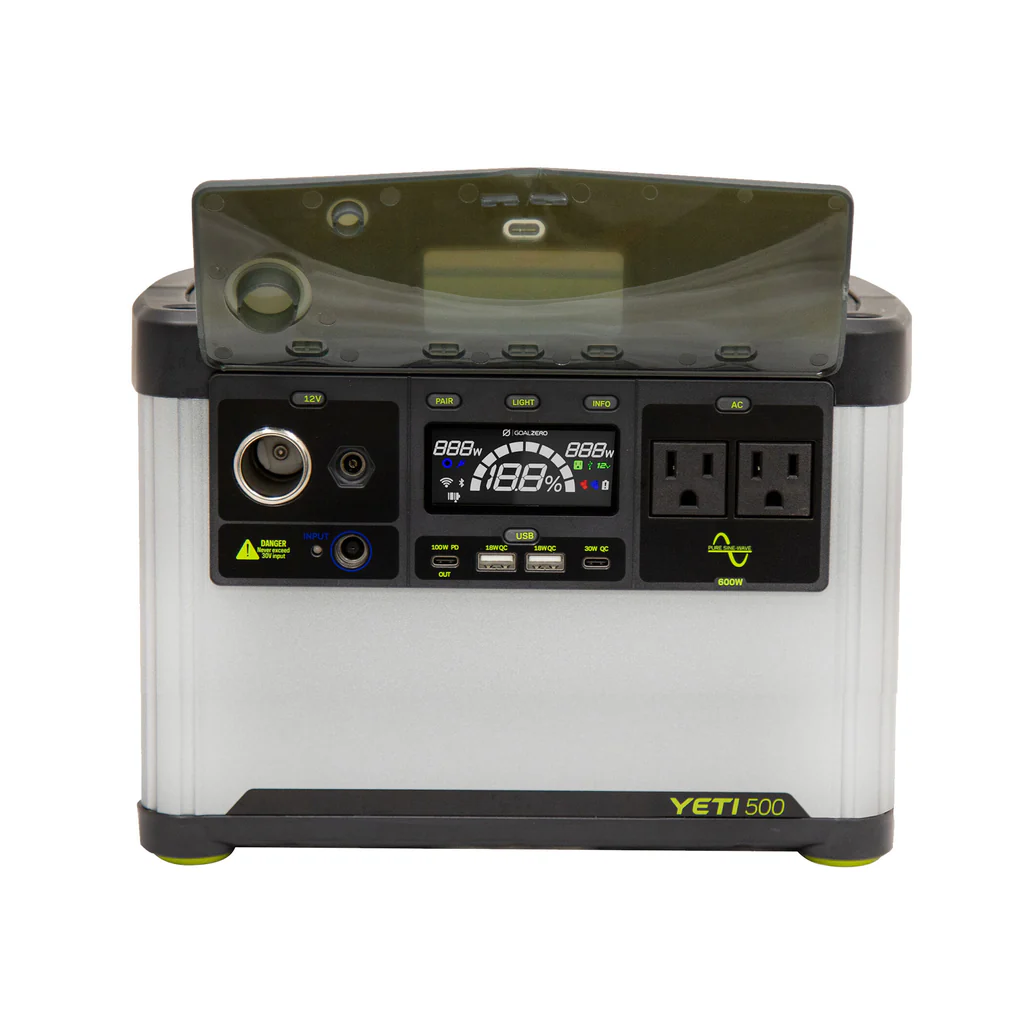
$499.95 · direct from Goal Zero
Last checked 1 day ago. Prices move — check before you buy.
Spec deltas
The EcoFlow DELTA 3 1000 Air holds 960Wh for $309; the Goal Zero Yeti 500 holds 499Wh for $500 — almost double the battery for $191 less, and the arithmetic only gets more lopsided once you run each unit's full lifetime.
Both share the identical 500W continuous, 1,000W surge inverter and the same 10ms UPS switchover, so this isn't a power-ceiling fight. It's entirely about how much energy is in the box, how long the maker backs it, and — this matters — whether you can still buy the exact box in question from the manufacturerA4.
Take the extra capacity and the lower price if you're running desk-side gear through outages. Pay more for the Yeti 500 only if the 100W USB-C port or the longer warranty is worth trading away nearly half your battery for.
What the Numbers Reveal
Each conclusion stated first — the numbers behind it on one line, the full analysis below.
rated cycles
The Yeti 500's extra cycle life can't outrun its capacity deficit. It would need to roughly double its Wh rating just to match the DELTA 3 1000 Air's per-kWh economics — cycles alone don't get it there.
DELTA 3 1000 Air: $309 for 960Wh at 3,000 cyclesYeti 500: $500 for 499Wh at 4,000 cycles
Why it mattersAnyone buying primarily on total cost of ownership should default to the DELTA 3 1000 Air; cycle-life bragging rights don't change the bill.
Even in the one scenario both units can finish — CPAP Overnight — the DELTA 3 1000 Air is sitting on far more unused capacity than the Yeti 500, a real buffer if the outage runs into a second night.
Tailgate Party needs 670Wh: the DELTA 3 1000 Air uses 82% of its usable capacity, the Yeti 500 needs 158% and can't finish itCPAP Overnight needs 320Wh: the DELTA 3 1000 Air uses 39%, the Yeti 500 uses 75%
Why it mattersBuyers whose outings or outages might run long get an actual margin with the bigger battery, not just a bigger number on a spec sheet.
Goal Zero's LFP cell is rated for daily use past 10 yearsB1, and EcoFlow has already discontinued the DELTA 3 1000 Air in favor of the pricier, higher-output standard DELTA 3A4 — the unit that wins the sticker-price and per-kWh math is also the one you can no longer buy new from EcoFlow.
Yeti 500: 5-year warranty, working out to $100 per warranty-yearDELTA 3 1000 Air: 2-year warranty, working out to $155 per warranty-year
Why it mattersBuyers optimizing for a decade of hands-off ownership, or who want a manufacturer still selling the exact unit, should weight the warranty gap and the discontinuation notice over the lifetime-kWh number alone.
That's a real functional gap for anyone using the unit as a desk-side power source, and it isn't offset by a noise advantage either way: the DELTA 3 1000 Air's 39dBA rating is disclosed and quiet, but Goal Zero hasn't published a noise spec for the Yeti 500 at all — there's nothing to verify it against.
DELTA 3 1000 Air USB-C tops out at 18WYeti 500 USB-C delivers up to 100W
Why it mattersRoad warriors who charge a laptop straight off the unit should credit the Yeti 500's port; anyone charging phones and small devices won't notice the difference.
The specific dimensions that decide these two units — everything else is a tie.
Lifetime Value
Selected because: Nearly double the capacity for $191 less flips into a more-than-2x gap in cost per lifetime kWh — the core value argument.
cost / lifetime kWh
Run the full battery life on both and the DELTA 3 1000 Air lands at $0.11 per lifetime kWh, the Yeti 500 at $0.25 — read that once and you don't need the number again; everything else here is commentary on why.
The extra 1,000 cycles on the Yeti 500's cell doesn't rescue the math. It would need to roughly double its Wh rating to catch up on cost per kWh delivered, not add cycles. If total ownership cost is the deciding metric, this section already decided the page.
Your Life, Your Pick
Selected because: The two scenarios where they diverge, CPAP Overnight and Tailgate Party, are where capacity — not power — decides it.
Weekend Camping, the 8-Hour Blackout, Remote Workday, and Van Life Daily beat both units — neither is sized for a two-night trip, a multi-appliance outage, or a full workday, let alone van life's daily draw. The DELTA 3 1000 Air gets meaningfully closer on Remote Workday, needing just a hair over its own usable capacity, while the Yeti 500 isn't close on any of the four.
Where the extra capacity actually earns its keep is CPAP Overnight and Tailgate Party — the two jobs the DELTA 3 1000 Air finishes with real capacity left over, and the one job, Tailgate Party, the Yeti 500 can't finish at all. That's not a power-delivery gap; both units share the same inverter. It's the Yeti 500 simply running out of tank.
What the Specs Don't Tell You
Selected because: USB-C wattage, warranty term, cycle life, and undisclosed Yeti noise are the real, spec-true tiebreakers.
rated cycles
The DELTA 3 1000 Air's USB-C caps at 18W — fine for a phone, useless for a laptop, which needs 60-100W over PD to charge under load. The Yeti 500's 100W port handles that job directly; the DELTA 3 1000 Air pushes you to the AC outlet instead.
Warranty and cycle life cut the other way. The Yeti 500's five-year term works out to $100 per warranty-year against the DELTA 3 1000 Air's $155, and its LFP cell is rated for daily use past 10 yearsB1. Noise is a wash by default, not by comparison: the DELTA 3 1000 Air discloses 39dBA under load, but Goal Zero has never published a noise figure for the Yeti 500, so there's no verified number on that side of the ledger at all.
Portability & Form Factor
Selected because: 22 lbs vs 16.5 lbs looks like a Yeti win until you check watt-hours per pound.
weight
The DELTA 3 1000 Air is the heavier unit at 22 lbs against the Yeti 500's 16.5 lbs, but that's not extra bulk for nothing. Divide capacity by weight and the DELTA 3 1000 Air packs roughly 44Wh per pound to the Yeti 500's 30 — the extra 5.5 lbs is buying energy density, not padding.
Field coverage frames the DELTA 3 1000 Air as a minimalist home-office UPS with fewer ports and features than EcoFlow's fuller lineupA1 — a unit you set on a desk and forget, not one you haul up a trail. At 22 lbs it's still a one-hand carry for most people; the Yeti 500's lighter build matters more if you're loading it in and out of a vehicle daily than if it's living under a desk.
Brand Trust
Selected because: EcoFlow's speed already discontinued this exact unit; Goal Zero's slower pace kept the Yeti 500 current.
EcoFlow ships more models, updates faster, and prices lower — and the DELTA 3 1000 Air being discontinued in favor of the standard DELTA 3 within roughly a year of launch is that speed working against a buyer of this exact unitA4. Goal Zero moves slower and charges more for it, but the Yeti 500 is squarely still in the current lineup.
Support tells a related story: EcoFlow's own device is the better deal on paper, but its support experience is polarized, and Goal Zero's premium-support reputation has been slipping too. Neither brand gives you a clean reason to pay for peace of mind alone — the DELTA 3 1000 Air's discontinuation is the one brand-level fact that should actually weigh on this specific purchase.
Strengths & trade-offs
EcoFlow DELTA 3 1000 Air
Strengths
- +Costs $191 less
- +Larger battery capacity
- +Faster solar charging
Trade-offs
- –Shorter-lived battery — rated for 3,000 charge cycles vs the Yeti 500's 4,000, so it wears out sooner.
Goal Zero Yeti 500
Strengths
- +Lighter by 5.9 lb
- +Longer warranty
- +Rated for 4,000 charge cycles — much longer battery lifespan
Trade-offs
- –Substantially more expensive (+$191) than the DELTA 3 1000 Air.
Will It Power Your Gear?
Scenario math and per-appliance runtimes, modeled from the spec record.
Scenario verdicts
We ran the math on six real-world scenarios. Here's which unit survives your actual life.
SCN-01 · 2 nights · needs 2,100Wh
Weekend Camping
Two nights off-grid with essential comfort
Neither unit
A two-night trip needs roughly 2,100Wh — more than double what either unit holds. The DELTA 3 1000 Air would need 257% of its usable capacity to cover it, the Yeti 500 495%. Neither is the right class of unit for this job; look at something in the 1,500Wh-plus range from either brand.
Battery budget usedlower = more headroom
LOAD Phone Charger 15W×6h · LED Lights 40W×8h · Box Fan 75W×14h · CPAP Machine 40W×16h
SCN-02 · 8 hours · needs 1,645Wh
8-Hour Blackout
Keep the essentials running through a night without power
Neither unit
An 8-hour outage running a fridge, some lights, and a router needs about 1,645Wh. The DELTA 3 1000 Air comes up short at 202% of its usable capacity; the Yeti 500 is further behind at 388%. Both are undersized for a real multi-appliance blackout.
Battery budget usedlower = more headroom
LOAD Fridge 150W×8h · Router + Modem 20W×8h · LED Lights (4 bulbs) 40W×6h · Phone Charger 15W×3h
SCN-03 · 8 hours · needs 320Wh
CPAP Overnight
Sleep therapy without interruption — the #1 medical use case
Either unit
Both units handle a CPAP overnight comfortably, but not equally: the DELTA 3 1000 Air uses 39% of its usable capacity, the Yeti 500 uses 75%. If the power's still out the next night, the DELTA 3 1000 Air has real capacity left to do it again.
Battery budget usedlower = more headroom
LOAD CPAP Machine 40W×8h
SCN-04 · 8 hours · needs 910Wh
Remote Workday
Full work day off-grid without power anxiety
Neither unit
A full remote workday of laptop, monitor, and router needs about 910Wh. The DELTA 3 1000 Air comes close, needing just 112% of its usable capacity — near enough that a lighter day would actually finish. The Yeti 500 isn't close at 215%.
Battery budget usedlower = more headroom
LOAD Laptop 60W×8h · External Monitor 30W×8h · Router + Modem 20W×8h · Phone Charger 15W×2h
SCN-05 · 4 hours · needs 670Wh
Tailgate Party
Game day power for the crew
DELTA 3 1000 Air
A tailgate afternoon needs about 670Wh, and this is where the two units actually split: the DELTA 3 1000 Air finishes it using 82% of its usable capacity, while the Yeti 500 can't — it would need 158%. This is the clearest single win for the DELTA 3 1000 Air on this page.
Battery budget usedlower = more headroom
LOAD Blender 400W×0.5h · LED TV (55") 80W×4h · Bluetooth Speaker 15W×4h · Phone Charger (×3) 45W×2h
SCN-06 · 24 hours · needs 4,685Wh
Van Life Daily
A full day of mobile living — the ultimate endurance test
Neither unit
Van life's daily draw of roughly 4,685Wh is nowhere near what either unit holds — the DELTA 3 1000 Air would need 574% of its usable capacity, the Yeti 500 1,105%. Neither of these is a van life power system; that's a different, much bigger class of unit.
Battery budget usedlower = more headroom
LOAD Mini-Fridge 150W×24h · Laptop 60W×4h · Phone Charger 15W×3h · LED Lights 40W×5h · Fan 75W×8h
The Load Test
RUNTIME = (Wh × 0.85) ÷ LOAD
None of the scenarios above exactly yours? Build it. Toggle what you'd plug in; both units are tested against the combined draw.
Essentials
Comfort & Convenience
High-Draw Appliances
Test duration
8h
Continuous draw
205W
Projected runtime
For this load: DELTA 3 1000 Air runs 4h vs 2.1h.
Modeled from the spec record — same math as the tables below. Methodology
Runtime by appliance
Real-world runtime estimates for common appliances, modeled at 85% inverter efficiency.¹
Essentials
The basics you need runningscale 0–54.4hComfort & Convenience
Makes off-grid life actually enjoyablescale 0–10.9hHigh-Draw Appliances
These reveal the real limits¹ Runtime = (capacity × 0.85) ÷ appliance watts. Within each group, all bars share one time scale (the group's longest runtime), so lengths are comparable across appliances; identical runtimes collapse into a single blue/orange bar. Actual runtime varies with battery age, temperature, and simultaneous loads — see methodology.
Conclusion
July 14, 2026
Verdict: the DELTA 3 1000 Air
Take the DELTA 3 1000 Air unless the Yeti 500's 100W USB-C port or its five-year warranty specifically matters to you. It holds almost double the Yeti 500's capacity for $191 less, wins the lifetime-cost math outright at $0.11 per kWh against $0.25, and covers both scenarios where the two units actually diverge — CPAP Overnight and Tailgate Party — while the Yeti 500 can't finish the tailgate at all. The honest catch: EcoFlow has already discontinued this exact unit in favor of the pricier standard DELTA 3A4, and you're trading Goal Zero's 5-year warranty and 4,000-cycle cell for a shorter 2-year term. If you need to charge a laptop straight off the port, or you'd rather buy from the brand still selling this unit new, pay the premium for the Yeti 500.
Editor-assigned confidence, based on cited owner research and spec analysis.
List prices as of July 14, 2026. The links below open EcoFlow's and Goal Zero's current prices.
$309.00 · direct from EcoFlow
or check the Yeti 500 price$499.95 list
Written by Ian Schneider, Solar & Off-Grid Tester · Station Arena Test Desk · Updated July 14, 2026
Measured Data
Benchmark scores and the full spec record, side by side.
Benchmark scores
Full specifications
ᵈ Derived: price ÷ rated capacity. See the data behind our comparisons →
Comparison ToolAdd more power stations, side by sideOpen Tool →How these numbers are produced
Numeric verification
Every figure on this page traces to our spec database or arithmetic on it — no estimated numbers.
Owner claims
Statements about owner experience are cited to published reviews — see Sources & Research Notes below.
Runtime model
Runtime = (rated capacity × 0.85 inverter efficiency) ÷ device wattage. Solar recharge estimates assume panels deliver 70% of rated output. Cold weather, battery age, and stacked loads reduce real-world results.
Power Score
Computed from 14 published spec dimensions, weighted per use-case bench. Higher is better; a unit must meet a bench's minimum threshold to be rated.
See the full weight table and data sourcing on our methodology page →Class ranking (the star rating)
Each unit's star score is a category ranking, not customer reviews — no buyer opinions feed it. We score every station on size-independent quality (value, output, portability, endurance, ports, warranty, and more), then percentile-rank it against the other units in its capacity class, so a class-leading compact unit and a class-leading whole-home unit can both earn 5★. Here, DELTA 3 1000 Air rates 5.0/5 (99th percentile of 20 Compact-class units), and Yeti 500 rates 4.5/5 (71st percentile of 22 Personal-class units).
How the class ranking is computed →Test Notes & Caveats
Hidden gotchas and advantages we spotted that you won't find on the product page.
DELTA 3 1000 Air's USB-C Tops Out at 18W
18W charges a phone comfortably but won't meaningfully charge a modern laptop — those need 60-100W over USB-C PD. Plug one in here and you're better off using the AC outlet instead. The Yeti 500's 100W port handles a laptop directly.
UPS Switchover: ≤10ms vs ≤20ms
Both list a UPS mode, at different rated speeds. The DELTA 3 1000 Air is rated ≤10ms — quick enough on paper that desktop PCs and routers should ride through, treating that as the rating it is. The Yeti 500 is rated ≤20ms — fine on paper for routers and most electronics; the fussiest PC power supplies sit right at this line. If a computer with unsaved work is the thing being protected, the stated class is worth the attention; nothing here is a lab result.
Five Years Against Two
Goal Zero backs the Yeti 500 for five years; EcoFlow backs the DELTA 3 1000 Air for two. Worked out per year of coverage, the Yeti 500 is actually the cheaper warranty at $100 a year against $155 — the longer term more than offsets its higher price tag.
Battery Lifespan in Real Years
At daily use, the DELTA 3 1000 Air's 3,000-cycle cell lasts roughly 8.2 years before dropping to 80% capacity; the Yeti 500's 4,000-cycle cell stretches to about 11. Weekend-only use pushes both well past two decades, at which point the warranty term matters more than the cycle count.
Yeti 500: Noise Level Not Disclosed
The DELTA 3 1000 Air is rated at 39dBA under load — quiet, on paper. Goal Zero doesn't publish a noise spec for the Yeti 500 at all, so there's no verified number to compare it against; treat any noise claim about the Yeti 500 as unconfirmed until you've heard one running.
Full record above — the Test Desk pick is the DELTA 3 1000 Air.
Check DELTA 3 1000 Air price →or check the Yeti 500 priceOwnership Analysis
What happens after you buy — true cost of ownership, brand trust, and growth potential.
Lifetime value
Service lifeyears at one full cycle per day
Lifetime energy delivered
Cost per delivered kWh
│ warranty ends · Reaching the cycle rating means ~80% capacity remains — degraded, not dead.
Analyst note
The DELTA 3 1000 Air wins on both sticker price and long-term value. At $0.11/kWh over its lifetime, it's meaningfully cheaper to own. Clear value winner. One caution on the lifespan row: the Yeti 500 takes longer to reach its cycle rating, but a cycle moves a different amount of energy on each unit — the DELTA 3 1000 Air still delivers more over its shorter horizon (2,880 vs 1,996 kWh). Years measure wear, not usefulness.
Delivers each lifetime kWh for $0.14 less — check the DELTA 3 1000 Air price →
Brand trust
EcoFlow
Ecosystem
The largest ecosystem in portable power — a dozen-plus models across DELTA Pro, DELTA 3, and RIVER 3, plus solar panels and smart home panels. None of that helps this exact SKU, which has already been folded into the standard DELTA 3.
Support
Phone, email, and chat support out of the US, but experiences split hard: some get a hassle-free prepaid-label swap, others wait weeks or get a refurbished unit back for a new claim. Buying through a big-box retailer adds a return safety net the direct channel doesn't guarantee.
Community
Largest community in the space — Reddit r/Ecoflow_community (~31K members), multiple Facebook groups, and an official community forum
App experience
Rated 4.6/5 iOS (~8,400 ratings) · 4.2/5 Android (~17,000 ratings)
Unique strength
Fastest charging technology in the category and the most active innovation cadence of any portable power brand — the same pace that got this specific unit replaced so quickly.
Worth knowing
EcoFlow tested a subscription paywall for advanced app features in early 2025 before backing off under community pushback. No out-of-warranty parts or service is offered.
Goal Zero
Ecosystem
Tighter and more focused — five or six active Yeti models plus Alta coolers and vehicle integration kits, a much smaller catalog than EcoFlow's.
Support
Historically the 'premium support' brand, but recent reports describe long waits and unanswered tickets. The case for paying more because Goal Zero picks up the phone faster is weaker than it used to be.
Community
Small but loyal — strong following in overlanding and preparedness communities. Official community forums were recently shuttered, frustrating long-time users.
App experience
Rated 4.4/5 iOS (~1,200 ratings) but recent reviews skew negative — recurring connectivity issues, crashes, and stability problems.
Unique strength
The category pioneer, with weather-resistant construction and an integrated 'Yeti-Ready' accessory ecosystem — coolers, lights, vehicle kits — built around the same battery.
Worth knowing
Widely regarded as the most expensive brand per watt-hour in the category, and its official community forums were recently shut down, frustrating longtime owners who used them.
Analyst note
EcoFlow moves faster and prices lower; Goal Zero backs its unit longer and builds heavier-duty accessories around it. On this specific pair, EcoFlow's speed already cost it — the DELTA 3 1000 Air being compared here is discontinued, while the Yeti 500 is Goal Zero's current lineup.
Growth path
DELTA 3 1000 Air
FIXED CAPACITYFixed at 960Wh, with no expansion — so size it for your needs up front rather than planning to add capacity later.
Accepts up to 500W of solar. Suitable for a 1-2 panel setup.
Adequate ports for most setups, but heavy users may want a power strip.
Yeti 500
FIXED CAPACITYFixed at 499Wh, with no expansion — so size it for your needs up front rather than planning to add capacity later.
Accepts up to 200W of solar. Limited to a single portable panel.
Adequate ports for most setups, but heavy users may want a power strip.
Realistic full solar rechargeat 70% of rated panel output — see methodology
Analyst note
Neither expands, and that's no knock on either — each is a complete unit at a fixed size. Buy the capacity that covers your needs now (the DELTA 3 1000 Air gives you the larger ceiling); you can't add to either later.
What Owners Report
Patterns from published owner reports and long-term reviews — every claim cited to its source below.
EcoFlow DELTA 3 1000 Air
Coverage frames the DELTA 3 1000 Air as a minimalist, home-office UPS: a 960Wh LiFePO4 battery, 500W inverter (800W with X-Boost), 22 lbs, fewer ports and features than EcoFlow's fuller lineupA1. Its actual job is keeping a computer, monitor, and router alive through an outage on a 10ms switchoverA2 — reviewers are blunt that at only 500W continuous it won't run a space heater or hair dryer, this is built for low-to-moderate draw onlyA3.
The most important field note here isn't a complaint, it's a status update: EcoFlow no longer sells the DELTA 3 1000 Air. The closest replacement is the standard DELTA 3 — 1,024Wh, 1,800W output, around $549A4. If you're buying this exact unit today, confirm it's actually in stock and not simply a legacy listing.
“A 960Wh LiFePO4 unit with a 500W inverter (800W X-Boost) weighing only 22 lbs — a focused, minimalist design with fewer ports and features.”
Sources
thesolarlab.com · batteryskills.com · backuppowerhub.com · matanich.com
Goal Zero Yeti 500
Field coverage on the Yeti 500 leads with its cell: the newer LiFePO4 pack is rated for 4,000+ cycles, which Goal Zero frames as daily use for over a decade before dropping to 80% capacity at room temperatureB1. One 2026 long-term reviewer backs that up directly, logging 180+ charge cycles with minimal observed degradation so farB4.
Owners also point to its role as blackout insurance: plug a full-size refrigerator straight in and it'll run for up to six hours, enough to save the contents through a typical outageB2. That's a real step up from the older NMC-based Yeti 500X it replaced, and it comes in close to its specced 16.5 lbsB3.
“The Yeti 500's LiFePO4 battery is rated for 4,000+ cycles, meaning daily use for over 10 years (to 80% capacity at 75F).”
Sources
goalzero.com · rei.com · propaneva.com · portablepowernerd.com
Sources & Research Notes
Every owner claim in this report is traceable to a published source. The bracketed references above resolve here.
Recurring owner themes
- A focused home-office UPS unit — LFP, 10ms UPS, quiet and light — but low 500W output; now discontinued in favor of the DELTA 3. [DELTA 3 1000 Air · 3 entries]
- High 4,000+ cycle LFP rating and outage-backup capability (including running a fridge for hours) are the standout points. [Yeti 500 · 2 entries]
- A1
“A 960Wh LiFePO4 unit with a 500W inverter (800W X-Boost) weighing only 22 lbs — a focused, minimalist design with fewer ports and features.”
thesolarlab.com / batteryskills.com — DELTA 3 1000 Air review · 2026 · [mixed]
- A2
“Built as a power-protection device with a 10ms UPS switchover to keep a computer, monitor, and router running through outages.”
backuppowerhub.com — DELTA 3 1000 Air review · 2026 · [positive]
- A3
“With only 500W continuous output, it won't run a space heater or hair dryer — it's built for low-to-moderate draw devices.”
backuppowerhub.com / matanich.com — DELTA 3 1000 Air review · 2026 · [mixed]
- A4
“EcoFlow no longer sells the DELTA 3 1000 Air; the closest successor is the standard DELTA 3 (1,024Wh LFP, 1,800W output, ~$549).”
backuppowerhub.com — DELTA 3 line · 2026 · [mixed]
- B1
“The Yeti 500's LiFePO4 battery is rated for 4,000+ cycles, meaning daily use for over 10 years (to 80% capacity at 75F).”
goalzero.com / rei.com — Yeti 500 LFP · 2026 · [positive]
- B2
“Acts as a backup power supply when the grid drops — you can plug a full-size refrigerator directly in for up to six hours of runtime to prevent food waste.”
goalzero.com — Yeti 500 backup · 2026 · [positive]
- B3
“Weighs about 16 lbs, upgraded to LiFePO4 battery technology from the older NMC-based Yeti 500X.”
goalzero.com / propaneva.com — Yeti 500 review · 2026 · [mixed]
- B4
“One 2026 reviewer completed 180+ charge/discharge cycles with minimal observed degradation.”
portablepowernerd.com — Yeti 500 long-term review · 2026 · [positive]
Research compiled July 14, 2026.
Who Should Buy Which
Buy the DELTA 3 1000 Air if you…
- →You want the best per-kWh math for a desk-side UPS setup — computer, monitor, router — and don't mind a shorter 2-year warranty in exchange for $191 back in your pocket.
- →Your outings or outages tend to run one intense day or night, where the extra headroom on CPAP Overnight and Tailgate Party means real margin, not just a bigger spec.
This is you — check the DELTA 3 1000 Air price
Buy the Yeti 500 if you…
- →You're charging a laptop that needs real USB-C PD — the Yeti 500's 100W port does that directly, where the DELTA 3 1000 Air's 18W port can't.
- →You want the longer warranty and a cell independently logged past 180 cycles with minimal degradationB4, and you're willing to pay $191 more and give up nearly half the capacity for it.
If neither fits
If your real need is a two-night camping trip (about 2,100Wh) or an 8-hour multi-appliance blackout (about 1,645Wh), both of these fail outright — the DELTA 3 1000 Air would need 257% of its usable capacity for the camping trip and 202% for the blackout, and the Yeti 500 needs even more of both. Look at a 1,500Wh-plus unit from either brand instead.
The Bottom Line
The DELTA 3 1000 Air wins this on the numbers that decide most purchases: almost double the capacity, $191 less, and less than half the cost per lifetime kWh. It also wins the two scenarios where the units actually diverge, finishing a tailgate afternoon the Yeti 500 can't touch.
The trade is real, not manufactured: a 2-year warranty against five, an 18W USB-C port against 100W, and a unit EcoFlow has already stopped sellingA4. If none of that changes your evening, take the DELTA 3 1000 Air and keep the $191.
Frequently Asked Questions
Answers drawn from the spec record and cited owner research.
Which one actually costs less to own?
The DELTA 3 1000 Air, by a wide margin. Run each unit's full battery life and it works out to $0.11 per lifetime kWh against $0.25 for the Yeti 500 — more than double, even after accounting for the Yeti 500's higher cycle rating. The Yeti 500's only cost-per-year advantage is warranty coverage, not energy.
Can either of these run a fridge or handle a full weekend camping trip?
Not comfortably. A two-night camping trip needs roughly 2,100Wh, which is more than double what either unit holds — the DELTA 3 1000 Air would need 257% of its usable capacity to cover it, the Yeti 500 495%. Goal Zero's own marketing for the Yeti 500 focuses on running a fridge for up to six hours during a blackout, which is a shorter, lighter job than a full weekend trip.
Is the EcoFlow DELTA 3 1000 Air still available to buy?
EcoFlow has discontinued it; the closest current replacement is the standard DELTA 3 at roughly $549 with a larger 1,024Wh battery and 1,800W output. If you're comparing these two today, confirm the listing you're looking at is genuinely in stock and not an old page.
Which one charges a laptop faster over USB-C?
The Yeti 500, decisively. Its USB-C port delivers up to 100W, enough to charge a modern laptop directly under load. The DELTA 3 1000 Air's USB-C tops out at 18W, which charges a phone but won't meaningfully power a laptop — you'd need the AC outlet instead.
Which one has the better warranty?
The Yeti 500, at five years against the DELTA 3 1000 Air's two. Worked out per year of coverage, the Yeti 500 is actually the cheaper warranty at $100 a year versus $155, even though it costs $191 more upfront. If long-term coverage matters more than upfront price, that flips the value argument.
Check DELTA 3 1000 Air price →
Where to buy
EcoFlow DELTA 3 1000 AirPick
$309.00
$309.00 · direct from EcoFlow
Goal Zero Yeti 500
$499.95
$499.95 · direct from Goal Zero
Last checked 1 day ago. Prices move — check before you buy.
Prices may vary by retailer and are subject to change.