Head-to-head test
EcoFlow DELTA 3 1000 Air vs EcoFlow DELTA 3 1500
Both of these are out of production, so this stopped being a choice: the only live questions are what you own, and which of the two replacements — the DELTA 3 Classic or the DELTA 3 Max — is the box you were actually shopping for.
Full profiles: EcoFlow DELTA 3 1500 →

Written by Ian SchneiderUpdated
Solar & Off-Grid Tester, Station Arena Test Desk
Spec deltas
EcoFlow has discontinued both of these, and that changes the question this page answers. The DELTA 3 1000 Air left the range first, with the DELTA 3 Classic named as its replacement. The DELTA 3 1500 followed it out: its product page forwards elsewhere, the one listing left is a sold-out solar bundle, and EcoFlow's current range has nothing at the 1500's 1,536Wh, which makes the DELTA 3 Max the nearest live equivalent. There is no winner to hand out here because there is nothing left to hand it to.
That leaves two readers, and this page is written for both. One of you owns a 1000 Air or a 1500 and wants to know what is actually in the box. The specs are all still true, so compare away. The other typed a model name from a review or a spec chart and needs telling that the line moved on before spending an evening choosing between two things that aren't sold. Both of you deserve the honest comparison. Neither of you deserves a recommendation to buy a ghost.
Between the two boxes the gap is not subtle, and it isn't mainly capacity. The 1500 holds 1.6 times the battery of the Air (1,536Wh against 960Wh) behind 3.6 times the inverter (1,800W against 500W). Reviewers describe the Air as a power-protection device first, sized to keep a computer, a monitor and a router alive through a cutA2. The 1500 is a portable station that starts loads the Air refuses. They were never really answering the same question, and now neither of them answers it at all.
What the Numbers Reveal
Each conclusion stated first — the numbers behind it on one line, the full analysis below.
Which makes the 18W USB-C port the odd one out, because it undercuts the exact job the unit exists for. A MacBook Air wants 30W before it charges at full speed and most USB-C laptops want 60W, so the laptop on that desk can drain faster than the Air's best USB-C port refills it. The fix costs nothing and nobody mentions it: use one of the three AC outlets and the laptop's own brick, and the port goes back to being a good phone charger.
DELTA 3 1000 Air: 500W continuous output, 1,000W surge, three AC outlets, rated at or under 10ms UPS switchoverDELTA 3 1000 Air: its fastest USB-C port outputs 18WDELTA 3 1500: 140W from USB-C
Why it mattersIf you own a 1000 Air, move the laptop off USB-C tonight. If you were shopping for one, the DELTA 3 Classic is what EcoFlow put in its place.
The explanation posters give is that the 1500 isn't a scaled-up Delta 3 at all but a hybrid, carrying Delta 2 cutover hardware inside a Delta 3 shellB3B5. Both figures are ceilings rather than measured results, and a 15ms class is still fine for a router, a modem or a TV. It is the fussiest desktop power supplies that sit right on that line, and those are precisely what a UPS gets bought for.
DELTA 3 1000 Air: rated at or under 10ms switchoverDELTA 3 1500: rated at or under 15ms switchoverForum posters pegged the 1500's cutover at 15ms against a sub-10ms figure for the standard Delta 3B5, and described the 1500 as Delta 2 cutover electronics in a new Delta 3 caseB3
Why it mattersWhichever of the two you own, put the computer with unsaved work on the Air and the heavy appliance on the 1500 — roughly the opposite of how their sizes suggest you'd wire them.
And the extra capacity costs time to put back. Both units take 500W of panels at most, so from empty the 1500 needs roughly three hours of strong sun where the Air needs two (1,536Wh and 960Wh, each at 500W). In a multi-day outage, which is the exact event that sells these boxes, the bigger pack is the slower one to refill. The gap between them narrows every day the power stays off.
8-Hour Blackout needs 1,645Wh and neither unit covers it: the 1500 reaches 79%, the Air 50%Usable energy after the flat 15% derate this site applies to every unit: 1,306Wh for the 1500, 816Wh for the AirBoth units cap solar input at 500W
Why it mattersIf outage cover is why you are here, neither of these was ever the answer. You want a larger station, and in EcoFlow's live range that is the DELTA 3 Max.
The 1500 is the unit with the thinner reliability record and the longer cover, which is at least the right way roundB0B1B2. The Air's 2 years is the short end of that deal, and short in an awkward way for a box whose entire pitch was sitting untouched under a desk for years on endA2. Neither term is transferable to a replacement, because there is no replacement to buy in the same model.
DELTA 3 1500: 5-year warranty term. DELTA 3 1000 Air: 2 yearsBoth packs are rated for 3,000 cyclesIndependent field data on the 1500 is very thin and secondhandB0; in the one forum thread that discusses it, a poster reported a neighbour losing three units in roughly eight monthsB1 and the consensus leaned toward the Delta 3 line drawing more failure reports than the Delta 2B2
Why it mattersWhichever you own, find the receipt and check what is left of the term this week, not the morning something stops working.
The specific dimensions that decide these two units — everything else is a tie.
Runtime: Will It Power Your Gear?
Selected because: The two differ more in what they can start than in how long they last: 500W continuous and a 1,000W surge against 1,800W and 3,600W.
continuous output
Both units carry exactly double their rated output in surge — 1,000W over 500W, 3,600W over 1,800W — so the headroom ratio is identical and the headroom itself isn't close. Fridge and pump compressors pull two to three times their running wattage for the half-second they start, which is why the 500W rating is the wall the Air hits first. Reviewers put it at low-to-moderate draw and note it won't run a space heater or a hair dryerA3.
Run the Air flat out and it empties in about an hour and a half: 816Wh of usable energy at 500W. That isn't a criticism, it's the design. A box built to hold a desk up through a power cutA2 never expects to be drained, and 960Wh behind a small inverter is a sensible shape for that job. It only becomes a problem when someone buys it to run a campsite.
Your Life, Your Pick
Selected because: Six profiles split three ways — both cover the CPAP night, the 1500 alone finishes the workday and the tailgate, and neither finishes camping, a full blackout or van life.
Read the table as a list of things these two don't do. Camping wants 2,100Wh and a van day 4,685Wh; the 1500 reaches 62% and 28% of them, the Air 39% and 17%. No amount of picking between the two closes a gap that size. The rows they both pass are the small ones, and that is the honest size class here.
The Remote Workday row is the one to read carefully before you believe it. The Air fails by 94Wh against a 910Wh load that its 960Wh nameplate actually clears; the flat 15% conversion allowance applied to every unit on this site is what tips it under. In practice that is a workday you finish on fumes rather than one you don't finish. It is still a fair warning, because nobody runs a battery to zero on purpose.
What the Specs Don't Tell You
Selected because: Five catches fire on this pair, and the one that changes a daily habit is the Air's 18W USB-C ceiling against the 1500's 140W.
Three of the five catches land on the Air and two on the 1500, which looks like a scoreline and isn't one. The Air's three are all consequences of a single decision: a small inverter, a small USB-C port and a sealed pack were the price of a box meant to sit under a desk and be forgottenA2. The 1500's two are a different species — a longer warranty in its favour, and a missing number that is neither good news nor bad.
That missing number deserves a flag in the other direction, because it reads like a win for the Air and isn't. The Air publishes 39dB and the 1500 publishes nothing, but a spec-sheet figure is not a measurement, and makers don't even agree on what such a figure means: some publish a quiet-mode floor, others a full-load ceiling. So there is no comparison available here. There is one number on the table and no way to check it against the other unit.
Portability & Form Factor
Selected because: 22 lbs against 36 lbs is the one comparison the smaller unit wins outright.
weight
22 lbs is a one-hand carry from the trunk. 36 lbs is both hands, bent knees and a decision about where you are going to set it down, and the 14 lbs between them is a small number that behaves like a large one when the walk is long or the tailgate is high. This is the only row the Air wins outright.
It also happens to be the row that decides things in the one outdoor scenario both units pass. When the load is 670Wh and neither box is straining, the spec you feel is the one in your hands on the walk from the car.
Strengths & trade-offs
EcoFlow DELTA 3 1000 Air
Strengths
- +Lighter by 14 lb
Trade-offs
- –Weaker inverter (-1,300W) limits appliance compatibility.
- –Sealed capacity — the DELTA 3 1500 can add batteries to grow past 960Wh; this one can't.
EcoFlow DELTA 3 1500
Strengths
- +Larger battery capacity
- +Higher AC output
- +Longer warranty
Trade-offs
- –Significantly heavier (+14 lbs), making it harder to move.
Will It Power Your Gear?
Scenario math and per-appliance runtimes, modeled from the spec record.
Scenario verdicts
We ran the math on six real-world scenarios. Here's which unit survives your actual life.
SCN-01 · 2 nights · needs 2,100Wh
Weekend Camping
Two nights off-grid with essential comfort
Neither unit
Neither unit covers this scenario's 2,100Wh: the DELTA 3 1000 Air comes up 1,284Wh short (about 39% covered), the DELTA 3 1500 794Wh (62%). Treat this as partial cover — enough for the essentials in it, not the whole list.
Battery budget usedlower = more headroom
LOAD Phone Charger 15W×6h · LED Lights 40W×8h · Box Fan 75W×14h · CPAP Machine 40W×16h
SCN-02 · 8 hours · needs 1,645Wh
8-Hour Blackout
Keep the essentials running through a night without power
Neither unit
Neither one finishes. The profile wants 1,645Wh, and the 1500 comes up 339Wh short where the Air is 829Wh short, so the choice between them is a choice between two partial answers. Both also cap solar input at 500W, which means the bigger pack is the slower one to refill rather than the faster: roughly three hours of strong sun for the 1500's 1,536Wh against two for the Air's 960Wh. If the lights being out is why you are reading this, the answer isn't on this page. It is a size up.
Battery budget usedlower = more headroom
LOAD Fridge 150W×8h · Router + Modem 20W×8h · LED Lights (4 bulbs) 40W×6h · Phone Charger 15W×3h
SCN-03 · 8 hours · needs 320Wh
CPAP Overnight
Sleep therapy without interruption — the #1 medical use case
Either unit
A CPAP is about 40W, so eight hours of it is 320Wh: a quarter of the 1500's usable energy and under two-fifths of the Air's. Capacity decides nothing, which leaves the fan, and there the record is uneven. The Air publishes a noise figure and the 1500 publishes none at all. At 3 a.m., eighteen inches from your head, that is the spec you care about and the one you cannot check. If you own the Air, this is the exact night it was built for. If you own the 1500, run it once and listen before you trust it.
Battery budget usedlower = more headroom
LOAD CPAP Machine 40W×8h
SCN-04 · 8 hours · needs 910Wh
Remote Workday
Full work day off-grid without power anxiety
DELTA 3 1500
The DELTA 3 1000 Air doesn't finish — 816Wh usable against the 910Wh this needs leaves it 94Wh short, about 89% of the scenario covered (its nameplate 960Wh actually clears this — the flat 15% conversion allowance is what tips it under). The DELTA 3 1500 covers it with 396Wh to spare.
Battery budget usedlower = more headroom
LOAD Laptop 60W×8h · External Monitor 30W×8h · Router + Modem 20W×8h · Phone Charger 15W×2h
SCN-05 · 4 hours · needs 670Wh
Tailgate Party
Game day power for the crew
DELTA 3 1500
Both cover game day's 670Wh, so the 1500's win here is about reserve rather than capability: it ends the afternoon at 51% used and the Air at 82%. The number that decides more is the 400W peak, which is four-fifths of the Air's 500W rating. The specs say it holds, and they are right, but that is the margin a second appliance eats in one plug.
Battery budget usedlower = more headroom
LOAD Blender 400W×0.5h · LED TV (55") 80W×4h · Bluetooth Speaker 15W×4h · Phone Charger (×3) 45W×2h
SCN-06 · 24 hours · needs 4,685Wh
Van Life Daily
A full day of mobile living — the ultimate endurance test
Neither unit
Neither unit covers this scenario's 4,685Wh: the DELTA 3 1000 Air comes up 3,869Wh short (about 17% covered), the DELTA 3 1500 3,379Wh (28%). This is well outside what either unit is for; the right answer here is a larger station, not a choice between these two.
Battery budget usedlower = more headroom
LOAD Mini-Fridge 150W×24h · Laptop 60W×4h · Phone Charger 15W×3h · LED Lights 40W×5h · Fan 75W×8h
The Load Test
RUNTIME = (Wh × 0.85) ÷ LOAD
None of the scenarios above exactly yours? Build it. Toggle what you'd plug in; both units are tested against the combined draw.
Essentials
Comfort & Convenience
High-Draw Appliances
Test duration
8h
Continuous draw
205W
Projected runtime
For this load: DELTA 3 1500 runs 6.4h vs 4h.
Planning for more than this? Describe your whole setup and get it sized →
Modeled from the spec record — same math as the tables below. Methodology
Runtime by appliance
Real-world runtime estimates for common appliances, modeled at 85% inverter efficiency.¹
Essentials
The basics you need runningscale 0–87hComfort & Convenience
Makes off-grid life actually enjoyablescale 0–17.4hHigh-Draw Appliances
These reveal the real limitsscale 0–1.3h¹ Runtime = (capacity × 0.85) ÷ appliance watts. Within each group, all bars share one time scale (the group's longest runtime), so lengths are comparable across appliances; identical runtimes collapse into a single blue/orange bar. Actual runtime varies with battery age, temperature, and simultaneous loads — see methodology.
Conclusion
September 19, 2026
Verdict: the DELTA 3 1500, on Power Score margin
Nothing on this page is buyable, so the tie is a statement about availability rather than a dead heat on merit. The DELTA 3 1500 is the better unit on nearly every spec that isn't weight or rated switchover, and it is exactly as discontinued as the DELTA 3 1000 Air. If you are shopping, take the successor that matches the shape you wanted: the DELTA 3 Classic where the Air's size and job was the appeal, the DELTA 3 Max where you wanted the 1500's output and headroom. If you already own one, the useful news is that both packs are rated for 3,000 cycles, about 8.2 years at one full cycle a day, so the unit in your hallway has years of service left in it. What it doesn't have is a price, a buy button, or any reason to be swapped for the other one.
Editor-assigned confidence, based on cited owner research and spec analysis.
Written by Ian Schneider, Solar & Off-Grid Tester · Station Arena Test Desk · Updated September 19, 2026
Measured Data
Benchmark scores and the full spec record, side by side.
Benchmark scores
Not rated for both units (minimum threshold unmet): RV Living, Home Backup, Tailgating, Food Truck.
Full specifications
ᵈ Derived: price ÷ rated capacity. See the data behind our comparisons →
Comparison ToolAdd more power stations, side by sideOpen Tool →How these numbers are produced
Numeric verification
Every figure on this page traces to our spec database or arithmetic on it — no estimated numbers.
Owner claims
Statements about owner experience are cited to published reviews — see Sources & Research Notes below.
Runtime model
Runtime = (rated capacity × 0.85 inverter efficiency) ÷ device wattage. Solar recharge estimates assume panels deliver 70% of rated output. Cold weather, battery age, and stacked loads reduce real-world results.
Power Score
Computed from 14 published spec dimensions, weighted per use-case bench. Higher is better; a unit must meet a bench's minimum threshold to be rated.
See the full weight table and data sourcing on our methodology page →Class ranking (the star rating)
Each unit's star score is a category ranking, not customer reviews — no buyer opinions feed it. We score every station on size-independent quality (value, output, portability, endurance, ports, warranty, and more), then percentile-rank it against the other units in its capacity class, so a class-leading compact unit and a class-leading whole-home unit can both earn 5★. Here, DELTA 3 1000 Air rates 5.0/5 (99th percentile of 20 Compact-class units), and DELTA 3 1500 rates 5.0/5 (99th percentile of 27 Everyday-class units).
How the class ranking is computed →Test Notes & Caveats
Hidden gotchas and advantages we spotted that you won't find on the product page.
The Air's USB-C Stops at 18W
18W is a phone port with a laptop-shaped plug on it. A MacBook Air wants 30W before it charges at full speed, most USB-C laptops want 60W, and under load an 18W supply can lose ground to the machine it is meant to be filling. The 1500 does 140W from the same connector. If you own the Air, the fix takes two seconds: put the laptop on one of the three AC outlets with its own brick, and leave USB-C to the phones.
Sealed at 960Wh, and Now That's Permanent
The Air is a fixed 960Wh pack. That was a fair trade while it was a current product; it is a hard ceiling now, because the obvious way past it was a second one and EcoFlow doesn't make those either. The 1500 takes EcoFlow expansion batteries, which is the only upgrade path still open to anyone holding either of these two, with the honest caveat that sourcing a matching expansion battery for a discontinued base unit is its own errand. And at this size more battery buys longer runtimes on the same loads, not a wider set of loads.
UPS Switchover: ≤10ms vs ≤15ms
Both list a UPS mode, at different rated speeds. The DELTA 3 1000 Air is rated ≤10ms — quick enough on paper that desktop PCs and routers should ride through, treating that as the rating it is. The DELTA 3 1500 is rated ≤15ms — fine on paper for routers and most electronics; the fussiest PC power supplies sit right at this line. If a computer with unsaved work is the thing being protected, the stated class is worth the attention; nothing here is a lab result.
Warranty: 5 Years vs 2, on Two Units You Can't Rebuy
The 1500 carries a 5-year term and the DELTA 3 1000 Air 2 years, and now that both are out of production that cover is the most valuable thing either one still gives you. It runs from your purchase date rather than from the day EcoFlow stopped selling the model, so a 1500 bought late in its run can still have most of its term in hand. That is the fact worth acting on: dig out the receipt and find out where you stand, because on a discontinued unit the warranty is the last support channel there is.
DELTA 3 1500: Noise Level Not Disclosed
The DELTA 3 1000 Air publishes its noise level (39dB); the DELTA 3 1500 doesn't publish one. That isn't evidence the DELTA 3 1500 is louder — it means there's no figure to hold it to, and no way to compare the two on this without hearing them. If you're buying for a bedroom, a CPAP, or an apartment, treat the DELTA 3 1000 Air's 39dB as the only published number on the table — a spec-sheet figure, not a measurement — and look for hands-on reports of the DELTA 3 1500 before deciding.
Ownership Analysis
What happens after you buy — true cost of ownership, brand trust, and growth potential.
Lifetime value
Service lifeyears at one full cycle per day
Lifetime energy delivered
│ warranty ends · Reaching the cycle rating means ~80% capacity remains — degraded, not dead.
Analyst note
Neither is sold new any more, so there is no price left to work a cost per kWh from, and what either costs you now depends on the used market. The hardware comparison still holds: over its rated life the DELTA 3 1000 Air delivers about 2,880 kWh and the DELTA 3 1500 about 4,608 kWh. One thing to know reading the table: both carry the same 3,000-cycle rating, so the lifetime rows are sticker price and capacity in disguise — the wear horizon is identical and decides nothing here.
Growth path
DELTA 3 1000 Air
FIXED CAPACITYFixed at 960Wh, with no expansion — so size it for your needs up front rather than planning to add capacity later.
Accepts up to 500W of solar. Suitable for a 1-2 panel setup.
Limited ports. You'll likely need a power strip or splitter.
DELTA 3 1500
EXPANDABLESupports EcoFlow expansion batteries, so you can add capacity later without replacing the base unit — useful if your needs may climb past 1,536Wh.
Accepts up to 500W of solar. Suitable for a 1-2 panel setup.
Generous port selection supports complex multi-device setups.
Expansion batteries are EcoFlow-specific. You're investing in the EcoFlow ecosystem.
Realistic full solar rechargeat 70% of rated panel output — see methodology
Analyst note
Neither of these is sold new any more, so there is no growth path to buy into on either side. If you already own one: the DELTA 3 1000 Air is fixed at 960Wh and the DELTA 3 1500 takes expansion batteries. As a purchase decision, expandability isn't the question here.
What Owners Report
Patterns from published owner reports and long-term reviews — every claim cited to its source below.
EcoFlow DELTA 3 1000 Air
What exists on the Air comes from reviewers rather than long-term owners, and they agree on what it is: a focused, minimalist 960Wh LFP unit with a 500W inverter (800W in X-Boost), fewer ports than its siblings, and 22 lbs of weightA1. It was built as a power-protection device, the UPS switchover there to keep a computer, a monitor and a router alive through a cutA2. The consistent caveat is the one the spec sheet implies anyway: at 500W continuous it won't run a space heater or a hair dryer, and it is meant for low-to-moderate drawA3. Our own research files it as a minimalist home-office UPS whose low output limits it to light loads, and records it as discontinuedA0A4.
“A 960Wh LiFePO4 unit with a 500W inverter (800W X-Boost) weighing only 22 lbs — a focused, minimalist design with fewer ports and features.”
Sources
thesolarlab.com · batteryskills.com · backuppowerhub.com · matanich.com
EcoFlow DELTA 3 1500
There is almost no independent field data on this exact SKU, and that is the most important thing anyone can tell you about it. Our researcher found no Reddit, YouTube-comment or Amazon-review content specific to the 1,536Wh/1,800W 1500, and the two forum threads that do discuss it refused direct fetch, so what we hold are paraphrases of indexed snippets rather than verbatim testimonyB0. Treat everything in the next paragraph as thin.
What is in those snippets is not reassuring. One poster described a neighbour going through three 1500 units in roughly eight monthsB1, and in the same thread the consensus leaned toward the Delta 3 line drawing more failure reports than the Delta 2, with one poster contrasting two Delta 2 units that never gave a single problemB2. Posters also described the 1500 as a hybrid rather than a scaled-up Delta 3: Delta 2 cutover electronics in a new case, with what one called larger grade B cellsB3. That is the tidiest explanation going for why its switchover is rated slower than the standard Delta 3'sB5. Idle draw came up too, with figures traded back and forth, but our researcher could not confirm those posts were about the 1500 rather than a sibling model, so take that one as colour and not as specB4.
“Posters described the Delta 3 1500 as essentially a Delta 2/Delta 3 hybrid — UPS-cutover electronics carried over from the Delta 2, housed in a new case with what one called "larger grade B cells."”
Sources
diysolarforum.com
Sources & Research Notes
Every owner claim in this report is traceable to a published source. The bracketed references above resolve here.
Recurring owner themes
- A focused home-office UPS unit — LFP, 10ms UPS, quiet and light — but low 500W output; now discontinued in favor of the DELTA 3. [DELTA 3 1000 Air · 3 entries]
- Forum posters flagged the Delta 3 1500 as less reliable than EcoFlow's earlier Delta 2, both from direct failure reports and from its unusual hybrid Delta 2/Delta 3 hardware platform. [DELTA 3 1500 · 3 entries]
- Idle power draw and UPS cutover time are both discussed as possible regressions or open questions relative to the standard Delta 3 / Delta 3 Plus, without firm confirmation for the 1500 variant specifically. [DELTA 3 1500 · 2 entries]
- A1
“A 960Wh LiFePO4 unit with a 500W inverter (800W X-Boost) weighing only 22 lbs — a focused, minimalist design with fewer ports and features.”
thesolarlab.com / batteryskills.com — DELTA 3 1000 Air review · 2026 · [mixed]
- A2
“Built as a power-protection device with a 10ms UPS switchover to keep a computer, monitor, and router running through outages.”
backuppowerhub.com — DELTA 3 1000 Air review · 2026 · [positive]
- A3
“With only 500W continuous output, it won't run a space heater or hair dryer — it's built for low-to-moderate draw devices.”
backuppowerhub.com / matanich.com — DELTA 3 1000 Air review · 2026 · [mixed]
- A4
“EcoFlow no longer sells the DELTA 3 1000 Air; the closest successor is the standard DELTA 3 (1,024Wh LFP, 1,800W output, ~$549).”
backuppowerhub.com — DELTA 3 line · 2026 · [mixed]
- B1
“A poster's neighbor had three separate Delta 3 1500 units fail on him over roughly eight months.”
diysolarforum.com — "Ecoflow Delta 3 1500 (the newer one), refurbed from EF for $360pt, shipped free" · 2026-02 · [negative]
- B2
“Forum consensus leaned toward the Delta 3 line seeing more failure reports than the Delta 2 — one poster said their two Delta 2 units never gave them a single issue by comparison.”
diysolarforum.com — "Ecoflow Delta 3 1500 (the newer one), refurbed from EF for $360pt, shipped free" · 2026-02 · [negative]
- B3
“Posters described the Delta 3 1500 as essentially a Delta 2/Delta 3 hybrid — UPS-cutover electronics carried over from the Delta 2, housed in a new case with what one called "larger grade B cells."”
diysolarforum.com — "Ecoflow Delta 3 1500 (the newer one), refurbed from EF for $360pt, shipped free" · 2026-02 · [mixed]
- B4
“Idle power draw for the Delta 3 line was debated — some cite roughly 25-30W, others said a firmware update cut it from about 40W to 17W — and posters weren't sure whether the 1500 specifically had received that fix.”
diysolarforum.com — "EcoFlow Delta 3 1500? Any user experiences" and "...refurbed from EF for $360pt" threads · 2026-02 to 2026-03 · [mixed]
- B5
“The Delta 3 1500's UPS cutover was pegged at 15ms in forum discussion, versus a sub-10ms cutover reported for the standard Delta 3 and Delta 3 Plus.”
diysolarforum.com — "EcoFlow Delta 3 1500? Any user experiences" · 2026-03 · [mixed]
Research compiled September 19, 2026.
Who Should Buy Which
Buy the DELTA 3 1000 Air if you…
- →You own a 1000 Air and it lives under a desk. That is precisely the job it was built forA2, and at 3,000 cycles it will keep doing it for years. Move the laptop to an AC outlet and you have fixed its one everyday annoyance.
- →You were shopping the 1000 Air because you wanted a small box that keeps a computer and a router up through a cut. The live replacement in EcoFlow's range is the DELTA 3 Classic, and buying that beats hunting down leftover Air stock.
- →You want something you can carry one-handed for genuinely light loads. At 22 lbs the Air is 14 lbs easier to move than the 1500, and if one turns up secondhand it is still a competent little unit for the work it was designed to do.
Buy the DELTA 3 1500 if you…
- →You own a 1500. It is the more capable box of the two by a wide margin, and the 5-year term is the part of the original purchase still working for you. Check what is left of it now rather than on the morning something goes wrong.
- →You were shopping the 1500 for its 1,800W output and 3,600W surge. EcoFlow's range no longer holds anything at the 1500's 1,536Wh, and the DELTA 3 Max is the nearest live equivalent to what you were after.
- →You have found retailer stock of a 1500 and want to know whether to take it. On specs, it is the stronger unit here. The caution is that independent field data on this exact SKU is very thin and secondhandB0, and the little that exists is not flattering about reliabilityB1B2.
If neither fits
Anyone shopping for camping, van life or a whole blackout should close this tab cheerfully. Weekend Camping wants 2,100Wh and Van Life Daily 4,685Wh, and these two cover 62% and 28% of those at best. Neither unit is short of a smart decision here — it is short of a battery, and choosing between them doesn't add one. Go a size class up, and if the plan is to live off it rather than ride out an evening, budget for panels as seriously as for the box.
The Bottom Line
The 1500 is the better box and it doesn't matter, which is the strangest verdict we hand out. EcoFlow sells neither one now. The 490Wh of usable energy that separates them was always a second CPAP night rather than a second day of running the house, and both of them fail the camping, blackout and van-life profiles that people actually go shopping for.
So: if you own one, you own a unit rated for 3,000 cycles with years of service ahead of it, and the most useful thing you can do this week is find the receipt and see what is left of the warranty. If you are shopping, EcoFlow has already answered you. Take the DELTA 3 Classic where the Air's shape was the appeal, and the DELTA 3 Max where you wanted the 1500's muscle. Either way, stop comparing these two. That race finished before you got here.
Frequently Asked Questions
Answers drawn from the spec record and cited owner research.
Can I still buy the EcoFlow DELTA 3 1000 Air?
No. EcoFlow has discontinued it, and it has left EcoFlow's own store and our price tracking, though leftover retailer stock can linger for a while after that. EcoFlow's named replacement is the DELTA 3 Classic. Our research records the same discontinuation independently.
Is the DELTA 3 1500 discontinued too?
Yes. EcoFlow has folded it out of the range: its product page forwards elsewhere and the one listing left is a sold-out solar bundle. Nothing EcoFlow currently sells sits at the 1500's 1,536Wh, so the DELTA 3 Max is the nearest live equivalent. That is also the likeliest reason independent coverage of the 1500 is so sparse — most review content now redirects away from it.
I own a DELTA 3 1000 Air. What shouldn't I plug into it?
Anything with a heating element. It runs 500W continuously and peaks at 1,000W, which rules out space heaters and hair dryers. Watch the total rather than the individual device, too: the tailgate profile's 400W peak is already four-fifths of the inverter's rating, so it is the second appliance arriving at the same moment that trips it, not the hours. The other everyday catch is the USB-C port, which charges phones well and laptops badly.
Which is better, the DELTA 3 1000 Air or the DELTA 3 1500?
The 1500, on nearly everything that isn't weight or the rated UPS class: 1,536Wh against 960Wh, 1,800W against 500W, a 3,600W surge against 1,000W, 140W of USB-C against 18W, six AC outlets against three, and five years of warranty against two. The Air answers with 22 lbs against 36 and the faster rated switchover. Since neither is sold any more, read that as a description of what you own rather than as a shopping list.
Will either one get me through an 8-hour blackout?
Not the whole thing. That profile needs 1,645Wh and neither unit covers it; the 1500 gets about four-fifths of the way and the Air about half. Both will hold the essentials on that list for most of an outage, and neither will hold all of it to the end. If blackout cover is the entire reason you are shopping, go a size up: in EcoFlow's live range that is the DELTA 3 Max.
Where to buy

EcoFlow DELTA 3 1000 Air
No longer sold
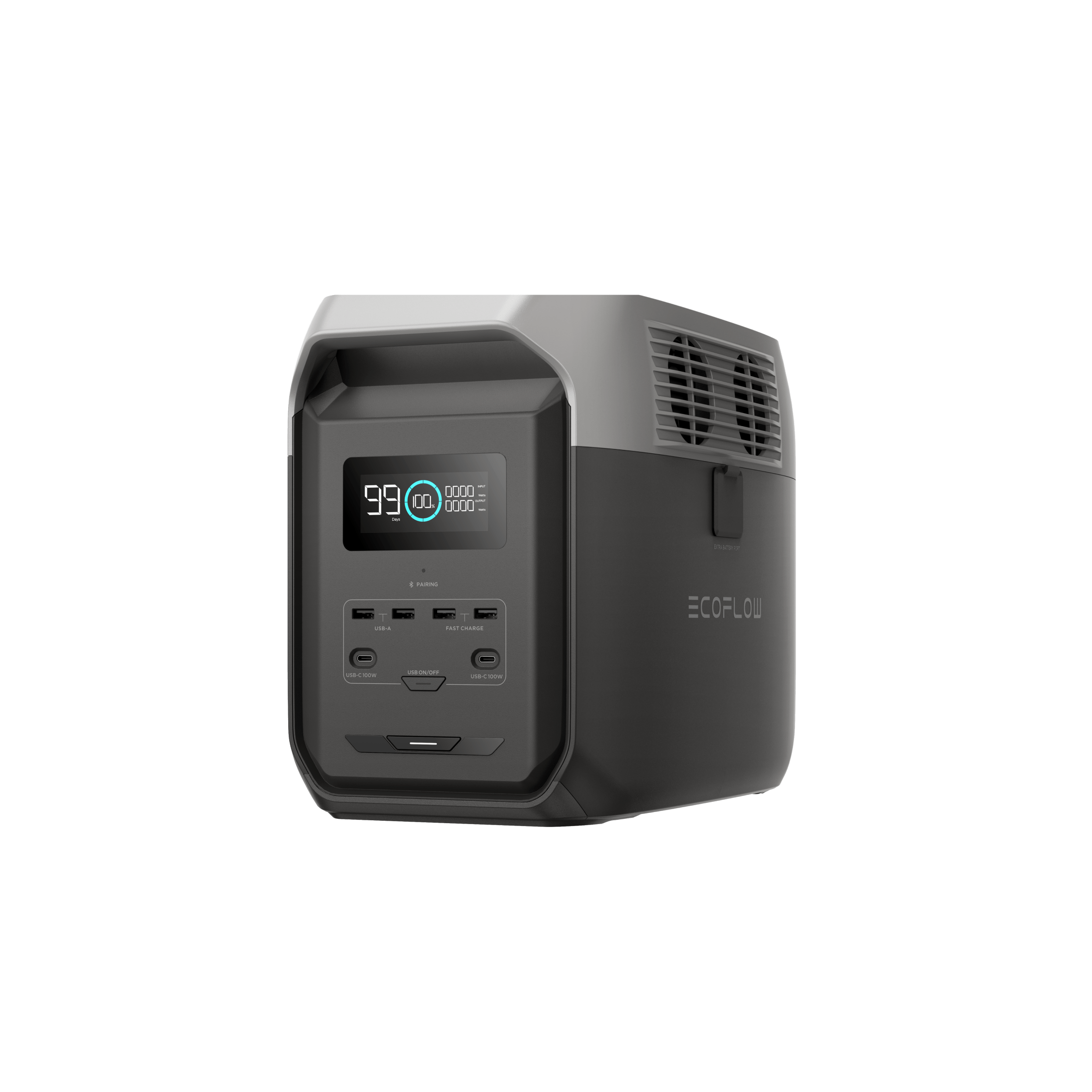
EcoFlow DELTA 3 1500
No longer sold
Prices may vary by retailer and are subject to change.