Head-to-head test
EcoFlow DELTA 3 1000 Air vs BLUETTI AC50B
$309 against $279 buys you 960Wh against 448Wh, so the only question left is whether the EcoFlow is still in stock when you go looking.
Full profiles: BLUETTI AC50B →

Written by Ian SchneiderUpdated
Solar & Off-Grid Tester, Station Arena Test Desk

EcoFlow
DELTA 3 1000 Air
2,933Power Score · Appliance Class
No longer sold
EcoFlow has discontinued the DELTA 3 1000 Air — it has left EcoFlow's own store and our price tracking, though remaining retailer stock may linger. Our recommended replacement is the EcoFlow DELTA 3 Classic: the same 1kWh class, with an 1,800W inverter to the Air's 500W.
DELTA 3 Classic · $559.00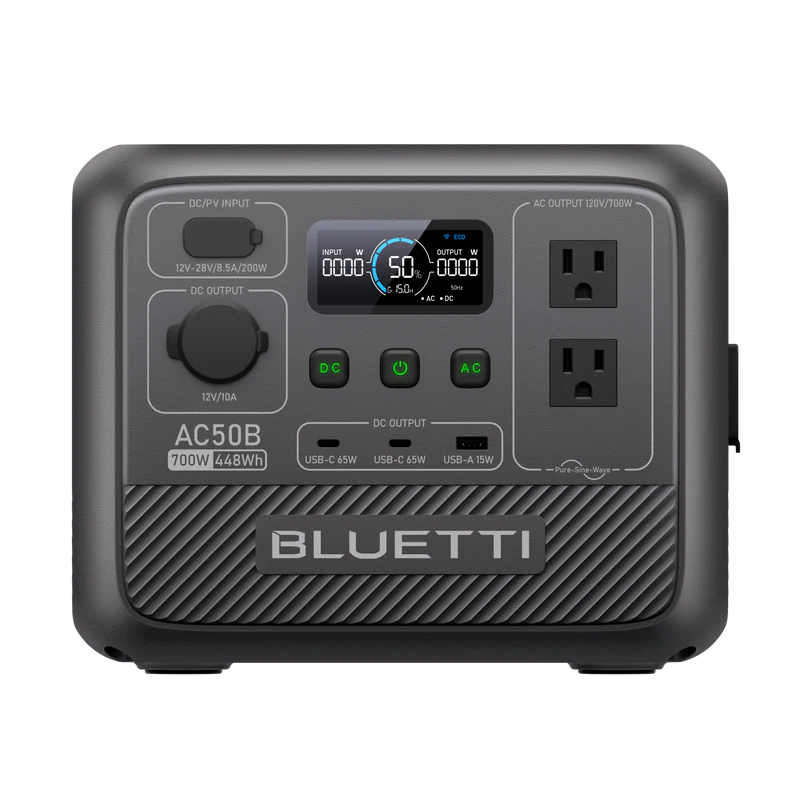
$399.00 · direct from BLUETTI
Last checked 1 day ago. Prices move — check before you buy.
Spec deltas
Thirty dollars is the whole price gap here, $309 against $279, and it buys the difference between 960Wh and 448Wh. That difference is larger than everything the BLUETTI holds. On the numbers this is a short conversation: buy the EcoFlow.
The complication isn't a spec. EcoFlow no longer sells the DELTA 3 1000 Air, and the model that took its slot in the line costs about $549A4. Our price for it rests on one capture with no history behind it. Check that the listing is live and near $309 before you plan around it, because if it isn't, this page ends early and the AC50B wins by being purchasable.
What you give up going EcoFlow is real, so here it is up front: a USB-C port that stops at 18W where the AC50B does 65W, 200W less continuous output at 500W against 700W, 7.2 more pounds at 22 lbs against 14.8, and three fewer warranty years. What you get is more than twice the battery and a unit that covers two of the six load profiles we run, where the AC50B covers one.
What the Numbers Reveal
Each conclusion stated first — the numbers behind it on one line, the full analysis below.
Capacity
Both cells carry the same 3,000-cycle rating, so that capacity gap compounds across the whole life of the unit. 2,880 kWh will pass through the EcoFlow against 1,344 through the BLUETTI, which turns the cheaper sticker into the more expensive energy: 11 cents a lifetime kilowatt-hour against 21.
DELTA 3 1000 Air: 960Wh at $309AC50B: 448Wh at $279Both rated 3,000 cyclesLifetime energy: 2,880 kWh vs 1,344 kWh
Why it mattersAnyone picking on price is optimising the smaller of the two numbers that matter.
continuous output
So the extra output buys the BLUETTI the right to start a load that empties it before the afternoon is over, and the extra capacity buys the EcoFlow duration it can only deliver below 500WA3. These two fail in opposite directions. Neither is a high-draw machine, and the one that looks stronger on the output line is the one that has the least energy behind it.
AC50B: 700W continuous, 381Wh usable after the flat 0.85 derateDELTA 3 1000 Air: 500W continuous, 816Wh usableAt 500W continuous the DELTA won't run a space heater or a hair dryerA3
Why it mattersIf your list has one 600W item on it, the AC50B is the only unit here that starts it, and you should budget half an hour of it, not an evening.
That's survivable, because a desk setup plugs into the AC outlets anyway. But it kills the tidy version of this purchase. And the switchover spec people reach for doesn't rescue it either: 10ms and 20ms both sit on the safe side of the line for a desktop, a router or a NAS, so what actually decides how long your session survives is the 960Wh against 448Wh behind the outlets, not the milliseconds in front of them.
The DELTA 3 1000 Air is built as a power-protection device, sized to keep a computer, monitor and router alive through an outageA2DELTA 3 1000 Air USB-C tops out at 18W; the AC50B does 65WMost USB-C laptops need at least 60W to charge at full speedSwitchover: 10ms vs 20ms
Why it mattersIf your backup plan is one cable to a laptop, that's the AC50B and its 65W port. If it's a desktop that must not reboot, it's the EcoFlow, for the capacity rather than the switchover.
That's the actual risk in buying the EcoFlow at $309, and it isn't the cells. It's year three arriving with the warranty expired on a product the manufacturer has moved on fromA4. The AC50B answers with $56 per covered year against $155, which is the cheapest thing on this page that isn't energy.
AC50B: 5-year warranty at $56 per covered yearDELTA 3 1000 Air: 2-year warranty at $155 per covered yearBoth rated 3,000 cyclesEcoFlow no longer sells the DELTA 3 1000 AirA4
Why it mattersIf you keep small electronics until they die and you want a claim you can actually file, weigh the five years harder than the watt-hours.
The specific dimensions that decide these two units — everything else is a tie.
Runtime: Will It Power Your Gear?
Selected because: 960Wh against 448Wh for $309 against $279 is the axis this whole matchup turns on.
continuous output
Apply the flat 0.85 factor our scenario table puts on every unit and 960Wh becomes 816 usable watt-hours while 448Wh becomes 381. It isn't a per-unit measurement, just a house derate, but it's applied the same way to both, so the ratio survives it: the EcoFlow holds more than twice the energy of the BLUETTI.
The catch is that it can only hand that energy out at 500W, where the AC50B goes to 700W. The bigger battery is the slower tap. 816Wh at 500W is about an hour and a half flat out; 381Wh at 700W is about half an hour. One of these runs a modest load most of an evening. The other starts a bigger load and then stops.
Lifetime Value
Selected because: Both cells are rated 3,000 cycles, so the capacity gap becomes an energy-cost gap: 11 cents per lifetime kilowatt-hour against 21.
cost / lifetime kWh
Eleven cents a lifetime kilowatt-hour against twenty-one. Read that once and the rest of this section is bookkeeping: same 3,000-cycle rating on both, so the entire gap is capacity, and 2,880 kWh will move through the EcoFlow over its life against 1,344 through the BLUETTI.
BLUETTI's counter is the warranty, and it's a genuine one: five years against two works out to $56 per covered year against $155. That's the honest tension on this page. The EcoFlow is cheaper per unit of energy it will ever deliver. The BLUETTI is cheaper per year that somebody else is responsible for it. Which of those you're buying depends on whether you expect to use the thing or to own it.
What the Specs Don't Tell You
Selected because: The EcoFlow's 18W USB-C ceiling and the BLUETTI's five-year warranty are the two facts most likely to change your mind.
Stare at the 18W USB-C port before you buy the EcoFlow. Most USB-C laptops want at least 60W to charge at full speed and a MacBook Air asks for 30W, so at 18W you're topping up a phone and pretending it's a work session. The AC50B does 65W from the same kind of port, and that is the clearest thing the smaller unit wins.
Two of the other cards read stronger than they are. Both units peak at the same 1,000W surge, and the EcoFlow's 2x surge-to-continuous ratio against the BLUETTI's 1.4x falls out of its lower 500W continuous rating rather than a bigger inverter, so the ratio flatters it. And the 10ms against 20ms switchover sorts them into different UPS tiers without changing any outcome you care about, because a desktop, a router, a NAS and a CPAP all ride through either. The warranty card is the one that's exactly as big as it looks.
Your Life, Your Pick
Selected because: Four of the six load profiles come back 'neither', which is worth seeing before you assume either unit covers your outage.
Four of the six load profiles come back 'neither', and that isn't a knock on either unit so much as a description of what they're for. A camping weekend, an 8-hour blackout and a day of van life all want thousands of watt-hours. These two are a laptop, a router, some lights and a CPAP machine. Buy accordingly.
The line falls just above a remote workday. 910Wh is where the EcoFlow lands 94Wh short, close enough that dropping one appliance off the list gets you a full day, while the AC50B is 529Wh short and was never in it. Everything below that line, the EcoFlow takes.
Portability & Form Factor
Selected because: 22 lbs against 14.8 is a 7.2-pound difference, and at this size that lands harder than it would two categories up.
weight
At 14.8 lbs the AC50B is a one-handed carry to the car; at 22 lbs the EcoFlow is the one you set down to open the door. Neither needs a cart, neither needs two people, and anyone telling you a 22-pound box is heavy hasn't lifted a real one.
The trade is legible: 7.2 extra pounds buys the 512Wh between 960Wh and 448Wh, which is about 71Wh a pound. That's a good rate. The question is whether the trip you're packing for cares about the pound or the watt-hour, and for anything that lives in a truck bed, a closet or under a desk, it doesn't care.
Strengths & trade-offs
EcoFlow DELTA 3 1000 Air
Strengths
- +Costs $90 less
- +Larger battery capacity
- +Faster solar charging
Trade-offs
- –No major technical downsides compared to rival.
BLUETTI AC50B
Strengths
- +Lighter by 7.2 lb
- +Higher AC output
- +Longer warranty
Trade-offs
- –No major technical downsides compared to rival.
Will It Power Your Gear?
Scenario math and per-appliance runtimes, modeled from the spec record.
Scenario verdicts
We ran the math on six real-world scenarios. Here's which unit survives your actual life.
SCN-01 · 2 nights · needs 2,100Wh
Weekend Camping
Two nights off-grid with essential comfort
Neither unit
A 2,100Wh weekend is out of reach for both of these. The DELTA 3 1000 Air ends 1,284Wh short and the AC50B 1,719Wh short. That isn't a shortfall you manage with careful use, it's one you fix with a bigger station, and the honest answer is that a camping weekend was never what either box was built for.
Battery budget usedlower = more headroom
LOAD Phone Charger 15W×6h · LED Lights 40W×8h · Box Fan 75W×14h · CPAP Machine 40W×16h
SCN-02 · 8 hours · needs 1,645Wh
8-Hour Blackout
Keep the essentials running through a night without power
Neither unit
1,645Wh of essentials for eight hours, and the DELTA 3 1000 Air is 829Wh short of it while the AC50B is 1,264Wh short. Either one will hold the router, the phones and a lamp through the evening. Neither one holds the fridge, and the fridge is usually what the blackout is about.
Battery budget usedlower = more headroom
LOAD Fridge 150W×8h · Router + Modem 20W×8h · LED Lights (4 bulbs) 40W×6h · Phone Charger 15W×3h
SCN-03 · 8 hours · needs 320Wh
CPAP Overnight
Sleep therapy without interruption — the #1 medical use case
DELTA 3 1000 Air
Take the DELTA 3 1000 Air, on reserve rather than noise. A 320Wh night leaves it 496Wh spare where the AC50B finishes with 61Wh, and since 496Wh is another full night's worth, one of these lets you skip a morning at the outlet and the other doesn't. That's the difference worth paying for at this size.
Battery budget usedlower = more headroom
LOAD CPAP Machine 40W×8h
SCN-04 · 8 hours · needs 910Wh
Remote Workday
Full work day off-grid without power anxiety
Neither unit
Neither quite gets there, but the two failures aren't the same failure. The DELTA 3 1000 Air finishes 94Wh short of a 910Wh workday, which one fewer appliance on the list closes. The AC50B is 529Wh short, and nothing you unplug rescues that.
Battery budget usedlower = more headroom
LOAD Laptop 60W×8h · External Monitor 30W×8h · Router + Modem 20W×8h · Phone Charger 15W×2h
SCN-05 · 4 hours · needs 670Wh
Tailgate Party
Game day power for the crew
DELTA 3 1000 Air
The DELTA 3 1000 Air covers a 670Wh tailgate and finishes with 146Wh in hand. The AC50B comes up 289Wh short of the same 670Wh, so it's not a question of stretching it. Bring the bigger box, or bring the smaller one and a plan for when it stops.
Battery budget usedlower = more headroom
LOAD Blender 400W×0.5h · LED TV (55") 80W×4h · Bluetooth Speaker 15W×4h · Phone Charger (×3) 45W×2h
SCN-06 · 24 hours · needs 4,685Wh
Van Life Daily
A full day of mobile living — the ultimate endurance test
Neither unit
4,685Wh a day is nearly five times the DELTA 3 1000 Air's 960Wh and more than ten times the AC50B's 448Wh, leaving shortfalls of 3,869Wh and 4,304Wh. Full-time van life on either of these means a generator, an alternator charger, or a much larger battery. Realistically all three.
Battery budget usedlower = more headroom
LOAD Mini-Fridge 150W×24h · Laptop 60W×4h · Phone Charger 15W×3h · LED Lights 40W×5h · Fan 75W×8h
The Load Test
RUNTIME = (Wh × 0.85) ÷ LOAD
None of the scenarios above exactly yours? Build it. Toggle what you'd plug in; both units are tested against the combined draw.
Essentials
Comfort & Convenience
High-Draw Appliances
Test duration
8h
Continuous draw
205W
Projected runtime
For this load: DELTA 3 1000 Air runs 4h vs 1.9h.
Modeled from the spec record — same math as the tables below. Methodology
Runtime by appliance
Real-world runtime estimates for common appliances, modeled at 85% inverter efficiency.¹
Essentials
The basics you need runningscale 0–54.4hComfort & Convenience
Makes off-grid life actually enjoyablescale 0–10.9hHigh-Draw Appliances
These reveal the real limits¹ Runtime = (capacity × 0.85) ÷ appliance watts. Within each group, all bars share one time scale (the group's longest runtime), so lengths are comparable across appliances; identical runtimes collapse into a single blue/orange bar. Actual runtime varies with battery age, temperature, and simultaneous loads — see methodology.
Conclusion
August 9, 2026
Verdict: the DELTA 3 1000 Air
Take the DELTA 3 1000 Air at $309 if you can find one in stock. It holds 960Wh where the AC50B holds 448Wh, and at 11 cents per lifetime kilowatt-hour against 21 the bigger battery is also the cheaper energy. Confidence sits at six rather than nine for one reason: EcoFlow has stopped selling this model, and the closest thing left in its line runs about $549A4. Our $309 comes from a single price capture with no history behind it, which is what a unit looks like on its way off the shelves, so verify the listing before you plan around it. If it's gone, buy the AC50B without regret: $279, 700W continuous, 65W over USB-C, five years of warranty against two. What you should not do is stretch to the roughly $549 replacementA4 unless the thing you actually needed was more output, in which case neither of these two was ever the right shelf.
Editor-assigned confidence, based on cited owner research and spec analysis.
List prices as of August 9, 2026. The links below open EcoFlow's and BLUETTI's current prices.
$309.00 · direct from EcoFlow
or check the AC50B price$399.00 list
Written by Ian Schneider, Solar & Off-Grid Tester · Station Arena Test Desk · Updated August 9, 2026
Measured Data
Benchmark scores and the full spec record, side by side.
Benchmark scores
Not rated for both units (minimum threshold unmet): Tailgating.
Full specifications
ᵈ Derived: price ÷ rated capacity. See the data behind our comparisons →
Comparison ToolAdd more power stations, side by sideOpen Tool →How these numbers are produced
Numeric verification
Every figure on this page traces to our spec database or arithmetic on it — no estimated numbers.
Owner claims
Statements about owner experience are cited to published reviews — see Sources & Research Notes below.
Runtime model
Runtime = (rated capacity × 0.85 inverter efficiency) ÷ device wattage. Solar recharge estimates assume panels deliver 70% of rated output. Cold weather, battery age, and stacked loads reduce real-world results.
Power Score
Computed from 14 published spec dimensions, weighted per use-case bench. Higher is better; a unit must meet a bench's minimum threshold to be rated.
See the full weight table and data sourcing on our methodology page →Class ranking (the star rating)
Each unit's star score is a category ranking, not customer reviews — no buyer opinions feed it. We score every station on size-independent quality (value, output, portability, endurance, ports, warranty, and more), then percentile-rank it against the other units in its capacity class, so a class-leading compact unit and a class-leading whole-home unit can both earn 5★. Here, DELTA 3 1000 Air rates 5.0/5 (99th percentile of 20 Compact-class units), and AC50B rates 4.6/5 (76th percentile of 22 Personal-class units).
How the class ranking is computed →Test Notes & Caveats
Hidden gotchas and advantages we spotted that you won't find on the product page.
45dB vs 39dB, Rated
The AC50B is rated 45dB under load against the DELTA 3 1000 Air's 39dB, a six-decibel gap that looks decisive on paper. These are single rated figures, though, not curves, and neither is measured at the low draw a CPAP or a router actually pulls. Use them as a tiebreak between otherwise equal units and no further. On this pair the bedside argument is settled by reserve capacity long before it gets to decibels.
DELTA 3 1000 Air: 18W Is a Phone Port
18W is the ceiling on the DELTA 3 1000 Air's fastest USB-C port. A MacBook Air asks for 30W, a MacBook Pro 96W, and most USB-C laptops want at least 60W to charge at full speed, so at 18W the laptop charges slowly and under load may not charge at all. You'd run its own charger from an AC outlet instead, which works but costs you the tidy single-cable version of this setup. The AC50B does 65W from its port, and this is the clearest thing the smaller, cheaper unit wins.
Surge: Same 1,000W Ceiling, Different Ratio
Both units peak at 1,000W. The DELTA 3 1000 Air's 2x surge-to-continuous ratio against the AC50B's 1.4x comes from its lower 500W continuous rating rather than a bigger inverter, so read the ratio as headroom over its own steady state, not as a higher ceiling. On a compressor startup the number both units bring is the same 1,000W. What separates them is what happens after the motor spins up, and there the AC50B holds 700W continuous against the DELTA 3 1000 Air's 500W.
10ms vs 20ms: Both Clear the Bar
The DELTA 3 1000 Air switches to battery in 10ms and the AC50B in 20ms, which sorts them into line-interactive and standby. Both are inside what a desktop, a router, a NAS or a CPAP rides through without noticing, so the millisecond gap isn't the reason to pick one over the other. If you're buying either as a desk UPS, the spec that decides how long the session survives the outage is capacity: 960Wh against 448Wh.
Warranty: 5 Years vs 2
The AC50B is covered for 5 years against the DELTA 3 1000 Air's 2 years. The AC50B's figure is a maximum rather than a guarantee — it depends on buying direct from BLUETTI or registering the unit, since reseller purchases carry a shorter term. An underrated factor if you're keeping this unit for years.
Full record above — the Test Desk pick is the DELTA 3 1000 Air.
Check DELTA 3 1000 Air price →or check the AC50B priceOwnership Analysis
What happens after you buy — true cost of ownership, brand trust, and growth potential.
Lifetime value
Service lifeyears at one full cycle per day
Lifetime energy delivered
Cost per delivered kWh
│ warranty ends · Reaching the cycle rating means ~80% capacity remains — degraded, not dead.
Analyst note
The DELTA 3 1000 Air wins on both sticker price and long-term value. At $0.11/kWh over its lifetime, it's meaningfully cheaper to own. Clear value winner. One thing to know reading the table: both carry the same 3,000-cycle rating, so the lifetime rows are sticker price and capacity in disguise — the wear horizon is identical and decides nothing here.
Delivers each lifetime kWh for $0.19 less — check the DELTA 3 1000 Air price →
Brand trust
EcoFlow
Ecosystem
The deepest catalog in portable power, 12 to 15 models plus panels and home smart panels. At 960Wh you're shopping the small end of it.
Support
US-based phone/email/chat support (1-800-368-8604). Experiences are polarized — many report hassle-free prepaid-label replacements, but others report long waits and refurbished units sent for new claims. Pro tip: buying from Costco or Amazon gives you a stronger return safety net.
Community
Largest community in the space — Reddit r/Ecoflow_community (~31K members), multiple Facebook groups, and an official community forum
App experience
Rated 4.6/5 iOS (~8,400 ratings) · 4.2/5 Android (~17,000 ratings)
Unique strength
Intake speed is the standing EcoFlow edge and it shows here: a 500W solar ceiling on a 960Wh battery, against 200W on the AC50B's 448Wh.
Worth knowing
Tested subscription paywalls for advanced app features in early 2025 before community backlash paused the plan. No parts or service offered out of warranty.
BLUETTI
Ecosystem
One of the broadest lineups going, from budget stations to flagship portables, including sodium-ion cold-weather units and vehicle solar hubs.
Support
The most inconsistent support in the space. Heavily email-based with China timezone delays. Some users get smooth, efficient service; others report weeks of troubleshooting runarounds, being offered discounts on new units instead of repairs, and confusing third-party purchase claim processes. Buying direct from Bluetti's website tends to produce better support outcomes.
Community
Active and growing — Reddit r/bluetti has a dedicated community. Second-largest after EcoFlow in engagement.
App experience
Rated 4.5/5 iOS and Android — tied for best app experience in the category. V3.0 UI redesign was well-received.
Unique strength
Capacity per dollar is BLUETTI's standing argument, and this is the rare page where it loses it: 62 cents a watt-hour against the EcoFlow's 32.
Worth knowing
LFP across the whole lineup, though the cycle ratings vary more than the headline range suggests. The AC50B is rated 3,000 cycles, the same number as the EcoFlow.
Analyst note
Two different bets separated by thirty dollars, $309 against $279. EcoFlow's is the bigger battery and the cheaper energy across its life. BLUETTI's is five years of cover at $56 a covered year against $155. Neither brand argument decides this one, though. The capacity does.
Growth path
DELTA 3 1000 Air
FIXED CAPACITYFixed at 960Wh, with no expansion — so size it for your needs up front rather than planning to add capacity later.
Accepts up to 500W of solar. Suitable for a 1-2 panel setup.
Adequate ports for most setups, but heavy users may want a power strip.
AC50B
FIXED CAPACITYFixed at 448Wh, with no expansion — so size it for your needs up front rather than planning to add capacity later.
Accepts up to 200W of solar. Limited to a single portable panel.
Limited ports. You'll likely need a power strip or splitter.
Realistic full solar rechargeat 70% of rated panel output — see methodology
Analyst note
Neither expands, and that's no knock on either — each is a complete unit at a fixed size. Buy the capacity that covers your needs now (the DELTA 3 1000 Air gives you the larger ceiling); you can't add to either later.
What Owners Report
Patterns from published owner reports and long-term reviews — every claim cited to its source below.
EcoFlow DELTA 3 1000 Air
Field data on the DELTA 3 1000 Air is thin, and what exists comes from reviewers rather than long-term ownersA1A2A3. It's consistent, at least. The picture is a 960Wh LFP unit with a 500W inverter and an 800W X-Boost mode at 22 lbs, deliberately minimalist, with fewer ports and fewer features than EcoFlow usually shipsA1. Reviewers frame it as a power-protection device first, sized to hold a computer, monitor and router through an outage rather than to run a campsiteA2.
The recurring caveat is the one the spec sheet already implies: at 500W continuous it won't run a space heater or a hair dryer, and it was never built toA3. The most load-bearing entry in this ledger isn't about performance at all. EcoFlow has stopped selling the unit, with the closest current model in the line at roughly $549A4. Treat the $309 as a closeout number and confirm it's still real.
“A 960Wh LiFePO4 unit with a 500W inverter (800W X-Boost) weighing only 22 lbs — a focused, minimalist design with fewer ports and features.”
Sources
thesolarlab.com · batteryskills.com · backuppowerhub.com · matanich.com
BLUETTI AC50B
The AC50B's reputation is built on being the cheap LFP unit that doesn't feel cheap: 448Wh, 700W of output with a 1,000W Power Lifting mode, at 14.8 lbsB1B2. The weight is the part reviewers keep returning to, a genuinely sub-15-pound station with a long-cycle battery and 700W behind it at a price that's easy to justifyB2.
Charging is a real strength, and one we have no matching figure for on the EcoFlow side: about 3 hours on standard AC, down to 1.25 hours with the optional 480W Turbo charger, and 0-80% in 45 minutesB3. One caution about the expansion story. BLUETTI's own FAQ scopes the optional add-on pack to a power-bank mode that recharges the station over a cable rather than joining it as one larger system, so it isn't expandability in the sense this site usesB4, and that entry comes from the manufacturer rather than the field.
“A 448Wh LiFePO4 battery with 700W output (1,000W Power Lifting), rated for 2,500+ cycles to 80% — years of reliable use.”
Sources
amazon.com · backuppowerhub.com · the-gadgeteer.com · t3.com · bluettipower.com
Sources & Research Notes
Every owner claim in this report is traceable to a published source. The bracketed references above resolve here.
Recurring owner themes
- A focused home-office UPS unit — LFP, 10ms UPS, quiet and light — but low 500W output; now discontinued in favor of the DELTA 3. [DELTA 3 1000 Air · 3 entries]
- Affordable, genuinely portable LFP unit with 700W output, 2,500+ cycles, fast Turbo charging, and B80 expandability. [AC50B · 3 entries]
- A1
“A 960Wh LiFePO4 unit with a 500W inverter (800W X-Boost) weighing only 22 lbs — a focused, minimalist design with fewer ports and features.”
thesolarlab.com / batteryskills.com — DELTA 3 1000 Air review · 2026 · [mixed]
- A2
“Built as a power-protection device with a 10ms UPS switchover to keep a computer, monitor, and router running through outages.”
backuppowerhub.com — DELTA 3 1000 Air review · 2026 · [positive]
- A3
“With only 500W continuous output, it won't run a space heater or hair dryer — it's built for low-to-moderate draw devices.”
backuppowerhub.com / matanich.com — DELTA 3 1000 Air review · 2026 · [mixed]
- A4
“EcoFlow no longer sells the DELTA 3 1000 Air; the closest successor is the standard DELTA 3 (1,024Wh LFP, 1,800W output, ~$549).”
backuppowerhub.com — DELTA 3 line · 2026 · [mixed]
- B1
“A 448Wh LiFePO4 battery with 700W output (1,000W Power Lifting), rated for 2,500+ cycles to 80% — years of reliable use.”
amazon.com / backuppowerhub.com — AC50B review · 2026 · [positive]
- B2
“At 14.8 lbs it's meaningfully lighter than the AC70 (21.4 lbs) — a genuinely portable sub-15-lb unit with a long-cycle battery and 700W output at an easy-to-justify price.”
backuppowerhub.com / the-gadgeteer.com — AC50B review · 2026 · [positive]
- B3
“Standard AC charging is about 3 hours, dropping to 1.25 hours with the optional 480W Turbo charger; 0-80% in 45 minutes.”
amazon.com / t3.com — AC50B review · 2026 · [positive]
- B4
“The B80 can add 806Wh, but BLUETTI scopes this to "capacity expansion with B80 battery in Power Bank Mode" over an Aviation-to-XT60 cable — the pack recharges the unit rather than extending it as one system, so this is not expandability in the sense this site uses. At $279 it is BLUETTI's most affordable LiFePO4 station.”
bluettipower.com AC50B FAQ (primary) · 2026 · [positive]
Research compiled August 9, 2026.
Who Should Buy Which
Buy the DELTA 3 1000 Air if you…
- →You want the most watt-hours you can get near $300 and you'll accept a 500W ceiling to get them: $309 for 960Wh, and nothing on this page comes near it.
- →Your outage plan is a desktop, a monitor and a router that must not reboot, and you'd rather have a second night of CPAP in reserve than a faster USB-C port.
- →You buy on cost per unit of energy and keep gear for years, in which case what you're really paying for is the 2,880 kWh this unit will deliver across its rated 3,000 cycles.
- →You want the unit that finishes a 670Wh tailgate with 146Wh still in it rather than the one that stops 289Wh short.
This is you — check the DELTA 3 1000 Air price
Buy the AC50B if you…
- →One item on your list needs 700W and won't start at 500W, and you accept that 448Wh means running it in short stretches rather than all afternoon.
- →The laptop is the whole point: 65W down a single USB-C cable, no brick, no AC outlet in the chain.
- →You're carrying it. 14.8 lbs is a one-hand lift in and out of a car all weekend, where 22 lbs is a two-hand one.
- →You want the longer cover on a unit that's easy to find in stock: five years against two, at $56 per covered year against $155.
If neither fits
If your list has a fridge overnight, a space heater, or anything that resembles a real blackout on it, close this tab. The 8-hour blackout profile we run needs 1,645Wh and the larger of these two finishes 829Wh short; a camping weekend at 2,100Wh leaves it 1,284Wh short. That's not a gap you manage with careful rationing, it's a gap you fix with a different product. Shop for a station that clears the 1,645Wh blackout outright with headroom above 700W of continuous output, and accept that it's a different price bracket and a different page.
The Bottom Line
$309 buys 960Wh. $279 buys 448Wh. Same 3,000-cycle rating on both, which makes the bigger battery the cheaper energy over its life rather than the expensive option, and that is the argument the AC50B has no answer to. Its 65W USB-C port, its 700W output and its five years of cover are all real, and none of them close a gap that size.
The one thing that does beat the argument is a listing that doesn't exist. EcoFlow has stopped selling the DELTA 3 1000 AirA4 and our price for it rests on a single capture, so check stock first and treat anything far above $309 as a signal to walk. If it's gone, take the AC50B at $279 and enjoy the lighter carry and the longer warranty. Just buy it knowing you bought the smaller battery on purpose.
Frequently Asked Questions
Answers drawn from the spec record and cited owner research.
Is the EcoFlow DELTA 3 1000 Air still being sold?
Not by EcoFlow. Our research has it out of production, with the closest current model in the line running about $549. The $309 we show comes from a single price capture with no history behind it, which is typically what a unit looks like once it stops being restocked. If you find one live at that price it's the better buy of the two, but confirm stock before you build a plan around it.
Which one is better for working off a laptop all day?
The EcoFlow, but not over USB-C. Its USB-C port maxes at 18W, where most USB-C laptops want 60W and even a MacBook Air asks 30W, so you'd run the laptop's own charger from an AC outlet. The AC50B's 65W port is the one-cable answer, but with 448Wh against 960Wh there's less than half the energy behind it. Note that a full 910Wh remote workday beats both: the EcoFlow misses it by 94Wh and the AC50B by 529Wh.
Can I add more battery to either of these later?
No. Both are fixed at the size you buy, 960Wh and 448Wh, and neither has an expansion port that grows the system. BLUETTI's optional add-on pack for the AC50B runs in a power-bank mode that recharges the station over a cable instead of joining it as one larger battery, which per BLUETTI's own FAQ is not expansion in any sense that helps you here. Size for what you need now.
Which is better for running a CPAP overnight?
The EcoFlow, on reserve rather than noise. A 320Wh night leaves it 496Wh spare against the AC50B's 61Wh, so one of them goes a second night without finding an outlet and the other gets recharged every morning. Both are rated quietly enough to sit beside a bed, but those decibel figures are single bucketed ratings rather than measurements at the roughly 40W a CPAP actually pulls, so don't let them be the tiebreak.
Is BLUETTI's five-year warranty worth $30 and half the capacity?
Only if you keep small electronics past year three. BLUETTI covers the AC50B for five years and EcoFlow covers the DELTA 3 1000 Air for two, which works out to $56 per covered year against $155. Against that, the EcoFlow delivers 2,880 kWh across its rated 3,000 cycles to the AC50B's 1,344, so you're trading energy you will definitely use for a claim you might never file. On a unit EcoFlow has stopped selling, though, that trade is closer than the raw numbers make it look.
Check DELTA 3 1000 Air price →
Brand matchup
EcoFlow vs BLUETTI: measured across every matchup →Where to buy
EcoFlow DELTA 3 1000 AirPick
$309.00
$309.00 · direct from EcoFlow
BLUETTI AC50B
$399.00
$399.00 · direct from BLUETTI
Last checked 1 day ago. Prices move — check before you buy.
Prices may vary by retailer and are subject to change.