Head-to-head test
EcoFlow DELTA 2 vs DJI Power 1000 V2
The DELTA 2 is cheaper to buy and cheaper to own, but its fans are its most-cited flaw and the DJI's near-silence is its headline — so this whole matchup is a clean trade of $220 for quiet.
Full profiles: EcoFlow DELTA 2 → · DJI Power 1000 V2 →

Written by Ian SchneiderUpdated
Solar & Off-Grid Tester, Station Arena Test Desk
Spec deltas
The DELTA 2 costs $220 less than the DJI and is cheaper to own on top of it, $0.16 per lifetime kilowatt-hour against $0.17. On money alone this is over before it starts. What keeps it interesting is that the DELTA 2's best-documented weakness lines up precisely with the DJI's headline strength.
That weakness is noise. Owners consistently report the DELTA 2's fans triggering above 120W and climbing toward a gaming-laptop whir at full charge, loud enough that running medical gear in a bedroom means the fan or an extension cord out the doorA1A2. The DJI is the quietest box in this comparison, near-silent even while charging at speedB1, and it throws in a faster 10ms UPS handoff against the DELTA 2's 20, plus 4,000-cycle cells and a 56-minute refillB4.
So pick your priority honestly. The DELTA 2 is the value winner and it isn't close on price — same 1,024Wh, five-year warranty, six outlets, $220 kept. The DJI is the same capacity done quietly and built better, for a premium and no listed warranty. If the unit shares a room with sleeping people, that's the DJI's row. Everywhere else, take the DELTA 2 and the savings.
What the Numbers Reveal
Each conclusion stated first — the numbers behind it on one line, the full analysis below.
So the decision is unusually clean: $220 buys silence, nothing more and nothing less. Neither is quieter for free — the DELTA 2 makes you choose between the savings and the sound, and only you know whether the unit lives 18 inches from a pillow or 18 feet away in a garage.
DELTA 2: fans trigger above 120W, gaming-laptop volume at full chargeA1A2DJI: near-silent even during full-speed chargingB1DELTA 2 is $220 cheaper and cheaper to own ($0.16 vs $0.17/kWh)
Why it mattersBedroom, nursery, or home office: pay for the DJI. Garage, jobsite, or RV bay: bank the $220 on the DELTA 2.
The DJI's quiet isn't a setting or a pending update; it's the default at full speedB1. That's the difference between a unit that's quiet when you manage it and one that's quiet when you ignore it. For a set-and-forget backup you never want to babysit, the second kind is worth more.
EcoFlow said a firmware update would address the DELTA 2's fan noiseA4DELTA 2 fans can be quieted by lowering charge speed in the appA2The DJI needs no workaround — it's quiet at full speedB1
Why it mattersIf you won't fiddle with app settings every charge, the DJI's out-of-the-box silence is the safer bet than the DELTA 2's conditional quiet.
Both switchover speeds keep a router or a fridge alive without a blink, so the 10ms edge only bites for the fussiest electronics. Meanwhile the DELTA 2's track record — outages, camping trips, daily office duty, still goingA3 — is the kind of proof a new premium brand simply hasn't had time to earn.
DELTA 2: 20ms standby UPS switchoverDJI: 10ms line-interactive UPS switchoverDELTA 2 has a documented 18-month reliability record across outages and campingA3
Why it mattersFussy always-on gear leans DJI for the faster handoff; buyers who value a proven survivor lean DELTA 2.
The specific dimensions that decide these two units — everything else is a tie.
Lifetime Value
Selected because: DELTA 2 wins both cost columns — cheaper to buy ($220) and cheaper to own ($0.16 vs $0.17) — the strongest value case in the DJI's bracket.
This is the one section with a clean winner, and it's the DELTA 2. It's cheaper on the sticker by $220 and cheaper to own too, $0.16 per lifetime kilowatt-hour against the DJI's $0.17 — the only pairing in the DJI's 1kWh lineup where the rival takes both money columns outright.
That matters because it removes the usual 'pay more now, save later' defense of a premium unit. Here there's no later saving to point to; the DJI is dearer to buy and dearer to run. Whatever it earns, it earns on quiet and build, not on economics.
What the Specs Don't Tell You
Selected because: Noise card on the DELTA 2, UPS to DJI, cycle life to DJI, and the ironic noise-disclosure flag on the quiet DJI — the noise theme runs through all four.
rated cycles
Four cards fire and the noise theme threads through three of them. The DELTA 2 draws the noise card for its 50dB under load. The DJI takes the UPS card at 10ms against 20, and the cycle-life card at 4,000 cells against 3,000.
The fourth card is the quiet joke of the set: the noise-disclosure flag lands on the DJI for publishing no decibel number, while the DELTA 2 dutifully lists 50. So the transparent one is the loud one, and the box that hid its figure is the one that tested near-silent. Ding the DJI for the missing spec if you like — just don't read the blank as 'louder,' because on this pair the measured reality runs the other way.
Portability & Form Factor
Selected because: 27 lb vs 31.3, 4.3 lb, plus the DELTA 2's centered handle against the DJI's unbalanced side grips.
weight
The DELTA 2 is the lighter carry at 27 lb against 31.3, a 4.3 lb gap that's the difference between a casual one-hand grab and a more deliberate lift. It also has the better-placed handle: reviewers found the DJI's side grips leave it swinging unbalanced when carried one-handed at just over 31 lbB11, where the DELTA 2's stays level. Neither needs wheels; both go up basement stairs in one trip.
Brand Trust
Selected because: Cross-brand: EcoFlow's proven-if-polarized support vs DJI's two-year, premium-but-unlisted-warranty entry.
EcoFlow is the category veteran with the biggest owner community and the deepest catalog, and the DELTA 2 has aged into a known quantity — a unit with years of field history behind it. The honest asterisks are a polarized support desk and a 2025 DELTA Max recall worth knowing; a retailer with an easy return policy is the smart buy.
DJI is two years into power stations, offering drone-grade build and a walled garden around it: proprietary solar, SDC ports for DJI gear only, an app rated for the whole DJI catalog rather than this box. The hardware feels a class above; the reassurance around it — a listed warranty, an owner community, a long track record — is the part still missing.
Strengths & trade-offs
EcoFlow DELTA 2
Strengths
- +Lighter by 4.3 lb
Trade-offs
- –Weaker inverter (-800W) limits appliance compatibility.
- –Shorter-lived battery — rated for 3,000 charge cycles vs the Power 1000 V2's 4,000, so it wears out sooner.
DJI Power 1000 V2
Strengths
- +Higher AC output
- +Faster solar charging
- +Rated for 4,000 charge cycles — much longer battery lifespan
Trade-offs
- –No major technical downsides compared to rival.
Will It Power Your Gear?
Scenario math and per-appliance runtimes, modeled from the spec record.
Scenario verdicts
We ran the math on six real-world scenarios. Here's which unit survives your actual life.
SCN-01 · 2 nights · needs 2,100Wh
Weekend Camping
Two nights off-grid with essential comfort
Neither unit
Neither unit covers this scenario's 2,100Wh: the DELTA 2 comes up 1,230Wh short (about 41% covered), the Power 1000 V2 1,230Wh (41%). Treat this as partial cover — enough for the essentials in it, not the whole list.
Battery budget usedlower = more headroom
LOAD Phone Charger 15W×6h · LED Lights 40W×8h · Box Fan 75W×14h · CPAP Machine 40W×16h
SCN-02 · 8 hours · needs 1,645Wh
8-Hour Blackout
Keep the essentials running through a night without power
Neither unit
The full 1,645Wh basket is well over what 1,024Wh holds, so both cover only about half the night and neither truly wins. Trim to a fridge, a router, and phones and either stretches much further — identically, since the tanks are the same size. The real fix is more capacity, not a choice between these two.
Battery budget usedlower = more headroom
LOAD Fridge 150W×8h · Router + Modem 20W×8h · LED Lights (4 bulbs) 40W×6h · Phone Charger 15W×3h
SCN-03 · 8 hours · needs 320Wh
CPAP Overnight
Sleep therapy without interruption — the #1 medical use case
Either unit
A 320Wh night uses about a third of either tank, so capacity is a non-issue and this comes down to the pillow. A basic CPAP draws too little to wake either unit's fans, so both sit silent and the DELTA 2's lower price wins. But a heated-humidifier setup can push past the 120W where the DELTA 2's fans trigger — if that's your machine, the DJI's near-silence is worth the premium beside your head.
Battery budget usedlower = more headroom
LOAD CPAP Machine 40W×8h
SCN-04 · 8 hours · needs 910Wh
Remote Workday
Full work day off-grid without power anxiety
Neither unit
This scenario needs 910Wh and neither unit quite finishes it. Both land within 5% of it — close enough that trimming one appliance, or accepting a shorter evening, gets you there on the day.
Battery budget usedlower = more headroom
LOAD Laptop 60W×8h · External Monitor 30W×8h · Router + Modem 20W×8h · Phone Charger 15W×2h
SCN-05 · 4 hours · needs 670Wh
Tailgate Party
Game day power for the crew
Either unit
Both handle game day easily. Since capacity isn't the deciding factor, weight is: at 27 lbs the DELTA 2 is the easier carry, but it is no longer sold, so the Power 1000 V2 is the one to plan around. Fan noise under load is worth a listen too — it's audible in the lulls between songs.
Battery budget usedlower = more headroom
LOAD Blender 400W×0.5h · LED TV (55") 80W×4h · Bluetooth Speaker 15W×4h · Phone Charger (×3) 45W×2h
SCN-06 · 24 hours · needs 4,685Wh
Van Life Daily
A full day of mobile living — the ultimate endurance test
Neither unit
A 4,685Wh day is more than four times either unit, so neither belongs as a solo house battery in a full-time van. The DELTA 2's proven expansion path is the more relevant answer here — plan the extra battery from the start, and treat the base unit as the first module rather than the whole system.
Battery budget usedlower = more headroom
LOAD Mini-Fridge 150W×24h · Laptop 60W×4h · Phone Charger 15W×3h · LED Lights 40W×5h · Fan 75W×8h
The Load Test
RUNTIME = (Wh × 0.85) ÷ LOAD
None of the scenarios above exactly yours? Build it. Toggle what you'd plug in; both units are tested against the combined draw.
Essentials
Comfort & Convenience
High-Draw Appliances
Test duration
8h
Continuous draw
205W
Projected runtime
Dead heat — both run this 205W load for roughly 4.2h. Pick on price, weight, or ports.
Planning for more than this? Describe your whole setup and get it sized →
Modeled from the spec record — same math as the tables below. Methodology
Runtime by appliance
Real-world runtime estimates for common appliances, modeled at 85% inverter efficiency.¹
Essentials
The basics you need runningscale 0–58hComfort & Convenience
Makes off-grid life actually enjoyablescale 0–11.6hHigh-Draw Appliances
These reveal the real limitsscale 0–0.9h¹ Runtime = (capacity × 0.85) ÷ appliance watts. Within each group, all bars share one time scale (the group's longest runtime), so lengths are comparable across appliances; identical runtimes collapse into a single blue/orange bar. Actual runtime varies with battery age, temperature, and simultaneous loads — see methodology.
Conclusion
July 18, 2026
Verdict withdrawn: the DELTA 2 is no longer sold
We picked the DELTA 2, but it's been discontinued (EcoFlow now points buyers to the DELTA 3). The Power 1000 V2 is still on sale, but that alone doesn't make it our pick. The comparison below is still accurate if you own either one.
Editor-assigned confidence, based on cited owner research and spec analysis.
Written by Ian Schneider, Solar & Off-Grid Tester · Station Arena Test Desk · Updated July 18, 2026
Black Friday · 38 days out
Price to beat:Power 1000 V2 $699
We have never seen it discounted, so any real cut would be a first.
Measured Data
Benchmark scores and the full spec record, side by side.
Benchmark scores
Full specifications
ᵈ Derived: price ÷ rated capacity. See the data behind our comparisons →
Comparison ToolAdd more power stations, side by sideOpen Tool →How these numbers are produced
Numeric verification
Every figure on this page traces to our spec database or arithmetic on it — no estimated numbers.
Owner claims
Statements about owner experience are cited to published reviews — see Sources & Research Notes below.
Runtime model
Runtime = (rated capacity × 0.85 inverter efficiency) ÷ device wattage. Solar recharge estimates assume panels deliver 70% of rated output. Cold weather, battery age, and stacked loads reduce real-world results.
Power Score
Computed from 14 published spec dimensions, weighted per use-case bench. Higher is better; a unit must meet a bench's minimum threshold to be rated.
See the full weight table and data sourcing on our methodology page →Class ranking (the star rating)
Each unit's star score is a category ranking, not customer reviews — no buyer opinions feed it. We score every station on size-independent quality (value, output, portability, endurance, ports, warranty, and more), then percentile-rank it against the other units in its capacity class, so a class-leading compact unit and a class-leading whole-home unit can both earn 5★. Here, DELTA 2 rates 4.1/5 (50th percentile of 27 Everyday-class units), and Power 1000 V2 rates 4.9/5 (92nd percentile of 27 Everyday-class units).
How the class ranking is computed →Test Notes & Caveats
Hidden gotchas and advantages we spotted that you won't find on the product page.
The DELTA 2 is the loud one, and we're not hiding it
Under heavy load the DELTA 2 runs around 50dB, and its fans wake up at anything past 120W — the honest catch against our value pick. You can tame it by throttling charge speed in the app, but that costs you the fast recharge. If the unit lives somewhere quiet, weigh this seriously; if it lives in a garage, it's noise nobody will hear.
10ms line-interactive vs 20ms standby
The DJI hands off in 10ms, the DELTA 2 in 20 — both fast enough for a router or fridge to never notice, but the DJI's is the one you'd trust under a desktop mid-save or a NAS array. If blackout desk duty is the job, this card leans DJI. For ordinary gear, the gap is one you'll never perceive.
Warranty: No Difference
Both units carry the same 5-year warranty, so coverage isn't a tiebreaker here. The Power 1000 V2's figure is a maximum rather than a guarantee — it depends on buying from DJI's own store, which is where the full five years is advertised.
The DJI's cells are rated to last longer
4,000 cycles against 3,000 works out to roughly 11 years of daily use versus 8.2 — a real durability edge for the DJI. Set it beside the coverage picture, though: the longer-rated cells carry no published warranty, while the shorter-rated DELTA 2 is backed for five years. More cycles on the spec sheet, less protection on paper.
The unit that hid its dB number is the quiet one
This card flags the DJI for publishing no decibel figure, and as a rule that's a yellow flag. This pair is the exception: the DELTA 2 discloses 50dB and is genuinely the louder box under load, while the DJI tested near-silent despite listing nothing. Fair to mark DJI down for the missing spec — just don't read the blank as 'louder' here, because the measured reality points the other way.
Ownership Analysis
What happens after you buy — true cost of ownership, brand trust, and growth potential.
Lifetime value
Service lifeyears at one full cycle per day
Lifetime energy delivered
Cost per delivered kWh
│ warranty ends · Reaching the cycle rating means ~80% capacity remains — degraded, not dead.
Analyst note
The DELTA 2 is no longer sold, so there is no price to work its cost per kWh from, and this comparison doesn't quote one. On what you can actually buy today, the Power 1000 V2 works out at $0.17/kWh over its rated life. If you already own the DELTA 2, the hardware comparison still holds: over its rated life the DELTA 2 delivers about 3,072 kWh and the Power 1000 V2 about 4,096 kWh.
Brand trust
EcoFlow
Ecosystem
Largest in portable power — 12-15 models across DELTA Pro, DELTA 3, and RIVER 3 series, plus solar panels and smart home panels
Support
US-based phone/email/chat support (1-800-368-8604). Experiences are polarized — many report hassle-free prepaid-label replacements, but others report long waits and refurbished units sent for new claims. Pro tip: buying from Costco or Amazon gives you a stronger return safety net.
Community
Largest community in the space — Reddit r/Ecoflow_community (~31K members), multiple Facebook groups, and an official community forum
App experience
Rated 4.6/5 iOS (~8,400 ratings) · 4.2/5 Android (~17,000 ratings)
Unique strength
Fastest-charging technology (X-Stream), deepest product ecosystem, and most active innovation cadence. At the top of the range sit two whole-home paths: the TITAN line, one 5 kWh unit that grows to 30 kWh, and the DELTA Pro Ultra platform, which stacks batteries and inverters further — flagship paths, not line-wide features.
Worth knowing
EcoFlow has the deepest catalog and the largest owner community in portable power, and the DELTA 2 is a mature, well-understood unit. Weigh it against a polarized support record and a 2025 DELTA Max recall worth knowing — buying where returns are easy is the cheap hedge.
DJI
Ecosystem
New entrant (2024) — five power station models to date: Power 500, Power 1000 (since superseded by the V2 but still sold), Power 1000 V2, Power 1000 Mini, Power 2000. Buying a "Power 1000" listing? Check which revision it actually ships.
Support
Leveraging DJI's established global support and repair center network from the drone business. Generally positive reputation inherited from drone operations, but limited power-station-specific track record.
Community
No dedicated power station community yet. Discussions happen within r/dji (~250K members, mostly drone users). Very small power-specific presence on Facebook and forums.
App experience
Rated 3.5/5 iOS and Android (DJI Home app ratings reflect entire DJI ecosystem including drones/cameras, not power-station-specific). Users report the on-device screen is more reliable than the app.
Unique strength
Runs quiet — 23-30dB published on most of the range (manufacturer best-case figures), at the quiet end of the category; our record carries no figure for the Power 1000 V2. Fast wall charging, quickest on the Power 1000 V2 at ~56 min — that figure is the V2's, not the whole line's. 700+ battery patents from drone R&D. SDC ports for ultra-fast DJI drone charging. Premium industrial design and build quality. LFP batteries rated for 4,000+ cycles.
Worth knowing
Two years into power stations, DJI runs proprietary: its own solar adapter, SDC ports that fast-charge only DJI gear, no listed warranty on the spec sheet, and an app rated for the whole DJI catalog. Premium hardware, thin reassurance around it.
Analyst note
EcoFlow and DJI are close competitors. Both have established support channels and growing ecosystems. Compare their specific warranty terms and community size for your peace of mind.
Growth path
DELTA 2
EXPANDABLESupports EcoFlow expansion batteries, so you can add capacity later without replacing the base unit — useful if your needs may climb past 1,024Wh.
Accepts up to 500W of solar. Suitable for a 1-2 panel setup.
Generous port selection supports complex multi-device setups.
Expansion batteries are EcoFlow-specific. You're investing in the EcoFlow ecosystem.
Power 1000 V2
EXPANDABLESupports DJI expansion batteries, so you can add capacity later without replacing the base unit — useful if your needs may climb past 1,024Wh.
Accepts up to 1,200W of solar. Enough for a serious multi-panel array.
Adequate ports for most setups, but heavy users may want a power strip.
Expansion batteries are DJI-specific. You're investing in the DJI ecosystem.
Realistic full solar rechargeat 70% of rated panel output — see methodology
Analyst note
Growth only counts if you can still buy in, and the DELTA 2 is no longer sold (EcoFlow points owners to the DELTA 3). That leaves the Power 1000 V2: it starts at 1,024Wh and takes DJI expansion batteries, so the ceiling moves if your needs do. The DELTA 2's expandability still matters if you already own one, but it isn't a reason to pick it over the Power 1000 V2.
What Owners Report
Patterns from published owner reports and long-term reviews — every claim cited to its source below.
EcoFlow DELTA 2
The noise is the story owners tell first. The DELTA 2's fans trigger at anything above 120W and run continuously into the low 50s of decibels at full load, and more than one reviewer describes the full-speed charge as sounding like a gaming laptop — enough that powering medical equipment in a bedroom means listening to it or running a cord out of the roomA1A2. EcoFlow has said a firmware update will calm the fans, the same thing they've promised for other models after launch, and in the meantime you can throttle the charge speed in the app to quiet itA2A4.
Underneath the noise is a genuinely proven machine. After roughly eighteen months of real use across power outages, camping trips, and daily home-office duty, reviewers still credit the DELTA 2 for fast charging, reliable LiFePO4 chemistry, and expandabilityA3. It's the loud reliable one — a unit whose biggest fault is audible and whose strengths have had time to prove themselves.
“When charging at 1200W the fans sound like a gaming laptop, though you can lower the charging speed in the app to silence it.”
Sources
portablepowerlab.com
DJI Power 1000 V2
The recharge is where testers start: empty to full in 56 minutes, a genuine lunch-break refillB4. What makes it notable next to the DELTA 2 is how it does it — near-silent even at full-speed charging, one of the quietest boxes in its class, where the DELTA 2 would be filling the roomB1. Testers also single out the build, premium enough that one said it wouldn't look out of place in a studioB3.
The catches sit around the edges. The AC charging cable is a non-standard C19, the first thing you'll lose because you won't have a spareB5. Standby draw runs around 18W, enough to quietly flatten the pack in a couple of days left idleB8. And solar is proprietary and pricey — a tester found the required $329 adapter caps real throughput and pushes a full panel rig toward a thousand dollarsB6. The overall caveat is the calendar: this is professional-tester experience, not the years of owner history the DELTA 2 already has, since DJI has only built power stations since 2024.
“The fan barely makes a sound even during full-speed charging around 1,400-1,450W — one of the quietest power stations in its class, nearly silent under normal loads.”
Sources & Research Notes
Every owner claim in this report is traceable to a published source. The bracketed references above resolve here.
Recurring owner themes
- Fan noise under moderate-to-high load is the dominant, repeatedly-cited complaint; the fan spins up above ~120W. [DELTA 2 · 3 entries]
- Quiet operation is the standout, consistently praised across independent reviewers, though a couple of testers separately noticed a faint smell when the fans do spin up. [Power 1000 V2 · 2 entries]
- Charging is dramatically faster than the original Power 1000, but real-world charging setups bring their own friction: a non-standard AC cable and, for solar, an expensive proprietary adapter with limited throughput. [Power 1000 V2 · 3 entries]
- The two shared SDC expansion ports are a recurring bottleneck — using them for an expansion battery or solar accessory can leave no capacity for other add-ons. [Power 1000 V2 · 2 entries]
- UPS switchover speed and overall build quality are the two things independent reviewers most directly credit as concrete improvements over the original Power 1000. [Power 1000 V2 · 2 entries]
- A1
“Fans trigger at anything above 120 watts; at maximum load (1,500–1,800W) they run continuously at ~48–55 dB. Powering medical equipment above 120W in a bedroom means listening to the fans or running an extension cable out of the room.”
portablepowerlab.com — EcoFlow Delta 2 Review: 6 Months of Real Use; PCWorld — EcoFlow Delta 2 review · 2026 · [negative]
- A2
“When charging at 1200W the fans sound like a gaming laptop, though you can lower the charging speed in the app to silence it.”
PCWorld — EcoFlow Delta 2 power station review · 2026 · [mixed]
- A3
“After 18 months of real-world testing through multiple power outages, camping trips, and daily home-office use, the unit earned recognition for fast charging, reliable LiFePO4 battery chemistry, and expandability.”
portablepowerlab.com — EcoFlow Delta 2 Review: 6 Months of Real Use · 2026 · [positive]
- A4
“EcoFlow officials indicated they plan to address the fan noise in an upcoming firmware update, as they have for other models after release.”
portablepowerlab.com — EcoFlow Delta 2 Review · 2026 (dated claim — may be partially addressed) · [mixed]
- B1
“The fan barely makes a sound even during full-speed charging around 1,400-1,450W — one of the quietest power stations in its class, nearly silent under normal loads.”
DroneXL / Haye Kesteloo (Medium mirror) — DJI Power 1000 V2 Review: 2,600W Output In A Package That Won't Wake The Neighbors · 2026-01 · [positive]
- B3
“DJI gear tends to feel really premium — nothing feels cheap or fragile, and it wouldn't look out of place in an office or studio.”
T3 — I tested the DJI Power 1000 v2, and it's the best power station upgrade you shouldn't ignore · 2026 · [positive]
- B4
“Can be recharged from empty to full in 56 minutes — your lunch break, or maybe while cooking dinner.”
GadgetGuy (Australia) — DJI Power 1000 V2 power station review · 2026 · [positive]
- B5
“The non-standard C19 AC charging cable is just asking to get lost, since most people won't have a spare on hand the way they would for a common C13 cable.”
Android Authority — DJI Power 1000 V2 review: Mobile power for drone lovers and more · 2026 · [negative]
- B6
“Solar charging is where things get a little odd: the $329 adapter only allows 600W of solar input despite '1.8kW' branding on the box; pairing solar panels with the adapter runs close to $1,000, which is extremely difficult to justify.”
TheSolarLab — DJI Power 1000 V2 Review: A Quieter, Faster Upgrade? · 2026 · [negative]
- B8
“Idle/standby consumption was measured at roughly 18 watts in testing, enough to drain the battery in about two and a half days if left connected with nothing else drawing power.”
TheSolarLab — DJI Power 1000 V2 Review: A Quieter, Faster Upgrade? · 2026 · [mixed]
- B11
“Side-positioned handles make one-handed carrying feel very unbalanced at just over 31 lbs.”
Android Authority — DJI Power 1000 V2 review: Mobile power for drone lovers and more · 2026 · [negative]
Research compiled July 18, 2026.
Who Should Buy Which
Buy the DELTA 2 if you…
- →Anyone whose unit lives where noise doesn't matter: garage, workshop, RV bay, jobsite — bank the $220 and the lower running cost.
- →The value buyer flat out: cheapest to buy and cheapest to own in the DJI's 1kWh bracket, with a five-year warranty.
- →Buyers who want a proven survivor: eighteen months of logged reliability across outages and campingA3.
- →Households plugging in several things at once: six AC outlets against the DJI's two.
Buy the Power 1000 V2 if you…
- →Bedrooms, nurseries, and home offices: near-silent even while fast-charging is the DJI's whole argument here, and it's a strong oneB1.
- →Fussy always-on gear: the 10ms line-interactive handoff beats the DELTA 2's 20ms standby for a desktop or NAS.
- →Buyers who recharge constantly and want it done in under an hour without noiseB4.
If neither fits
If your real load is our weekend-camping basket at 2,100Wh or a full 8-hour blackout at 1,645Wh, both come up short — 1,024Wh is about half of either. That's 2kWh-class territory, or a DELTA 2 with its expansion battery bought on day one rather than discovered mid-outage.
The Bottom Line
Strip it to one line and this matchup is $220 for quiet. The DELTA 2 wins the money cleanly — cheaper to buy, cheaper to own, five-year warranty, six outlets — and its only real fault is that you can hear it workA1A2. The DJI fixes exactly that, staying near-silent even at full chargeB1, and asks a premium plus a blank warranty in return.
So the read is honest and simple. If this unit lives where noise costs you sleep or concentration, the DJI earns its price. If it lives anywhere else, the DELTA 2 does the same 1,024Wh job for $220 less and a lower running cost. For most rooms that aren't bedrooms, get the DELTA 2.
Frequently Asked Questions
Answers drawn from the spec record and cited owner research.
Is the EcoFlow DELTA 2 or the DJI Power 1000 V2 cheaper?
The DELTA 2, both ways. It's $479 against $699 on the sticker, and cheaper to own over its life at $0.16 per lifetime kilowatt-hour versus $0.17. This is the only pairing in the DJI's 1kWh bracket where the rival wins both the purchase price and the running cost, so the DJI's premium here buys quality and quiet, never savings.
How loud is the DELTA 2 really?
Loud enough to matter in a quiet room. Owners report the fans kicking in above 120W and running into the low 50s of decibels at heavy load, with the full-speed charge compared to a gaming laptop. You can quiet it by lowering the charge speed in the app, and EcoFlow has promised a firmware fix, but out of the box it's the loud unit in this matchup.
Is the DJI Power 1000 V2 worth $220 more?
It depends almost entirely on where the unit lives. The DJI buys you near-silence, a faster 10ms UPS, 1,000 more cycles, and a premium build for that $220 — genuinely valuable if it sits in a bedroom or office. If it lives in a garage or RV where fan noise is a non-issue, you're paying a premium for quiet you won't use, and the DELTA 2 is the smarter money.
Which is the better home UPS?
The DJI, marginally. It switches to battery in 10ms as a line-interactive unit, against the DELTA 2's 20ms standby, so it's a step safer for a desktop mid-save or a NAS. Both are quick enough that a router or fridge never notices the handoff, so unless you run genuinely switch-sensitive gear, the difference stays theoretical.
Does the DELTA 2's age count against it?
Mostly it counts for it. The DELTA 2 has eighteen-plus months of logged real-world reliability across outages, camping, and office use, where the DJI is a two-year-old entrant still building its record. The older design does show in a slower 20ms UPS and louder fans, but the trade is a proven survivor against a promising unknown.
Brand matchup
EcoFlow vs DJI: measured across every matchup →Where to buy
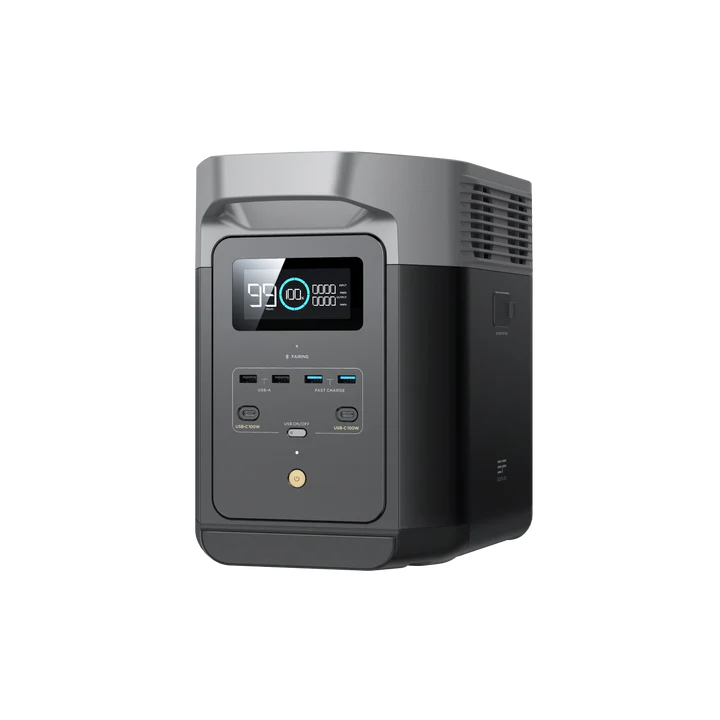
EcoFlow DELTA 2
No longer sold

DJI Power 1000 V2
$699.00
$699.00 · direct from DJI
Last checked 16 days ago. Prices move — check before you buy.
Prices may vary by retailer and are subject to change.