Head-to-head test
EcoFlow DELTA 2 vs BLUETTI AC200L
One of these finishes an eight-hour blackout on a single charge and the other quits a little past halfway, and which side of that line your worst day falls on settles this matchup more than the $400 between them.
Full profiles: EcoFlow DELTA 2 → · BLUETTI AC200L →

Written by Ian SchneiderUpdated
Solar & Off-Grid Tester, Station Arena Test Desk
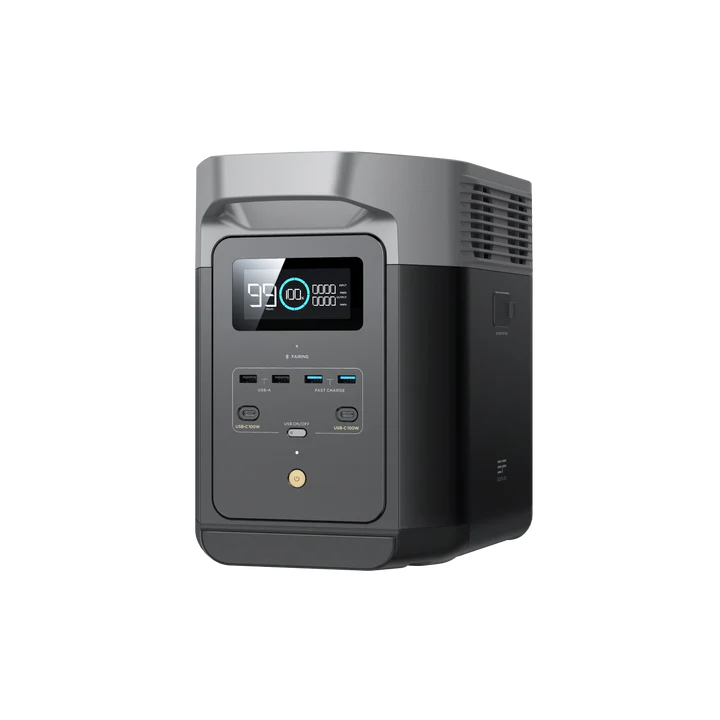
$499.00 · direct from EcoFlow
Last checked 58 days ago. Prices move — check before you buy.

$899.00 · direct from BLUETTI
Last checked 1 day ago. Prices move — check before you buy.
Spec deltas
Take the AC200L at $899, unless you have to carry it. It holds twice the energy of the DELTA 2 for $400 more, which works out to $0.44 per watt-hour against $0.49. The bigger box is the cheaper one per unit of energy, at the register and again across its life, so the gap is buying quantity rather than a markup.
Here is the line that matters. Knock the usual 15% off for inverter losses and the DELTA 2 has about 870 usable watt-hours (1,024 x 0.85) against the AC200L's roughly 1,741. An eight-hour blackout profile draws 1,645Wh. The DELTA 2 gets you a little past halfway and then wants a wall socket, in the one situation where wall sockets are the thing that stopped working.
The catch is 62.4 pounds. That is two and a third DELTA 2s in one box, a bent-knees lift, and the reason this verdict has a fence around it. If the unit's real job is riding in a trunk to campsites and tailgates, the 27-pound EcoFlow is the right answer and the extra capacity is weight you are paying to lift.
What the Numbers Reveal
Each conclusion stated first — the numbers behind it on one line, the full analysis below.
Put the AC200L's roughly 1,741 usable watt-hours (2,048 x 0.85) beside those same two loads and both land inside it, the blackout at 94% and the workday at 52%. These units are not separated by degree. They are separated by which side of one line the loads people actually buy these for happen to fall on.
DELTA 2: 1,024Wh rated, about 870Wh usable after the standard 15% inverter derate8-Hour Blackout profile draws 1,645WhRemote Workday profile draws 910Wh
Why it mattersIf your reason for buying is an outage or a day of work away from a socket, the DELTA 2 is not a cheaper version of the AC200L. It is a unit that stops before you are finished.
Capacity
That kills the usual instinct. The $400 gap is not the AC200L charging a premium for capability, it is the price of the second 1,024Wh sold at a slightly better rate than the first. Identical five-year warranties and identical cycle ratings mean there is no quality story hiding in the gap either.
DELTA 2: $499 for 1,024Wh, or $0.49 per watt-hourAC200L: $899 for 2,048Wh, or $0.44 per watt-hourBoth rated 3,000 cycles, giving 3,072 lifetime kWh against 6,144
Why it mattersReject the AC200L because you do not have $400 spare, not because it is the expensive one. On energy delivered, it isn't.
solar input
That flips the multi-day math. Since neither unit covers a 2,100Wh camping weekend on one charge, the weekend belongs to whichever one recovers fastest between uses, and that is the unit taking 2.4 times the panel input. The DELTA 2's real off-grid limit is not the size of its tank. It is the width of its filler neck.
AC200L accepts 1,200W of solar input; DELTA 2 accepts 500WCapacities of 2,048Wh and 1,024WhWeekend Camping needs 2,100Wh, more than either unit holds
Why it mattersAnyone buying for multi-day off-grid should compare solar input before capacity, because the smaller unit's ceiling is how little sun it can take, not how little it holds.
Now add the reason people buy a 2,048Wh unit in the first place, which is usually a freezer that has to survive a workday outage. The box will hold that load without complaint, but the one question you will want answered from the office is the question it answers worst. Owners also report new units that never finish WiFi pairingB2, and at least one review in this evidence set tells buyers to go to EcoFlow insteadB5.
AC200L monitoring works in practice only inside Bluetooth range, roughly 30 feetB14Owners report the iOS app dropping its cloud login away from the home networkB3Both units switch over to battery in 20ms, so neither needs supervision to carry a load
Why it mattersIf checking the unit remotely is part of why you are buying, either accept that you will be checking the freezer in person or take the DELTA 2 and its smaller tank.
The specific dimensions that decide these two units — everything else is a tie.
Runtime: Will It Power Your Gear?
Selected because: Twice the energy for $400 more, and the usable ceilings of about 870Wh against about 1,741Wh are what every other section here is downstream of.
continuous output
1,024Wh is the number on the box; about 870Wh is the number you get, once the inverter takes its cut and you stop short of a dead-flat battery. Every question further down this page, from whether a workday finishes to how long the fridge lasts, is really a question about that smaller number. The AC200L's version of it is roughly twice as big.
Output splits the same way but less dramatically. The AC200L runs 2,400W continuous against 1,800W, a third more envelope, and both carry the same 1.5x surge cushion at 3,600W and 2,700W. So there is no ratio advantage hiding anywhere. The AC200L simply starts a band of motors and compressors that the DELTA 2 refuses, and everything the DELTA 2 starts, the AC200L starts too. If your load list has a compressor in it, that band is where you find out which side you are on.
Your Life, Your Pick
Selected because: Four of the six standard loads produce a winner and all four go to the AC200L; the two that don't are the ones neither unit finishes.
Four of the six profiles produce a winner and all four go the same way, which is less interesting than where the other two land. A camping weekend at 2,100Wh and a van-life day at 4,685Wh are bigger than both units. Those are not losses for the DELTA 2 so much as evidence that a buyer with those loads is shopping in the wrong class entirely.
The instructive one is the remote workday. 910Wh against roughly 870 usable means the DELTA 2 comes up about 40 watt-hours short, which is the last stretch of the afternoon rather than the middle of the morning. A near-miss is worse than a clear miss. You plan around a unit you believe covers the day, and then it doesn't, once, at the worst possible point in it.
Portability & Form Factor
Selected because: 27 lbs against 62.4 is the one column the DELTA 2 wins, and it wins it by more than double.
weight
27 pounds is a one-handed grab out of a trunk. 62.4 is a two-hands, bent-knees lift that you perform once and then leave wherever it lands, and reviewers running the AC200L in a van build called repositioning it awkwardB17B13. This is the single column the DELTA 2 wins, and it wins it by 2.3x.
Weight is also the only spec here that cannot be fixed later. You can add panels, you can add expansion batteries, you can wait out a firmware update. You cannot make a 62.4-pound box lighter, and every trip it doesn't make because lifting it is a project is capacity you paid for and never used.
Lifetime Value
Selected because: Across 3,000 cycles each, the two land a penny apart per lifetime kilowatt-hour, which tells you the $400 is buying quantity rather than quality.
cost / lifetime kWh
A penny separates these two over their lives: $0.16 per lifetime kilowatt-hour for the DELTA 2, $0.15 for the AC200L, on identical 3,000-cycle ratings. The AC200L is the cheaper one to own, and by an amount nobody should make a decision on.
What the number rules out is more useful than what it proves. There is no premium being charged and no bargain being had. Both units deliver energy at essentially the same rate, so the $400 is a question about your budget and your loads, not about value. The warranty says it a second time: five years each, which prices out at $100 a covered year against $180, which is just the sticker gap divided by five.
Brand Trust
Selected because: Both carry five-year warranties, so what actually separates EcoFlow and BLUETTI is what happens after you file a claim.
Both warranties run five years, so the difference is what happens after you file. EcoFlow answers a US phone number, and outcomes swing between a prepaid label with a fast replacement and a long wait ending in a refurbished unit. BLUETTI is email-first across a time-zone gap, and BLUETTI's own acknowledged weak point is support consistency. Buying direct from BLUETTI rather than through a marketplace tends to produce the better outcome, which is the most actionable sentence on this page for an AC200L buyer.
The app is the odd part. BLUETTI's app rates 4.5 on both stores, tied for the best in the category, and yet the AC200L-specific complaints cluster almost entirely on connectivity: WiFi pairing that never completes, cloud logins that drop the moment the owner leaves the house, monitoring that in practice means standing within Bluetooth rangeB2B3B5B14. A well-reviewed app you cannot keep connected is still an app you cannot keep connected. EcoFlow's rates lower on Android at 4.2 and is still the one an owner in this evidence set recommends switching to for stabilityB5.
Strengths & trade-offs
EcoFlow DELTA 2
Strengths
- +Costs $400 less
- +Lighter by 35.4 lb
Trade-offs
- –Weaker inverter (-600W) limits appliance compatibility.
BLUETTI AC200L
Strengths
- +Larger battery capacity
- +Higher AC output
- +Faster solar charging
Trade-offs
- –Substantially more expensive (+$400) than the DELTA 2.
- –Significantly heavier (+35.4 lbs), making it harder to move.
Will It Power Your Gear?
Scenario math and per-appliance runtimes, modeled from the spec record.
Scenario verdicts
We ran the math on six real-world scenarios. Here's which unit survives your actual life.
SCN-01 · 2 nights · needs 2,100Wh
Weekend Camping
Two nights off-grid with essential comfort
Neither unit
Neither one finishes the weekend. A 2,100Wh weekend is more than either unit holds, so the real question is which one claws energy back during the day, and that is the AC200L by a wide margin of solar input. The DELTA 2 would need filling roughly two and a half times across those two days, on less than half the panel input.
Battery budget usedlower = more headroom
LOAD Phone Charger 15W×6h · LED Lights 40W×8h · Box Fan 75W×14h · CPAP Machine 40W×16h
SCN-02 · 8 hours · needs 1,645Wh
8-Hour Blackout
Keep the essentials running through a night without power
AC200L
The AC200L finishes this on one charge with a sliver to spare, and the DELTA 2 stops a little past halfway. That is the whole argument for the bigger unit compressed into one scenario: an outage does not pause while you go find sunlight, and the wall socket you would normally reach for is the thing that failed.
Battery budget usedlower = more headroom
LOAD Fridge 150W×8h · Router + Modem 20W×8h · LED Lights (4 bulbs) 40W×6h · Phone Charger 15W×3h
SCN-03 · 8 hours · needs 320Wh
CPAP Overnight
Sleep therapy without interruption — the #1 medical use case
Either unit
The AC200L takes this on margin, using well under a fifth of its usable stack against the DELTA 2's roughly a third. Read it the other way too: a breathing machine is the one job on this page where the DELTA 2's ceiling never comes near, so a buyer whose whole load is a CPAP and a phone is choosing on weight and price, not capacity.
Battery budget usedlower = more headroom
LOAD CPAP Machine 40W×8h
SCN-04 · 8 hours · needs 910Wh
Remote Workday
Full work day off-grid without power anxiety
AC200L
The DELTA 2 misses this by about 40 watt-hours, 910Wh needed against roughly 870 usable, which is not the middle of the day but the end of it. The AC200L finishes a workday on half a charge and keeps the evening in reserve.
Battery budget usedlower = more headroom
LOAD Laptop 60W×8h · External Monitor 30W×8h · Router + Modem 20W×8h · Phone Charger 15W×2h
SCN-05 · 4 hours · needs 670Wh
Tailgate Party
Game day power for the crew
AC200L
A 670Wh afternoon eats three-quarters of the DELTA 2's usable stack and a bit over a third of the AC200L's, which is why the bigger unit takes this one. Both get you through the game. Only one gets you through the game plus the drive-home phone charging without anyone watching a percentage.
Battery budget usedlower = more headroom
LOAD Blender 400W×0.5h · LED TV (55") 80W×4h · Bluetooth Speaker 15W×4h · Phone Charger (×3) 45W×2h
SCN-06 · 24 hours · needs 4,685Wh
Van Life Daily
A full day of mobile living — the ultimate endurance test
Neither unit
Both fail this, and not narrowly. A 4,685Wh day is more than twice what the AC200L holds and better than five times the DELTA 2, so a van running fridge, fans, laptops and lights all day wants a house bank with alternator charging, not a portable box with a handle.
Battery budget usedlower = more headroom
LOAD Mini-Fridge 150W×24h · Laptop 60W×4h · Phone Charger 15W×3h · LED Lights 40W×5h · Fan 75W×8h
The Load Test
RUNTIME = (Wh × 0.85) ÷ LOAD
None of the scenarios above exactly yours? Build it. Toggle what you'd plug in; both units are tested against the combined draw.
Essentials
Comfort & Convenience
High-Draw Appliances
Test duration
8h
Continuous draw
205W
Projected runtime
For this load: AC200L runs 8.5h vs 4.2h.
$899 list · direct from BLUETTI
Modeled from the spec record — same math as the tables below. Methodology
Runtime by appliance
Real-world runtime estimates for common appliances, modeled at 85% inverter efficiency.¹
Essentials
The basics you need runningscale 0–116.1hComfort & Convenience
Makes off-grid life actually enjoyablescale 0–23.2hHigh-Draw Appliances
These reveal the real limitsscale 0–1.7h¹ Runtime = (capacity × 0.85) ÷ appliance watts. Within each group, all bars share one time scale (the group's longest runtime), so lengths are comparable across appliances; identical runtimes collapse into a single blue/orange bar. Actual runtime varies with battery age, temperature, and simultaneous loads — see methodology.
Conclusion
August 1, 2026
Verdict: the AC200L, on Power Score margin
Take the AC200L at $899 unless the unit has to travel. It holds 2,048Wh against 1,024, which after the standard 15% inverter derate is roughly 1,741 usable watt-hours against about 870, and that gap is the difference between finishing an eight-hour outage on one charge and stopping a little past halfway through it. It also costs less per watt-hour than the DELTA 2 at the register and across 3,000 cycles, so the $400 buys quantity rather than a premium, and its 1,200W solar ceiling puts that quantity back faster than the DELTA 2 refills half as much. Two things keep the confidence at 7 rather than 9: 62.4 pounds is a genuine disqualifier for anyone who moves the unit regularly, and the app is the weakest part of the package, with owners reporting WiFi pairing failures and cloud dropouts away from homeB2B3B14. Buy it direct from BLUETTI, put it where it is going to live, and the trade is a good one.
Editor-assigned confidence, based on cited owner research and spec analysis.
List prices as of August 1, 2026. The links below open EcoFlow's and BLUETTI's current prices.
$899.00 · direct from BLUETTI
Last checked 1 day ago. Prices move — check before you buy.
or check the DELTA 2 price$499.00 list
Written by Ian Schneider, Solar & Off-Grid Tester · Station Arena Test Desk · Updated August 1, 2026
Measured Data
Benchmark scores and the full spec record, side by side.
Benchmark scores
Not rated for both units (minimum threshold unmet): CPAP, Camping.
Full specifications
ᵈ Derived: price ÷ rated capacity. See the data behind our comparisons →
Comparison ToolAdd more power stations, side by sideOpen Tool →How these numbers are produced
Numeric verification
Every figure on this page traces to our spec database or arithmetic on it — no estimated numbers.
Owner claims
Statements about owner experience are cited to published reviews — see Sources & Research Notes below.
Runtime model
Runtime = (rated capacity × 0.85 inverter efficiency) ÷ device wattage. Solar recharge estimates assume panels deliver 70% of rated output. Cold weather, battery age, and stacked loads reduce real-world results.
Power Score
Computed from 14 published spec dimensions, weighted per use-case bench. Higher is better; a unit must meet a bench's minimum threshold to be rated.
See the full weight table and data sourcing on our methodology page →Class ranking (the star rating)
Each unit's star score is a category ranking, not customer reviews — no buyer opinions feed it. We score every station on size-independent quality (value, output, portability, endurance, ports, warranty, and more), then percentile-rank it against the other units in its capacity class, so a class-leading compact unit and a class-leading whole-home unit can both earn 5★. Here, DELTA 2 rates 4.1/5 (46th percentile of 27 Everyday-class units), and AC200L rates 3.9/5 (36th percentile of 26 Large-class units).
How the class ranking is computed →Test Notes & Caveats
Hidden gotchas and advantages we spotted that you won't find on the product page.
The 62.4 lb Tax on Our Pick
This is what the AC200L costs you outside of dollars. At 62.4 lbs it is a two-hands, bent-knees lift and it stays wherever you set it down, while the 27 lb DELTA 2 comes out of a trunk one-handed. If the unit moves more than a couple of times a year, this number outranks capacity, solar input and price combined.
Same 50 dB Rating, Different Workload
Both are rated 50 dB, which is close to the least useful number on this page, because fans respond to how hard a unit is working rather than to its label. The DELTA 2 runs any given load at a higher fraction of its 1,800W inverter than the AC200L does of its 2,400W, so the smaller unit reaches its loud state on jobs the bigger one handles quietly. Size is a noise spec.
Five Years Each, So This Is Not a Tiebreak
Identical terms on both units, five years, which makes this card the price gap wearing a different hat: $100 per covered year on the DELTA 2 against $180 on the AC200L. What a warranty length never tells you is how the claim actually goes, and that is where these two genuinely differ.
Ownership Analysis
What happens after you buy — true cost of ownership, brand trust, and growth potential.
Lifetime value
Service lifeyears at one full cycle per day
Lifetime energy delivered
Cost per delivered kWh
│ warranty ends · Reaching the cycle rating means ~80% capacity remains — degraded, not dead.
Analyst note
The DELTA 2 is cheaper to buy, but the AC200L is cheaper to own. At $0.15/kWh over its lifetime vs $0.16/kWh, the AC200L's higher cycle life and capacity make each dollar go further over the years. One thing to know reading the table: both carry the same 3,000-cycle rating, so the lifetime rows are sticker price and capacity in disguise — the wear horizon is identical and decides nothing here.
Brand trust
EcoFlow
Ecosystem
Largest in portable power — 12-15 models across DELTA Pro, DELTA 3, and RIVER 3 series, plus solar panels and smart home panels
Support
A US phone line and polarized outcomes: a prepaid label and a fast replacement in the good version, long waits and a refurbished unit against a new claim in the bad one. Buying through Costco or Amazon adds a return path EcoFlow does not control, which is worth more than it sounds.
Community
Largest community in the space — Reddit r/Ecoflow_community (~31K members), multiple Facebook groups, and an official community forum
App experience
Rated 4.6/5 iOS (~8,400 ratings) · 4.2/5 Android (~17,000 ratings)
Unique strength
The deepest ecosystem in portable power, twelve to fifteen models plus panels and smart home panels, and X-Stream, the fastest charging in the category.
Worth knowing
EcoFlow recalled the DELTA Max 2000 in October 2025 over overheating and fire risk across six incidents, and floated a subscription paywall for advanced app features in early 2025 before community backlash paused it. There is also no service offered once you are out of warranty.
BLUETTI
Ecosystem
One of the broadest lineups — 15-20+ models from budget (AC2A) to flagship portable (Apex 300, 2764.8Wh). Includes specialized products: vehicle solar hubs, sodium-ion cold-weather units, and balcony storage systems.
Support
Email-first across a time-zone gap, and the least consistent in the category. Some claims go smoothly; others turn into weeks of troubleshooting, or an offer of a discount on a new unit instead of a repair. Buying direct from BLUETTI rather than through a marketplace is the version of this with the best odds.
Community
Active and growing — Reddit r/bluetti has a dedicated community. Second-largest after EcoFlow in engagement.
App experience
Rated 4.5/5 iOS and Android — tied for best app experience in the category. V3.0 UI redesign was well-received.
Unique strength
Among the best capacity-per-dollar in the category, full LFP standardization across the lineup, and the widest product range in the space, including sodium-ion cold-weather units and vehicle solar hubs nobody else builds.
Worth knowing
Support consistency is the headline risk here, not the hardware. Older and discontinued models can become unrepairable because spare parts are not guaranteed, which matters more on a unit you intend to run out to its full 3,000 cycles.
Analyst note
EcoFlow sells the better safety net and BLUETTI sells the better dollar, and on this pair both are true at once. The AC200L's advantage in cost per watt-hour is real, and so is the fact that a US phone number beats an email thread on the day something stops working. If you take the AC200L, buy it from BLUETTI directly and register it, and you have closed most of that gap before you need it.
Growth path
DELTA 2
EXPANDABLESupports EcoFlow expansion batteries, so you can add capacity later without replacing the base unit — useful if your needs may climb past 1,024Wh.
Accepts up to 500W of solar. Suitable for a 1-2 panel setup.
Generous port selection supports complex multi-device setups.
Expansion batteries are EcoFlow-specific. You're investing in the EcoFlow ecosystem.
AC200L
EXPANDABLESupports BLUETTI expansion batteries, so you can add capacity later without replacing the base unit — useful if your needs may climb past 2,048Wh.
Accepts up to 1,200W of solar. Enough for a serious multi-panel array.
Adequate ports for most setups, but heavy users may want a power strip.
Expansion batteries are BLUETTI-specific. You're investing in the BLUETTI ecosystem.
Realistic full solar rechargeat 70% of rated panel output — see methodology
Analyst note
Both expand, but the AC200L's higher solar ceiling (1,200W vs 500W) gives it the stronger off-grid growth path — more panels can feed a bigger bank as it grows.
What Owners Report
Patterns from published owner reports and long-term reviews — every claim cited to its source below.
EcoFlow DELTA 2
The DELTA 2 has been out long enough for real multi-month data, and it converges on one complaint. The fans wake at anything above about 120W and run continuously at high loadA1, and at 1,200W of charging one reviewer put them at gaming-laptop volumeA2. The fix lives in the app: throttle the charge rate and you get the room backA2. EcoFlow has said a firmware update will address the fan behaviorA4, which is a plan rather than a fix.
The compliment is quieter and more valuable. Eighteen months of outages, camping trips and daily desk duty produced fast charging, stable LiFePO4 behavior and expandability that worked, with nothing else to complain aboutA3. That is the profile of a unit whose one flaw you can hear coming.
“When charging at 1200W the fans sound like a gaming laptop, though you can lower the charging speed in the app to silence it.”
Sources
portablepowerlab.com
BLUETTI AC200L
Hands-on testers got the AC200L to do what its spec sheet claims. One ran a full-size refrigerator for 32 hours from a full charge and still had 7% leftB9. Another measured the UPS switchover at 13.1 milliseconds against a 20-millisecond ratingB7. A six-month check read 97% of original capacity after 183 full cyclesB16, and fan measurements at three feet came in around 40 dB on the low speed and 48 dB on the highB8. The battery and the inverter are not the problem here.
The app is. Owners describe WiFi pairing that never completes on a new unitB2 and an iOS app that drops its cloud login whenever they leave the home network, with support proposing they ship the whole battery back over a software issueB3, plus no practical remote monitoring outside Bluetooth rangeB14. One owner spent three days trying to get the AC200L to see its own B230 expansion batteryB4. Another reports the fan running about 25 seconds out of every minute along with the PV relay clicking at sunrise and sunsetB1, which sits oddly beside the quiet measurements aboveB8; different rooms, different loads, both probably true. Worth knowing how thin this record is: the AC200L evidence leans on BLUETTI's own community forum and independent review sites rather than long-run owner threadsB1B2B9.
“The BLUETTI app works well to give one all of the relevant info on a BLUETTI power system...after almost a year of use...the account for logging into the app is not the same as the BLUETTI web account.”
Sources
reviews.matanich.co · portablepowernerd.com · backuppowerhub.com
Sources & Research Notes
Every owner claim in this report is traceable to a published source. The bracketed references above resolve here.
Recurring owner themes
- Fan noise under moderate-to-high load is the dominant, repeatedly-cited complaint; the fan spins up above ~120W. [DELTA 2 · 3 entries]
- App/WiFi connectivity is a recurring pain point — owners report failed WiFi pairing, cloud disconnects, and no remote (non-Bluetooth) monitoring option. [AC200L · 4 entries]
- Fan/relay cycling behavior gets mixed reports: some owners flag frequent on/off cycling at idle/solar cutover, while a hands-on tester measured the fans as relatively quiet under load. [AC200L · 2 entries]
- UPS switchover is fast and reliable in practical tests, but reviewers note the 20ms spec (vs newer 10ms competitors) could risk flicker for very sensitive electronics. [AC200L · 2 entries]
- Independent runtime/capacity and cycle-health tests have generally matched or come close to the advertised 2048Wh rating and cycle-life claims. [AC200L · 3 entries]
- Weight and lack of wheels/accessory-integration quirks are recurring physical/practical gripes despite otherwise positive reception. [AC200L · 2 entries]
- A1
“Fans trigger at anything above 120 watts; at maximum load (1,500–1,800W) they run continuously at ~48–55 dB. Powering medical equipment above 120W in a bedroom means listening to the fans or running an extension cable out of the room.”
portablepowerlab.com — EcoFlow Delta 2 Review: 6 Months of Real Use; PCWorld — EcoFlow Delta 2 review · 2026 · [negative]
- A2
“When charging at 1200W the fans sound like a gaming laptop, though you can lower the charging speed in the app to silence it.”
PCWorld — EcoFlow Delta 2 power station review · 2026 · [mixed]
- A3
“After 18 months of real-world testing through multiple power outages, camping trips, and daily home-office use, the unit earned recognition for fast charging, reliable LiFePO4 battery chemistry, and expandability.”
portablepowerlab.com — EcoFlow Delta 2 Review: 6 Months of Real Use · 2026 · [positive]
- A4
“EcoFlow officials indicated they plan to address the fan noise in an upcoming firmware update, as they have for other models after release.”
portablepowerlab.com — EcoFlow Delta 2 Review · 2026 (dated claim — may be partially addressed) · [mixed]
- B1
“I own a AC200L (US)...one is the common PV relay clicking at sunset/sunrise and the other is the fan turning on for 25 seconds every 60 seconds or so.”
BLUETTI Community forum — 'ac200L PV relay and fan turning on every minute' · 2024-05 · [negative]
- B2
“WIFI WIFI! I can't get my new AC200L to log into my WIFI network. Have reached out to company they keep telling me to do the same things I have already done.”
BLUETTI Community forum — 'AC200L trouble' · 2025-11 · [negative]
- B3
“The IOS app for my AC200L will disconnect from the cloud on a consistent basis when I'm away from my home network...wants me to return the 65lb battery for an app issue.”
BLUETTI Community forum — 'AC200L IOS app Cloud login not working' · 2025-03 · [negative]
- B4
“I just received my AC200L and B230 but I'm struggling since 3 days because the AC200L does not detect the B230.”
BLUETTI Community forum — 'AC200L not detecting B230 / nothing on the APP' · 2024-08 · [negative]
- B5
“You are better off buying a Ecoflow or Anker! Bluetti app is not stable enough. It disconnects from my WiFi every month or two without warning.”
Apple App Store — BLUETTI App reviews · unknown · [negative]
- B7
“It's advertised to switch from wall power to battery power within 20 milliseconds, but I measured it at just 13.1 milliseconds! This is one of the fastest UPS modes I've seen.”
Lifenhancer — 'Bluetti AC200L Review' · 2024-03 · [positive]
- B8
“The AC200L's fans surprised me with their quietness. They have two variable speeds...At 3 feet away, I measured around 40dB at the lower speed and 48dB at the higher speed.”
Lifenhancer — 'Bluetti AC200L Review' · 2024-03 · [positive]
- B9
“I then tested how long the AC200L would run a full-size refrigerator. Starting at 100% charge, it powered the refrigerator for 32 hours and still had 7% of the capacity remaining.”
Lifenhancer — 'Bluetti AC200L Review' · 2024-03 · [positive]
- B13
“an optional remote screen would have been extremely useful...While the AC200L supports the Charger 2 and DC Hub, I have encountered a few issues that impact the hands-off reliability for a van build.”
reviews.matanich.com — 'BLUETTI AC200L Review: Portable Power Station' · 2026-04 · [mixed]
- B14
“The lack of Wi-Fi is our biggest gripe...with the AC200L, you need to be within Bluetooth range (about 30 feet practically). For home backup use where you might be away when an outage hits, this is a real limitation.”
portablepowernerd.com — 'Bluetti AC200L Tested: 4-Month Honest Review' · 2026-02 · [negative]
- B16
“I checked the battery health in the Bluetti app six months later in September. After 183 full cycles the capacity read 97% of original.”
GridFree Guide — 'The Workhorse Standard: Bluetti AC200L Review' · 2026-04 · [positive]
- B17
“the unit's 62.4 lbs weight with no integrated wheels makes repositioning awkward. Users with mobility constraints or who need to move the unit frequently will want to factor that in.”
backuppowerhub.com — 'Bluetti AC200L Review: Expandable Power Station Worth It' · 2026 (approx, '3 weeks ago' at time of search) · [negative]
Research compiled August 1, 2026.
What Owners Actually Report
Drawn from 182 comments on independent review channels — not from retailer reviews, which skew to the first week of ownership. Each line is our summary of one commenter's claim, linked to the original. We record what they said, including where it contradicts the spec sheet.
EcoFlow DELTA 2
224 claims from 155 comments · 178 from owners · 60 with figures
- Runtime
- 32 · 13% negative
- Price & value
- 38 · 4% negative
- Charging
- 17 · 23% negative
- Durability
- 22 · 67% negative
- Warranty & support
- 22 · 59% negative
What owners complain about
Ignores solar unless he unplugs it from the wall, so he switched to the AC180.
Solar inputowner63 agreedsource →
His Delta 2 went bad three months after purchase and EcoFlow agreed it was defective.
Durabilityownerafter 3 months236 agreedsource →
Past 30 days the five-year warranty only gets a refurbished unit covered for 30 days.
Warranty & supportowner236 agreedsource →
What owners praise
DELTA 2 plus extra battery and 600W solar cost ~$1200 and paid for itself in under 2 years in California.
Price & valuemeasuredowner736 agreedsource →
Batteries still hold 98%+ capacity, ahead of the 80%-at-10-years warranty curve.
Durabilitymeasuredowner736 agreedsource →
Gets 180-190W into it from a 100Ah LiFePO4 via XT60i cable, no converter needed.
Chargingmeasuredowner106 agreedsource →
BLUETTI AC200L
41 claims from 27 comments · 30 from owners · 12 with figures
- Solar input
- 6 · 0% negative
- Price & value
- 6 · 0% negative
- Build quality
- 5 · 5% negative
- Charging
- 4 · 17% negative
- Runtime
- 2 · 43% negative
What owners complain about
His Nomadic X2 air conditioner would drain the 2048Wh AC200L in about an hour.
Runtimemeasuredownersource →
His crosscut saw plus dust collector keeps kicking off the 2400W inverter.
Inverter & surgeownersource →
So heavy it took two people to move; not something he would carry around.
Size & weightownersource →
What owners praise
Runs everything else on the AC200L, which uses very little idle consumption.
Idle drainowner11 agreedsource →
Recharges from 65% to full by 1pm on a portable 350W array, so he stopped tracking it.
Solar inputmeasuredownerafter 2 months4 agreedsource →
Just bought an AC200L for $1200 and calls it much better price-to-performance than solid state.
Price & valuemeasuredowner2 agreedsource →
Claims are weighted by how specific they are, whether the commenter owns the unit, and how many readers agreed. Comments that mention a product under a rival's review count for more, because the commenter had no reason to be there. This is what buyers report, not our test results — for measurements we ran ourselves, see the methodology.
Who Should Buy Which
Buy the DELTA 2 if you…
- →You take it places. 27 pounds comes out of a trunk one-handed and onto a picnic table without a second person, and that is a different product from a box that lives in a closet.
- →Your worst load is a CPAP, a laptop and phones. A night of CPAP draws 320Wh, roughly a third of the DELTA 2's usable capacity, and everything above that is headroom you would pay for and never touch.
- →The $400 is the difference between buying now and putting it off until spring. Buy the DELTA 2 today, because a power station you own beats a better one you are saving toward.
- →You want to see the unit's state of charge from your phone while you are at work. Every connectivity complaint on this page points the same directionB2B3B14.
Buy the AC200L if you…
- →The fridge and the modem through a full outage. The AC200L covers an eight-hour blackout profile on a single charge; the DELTA 2 covers a bit over half of it and then needs the grid that just failed.
- →You are running panels. 1,200W of solar input against 500W means the AC200L recovers a day of use inside a day of sun, which is what multi-day off-grid actually turns on.
- →It is going to live in one place: a utility room, a van bay, a shop bench. If you are not lifting it, its worst spec stops mattering the day after delivery.
- →You want the starting muscle. 2,400W continuous and 3,600W surge is a third more envelope than the DELTA 2 on the same 1.5x surge ratio, so there is a band of compressors and motors it starts that the smaller unit will not.
If neither fits
If your day looks like the van-life profile, 4,685Wh of fridge, fans, laptops and lights, both of these are the wrong shape and expansion batteries will not save a base unit that covers about a fifth of the job. Go up a class to a house bank with alternator charging and stop shopping portable boxes. And at the other end: if the honest total is a phone, a laptop and a few lights for one evening, you are shopping two classes too high, and the small end of the category does that job for less money and a fraction of the weight.
The Bottom Line
Buy the AC200L. Twice the energy at a slightly better rate per watt-hour, the only one of the two that finishes an eight-hour outage on one charge, and more than twice the solar input to put that charge back the next day. The thing buyers expect to be the catch, that the bigger unit must be the expensive one, turns out to be false in the only currency that matters here.
The real catch is 62.4 pounds and an app owners fight withB2B3B14. Buy it direct from BLUETTI so a claim has the shortest path, set it where it is going to live, and do not plan on carrying it anywhere. If that last part is the dealbreaker, the DELTA 2 at $499 is a genuinely good small unit and you will like it right up to the evening you need more than it holds.
Frequently Asked Questions
Answers drawn from the spec record and cited owner research.
Is the BLUETTI AC200L worth $400 more than the EcoFlow DELTA 2?
Yes, if your worst day needs more than about 870 watt-hours, which is the DELTA 2's usable capacity after the standard 15% inverter derate. The AC200L holds twice the rated energy and costs less per watt-hour doing it, $0.44 against $0.49, so the extra money buys quantity rather than a premium. If your loads stay under that line, the $400 is buying headroom you will never reach.
Can the EcoFlow DELTA 2 run a refrigerator through a power outage?
It can start one, since 2,700W of surge is a 1.5x cushion over its 1,800W continuous rating, but it will not run a household outage profile to the end. The eight-hour blackout load here is 1,645Wh, close to twice the DELTA 2's usable stack. The AC200L covers the same eight hours with a sliver of charge left.
How much heavier is the AC200L in practice?
62.4 pounds against 27, so about two and a third times the DELTA 2. That is a two-hands, bent-knees lift rather than a one-handed grab, and reviewers running one in a van build flagged repositioning as awkward. If the unit has to move often, this single spec decides the purchase.
Which one charges faster from solar?
The AC200L, and by more than its capacity advantage. It accepts 1,200W of panel input against the DELTA 2's 500W, so the bigger battery actually refills in less wall-clock time from empty. For multi-day off-grid use the input ceiling matters more than capacity, because capacity only has to be refilled once a day.
Is the BLUETTI app reliable on the AC200L?
This is the AC200L's weakest link. Owners report WiFi pairing that never completes, cloud logins dropping when they are away from home, and monitoring that in practice means standing within Bluetooth range of the unit, and one owner could not get it to recognize its own expansion battery. If remote monitoring during an outage is part of why you are buying, that is the one place the DELTA 2 is clearly ahead.
Brand matchup
EcoFlow vs BLUETTI: measured across every matchup →Where to buy
EcoFlow DELTA 2
$499.00
$499.00 · direct from EcoFlow
Last checked 58 days ago. Prices move — check before you buy.
BLUETTI AC200LPick
$899.00
$899.00 · direct from BLUETTI
Last checked 1 day ago. Prices move — check before you buy.
Prices may vary by retailer and are subject to change.