Head-to-head test
EcoFlow DELTA 2 Max vs BLUETTI Premium 200 V2
These two 2kWh units run every load to the same finish, so the whole decision is one question: the BLUETTI's $500 premium buys double the lifespan and a fan you can't hear, and unless your loads have big motors, that's money well spent.
Full profiles: EcoFlow DELTA 2 Max → · BLUETTI Premium 200 V2 →

Written by Gunner GustafsonUpdated
Whole-Home Backup Tester, Station Arena Test Desk
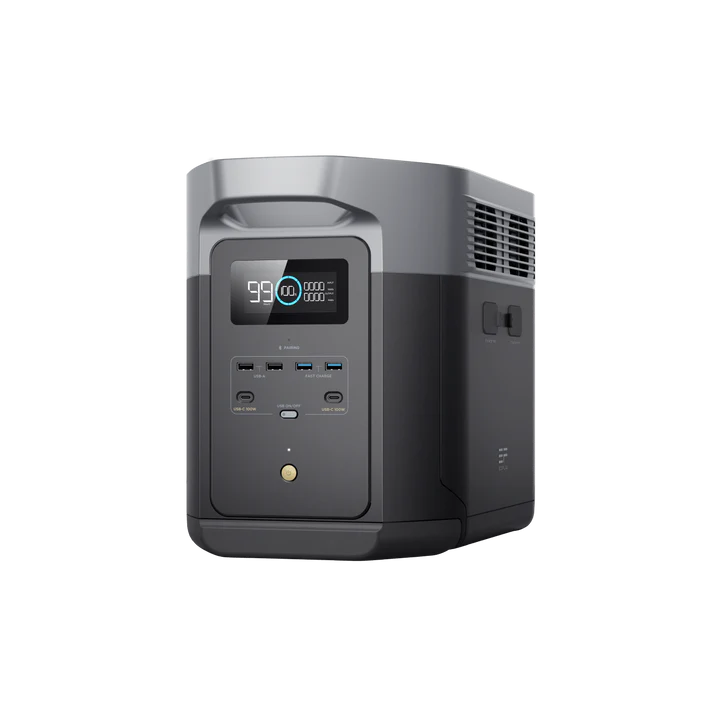
$1,049.00 · direct from EcoFlow
Last checked 1 day ago. Prices move — check before you buy.

$1,549.00 · direct from BLUETTI
Last checked 1 day ago. Prices move — check before you buy.
Spec deltas
The EcoFlow DELTA 2 Max costs $1,049; the BLUETTI Premium 200 V2 costs $1,549, a $500 gap. For that money you get two units that are, on paper, near-twins: 2,048Wh against 2,073.6Wh (a 25.6Wh difference, about 1%), the same 1,000W solar ceiling, the same 100W USB-C, expansion support on both, and weights within 3 lbs. Every runtime scenario on this page comes back a tie. So the premium isn't buying capacity. It's buying two things that never show up on a gauge.
Those two things are longevity and quiet. The Premium's cells are rated for twice the cycles of the DELTA's, and its fan is rated 16dBA, low enough to disappear in a still room. The EcoFlow's fan does the opposite: its owners consistently flag it as the unit's one real annoyance, loud enough under heavy load to notice across a roomA1. If this box will cycle daily or share your bedroom, those are the specs that decide it, and BLUETTI takes both.
Everywhere else the EcoFlow has the edge, and none of it is decisive. It costs less up front, carries a fifth year of warranty the BLUETTI doesn't, and keeps 900W more surge in reserve for the half-second a fridge or pump slams on. Real reasons, for the right buyer. But the BLUETTI is cheaper to own once you count the cycles, quieter every night, and posts the higher power score, 4,020 to 3,810. Pay the premium unless a motor-heavy load or a tight budget argues you out of it.
What the Numbers Reveal
Each conclusion stated first — the numbers behind it on one line, the full analysis below.
rated cycles
Divide each sticker by the energy it will ever deliver and the premium inverts: the BLUETTI costs $0.12 per lifetime kilowatt-hour, the EcoFlow $0.21. The pricier box is the cheaper one to own, because you're spreading its cost across twice the throughput. The extra you pay up front comes back as nine cents on every kilowatt-hour.
BLUETTI Premium 200 V2: 6,000-cycle rating at $1,549EcoFlow DELTA 2 Max: 3,000-cycle rating at $1,049Both hold about 2kWh (2,073.6Wh vs 2,048Wh)
Why it mattersAnyone who'll actually cycle the unit hard should read the sticker as the down payment, not the price. The BLUETTI wins the number that compounds.
That's the honest hole in the BLUETTI's best argument: its extra cycles only turn into money if you drain and refill the thing most days. Buy either as occasional blackout insurance and you'll retire it on dead electronics decades before the cells fade, at which point the BLUETTI's longevity is a spec you paid a premium for and never used.
6,000 cycles works out to about 16.4 years at daily use, 57.7 years at weekend use3,000 cycles works out to about 8.2 years daily, 28.8 years weekendMost backup units cycle a few dozen times a year, not daily
Why it mattersThe weekend-and-emergency crowd should ignore the cycle column entirely and let warranty, surge, and up-front price decide, and those lean EcoFlow.
16dBA against a real-world 52dB under loadA1 isn't a spec-sheet quibble; it's the difference between a box you forget is on and one that announces itself every time the fridge kicks up the load. The EcoFlow's quiet mode helps, but it buys hush by slowing the chargeA1, so you're trading recharge speed for the peace the BLUETTI gives you for nothing.
Premium 200 V2 fan rated 16dBA; DELTA 2 Max rated 30dBADELTA 2 Max owners report the fan reaching about 52dB under heavy load or charging, tamed only by a quiet mode that slows the chargeA1A CPAP night and a remote workday leave both batteries most of the way full
Why it mattersIf the unit lives in a bedroom, an office, or a van you sleep in, the BLUETTI's fan is reason enough on its own; if it lives in a garage, skip this line.
continuous output
Steady loads that sit between 2,400W and 2,700W barely exist in a house; you'd have to run a space heater and a toaster at once. Motor startups, though, happen every time a compressor cycles, and they pull against surge, not continuous. The EcoFlow's 2.0x reserve swallows a start the BLUETTI's 1.4x can flinch at, even though the BLUETTI's steady rating looks bigger.
DELTA 2 Max: 2,400W continuous, 4,800W surge, a 2.0x ratioPremium 200 V2: 2,700W continuous, 3,900W surge, a 1.4x ratioFridge, AC, and pump motors pull 2-3x their running watts for the first half-second
Why it mattersWell pump, RV air conditioner, shop tools: motor-heavy buyers should take the EcoFlow and its deeper reserve, the one place the cheaper box is flatly better.
The specific dimensions that decide these two units — everything else is a tie.
Lifetime Value
Selected because: Cycle-life math is the case for BLUETTI's premium; per-lifetime-kWh flips to p2 here (unlike the DELTA 3 Max pairing, where the $799 EcoFlow won it).
cost / lifetime kWh
The cost-per-kilowatt-hour verdict above is the BLUETTI's entire financial argument, and it holds, but only if you spend the cycles. Cabin, van, market stall, daily solar top-up: cycle it every day and the longer-lived cells are money in the bank. Drain it twice a month for blackouts and you'll never approach either rating; both batteries die of old electronics with most of their cycles unspent, and the cheaper-to-own math quietly stops applying to you.
There's also a gap between the life a maker rates and the life a maker guarantees. The BLUETTI's cells may well run longest, but it backs them for four years while the EcoFlow backs its shorter-lived unit for five, coverage that costs $259 a year on the EcoFlow against $387 on the BLUETTI. Every celebrated extra cycle on the Premium sits in years no warranty reaches. Buy the longevity if you'll use it; just know you're buying it on trust, not on paper.
What the Specs Don't Tell You
Selected because: Four cards fire: surge and warranty favor EcoFlow, cycle life favors BLUETTI, UPS is a wash.
rated cycles
Four gotcha cards fire, and they split the way the whole matchup does. Two favor the EcoFlow: the deeper surge reserve and the better warranty value per dollar. One favors the BLUETTI, and it's the cycle-life card its entire premium rides on. The last, UPS speed, is a wash both units pass. Nothing here surprises once you've read the price tags backward: the cheaper box wins the specs you notice on day one, the dearer one wins the spec that only shows up after a decade.
The UPS line is worth thirty seconds, then forget it. The BLUETTI switches to battery in 15ms, the EcoFlow in 20ms; both are standby class, both quick enough that a desktop or router rides through an outage without blinking. Neither is a true double-conversion UPS, so don't hang a server that genuinely can't hiccup on either one. Between these two, switchover speed is not a reason to choose.
Your Life, Your Pick
Selected because: All six tie (both/neither); reader must see runtime can't decide this matchup.
Six scenarios, six ties, because a 25.6Wh difference can't separate anything. Both cruise a CPAP night at 18% used and a remote workday at 52%; both handle a tailgate without trying; both scrape through an 8-hour blackout with a sliver left, 94% and 93% of usable capacity gone; both fall a fifth short of a 2,100Wh camping weekend and miss a van-life day by a mile. Runtime can't pick a winner here, and that's the finding: you're buying the electronics wrapped around the battery, not the battery.
The blackout result deserves a second look, because passing hides how close it is; both boxes limp across hour eight nearly empty. If your outages run longer than a single evening, the purchase that matters isn't this one. It's the solar panel you bolt onto whichever you buy, and both accept the same input.
Growth Path
Selected because: Both expand now; a wash that kills sealed-vs-expandable and slightly favors the cheaper base.
Expansion is off the table as a tiebreaker, because both units take their maker's add-on batteries. Outgrow 2kWh and either brand sells you more without replacing the base; the old sealed-versus-expandable question just doesn't apply to this pair. If anything, a dead heat here nudges toward the cheaper base: the money you keep with the EcoFlow up front is a running start on the battery you'd bolt on later.
One caveat worth planning around: expansion locks you into the brand you started with. If you expect to build out seriously, van, cabin, whole-home, pick the ecosystem you want to live in. EcoFlow's runs deeper at the high end; BLUETTI's runs broader on value. For a single-unit buyer, none of this moves the needle.
Brand Trust
Selected because: Cross-brand: EcoFlow's polarized support vs BLUETTI's inconsistency, plus the route-arounds.
Neither support desk earns the sale outright. EcoFlow's reputation is polarized, prepaid-label replacements when it's good, long waits and refurbished-for-new swaps when it isn't, and it carries a recent ding worth knowing: a 2025 experiment with app-feature subscriptions that community pushback shut down. BLUETTI's email-first, China-hours support is the most inconsistent in the category, and that inconsistency is the single biggest risk of owning one.
So manage the risk instead of picking on it. EcoFlow buyers get a real safety net through Costco or Amazon, whose return counters become the warranty department; BLUETTI's outcomes improve markedly when you buy direct from its own site. The apps are a wash, both rate among the best in the class, so treat brand here as risk management, not a tiebreaker, and route around the weak spot on whichever you choose.
Strengths & trade-offs
EcoFlow DELTA 2 Max
Strengths
- +Costs $500 less
- +Lighter by 2.7 lb
- +Longer warranty
Trade-offs
- –Shorter-lived battery — rated for 3,000 charge cycles vs the Premium 200 V2's 6,000, so it wears out sooner.
BLUETTI Premium 200 V2
Strengths
- +Larger battery capacity
- +Higher AC output
- +Rated for 6,000 charge cycles — much longer battery lifespan
Trade-offs
- –Substantially more expensive (+$500) than the DELTA 2 Max.
Will It Power Your Gear?
Scenario math and per-appliance runtimes, modeled from the spec record.
Scenario verdicts
We ran the math on six real-world scenarios. Here's which unit survives your actual life.
SCN-01 · 2 nights · needs 2,100Wh
Weekend Camping
Two nights off-grid with essential comfort
Neither unit
A full weekend outruns both of these batteries by about a fifth, and they miss it within two points of each other, a dead heat with no winner to call. The fix is the same for either box: bring panels or an expansion battery, because the base units alone send you home Saturday night.
Battery budget usedlower = more headroom
LOAD Phone Charger 15W×6h · LED Lights 40W×8h · Box Fan 75W×14h · CPAP Machine 40W×16h
SCN-02 · 8 hours · needs 1,645Wh
8-Hour Blackout
Keep the essentials running through a night without power
Either unit
Both cross the eight-hour line with almost nothing left, a photo finish. Break the tie on hardware if you must: the EcoFlow keeps more surge in reserve for the fridge's restart, while the BLUETTI hands off to battery a few milliseconds sooner. If your outages tend to run past dinner, both boxes want a solar panel more than either wants your loyalty.
Battery budget usedlower = more headroom
LOAD Fridge 150W×8h · Router + Modem 20W×8h · LED Lights (4 bulbs) 40W×6h · Phone Charger 15W×3h
SCN-03 · 8 hours · needs 320Wh
CPAP Overnight
Sleep therapy without interruption — the #1 medical use case
Premium 200 V2
Both clear the night with more than four-fifths of the battery untouched, so capacity is beside the point. Two feet from your pillow, the deciding spec is the fan, and it's the BLUETTI's cleanest edge: rated near-silent against the EcoFlow's merely-quiet. The EcoFlow's low-power quiet mode narrows the gap, but a light sleeper will still know which one is in the room.
Battery budget usedlower = more headroom
LOAD CPAP Machine 40W×8h
SCN-04 · 8 hours · needs 910Wh
Remote Workday
Full work day off-grid without power anxiety
Either unit
Both power your workstation all day without strain, and their USB-C output is a wash — pick on weight, ports, or price.
Battery budget usedlower = more headroom
LOAD Laptop 60W×8h · External Monitor 30W×8h · Router + Modem 20W×8h · Phone Charger 15W×2h
SCN-05 · 4 hours · needs 670Wh
Tailgate Party
Game day power for the crew
Either unit
Both handle game day easily. Since capacity isn't the deciding factor, weight is: at 50.7 lbs the DELTA 2 Max is the one you'll be glad you brought. Fan noise under load is worth a listen too — it's audible in the lulls between songs.
Battery budget usedlower = more headroom
LOAD Blender 400W×0.5h · LED TV (55") 80W×4h · Bluetooth Speaker 15W×4h · Phone Charger (×3) 45W×2h
SCN-06 · 24 hours · needs 4,685Wh
Van Life Daily
A full day of mobile living — the ultimate endurance test
Neither unit
This day needs nearly three of either battery, and neither gets close, so there's no tiebreak to make. If this is your real load, you're shopping the wrong class: start at roughly double this capacity plus expansion batteries, or budget for serious solar and the discipline to live by it.
Battery budget usedlower = more headroom
LOAD Mini-Fridge 150W×24h · Laptop 60W×4h · Phone Charger 15W×3h · LED Lights 40W×5h · Fan 75W×8h
The Load Test
RUNTIME = (Wh × 0.85) ÷ LOAD
None of the scenarios above exactly yours? Build it. Toggle what you'd plug in; both units are tested against the combined draw.
Essentials
Comfort & Convenience
High-Draw Appliances
Test duration
8h
Continuous draw
205W
Projected runtime
Dead heat — both run this 205W load for roughly 8.5h. Pick on price, weight, or ports.
Modeled from the spec record — same math as the tables below. Methodology
Runtime by appliance
Real-world runtime estimates for common appliances, modeled at 85% inverter efficiency.¹
Essentials
The basics you need runningscale 0–117.5hComfort & Convenience
Makes off-grid life actually enjoyablescale 0–23.5hHigh-Draw Appliances
These reveal the real limitsscale 0–1.8h¹ Runtime = (capacity × 0.85) ÷ appliance watts. Within each group, all bars share one time scale (the group's longest runtime), so lengths are comparable across appliances; identical runtimes collapse into a single blue/orange bar. Actual runtime varies with battery age, temperature, and simultaneous loads — see methodology.
Conclusion
July 13, 2026
Verdict: the BLUETTI Premium 200 V2
Buy the BLUETTI Premium 200 V2 unless your loads lean on big motors or you won't keep the unit long enough for its cells to matter. It matches the DELTA 2 Max's capacity within about 1% and ties it in every runtime scenario, then pulls ahead where it counts over years: 6,000 charge cycles against 3,000, which drops its lifetime energy to $0.12 a kilowatt-hour against the EcoFlow's $0.21, plus a fan rated 16dBA against 30 and the loud-under-load reputation the EcoFlow's owners flagA1. The EcoFlow answers with real cards: it costs less up front, adds a fifth year of warranty, and holds 900W more surge for compressor starts, so a motor-heavy or budget-first buyer can rightly take it. But for the person who'll live near this box or cycle it for a decade, the quieter, longer-lived unit is worth its modest premium.
Editor-assigned confidence, based on cited owner research and spec analysis.
List prices as of July 13, 2026. The links below open EcoFlow's and BLUETTI's current prices.
$1,549.00 · direct from BLUETTI
Last checked 1 day ago. Prices move — check before you buy.
or check the DELTA 2 Max price$1,049.00 list
Written by Gunner Gustafson, Whole-Home Backup Tester · Station Arena Test Desk · Updated July 13, 2026
Measured Data
Benchmark scores and the full spec record, side by side.
Benchmark scores
Full specifications
ᵈ Derived: price ÷ rated capacity. See the data behind our comparisons →
Comparison ToolAdd more power stations, side by sideOpen Tool →How these numbers are produced
Numeric verification
Every figure on this page traces to our spec database or arithmetic on it — no estimated numbers.
Owner claims
Statements about owner experience are cited to published reviews — see Sources & Research Notes below.
Runtime model
Runtime = (rated capacity × 0.85 inverter efficiency) ÷ device wattage. Solar recharge estimates assume panels deliver 70% of rated output. Cold weather, battery age, and stacked loads reduce real-world results.
Power Score
Computed from 14 published spec dimensions, weighted per use-case bench. Higher is better; a unit must meet a bench's minimum threshold to be rated.
See the full weight table and data sourcing on our methodology page →Class ranking (the star rating)
Each unit's star score is a category ranking, not customer reviews — no buyer opinions feed it. We score every station on size-independent quality (value, output, portability, endurance, ports, warranty, and more), then percentile-rank it against the other units in its capacity class, so a class-leading compact unit and a class-leading whole-home unit can both earn 5★. Here, DELTA 2 Max rates 3.8/5 (28th percentile of 26 Large-class units), and Premium 200 V2 rates 3.4/5 (8th percentile of 26 Large-class units).
How the class ranking is computed →Test Notes & Caveats
Hidden gotchas and advantages we spotted that you won't find on the product page.
Premium 200 V2: Fixed Capacity
The Premium 200 V2 is sealed at 2,074Wh — a complete unit, and already larger than the DELTA 2 Max's 2,048Wh. By contrast the DELTA 2 Max can add expansion batteries, but that only pulls ahead if you'd grow past 2,074Wh.
The bigger continuous number isn't the stronger inverter
BLUETTI prints the higher steady-output rating; EcoFlow builds the DELTA with double its rating held in reserve, where the Premium keeps well under half again on top of its bigger number. Steady loads that live in the narrow band between the two ratings are rare in a real house. Compressor starts that lean on surge happen every time the fridge cycles, and that's the instant a thinner reserve folds. This card is the clearest reason a motor-heavy buyer should take the cheaper box.
Both hand off fast enough to keep a desktop alive
Fifteen milliseconds against twenty: the BLUETTI is nominally quicker, and neither gap is one a router, desktop, or CPAP will ever notice. Treat switchover as a shared feature here, not a differentiator, and don't lean on either as a substitute for a true double-conversion UPS on gear that genuinely can't blink.
Five years on the cheaper one, four on the pricier one
That's backwards from what the stickers suggest, and it matters more than a single year implies: measured per dollar spent, the EcoFlow's coverage costs well under what the BLUETTI's does. The Premium's cells may outlast everything in this comparison, but the paper that promises anything runs out a year sooner, and every extra cycle it's famous for lives outside that promise.
The one number where the BLUETTI genuinely pulls away
Rated cycle life is the Premium's best argument: twice the cycles of the DELTA, which at a full cycle every day is the difference between retiring the unit in year eight and year sixteen. If your box truly will cycle daily, this card is the counterweight to everything else on this page. Most backup units cycle a few dozen times a year, and for them both ratings are effectively forever.
Full record above — the Test Desk pick is the Premium 200 V2.
Check Premium 200 V2 price →or check the DELTA 2 Max priceOwnership Analysis
What happens after you buy — true cost of ownership, brand trust, and growth potential.
Lifetime value
Service lifeyears at one full cycle per day
Lifetime energy delivered
Cost per delivered kWh
│ warranty ends · Reaching the cycle rating means ~80% capacity remains — degraded, not dead.
Analyst note
The DELTA 2 Max is cheaper to buy, but the Premium 200 V2 is cheaper to own. At $0.12/kWh over its lifetime vs $0.17/kWh, the Premium 200 V2's higher cycle life and capacity make each dollar go further over the years.
Brand trust
EcoFlow
Ecosystem
Largest in portable power — 12-15 models across DELTA Pro, DELTA 3, and RIVER 3 series, plus solar panels and smart home panels
Support
US phone, email, and chat, with a fast prepaid-label replacement track record at its best and long waits or refurbished-for-new swaps at its worst. Buying through Costco or Amazon turns the return counter into your real warranty department.
Community
Largest community in the space — Reddit r/Ecoflow_community (~31K members), multiple Facebook groups, and an official community forum
App experience
Rated 4.6/5 iOS (~8,400 ratings) · 4.2/5 Android (~17,000 ratings)
Unique strength
The deepest ecosystem in portable power and the fastest wall charging in the class, X-Stream, plus the most active innovation cadence of any brand here.
Worth knowing
One recent trust ding: a brief 2025 experiment with app-feature subscriptions that community backlash paused. It didn't touch the DELTA 2 Max directly, but it's worth knowing about the company you'd be buying into.
BLUETTI
Ecosystem
One of the broadest lineups — 15-20+ models from budget (AC2A) to flagship portable (Apex 300, 2764.8Wh). Includes specialized products: vehicle solar hubs, sodium-ion cold-weather units, and balcony storage systems.
Support
Email-first support on China hours is the brand's known weak point; outcomes range from smooth to weeks of runaround. Buying direct from BLUETTI's own site tends to produce the better experience.
Community
Active and growing — Reddit r/bluetti has a dedicated community. Second-largest after EcoFlow in engagement.
App experience
Rated 4.5/5 iOS and Android — tied for best app experience in the category. V3.0 UI redesign was well-received.
Unique strength
The strongest capacity-per-dollar lineup on the market, full LFP standardization across the range, and an app rating tied for best in the category.
Worth knowing
Older or discontinued units can become hard to service, since spare-parts support is spotty for some models. Support consistency, not hardware, is the real risk of ownership.
Analyst note
EcoFlow brings the deeper ecosystem, the faster charging, and the wider retail safety net; BLUETTI brings the value positioning and the longest-lived cells. Neither support record should close the sale on its own, so route around it: big-box returns for EcoFlow, direct purchase for BLUETTI.
Growth path
DELTA 2 Max
EXPANDABLESupports EcoFlow expansion batteries, so you can add capacity later without replacing the base unit — useful if your needs may climb past 2,048Wh.
Accepts up to 1,000W of solar. Enough for a serious multi-panel array.
Generous port selection supports complex multi-device setups.
Expansion batteries are EcoFlow-specific. You're investing in the EcoFlow ecosystem.
Premium 200 V2
FIXED CAPACITYFixed at 2,074Wh — a sealed, complete system rather than a starting point. There's no expansion port, so that figure is the ceiling: check it against your longest unplugged stretch before you buy.
Accepts up to 1,000W of solar. Enough for a serious multi-panel array.
Adequate ports for most setups, but heavy users may want a power strip.
Realistic full solar rechargeat 70% of rated panel output — see methodology
Analyst note
Don't read the DELTA 2 Max's expandability as a straight win here: it starts at 2,048Wh, below the Premium 200 V2's 2,074Wh, so a first expansion battery largely buys back capacity the Premium 200 V2 already includes. It only pulls ahead if you'd grow past 2,074Wh — short of that, the Premium 200 V2's larger fixed capacity is the simpler value.
What Owners Report
Patterns from published owner reports and long-term reviews — every claim cited to its source below.
EcoFlow DELTA 2 Max
Field reporting on the DELTA 2 Max is solid, and it agrees on one sore point: the fans. Owners consistently report them getting loud under heavy load or while charging, around 52dB, with a Quiet Charging mode that helps but stretches the charge time, and roughly six inches of clearance recommended for airflowA1. The flip side of that hard charging is speed: testers clock 0 to 80% in about 50 minutes and a full battery in roughly 80A2. On durability the news is good, the LiFePO4 pack is rated past 3,000 cycles, and one hands-on reviewer found no measurable degradation after six months of real use, calling it as solid as day oneA3. The consensus is a versatile, expandable unit still worth buying, caveats and allA4.
“Fast AC wall charging — 0 to 80% in about 50 minutes and a full charge in roughly 80 minutes.”
Sources
powerstationadvisor.com · pcworld.com · thesolarlab.com · protoolsadvisor.com · trailandkale.com
BLUETTI Premium 200 V2
Honest disclosure: field data on the Premium 200 V2 under this exact name is thin. Most long-term testing follows its near-twin, the Elite 200 V2, which we've left out rather than blur two SKUs, though one buyer frames the Premium as simply the higher-specced version of the Elite, the difference likely softwareB1. What exists on this unit directly is mostly the buying experience: retailer-page owners describe smooth ordering, careful packaging, and units that arrive healthyB2B3B4. On performance, independent charge testing put it at 80% in about an hour on turbo and a full charge in under two hours from the wallB6, while real-world solar harvest landed near 70% of a panel's rated wattage in average conditionsB5. Treat all of it as a promising start, not a verdict from the field.
“This is the slightly higher specced version of the Elite 200 v2. The only difference is probably in the software limitations.”
Sources
backuppowerhub.com
Sources & Research Notes
Every owner claim in this report is traceable to a published source. The bracketed references above resolve here.
Recurring owner themes
- Solid LFP durability, fast charging, and ecosystem/expandability are the praise; loud fans under heavy load or charging are the recurring complaint. [DELTA 2 Max · 3 entries]
- Buyers who purchased the Premium 200 V2 through the retailer's storefront consistently describe the ordering, packaging, and delivery experience as smooth and well-communicated. [Premium 200 V2 · 3 entries]
- Independent charging-performance write-ups report the Premium 200 V2's turbo AC recharge and solar input behaving close to BLUETTI's stated figures, with solar harvest efficiency landing a bit below the panel's rated wattage in real conditions. [Premium 200 V2 · 2 entries]
- A1
“Fan noise is a significant issue — cooling fans can get loud, around 52 dB during heavy loads or charging; a Quiet Charging mode reduces noise but extends charge time, and giving it 6 inches of clearance helps airflow.”
powerstationadvisor.com / pcworld.com — DELTA 2 Max review · 2025-2026 · [negative]
- A2
“Fast AC wall charging — 0 to 80% in about 50 minutes and a full charge in roughly 80 minutes.”
thesolarlab.com / protoolsadvisor.com — DELTA 2 Max review · 2025-2026 · [positive]
- A3
“LiFePO4 chemistry rated for 3,000+ cycles to 80% with superior thermal stability; after 6 months of real use there was no structural degradation and it felt as solid as day one.”
powerstationadvisor.com / trailandkale.com — DELTA 2 Max review · 2025-2026 · [positive]
- A4
“Reviewers say it's still worth buying but with caveats — a versatile unit with expandability and ecosystem compatibility.”
thesolarlab.com / powerstationadvisor.com — DELTA 2 Max review · 2025-2026 · [mixed]
- B1
“This is the slightly higher specced version of the Elite 200 v2. The only difference is probably in the software limitations.”
Outbound Power — customer review on BLUETTI Premium 200 V2 product page · unknown · [mixed]
- B2
“I'm glad to hear your BLUETTI Premium 200 V2 arrived safely, packaged well, and already powering up nicely... once you have it fully set up in your van with the charger.”
Outbound Power — retailer reply paraphrasing a customer review (product page) · unknown · [positive]
- B3
“Excellent service with excellent pricing. By far the best price I could find on the battery. Delivery arrived in perfect condition.”
Outbound Power — customer review on BLUETTI Premium 200 V2 product page · unknown · [positive]
- B4
“Saving $90, fast processing, and clear communication — that's exactly the kind of experience we strive to deliver every time.”
Outbound Power — retailer reply paraphrasing a customer review (product page) · unknown · [positive]
- B5
“Efficiency data suggests real-world solar harvest lands around 70% of rated panel capacity in average conditions.”
backuppowerhub.com — "BLUETTI Premium 200 V2 Review: Is the $750 Premium Upgrade Worth It?" · 2026-04 (page_age) · [mixed]
- B6
“Charge time data confirms the unit reaches 80% state-of-charge in roughly an hour at full turbo, with a full cycle completing in under two hours from the wall.”
backuppowerhub.com — "BLUETTI Premium 200 V2 Review: Is the $750 Premium Upgrade Worth It?" · 2026-04 (page_age) · [positive]
Research compiled July 13, 2026.
Who Should Buy Which
Buy the DELTA 2 Max if you…
- →Your loads have motors, a well pump, an RV air conditioner, a circular saw. The EcoFlow carries the deeper surge reserve, and that headroom is the spec you'll feel every time a compressor slams on.
- →You want the unit cheap and don't plan to wear it out, a closet blackout box for the occasional storm. You'll never come close to its cycle rating, so the BLUETTI's longevity is money spent and never drawn down. Pocket the savings and take the longer warranty.
- →You're already in EcoFlow, panels, a second unit, the app your household knows. The DELTA 2 Max slots into the deepest ecosystem in portable power and the fast X-Stream charging that comes with it.
Buy the Premium 200 V2 if you…
- →The unit will cycle daily for a decade or more, solar cabin, van build, a market stall you power every weekend. The extra cycles are engineered for exactly this buyer, and the lower cost per kilowatt-hour is real money over that life.
- →It'll run in a room where you live, bedroom CPAP, a home office, a van you sleep in. The near-silent fan is a quality-of-life spec the EcoFlow can't match without throttling its own charge.
- →You want the higher-output, higher-scoring box and can absorb the premium. The BLUETTI sustains more continuous output and posts the better power score; if you're keeping it for years, it's the more capable unit to live with.
If neither fits
If your day genuinely looks like van life, the 4,685Wh draw in that scenario, or a full off-grid weekend with no panels, both units tap out; step up to the 3-4kWh class or plan a base-plus-expansion bundle from the start. And if your reality is two short outages a year running a router and phones, neither of these is your unit; a much smaller 1kWh box does that job for a few hundred dollars and leaves the rest in your pocket.
The Bottom Line
These are twins on every spec you can watch on a gauge and every scenario you'd run them through, so the decision lives entirely in the two numbers you can't see working: cycle life and fan noise. The BLUETTI wins both, and once the cycles are counted it's the cheaper box to own despite the $500 premium. It's also the higher-scoring, higher-output, quieter unit. That's a lot of better for not much more money.
The EcoFlow keeps its dignity, cheaper up front, a year more warranty, and the deeper surge a motor-heavy house or a job-site tool will genuinely want. Buy it for those reasons with a clear conscience. But for the person who'll sleep near this box, or cycle it for years, the Premium 200 V2 is the one to own. Pay the premium and stop thinking about it.
Frequently Asked Questions
Answers drawn from the spec record and cited owner research.
Is the BLUETTI Premium 200 V2 worth $500 more than the EcoFlow DELTA 2 Max?
For most buyers who'll keep it, yes. The two hold effectively the same capacity and tie every runtime scenario, but the Premium is rated for twice the cycles and runs far quieter, and once you count the cycles it's actually cheaper per kilowatt-hour despite the higher sticker. Pay the $500 unless your loads lean on big motors, where the EcoFlow's deeper surge wins, or you won't keep the unit long enough to use the extra life.
Which is quieter, the DELTA 2 Max or the Premium 200 V2?
The BLUETTI, by a real margin. It's rated 16dBA against the EcoFlow's 30dBA, and the DELTA 2 Max's fans are its most common owner complaint, loud enough under heavy load or charging to notice across a room. The EcoFlow has a quiet mode, but it buys hush by slowing the charge. If the unit shares your bedroom, take the BLUETTI.
Can these 2kWh units start and run a full-size refrigerator during a blackout?
Yes, both, and the start is the hard part, since a compressor briefly pulls two to three times its running watts. Both carry surge headroom, but the EcoFlow holds more of it: 4,800W of surge on a 2,400W rating versus the BLUETTI's 3,900W. Through a typical 8-hour blackout, fridge, lights, router, phones, about 1,645Wh, both finish with only a sliver to spare, so plan on solar or an expansion battery for anything longer.
Will I actually use the BLUETTI's 6,000 cycles?
Probably not, unless you cycle it hard. At weekend use, even the EcoFlow's 3,000 cycles work out to about 29 years, longer than the electronics will last. The Premium's 6,000-cycle rating only becomes real value if you drain and refill it most days, like a van or off-grid cabin. If it's occasional backup, buy on price, warranty, and surge instead, and those favor the EcoFlow.
Which has the better warranty, the DELTA 2 Max or the Premium 200 V2?
The EcoFlow, and it's an inversion worth noticing: five years on the cheaper unit against four on the pricier BLUETTI. Measured per year of coverage, the EcoFlow runs $259 to the BLUETTI's $387. The Premium's cells may outlast everything here, but the paper that actually promises something runs out a year sooner.
Brand matchup
EcoFlow vs BLUETTI: measured across every matchup →Where to buy
EcoFlow DELTA 2 Max
$1,049.00
$1,049.00 · direct from EcoFlow
Last checked 1 day ago. Prices move — check before you buy.
BLUETTI Premium 200 V2Pick
$1,549.00
$1,549.00 · direct from BLUETTI
Last checked 1 day ago. Prices move — check before you buy.
Prices may vary by retailer and are subject to change.