Head-to-head test
DJI Power 2000 vs Jackery Explorer 2000 v2
Both boxes are built around the same battery; the DJI charges $400 more for the electronics wrapped around it — hardware that earns its keep off-grid and sits idle in a hall closet.
Full profiles: DJI Power 2000 → · Jackery Explorer 2000 v2 →

Written by Gunner GustafsonUpdated
Whole-Home Backup Tester, Station Arena Test Desk
$1,299.00 · direct from DJI
Last checked 1 day ago. Prices move — check before you buy.

$999.00 · direct from Jackery
Last checked 1 day ago. Prices move — check before you buy.
Spec deltas
The DJI Power 2000 lists at $1,299. The Jackery Explorer 2000 v2 lists at $899, and inside both prices sits what is functionally the same battery: 2,048Wh against 2,042, the same LFP chemistry, the same 4,000-cycle rating, the same five-year warranty. The $400 between them buys nothing at the battery level. It's all in what's bolted around it.
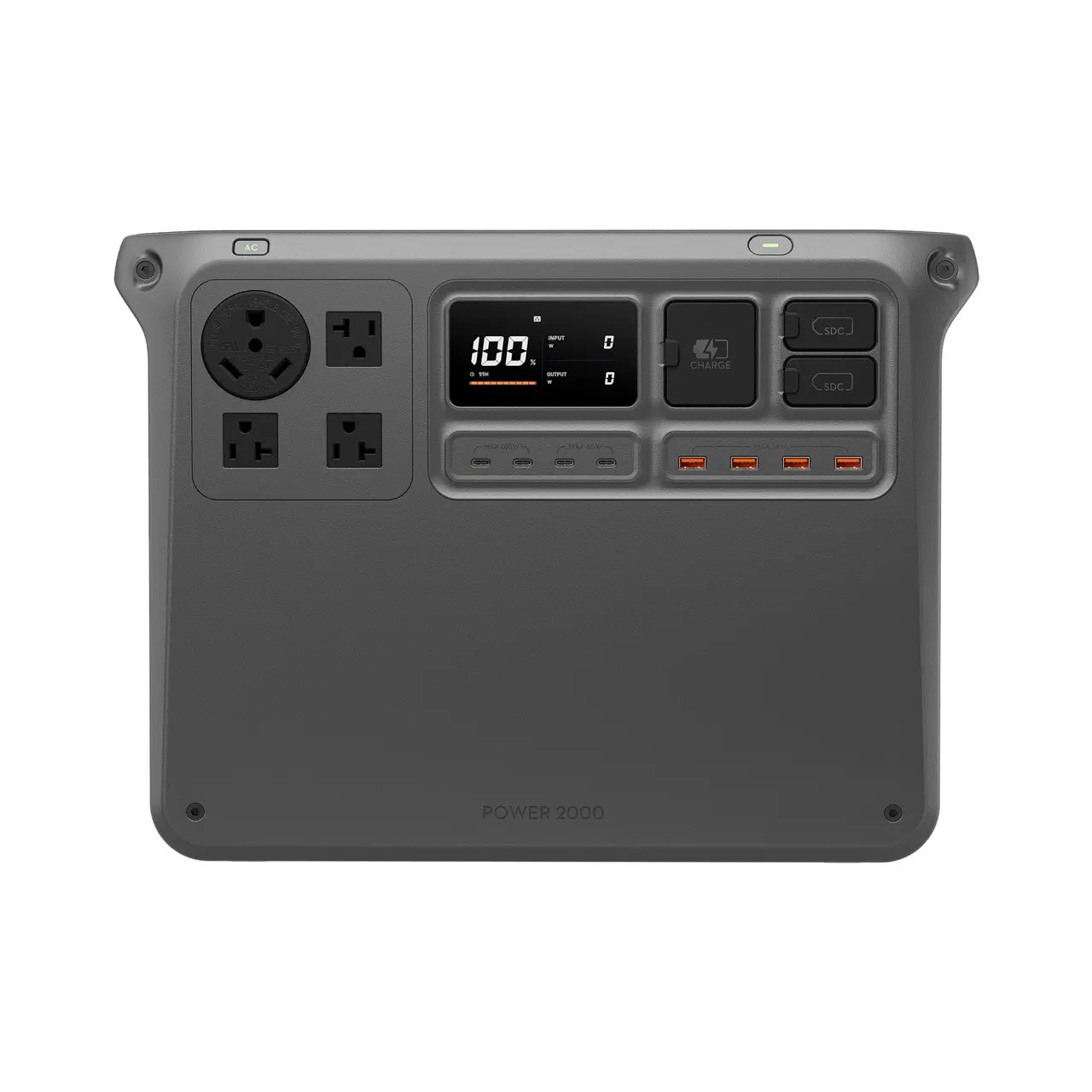
To be fair to the DJI, it bolts on plenty: a 3,000W inverter to the Explorer's 2,200W, four and a half times the solar intake, 140W USB-C against 100W, four AC outlets to three, and an expansion port the sealed Jackery will never grow. Reviewers add that it's among the quietest and fastest-charging units they've testedA1A2. None of that is markup. It's real hardware.
Here's the DJI's problem: run both boxes through all six of our modeled scenarios — blackout, CPAP, remote workday, tailgate, weekend camp, van life — and they finish within a single percentage point of each other every time. Same nights, same margins, same two failures. The better machine never gets to prove it, which makes the 63% premium a bet that your life contains the loads and the solar arrays that would. Most buyers' lives don't. Take the Explorer.
What the Numbers Reveal
Each conclusion stated first — the numbers behind it on one line, the full analysis below.
Capacity
The premium is therefore spent entirely on the equipment around the battery — inverter, charge electronics, ports, an expansion socket — and the lifetime ledger prices that choice at a 60% surcharge per kilowatt-hour for energy that is watt-for-watt the same. You aren't paying DJI for electricity. You're paying for machinery, and machinery only pays you back when it runs.
DJI Power 2000: $1,299 for 2,048Wh rated 4,000 cyclesJackery Explorer 2000 v2: $899 for 2,042Wh rated 4,000 cyclescomputed lifetime energy: 8,192kWh vs 8,168kWh, at $0.16 vs $0.10 per lifetime kWh
Why it mattersIf your loads are a fridge, a router, and a CPAP, buy the Explorer and let the DJI's electronics idle in someone else's closet.
solar input
The catch is the connector: that 1,800W arrives through DJI's proprietary SDC input, so budget for DJI's own adapter rather than plugging in any panel you own. Even so, off-grid this is the matchup's one category-sized gap — it converts solar from a trickle that offsets your draw into a refill you can schedule.
DJI solar input: 1,800W, through its proprietary SDC connectorJackery solar input: 400Wreviewers measured a full DJI solar recharge in about 75 minutesA1
Why it mattersIf panels are your primary charger, stop weighing the price and take the DJI; it's the one buyer for whom the premium is obviously cheap.
What's left are the edges: the DJI hands off to battery in half the time, a margin that matters for a desktop PC and not at all for the fridge, and it refills far faster once the grid returns. The Explorer's counter is field-proven adequacy — the documented multi-hour outage run is on its side of the ledgerB4. For one blackout a year, edges don't cash. For storm-season clusters, the DJI's recharge speed starts to.
computed 8-hour blackout: a 1,645Wh draw uses 94% of the DJI's usable capacity vs 95% of the Jackery'sUPS switchover: 10ms line-interactive on the DJI vs 20ms standby on the Explorerone reviewer rode out a multi-hour simulated outage on the Explorer — fridge, lights, laptop — with no voltage dropsB4
Why it mattersCount your outages: occasional, keep the difference; recurring and multi-day, the DJI's refill speed is the one luxury worth paying for.
The specific dimensions that decide these two units — everything else is a tie.
Lifetime Value
Selected because: Price corrected $899 to $1,299 — identical lifetime energy now splits 16 vs 10 cents/kWh; this is the axis that flipped the verdict.
cost / lifetime kWh
Run both to their rated 4,000 cycles and the ledger reads 8,192 lifetime kilowatt-hours from the DJI, 8,168 from the Jackery — a difference you couldn't find on a utility bill. Cycle one daily and either lasts eleven years. The energy half of this purchase is a dead heat, which leaves the money half: a dime per lifetime kilowatt-hour on the Explorer, sixteen cents on the Power 2000.
That surcharge is the corrected heart of this page. The DJI's premium buys genuinely better electronics around an identical battery, so the question the lifetime table asks is blunt: will you use them? Solar arrays and loads past 2,200W, and the surcharge is a bargain. Wall charging and a fridge, and it's a tip.
Your Life, Your Pick
Selected because: All six computed verdicts tie within one point — proof the premium buys no outcome coverage; backbone of the p2 case.
Six scenarios, six dead heats. Both clear an 8-hour blackout with the same slim reserve, both barely notice a CPAP night or a workday, both cruise through a tailgate, and both tap out at the same two walls — a full weekend camp and a van-life day. Nowhere in the table does the DJI's extra hardware flip an outcome. If the job fits in 2kWh, both do it; if it doesn't, neither does.
That table is the Explorer's whole closing argument. The DJI's premium doesn't buy more nights — it buys faster refills between nights and more simultaneous draw during them. Those are real advantages, but they live around the scenarios, not in them, and you should only pay for the around if you'll actually visit it.
Growth Path
Selected because: DJI's strongest surviving counterargument (expansion + huge solar ceiling), aired with the young-ecosystem and proprietary-connector caveats.
solar input
The Power 2000 is the one with a future tense. It accepts DJI expansion batteries, and its solar ceiling is sized for a rooftop's worth of panels where the Explorer maxes out at one or two. If a move toward partial home backup is anywhere in your plans, this is a genuine fork, not a spec-sheet garnish.
Two asterisks before you pay for that future. The expansion batteries are DJI-specific and the company is two years into this category, so the accessory shelf is still short — confirm the add-on you're counting on actually ships before you price it into the decision. And the big solar number arrives through DJI's proprietary SDC connector, adapter required, not a plug-any-panel port. The path is real; it's a toll road.
Portability & Form Factor
Selected because: 39.5 vs 48.5 lb — the cheaper unit is also the lighter one; second tangible p2 advantage.
weight
At 39.5 pounds the Explorer undercuts the 48.5-pound DJI by nine — the gap between a box you grab one-handed and a box you address with both. Reviewers single out how manageable it is for a 2kWh unit, flip-up handle and all, easy to shuttle from car to garage to campsiteB1.
The DJI's extra weight is honest — it is the bigger inverter and the charging hardware — and it remains a one-person carry. But a power station that travels gets chosen by feel, and the one that's lighter, smaller, and cheaper is the one that keeps ending up in the trunk.
Brand Trust
Selected because: Cross-brand tension: 2024 entrant with no track record vs known name with weak service; frames the residual risk on both sides.
This is the category's newest serious name against its most recognized one. DJI showed up in 2024 carrying drone-battery R&D and built the Power 2000 like it expects abuse — reviewers catalog flame-retardant materials, 26 temperature sensors, 21 fuses, and a frame rated to hold a one-ton static loadA3. What it can't ship is a track record: two years in, the long-term data simply doesn't exist yet.
Jackery's profile is the mirror image. It's the name on the shelf at Costco, Home Depot, and Best Buy, with years of field history — and a service reputation weak enough that the standing advice is to buy it from a retailer whose return desk you trust. Choose your uncertainty: an impressive newcomer without a history, or a proven box you'd rather not need to warranty.
Strengths & trade-offs
DJI Power 2000
Strengths
- +Larger battery capacity
- +Higher AC output
- +Faster solar charging
Trade-offs
- –Substantially more expensive (+$400) than the Explorer 2000 v2.
Jackery Explorer 2000 v2
Strengths
- +Costs $400 less
- +Lighter by 9 lb
Trade-offs
- –Weaker inverter (-800W) limits appliance compatibility.
- –Sealed capacity — the Power 2000 can add batteries to grow past 2,042Wh; this one can't.
Will It Power Your Gear?
Scenario math and per-appliance runtimes, modeled from the spec record.
Scenario verdicts
We ran the math on six real-world scenarios. Here's which unit survives your actual life.
SCN-01 · 2 nights · needs 2,100Wh
Weekend Camping
Two nights off-grid with essential comfort
Neither unit
Two nights off-grid wants 2,100Wh and both boxes come up about a fifth short, so either way you're topping up by the second afternoon. The difference is what topping up costs you: the DJI can bank the deficit from a big panel array over a long lunch, while the Explorer's panel-or-two input spends the whole afternoon on it. A tie on paper; off-grid, recovery speed is the tiebreak.
Battery budget usedlower = more headroom
LOAD Phone Charger 15W×6h · LED Lights 40W×8h · Box Fan 75W×14h · CPAP Machine 40W×16h
SCN-02 · 8 hours · needs 1,645Wh
8-Hour Blackout
Keep the essentials running through a night without power
Either unit
Both finish the night one percentage point apart with a sliver in reserve — functionally the same unit here. The DJI switches to battery in half the time and refills far faster once the grid returns; the Explorer does the same night's work for less money. If blackouts are rare where you live, buy the cheap ticket. If they arrive in clusters, the faster refill starts to matter.
Battery budget usedlower = more headroom
LOAD Fridge 150W×8h · Router + Modem 20W×8h · LED Lights (4 bulbs) 40W×6h · Phone Charger 15W×3h
SCN-03 · 8 hours · needs 320Wh
CPAP Overnight
Sleep therapy without interruption — the #1 medical use case
Either unit
A 40W CPAP sips 18% of either box overnight — call it five nights per charge, from either. Both carry the same 30dB noise rating, so neither announces itself at 2 a.m. This scenario refuses to pick a side; let the price do it.
Battery budget usedlower = more headroom
LOAD CPAP Machine 40W×8h
SCN-04 · 8 hours · needs 910Wh
Remote Workday
Full work day off-grid without power anxiety
Either unit
A 910Wh workday uses about half of either unit, with a second day banked. The thin advantages here are the DJI's: stronger USB-C for feeding a laptop directly and a fourth AC outlet for a crowded desk. Call it a tie you'd only notice on moving day — when the Explorer is the lighter one to relocate.
Battery budget usedlower = more headroom
LOAD Laptop 60W×8h · External Monitor 30W×8h · Router + Modem 20W×8h · Phone Charger 15W×2h
SCN-05 · 4 hours · needs 670Wh
Tailgate Party
Game day power for the crew
Either unit
Game day uses under 40% of either box in four hours — neither breaks a sweat. Choose on logistics: the Explorer is the easier lift over a tailgate, while the DJI brings more sockets and more headroom if a serious griddle comes along. The one that's cheaper and lighter tends to be the one that makes the trip.
Battery budget usedlower = more headroom
LOAD Blender 400W×0.5h · LED TV (55") 80W×4h · Bluetooth Speaker 15W×4h · Phone Charger (×3) 45W×2h
SCN-06 · 24 hours · needs 4,685Wh
Van Life Daily
A full day of mobile living — the ultimate endurance test
Neither unit
A real van day draws 4,685Wh — nearly three of either box. Neither belongs at the center of a van build on its own. The DJI at least gestures at the job, with expansion batteries and a solar intake sized for a roof array; the honest answer for this scenario is a larger system entirely.
Battery budget usedlower = more headroom
LOAD Mini-Fridge 150W×24h · Laptop 60W×4h · Phone Charger 15W×3h · LED Lights 40W×5h · Fan 75W×8h
The Load Test
RUNTIME = (Wh × 0.85) ÷ LOAD
None of the scenarios above exactly yours? Build it. Toggle what you'd plug in; both units are tested against the combined draw.
Essentials
Comfort & Convenience
High-Draw Appliances
Test duration
8h
Continuous draw
205W
Projected runtime
Dead heat — both run this 205W load for roughly 8.5h. Pick on price, weight, or ports.
Modeled from the spec record — same math as the tables below. Methodology
Runtime by appliance
Real-world runtime estimates for common appliances, modeled at 85% inverter efficiency.¹
Essentials
The basics you need runningscale 0–116.1hComfort & Convenience
Makes off-grid life actually enjoyablescale 0–23.2hHigh-Draw Appliances
These reveal the real limitsscale 0–1.7h¹ Runtime = (capacity × 0.85) ÷ appliance watts. Within each group, all bars share one time scale (the group's longest runtime), so lengths are comparable across appliances; identical runtimes collapse into a single blue/orange bar. Actual runtime varies with battery age, temperature, and simultaneous loads — see methodology.
Conclusion
July 13, 2026
Verdict: the Jackery Explorer 2000 v2
The corrected price settles this. The two share what is functionally one battery — 2,048Wh against 2,042, identical 4,000-cycle LFP, identical five-year warranties — and across all six modeled scenarios they finish within a single percentage point of each other, so the DJI's extra output and intake never change an outcome you'd actually live through. What the Power 2000's premium buys is real: a far bigger inverter, vastly faster solar, an expansion path. Pay it if panels are your charger, your loads outrun the Explorer's inverter, or expansion is genuinely in your plans; that buyer gets full value. Everyone else gets identical nights from the Explorer 2000 v2 at $400 less, in a lighter box that's also the cheaper one per lifetime kilowatt-hour by a wide margin.
Editor-assigned confidence, based on cited owner research and spec analysis.
List prices as of July 13, 2026. The links below open DJI's and Jackery's current prices.
$999.00 · direct from Jackery
Last checked 1 day ago. Prices move — check before you buy.
or check the Power 2000 price$1,299.00 list
Written by Gunner Gustafson, Whole-Home Backup Tester · Station Arena Test Desk · Updated July 13, 2026
Measured Data
Benchmark scores and the full spec record, side by side.
Benchmark scores
Full specifications
ᵈ Derived: price ÷ rated capacity. See the data behind our comparisons →
Comparison ToolAdd more power stations, side by sideOpen Tool →How these numbers are produced
Numeric verification
Every figure on this page traces to our spec database or arithmetic on it — no estimated numbers.
Owner claims
Statements about owner experience are cited to published reviews — see Sources & Research Notes below.
Runtime model
Runtime = (rated capacity × 0.85 inverter efficiency) ÷ device wattage. Solar recharge estimates assume panels deliver 70% of rated output. Cold weather, battery age, and stacked loads reduce real-world results.
Power Score
Computed from 14 published spec dimensions, weighted per use-case bench. Higher is better; a unit must meet a bench's minimum threshold to be rated.
See the full weight table and data sourcing on our methodology page →Class ranking (the star rating)
Each unit's star score is a category ranking, not customer reviews — no buyer opinions feed it. We score every station on size-independent quality (value, output, portability, endurance, ports, warranty, and more), then percentile-rank it against the other units in its capacity class, so a class-leading compact unit and a class-leading whole-home unit can both earn 5★. Here, Power 2000 rates 4.3/5 (56th percentile of 26 Large-class units), and Explorer 2000 v2 rates 3.6/5 (16th percentile of 26 Large-class units).
How the class ranking is computed →Test Notes & Caveats
Hidden gotchas and advantages we spotted that you won't find on the product page.
The Explorer's ceiling is printed on the box
Outgrow 2,042Wh and the Explorer's upgrade path is buying a second unit; it's a sealed system by design. The Power 2000 accepts DJI expansion batteries, which is a real fork between these two. One honest check before that decides your purchase: DJI is two years into this category and the accessory shelf is young — make sure the add-on battery you're planning around actually ships.
Ten milliseconds against twenty
Both switch to battery fast enough that a fridge, router, or modem never notices the grid left. The DJI's line-interactive design halves the gap, which is the safer margin for a desktop PC or anything that reboots on a flicker. Kitchen-and-Wi-Fi households can score this a tie; keep-the-computer-alive households should tilt DJI.
Same five years, different bill
Both boxes carry five-year warranties over the same 4,000-cycle life, so the promise is identical — what differs is its price. Spread each sticker across the coverage and the DJI costs $260 per warranted year to the Explorer's $160. You're not buying more protection with the premium; you're buying the hardware around it.
Full record above — the Test Desk pick is the Explorer 2000 v2.
Check Explorer 2000 v2 price →or check the Power 2000 priceOwnership Analysis
What happens after you buy — true cost of ownership, brand trust, and growth potential.
Lifetime value
Service lifeyears at one full cycle per day
Lifetime energy delivered
Cost per delivered kWh
│ warranty ends · Reaching the cycle rating means ~80% capacity remains — degraded, not dead.
Analyst note
The Explorer 2000 v2 wins on both sticker price and long-term value. At $0.11/kWh over its lifetime, it's meaningfully cheaper to own. Clear value winner. One thing to know reading the table: both carry the same 4,000-cycle rating, so the lifetime rows are sticker price and capacity in disguise — the wear horizon is identical and decides nothing here.
Brand trust
DJI
Ecosystem
New entrant (2024) — five power station models to date: Power 500, Power 1000 (since superseded by the V2 but still sold), Power 1000 V2, Power 1000 Mini, Power 2000. Buying a "Power 1000" listing? Check which revision it actually ships.
Support
Leveraging DJI's established global support and repair center network from the drone business. Generally positive reputation inherited from drone operations, but limited power-station-specific track record.
Community
No dedicated power station community yet. Discussions happen within r/dji (~250K members, mostly drone users). Very small power-specific presence on Facebook and forums.
App experience
Rated 3.5/5 iOS and Android (DJI Home app ratings reflect entire DJI ecosystem including drones/cameras, not power-station-specific). Users report the on-device screen is more reliable than the app.
Unique strength
Runs quiet — 23-30dB published on most of the range (manufacturer best-case figures), at the quiet end of the category; our record carries no figure for the Power 1000 V2. Fast wall charging, quickest on the Power 1000 V2 at ~56 min — that figure is the V2's, not the whole line's. 700+ battery patents from drone R&D. SDC ports for ultra-fast DJI drone charging. Premium industrial design and build quality. LFP batteries rated for 4,000+ cycles.
Worth knowing
Budget for the fine print: solar arrives through DJI's proprietary SDC connector, so panels need DJI's own adapter, and the SDC fast-charge ports mostly reward people who fly DJI drones. The engineering pedigree is real — 700-plus battery patents out of the drone business — but the power-station accessory shelf is only two years old.
Jackery
Ecosystem
12-15+ models across Explorer (portable) and HomePower (home backup) series, plus SolarSaga panel ecosystem and innovative form factors
Support
The service desk is Jackery's soft spot, and the fix is procedural: buy from Costco, Amazon, or another big-box counter and let a generous return window be your first line of defense rather than a warranty ticket.
Community
Smallest community of the major brands — Reddit r/Jackery has ~2,000 members. YouTube presence is solid due to brand recognition.
App experience
Rated 2.3-3.3/5 iOS and Android — the weakest app experience of the major brands. Multiple confusing apps (Jackery app vs Jackery Home) and mandatory login even offline.
Unique strength
Highest brand recognition and widest retail distribution (Costco, Home Depot, Best Buy, Amazon). The "Toyota" of power stations — dependable, proven, wide availability. Innovative form factors like the Solar Gazebo and Solar Mars Bot.
Worth knowing
A couple of older models still ship NMC chemistry with a shorter rated lifespan, so check the cycle rating on the specific unit — though most of the current line has moved to LFP. Generally perceived as overpriced for the specs offered compared to newer competitors. App experience is significantly behind rivals.
Analyst note
Two kinds of confidence. DJI offers the deeper engineering story — drone-battery R&D, a global support network, premium build — with only two years of power-station history behind it. Jackery offers ubiquity: the most recognized name in the category, sold everywhere, with a long field record and a support reputation that trails its hardware. At these prices the Explorer only has to be adequate to win the value case; the DJI has to be used hard to justify itself.
Growth path
Power 2000
EXPANDABLESupports DJI expansion batteries, so you can add capacity later without replacing the base unit — useful if your needs may climb past 2,048Wh.
Accepts up to 1,800W of solar. Enough for a serious multi-panel array.
Generous port selection supports complex multi-device setups.
Expansion batteries are DJI-specific. You're investing in the DJI ecosystem.
Explorer 2000 v2
FIXED CAPACITYFixed at 2,042Wh — a sealed, complete system rather than a starting point. There's no expansion port, so that figure is the ceiling: check it against your longest unplugged stretch before you buy.
Accepts up to 400W of solar. Suitable for a 1-2 panel setup.
Adequate ports for most setups, but heavy users may want a power strip.
Realistic full solar rechargeat 70% of rated panel output — see methodology
Analyst note
The Explorer 2000 v2 is sealed at 2,042Wh, which is fine if that covers you. The Power 2000 starts at 2,048Wh and can grow beyond it with DJI expansion batteries — real headroom the Explorer 2000 v2 doesn't have if your needs climb toward partial-home backup.
What Owners Report
Patterns from published owner reports and long-term reviews — every claim cited to its source below.
DJI Power 2000
Review coverage of the Power 2000 reads like a highlight reel: among the fastest-charging units tested, with a full wall charge in about 90 minutes and a full solar refill in roughly 75 at its maximum inputA1; among the quietest, holding around 29dB at five feet even under heavy loadA2; and built to a safety spec reviewers describe in hardware-store detail — flame-retardant materials, 26 temperature sensors, 21 fuses, a one-ton static load ratingA3. One reviewer's bottom line was that it ran everything they plugged in and shrugged at surgesA4.
The honest gap is time. DJI has sold power stations for about two years, so multi-year reliability data doesn't exist — what exists is drone-battery pedigree and a strong first impressionA4. Nothing in the ledger argues against this unit; there just isn't much ledger yet.
“Among the fastest-charging tested — a full wall charge in about 90 minutes (reviewers measured even faster, roughly an hour), and up to 1,800W of solar input for a full solar charge in about 75 minutes.”
Sources
bobvila.com · t3.com · thesolarlab.com · campingsolar.us · protoolreviews.com · greenerideal.com · dronexl.co
Jackery Explorer 2000 v2
The Explorer 2000 v2's file has the thing the DJI's can't: duration. One reviewer ran it for over six months across camping trips and office-backup duty — laptop, monitor, Starlink — then rode out a simulated multi-hour home outage powering a fridge, lights, and a laptop with no voltage dropsB4. The portability praise is constant: right under 40 pounds, compact for its class, with a flip-up handle that makes the car-to-garage shuffle painlessB1.
Two texture notes: its LFP chemistry and five-year warranty draw approval as a long-haul packageB3, and the fan is quiet but honest — louder than the sub-30dB spec during normal charging, with an app-side silent mode that trades charging speed for hushB2.
“At right under 40 lbs it's noticeably lighter than many other 2kWh stations — small, compact, with a flip-up handle that makes it easy to carry and stash in a car. Not featherweight, but easy to move from car to garage.”
Sources
outdoorgearlab.com · backuppowerhub.com · thesolarlab.com · voltagebasics.com · portablepowerstationreview.com · gp-reviews.com
Sources & Research Notes
Every owner claim in this report is traceable to a published source. The bracketed references above resolve here.
Recurring owner themes
- Standout fast charging (wall and 1800W solar), near-silent operation, and an unusually robust safety-focused build are the consistent praise. [Power 2000 · 3 entries]
- Lightweight, compact portability is the standout theme; quiet operation (especially in Silent mode) and proven real-world reliability round out strong sentiment. [Explorer 2000 v2 · 3 entries]
- A1
“Among the fastest-charging tested — a full wall charge in about 90 minutes (reviewers measured even faster, roughly an hour), and up to 1,800W of solar input for a full solar charge in about 75 minutes.”
bobvila.com / t3.com — DJI Power 2000 review · 2025-2026 · [positive]
- A2
“One of the quietest power stations tested — only about 29 dB at 5 feet when the fan kicked in, virtually silent, and it stayed among the quietest units even under the heaviest loads.”
bobvila.com / thesolarlab.com — DJI Power 2000 review · 2025-2026 · [positive]
- A3
“Built with an eightfold protection system — flame-retardant materials, a nano-coated BMS, 26 temperature sensors, 21 fuses, and structural reinforcement rated to support a one-ton static load — positioning it as one of the safest, most robust units on the market.”
campingsolar.us / protoolreviews.com — DJI Power 2000 review · 2025-2026 · [positive]
- A4
“Ran everything reviewers threw at it, handled surges consistently, and recharged incredibly fast, especially from solar; deep integration for DJI drone users is a unique advantage.”
greenerideal.com / dronexl.co — DJI Power 2000 review · 2025-2026 · [positive]
- B1
“At right under 40 lbs it's noticeably lighter than many other 2kWh stations — small, compact, with a flip-up handle that makes it easy to carry and stash in a car. Not featherweight, but easy to move from car to garage.”
outdoorgearlab.com / backuppowerhub.com — Jackery Explorer 2000 v2 review · 2025-2026 · [positive]
- B2
“The fan is relatively quiet and comes on infrequently — about 30 dB in Silent Charging Mode, ideal for indoor use. It's louder than the advertised sub-30 dB during normal charging, but the app's Silent mode dramatically reduces fan noise at the cost of charge speed.”
thesolarlab.com / voltagebasics.com — Explorer 2000 v2 review · 2025-2026 · [positive]
- B3
“LiFePO4 chemistry gives a long lifespan and indoor-safe operation, backed by a 5-year manufacturer warranty.”
portablepowerstationreview.com / gp-reviews.com — Explorer 2000 v2 review · 2025-2026 · [positive]
- B4
“Used for over six months on camping trips and as office backup for a laptop, monitor, and Starlink; rode out a multi-hour simulated home outage powering a standard fridge plus lighting and a laptop with no noticeable voltage drops.”
outdoorgearlab.com — Explorer 2000 v2 long-term testing · 2026 · [positive]
Research compiled July 13, 2026.
Who Should Buy Which
Buy the Power 2000 if you…
- →Panels are your primary charger — off-grid weekends, a cabin, storm-season prep. The DJI's solar intake is this matchup's one enormous gap, and it's pointed straight at you.
- →Your loads outrun the Explorer's 2,200W inverter, or you stack appliances and want the extra 800W of headroom plus a fourth AC outlet.
- →You expect your capacity needs to grow — DJI's expansion batteries let this box scale, where the Explorer's only upgrade is a second Explorer. Confirm the add-on you want actually ships; the ecosystem is young.
- →You fly DJI drones — the SDC ports fast-charge them natively, a perk nothing else in this comparison offers.
Buy the Explorer 2000 v2 if you…
- →Your load list reads fridge, router, lights, CPAP. Both boxes deliver identical nights there, and this one leaves $400 in your pocket.
- →The unit travels more than it sits — noticeably lighter and more compact, with a flip-up handle built for the trunk-to-campsite shuffleB1.
- →You start hard-surging motors and want the number in writing: the Explorer publishes a 4,400W surge peak; the DJI's spec sheet says 'Not Specified.'
- →You'd rather buy a known name off a big-box shelf with an easy return window than be early to a two-year-old product line.
If neither fits
If your real plan is van life or full off-grid weekends, both of these tap out partway through — you're shopping the wrong shelf. Step up to a 3kWh-class unit or an expandable system with a battery already added, or budget serious solar alongside whichever you pick; a 2kWh box can't be willpowered into a 4kWh job.
The Bottom Line
Take the Explorer 2000 v2. It shares the DJI's battery in everything but the logo — same capacity class, same cycle life, same warranty — and it matches the Power 2000 across every scenario we model, at $400 less. When two machines do identical work and one is the cheaper box per lifetime kilowatt-hour by a wide margin, the verdict writes itself.
The Power 2000 remains the better machine, and a specific buyer should ignore everything above: if panels are your charger, if your loads outrun the Explorer's inverter, if expansion is genuinely coming, pay the premium happily — you're the buyer it was built for. Everyone else is buying capability they'll never plug in. Keep the money. Get the Jackery.
Frequently Asked Questions
Answers drawn from the spec record and cited owner research.
Is the DJI Power 2000 worth $400 more than the Jackery Explorer 2000 v2?
Only for three buyers: people charging mainly from solar (the DJI's intake is four and a half times larger), people running loads past the Explorer's inverter, and people who plan to add DJI expansion batteries. For everyone else the two deliver the same capacity, cycle life, warranty, and scenario outcomes, and the Explorer does it at $899. Same battery, cheaper wrapper.
Which charges faster from solar, the DJI Power 2000 or the Jackery Explorer 2000 v2?
The DJI, and it isn't close. Reviewers measured a full solar recharge in about 75 minutes at its 1,800W intake; the Explorer's 400W input needs around five hours of perfect sun for the same 2,042Wh refill. One catch: the DJI's solar comes through its proprietary SDC connector, so plan on DJI's own adapter rather than plugging in any panel.
Can these run a refrigerator through an 8-hour blackout?
Both can. A blackout night running a fridge, router, lights, and phone charging draws about 1,645Wh — 94 to 95% of either unit's usable capacity — so both finish with a little in reserve. One reviewer rode out a simulated multi-hour outage on the Explorer with a fridge, lights, and a laptop and saw no voltage drops. Both also switch to battery fast enough (10 to 20ms) that a fridge never notices.
Is DJI a trustworthy power station brand?
New but serious. DJI entered power stations in 2024, and reviewers rate the Power 2000 among the quietest and fastest-charging units they've tested, with an unusually thorough safety build. The honest caveats are structural: about two years of track record, a young accessory ecosystem, and proprietary SDC connectors for solar and drone charging. It leans on DJI's existing global support network rather than a power-station-specific history.
Which is better for camping?
For a full two-night trip, honestly neither on a single charge — that load runs about 2,100Wh and both come up roughly a fifth short, so plan a top-up either way. If you recharge from panels at camp, the DJI refills dramatically faster and wins the use case. If you top up from the car or at home between trips, take the Explorer — it's the lighter carry and the cheaper buy.
Brand matchup
DJI vs Jackery: measured across every matchup →Where to buy
DJI Power 2000
$1,299.00
$1,299.00 · direct from DJI
Last checked 1 day ago. Prices move — check before you buy.
Jackery Explorer 2000 v2Pick
$999.00
$999.00 · direct from Jackery
Last checked 1 day ago. Prices move — check before you buy.
Prices may vary by retailer and are subject to change.