Head-to-head test
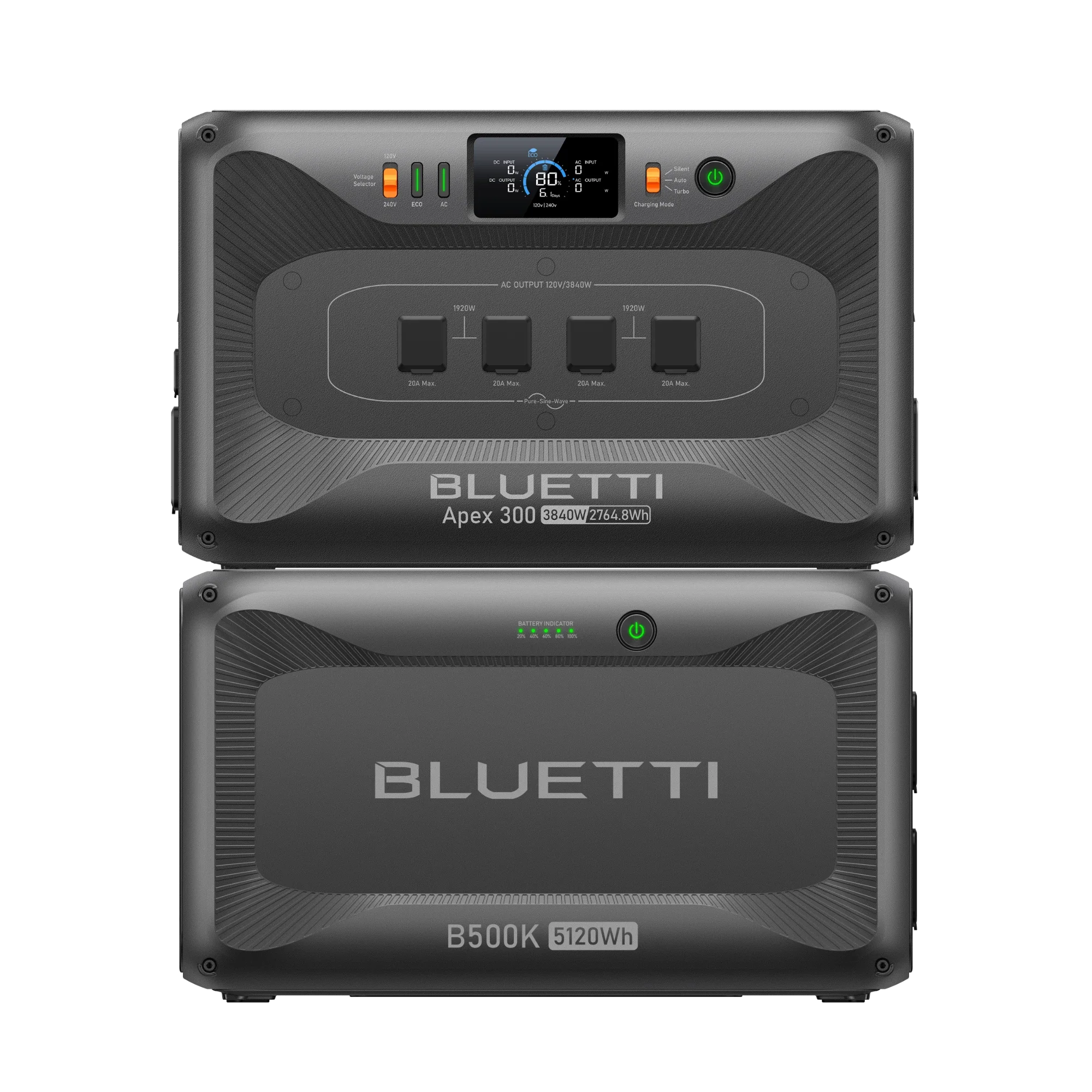
BLUETTI Apex 300 + B500K vs BLUETTI Elite 400
Both boxes work out to twelve cents per lifetime kilowatt-hour, so the $1,900 between them buys watt-hours and nothing else, and the only question left is whether your heaviest day runs past the Elite 400's 3,264Wh of usable reserve.
Full profiles: BLUETTI Apex 300 + B500K → · BLUETTI Elite 400 →

Written by Gunner GustafsonUpdated
Whole-Home Backup Tester, Station Arena Test Desk
$3,299.00 · direct from BLUETTI
Last checked 1 day ago. Prices move — check before you buy.

$1,299.00 · direct from BLUETTI
down from $1,399 · 7% below usual
Last checked 1 day ago. Prices move — check before you buy.
Spec deltas
Twelve cents a kilowatt-hour, both of them. $3,299 buys 3,500 cycles of a 7,885Wh pack and $1,399 buys 3,000 cycles of a 3,840Wh one, and when you divide it out the two land on the same figure to the cent. Whatever settles this matchup, it is not long-run cost.
What the extra $1,900 buys is room. The Apex 300 + B500K holds 6,702Wh of usable reserve against the Elite 400's 3,264Wh once you take the 85% inverter derate off both. Five of the six load profiles on this page finish comfortably on either unit. One does not, and if that one is your Tuesday, the rest of this page is a formality.
The other thing $1,900 buys is 98 pounds and a second box. Take the Elite 400 unless your worst realistic day clears 3,264Wh. The cheaper unit here is also the one that fits in a car.
What the Numbers Reveal
Each conclusion stated first — the numbers behind it on one line, the full analysis below.
Capacity
So the bigger pack is not a bulk discount that pays itself back. You pay a six-cent-per-watt-hour premium at the register, and the extra 500 cycles claw it back to exactly even rather than ahead. The $1,900 gap is a capacity purchase with the long-run savings argument pulled out from underneath it.
Apex 300 + B500K: $3,299 for 7,884.8Wh rated at 3,500 cyclesElite 400: $1,399 for 3,840Wh rated at 3,000 cyclesCost per watt-hour bought today: $3,299 divided by 7,885Wh is 42 cents; $1,399 divided by 3,840Wh is 36 cents
Why it mattersAnyone talking themselves into the bundle because it is the better value over ten years should stop. It is the same value. Buy it for the watt-hours or do not buy it.
That puts the real threshold at 3,264Wh rather than 3,840Wh, because the derate is where the ceiling actually sits. A scoreboard reading five to one is measuring reserve, not capability, in four of those five rows, and reserve is the cheapest thing in the world to buy and the easiest to never touch.
Weekend Camping needs 2,100Wh: 31% of the bundle's usable reserve, 64% of the Elite 400's8-Hour Blackout needs 1,645Wh: 25% against 50%Van Life Daily needs 4,685Wh: 70% against 144%Usable reserve is 85% of nameplate, so 6,702Wh and 3,264Wh
Why it mattersAdd up your genuinely worst day before you read the scenario table. Under roughly 3,264Wh, the extra $1,900 buys a number you watch rather than energy you use.
weight
That reframes the weight row completely. The bundle is not a heavier version of the same object. 2,400W of solar input and 3,840W of continuous output describe something you install once and leave alone, while 85 lb on wheels describes something that goes in a trunk on Friday. The 98 lb spread is a category tell, not a handicap.
The Apex bundle's 183 lb covers two boxes, the Apex 300 and the B500K, not one chassisThe Elite 400 is a single 85 lb unit, and review coverage notes it rolls on a built-in trolleyB2B3One reviewer could hardly carry the Apex more than a few feet at a time and could not lift it onto a tableA11
Why it mattersIf the unit is ever leaving the house, that settles it for the Elite 400. If it is going beside the breaker panel and staying there, the bundle's mass costs you one afternoon and never again.
continuous output
A compressor's startup spike is a multiple of its running draw, which is why surge headroom decides whether a unit will start a well pump or a shop compressor, not whether it will run a fridge. Every load modeled here starts on both units. The Apex's doubling is a workshop credential, and workshops are a different buyer.
Apex bundle: 7,680W surge on 3,840W continuous, exactly doubleElite 400: 3,900W surge on 2,600W continuous, one and a half timesBoth units start every peak load in all six scenario profiles
Why it mattersIf nothing you own spikes past 3,900W on startup, the surge row is a spec you will never once observe.
The specific dimensions that decide these two units — everything else is a tie.
Runtime: Will It Power Your Gear?
Selected because: Everything turns on one line: 3,264Wh of usable reserve in the Elite 400 against 6,702Wh in the Apex bundle, both after the 85% inverter derate.
continuous output
6,702Wh and 3,264Wh are the numbers to plan against, not 7,885 and 3,840. The 85% derate is the whole difference between a spec sheet and a Tuesday, and everything downstream of it is arithmetic against your own load list.
Take the blackout profile as the yardstick: 1,645Wh over eight hours of fridge, lights and a router. Run that same load until the battery quits and the Elite 400 gives you about 16 hours, the bundle about 32 (3,264Wh and 6,702Wh against 1,645Wh per eight hours). Both keep the food cold overnight. The bundle's advantage starts on day two, which is exactly the sort of thing worth knowing before you spend $1,900 on it.
Your Life, Your Pick
Selected because: The scoreboard reads five to one for the bundle, and in five of those six runs both units finish the job, which is worth knowing before the tally does your thinking for you.
Four of the bundle's five wins are it finishing with more left in the tank, not the Elite 400 falling short. Camping at 2,100Wh, a blackout at 1,645Wh, a workday at 910Wh, a tailgate at 670Wh: both units clear every one of them, and the Elite's worst showing across the four is 64% of usable on a camping weekend. A scenario winner is a headroom measurement wearing a rosette.
Van Life Daily is the exception and it is not close. 4,685Wh against 3,264Wh of usable reserve is 144%, which is not a shortfall you fix by turning off the lights. That single row is the entire case for the bundle, and it is a complete case if you are the person living it.
Lifetime Value
Selected because: $3,299 across 27,597 kWh and $1,399 across 11,520 kWh both land on 12 cents a kilowatt-hour, which takes long-run cost off the table entirely.
cost / lifetime kWh
A dead heat, to the cent, by two routes that could hardly look less alike. $3,299 spread across 27,597 kWh of rated throughput, $1,399 across 11,520. The bigger pack has twice the capacity and 500 more cycles, it costs a little more than twice as much, and the arithmetic swallows the difference whole.
What is not a tie is the money you are out today and the money you are out per year of coverage: $660 a warranty year against $280 across the same five years. If the Elite 400 covers your loads, the tie means the cheaper box is simply the cheaper box, permanently.
Portability & Form Factor
Selected because: 183 lb is two boxes and 85 lb is one, and that difference decides where each unit spends its life.
weight
Two boxes at roughly 92 lb each, or one at 85 with a trolley. That is the honest portability line, and it is not the flat 98 lb spread the weight row implies, because 183 lb is the Apex 300 and the B500K added together and no human being lifts them as one object.
The split cuts both ways. Halving the load means the bundle can go down a staircase in two trips instead of never, but each of those trips is heavier than the Elite 400 is in total, and one reviewer could not get the Apex onto a table on their ownA11. Review coverage flags the Elite's weight too, wheels notwithstandingB3. Neither of these is a two-finger carry. Only one of them is a one-person, one-trip carry.
Growth Path
Selected because: The Elite 400 is sealed at 3,840Wh while the bundle starts at 7,885Wh and takes more, the one advantage you cannot buy back later.
solar input
The Elite 400 stops at 3,840Wh and that is the ceiling. A fixed number is only a flaw if the number misses, and against the six profiles here it misses exactly once, so read the expansion row as a question about your next three years rather than a defect in the present box.
Where the bundle earns its premium is if you are heading toward partial-home backup: it already starts at 7,885Wh and accepts further BLUETTI expansion batteries, so the ceiling moves when you do. One caution before you buy the growth story. Owners running Apex packs in parallel report them charging from the grid at uneven rates, with unofficial workarounds traded on the forum to keep them in syncA3A4. Expansion that needs a workaround is still expansion, but plan on some reading.
Strengths & trade-offs
BLUETTI Apex 300 + B500K
Strengths
- +Larger battery capacity
- +Higher AC output
- +Faster solar charging
- +Rated for 6,000 charge cycles — much longer battery lifespan
Trade-offs
- –Substantially more expensive (+$1,900) than the Elite 400.
- –Significantly heavier (+98 lbs), making it harder to move.
- –Very heavy unit that may be difficult for one person to lift.
BLUETTI Elite 400
Strengths
- +Costs $1,900 less
- +Lighter by 98 lb
Trade-offs
- –Weaker inverter (-1,240W) limits appliance compatibility.
- –Very heavy unit that may be difficult for one person to lift.
- –Sealed capacity — the Apex 300 + B500K can add batteries to grow past 3,840Wh; this one can't.
- –Shorter-lived battery — rated for 3,000 charge cycles vs the Apex 300 + B500K's 6,000, so it wears out sooner.
Will It Power Your Gear?
Scenario math and per-appliance runtimes, modeled from the spec record.
Scenario verdicts
We ran the math on six real-world scenarios. Here's which unit survives your actual life.
SCN-01 · 2 nights · needs 2,100Wh
Weekend Camping
Two nights off-grid with essential comfort
Elite 400
Both finish the weekend. 2,100Wh of camping load takes 31% out of the bundle's 6,702Wh of usable reserve and 64% out of the Elite 400's 3,264Wh, so the question is not whether the lights stay on, it is how much you have left on Sunday afternoon. For a cooler, some lights and a stack of phones, the Elite's remaining third is a margin rather than a squeeze.
Battery budget usedlower = more headroom
LOAD Phone Charger 15W×6h · LED Lights 40W×8h · Box Fan 75W×14h · CPAP Machine 40W×16h
SCN-02 · 8 hours · needs 1,645Wh
8-Hour Blackout
Keep the essentials running through a night without power
Apex 300 + B500K
Eight hours of fridge, lights and router costs 1,645Wh, a quarter of the bundle's usable reserve and half of the Elite 400's. Both keep the food cold. Run the same load until empty and the Elite gives you about 16 hours against the bundle's 32 (3,264Wh and 6,702Wh against 1,645Wh per eight hours), so the bundle's real edge shows up on the second day of an outage rather than the first night.
Battery budget usedlower = more headroom
LOAD Fridge 150W×8h · Router + Modem 20W×8h · LED Lights (4 bulbs) 40W×6h · Phone Charger 15W×3h
SCN-03 · 8 hours · needs 320Wh
CPAP Overnight
Sleep therapy without interruption — the #1 medical use case
Elite 400
A night on the machine is 320Wh: 10% of the Elite 400's usable reserve, 5% of the bundle's. That is about ten nights on one charge from the Elite and twenty from the bundle, which is a long way of saying capacity has nothing to do with this one. What decides it is what stands next to the bed, and one 85 lb box on a trolley beats a two-box, 183 lb installation. The Elite takes it, and a much smaller unit would take it too.
Battery budget usedlower = more headroom
LOAD CPAP Machine 40W×8h
SCN-04 · 8 hours · needs 910Wh
Remote Workday
Full work day off-grid without power anxiety
Apex 300 + B500K
The Apex 300 + B500K clears the workday at 14% used, banking 5,792Wh — late work, extra calls, or a second laptop charge without arithmetic. The Elite 400 at 28% also finishes, with 2,354Wh of slack for the unplanned.
Battery budget usedlower = more headroom
LOAD Laptop 60W×8h · External Monitor 30W×8h · Router + Modem 20W×8h · Phone Charger 15W×2h
SCN-05 · 4 hours · needs 670Wh
Tailgate Party
Game day power for the crew
Elite 400
The Apex 300 + B500K at 183 lbs is not a take-along — it rolls off a truck bed if it travels at all, so this scenario belongs to the Elite 400 by default — and it earns it, covering the 670Wh with 2,594Wh to spare. Capacity was never the Apex 300 + B500K's problem here; getting to a tailgate was.
Battery budget usedlower = more headroom
LOAD Blender 400W×0.5h · LED TV (55") 80W×4h · Bluetooth Speaker 15W×4h · Phone Charger (×3) 45W×2h
SCN-06 · 24 hours · needs 4,685Wh
Van Life Daily
A full day of mobile living — the ultimate endurance test
Apex 300 + B500K
The one row that genuinely separates them. 4,685Wh a day is 144% of the Elite 400's 3,264Wh of usable reserve, so it does not reach morning, and switching things off does not close a 44% overshoot. The bundle ends the same day at 70%. If this profile is your actual life, the $1,900 stops being a premium and becomes the price of the unit that works.
Battery budget usedlower = more headroom
LOAD Mini-Fridge 150W×24h · Laptop 60W×4h · Phone Charger 15W×3h · LED Lights 40W×5h · Fan 75W×8h
The Load Test
RUNTIME = (Wh × 0.85) ÷ LOAD
None of the scenarios above exactly yours? Build it. Toggle what you'd plug in; both units are tested against the combined draw.
Essentials
Comfort & Convenience
High-Draw Appliances
Test duration
8h
Continuous draw
205W
Projected runtime
For this load: Apex 300 + B500K runs 32.7h vs 15.9h.
$3,299 list · direct from BLUETTI
Modeled from the spec record — same math as the tables below. Methodology
Runtime by appliance
Real-world runtime estimates for common appliances, modeled at 85% inverter efficiency.¹
Essentials
The basics you need runningscale 0–446.8hComfort & Convenience
Makes off-grid life actually enjoyablescale 0–89.4hHigh-Draw Appliances
These reveal the real limitsscale 0–6.7h¹ Runtime = (capacity × 0.85) ÷ appliance watts. Within each group, all bars share one time scale (the group's longest runtime), so lengths are comparable across appliances; identical runtimes collapse into a single blue/orange bar. Actual runtime varies with battery age, temperature, and simultaneous loads — see methodology.
Conclusion
August 9, 2026
Verdict: the BLUETTI Elite 400
Buy the Elite 400 at $1,399 unless you can name a day that draws more than 3,264Wh, which is what is actually left of its 3,840Wh after the standard 85% inverter derate. Of the six load profiles modeled on this page, five finish on either unit; only the van-life day at 4,685Wh crosses the Elite's line, and it crosses it at 144%. The Apex 300 + B500K is the better machine and the numbers behind that are real: 7,885Wh, 3,840W continuous, double its rating on surge, 2,400W of solar input. None of it is a value argument, because both units land on the same 12 cents per lifetime kilowatt-hour ($3,299 across 27,597 kWh, $1,399 across 11,520). Spend the extra $1,900 on headroom you will use, not headroom you will admire.
Today the Elite 400 is $1,299, $100 under its typical $1,399. The verdict weighs typical prices, not today's. Prices checked 1 day ago.
Editor-assigned confidence, based on cited owner research and spec analysis.
List prices as of August 9, 2026. The links below open BLUETTI's current price.
$1,299.00 · direct from BLUETTI
down from $1,399 · 7% below usual
Last checked 1 day ago. Prices move — check before you buy.
or check the Apex 300 + B500K price$3,299.00 list
Written by Gunner Gustafson, Whole-Home Backup Tester · Station Arena Test Desk · Updated August 9, 2026
Measured Data
Benchmark scores and the full spec record, side by side.
Benchmark scores
Not rated for both units (minimum threshold unmet): UPS, RV Living, Solar Generator.
Full specifications
ᵈ Derived: price ÷ rated capacity. See the data behind our comparisons →
Comparison ToolAdd more power stations, side by sideOpen Tool →How these numbers are produced
Numeric verification
Every figure on this page traces to our spec database or arithmetic on it — no estimated numbers.
Owner claims
Statements about owner experience are cited to published reviews — see Sources & Research Notes below.
Runtime model
Runtime = (rated capacity × 0.85 inverter efficiency) ÷ device wattage. Solar recharge estimates assume panels deliver 70% of rated output. Cold weather, battery age, and stacked loads reduce real-world results.
Power Score
Computed from 14 published spec dimensions, weighted per use-case bench. Higher is better; a unit must meet a bench's minimum threshold to be rated.
See the full weight table and data sourcing on our methodology page →Class ranking (the star rating)
Each unit's star score is a category ranking, not customer reviews — no buyer opinions feed it. We score every station on size-independent quality (value, output, portability, endurance, ports, warranty, and more), then percentile-rank it against the other units in its capacity class, so a class-leading compact unit and a class-leading whole-home unit can both earn 5★. Here, Apex 300 + B500K rates 3.5/5 (11th percentile of 29 Whole-Home / Off-Grid-class units), and Elite 400 rates 3.8/5 (27th percentile of 16 Home Backup-class units).
How the class ranking is computed →Test Notes & Caveats
Hidden gotchas and advantages we spotted that you won't find on the product page.
183 lb Is Two Boxes, Not One
This row adds the Apex 300 and the B500K together, so 183 lb describes a pair rather than an object. Split it and you get roughly 92 lb a box (183 divided by 2), each half heavier than the entire 85 lb Elite 400. That is better news than 183 lb in one lump, and it is still not portable: two hard trips against one, and the Elite is the only one of the two that a single person moves in a single go.
45 dB and 30 dB Are Ratings, Not Measurements
The bundle is rated 45 dB under load against the Elite 400's 30 dB, and most of that 15-point spread is simply how much fan a 3,840W inverter needs compared with a 2,600W one. These are class ratings taken under the manufacturer's conditions, not readings from your bedroom, so treat the gap as a category hint rather than a promise about a specific night. Neither number is a good reason to change your pick.
Fixed Capacity Is Only a Flaw If the Number Misses
The Elite 400 stops at 3,840Wh with no expansion port, so what you buy is the ceiling. Against the six load profiles on this page it clears five and misses one, which makes this a question about your future rather than a defect in the box. If you can see your draw climbing toward partial-home backup, the sealed design is the reason to spend up. If you cannot, it is the reason not to.
Elite 400: Power Lifting to 3,900W
The Elite 400 has BLUETTI's Power Lifting mode, which runs a resistive appliance rated up to 3,900W from its 2,600W inverter. It does that by delivering less power than the appliance asks for, not more than the inverter has: the heater still works, it just heats more slowly. Two things follow. BLUETTI scopes the mode to purely resistive loads — a heater, a kettle, an incandescent lamp — so it does nothing for a fridge compressor, a pump or a power tool, and this record publishes no surge figure at all, so read the mode as a resistive-load feature rather than as starting ability. And it is not a reason to size down, because running a load that big from 3,840Wh is a short session either way. Genuinely useful if a heater or a kettle is why you're buying; beside the point otherwise. The Apex 300 + B500K publishes no equivalent.
Ten Milliseconds Against Fifteen
Both units carry the load over inside the same blink: 10ms for the bundle, 15ms for the Elite 400. The category labels make five milliseconds sound like two different technologies. If you have one specific machine you cannot risk dropping, the number to check is that machine's ride-through, not this row, because this row is not what separates these two.
Same Five Years, Different Bill
Both units carry a 5-year warranty on identical terms, so this row is not telling you anything about protection. It is telling you about price: $660 per warranty year for the bundle against $280 for the Elite 400. When the coverage matches, the only variable left is how much box you bought.
Battery Lifespan in Real Years
The Apex 300 + B500K is rated for 6,000 cycles vs 3,000. In real life: at daily use, that's 16.4 vs 8.2 years. At weekend use (twice a week), it's 58 vs 29 years. One caution reading years across different sizes: a cycle is 7,885Wh on the Apex 300 + B500K and 3,840Wh on the Elite 400, so count lifetime energy — roughly 47,309 kWh against 11,520 kWh over the rated life. After hitting the cycle limit, the battery doesn't die — it drops to ~80% of original capacity, which is still very usable.
Full record above — the Test Desk pick is the Elite 400.
Check Elite 400 price →or check the Apex 300 + B500K priceOwnership Analysis
What happens after you buy — true cost of ownership, brand trust, and growth potential.
Lifetime value
Service lifeyears at one full cycle per day
Lifetime energy delivered
Cost per delivered kWh
│ warranty ends · Reaching the cycle rating means ~80% capacity remains — degraded, not dead.
Analyst note
The Elite 400 is cheaper to buy, but the Apex 300 + B500K is cheaper to own. At $0.07/kWh over its lifetime vs $0.12/kWh, the Apex 300 + B500K's higher cycle life and capacity make each dollar go further over the years.
Growth path
Apex 300 + B500K
EXPANDABLESupports BLUETTI expansion batteries, so you can add capacity later without replacing the base unit — useful if your needs may climb past 7,885Wh.
Accepts up to 2,400W of solar. Enough for a serious multi-panel array.
Generous port selection supports complex multi-device setups.
Expansion batteries are BLUETTI-specific. You're investing in the BLUETTI ecosystem.
Elite 400
FIXED CAPACITYFixed at 3,840Wh — a sealed, complete system rather than a starting point. There's no expansion port, so that figure is the ceiling: check it against your longest unplugged stretch before you buy.
Accepts up to 1,000W of solar. Enough for a serious multi-panel array.
Adequate ports for most setups, but heavy users may want a power strip.
Realistic full solar rechargeat 70% of rated panel output — see methodology
Analyst note
The Elite 400 is sealed at 3,840Wh, which is fine if that covers you. The Apex 300 + B500K starts at 7,885Wh and can grow beyond it with BLUETTI expansion batteries — real headroom the Elite 400 doesn't have if your needs climb toward partial-home backup.
What Owners Report
Patterns from published owner reports and long-term reviews — every claim cited to its source below.
BLUETTI Apex 300 + B500K
The field record here is thin and it is mostly reviewers rather than ownersA1A2A13. It is also not quite about this product: the first-hand posts that exist are about the bare Apex 300 or the Apex plus B300K combo rather than the B500K pairing, and none of them run to six months of ownershipA5A6. Read what follows as early signal, not as a track record.
The consistent positive is fan behavior, with three separate reviews describing the cooling as even and unobtrusive for a machine in this output classA1A2A13. The consistent negative is software. One owner's unit stuck in Backup mode after a firmware update with the app refusing to switch it backA7, another lost app connectivity after an IOT update and later found it fixed itselfA8, and a third hit an E004 inverter output failure the moment an update finishedA9. Owners chaining units in parallel report the packs taking grid charge at different rates and swapping unofficial fixes for itA3A4. On the physical side, one reviewer could hardly carry the thing a few feet at a stretchA11.
“Turns out the Apex 300's noise control is on par with the quietest power stations on the market, like those on offer from EcoFlow and DJI.”
BLUETTI Elite 400
Four entries, all of them reviews, none of them long-termB1B2B3B4. They agree on the shape of the machine: 3,840Wh of LFP, 3,900W of power lifting, 15ms UPS, quick charging and a built-in trolley, described as one of the more complete units at its tierB1B2. The recurring caveat is that it stops where it stops, with reviewers flagging no expansion and only two AC sockets as the compromisesB4, and the weight as real even with wheels under itB3. Nobody in this ledger has owned one through a winter, so treat reliability here as unproven rather than proven.
“BLUETTI's largest Elite-range unit — a 3,840Wh LiFePO4 battery with 2,600W continuous output (3,900W Power Lifting), fixed at native capacity with no expansion.”
Sources
techradar.com · amazon.com · backuppowerhub.com · cleantechnica.com · notebookcheck.net · thesolarlab.com · edinburghnews.scotsman.co
Sources & Research Notes
Every owner claim in this report is traceable to a published source. The bracketed references above resolve here.
Recurring owner themes
- Multiple independent reviewers describe the dual-fan cooling as noticeably quiet/even for a unit of this output class, even under load. [Apex 300 + B500K · 3 entries]
- Firmware and app updates have repeatedly caused mode-lock, download failures, or inverter error codes; several threads show the issue eventually resolved after further updates or support contact. [Apex 300 + B500K · 4 entries]
- When running multiple Apex 300 units or expansion batteries in parallel, owners report uneven charge rates between units, with community-devised (unofficial) workarounds needed to keep them in sync. [Apex 300 + B500K · 2 entries]
- The stripped-down, modular design draws criticism for real-world handling: extreme weight makes it hard to move, and lack of native USB/DC ports forces reliance on a separate paid hub accessory. [Apex 300 + B500K · 2 entries]
- Large 3,840Wh LFP capacity, fast charging, 15ms UPS, and a trolley are the praise; only two AC sockets, no expansion, and heavy weight are the caveats. [Elite 400 · 2 entries]
- A1
“Turns out the Apex 300's noise control is on par with the quietest power stations on the market, like those on offer from EcoFlow and DJI.”
The Solar Lab — "Bluetti Apex 300 Review: Cheap, Practical Home Backup?" · unknown · [positive]
- A2
“Some units sound like small jet engines under load, but the Apex 300's fans are relatively tame.”
Techspective — "Bluetti Apex 300 with B300K Review" · 2025-09 · [positive]
- A3
“The Apex 300 have some major charging problems... When the units are charging from the grid they charge at different rates and not together.”
DIY Solar Power Forum — "Bluetti Apex 300 problems" · 2025-09 · [negative]
- A4
“I have found a simple way to get around some of the solar charging limitations with multiple APEX 300s hooked up in parallel... So far, I have not had any problems with my setup.”
DIY Solar Power Forum — "Bluetti Apex 300 problems" · 2025-09 · [mixed]
- A5
“So far so good. Works with external batteries. For small applications the solar available works OK. For me the 240V output is great.”
DIY Solar Power Forum — "Bluetti Apex 300 launched today… anyone have thoughts?" (page 2) · 2025-05 · [positive]
- A6
“I was looking at building a full system and it was getting very overwhelming and I'm hoping this may be the answer.”
VW T6 Transporter Forum — "Bluetti Apex 300" · 2025-07 · [positive]
- A7
“I updated my Apex 300 to the latest firmware yesterday. Now it's stuck in 'Backup' mode... when I go into the app to try to change it back, it flashes to...”
BLUETTI Community — "Apex 300 stuck in Backup mode after last firmware update" · 2025-11 · [negative]
- A8
“There was an update on my Apex 300 a few days ago IOT v8026.12... Problem is every time I connect to the power st[ation]... Edit - This seems fixed now hooray!”
BLUETTI Community — "Check For Update App issue" · 2025-09 · [mixed]
- A9
“After the update completed, the charging stopped and I received Error 004... I have error E004 Inverter Output Failure.”
BLUETTI Community — "Error E004 Apex 300" · 2025-11 · [negative]
- A11
“it's so heavy I can hardly carry it more than a few feet at a time and have been unable to lift it onto a table.”
T3 — "Bluetti Apex 300 review: transform your off-grid life" · 2025-11 · [negative]
- A13
“Fan noise remains even, with no distracting pitch or rattle. This makes the Apex 300 usable near sleeping areas or indoor workspaces without disturbance.”
Yanko Design — "BLUETTI Apex 300 Review" · 2025-05 · [positive]
- B1
“BLUETTI's largest Elite-range unit — a 3,840Wh LiFePO4 battery with 2,600W continuous output (3,900W Power Lifting), fixed at native capacity with no expansion.”
techradar.com / amazon.com — Elite 400 review · 2026 · [mixed]
- B2
“Combines 3,840Wh LFP capacity, 3,900W surge, 70-minute fast charging, 15ms UPS protection, and a built-in trolley system — one of the most complete units at the 3,000Wh+ tier in 2026.”
backuppowerhub.com / cleantechnica.com — Elite 400 review · 2026 · [positive]
- B3
“A hefty ~86 lbs (39 kg), though reviewers note it's lighter than some competitors, with wheels and a trolley for mobility.”
notebookcheck.net / thesolarlab.com — Elite 400 review · 2026 · [mixed]
- B4
“Powerful, but reviewers flag only two AC sockets and no battery expansion as compromises — good but not quite as good as it could have been.”
techradar.com / edinburghnews.scotsman.com — Elite 400 review · 2026 · [mixed]
Research compiled August 9, 2026.
Who Should Buy Which
Buy the Apex 300 + B500K if you…
- →You are wiring backup into a subpanel and it never moves again. 3,840W continuous and 7,885Wh is partial-home territory, and 2,400W of solar input puts that pack back in about three and a half hours at the rated ceiling, quicker than the Elite refills a pack half the size (7,885 divided by 2,400 against 3,840 divided by 1,000). No array hits its ceiling on a grey afternoon, but the ratio holds.
- →Your real daily draw is near the van-life number of 4,685Wh. That is 70% of the bundle's usable reserve and 144% of the Elite's, which is the difference between a routine and a nightly rationing exercise.
- →Something on your circuit starts hard. 7,680W of surge against the Elite's 3,900W is the one spec on this page that decides whether a motor spins up at all.
- →You already know you are growing. The bundle takes expansion batteries and the Elite does not, and retrofitting that decision means buying a whole second unit.
Buy the Elite 400 if you…
- →You are buying for outages. Eight hours of fridge, lights and router is 1,645Wh, half of the Elite's usable 3,264Wh, it picks the load back up in 15ms, and it costs $1,399.
- →Camping, tailgates and remote work. Those profiles run 2,100Wh, 670Wh and 910Wh, which the Elite covers at 64%, 21% and 28% of usable without breathing hard.
- →The unit has to move. 85 lb on a trolley goes in a trunk. Two boxes and 183 lb goes in a truck, once.
- →You would rather keep the $1,900 than own reserve you never reach. Both units cost the same 12 cents per lifetime kilowatt-hour, so those savings are not borrowed from the future.
If neither fits
If the job is a CPAP and a couple of phones, close both tabs. A night on the machine is 320Wh, which is 10% of the Elite 400's usable reserve and 5% of the bundle's, so you would be paying $1,399 at the very least for a box that spends every night above 90% charge. Buy the smallest LFP unit that clears 320Wh with real margin and put the difference toward a second one, so the spare is the redundancy instead of the capacity.
The Bottom Line
Take the Elite 400 at $1,399. Both units cost the same 12 cents per lifetime kilowatt-hour, so the extra $1,900 is not buying durability or efficiency, it is buying watt-hours, and five of the six load profiles here finish on either box. The one that does not, van life at 4,685Wh a day, is the whole argument for the Apex 300 + B500K, and it is a complete argument for the person living it.
So the test is short. Write down your worst realistic day. If it lands under 3,264Wh, the Elite 400 does the same job in one box you can wheel to the car for less than half the money. If it lands over, stop reading and buy the bundle, because no amount of careful load management turns 144% into 100%.
Frequently Asked Questions
Answers drawn from the spec record and cited owner research.
Is the Apex 300 + B500K worth double the price of the Elite 400?
Only if your heaviest day draws more than 3,264Wh, which is what the Elite 400 actually holds after the 85% inverter derate. Below that line you are paying $1,900 for reserve you never reach, and the two units cost the same 12 cents per lifetime kilowatt-hour, so there is no long-run rebate waiting. Above that line the bundle is not a luxury, it is the only one of the two that finishes the day.
How heavy is the Apex 300 + B500K, really?
183 lb, but that figure is the pair added together rather than one object. It is two boxes at roughly 92 lb each, so each half outweighs the whole 85 lb Elite 400. You will never lift 183 lb in one go; you will make two hard trips instead of one manageable one.
Which one is quieter to sleep next to?
The Elite 400 is rated 30 dB against the bundle's 45, though both are class ratings rather than readings taken in your bedroom. Reviewers who have run the Apex describe the fans as even and unobtrusive for the output class, so the fairer answer is that noise probably should not decide this. The two-box footprint is the bigger bedroom problem.
Can I add batteries to the Elite 400 later?
No. 3,840Wh is fixed and there is no expansion port, so growing means buying a second unit outright. The Apex 300 + B500K does accept BLUETTI expansion batteries, but owners running packs in parallel have reported them taking grid charge at uneven rates and passing around unofficial workarounds.
Will the Elite 400 run my house during a blackout?
Parts of it. 2,600W of continuous output covers a fridge, lights, a router and a laptop, and an eight-hour outage profile of 1,645Wh uses half its usable 3,264Wh. What it will not do is start anything that spikes past 3,900W, or carry central air conditioning. Plan circuits, not the whole panel.
Where to buy
BLUETTI Apex 300 + B500K
$3,299.00
$3,299.00 · direct from BLUETTI
Last checked 1 day ago. Prices move — check before you buy.
BLUETTI Elite 400Pick
$1,299.00
$1,299.00 · direct from BLUETTI
down from $1,399 · 7% below usual
Last checked 1 day ago. Prices move — check before you buy.
Prices may vary by retailer and are subject to change.