Head-to-head test
BLUETTI AC70 vs BLUETTI Elite 300
BLUETTI AC70 vs BLUETTI Elite 300: Take the Elite 300 if your real load list clears 653 watt-hours, which four of our six scenarios do.
Full profiles: BLUETTI AC70 → · BLUETTI Elite 300 →

Written by Ian SchneiderUpdated
Solar & Off-Grid Tester, Station Arena Test Desk
.webp)
$359.00 · direct from BLUETTI
Last checked 1 day ago. Prices move — check before you buy.
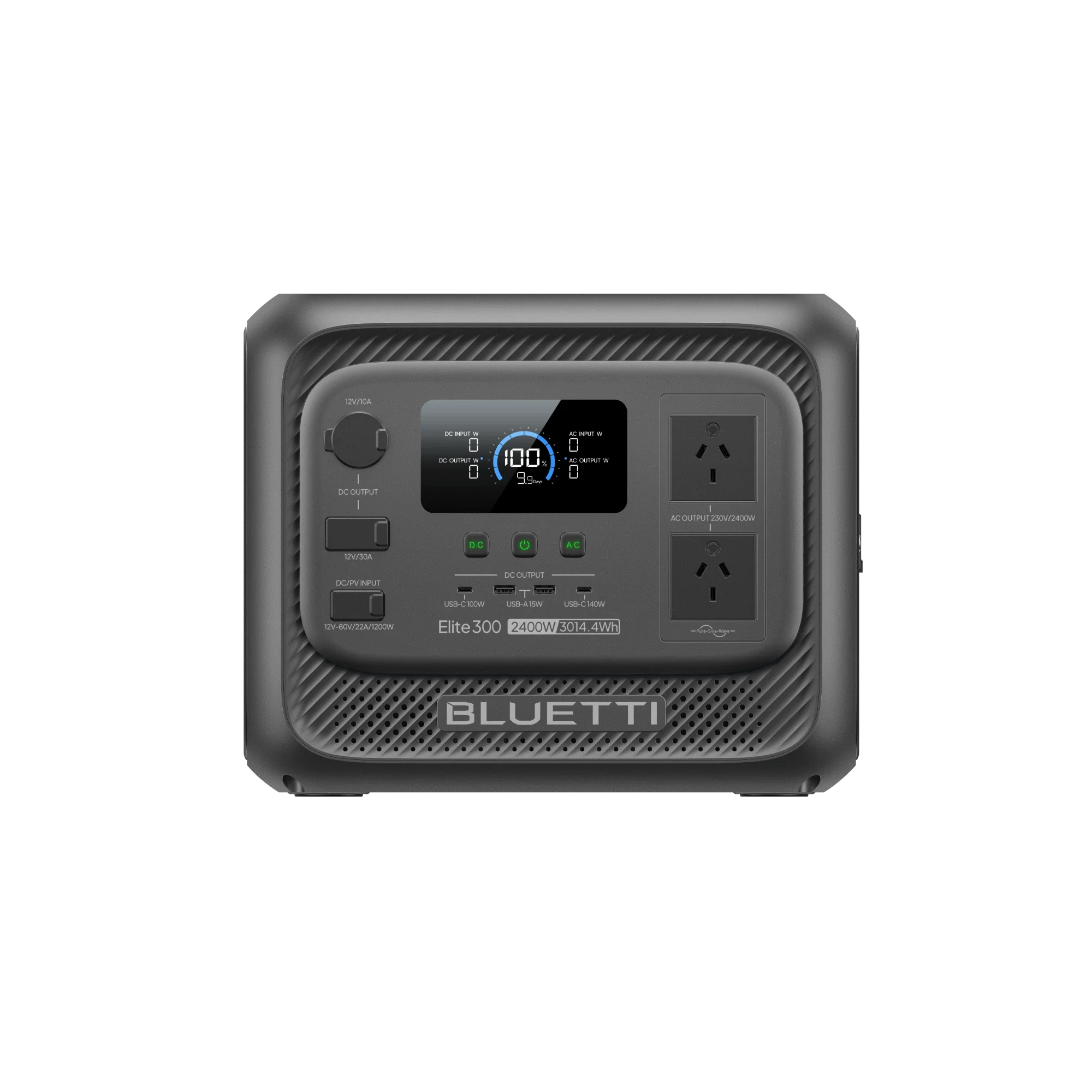
$1,099.00 · direct from BLUETTI
down from $1,199 · 8% below usual
Last checked 1 day ago. Prices move — check before you buy.
Spec deltas
Add up the longest stretch you'll go without an outlet, because that single figure settles this. The AC70 holds 653 usable watt-hours (768Wh less the 15% inverter derate) and the Elite 300 holds 2,562 (3,014Wh, same derate). Four of the six scenarios we model land in between the two.
The surprise is that the AC70 never trips on power. Its 2,000W surge covers the peak draw in every scenario here, same as the Elite 300's 4,800W. What it runs out of is energy, and that isn't a failure you fix by being careful with what you plug in. An eight-hour blackout list of 1,645Wh is two and a half times what the AC70 has to give.
The $840 between them ($1,199 minus $359) also doesn't buy what you'd expect. Across the packs' rated lives the Elite 300 delivers 18,086 kWh against the AC70's 2,304, which works out to 7 cents a lifetime kilowatt-hour versus 16. The expensive one is the cheaper one, provided you actually cycle it.
What the Numbers Reveal
Each conclusion stated first — the numbers behind it on one line, the full analysis below.
continuous output
The tailgate makes that concrete: 670Wh needed against 653Wh usable, a 17-watt-hour miss. Nothing about a gentler load or better cable management closes a shortfall that lives in the cells. Either the day fits inside 653Wh or you're buying the bigger box.
AC70: 1,000W continuous, 2,000W surge. Elite 300: 2,400W continuous, 4,800W surgeThe AC70 clears the peak draw in all six modelled scenarios, including the 4,685Wh van-life dayAC70 usable energy 653Wh (768Wh x 0.85); Tailgate Party needs 670Wh
Why it mattersTotal your actual load list before you compare anything else on this page. 653 watt-hours is the line, and it's a hard one.
rated cycles
That argument has an expiry date and it's fair to say so out loud. Cycle life only pays if you spend it. At weekend cadence both packs outlast their five-year warranty by decades, so the buyer who pulls this out twice a year never reaches the part of the math where the Elite 300 wins. They just paid $840 more for a box sitting at storage charge.
AC70: $359, 3,000 cycles, 768Wh, for 2,304 kWh over the pack's rated lifeElite 300: $1,199, 6,000 cycles, 3,014Wh, for 18,086 kWh over its rated lifeAt weekend-only use the AC70's pack runs 28.8 years and the Elite 300's 57.7, while both warranties run 5 years
Why it mattersWeekly use or harder, buy the Elite 300 on cost per kilowatt-hour. Twice-a-year storm duty, the cycle math never gets a chance to matter and the AC70 is the right answer.
solar input
In a multi-day outage the scarce resource is daylight, not panel watts, and both of these fill inside one good window. The larger tank doesn't cost you a solar day. It gives the day's harvest somewhere to go, where the AC70 reaches full in about ninety minutes of strong sun and then has nothing to do with the rest of the afternoon.
AC70: 500W maximum solar input into 768WhElite 300: 1,200W maximum solar input into 3,014Wh
Why it mattersIf you're planning to ride out a long outage on panels, size the battery rather than the input.
Only one of these two has told you anything about that. The AC70 publishes 45dB and its reviewers describe how it behaves at low drawA1. The Elite 300's line is blank, and blank is not quiet. Paying $840 more to discover how loud a unit is in your own bedroom is a poor trade on a job that uses 12% of its capacity.
AC70: 45dB published under load, described by reviewers as quiet at light draw and about as loud as a hard-working laptop when pushedA1Elite 300: no noise figure published in our spec setCPAP Overnight needs 320Wh, which is 49% of the AC70's usable energy and 12% of the Elite 300's
Why it mattersIf the unit sleeps in the room with you, the AC70's disclosed number is worth more than the Elite 300's missing one.
The specific dimensions that decide these two units — everything else is a tie.
Runtime: Will It Power Your Gear?
Selected because: 653 usable watt-hours against 2,562 is the entire decision, and four of our six scenarios land between the two.
continuous output
The eight-hour blackout list runs 1,645 watt-hours and the remote workday 910. The AC70 has 653 usable. Those numbers are the whole reason four of six scenarios go one way, and they're not the kind of gap that closes with discipline.
The AC70's answer to a small tank is refill speed. Turbo AC charging is reported to refuel it in under an hour with pass-through running the whole timeA2, which genuinely solves the problem when you're near an outlet. It solves nothing when the outlet is the thing that failed. That asymmetry is why the same unit can be the obvious pick for a campsite with a hookup and the wrong pick for a storm.
Your Life, Your Pick
Selected because: The AC70 clears the peak draw in all six and runs out of energy in four, including a tailgate it misses by 17 watt-hours.
The AC70 clears one of the six, and the Elite 300 clears that one too. Camping at 2,100Wh and the blackout at 1,645Wh aren't near misses. They're 3.2 and 2.5 times the AC70's 653 usable watt-hours.
The tailgate is the one worth staring at. 670 watt-hours needed, 653 usable, a 17-watt-hour gap. That's the difference between one last phone charge and none, and it's a tidy illustration of why sizing one of these by feel goes wrong. The Elite 300 finishes the same afternoon at 26% used.
Lifetime Value
Selected because: 7 cents per lifetime kilowatt-hour against 16 flips which of these is the cheap one, but only for people who actually cycle it.
cost / lifetime kWh
Even at the till the Elite 300 is the cheaper energy. $1,199 across 3,014Wh works out to 40 cents a watt-hour; $359 across 768Wh is 47. That's before cycle life doubles the gap.
Where it stops being true is duty cycle. Those per-kilowatt-hour figures assume you spend the cycles, and 6,000 of them is 16.4 years of daily use against the AC70's 8.2. Very few emergency boxes get cycled daily. If yours lives in a closet waiting for weather, you're buying capacity and calendar life rather than cost per kilowatt-hour, and the AC70's five-year warranty covers exactly as many years as the Elite 300's.
Portability & Form Factor
Selected because: 22.5 lb against 58 is the AC70's strongest argument and the one column the Elite 300 can't answer.
weight
22.5 lb is a one-handed carry from the trunk to the picnic table. 58 lb is two hands, bent knees, and a plan for the stairs. That 35.5-lb difference (58 minus 22.5) is the AC70's real argument, and no quantity of watt-hours answers it.
To BLUETTI's credit the Elite 300 is dense rather than large. It's certified the smallest 3kWh portable by volume as of January 2026, in a chassis closer to a standard 2kWh unit, at just under 58 lbB2, and only about 2 kg more than the Elite 200 V2B3. Dense is still heavy. If the job is moving between a campsite, a tailgate and a trunk every weekend, weight is a real cost and the AC70 takes that column outright.
What the Specs Don't Tell You
Selected because: Identical five-year warranties, ten milliseconds of UPS difference, and one unit that publishes a noise figure while the other doesn't.
rated cycles
The warranty card looks like a difference and isn't. Both units carry five years. The $72-versus-$240 per warranty year figure is the price gap wearing a different hat, not better coverage.
The noise cards are the ones to read properly. The AC70 publishes 45dB under load and the Elite 300 publishes nothing, so the warning on this page is the missing figure rather than the 45dB one. A blank field is an unknown, not a quiet unit. On UPS, 20ms against 10ms is a real difference of ten milliseconds, and it decides something only if you own a device that trips on the longer gap. Both units transfer; neither runs online.
Strengths & trade-offs
BLUETTI AC70
Strengths
- +Costs $840 less
- +Lighter by 35.5 lb
Trade-offs
- –Weaker inverter (-1,400W) limits appliance compatibility.
- –Shorter-lived battery — rated for 3,000 charge cycles vs the Elite 300's 6,000, so it wears out sooner.
BLUETTI Elite 300
Strengths
- +Larger battery capacity
- +Higher AC output
- +Faster solar charging
- +Rated for 6,000 charge cycles — much longer battery lifespan
Trade-offs
- –Substantially more expensive (+$840) than the AC70.
- –Significantly heavier (+35.5 lbs), making it harder to move.
Will It Power Your Gear?
Scenario math and per-appliance runtimes, modeled from the spec record.
Scenario verdicts
We ran the math on six real-world scenarios. Here's which unit survives your actual life.
SCN-01 · 2 nights · needs 2,100Wh
Weekend Camping
Two nights off-grid with essential comfort
Elite 300
The AC70 doesn't finish — 653Wh usable against the 2,100Wh this needs leaves it 1,447Wh short, about 31% of the scenario covered. The Elite 300 covers it with 462Wh to spare.
Battery budget usedlower = more headroom
LOAD Phone Charger 15W×6h · LED Lights 40W×8h · Box Fan 75W×14h · CPAP Machine 40W×16h
SCN-02 · 8 hours · needs 1,645Wh
8-Hour Blackout
Keep the essentials running through a night without power
Elite 300
1,645 watt-hours across eight hours against 653 usable in the AC70. That's not a near miss you close by unplugging the TV. It's two and a half times over. The Elite 300 does the same eight hours at 64% and still has a third of its usable energy left for the morning.
Battery budget usedlower = more headroom
LOAD Fridge 150W×8h · Router + Modem 20W×8h · LED Lights (4 bulbs) 40W×6h · Phone Charger 15W×3h
SCN-03 · 8 hours · needs 320Wh
CPAP Overnight
Sleep therapy without interruption — the #1 medical use case
Either unit
Both units clear this one without effort. 320Wh is 49% of the AC70's usable energy and 12% of the Elite 300's, so capacity stops being the question and price and noise take over. That points at the AC70: it's $840 cheaper and it's the one with a published decibel figure. The Elite 300 brings nothing to this night except a lot of unused battery.
Battery budget usedlower = more headroom
LOAD CPAP Machine 40W×8h
SCN-04 · 8 hours · needs 910Wh
Remote Workday
Full work day off-grid without power anxiety
Elite 300
The AC70 doesn't finish — 653Wh usable against the 910Wh this needs leaves it 257Wh short, about 72% of the scenario covered. The Elite 300 covers it with 1,652Wh to spare.
Battery budget usedlower = more headroom
LOAD Laptop 60W×8h · External Monitor 30W×8h · Router + Modem 20W×8h · Phone Charger 15W×2h
SCN-05 · 4 hours · needs 670Wh
Tailgate Party
Game day power for the crew
Elite 300
670 watt-hours of tailgate against 653 usable in the AC70. It misses by 17, which is the most irritating possible way to run out: everything worked all afternoon and then the last phone doesn't charge. The Elite 300 finishes the same afternoon having spent 26% of itself.
Battery budget usedlower = more headroom
LOAD Blender 400W×0.5h · LED TV (55") 80W×4h · Bluetooth Speaker 15W×4h · Phone Charger (×3) 45W×2h
SCN-06 · 24 hours · needs 4,685Wh
Van Life Daily
A full day of mobile living — the ultimate endurance test
Neither unit
Neither one covers this day. 4,685 watt-hours is 183% of the Elite 300's usable energy and 718% of the AC70's, and no amount of rationing bridges either gap. Full-time van power is a wired house bank charged off the alternator and the roof, not a portable unit you plug things into.
Battery budget usedlower = more headroom
LOAD Mini-Fridge 150W×24h · Laptop 60W×4h · Phone Charger 15W×3h · LED Lights 40W×5h · Fan 75W×8h
The Load Test
RUNTIME = (Wh × 0.85) ÷ LOAD
None of the scenarios above exactly yours? Build it. Toggle what you'd plug in; both units are tested against the combined draw.
Essentials
Comfort & Convenience
High-Draw Appliances
Test duration
8h
Continuous draw
205W
Projected runtime
For this load: Elite 300 runs 12.5h vs 3.2h.
$1,199 list · direct from BLUETTI
Modeled from the spec record — same math as the tables below. Methodology
Runtime by appliance
Real-world runtime estimates for common appliances, modeled at 85% inverter efficiency.¹
Essentials
The basics you need runningscale 0–170.8hComfort & Convenience
Makes off-grid life actually enjoyablescale 0–34.2hHigh-Draw Appliances
These reveal the real limitsscale 0–2.6h¹ Runtime = (capacity × 0.85) ÷ appliance watts. Within each group, all bars share one time scale (the group's longest runtime), so lengths are comparable across appliances; identical runtimes collapse into a single blue/orange bar. Actual runtime varies with battery age, temperature, and simultaneous loads — see methodology.
Conclusion
August 9, 2026
Verdict: the Elite 300, on Power Score margin
Take the Elite 300 if your real load list clears 653 watt-hours, which four of our six scenarios do. It carries 2,562 usable watt-hours to the AC70's 653, starts anything the AC70 can start and plenty it can't (2,400W continuous against 1,000W), and it comes to 7 cents per lifetime kilowatt-hour against 16. Confidence stops at 7 for one honest reason: the gap is $840 and the lifetime-cost argument only pays if you spend the cycles. If your use is a CPAP overnight or a twice-a-year outage box, the AC70 is the better buy and this verdict doesn't apply to you.
Today the Elite 300 is $1,099, $100 under its typical $1,199. The verdict weighs typical prices, not today's. Prices checked 1 day ago.
Editor-assigned confidence, based on cited owner research and spec analysis.
List prices as of August 9, 2026. The links below open BLUETTI's current price.
$1,099.00 · direct from BLUETTI
down from $1,199 · 8% below usual
Last checked 1 day ago. Prices move — check before you buy.
or check the AC70 price$359.00 list
Written by Ian Schneider, Solar & Off-Grid Tester · Station Arena Test Desk · Updated August 9, 2026
Measured Data
Benchmark scores and the full spec record, side by side.
Benchmark scores
Not rated for both units (minimum threshold unmet): RV Living, Home Backup, CPAP, Food Truck, Camping.
Full specifications
ᵈ Derived: price ÷ rated capacity. See the data behind our comparisons →
Comparison ToolAdd more power stations, side by sideOpen Tool →How these numbers are produced
Numeric verification
Every figure on this page traces to our spec database or arithmetic on it — no estimated numbers.
Owner claims
Statements about owner experience are cited to published reviews — see Sources & Research Notes below.
Runtime model
Runtime = (rated capacity × 0.85 inverter efficiency) ÷ device wattage. Solar recharge estimates assume panels deliver 70% of rated output. Cold weather, battery age, and stacked loads reduce real-world results.
Power Score
Computed from 14 published spec dimensions, weighted per use-case bench. Higher is better; a unit must meet a bench's minimum threshold to be rated.
See the full weight table and data sourcing on our methodology page →Class ranking (the star rating)
Each unit's star score is a category ranking, not customer reviews — no buyer opinions feed it. We score every station on size-independent quality (value, output, portability, endurance, ports, warranty, and more), then percentile-rank it against the other units in its capacity class, so a class-leading compact unit and a class-leading whole-home unit can both earn 5★. Here, AC70 rates 4.8/5 (89th percentile of 20 Compact-class units), and Elite 300 rates 4.6/5 (76th percentile of 26 Large-class units).
How the class ranking is computed →Test Notes & Caveats
Hidden gotchas and advantages we spotted that you won't find on the product page.
The AC70 Publishes a Number
45dB is the AC70's rated figure under load, and under load is the operative phrase. That's what it sounds like with the inverter working, not what it sounds like keeping a CPAP and a phone going on 320Wh overnight. The point of this card isn't that the AC70 is loud. It's that you know.
Ten Milliseconds Apart
The Elite 300 transfers in 10ms and the AC70 in 20ms. Both are transfer devices rather than true online UPSes, so the useful question is whether the thing you're protecting tolerates a gap at all. If your desktop rides out the AC70's 20ms it will never notice the Elite 300's 10ms. If it can't, you want a proper online UPS in front of it and neither of these solves that.
Same Five Years, Different Price Tag
Both units carry five-year coverage, so the term is identical. The per-year figures, $72 against $240, are the $1,199-versus-$359 price difference divided by the same five years. That makes them a restatement of the price gap rather than a fact about warranty quality.
8.2 Years or 16.4, If You Spend the Cycles
At one cycle a day the AC70's 3,000 cycles are gone in 8.2 years and the Elite 300's 6,000 in 16.4. At weekend cadence the same packs stretch to 28.8 and 57.7 years, which is the genuinely useful thing this card says: for occasional use, cycle life stops being the binding constraint long before the five-year warranty does. Buy on cycles only if you plan to use them.
A Blank Line Is Not a Quiet Unit
BLUETTI publishes no decibel figure for the Elite 300, so this comparison can't rate it against the AC70's 45dB. Read that as missing information, not as a result. If the unit is going to live in a bedroom or a small van, the one with a published number is the one you can plan around, and here that's the smaller, cheaper unit.
Full record above — the Test Desk pick is the Elite 300.
Check Elite 300 price →or check the AC70 priceOwnership Analysis
What happens after you buy — true cost of ownership, brand trust, and growth potential.
Lifetime value
Service lifeyears at one full cycle per day
Lifetime energy delivered
Cost per delivered kWh
│ warranty ends · Reaching the cycle rating means ~80% capacity remains — degraded, not dead.
Analyst note
The AC70 is cheaper to buy, but the Elite 300 is cheaper to own. At $0.07/kWh over its lifetime vs $0.16/kWh, the Elite 300's higher cycle life and capacity make each dollar go further over the years.
Growth path
AC70
FIXED CAPACITYFixed at 768Wh, with no expansion — so size it for your needs up front rather than planning to add capacity later.
Accepts up to 500W of solar. Suitable for a 1-2 panel setup.
Adequate ports for most setups, but heavy users may want a power strip.
Elite 300
FIXED CAPACITYFixed at 3,014Wh — a sealed, complete system rather than a starting point. There's no expansion port, so that figure is the ceiling: check it against your longest unplugged stretch before you buy.
Accepts up to 1,200W of solar. Enough for a serious multi-panel array.
Adequate ports for most setups, but heavy users may want a power strip.
Realistic full solar rechargeat 70% of rated panel output — see methodology
Analyst note
Neither expands, and that's no knock on either — each is a complete unit at a fixed size. Buy the capacity that covers your needs now (the Elite 300 gives you the larger ceiling); you can't add to either later.
What Owners Report
Patterns from published owner reports and long-term reviews — every claim cited to its source below.
BLUETTI AC70
The fan is the one thing that comes up repeatedly. Light loads keep it quiet, but push the output and it climbs to something like an old laptop or a gaming PC working hard, which reviewers rate as noticeable rather than obnoxiousA1. The rest of the record is warm: Turbo AC charging refuels it in under an hour, and pass-through works cleanly, so it powers devices while taking on AC, solar or car inputA2. At roughly 22 lb it's treated as the benchmark budget compactA4.
Worth knowing on the warranty: the five years on our spec line is three years standard plus an automatic two-year extension that comes with buying from BLUETTI's own siteA3. Testing turned up no faultsA3, though what exists is review-desk work rather than multi-year owner reportsA1A3.
“Under light loads the fan is quiet, but push past heavier output and it ramps up to a noticeable but not obnoxious level — comparable to an old laptop or gaming PC under load.”
Sources
backuppowerhub.com · root-nation.com · phonearena.com · trustedreviews.com · myoutdoorbasecamp.com · thedigitalstory.com · kenrockwell.com
BLUETTI Elite 300
The Elite 300's field record is built around its cells and its size. It uses the same LFP tier as the Elite 100 V2, Elite 200 V2 and Apex 300, rated 6,000+ cycles to 80% capacity, which reviewers translate to over 16 years of daily cyclingB1. It's certified the world's smallest 3kWh portable by volume as of January 2026, in a chassis closer to a standard 2kWh unit, at just under 58 lbB2, and roughly 2 kg heavier than the Elite 200 V2B3.
2026 owner reports across home backup, RV and off-grid duty are consistently positiveB4. That's the caveat as well: this is a 2026 unit, so the record is a year of good reports rather than a decade of themB1B4.
“3,014Wh of premium LiFePO4 rated for 6,000+ cycles to 80% — over 16 years of daily use — the same cell tier used in the Elite 100 V2, Elite 200 V2, and Apex 300.”
Sources
backuppowerhub.com · trustedreviews.com · rv.com · thetechnologyman.com · exspenditure.com · reviewed.com · camerajabber.com
Sources & Research Notes
Every owner claim in this report is traceable to a published source. The bracketed references above resolve here.
Recurring owner themes
- Fast charging, compact portability, and strong value are the consistent praise; fan noise rises under heavier load but isn't considered intrusive. [AC70 · 2 entries]
- 6,000-cycle LFP longevity, a class-leading compact size for 3kWh, and strong real-world performance are the standout praise. [Elite 300 · 3 entries]
- A1
“Under light loads the fan is quiet, but push past heavier output and it ramps up to a noticeable but not obnoxious level — comparable to an old laptop or gaming PC under load.”
backuppowerhub.com / root-nation.com — BLUETTI AC70 review · 2025-2026 · [mixed]
- A2
“Fast AC charging via Turbo mode refuels it in under an hour, and pass-through charging works smoothly — you can charge via AC, solar, or car while simultaneously powering devices.”
phonearena.com / trustedreviews.com — AC70 review · 2025-2026 · [positive]
- A3
“No issues reported during testing; backed by a 3-year standard warranty plus an automatic 2-year extension when purchased from BLUETTI's official site, for up to 5 years total.”
backuppowerhub.com / myoutdoorbasecamp.com — AC70 review · 2025-2026 · [positive]
- A4
“A compact ~22-lb unit — small enough to carry around but big enough to power devices for a day or more; widely regarded as a strong budget power station.”
thedigitalstory.com / kenrockwell.com — AC70 review · 2024-2026 · [positive]
- B1
“3,014Wh of premium LiFePO4 rated for 6,000+ cycles to 80% — over 16 years of daily use — the same cell tier used in the Elite 100 V2, Elite 200 V2, and Apex 300.”
backuppowerhub.com / trustedreviews.com — Elite 300 review · 2026 · [positive]
- B2
“Certified as the world's smallest 3kWh portable power station by volume (as of January 2026), fitting a chassis closer to a standard 2kWh unit, at just under 58 lbs.”
backuppowerhub.com / rv.com — Elite 300 review · 2026 · [positive]
- B3
“Only about 2 kg heavier than the Elite 200 V2 and not dramatically larger, so it's still manageable to move around for a 3kWh unit.”
thetechnologyman.com / exspenditure.com — Elite 300 review · 2026 · [positive]
- B4
“Multiple 2026 owner reviews report strong real-world performance across home backup, RV, and off-grid use.”
reviewed.com / camerajabber.com — Elite 300 owner reviews · 2026 · [positive]
Research compiled August 9, 2026.
Who Should Buy Which
Buy the AC70 if you…
- →Your overnight list is a CPAP and a phone. 320Wh is 49% of the AC70's usable energy, and the Elite 300 would spend 12% of itself on the same night for $840 more.
- →You lift it more often than you drain it. 22.5 lb goes over a tailgate one-handed and into a canoe without a second person.
- →You're rarely far from an outlet. A small tank stops mattering when it refills in under an hour from the wallA2.
Buy the Elite 300 if you…
- →You're buying for weather. An eight-hour list of 1,645Wh takes 64% of the Elite 300's usable energy and 252% of the AC70's, and outages don't check your capacity first.
- →You'll cycle it weekly or harder. That's the condition under which 7 cents a lifetime kilowatt-hour against 16 becomes a real saving rather than a spreadsheet one.
- →You need to start things, not only run them. 2,400W continuous and 4,800W surge is more than double the AC70 on both counts.
If neither fits
The full-time van dweller. A 4,685Wh day is 183% of the Elite 300's usable energy and 718% of the AC70's, so both of these end the day flat. That's a job for a wired house bank charged off the alternator and the roof, not a portable box you carry in and plug things into.
The Bottom Line
Take the Elite 300 if your longest unplugged stretch clears 653 watt-hours. That's the page. It carries just under four times the usable energy, starts more than the AC70 can, refills a much larger tank on about an extra hour of sun, and costs less than half as much per lifetime kilowatt-hour.
Then hold that verdict against your own week. The AC70 handles the CPAP night on 49% of its usable energy, weighs 35.5 lb less and costs $840 less, and if it spends most of the year at storage charge waiting for a storm, none of the Elite 300's cycle-life advantage ever gets spent. Buy the big one because you'll use it, not because it wins on paper. It does win on paper, and that's the least important reason to own it.
Frequently Asked Questions
Answers drawn from the spec record and cited owner research.
Is the Elite 300 worth three times the price of the AC70?
It is if your load list clears 653 watt-hours, which is the AC70's usable energy after the 15% inverter derate on its 768Wh. Four of the six scenarios we model clear it, including an eight-hour blackout at 1,645Wh. Below that line you'd be paying $840 for capacity you'd never discharge.
Will the AC70 get me through an 8-hour blackout?
Not the one we model. That list runs 1,645Wh and the AC70 has 653 usable, so it covers roughly the first 40% of the night (653 of 1,645). It can start everything on the list, peak draw included. It just can't feed it for eight hours.
Which one is quieter?
We can only half-answer that, and the half we have belongs to the AC70. It's rated 45dB under load, and reviewers describe it as quiet at light draw and about as loud as a hard-working laptop when pushed. BLUETTI publishes no figure for the Elite 300, so we won't invent one. If the unit sleeps in your bedroom, the known quantity counts for something.
Do both come with the same warranty?
Five years each, so the term is a wash. On the AC70 that five years is three standard plus an automatic two-year extension tied to buying from BLUETTI's own site, worth checking before you order from a marketplace. The $72-per-year versus $240-per-year figures you'll see elsewhere on this page are the price difference divided by the same five years.
Which is actually cheaper to own?
The Elite 300, by a margin that surprises people. Its 6,000 cycles across 3,014Wh come to 18,086 kWh over the pack's rated life, against 2,304 kWh from the AC70's 3,000 cycles across 768Wh. Divide by price and that's 7 cents per lifetime kilowatt-hour versus 16. The catch is that you only collect it if you cycle the unit; one that sits in a closet ages out on the calendar instead.
Where to buy
BLUETTI AC70
$359.00
$359.00 · direct from BLUETTI
Last checked 1 day ago. Prices move — check before you buy.
BLUETTI Elite 300Pick
$1,099.00
$1,099.00 · direct from BLUETTI
down from $1,199 · 8% below usual
Last checked 1 day ago. Prices move — check before you buy.
Prices may vary by retailer and are subject to change.