Head-to-head test
BLUETTI AC50B vs DJI Power 1000
Price isn't the axis here: at $.62 and $.68 per watt-hour these are the same deal in two different sizes, and the AC50B's usable 381Wh clears exactly one of the six loads on this page.
Full profiles: BLUETTI AC50B → · DJI Power 1000 →

Written by Ian SchneiderUpdated
Solar & Off-Grid Tester, Station Arena Test Desk
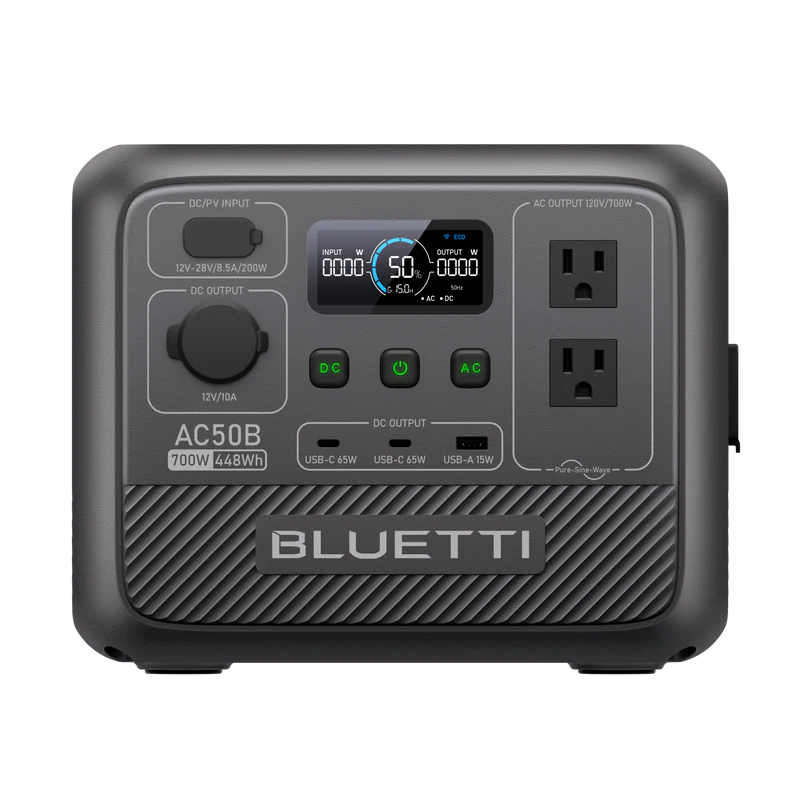
$399.00 · direct from BLUETTI
Last checked 1 day ago. Prices move — check before you buy.

Superseded — buy the V2
DJI has superseded the Power 1000 with the Power 1000 V2 — same $699, with 2,600W output against 2,200W. The original may still be purchasable while stock lasts, but unless it is meaningfully discounted, buy the V2.
Power 1000 V2 · $699.00Spec deltas
At $.62 and $.68 per watt-hour, these two are priced within six cents of each other. That kills the budget-versus-premium framing before it starts. The difference between $399 and $699 buys watt-hours and inverter at roughly the going rate, and almost nothing else.
So the question is size, and the scenario table answers it bluntly. The AC50B has 381Wh usable and clears one of the six loads modeled here. The Power 1000 has 870Wh and clears two, plus a third it misses by 40Wh. If anything on your list is bigger than a laptop and a bedside machine, that gap is the whole decision.
Two things before you act on it. Confirm the model number on the DJI listing, because our lineup record for the brand names a Power 1000 V2 and does not name this one. And be honest about your list: if it really is phones, a laptop, lights and a CPAP, the AC50B does that job for $399 at 14.8 lbs, and the gap buys headroom you'll never touch.
What the Numbers Reveal
Each conclusion stated first — the numbers behind it on one line, the full analysis below.
That's the line between a miss you plan around and a miss that means you bought the wrong category. The Power 1000's 40Wh gap closes by unplugging a monitor or finishing at four. Nothing closes a gap bigger than the tank.
AC50B: 381Wh usable of 448Wh nameplate, using the flat 0.85 factor this site applies to every unitRemote Workday needs 910Wh, leaving the AC50B 529Wh shortThe Power 1000 misses the same 910Wh workday by 40Wh
Why it mattersIf a full day of laptop and peripherals is on your list at all, the AC50B isn't a cheaper route to it. It's a different product.
rated cycles
Both carry the same 5-year warranty, so nothing in the ownership math favours the small unit except the money you don't spend. The AC50B isn't the value play on this page. It's the smaller play, fairly priced for its size.
$399 divided by 448Wh is $.62 per watt-hour; $699 divided by 1,024Wh is $.68AC50B: 3,000 cycles, 1,344 kWh of rated lifetime delivery, $0.21 per kWhPower 1000: 4,000 cycles, 4,096 kWh, $0.17 per kWh
Why it mattersAnyone reaching for the AC50B to save money should check whether they're actually reaching for it because 448Wh is enough. Only one of those two reasons survives the table.
continuous output
That reframes the entire output column. Neither unit runs a heavy appliance for long, so the question was never endurance. It's whether the thing starts. Motor loads briefly pull two to three times their running draw, the AC50B's 1.4x is the narrowest cushion on this page, and reviewers pushed the Power 1000 to 2,400W for twenty minutes past its 2,200W rating without a shutdownB2.
AC50B: 700W continuous with 1,000W surge, a 1.4x ratioPower 1000: 2,200W continuous with 4,400W surge, a 2x ratioPower 1000: 870Wh usable, which against its own 2,200W rating is under half an hour
Why it mattersBuyers with a compressor, a pump or a corded tool on the list should stop reading the capacity column and read the surge column.
61Wh is one humidifier, one heated hose, one cold room or one late morning away from nothing. A second night without a wall socket isn't on offer at all. The Power 1000's 550Wh absorbs every one of those and still starts the following night with room.
CPAP Overnight needs 320Wh; the AC50B finishes with 61Wh of its 381Wh usable leftThe Power 1000 finishes the same night with 550Wh leftPublished noise figures: 45dB for the AC50B, 23dB for the Power 1000
Why it mattersCPAP users running a humidifier, or anyone who wants two nights of margin during an outage, should read the AC50B's pass on this row as a bare pass rather than a comfortable one.
The specific dimensions that decide these two units — everything else is a tie.
Your Life, Your Pick
Selected because: Six modeled loads decide this page, and the AC50B clears exactly one of them.
The pattern in this table is a cliff, not a slope. The AC50B has 381Wh usable and clears one of the six loads here, with 61Wh to spare. Above that line it doesn't get close: 289Wh short at a tailgate, 529Wh short at a workday, and short by more than a thousand watt-hours on the camping, blackout and van-life rows.
The Power 1000 clears two and lands 40Wh from a third, which sounds like a narrow win until you notice which rows both units fail. Those are the big ones: 2,100Wh for a weekend, 1,645Wh for an eight-hour outage, 4,685Wh for van life. If one of those is why you're here, the answer isn't on this page. It's a station sized well past the 2,100Wh weekend row, and preferably one that expands, because neither of these adds a watt-hour after purchase.
What the Specs Don't Tell You
Selected because: The output gap changes what you can plug in at all: 700W continuous against 2,200W.
rated cycles
Capacity decides how long. The inverter decides whether. The AC50B stops at 700W continuous with 1,000W of surge behind it, which rules out the entire heating-element aisle no matter how many watt-hours are still in the battery. The Power 1000's 2,200W and 4,400W turn that into a non-question.
The surge ratios say the same thing more quietly. 1,000W over 700W is 1.4x; 4,400W over 2,200W is 2x. Motor loads briefly pull two to three times their running draw at startup, so the narrower cushion is the one that trips, and reviewers ran the Power 1000 at 2,400W for twenty minutes past its 2,200W rating with no shutdownB2. Warranty is a wash at 5 years each, and the noise row is real but rated rather than measured, so read it as direction rather than decibels at your outlet.
Portability & Form Factor
Selected because: 14.8 lbs against 28.7 is the AC50B's one outright win, and for some buyers it settles the matter.
weight
This is the row the AC50B wins outright. 14.8 lbs is a one-hand grab off a shelf with a bag in the other hand. 28.7 lbs is two hands and a set-down point chosen in advance. Neither is a heavy lift by the standards of this category, but they're different objects: one goes where you go, the other goes where you put it.
It compounds with charging. The AC50B refills in about three hours on standard AC, roughly an hour and a quarter with BLUETTI's optional 480W Turbo charger, and hits 80% in 45 minutesA3. A light box that tops up over lunch is a different tool from one you plan around, even though the Power 1000 is quick too at about 70 minutes to fullB3. If your pattern is a day out and a top-up at home, the AC50B fits that rhythm better than its spec sheet suggests.
Lifetime Value
Selected because: The cheaper unit costs more per kilowatt-hour delivered, $0.21 against $0.17, which reverses the usual budget logic.
cost / lifetime kWh
The sticker order and the ownership order disagree. $399 buys 448Wh across 3,000 cycles, which is 1,344 kWh of rated delivery at $0.21 each. $699 buys 1,024Wh across 4,000 cycles, or 4,096 kWh at $0.17. Both are decent numbers. The point is that the budget pick isn't the frugal one, so don't reach for the AC50B to save money. Reach for it because 448Wh is genuinely enough.
One disclosure, since the table rests on it. We list the AC50B at 3,000 cycles while the review record behind it says 2,500 or moreA1, and BLUETTI's lineup-wide claims run higher still. We've used the SKU's own figure. The lower one would widen the gap in the Power 1000's favour rather than close it, so the direction survives either way. And the per-warranty-year line, $56 against $140, is the price gap wearing a different hat. Coverage is 5 years on both.
Brand Trust
Selected because: One listing needs a model-number check, and the other brand's support desk is its own biggest risk.
The DJI listing needs a model-number check before anything else. Our lineup record for DJI names the Power 500, the Power 1000 V2, the Power 1000 Mini and the Power 2000, and the base Power 1000 reviewed here isn't among them. The brand's own expansion caveat calls it the earlier Power 1000. That reads as a generational handover rather than a fire sale: at $.68 per watt-hour it's priced above the AC50B's $.62, which is not how stock gets cleared. Confirm which box is actually shipping, because the V2 accepts battery expansion and this one is fixed at 1,024Wh.
BLUETTI's risk sits at the other end of the transaction. Our brand assessment rates its support the least consistent in the category, email-driven with timezone delays, and notes that buying direct rather than through a marketplace tends to go better. DJI inherits a global repair network from the drone business and has almost no power-station history to judge it on. Pick your failure mode: a company that has done this for years and might not answer, or one that answers well and hasn't done this long.
Strengths & trade-offs
BLUETTI AC50B
Strengths
- +Costs $300 less
- +Lighter by 13.9 lb
Trade-offs
- –Weaker inverter (-1,500W) limits appliance compatibility.
- –Shorter-lived battery — rated for 3,000 charge cycles vs the Power 1000's 4,000, so it wears out sooner.
DJI Power 1000
Strengths
- +Larger battery capacity
- +Higher AC output
- +Faster solar charging
- +Rated for 4,000 charge cycles — much longer battery lifespan
Trade-offs
- –Substantially more expensive (+$300) than the AC50B.
- –Significantly heavier (+13.9 lbs), making it harder to move.
Will It Power Your Gear?
Scenario math and per-appliance runtimes, modeled from the spec record.
Scenario verdicts
We ran the math on six real-world scenarios. Here's which unit survives your actual life.
SCN-01 · 2 nights · needs 2,100Wh
Weekend Camping
Two nights off-grid with essential comfort
Neither unit
Neither of these does a weekend on one charge. The AC50B ends 1,719Wh short of this 2,100Wh trip and the Power 1000 ends 1,230Wh short, so the variable that matters is what you can put back during the day. That's where they separate: 1,024Wh accepting up to 800W of solar refills in fewer hours than 448Wh accepting up to 200W, despite holding more than twice as much. DJI's solar input runs through a separate adapter rather than a built-in controller, so budget for that. And a faster refill still doesn't turn either box into a weekend battery.
Battery budget usedlower = more headroom
LOAD Phone Charger 15W×6h · LED Lights 40W×8h · Box Fan 75W×14h · CPAP Machine 40W×16h
SCN-02 · 8 hours · needs 1,645Wh
8-Hour Blackout
Keep the essentials running through a night without power
Neither unit
Eight hours of a household list is 1,645Wh here, and both units miss it: the AC50B by 1,264Wh, the Power 1000 by 775Wh. The honest version of this scenario is triage rather than survival, meaning how much of the list you keep alive, not whether you keep all of it. The Power 1000 has 870Wh usable to spend on that decision and the AC50B has 381Wh. If whole-house-for-a-night is the actual goal, neither of these is the size you came for.
Battery budget usedlower = more headroom
LOAD Fridge 150W×8h · Router + Modem 20W×8h · LED Lights (4 bulbs) 40W×6h · Phone Charger 15W×3h
SCN-03 · 8 hours · needs 320Wh
CPAP Overnight
Sleep therapy without interruption — the #1 medical use case
Power 1000
Both units clear the 320Wh a night on the machine takes, so the real question is what's left afterwards. The AC50B finishes with 61Wh of its 381Wh usable still in reserve. The Power 1000 finishes with 550Wh. That 61Wh is the entire allowance for a humidifier, a heated hose, a cold room or a ninth hour in bed, and a second night without a wall socket isn't available. The Power 1000 absorbs all of it, which is why it takes this row.
Battery budget usedlower = more headroom
LOAD CPAP Machine 40W×8h
SCN-04 · 8 hours · needs 910Wh
Remote Workday
Full work day off-grid without power anxiety
Neither unit
Neither unit finishes a 910Wh workday, but the two misses aren't in the same league. The Power 1000 stops 40Wh short, which is one fewer monitor or an early finish. The AC50B stops 529Wh short, more than the 381Wh it holds usable in the first place. One of those is a rounding error you can plan around. The other isn't in the conversation.
Battery budget usedlower = more headroom
LOAD Laptop 60W×8h · External Monitor 30W×8h · Router + Modem 20W×8h · Phone Charger 15W×2h
SCN-05 · 4 hours · needs 670Wh
Tailgate Party
Game day power for the crew
Power 1000
670Wh is where the AC50B stops being an option: 381Wh usable leaves it 289Wh short with the game still on. The Power 1000 covers the load and parks 200Wh in reserve. Nothing subtle here and nothing brand-related either. It's a size gap doing exactly what size gaps do.
Battery budget usedlower = more headroom
LOAD Blender 400W×0.5h · LED TV (55") 80W×4h · Bluetooth Speaker 15W×4h · Phone Charger (×3) 45W×2h
SCN-06 · 24 hours · needs 4,685Wh
Van Life Daily
A full day of mobile living — the ultimate endurance test
Neither unit
Neither unit covers this scenario's 4,685Wh: the AC50B comes up 4,304Wh short (about 8% covered), the Power 1000 3,815Wh (19%). This is well outside what either unit is for; the right answer here is a larger station, not a choice between these two.
Battery budget usedlower = more headroom
LOAD Mini-Fridge 150W×24h · Laptop 60W×4h · Phone Charger 15W×3h · LED Lights 40W×5h · Fan 75W×8h
The Load Test
RUNTIME = (Wh × 0.85) ÷ LOAD
None of the scenarios above exactly yours? Build it. Toggle what you'd plug in; both units are tested against the combined draw.
Essentials
Comfort & Convenience
High-Draw Appliances
Test duration
8h
Continuous draw
205W
Projected runtime
For this load: Power 1000 runs 4.2h vs 1.9h.
Modeled from the spec record — same math as the tables below. Methodology
Runtime by appliance
Real-world runtime estimates for common appliances, modeled at 85% inverter efficiency.¹
Essentials
The basics you need runningscale 0–58hComfort & Convenience
Makes off-grid life actually enjoyablescale 0–11.6hHigh-Draw Appliances
These reveal the real limitsscale 0–0.9h¹ Runtime = (capacity × 0.85) ÷ appliance watts. Within each group, all bars share one time scale (the group's longest runtime), so lengths are comparable across appliances; identical runtimes collapse into a single blue/orange bar. Actual runtime varies with battery age, temperature, and simultaneous loads — see methodology.
Conclusion
August 9, 2026
Verdict: the Power 1000, on Power Score margin
Take the Power 1000. At $.62 and $.68 per watt-hour these two cost effectively the same per unit of energy, so the $300 between $399 and $699 is buying size rather than brand, and buying it at the going rate. What that size does shows up in the scenario table: 870Wh usable clears two of six modeled loads and comes within 40Wh of a third, while 381Wh clears one and misses a workday by more than it holds. Add a 2,200W inverter with 4,400W of surge behind it against 700W and 1,000W, and the Power 1000 will start appliances the AC50B can't attempt. Confidence stops at 7 because a real slice of buyers should take the AC50B instead: if your list ends at phones, a laptop, lights and a CPAP, 448Wh covers it, 14.8 lbs carries easily, and you keep the money. One errand before you order the DJI. Confirm the model number, because our DJI lineup record names a Power 1000 V2 and doesn't name this one.
Editor-assigned confidence, based on cited owner research and spec analysis.
List prices as of August 9, 2026. The links below open BLUETTI's and DJI's current prices.
$699.00 · direct from DJI
Last checked 1 day ago. Prices move — check before you buy.
or check the AC50B price$399.00 list
Written by Ian Schneider, Solar & Off-Grid Tester · Station Arena Test Desk · Updated August 9, 2026
Measured Data
Benchmark scores and the full spec record, side by side.
Benchmark scores
Not rated for both units (minimum threshold unmet): RV Living, Home Backup, Tailgating, Food Truck.
Full specifications
ᵈ Derived: price ÷ rated capacity. See the data behind our comparisons →
Comparison ToolAdd more power stations, side by sideOpen Tool →How these numbers are produced
Numeric verification
Every figure on this page traces to our spec database or arithmetic on it — no estimated numbers.
Owner claims
Statements about owner experience are cited to published reviews — see Sources & Research Notes below.
Runtime model
Runtime = (rated capacity × 0.85 inverter efficiency) ÷ device wattage. Solar recharge estimates assume panels deliver 70% of rated output. Cold weather, battery age, and stacked loads reduce real-world results.
Power Score
Computed from 14 published spec dimensions, weighted per use-case bench. Higher is better; a unit must meet a bench's minimum threshold to be rated.
See the full weight table and data sourcing on our methodology page →Class ranking (the star rating)
Each unit's star score is a category ranking, not customer reviews — no buyer opinions feed it. We score every station on size-independent quality (value, output, portability, endurance, ports, warranty, and more), then percentile-rank it against the other units in its capacity class, so a class-leading compact unit and a class-leading whole-home unit can both earn 5★. Here, AC50B rates 4.6/5 (76th percentile of 22 Personal-class units), and Power 1000 rates 3.8/5 (31st percentile of 27 Everyday-class units).
How the class ranking is computed →Test Notes & Caveats
Hidden gotchas and advantages we spotted that you won't find on the product page.
45dB vs 23dB, Rated Rather Than Measured
The AC50B is published at 45dB under load and the Power 1000 at 23dB, a 22-point spread and the widest single-spec gap on this page. Two cautions before you spend it. These are ratings taken under load, not measurements at yours, and a phone or a CPAP is not much of a load for either fan. And 45dB is itself the figure usually cited as the point where noise starts disrupting sleep, so the AC50B sits on that line rather than comfortably under it. If the unit lives in the room you sleep in, the DJI is the safer buy. If it lives in a garage, this row shouldn't move you.
AC50B: Power Lifting to 1,000W
The AC50B has BLUETTI's Power Lifting mode, which runs a resistive appliance rated up to 1,000W from its 700W inverter. It does that by delivering less power than the appliance asks for, not more than the inverter has: the heater still works, it just heats more slowly. Two things follow. BLUETTI scopes the mode to purely resistive loads — a heater, a kettle, an incandescent lamp — so it does nothing for a fridge compressor, a pump or a power tool, and this record publishes no surge figure at all, so read the mode as a resistive-load feature rather than as starting ability. And it is not a reason to size down, because running a load that big from 448Wh is a short session either way. Genuinely useful if a heater or a kettle is why you're buying; beside the point otherwise. The Power 1000 publishes no equivalent.
Warranty: No Difference
Both units carry the same 5-year warranty, so coverage isn't a tiebreaker here. Both figures are maximums rather than guarantees: BLUETTI's depends on buying direct from BLUETTI or registering the unit, since reseller purchases carry a shorter term; DJI's on buying from DJI's own store, which is where the full five years is advertised. Worth saying because the per-dollar framing can suggest otherwise: the AC50B works out at 12.5 years of cover per $1,000 spent against the Power 1000's 7.2, but that spread is the price gap, not the terms.
4,000 Cycles vs 3,000, With One Asterisk
The Power 1000 is rated for 4,000 charge cycles against the AC50B's 3,000, and past that point neither battery dies. Each settles at roughly 80% of original capacity and keeps working. The asterisk is what a cycle means on each unit. One AC50B cycle is 448Wh and one Power 1000 cycle is 1,024Wh, so any years-of-service figure produced by dividing cycles by days quietly assumes both units deliver the same energy per charge. They don't. If your daily draw is fixed, the smaller unit burns cycles faster than the calendar suggests.
Full record above — the Test Desk pick is the Power 1000.
Check Power 1000 price →or check the AC50B priceOwnership Analysis
What happens after you buy — true cost of ownership, brand trust, and growth potential.
Lifetime value
Service lifeyears at one full cycle per day
Lifetime energy delivered
Cost per delivered kWh
│ warranty ends · Reaching the cycle rating means ~80% capacity remains — degraded, not dead.
Analyst note
The AC50B is cheaper to buy, but the Power 1000 is cheaper to own. At $0.17/kWh over its lifetime vs $0.3/kWh, the Power 1000's higher cycle life and capacity make each dollar go further over the years.
Delivers each lifetime kWh for $0.13 less — check the Power 1000 price →
Brand trust
BLUETTI
Ecosystem
One of the broadest lineups — 15-20+ models from budget (AC2A) to flagship portable (Apex 300, 2764.8Wh). Includes specialized products: vehicle solar hubs, sodium-ion cold-weather units, and balcony storage systems.
Support
Our brand assessment flags BLUETTI's support as the least consistent in the category: email-first, subject to China-timezone delays, and producing outcomes that range from smooth to weeks of runaround. Buying direct from BLUETTI rather than through a marketplace tends to go better if you ever need it. On a $399 unit that's a live consideration, because the time cost of a bad claim can exceed what the box is worth.
Community
Active and growing — Reddit r/bluetti has a dedicated community. Second-largest after EcoFlow in engagement.
App experience
Rated 4.5/5 iOS and Android — tied for best app experience in the category. V3.0 UI redesign was well-received.
Unique strength
BLUETTI's case is breadth and price per watt-hour, and the AC50B is a fair example at $.62 against the Power 1000's $.68. The app is the best-rated in the category, 4.5 out of 5 in our brand assessment, and the lineup runs from budget units to flagship portables. Note that BLUETTI's lineup-wide cycle-life headlines run above this particular SKU's 3,000, so use the AC50B's own number rather than the family claim.
Worth knowing
The caveat that bites hardest on a budget unit: our brand assessment notes that some older or discontinued BLUETTI models become effectively unrepairable, with no spare-parts policy behind them. A 5-year warranty is only as good as the parts standing behind it.
DJI
Ecosystem
New entrant (2024) — five power station models to date: Power 500, Power 1000 (since superseded by the V2 but still sold), Power 1000 V2, Power 1000 Mini, Power 2000. Buying a "Power 1000" listing? Check which revision it actually ships.
Support
Our brand assessment gives DJI the stronger structural position, an established global repair network carried over from drones, with the honest caveat that its power-station track record is short. The app is rated 3.5 out of 5, and that rating covers the whole DJI ecosystem rather than this product; our assessment notes the on-device screen as the more reliable interface of the two.
Community
There's no dedicated DJI power-station community to search when something behaves oddly. Discussion happens inside r/dji, which is overwhelmingly drone traffic.
App experience
Rated 3.5/5 iOS and Android (DJI Home app ratings reflect entire DJI ecosystem including drones/cameras, not power-station-specific). Users report the on-device screen is more reliable than the app.
Unique strength
DJI's advantages come out of the drone business and show up as engineering rather than marketing: 23dB published operation, LFP cells rated for 4,000 cycles, and up to 800W of solar input. Two footnotes. There's no built-in solar charge controller, so that input figure assumes DJI's separate proprietary adapter. And the SDC ports charge DJI drone batteries fast, which is worth real money if you already own DJI gear and nothing at all if you don't.
Worth knowing
Check the model number on the listing before you buy this one. Our DJI lineup record names the Power 500, the Power 1000 V2, the Power 1000 Mini and the Power 2000, and the base Power 1000 on this page isn't among them, while the brand's expansion caveat calls it the earlier Power 1000. Read that as a generational handover, not a clearance: at $.68 per watt-hour it's priced above the AC50B's $.62, and stock doesn't get cleared at a premium. The difference is concrete. The V2 accepts battery expansion and this unit is fixed at 1,024Wh, so the reviews you find for one don't fully describe the other.
Analyst note
Two opposite risk profiles. BLUETTI has years of power-station history, an active user community and the least consistent support desk in the category. DJI has a repair network built for drones, a serious hardware pedigree, and barely any power-station history to judge it on. If you want to be able to search your way out of a problem at 11pm, BLUETTI's community is the deeper pool. If you'd rather a warranty claim were handled by people who handle a lot of them, DJI's network is the better bet.
Growth path
AC50B
FIXED CAPACITYFixed at 448Wh, with no expansion — so size it for your needs up front rather than planning to add capacity later.
Accepts up to 200W of solar. Limited to a single portable panel.
Limited ports. You'll likely need a power strip or splitter.
Power 1000
FIXED CAPACITYFixed at 1,024Wh, with no expansion — so size it for your needs up front rather than planning to add capacity later.
Accepts up to 800W of solar. Suitable for a 1-2 panel setup.
Adequate ports for most setups, but heavy users may want a power strip.
Realistic full solar rechargeat 70% of rated panel output — see methodology
Analyst note
Neither expands, and that's no knock on either — each is a complete unit at a fixed size. Buy the capacity that covers your needs now (the Power 1000 gives you the larger ceiling); you can't add to either later.
What Owners Report
Patterns from published owner reports and long-term reviews — every claim cited to its source below.
BLUETTI AC50B
The AC50B's field record is review coverage rather than long-term ownership, drawn from Amazon and review-site testing instead of people two years inA1A2A3. What it does establish is consistent. 448Wh of LFP behind a 700W inverter with 1,000W of lift, rated past 2,500 cyclesA1, in a genuinely light box at 14.8 lbs against the AC70's 21.4A2. Charging is the standout: about three hours on standard AC, roughly an hour and a quarter with the optional 480W Turbo charger, and 80% back in 45 minutesA3.
One clarification, because the accessory gets described loosely elsewhere. BLUETTI's own FAQ scopes the B80's 806Wh to capacity expansion in Power Bank Mode over an aviation-to-XT60 cableA4, which means the pack recharges the station rather than extending it as one system. That's a manufacturer description, not a field finding, and it matches the spec: this unit is fixed at 448Wh and 700W however many packs you attach.
“A 448Wh LiFePO4 battery with 700W output (1,000W Power Lifting), rated for 2,500+ cycles to 80% — years of reliable use.”
Sources
amazon.com · backuppowerhub.com · the-gadgeteer.com · t3.com · bluettipower.com
DJI Power 1000
Quiet is the theme that repeats across the Power 1000's coverage, and it's specific rather than atmospheric: near-silent under normal loads, with sound only appearing past 1,500W and reading as a soft whoosh when it doesB1, and the fan barely audible even during full-speed AC chargingB3. Two independent reviews land on the same behaviourB1B3, which is about as close to a pattern as a unit this new can get.
The output claim holds under pressure too. One test ran it at 2,400W for twenty minutes, above its own 2,200W rating, with no shutdown and no noise complaintB2. Another took it through a week of camping on a 45W compressor fridge, phones, laptops and LED lights, and notes it's a favourite with drone pilots for topping up DJI batteries while everything else stays runningB4. All of it is review-derived rather than long-term owner reporting, and with DJI arriving in this category in 2024 the record is short by definitionB1B2B3B4.
“Whisper-quiet operation — one of the quietest power stations in its class, nearly silent under normal loads; sound only becomes noticeable past 1,500W, and even then it's a soft whoosh rather than the high-pitched whirring you'd get from BLUETTI or EcoFlow.”
Sources
thesolarlab.com · trailandkale.com · offgridbenchmark.com · superfashion.us · dronexl.co
Sources & Research Notes
Every owner claim in this report is traceable to a published source. The bracketed references above resolve here.
Recurring owner themes
- Affordable, genuinely portable LFP unit with 700W output, 2,500+ cycles, fast Turbo charging, and B80 expandability. [AC50B · 3 entries]
- Standout quiet operation (quieter than EcoFlow/BLUETTI), robust real-world output above its rating, and appeal to drone pilots and campers are the consistent themes. [Power 1000 · 3 entries]
- A1
“A 448Wh LiFePO4 battery with 700W output (1,000W Power Lifting), rated for 2,500+ cycles to 80% — years of reliable use.”
amazon.com / backuppowerhub.com — AC50B review · 2026 · [positive]
- A2
“At 14.8 lbs it's meaningfully lighter than the AC70 (21.4 lbs) — a genuinely portable sub-15-lb unit with a long-cycle battery and 700W output at an easy-to-justify price.”
backuppowerhub.com / the-gadgeteer.com — AC50B review · 2026 · [positive]
- A3
“Standard AC charging is about 3 hours, dropping to 1.25 hours with the optional 480W Turbo charger; 0-80% in 45 minutes.”
amazon.com / t3.com — AC50B review · 2026 · [positive]
- A4
“The B80 can add 806Wh, but BLUETTI scopes this to "capacity expansion with B80 battery in Power Bank Mode" over an Aviation-to-XT60 cable — the pack recharges the unit rather than extending it as one system, so this is not expandability in the sense this site uses. At $279 it is BLUETTI's most affordable LiFePO4 station.”
bluettipower.com AC50B FAQ (primary) · 2026 · [positive]
- B1
“Whisper-quiet operation — one of the quietest power stations in its class, nearly silent under normal loads; sound only becomes noticeable past 1,500W, and even then it's a soft whoosh rather than the high-pitched whirring you'd get from BLUETTI or EcoFlow.”
thesolarlab.com / trailandkale.com — DJI Power 1000 review · 2026 · [positive]
- B2
“Tested at 2,400W — slightly above its 2,200W output rating — for 20 minutes and handled it without loud noise or automatic shut-offs.”
offgridbenchmark.com / superfashion.us — DJI Power 1000 review · 2026 · [positive]
- B3
“AC charging takes about 70 minutes from 0% to 100% (about 50 minutes to 80%), and during full-speed charging the fan barely makes a sound.”
thesolarlab.com — DJI Power 1000 review · 2026 · [positive]
- B4
“Over a week-long camping trip it powered a 45W compressor fridge, phones, laptops, and LED lights; it's also a favorite of drone pilots for fast-charging DJI batteries while running other devices.”
offgridbenchmark.com / dronexl.co — DJI Power 1000 review · 2026 · [positive]
Research compiled August 9, 2026.
Who Should Buy Which
Buy the AC50B if you…
- →Your list is a phone, a laptop, a couple of lights and a CPAP, and it isn't going to grow. 381Wh usable covers that night and leaves 61Wh.
- →You want something you can lift one-handed out of a hatchback. 14.8 lbs, and the optional 480W Turbo charger puts 80% back in 45 minutesA3.
- →You're buying a $399 hedge for phones, a router and lights during a short outage, and you already accept that the fridge isn't part of the plan.
- →You care about the software side. Our brand assessment rates BLUETTI's app 4.5 out of 5, the best in the category, against 3.5 for DJI.
Buy the Power 1000 if you…
- →Something on your list has a motor or a heating element. 2,200W continuous with 4,400W of surge makes that a non-issue; 700W and 1,000W don't.
- →You work off it. 870Wh usable gets within 40Wh of the modeled 910Wh workday, and the 140W USB-C port runs a laptop at full speed instead of trickling it.
- →You camp for more than a night and can lay panels out. Up to 800W of solar input against 200W is the difference between recovering a day's use and topping off, though DJI's input runs through a separate adapter rather than a built-in controller, so budget for that.
- →The unit sleeps in the room you sleep in. 23dB against 45dB is the widest single-spec gap between these two.
- →You fly DJI drones. The SDC ports charge their batteries fast, which is a real reason that has nothing to do with watt-hours.
This is you — check the Power 1000 price
If neither fits
If you're shopping for a weekend off-grid, an eight-hour outage that includes the fridge, or van life, close this tab cheerfully. Those loads run 1,645Wh to 4,685Wh here and both units miss all three, the AC50B by 1,264Wh at best and the Power 1000 by 775Wh at best. You want a station sized past the 2,100Wh weekend row, and ideally one that takes a second battery, since neither of these does. Buying the Power 1000 and hoping is the expensive version of that mistake.
The Bottom Line
Take the Power 1000. Not because it's the better-built box, though the 4,400W surge ceiling and the 23dB rating argue that on their own, but because of the shape of the scenario table: 870Wh usable clears two of six loads and comes within 40Wh of a third, while 381Wh clears one and misses a workday by more than it holds. That isn't a difference in quality. It's a difference in what the thing can be asked to do.
The AC50B keeps its argument, and it's a good one. 14.8 lbs, $399, 5 years of warranty and 3,000 cycles behind it. If your list genuinely stops at phones, a laptop, lights and a CPAP, it covers that and you keep the difference. Just don't buy it as the cheap version of the Power 1000. Per watt-hour they cost the same, and one of them is simply smaller.
Frequently Asked Questions
Answers drawn from the spec record and cited owner research.
Is the DJI Power 1000 still current, or has it been replaced?
Check the model number before you order. Our DJI lineup record lists the Power 500, Power 1000 V2, Power 1000 Mini and Power 2000, and the base Power 1000 reviewed here isn't on it, while the brand's expansion caveat refers to it as the earlier Power 1000. That points to a generational handover rather than a clearance: at $.68 per watt-hour it's priced above the AC50B's $.62, which isn't what a run-out looks like. The practical consequence is that the V2 accepts battery expansion and this unit is fixed at 1,024Wh, so the two aren't interchangeable.
Will the BLUETTI AC50B run a refrigerator?
A small compressor fridge, yes, for a while. The review record has a 45W compressor fridge running off the Power 1000 through a week of camping, and 45W sits well inside the AC50B's 700W ceiling. Duration is the catch: 381Wh usable against a 45W draw is about eight and a half hours of actual compressor time, and a fridge only runs its compressor for part of each hour. A full-size household fridge is a different question, because compressors briefly pull two to three times their running draw at startup and the AC50B has only 1,000W of surge above its 700W.
Can either of these be expanded with a second battery?
No. Both are fixed, at 448Wh and 1,024Wh. BLUETTI's own FAQ describes attaching a B80 to the AC50B as capacity expansion in Power Bank Mode over an aviation-to-XT60 cable, adding 806Wh, but the pack recharges the station rather than extending it as one system. That's a refill, not a bigger tank, and it doesn't lift the 700W output or the 448Wh you can draw in one sitting. Worth noting that DJI's Power 1000 V2 does take expansion, which is one more reason to confirm which model you're buying.
How much quieter is the DJI Power 1000 in practice?
On paper it's 23dB against 45dB, the widest single-spec gap between these two. Review coverage backs the direction: near-silent under normal loads, with sound only becoming noticeable past 1,500W, and the fan barely audible even during full-speed AC charging. Treat both decibel figures as ratings rather than measurements at your load, though. A CPAP or a laptop is a small enough draw that neither unit is likely to be working hard.
Is the Power 1000 worth more than twice the AC50B's price?
It's worth it if you need the size, and not otherwise. Per watt-hour the two sit six cents apart at $.62 and $.68, so you're paying roughly market rate for extra capacity rather than a brand premium, and across their rated lives the Power 1000 is actually the cheaper one at $0.17 per kilowatt-hour against $0.21. None of that helps if 448Wh already covers your list. The AC50B is the right buy for a small, fixed set of loads and the wrong one the moment something with a motor joins them.
Check Power 1000 price →
Brand matchup
BLUETTI vs DJI: measured across every matchup →Where to buy
BLUETTI AC50B
$399.00
$399.00 · direct from BLUETTI
Last checked 1 day ago. Prices move — check before you buy.
DJI Power 1000Pick
$699.00
$699.00 · direct from DJI
Last checked 1 day ago. Prices move — check before you buy.
Prices may vary by retailer and are subject to change.