Head-to-head test
BLUETTI AC500 + 2×B300K vs BLUETTI EP800 + 2×B500
BLUETTI sells you watt-hours at the same rate either way, so this was never a value question: it's whether the power has to come out of a socket or out of your wall.
Full profiles: BLUETTI AC500 + 2×B300K → · BLUETTI EP800 + 2×B500 →

Written by Gunner GustafsonUpdated
Whole-Home Backup Tester, Station Arena Test Desk
Spec deltas
71 cents a watt-hour, on both of these. BLUETTI isn't offering you a better deal for stepping up to the EP800, it's offering more of the same thing at the same price, and both packs are rated for the same 3,500-cycle minimum on top of that. The money question settles itself before it starts. What's left is a question about your house.
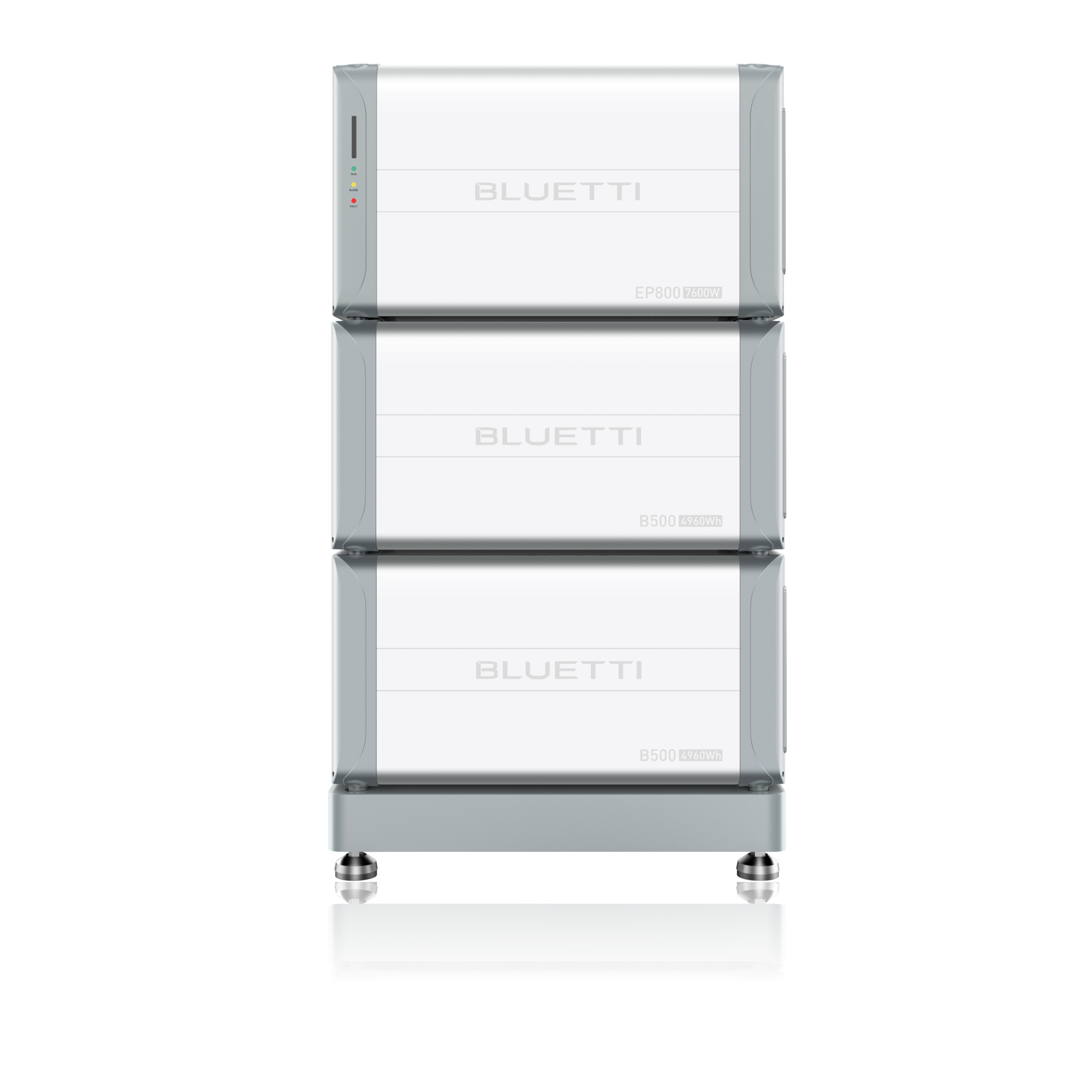
The difference that matters is physical. The AC500 stack is a head unit and two batteries with a 12V socket, a 30A RV outlet and 100W of USB-C on the front. The EP800 stack is 360.6 lbs of equipment an electrician wires to a subpanel, where it feeds the building at 120/240V and carries no sockets on the box at all. Nothing you own plugs into the EP800. That isn't a flaw, it's the product.
Take the AC500 + 2×B300K unless your load list has a 240V or hardwired circuit on it. Its 5,530Wh covers an eight-hour outage at 35% used and a CPAP night at 7%, and it leaves $3,051 in your pocket, while the EP800's 9,920Wh is mostly a second and third night you probably won't spend. But if the thing you need alive is a well pump, a dryer or a 240V mini-split, capacity was never the question. Panel access was, and only one of these has it.
What the Numbers Reveal
Each conclusion stated first — the numbers behind it on one line, the full analysis below.
Capacity
Now put a real night against it: the site's eight-hour outage profile asks 1,645Wh, and the AC500 stack ends that night at 35% used with 3,056Wh still in it, roughly two more nights like it. The EP800's premium isn't overpriced, it's unused. You're paying a proportional rate for headroom that the outage you're actually planning for never touches.
AC500 + 2×B300K: $3,948 for 5,530WhEP800 + 2×B500: $6,999 for 9,920Whboth list the same cost per watt-hour, and both work out to 20 cents per lifetime kilowatt-hour on a 3,500-cycle minimum
Why it mattersIf your worst blackout in living memory was a single evening, the extra capacity is inventory you're storing in your utility room at full retail.
Which makes the EP800's justification the one outlet it doesn't have: a 240V circuit. Add every battery BLUETTI makes to the AC500 stack and it still can't run a well pump, a dryer or a 240V mini-split, because it has no 240V outlet to run them from. The EP800 does it with no extension cord anywhere in the picture, and that capability is indifferent to how much energy either one stores.
AC500 + 2×B300K ports: 12V car output, a 30A RV outlet, USB-A and USB-C at 100W, and no 240V outletEP800 + 2×B500 ports: AC listed as hardwired 120/240V, with no 12V, no 30A RV and no USBthe EP800 is an installed system feeding a subpanel
Why it mattersWrite down the circuits that have to stay alive. If any of them is 240V or hardwired, stop comparing prices, because only one of these two is in the running.
The difference is what that failure costs you to fix. The AC500's head unit is a plug-in box: you unplug it, ship it, plug in its replacement. The EP800's is wired into a subpanel, so the identical fault arrives with an electrician's calendar attached, on the one system in this comparison that your house is depending on rather than merely using.
two sources report AC500 units needing BLUETTI support before they worked, a missing battery-link cable in one case and a battery that powered up while the inverter stayed dead in the otherA6A7forum members weighing an EP800 purchase flag that if its inverter head unit fails, the B500 batteries can't be driven by any other inverterB4BLUETTI's support reputation came up unprompted in that same threadB3
Why it mattersIf you're the kind of buyer who wants to be able to fix a bad week yourself, that argues for the serviceable box, or for budgeting an installer relationship alongside the EP800 rather than only its purchase price.
solar input
So the triple input ceiling isn't a spec you buy for later, it's a spec that presupposes the roof. A 9,000W array is a construction project, and it happens to be the same project as wiring a system into your panel. Buy the EP800 without that array and its single clearest advantage over the AC500 stack never switches on.
AC500 + 2×B300K accepts 3,000W of solar into 5,530WhEP800 + 2×B500 accepts 9,000W of solar into 9,920Whthe EP800 is already hardwired into the building's panel
Why it mattersRoof array in the plan: the EP800 is the better half of one job. Four portable panels on the lawn: you'd be paying for an input ceiling you can't fill.
The specific dimensions that decide these two units — everything else is a tie.
Your Life, Your Pick
Selected because: Only two of these six load profiles separate the stacks: the eight-hour outage goes to the EP800 on reserve, the van build goes to the AC500 by forfeit.
Only two of these six rows actually separate them, and they point in opposite directions. The eight-hour outage goes to the EP800 on what's left in the tank: it finishes the night at 20% used, with 6,787Wh spare against the AC500 stack's 3,056Wh. The van build goes to the AC500 stack by forfeit, because a system bolted to a building's subpanel doesn't move into a Sprinter. The camping and tailgate rows aren't close calls at all, they're category errors, and the engine is right to score them for neither.
The CPAP row deserves a slow read if you're the person it describes. A 40W machine for eight hours asks 320Wh, which is 7% of the AC500 stack, so capacity decides nothing at 3 a.m. Fan behavior would, and neither configuration has a published fan-noise figure, so there's nothing here to hold either one to. What we do have is a reviewer who ran an AC500 in a room and noted that its indicator lights stay on permanently, and who advised against sleeping beside itA11. That's a strip of tape rather than a dealbreaker, and it's still more than anyone has reported about sleeping near an EP800B0.
What the Specs Don't Tell You
Selected because: 196.1 lbs against 360.6 lbs is the difference between equipment you place yourself and equipment somebody installs.
The AC500 stack's 196.1 lbs arrives as a head unit plus its two packs, so no single piece is that whole figure. It's still a floor-level install you place once and stop moving, not something you slide aside to vacuum. The EP800 stack's 360.6 lbs is a number you meet exactly once, on the day it goes on the wall beside your panel, and then never think about again.
Which is the honest way to read the 164.5 lbs between them, two things that both stay home: it's a question about who does the lifting, not about portability. Pick the AC500 stack's spot deliberately, with airflow and nobody sleeping next to it, and pick the EP800's by where your panel already is, because that's the only place it goes.
Lifetime Value
Selected because: Both land at 20 cents per lifetime kilowatt-hour on the same 3,500-cycle minimum, so cost of ownership refuses to pick a side.
A dead heat, and a useful one. Both come to 20 cents per lifetime kilowatt-hour, because both packs carry the same 3,500-cycle minimum and both were priced at the same rate per watt-hour to begin with. The EP800 simply has 34,720 lifetime kilowatt-hours where the AC500 stack has 19,355, in exact proportion to what you handed over. There's no clever buy on this page and no trap either.
Where they do separate is what a weekend of use costs you: 32 cents a session on the AC500 stack, 57 cents on the EP800, across the same 33.7 years of weekend-only cycling. Both numbers are small enough to disappear into a power bill, which is the point. Neither of these ever pays for itself on arithmetic. You're buying the hours the grid isn't there, so buy exactly as many of those hours as you need and not one more.
Runtime: Will It Power Your Gear?
Selected because: Usable capacity works out to 4,701Wh against 8,432Wh, and one of the six scenarios finishes with 16Wh left.
continuous output
Plan against 4,701Wh and 8,432Wh, not the nameplates. Both figures come off a flat 85% usable factor this site applies to every unit rather than a measurement of either one, and it's the honest basis because nobody runs one of these to zero. On the AC500 stack that's five full workdays at 910Wh apiece, or fourteen CPAP nights at 320Wh, before anything needs a recharge. On the EP800 it's roughly double, which is precisely what you paid for.
The one place the AC500 stack runs out of road is the van-life load: 4,685Wh in a day, which it covers with 16Wh left. That's a pass in arithmetic and an empty tank in practice. One more device, one afternoon of cloud on the panels, and the day finishes short. If that draw is your ordinary Tuesday rather than your heaviest day of the year, add a third battery from the start or move up to the bigger system, because there is no margin in that result to spend.
Growth Path
Selected because: Both take more batteries; only one takes 9,000W of solar, and that ceiling needs a roof before it means anything.
solar input
Both accept more batteries, so growth isn't the question. What you'd feed them with is. The EP800 takes 9,000W of solar where the AC500 stack tops out at 3,000W, and that triple ceiling is the one spec gap here that capacity can't buy its way out of, on a system that's already wired to your panel and therefore already halfway to a roof array.
The catch is that 9,000W of panels is a construction project, not an accessory you add next spring. If your solar plan is portable panels you set out on the lawn, that ceiling never engages and the AC500 stack's 3,000W is the one you'd actually be using. If your plan is a roof, the EP800 is the better half of a job you were doing anyway.
Strengths & trade-offs
BLUETTI AC500 + 2×B300K
Strengths
- +Costs $3,051 less
- +Lighter by 164.5 lb
Trade-offs
- –Weaker inverter (-2,600W) limits appliance compatibility.
- –Very heavy unit that may be difficult for one person to lift.
BLUETTI EP800 + 2×B500
Strengths
- +Larger battery capacity
- +Higher AC output
- +Longer warranty
- +Faster solar charging
Trade-offs
- –Substantially more expensive (+$3,051) than the AC500 + 2×B300K.
- –Significantly heavier (+164.5 lbs), making it harder to move.
- –Very heavy unit that may be difficult for one person to lift.
Will It Power Your Gear?
Scenario math and per-appliance runtimes, modeled from the spec record.
Scenario verdicts
We ran the math on six real-world scenarios. Here's which unit survives your actual life.
SCN-01 · 2 nights · needs 2,100Wh
Weekend Camping
Two nights off-grid with essential comfort
Neither unit
The 2,100Wh a weekend asks is nothing to either of these: 45% of the AC500 stack, a quarter of the EP800. It's the getting there that doesn't happen. 196.1 lbs goes in a truck bed if it goes anywhere at all, and the EP800 is wired to your electrical panel and stays wired to it. Score this row for neither and buy something with a handle for the campsite.
Battery budget usedlower = more headroom
LOAD Phone Charger 15W×6h · LED Lights 40W×8h · Box Fan 75W×14h · CPAP Machine 40W×16h
SCN-02 · 8 hours · needs 1,645Wh
8-Hour Blackout
Keep the essentials running through a night without power
EP800 + 2×B500
Both survive the night. The EP800 + 2×B500 finishes at 20% used with 6,787Wh left — 4.1 more nights like it. The AC500 + 2×B300K finishes at 35% with 3,056Wh, 1.9 more nights like it. If your outages tend to run past one evening, that difference is the whole argument between them.
Battery budget usedlower = more headroom
LOAD Fridge 150W×8h · Router + Modem 20W×8h · LED Lights (4 bulbs) 40W×6h · Phone Charger 15W×3h
SCN-03 · 8 hours · needs 320Wh
CPAP Overnight
Sleep therapy without interruption — the #1 medical use case
Either unit
A CPAP is about 40W for eight hours, so both of these cover the night several times over — capacity isn't the question here. What would separate them is fan noise, but neither maker publishes a fan-noise figure, so there's nothing to hold either of them to. Buy on price, weight, and whether you can live with a fan you haven't heard.
Battery budget usedlower = more headroom
LOAD CPAP Machine 40W×8h
SCN-04 · 8 hours · needs 910Wh
Remote Workday
Full work day off-grid without power anxiety
Either unit
Both power your workstation all day without strain. The AC500 + 2×B300K lists 100W of USB-C for direct laptop charging; the EP800 + 2×B500 carries no USB-C at all, so a laptop there goes through the inverter — which is what a hardwired stack is: the power comes out of your wall sockets, not out of the box.
Battery budget usedlower = more headroom
LOAD Laptop 60W×8h · External Monitor 30W×8h · Router + Modem 20W×8h · Phone Charger 15W×2h
SCN-05 · 4 hours · needs 670Wh
Tailgate Party
Game day power for the crew
Neither unit
A 400W peak is trivial for a 5,000W inverter and the 670Wh an afternoon needs is a rounding error against either pack, so nothing here is about power. You're just not carrying 196.1 lbs across a parking lot, and the EP800 is at home keeping the house alive while you're out. Neither is a tailgate unit. Both would be excellent at being there when you get back.
Battery budget usedlower = more headroom
LOAD Blender 400W×0.5h · LED TV (55") 80W×4h · Bluetooth Speaker 15W×4h · Phone Charger (×3) 45W×2h
SCN-06 · 24 hours · needs 4,685Wh
Van Life Daily
A full day of mobile living — the ultimate endurance test
AC500 + 2×B300K
This row belongs to the AC500 stack by forfeit, since a system hardwired into a building's panel doesn't move into a van, but read the margin before you celebrate. A 4,685Wh day leaves it 16Wh, which is a pass on the spreadsheet and an empty tank in the morning. If that's your ordinary daily draw rather than your worst day, plan on a third battery from the outset.
Battery budget usedlower = more headroom
LOAD Mini-Fridge 150W×24h · Laptop 60W×4h · Phone Charger 15W×3h · LED Lights 40W×5h · Fan 75W×8h
The Load Test
RUNTIME = (Wh × 0.85) ÷ LOAD
None of the scenarios above exactly yours? Build it. Toggle what you'd plug in; both units are tested against the combined draw.
Essentials
Comfort & Convenience
High-Draw Appliances
Test duration
8h
Continuous draw
205W
Projected runtime
For this load: EP800 + 2×B500 runs 41.1h vs 22.9h.
$6,999 list · direct from BLUETTI
Planning for more than this? Describe your whole setup and get it sized →
Modeled from the spec record — same math as the tables below. Methodology
Runtime by appliance
Real-world runtime estimates for common appliances, modeled at 85% inverter efficiency.¹
Essentials
The basics you need runningscale 0–562.1hComfort & Convenience
Makes off-grid life actually enjoyablescale 0–112.4hHigh-Draw Appliances
These reveal the real limitsscale 0–8.4h¹ Runtime = (capacity × 0.85) ÷ appliance watts. Within each group, all bars share one time scale (the group's longest runtime), so lengths are comparable across appliances; identical runtimes collapse into a single blue/orange bar. Actual runtime varies with battery age, temperature, and simultaneous loads — see methodology.
Conclusion
September 13, 2026
Verdict: the BLUETTI AC500 + 2×B300K
Take the AC500 + 2×B300K at $3,948. Both stacks are priced at the same rate per watt-hour and both packs carry the same 3,500-cycle minimum, so the EP800's extra $3,051 buys capacity and nothing else, and the loads people actually name don't need it. An eight-hour outage leaves the AC500 stack 3,056Wh in reserve; a remote workday costs it 19% of the pack; a CPAP night costs it 7%. What the EP800 + 2×B500 buys that capacity can't is a 120/240V feed into your electrical panel, and the AC500 stack has no 240V outlet at any size. So decide on your circuit list, not your budget: if a 240V or hardwired circuit has to stay alive, the EP800 is the only one of these two that reaches it, and if it doesn't, you're paying a panel-system premium for nights you won't spend.
Today the AC500 + 2×B300K is $3,299, $649 under its typical $3,948. The verdict weighs typical prices, not today's. Prices checked 16 days ago.
Editor-assigned confidence, based on cited owner research and spec analysis.
List prices as of September 13, 2026. The links below open BLUETTI's current price.
$3,299.00 · direct from BLUETTI
down from $3,948 · 16% below usual
Last checked 16 days ago. Prices move — check before you buy.
or check the EP800 + 2×B500 price$6,999.00 list
Written by Gunner Gustafson, Whole-Home Backup Tester · Station Arena Test Desk · Updated September 13, 2026
Black Friday · 38 days out
Prices to beat:AC500 + 2×B300K $3,299EP800 + 2×B500 $4,499
The lowest we have recorded for each. A Black Friday price above it is a sale that unit has already had.
Measured Data
Benchmark scores and the full spec record, side by side.
Benchmark scores
Full specifications
ᵈ Derived: price ÷ rated capacity. See the data behind our comparisons →
Comparison ToolAdd more power stations, side by sideOpen Tool →How these numbers are produced
Numeric verification
Every figure on this page traces to our spec database or arithmetic on it — no estimated numbers.
Owner claims
Statements about owner experience are cited to published reviews — see Sources & Research Notes below.
Runtime model
Runtime = (rated capacity × 0.85 inverter efficiency) ÷ device wattage. Solar recharge estimates assume panels deliver 70% of rated output. Cold weather, battery age, and stacked loads reduce real-world results.
Power Score
Computed from 14 published spec dimensions, weighted per use-case bench. Higher is better; a unit must meet a bench's minimum threshold to be rated.
See the full weight table and data sourcing on our methodology page →Class ranking (the star rating)
Each unit's star score is a category ranking, not customer reviews — no buyer opinions feed it. We score every station on size-independent quality (value, output, portability, endurance, ports, warranty, and more), then percentile-rank it against the other units in its capacity class, so a class-leading compact unit and a class-leading whole-home unit can both earn 5★. Here, AC500 + 2×B300K rates 4.1/5 (47th percentile of 20 Home Backup-class units), and EP800 + 2×B500 rates 3.6/5 (18th percentile of 29 Whole-Home / Off-Grid-class units).
How the class ranking is computed →Test Notes & Caveats
Hidden gotchas and advantages we spotted that you won't find on the product page.
Both of these are furniture, not luggage
The AC500 stack's 196.1 lbs arrives as a head unit plus its two packs, so no single piece is that whole figure, but it's a floor-level install you position once and leave alone. The EP800 stack's 360.6 lbs is a number you meet exactly once, on the day it goes on the wall beside your panel, and never think about again. Neither of these is a unit you carry to anything. If that's what you came for, you're in the wrong aisle, not looking at the wrong one of these two.
AC500 + 2×B300K: Power Lifting to 6,000W
The AC500 + 2×B300K has BLUETTI's Power Lifting mode, which runs a resistive appliance rated up to 6,000W from its 5,000W inverter. It does that by delivering less power than the appliance asks for, not more than the inverter has: the heater still works, it just heats more slowly. Two things follow. BLUETTI scopes the mode to purely resistive loads — a heater, a kettle, an incandescent lamp — so it does nothing for a fridge compressor, a pump or a power tool; for motor loads the figure to read is the AC500 + 2×B300K's separate 10,000W surge peak, not this one. And it is not a reason to size down, because running a load that big from 5,530Wh is a short session either way. Genuinely useful if a heater or a kettle is why you're buying; beside the point otherwise. Our record for the EP800 + 2×B500 carries no Power Lifting figure, so check BLUETTI's own spec sheet before reading this as something the EP800 + 2×B500 lacks.
Warranty: 10 Years vs 4
The EP800 + 2×B500 is covered for 10 years against the AC500 + 2×B300K's 4 years. An underrated factor if you're keeping this unit for years.
Full record above — the Test Desk pick is the AC500 + 2×B300K.
Check AC500 + 2×B300K price →or check the EP800 + 2×B500 priceOwnership Analysis
What happens after you buy — true cost of ownership, brand trust, and growth potential.
Lifetime value
Service lifeyears at one full cycle per day
Lifetime energy delivered
Cost per delivered kWh
│ warranty ends · Reaching the cycle rating means ~80% capacity remains — degraded, not dead.
Analyst note
Both units cost the same to own over their rated lives — $0.20/kWh each. Lifetime cost can't separate them, so decide on the sticker price and everything else. One thing to know reading the table: both carry the same 3,500-cycle rating, so the lifetime rows are sticker price and capacity in disguise — the wear horizon is identical and decides nothing here.
Growth path
AC500 + 2×B300K
EXPANDABLESupports BLUETTI expansion batteries, so you can add capacity later without replacing the base unit — useful if your needs may climb past 5,530Wh.
Accepts up to 3,000W of solar. Enough for a serious multi-panel array.
Adequate ports for most setups, but heavy users may want a power strip.
Expansion batteries are BLUETTI-specific. You're investing in the BLUETTI ecosystem.
EP800 + 2×B500
EXPANDABLESupports BLUETTI expansion batteries, so you can add capacity later without replacing the base unit — useful if your needs may climb past 9,920Wh.
Accepts up to 9,000W of solar. Enough for a serious multi-panel array.
Limited ports. You'll likely need a power strip or splitter.
Expansion batteries are BLUETTI-specific. You're investing in the BLUETTI ecosystem.
Realistic full solar rechargeat 70% of rated panel output — see methodology
Analyst note
Both expand, but the EP800 + 2×B500's higher solar ceiling (9,000W vs 3,000W) gives it the stronger off-grid growth path — more panels can feed a bigger bank as it grows.
What Owners Report
Patterns from published owner reports and long-term reviews — every claim cited to its source below.
BLUETTI AC500 + 2×B300K
Nobody has written up this exact stack. Every field report we have describes an AC500 running one B300K rather than two, which makes the qualitative findings usable here and the runtime figures notA0. The richest of them is a dated install log from a named owner who wired his in as a home UPS, came away happy, and found it quieter than a smaller competing unit he already ownedA1A5. A second owner called his near-flawless from day one, with setup that made sense and an app he liked for monitoringA12.
The complaints are consistent, mostly small, and one of them isn't. Two sources report units that needed BLUETTI support before they would work at all: a missing battery-link cable in one case, a battery that powered up while the inverter stayed dead in the otherA6A7, and there's no hard reset button to recover from a glitch on your ownA8. Past that it's papercuts. The display shows percentage but no time-remaining and no pack voltageA2, the app covers the basics and not much beyond themA9, the fan is intermittent rather than constant but audible when it spins upA10, the indicator lights stay lit around the clockA11, and one owner measured it pulling roughly 35W more than his actual load when it handed back to grid powerA3. The same owner found the battery keeps the BMS awake, so the pack has to be disconnected before the head unit will shut downA4.
“So far pretty darn happy, and it's much quieter than the small Pecron E1500LFP I have.”
Sources
firewoodhoardersclub.com · thesolarlab.com · freshlycharged.com · diysolarforum.com
BLUETTI EP800 + 2×B500
Field data on the EP800 is close to nonexistent, and that's a fact about the product rather than a gap in our looking: it's an expensive, professionally installed whole-home system with low volume, so what exists is people deciding whether to buy one rather than people living with oneB0. Two prospective buyers on a solar forum landed on the same verdict from opposite directions, calling it a good product that most wallets won't reachB1B2. That tells you about the market and nothing about the hardware.
The substantive worries from that thread are worth carrying into the conversation with your installer. BLUETTI's support reputation came up unpromptedB3, one member pointed out that if the inverter head unit dies the B500 batteries can't be driven by anybody else's inverterB4, and another was frankly skeptical that the marketing picture of powering a house survives contact with a real houseB5. On the other side, one member liked that an EP-series install can come with you if you sell the place, which a wall-bolted competitor's won'tB6. One EP800 thread reports a CT clamp fitted to L1 with the arrow toward the grid and no home-consumption reading in the app afterwardB7. The only post-install praise we found, flawless switching and good build quality, comes from an owner of a sibling configuration with a different head unit, so treat it as a character reference for the platform rather than evidence about this oneB8.
“Haven't run accross any tests on this yet, but given the Bluetti marketing proclivity of over simplifying what it takes and how much energy it takes to power a house I have some doubts.”
Sources
solarquotes.com.au
Sources & Research Notes
Every owner claim in this report is traceable to a published source. The bracketed references above resolve here.
Recurring owner themes
- Multiple sources report AC500 units arriving with hardware faults — a dead inverter or a missing battery-link cable — that required contacting Bluetti support. [AC500 + 2×B300K · 2 entries]
- Fan noise is intermittent but noticeable during charging/heavy load across sources, though one owner found it quieter than a competing unit. [AC500 + 2×B300K · 2 entries]
- The app covers the basics but owners want more detail (time-remaining, battery voltage), and the unit lacks a hard-reset option to recover from glitches. [AC500 + 2×B300K · 2 entries]
- Prospective buyers on DIY/solar forums consistently cite the EP800's price premium as the main barrier, even while acknowledging it's a strong product. [EP800 + 2×B500 · 2 entries]
- Forum members weighing a purchase voice skepticism about Bluetti's support reputation and the risk of proprietary battery lock-in if the inverter head unit ever fails. [EP800 + 2×B500 · 2 entries]
- Positive sentiment about the modular EP-series design centers on physical portability if relocating and, in a sibling EP760+B500 install, flawless build quality and switchover. [EP800 + 2×B500 · 2 entries]
- A1
“So far pretty darn happy, and it's much quieter than the small Pecron E1500LFP I have.”
firewoodhoardersclub.com — jtakeman, "Bluetti AC500 w/B300K battery for our home backup/supplement system install and review" · 2025-02 · [positive]
- A2
“One other odd thing — it doesn't have a time-of-charge-remaining readout like my EF or Pecron units, just battery percentage. They don't even display battery voltage.”
firewoodhoardersclub.com — jtakeman, AC500 w/B300K install and review thread · 2025-02 · [negative]
- A3
“Only thing I see so far... when it switched to grid power it was drawing approximately 35 watts more than the actual usage.”
firewoodhoardersclub.com — jtakeman, AC500 w/B300K install and review thread · 2025-02 · [negative]
- A4
“Only drawback is it needs to be disconnected to shut the Bluetti unit down, as it keeps the BMS active and won't let it shut down.”
firewoodhoardersclub.com — jtakeman, AC500 w/B300K install and review thread · 2025-03 · [negative]
- A5
“Using about 31 watts an hour as a UPS — at 85% that should last about 8+ hours. Priceless!!”
firewoodhoardersclub.com — jtakeman, AC500 w/B300K install and review thread · 2025-03 · [positive]
- A6
“Got a hold of Bluetti support — seems they forgot to ship the cable connecting the main unit to the battery.”
firewoodhoardersclub.com — jtakeman, AC500 w/B300K install and review thread · 2025-02 · [negative]
- A7
“Both the AC300 and AC500 we tested had issues where the battery would turn on but not the inverter itself — dead on arrival, essentially.”
thesolarlab.com — Bluetti AC500 Review: Pros, Cons & the Ugly Truth · unknown · [negative]
- A8
“The lack of a hard reset button on these units is also really frustrating.”
thesolarlab.com — Bluetti AC500 Review: Pros, Cons & the Ugly Truth · unknown · [negative]
- A9
“The accompanying app is decent, plainly presenting all of the basic information.”
thesolarlab.com — Bluetti AC500 Review: Pros, Cons & the Ugly Truth · unknown · [positive]
- A10
“The fan can get loud, though it's only intermittent and doesn't run constantly.”
freshlycharged.com — Powering A Room with Solar: Bluetti AC500 & B300K Review · unknown · [mixed]
- A11
“The indicator lights are quite bright and remain on all the time, so it's best not to keep the AC500 in a room where you'll be sleeping.”
freshlycharged.com — Powering A Room with Solar: Bluetti AC500 & B300K Review · unknown · [negative]
- A12
“Performed near flawlessly from day one, with easy-to-understand setup and a nice app for monitoring.”
diysolarforum.com — "Bluetti ac 500" owner thread · unknown · [positive]
- B1
“It's a good product, but... many guys wallet won't allow it.”
DIY Solar Power Forum — "Has anyone used the Bluetti EP800 System?" thread · 2024-06 · [negative]
- B2
“I feel that the premiums of the leading power station companies's products are too high... In the current economic environment, products with high cost performance are more suitable for most people.”
DIY Solar Power Forum — "Has anyone used the Bluetti EP800 System?" thread · 2024-06 · [negative]
- B3
“Reputation for support is not great.”
DIY Solar Power Forum — "Has anyone used the Bluetti EP800 System?" thread · 2024-06 · [negative]
- B4
“If the inverter fails, the batteries are unusable with any other Inverter.”
DIY Solar Power Forum — "Has anyone used the Bluetti EP800 System?" thread · 2024-06 · [negative]
- B5
“Haven't run accross any tests on this yet, but given the Bluetti marketing proclivity of over simplifying what it takes and how much energy it takes to power a house I have some doubts.”
DIY Solar Power Forum — "Has anyone used the Bluetti EP800 System?" thread · 2024-06 · [mixed]
- B6
“The ability to take it with you. Meaning if you move homes, it seems like it would be a easy move, vs Tesla/Enphase/Franklin/etc.”
DIY Solar Power Forum — "Has anyone used the Bluetti EP800 System?" thread · 2024-06 · [positive]
- B7
“CT clamp was placed on L1 with the arrow pointing towards the grid, but the system did not show home consumption in the app.”
BLUETTI Community forum — EP800 CT clamp / load-monitoring thread · unknown · [negative]
- B8
“Has performed flawlessly... switches seamlessly and reliably, with no issues whatsoever. Outstanding build quality and an intuitive app.”
SolarQuotes.com.au — "Bluetti | Battery Review: Pros, Cons & Final Verdict" (owner installed EP760 + 8×B500) · 2026-05 · [positive]
Research compiled September 13, 2026.
Who Should Buy Which
Buy the AC500 + 2×B300K if you…
- →You want the outage and the trailer covered by one purchase. The 30A RV outlet and the 12V socket are on this stack and absent from the EP800 entirely, so a single box does the driveway and the basement.
- →Your worst blackout in memory was one evening. That night's 1,645Wh uses 35% of this pack and leaves 3,056Wh behind it, and you keep $3,051 you'd otherwise spend on the third and fourth nights.
- →You're powering a van build, a workshop, or a cabin that's still half-finished, where the electricity has to be plugged in rather than wired to a subpanel that doesn't exist yet.
- →You want room to be wrong. More B300K packs go on later without replacing the head unit, so the 5,530Wh you start with is a floor and not a ceiling.
Buy the EP800 + 2×B500 if you…
- →A 240V or hardwired circuit has to stay alive: a well pump, a dryer, a 240V mini-split. The AC500 stack has no 240V outlet, so no amount of capacity substitutes for what only the EP800 delivers.
- →Your outages have a habit of running past one evening. At 20% used after an eight-hour night, this one still holds 6,787Wh, and that reserve is the entire argument for the extra money.
- →You already have a roof array, or you're building one, big enough to make a 9,000W input ceiling mean something. An electrician is in the plan either way, so the hardwiring costs you nothing you weren't already spending.
- →You want whole-building backup that moves house with you if you sell, rather than a battery permanently married to this address.
If neither fits
Anyone who needs the power to leave the building should close this tab. The camping and tailgate loads here are 2,100Wh and 670Wh, which any carry-handle portable covers for a fraction of either price, while 196.1 lbs rides in a truck bed at best and 360.6 lbs of wall-mounted system doesn't ride anywhere at all. Buy a genuinely portable unit for the trips, and come back for one of these if and when the house is the thing you're worried about.
The Bottom Line
Take the AC500 + 2×B300K. The watt-hours cost the same either way, which strips this decision down to two questions: how many do you need, and does the power have to arrive through your wall? For an eight-hour outage, a workday at 19%, or a CPAP that asks 7% of the pack, 5,530Wh is already more than the night requires, and a panel-system premium is a lot to pay for nights you won't have.
The EP800 + 2×B500 isn't the loser here so much as the other product. If your list has a 240V circuit on it, or your outages like to run into a second day, it's the only one of these two that answers the question at all, and if you're putting a real array on the roof, its 9,000W input ceiling is the half of that project you can't retrofit onto the AC500 later. Everyone else: buy the cheaper stack, keep the difference, and add a battery if you turn out to be wrong.
Frequently Asked Questions
Answers drawn from the spec record and cited owner research.
Can the AC500 + 2×B300K back up my whole house like the EP800 does?
Not in the same way. The EP800 is hardwired into a subpanel and feeds the building at 120/240V, while the AC500 stack delivers power at its own outlets and has no 240V outlet, so 240V circuits stay dark no matter how many batteries you bolt on. With 5,000W continuous and a published 10,000W peak it will carry a lot of a house's 120V load, just not the dryer or the well pump.
Is the EP800 + 2×B500 worth almost twice the price of the AC500 stack?
It's worth exactly what it costs, which is the interesting part. $6,999 against $3,948 works out to the same rate per watt-hour on both and the same 20 cents per lifetime kilowatt-hour, so the extra $3,051 takes you from 5,530Wh to 9,920Wh, 4,390Wh more energy and no discount for buying in bulk. It's worth it if you'll genuinely use that capacity or need the panel connection, and it's a poor hedge if you're buying it just in case.
How long does each one last in a blackout?
Against this site's eight-hour outage profile, which asks 1,645Wh, the AC500 stack finishes with 3,056Wh left and the EP800 with 6,787Wh. Call it roughly two more nights like it versus four. Both figures are measured against an 85%-derated usable capacity rather than the nameplate, because a pack you run to zero isn't a pack you should be planning around.
Do I need an electrician for these?
For the EP800 + 2×B500, yes. It's an installed system feeding a subpanel with no sockets on the box, so professional installation isn't optional, it's how the product works. The AC500 stack plugs in and runs, though owners do wire it into a subpanel for whole-home switching, and the most detailed field report we have on it is exactly that kind of install used as a home UPS.
Which one is quieter for sleeping in the same room?
Nobody can tell you, us included. Neither configuration has a published fan-noise figure, so any decibel gap you see quoted between these two isn't a measurement. What exists is one reviewer reporting the AC500's fan as intermittent rather than constant, one owner finding it quieter than a smaller unit he owned, and no EP800 fan data at all. If someone is sleeping next to it, plan on the AC500 stack living outside the bedroom, if only because its indicator lights never go off.
Where to buy

BLUETTI AC500 + 2×B300KPick
$3,299.00
$3,299.00 · direct from BLUETTI
down from $3,948 · 16% below usual
Last checked 16 days ago. Prices move — check before you buy.
BLUETTI EP800 + 2×B500
$6,999.00
$6,999.00 · direct from BLUETTI
Last checked 16 days ago. Prices move — check before you buy.
Prices may vary by retailer and are subject to change.