Head-to-head test
Anker SOLIX F2000 vs BLUETTI Premium 200 V2
How often you drain the battery settles this matchup: cycled weekly or better, the Premium 200 V2's doubled lifetime makes it the cheaper unit per kilowatt-hour it delivers; parked as blackout insurance, the F2000's head start on price never gets caught.
Full profiles: Anker SOLIX F2000 → · BLUETTI Premium 200 V2 →

Written by Gunner GustafsonUpdated
Whole-Home Backup Tester, Station Arena Test Desk
No longer sold
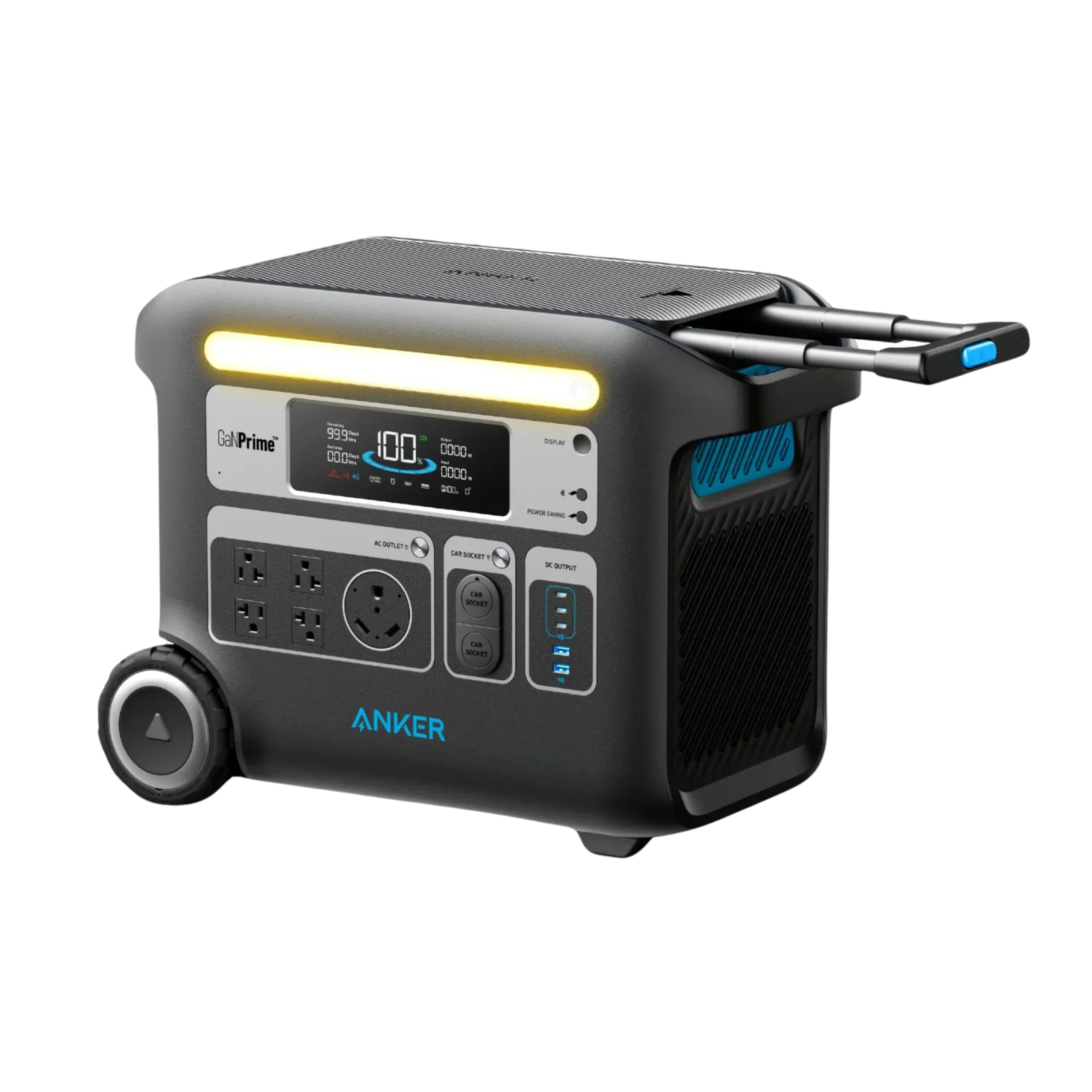
Anker no longer sells the SOLIX F2000 (PowerHouse 767). Its natural replacement is the SOLIX C2000 Gen 2 — the same 2,048Wh capacity and 2,400W output in a newer design.
SOLIX C2000 Gen 2 · $999.99
$1,549.00 · direct from BLUETTI
Last checked 1 day ago. Prices move — check before you buy.
Spec deltas
The Anker SOLIX F2000 costs $900. The BLUETTI Premium 200 V2 costs $1,549, and this entire matchup is the question of what that extra $649 buys. The headline answer: a battery the same size, rated for 6,000 charge cycles to the Anker's 3,000.
Run the everyday scenarios and you can't tell these two apart. Their capacities sit about 1% apart, both take 1,000W of solar, both push 100W over USB-C, both hold a fridge through an eight-hour blackout with nearly identical margin, and both accept expansion batteries from their own lines. Every scenario on this page is a photo finish, which means capacity settles nothing here.
So the decision moves to what capacity can't see. The Anker answers the BLUETTI's premium with wheels, a fifth warranty year, and its head start on price. The BLUETTI answers with a pack rated to outlast the Anker's twice over, nearly fourteen fewer pounds, a bigger surge ceiling, and the only published noise figure between them. If the unit will work for a living, the BLUETTI wins this. If it's insurance, it doesn't.
What the Numbers Reveal
Each conclusion stated first — the numbers behind it on one line, the full analysis below.
rated cycles
Per kilowatt-hour it will ever deliver, the BLUETTI is the cheap one: $0.12 against $0.16. But that discount is paid out only through use. Cycle it thirty-odd times a year as blackout insurance and even the Anker's rating takes the better part of a century to exhaust; you'd be paying a premium for cycles nobody will live to run.
Anker SOLIX F2000: $900, rated 3,000 cycles, 2,048WhBLUETTI Premium 200 V2: $1,549, rated 6,000 cycles, 2,073.6Whcomputed lifetime energy: 6,144 kWh for the F2000 vs 12,442 kWh for the Premium 200 V2
Why it mattersWeekly-or-better cyclers buy the BLUETTI and collect the discount; emergency-only buyers keep the difference and lose nothing.
weight
Wheels don't climb. The moment the route includes stairs, gravel, or a tailgate, both units are carried, and fourteen pounds is the difference between one trip and asking for help. The F2000's most-loved feature works exactly where the BLUETTI's advantage matters least, and disappears exactly where it matters most.
F2000: 67.2 lbs, with wheels and a retractable tow handlePremium 200 V2: 53.4 lbs, carried by handthe wheels and telescoping handle are the most-cited reason owners picked the F2000 over similar-spec rivalsA1
Why it mattersMap the unit's actual route before you pick: pavement people take the Anker's wheels, stairs-and-truck-bed people take the lighter BLUETTI.
continuous output
A 1,200W compressor spiking to triple its plate rating wants 3,600W for a split second: inside the BLUETTI's ceiling, over the Anker's. Both units run the same fridge all night; the BLUETTI simply starts a class of motors the F2000's inverter has to refuse.
F2000 inverter: 2,400W continuous, 2,800W surgePremium 200 V2 inverter: 2,700W continuous, 3,900W surgecompressor motors briefly pull 2-3x their rated draw at startup
Why it mattersAnyone with a well pump, RV air conditioner, or serious workshop tools should treat the surge column as the spec that picks the unit.
The specific dimensions that decide these two units — everything else is a tie.
Lifetime Value
Selected because: Core story after the reprice: p1 is cheaper to buy, p2 cheaper to own — and the warranty-per-dollar counterweight belongs right here.
cost / lifetime kWh
The F2000 is the cheaper purchase; the Premium 200 V2 is the cheaper machine to own. Same tank, twice the rated trips, so every dollar of the BLUETTI's premium is buying future kilowatt-hours at a discount, provided those kilowatt-hours ever get delivered. A unit that cycles twice a month collects almost none of them.
The counterweight is the warranty column, and it favors Anker twice: five years of coverage against four, and about $200 per covered year against $387. Read those together and the trade is honest. The BLUETTI's longevity case mostly plays out in years its own paperwork no longer covers, so its buyer is betting on chemistry; Anker's buyer is betting on the contract.
Portability & Form Factor
Selected because: The 13.8-lb gap vs the wheels is a genuine fork in the road, and the wheels are the most owner-cited theme in ledger A.
weight
Sixty-seven pounds normally reads as a warning label, but this is the rare unit built to be dragged: owners name the wheels and telescoping handle as the reason they bought it, moving it around like rolling luggageA1. The BLUETTI takes the opposite bet and shaves the weight instead of adding hardware.
Which bet wins is a map question. Smooth ground from garage to driveway to campsite pull-through: the Anker rolls, and its weight is irrelevant. Stairs, sand, or a truck bed: everything gets lifted, and fourteen pounds becomes the whole conversation.
What the Specs Don't Tell You
Selected because: Five cards fire; weight and noise disclosure both land on p1, and warranty-vs-cycleLife needs the paper-vs-chemistry framing.
rated cycles
Three of the five flags here point the same direction. The weight card and the noise-disclosure card are both Anker's to wear, and the disclosure one is sneaky-important: BLUETTI printed a number, Anker printed nothing, and only one of those can be held to account at 2 a.m.
The remaining pair, warranty versus cycle life, is really one question in two costumes: paper or chemistry. Anker gives you the longer promise; BLUETTI gives you the cells more likely to make the promise unnecessary. The UPS card is a tie. Read it and move on.
Brand Trust
Selected because: Cross-brand pair with a real support trade-off; the buy-direct advice materially changes BLUETTI outcomes.
Anker's column is a strong brand with a soft spot. The consumer-electronics halo is earned and the SOLIX line benefits from it, but its once famously no-hassle support has been trending down, with more generic responses and return logistics that get ugly when the product is a 67-pound box requiring hazmat-grade shipping.
BLUETTI's column is the category's widest lineup and its best capacity-per-dollar, carrying the space's most inconsistent support record: outcomes split between smooth service and long email runarounds, and they improve when you buy direct from BLUETTI, which is our advice if the Premium wins your money. Neither column should flip your verdict. Both argue for registering the warranty the day the box arrives.
Growth Path
Selected because: Both expand now, so this section neutralizes an assumption buyers may carry in; one paragraph keeps them from over-weighting it.
Both units take expansion batteries from their own lines, so neither is a dead end at 2kWh and neither earns an edge here. If you already know you need double the capacity on day one, the honest answer is a bigger base unit, not either of these plus a cart of add-ons.
Strengths & trade-offs
Anker SOLIX F2000
Strengths
- +Costs $649 less
- +Longer warranty
Trade-offs
- –Significantly heavier (+13.8 lbs), making it harder to move.
- –Shorter-lived battery — rated for 3,000 charge cycles vs the Premium 200 V2's 6,000, so it wears out sooner.
BLUETTI Premium 200 V2
Strengths
- +Lighter by 13.8 lb
- +Larger battery capacity
- +Higher AC output
- +Rated for 6,000 charge cycles — much longer battery lifespan
Trade-offs
- –Substantially more expensive (+$649) than the SOLIX F2000.
Will It Power Your Gear?
Scenario math and per-appliance runtimes, modeled from the spec record.
Scenario verdicts
We ran the math on six real-world scenarios. Here's which unit survives your actual life.
SCN-01 · 2 nights · needs 2,100Wh
Weekend Camping
Two nights off-grid with essential comfort
Neither unit
Two nights of fan, lights, CPAP, and phone charging outruns both tanks by about a fifth — this is a dead heat both units lose. The fix is the same for each: solar input and a sunny midday, or a shorter appliance list. Neither earns an edge here; pick your winner in the sections above.
Battery budget usedlower = more headroom
LOAD Phone Charger 15W×6h · LED Lights 40W×8h · Box Fan 75W×14h · CPAP Machine 40W×16h
SCN-02 · 8 hours · needs 1,645Wh
8-Hour Blackout
Keep the essentials running through a night without power
Either unit
Both clear the night with single-digit margin to spare, a genuine photo finish. Capacity settles nothing here, and both switch to battery fast enough that the router never notices the grid left. Call it the tie it is and decide on price and cycle life.
Battery budget usedlower = more headroom
LOAD Fridge 150W×8h · Router + Modem 20W×8h · LED Lights (4 bulbs) 40W×6h · Phone Charger 15W×3h
SCN-03 · 8 hours · needs 320Wh
CPAP Overnight
Sleep therapy without interruption — the #1 medical use case
Either unit
A CPAP sips — both units end the night still more than four-fifths full, so capacity is beside the point. The unit is a few feet from your pillow, which makes noise the real spec, and only the BLUETTI puts a number on it. Both do the job; one makes a written promise about how quietly.
Battery budget usedlower = more headroom
LOAD CPAP Machine 40W×8h
SCN-04 · 8 hours · needs 910Wh
Remote Workday
Full work day off-grid without power anxiety
Either unit
Both power your workstation all day without strain, and their USB-C output is a wash — pick on weight, ports, or price.
Battery budget usedlower = more headroom
LOAD Laptop 60W×8h · External Monitor 30W×8h · Router + Modem 20W×8h · Phone Charger 15W×2h
SCN-05 · 4 hours · needs 670Wh
Tailgate Party
Game day power for the crew
Either unit
Both handle game day easily. Since capacity isn't the deciding factor, weight is: at 53.4 lbs the Premium 200 V2 is the one you'll be glad you brought. Fan noise under load is worth a listen too — it's audible in the lulls between songs.
Battery budget usedlower = more headroom
LOAD Blender 400W×0.5h · LED TV (55") 80W×4h · Bluetooth Speaker 15W×4h · Phone Charger (×3) 45W×2h
SCN-06 · 24 hours · needs 4,685Wh
Van Life Daily
A full day of mobile living — the ultimate endurance test
Neither unit
A full van-life day asks for well over twice what either tank holds, so neither unit does this solo. Both accept expansion batteries from their own lines, so either can grow toward the job — but if this is your daily reality, budget for that second battery on day one or shop a class up.
Battery budget usedlower = more headroom
LOAD Mini-Fridge 150W×24h · Laptop 60W×4h · Phone Charger 15W×3h · LED Lights 40W×5h · Fan 75W×8h
The Load Test
RUNTIME = (Wh × 0.85) ÷ LOAD
None of the scenarios above exactly yours? Build it. Toggle what you'd plug in; both units are tested against the combined draw.
Essentials
Comfort & Convenience
High-Draw Appliances
Test duration
8h
Continuous draw
205W
Projected runtime
Dead heat — both run this 205W load for roughly 8.5h. Pick on price, weight, or ports.
Modeled from the spec record — same math as the tables below. Methodology
Runtime by appliance
Real-world runtime estimates for common appliances, modeled at 85% inverter efficiency.¹
Essentials
The basics you need runningscale 0–117.5hComfort & Convenience
Makes off-grid life actually enjoyablescale 0–23.5hHigh-Draw Appliances
These reveal the real limitsscale 0–1.8h¹ Runtime = (capacity × 0.85) ÷ appliance watts. Within each group, all bars share one time scale (the group's longest runtime), so lengths are comparable across appliances; identical runtimes collapse into a single blue/orange bar. Actual runtime varies with battery age, temperature, and simultaneous loads — see methodology.
Conclusion
July 13, 2026
Verdict: the Premium 200 V2
Buy the Premium 200 V2 if the battery will see regular rotation, weekly cycling or better. Its pack is rated for twice the lifetime energy of the F2000's, which makes it the cheaper unit per delivered kilowatt-hour despite costing half again as much up front, and it's also the lighter box, the stronger inverter under surge, and the only one of the two with a published noise floor. The F2000's case is narrower but real: a lower price, a fifth year of warranty, and wheels that make its weight irrelevant on pavement. That makes it the right unit for pure blackout insurance, where its rated cycles are already a lifetime supply. On balance the BLUETTI is the better machine and the better long-run buy; the Anker is the better bargain.
Editor-assigned confidence, based on cited owner research and spec analysis.
List prices as of July 13, 2026. The links below open Anker's and BLUETTI's current prices.
$1,549.00 · direct from BLUETTI
Last checked 1 day ago. Prices move — check before you buy.
or check the SOLIX F2000 price$899.99 list
Written by Gunner Gustafson, Whole-Home Backup Tester · Station Arena Test Desk · Updated July 13, 2026
Measured Data
Benchmark scores and the full spec record, side by side.
Benchmark scores
Not rated for both units (minimum threshold unmet): CPAP.
Full specifications
ᵈ Derived: price ÷ rated capacity. See the data behind our comparisons →
Comparison ToolAdd more power stations, side by sideOpen Tool →How these numbers are produced
Numeric verification
Every figure on this page traces to our spec database or arithmetic on it — no estimated numbers.
Owner claims
Statements about owner experience are cited to published reviews — see Sources & Research Notes below.
Runtime model
Runtime = (rated capacity × 0.85 inverter efficiency) ÷ device wattage. Solar recharge estimates assume panels deliver 70% of rated output. Cold weather, battery age, and stacked loads reduce real-world results.
Power Score
Computed from 14 published spec dimensions, weighted per use-case bench. Higher is better; a unit must meet a bench's minimum threshold to be rated.
See the full weight table and data sourcing on our methodology page →Class ranking (the star rating)
Each unit's star score is a category ranking, not customer reviews — no buyer opinions feed it. We score every station on size-independent quality (value, output, portability, endurance, ports, warranty, and more), then percentile-rank it against the other units in its capacity class, so a class-leading compact unit and a class-leading whole-home unit can both earn 5★. Here, SOLIX F2000 rates 3.7/5 (24th percentile of 26 Large-class units), and Premium 200 V2 rates 3.4/5 (8th percentile of 26 Large-class units).
How the class ranking is computed →Test Notes & Caveats
Hidden gotchas and advantages we spotted that you won't find on the product page.
Heavy, But It Rolls
This is a two-hands, mind-your-back box, and Anker knows it: the wheels and telescoping handle are the F2000's signature move, and on pavement they erase the weight entirely. On stairs, gravel, or a tailgate lift they don't — that's where the BLUETTI's lighter build quietly wins the day.
Premium 200 V2: Fixed Capacity
The Premium 200 V2 is sealed at 2,074Wh — a complete unit, and already larger than the SOLIX F2000's 2,048Wh. By contrast the SOLIX F2000 can add expansion batteries, but that only pulls ahead if you'd grow past 2,074Wh.
A Tie, Stated Precisely
Fifteen milliseconds versus twenty. Both are standby-class switchover, fine for routers, desktops, and fridges; neither is a true online UPS for genuinely interruption-sensitive gear. Nobody should pick between these two units on this spec.
Paper Favors Anker
Five years of coverage on the F2000 against four on the Premium 200 V2, and per dollar the Anker costs about half as much for each covered year. Worth naming against our own pick: the BLUETTI's longevity case is mostly cells outliving their paperwork. If a warranty claim is how you sleep at night, the Anker is the safer contract.
The Number Doing the Heavy Lifting
Rated cycle life is 6,000 against 3,000, and at a full cycle a day that's the difference between a battery fading around year eight and one still working past sixteen. The honest footnote: cycle it thirty times a year instead of three hundred and both ratings outlive your interest in the unit. This number only pays the people who use it.
One Published Number, One Shrug
BLUETTI states 16 dBA for the Premium 200 V2 — barely above the sound of the room itself. Anker publishes no noise figure for the F2000. An undisclosed spec isn't automatically a bad one, but if the unit is headed for a bedroom or a quiet campsite, only one company put its noise floor in writing.
Full record above — the Test Desk pick is the Premium 200 V2.
Check Premium 200 V2 price →or check the SOLIX F2000 priceOwnership Analysis
What happens after you buy — true cost of ownership, brand trust, and growth potential.
Lifetime value
Service lifeyears at one full cycle per day
Lifetime energy delivered
Cost per delivered kWh
│ warranty ends · Reaching the cycle rating means ~80% capacity remains — degraded, not dead.
Analyst note
The SOLIX F2000 is cheaper to buy, but the Premium 200 V2 is cheaper to own. At $0.12/kWh over its lifetime vs $0.15/kWh, the Premium 200 V2's higher cycle life and capacity make each dollar go further over the years.
Brand trust
Anker
Ecosystem
7-8 SOLIX portable power stations across C-series (compact) and F-series (flagship), plus the X1 home energy system
Support
US-based support. Historically known for incredible no-hassle replacements, but recent reports describe AI-driven support agents giving generic responses and complex return logistics for heavy units (hazmat shipping). The Anker brand reputation is still strong, but SOLIX-specific support quality is trending down.
Community
Moderate — active Reddit (r/Anker, r/AnkerSOLIXCommunity) and growing. Benefits from Anker's massive consumer electronics brand awareness.
App experience
Rated 4.5/5 iOS (~1,100 ratings) · 4.3/5 Android
Unique strength
Parent brand trust from Anker's consumer electronics dominance. InfiniPower technology for long cycle life. Strong $/Wh value in the mid-size and larger units — the S2000, F2600 and C1000 are among the better buys per watt-hour in the catalog.
Worth knowing
Support quality appears to be declining from its historically excellent level. Firmware updates have removed features without warning. Expansion ecosystem is smaller than EcoFlow's.
BLUETTI
Ecosystem
One of the broadest lineups — 15-20+ models from budget (AC2A) to flagship portable (Apex 300, 2764.8Wh). Includes specialized products: vehicle solar hubs, sodium-ion cold-weather units, and balcony storage systems.
Support
The most inconsistent support in the space. Heavily email-based with China timezone delays. Some users get smooth, efficient service; others report weeks of troubleshooting runarounds, being offered discounts on new units instead of repairs, and confusing third-party purchase claim processes. Buying direct from Bluetti's website tends to produce better support outcomes.
Community
Active and growing — Reddit r/bluetti has a dedicated community. Second-largest after EcoFlow in engagement.
App experience
Rated 4.5/5 iOS and Android — tied for best app experience in the category. V3.0 UI redesign was well-received.
Unique strength
Among the best capacity-to-price ratios available — several Elite and Apex units are the lowest $/Wh in the catalog. Widest product diversity including industry-firsts like sodium-ion cold-weather units and dual solar+alternator vehicle hubs. LFP across the rest of the range, though rated cycle life spans 2,500 (EB3A) to 6,000, and it varies WITHIN the Elite range rather than tracking it — the Elite 300 and Elite 200 V2 are rated 6,000 while the Elite 30 V2, Elite 10 Mini, Elite 320 and Elite 400 are rated 3,000+ and the Elite 100 V2 4,000+, so check the specific model. Dual-voltage (120V/240V) in flagships.
Worth knowing
Customer support inconsistency is the #1 risk factor. Older/discontinued units may become unrepairable — no spare parts policy for some models. Some reports of erratic communication from support agents.
Analyst note
This is a coin-flip on support and a real difference in shape. Anker brings the bigger consumer brand and a support record that was excellent and is lately slipping, plus the awkward reality that returning a unit this heavy means hazmat shipping. BLUETTI brings the broadest lineup and the category's best capacity-per-dollar, with the space's most inconsistent support — buying direct from BLUETTI improves your odds. Neither column should scare you off; both should stop you from losing the receipt.
Growth path
SOLIX F2000
EXPANDABLESupports Anker expansion batteries, so you can add capacity later without replacing the base unit — useful if your needs may climb past 2,048Wh.
Accepts up to 1,000W of solar. Enough for a serious multi-panel array.
Generous port selection supports complex multi-device setups.
Expansion batteries are Anker-specific. You're investing in the Anker ecosystem.
Premium 200 V2
FIXED CAPACITYFixed at 2,074Wh — a sealed, complete system rather than a starting point. There's no expansion port, so that figure is the ceiling: check it against your longest unplugged stretch before you buy.
Accepts up to 1,000W of solar. Enough for a serious multi-panel array.
Adequate ports for most setups, but heavy users may want a power strip.
Realistic full solar rechargeat 70% of rated panel output — see methodology
Analyst note
Don't read the SOLIX F2000's expandability as a straight win here: it starts at 2,048Wh, below the Premium 200 V2's 2,074Wh, so a first expansion battery largely buys back capacity the Premium 200 V2 already includes. It only pulls ahead if you'd grow past 2,074Wh — short of that, the Premium 200 V2's larger fixed capacity is the simpler value.
What Owners Report
Patterns from published owner reports and long-term reviews — every claim cited to its source below.
Anker SOLIX F2000
Field reports on the F2000 orbit one feature: the wheels. The oversized wheels and retractable tow handle are the most-cited reason buyers chose it over similar-spec rivals — big and full of batteries, but it lugs like rolling luggageA1. The app earns steady praise for monitoring and charge control, and a meaningful number of owners describe Anker stepping in proactively with firmware fixes or replacementsA2.
In RV duty it reads as a workhorse: usually quiet and quick to deploy for the fridge, CPAP, lights, and internet loads people actually runA3, on the same LFP cells Anker rates at 3,000-plus cycles across its lineupA4. One caveat: this coverage leans on review sites more than large owner forums, so we hold the marketing-adjacent claims loosely — though the wheels praise is consistent across independent reviewsA1.
“It's big and full of heavy batteries, but the durable 4.72-inch wheels and retractable EasyTow handle make it surprisingly easy to lug around — most positive reviews cite the wheels and telescoping handle as a top reason owners chose it over similar-spec competitors.”
Sources
rvoutfitting.com · trustedreviews.com · ankersolix.com · storagereview.com · generatorpeak.com
BLUETTI Premium 200 V2
Straight talk: field data on this exact SKU is thin. Most of the in-depth, long-term testing out there tracks its sibling, the Elite 200 V2, and we excluded it rather than pass off a cousin's report card as this unit's. One buyer sums up the relationship: it's the slightly higher-specced version of the Elite, with the difference likely living in software limitsB1.
What does exist is encouraging but early. Purchase-and-delivery experiences run smooth, with well-packaged units arriving intact and powering up on the first tryB2B3B4. Independent charge testing clocks it at 80% in roughly an hour on turbo and a full tank in under two hours from the wallB6, and real-world solar harvest lands near 70% of a panel's rating in average sunB5. Treat it as a promising early record, not a proven one.
“This is the slightly higher specced version of the Elite 200 v2. The only difference is probably in the software limitations.”
Sources
backuppowerhub.com
Sources & Research Notes
Every owner claim in this report is traceable to a published source. The bracketed references above resolve here.
Recurring owner themes
- The wheels + retractable handle are the standout, repeatedly-cited reason owners pick the F2000; app monitoring and responsive Anker support are also praised. [SOLIX F2000 · 2 entries]
- Buyers who purchased the Premium 200 V2 through the retailer's storefront consistently describe the ordering, packaging, and delivery experience as smooth and well-communicated. [Premium 200 V2 · 3 entries]
- Independent charging-performance write-ups report the Premium 200 V2's turbo AC recharge and solar input behaving close to BLUETTI's stated figures, with solar harvest efficiency landing a bit below the panel's rated wattage in real conditions. [Premium 200 V2 · 2 entries]
- A1
“It's big and full of heavy batteries, but the durable 4.72-inch wheels and retractable EasyTow handle make it surprisingly easy to lug around — most positive reviews cite the wheels and telescoping handle as a top reason owners chose it over similar-spec competitors.”
rvoutfitting.com / trustedreviews.com — Anker SOLIX F2000 (PowerHouse 767) review · 2025-2026 · [positive]
- A2
“WiFi and Bluetooth app lets you monitor battery, charging, and customize power usage; a meaningful number of owners reported Anker proactively solving issues with firmware updates or replacements.”
ankersolix.com / storagereview.com — F2000 review · 2025-2026 · [positive]
- A3
“For the loads RVers run most — fridge, CPAP, lights, fans, internet, TV, small kitchen appliances — the F2000 is usually quiet, capable, and easy to deploy fast.”
rvoutfitting.com — Anker SOLIX F2000 review · 2026 · [positive]
- A4
“Uses the same long-lasting LFP battery reliability as Anker's other models, rated over 3,000 cycles for years of off-grid or backup use.”
trustedreviews.com / generatorpeak.com — F2000 review · 2025-2026 · [positive]
- B1
“This is the slightly higher specced version of the Elite 200 v2. The only difference is probably in the software limitations.”
Outbound Power — customer review on BLUETTI Premium 200 V2 product page · unknown · [mixed]
- B2
“I'm glad to hear your BLUETTI Premium 200 V2 arrived safely, packaged well, and already powering up nicely... once you have it fully set up in your van with the charger.”
Outbound Power — retailer reply paraphrasing a customer review (product page) · unknown · [positive]
- B3
“Excellent service with excellent pricing. By far the best price I could find on the battery. Delivery arrived in perfect condition.”
Outbound Power — customer review on BLUETTI Premium 200 V2 product page · unknown · [positive]
- B4
“Saving $90, fast processing, and clear communication — that's exactly the kind of experience we strive to deliver every time.”
Outbound Power — retailer reply paraphrasing a customer review (product page) · unknown · [positive]
- B5
“Efficiency data suggests real-world solar harvest lands around 70% of rated panel capacity in average conditions.”
backuppowerhub.com — "BLUETTI Premium 200 V2 Review: Is the $750 Premium Upgrade Worth It?" · 2026-04 (page_age) · [mixed]
- B6
“Charge time data confirms the unit reaches 80% state-of-charge in roughly an hour at full turbo, with a full cycle completing in under two hours from the wall.”
backuppowerhub.com — "BLUETTI Premium 200 V2 Review: Is the $750 Premium Upgrade Worth It?" · 2026-04 (page_age) · [positive]
Research compiled July 13, 2026.
Who Should Buy Which
Buy the SOLIX F2000 if you…
- →Your station is insurance. If it cycles a few dozen times a year through outages and the odd trip, its rated cycle life is already more than a lifetime supply, and the price gap buys your first solar panel instead.
- →Its route is pavement: garage to driveway, house to campsite pull-through. The wheels and tow handle do the hauling, and the weight stops mattering the moment it lands on them.
- →You want the longer contract. Five years of coverage against four, at about half the cost per covered year — if warranty paper is how you de-risk a purchase, this is the stronger one.
This is you — check the SOLIX F2000 price
Buy the Premium 200 V2 if you…
- →The battery will work for a living: van weekends twice a month, an off-grid cabin, regular outages. Heavy rotation is exactly where the doubled cycle rating converts from spec-sheet trivia into money.
- →Your path involves stairs, gravel, or a truck bed. Wheels don't climb; fourteen fewer pounds do.
- →You start motors — a well pump, an RV air conditioner, workshop tools. Its surge headroom starts loads the F2000's inverter has to refuse.
- →It's sleeping in your bedroom next to a CPAP, and you want the unit whose quietness is a published spec rather than a hope.
If neither fits
If your real target is a no-recharge camping weekend (about 2,100Wh of load) or a full van-life day (pushing 4,685Wh), both of these tap out — shop a 3kWh-class base or plan an expansion battery from day one. And if the job is phones, laptops, and a lamp, a 1kWh station does it for hundreds less.
The Bottom Line
Same tank, very different engines — that's the whole page. The Premium 200 V2 is rated to push twice the lifetime energy through the same two kilowatt-hours, which makes the expensive unit the cheap one everywhere except the checkout page. It's also the lighter, stronger, quieter-on-paper machine. Its honest weaknesses: the up-front premium, a warranty a year shorter, and a field record on this exact SKU that's still thin.
So ask what the box will actually do all year. If it works — van weekends, cabin duty, regular outages — buy the Premium 200 V2 and stop shopping; the discount compounds every time you drain it. If it waits in the garage for the grid to blink, buy the F2000, pocket the difference, and enjoy the small pleasure of wheeling your backup power to the porch while the neighbors carry theirs.
Frequently Asked Questions
Answers drawn from the spec record and cited owner research.
Is the BLUETTI Premium 200 V2 worth $649 more than the Anker SOLIX F2000?
Only if you'll actually cycle it. Its 6,000-cycle pack is rated for double the F2000's lifetime energy, which makes it the cheaper unit per kilowatt-hour delivered, and it's also lighter with far more surge headroom. If the unit is occasional blackout insurance, the F2000 covers the same scenarios and you keep the $649.
Which lasts longer, the SOLIX F2000 or the Premium 200 V2?
The Premium 200 V2, by double the rated cycles. At a nightly full cycle that's roughly sixteen years of service against eight. At light emergency duty, both ratings outlast the decade and the difference stops mattering.
Can either one power a full weekend of camping without recharging?
No. A two-night camping load of about 2,100Wh overruns both batteries, since only about 85% of a rated watt-hour survives the inverter. Both accept 1,000W of solar, which is the practical fix — though testing on the Premium 200 V2 measured real-world harvest near 70% of a panel's rating in average conditions, so budget sun time generously for either unit.
Which is quieter, the F2000 or the Premium 200 V2?
The Premium 200 V2 is the only one with an answer on paper: BLUETTI publishes 16 dBA, which is close to silent. Anker discloses no noise spec for the F2000, though RV-focused reviewers describe it as usually quiet under typical loads. For a bedroom or bedside CPAP, the published number is the safer bet.
Do the SOLIX F2000 and Premium 200 V2 support expansion batteries?
Yes, both. Each accepts add-on batteries from its own brand, so neither strands you at 2kWh. That makes expansion a wash in this matchup — decide on cycle life, weight, and price instead.
Where to buy
Anker SOLIX F2000
$899.99
$899.99 · direct from Anker
Last checked 50 days ago. Prices move — check before you buy.
BLUETTI Premium 200 V2Pick
$1,549.00
$1,549.00 · direct from BLUETTI
Last checked 1 day ago. Prices move — check before you buy.
Prices may vary by retailer and are subject to change.