Head-to-head test
BLUETTI Premium 200 V2 vs DJI Power 2000
Six modeled evenings end in six ties, so the BLUETTI's whole premium is buying endurance that only kicks in past year eleven of daily cycling — while the DJI is cheaper, stronger, and longer-warrantied through every year before that.
Full profiles: BLUETTI Premium 200 V2 → · DJI Power 2000 →
Looking for a different matchup? BLUETTI Elite 200 V2 vs DJI Power 2000

Written by Gunner GustafsonUpdated
Whole-Home Backup Tester, Station Arena Test Desk

$1,549.00 · direct from BLUETTI
Last checked 1 day ago. Prices move — check before you buy.
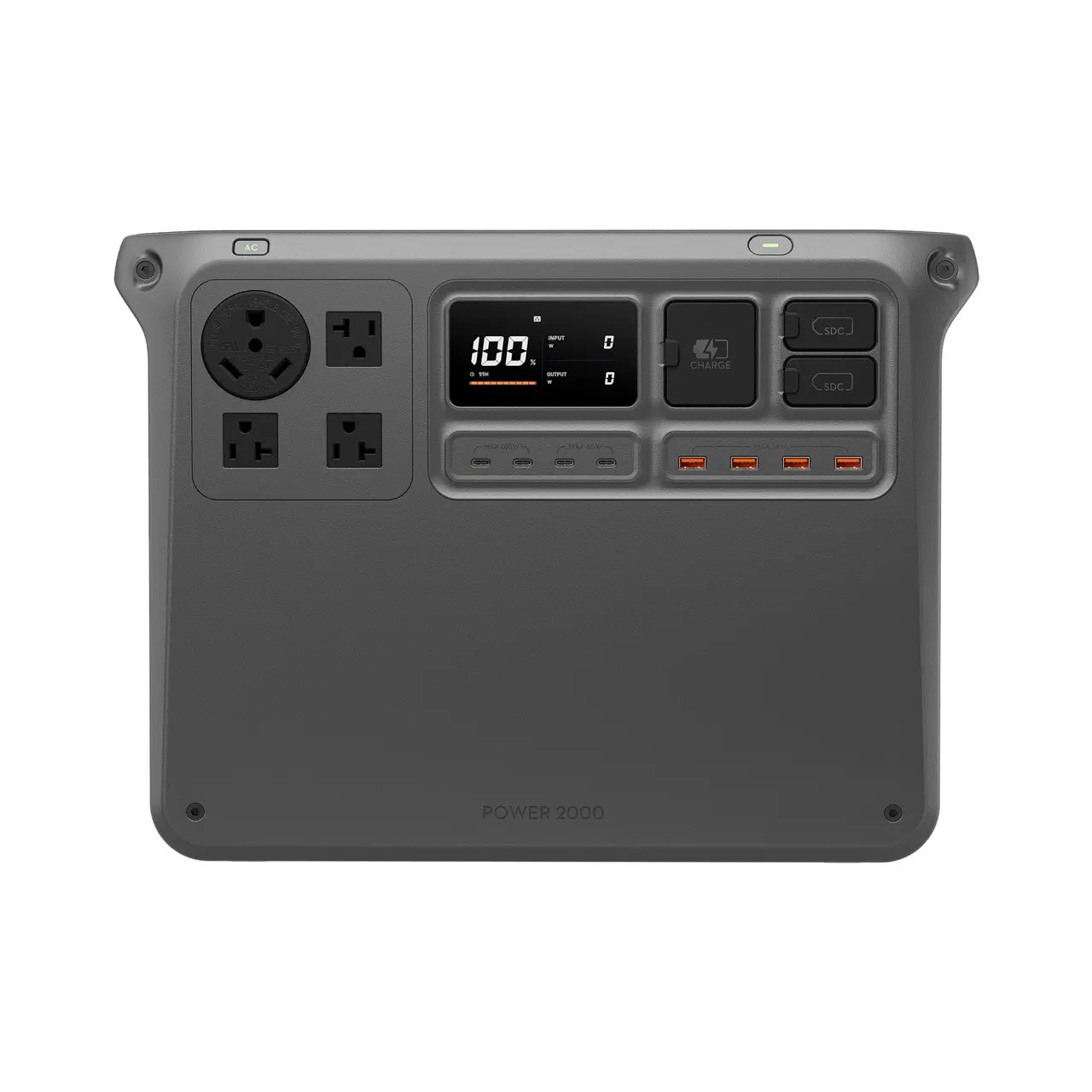
$1,299.00 · direct from DJI
Last checked 1 day ago. Prices move — check before you buy.
Spec deltas
The DJI Power 2000 costs $1,299; the BLUETTI Premium 200 V2 costs $1,549. Run both through the six scenarios we model — an 8-hour blackout, a CPAP night, a remote workday, a tailgate, a camping weekend, a van-life day — and they tie all six: four cleared with nearly identical margins, two failed by both. When the pricier unit can't name a single evening it wins, the premium needs another job.
It has exactly one candidate. The BLUETTI's pack is rated for 6,000 cycles to the DJI's 4,000, which makes it, by our own ownership math, the cheaper unit to own: 12 cents per lifetime kilowatt-hour against 16. That is a genuine card. But lay it on the calendar and it curls at the edges. The DJI's 4,000 cycles already cover 11 years of cycling daily, or 38.5 years of weekend trips; the BLUETTI's advantage begins where that rating runs out, in a second decade of hard daily use that almost no owner reaches.
Meanwhile the cheaper unit is also the better-armed one: stronger inverter, faster USB-C, quicker UPS cutover, twice the USB ports, a lighter carry, and a warranty that runs a year longer. The DJI's real weaknesses are the ones newness buys — solar only through a proprietary adapter, drone-flavored SDC ports, an accessory shelf still filling in — and we'll give each its full weight. They don't flip the verdict.
What the Numbers Reveal
Each conclusion stated first — the numbers behind it on one line, the full analysis below.
rated cycles
Now add the calendar. A 4,000-cycle pack survives 11 years of a full cycle every day — 38.5 years at weekend cadence — so every one of the BLUETTI's 2,000 extra cycles lives past a decade of daily grinding. Cheaper-to-own is true the way a pension is true: it pays out, provided you're still showing up in year twelve.
Premium 200 V2: $1,549, rated 6,000 cycles, 2,073.6WhPower 2000: $1,299, rated 4,000 cycles, 2,048WhRated lifetime energy: 12,442 kWh (BLUETTI) vs 8,192 kWh (DJI)
Why it mattersIf you'll cycle daily off solar for a decade and more, the BLUETTI's math is unanswerable; if you won't, you're prepaying for years you'll never use.
continuous output
Usually the better-specced unit is the pricier one and you weigh the gap. Here the spec winner is also the cheaper unit, so the tiebreaks stack on one side: price, warranty, weight, and ports all point DJI, and the runtime that might have argued back refuses to pick.
8-Hour Blackout: 93% of usable capacity (BLUETTI) vs 94% (DJI)Remote Workday: 52% vs 52%; CPAP Overnight: 18% vs 18%; Tailgate Party: 38% vs 38%Capacities sit 25.6Wh apart; DJI output 3,000W vs 2,700W
Why it mattersIf your question is which one runs your stuff longer, the answer is neither — so buy the one that costs less and does more around the edges.
solar input
That headline needs an adapter that isn't in the box and an array big enough to saturate it, and with real panels delivering around 70% of their sticker ratingA5, saturating 1,800W takes a serious wall of glass. The BLUETTI's smaller ceiling plugs into any brand of panel you already own, today, with nothing extra in the cart.
DJI solar input: up to 1,800W, but only through DJI's proprietary SDC connector — no standard PV portBLUETTI solar input: 1,000W through a built-in standard XT60 portIndependent testing puts real-world solar harvest near 70% of a panel's rating in average conditionsA5
Why it mattersBig-array off-gridders should spec the DJI kit with the adapter priced in; everyone else's two panels will never notice the ceiling.
Expansion is a bet on a company's shelf three years from now. DJI's drone record says it supports what it ships, and the port is real — but BLUETTI's expansion path is the only one you can actually price today. This is the strongest argument for paying the BLUETTI's premium that doesn't involve cycle math.
Both spec sheets list battery expansion: yesDJI entered power stations in 2024 with four models; its brand profile lists no expansion battery ecosystem yetBLUETTI's lineup spans 15-20+ models with established expansion batteries
Why it mattersA concrete add-a-battery-next-year plan leans BLUETTI; a vague someday shouldn't outvote the sticker.
The specific dimensions that decide these two units — everything else is a tie.
Lifetime Value
Selected because: The engine splits its own call — cheaperToBuy p2, cheaperToOwn p1 — and deciding which of those is real for the reader is the whole verdict.
cost / lifetime kWh
Our ownership math returns a split verdict on purpose: cheaper to buy, DJI; cheaper to own, BLUETTI. Stretched across its full rating, the BLUETTI's $1,549 buys 12,442 kilowatt-hours — 12 cents each — while the DJI's 8,192 kilowatt-hours land at 16. If this box is about to become the daily solar buffer for a cabin or a load-shifted house, that four-cent spread compounds for years, and nothing else on this page outweighs it.
But check where the payoff sits. Cycled hard daily, the DJI's rating carries it to year 11; the BLUETTI's edge occupies years twelve through sixteen of that same grind, and at weekend cadence the comparison goes abstract — 38.5 years against 57.7. The warranty column, meanwhile, runs backwards: the longer-lived BLUETTI is covered 4 years at $387 per covered year, the DJI 5 at $260. One unit's endurance claim comes with more paper behind it, and it isn't the one selling endurance.
Your Life, Your Pick
Selected because: Six ties prove the units are interchangeable at their actual job, routing the decision to price and day-one specs.
Six evenings, six ties. The four both units clear — blackout at 93% and 94% of usable pack, workday at 52% apiece, CPAP at 18%, tailgate at 38% — they clear in lockstep, and the two they fail, they fail together: the 2,100Wh camping weekend overdraws both, and the van-life day laps them more than twice. The closest thing to a gap shows up in the blackout, where the BLUETTI finishes with 118Wh in the tank and the DJI with 96. That's one laptop charge of daylight between them after eight hours of fridge, router, and lights.
When the product's actual job refuses to distinguish them, everything around the job decides, and most of it points DJI: sticker, warranty, weight, switchover, ports. What points BLUETTI — the noise rating, the published surge figure, the cycle math — is real, but it belongs to specific buyers rather than general ones. The scenarios' verdict is that there is no runtime reason to pay more.
Growth Path
Selected because: Engine leans DJI on the solar ceiling; the proprietary-adapter and young-catalog caveats need honest airing.
solar input
Both units take expansion batteries, which retires what used to be the classic tiebreak in this class. Our growth call still goes to the DJI, on intake: 1,800W of solar ceiling refills its pack in just over an hour of strong sun, where the BLUETTI's 1,000W takes about two. If your plan is more panels every spring, the DJI has nearly double the headroom to grow into.
One asterisk each. The DJI's solar arrives only through its proprietary SDC connector — the adapter is a separate purchase from an accessory catalog younger than most phone contracts, and its expansion batteries are still more announcement than shelf. The BLUETTI's XT60 port takes any panel brand today, and its expansion batteries ship from one of the broadest catalogs in the category. DJI owns the ceiling; BLUETTI owns the certainty. Pick by whether your growth plan is measured in watts or in trust.
Brand Trust
Selected because: Cross-brand pair: BLUETTI's support inconsistency vs DJI's two-year power-station track record.
BLUETTI brings incumbency: one of the broadest catalogs in the category, from budget bricks to 3,072Wh flagships, a large and active owner community, and a 4.5-rated app that ties for the segment's best. The asterisk is the service counter. Support runs email-first across time zones, and outcomes swing from painless to weeks of back-and-forth; buying direct from BLUETTI improves the odds without retiring the lottery.
DJI walks in with the opposite résumé: four power stations, all since 2024, backed by 700-plus battery patents from the drone business, a global repair network it didn't have to build for this category, and construction reviewers single out as unusually robust — flame-retardant materials and a chassis rated to hold a one-ton static loadB3. The costs of being new are all proprietary: an SDC solar input that demands DJI's own adapter, fast-charge ports only drone pilots use, a 3.5-rated app whose on-device screen is the better interface, and no dedicated owner community yet. A known flaw versus a short record, then — and for a sealed LFP box that should rarely raise a ticket, the short record is the easier risk to carry.
What the Specs Don't Tell You
Selected because: All three firing cards are info-grade; two lean DJI (ups, warranty), one leans BLUETTI (cycleLife) — the split needs interpreting.
rated cycles
All three cards here are info-grade — nothing disqualifying, but the arithmetic has a lean. Two rows go DJI: the quicker line-interactive switchover (10ms against the BLUETTI's 15ms standby, both fine for a desktop, the DJI safer for a fussy NAS), and a warranty that covers more years for less money. The third row is the BLUETTI's whole case compressed to one line: 2,000 more rated cycles.
Whether that third row outweighs the other two is the entire matchup in miniature. It does if you cycle daily. It doesn't if the unit spends eleven months a year in a closet waiting for weather.
Strengths & trade-offs
BLUETTI Premium 200 V2
Strengths
- +Larger battery capacity
- +Rated for 6,000 charge cycles — much longer battery lifespan
Trade-offs
- –No major technical downsides compared to rival.
DJI Power 2000
Strengths
- +Costs $250 less
- +Lighter by 4.9 lb
- +Higher AC output
- +Longer warranty
- +Faster solar charging
Trade-offs
- –Shorter-lived battery — rated for 4,000 charge cycles vs the Premium 200 V2's 6,000, so it wears out sooner.
Will It Power Your Gear?
Scenario math and per-appliance runtimes, modeled from the spec record.
Scenario verdicts
We ran the math on six real-world scenarios. Here's which unit survives your actual life.
SCN-01 · 2 nights · needs 2,100Wh
Weekend Camping
Two nights off-grid with essential comfort
Neither unit
A 2,100Wh weekend outdraws both packs — 119% of the BLUETTI's usable capacity, 121% of the DJI's. Saturday goes fine; Sunday goes dark. Bring panels or trim the load list, because on battery alone neither of these is a full weekend.
Battery budget usedlower = more headroom
LOAD Phone Charger 15W×6h · LED Lights 40W×8h · Box Fan 75W×14h · CPAP Machine 40W×16h
SCN-02 · 8 hours · needs 1,645Wh
8-Hour Blackout
Keep the essentials running through a night without power
Either unit
Both cover the essentials — the 150W fridge, the router, the lights — and both finish on fumes: 93% of the BLUETTI's usable pack, 94% of the DJI's. That's a pass, not a cushion. The units tie here; what differs is the paperwork for bigger loads, where the BLUETTI publishes a 3,900W surge rating and the DJI publishes none.
Battery budget usedlower = more headroom
LOAD Fridge 150W×8h · Router + Modem 20W×8h · LED Lights (4 bulbs) 40W×6h · Phone Charger 15W×3h
SCN-03 · 8 hours · needs 320Wh
CPAP Overnight
Sleep therapy without interruption — the #1 medical use case
Premium 200 V2
An 18% night for either pack, so capacity is beside the point. From two feet away the spec that matters is noise, and the ratings split 16 dBA to under 30. Both sit in whisper territory; the BLUETTI is simply rated nearer to silence.
Battery budget usedlower = more headroom
LOAD CPAP Machine 40W×8h
SCN-04 · 8 hours · needs 910Wh
Remote Workday
Full work day off-grid without power anxiety
Either unit
52% of either pack runs the full workday — a dead heat. The one difference you might notice by five o'clock: the DJI feeds a big laptop at 140W over USB-C while the BLUETTI tops out at 100W, so the DJI is the one that charges your machine as fast as your wall does.
Battery budget usedlower = more headroom
LOAD Laptop 60W×8h · External Monitor 30W×8h · Router + Modem 20W×8h · Phone Charger 15W×2h
SCN-05 · 4 hours · needs 670Wh
Tailgate Party
Game day power for the crew
Either unit
The same party either way: a 670Wh afternoon takes 38% of either unit, and no blender-and-TV rig comes close to troubling these inverters. The real tiebreak is the walk from the parking spot, where the DJI carries 4.9 lbs lighter.
Battery budget usedlower = more headroom
LOAD Blender 400W×0.5h · LED TV (55") 80W×4h · Bluetooth Speaker 15W×4h · Phone Charger (×3) 45W×2h
SCN-06 · 24 hours · needs 4,685Wh
Van Life Daily
A full day of mobile living — the ultimate endurance test
Neither unit
Neither, and it isn't close: a 4,685Wh day demands two and a half of whichever unit you buy, every day. Both are expandable, but this is a job you design a battery system for, not a suitcase you overwork. Different aisle.
Battery budget usedlower = more headroom
LOAD Mini-Fridge 150W×24h · Laptop 60W×4h · Phone Charger 15W×3h · LED Lights 40W×5h · Fan 75W×8h
The Load Test
RUNTIME = (Wh × 0.85) ÷ LOAD
None of the scenarios above exactly yours? Build it. Toggle what you'd plug in; both units are tested against the combined draw.
Essentials
Comfort & Convenience
High-Draw Appliances
Test duration
8h
Continuous draw
205W
Projected runtime
Dead heat — both run this 205W load for roughly 8.6h. Pick on price, weight, or ports.
Modeled from the spec record — same math as the tables below. Methodology
Runtime by appliance
Real-world runtime estimates for common appliances, modeled at 85% inverter efficiency.¹
Essentials
The basics you need runningscale 0–117.5hComfort & Convenience
Makes off-grid life actually enjoyablescale 0–23.5hHigh-Draw Appliances
These reveal the real limitsscale 0–1.8h¹ Runtime = (capacity × 0.85) ÷ appliance watts. Within each group, all bars share one time scale (the group's longest runtime), so lengths are comparable across appliances; identical runtimes collapse into a single blue/orange bar. Actual runtime varies with battery age, temperature, and simultaneous loads — see methodology.
Conclusion
July 13, 2026
Verdict: the Power 2000
Take the Power 2000 unless you cycle a battery every single day. It's $250 cheaper, it ties the BLUETTI in all six scenarios we model, and it leads everywhere around the battery: 3,000W of output to 2,700W, 140W USB-C to 100W, a 10ms UPS handoff to 15ms, 48.5 lbs to 53.4, five years of warranty to four. The BLUETTI's rebuttal is real but narrow: 6,000 rated cycles to 4,000 makes it the cheaper unit per lifetime kilowatt-hour — 12 cents to 16 — and it adds a 16 dBA noise rating, a published 3,900W surge figure, and a standard XT60 solar port where the DJI demands a proprietary adapter. Daily solar cyclers, CPAP sleepers, and people who already own panels should hear that out. Everyone else is paying more for years of endurance they'll never collect.
Editor-assigned confidence, based on cited owner research and spec analysis.
List prices as of July 13, 2026. The links below open BLUETTI's and DJI's current prices.
$1,299.00 · direct from DJI
Last checked 1 day ago. Prices move — check before you buy.
or check the Premium 200 V2 price$1,549.00 list
Written by Gunner Gustafson, Whole-Home Backup Tester · Station Arena Test Desk · Updated July 13, 2026
Measured Data
Benchmark scores and the full spec record, side by side.
Benchmark scores
Not rated for both units (minimum threshold unmet): Camping.
Full specifications
ᵈ Derived: price ÷ rated capacity. See the data behind our comparisons →
Comparison ToolAdd more power stations, side by sideOpen Tool →How these numbers are produced
Numeric verification
Every figure on this page traces to our spec database or arithmetic on it — no estimated numbers.
Owner claims
Statements about owner experience are cited to published reviews — see Sources & Research Notes below.
Runtime model
Runtime = (rated capacity × 0.85 inverter efficiency) ÷ device wattage. Solar recharge estimates assume panels deliver 70% of rated output. Cold weather, battery age, and stacked loads reduce real-world results.
Power Score
Computed from 14 published spec dimensions, weighted per use-case bench. Higher is better; a unit must meet a bench's minimum threshold to be rated.
See the full weight table and data sourcing on our methodology page →Class ranking (the star rating)
Each unit's star score is a category ranking, not customer reviews — no buyer opinions feed it. We score every station on size-independent quality (value, output, portability, endurance, ports, warranty, and more), then percentile-rank it against the other units in its capacity class, so a class-leading compact unit and a class-leading whole-home unit can both earn 5★. Here, Premium 200 V2 rates 3.4/5 (8th percentile of 26 Large-class units), and Power 2000 rates 4.3/5 (56th percentile of 26 Large-class units).
How the class ranking is computed →Test Notes & Caveats
Hidden gotchas and advantages we spotted that you won't find on the product page.
Premium 200 V2: Fixed Capacity
The Premium 200 V2 is sealed at 2,074Wh — a complete unit, and already larger than the Power 2000's 2,048Wh. By contrast the Power 2000 can add expansion batteries, but that only pulls ahead if you'd grow past 2,074Wh.
Ten Milliseconds vs Fifteen
The DJI hands off to battery in about 10ms — line-interactive territory — while the BLUETTI takes about 15ms, standby class. Desktops, routers, and modems ride through both without a flicker. If a workstation or NAS lives on this outlet permanently, the DJI's margin is the safer one; for everyone else this card is trivia.
The Long-Life Unit Has the Shorter Warranty
The BLUETTI is covered 4 years at $387 per covered year; the DJI, 5 at $260. Notice the inversion: the unit rated to run into a second decade carries the shorter guarantee, while the unit it outlasts on paper is backed longer for less. BLUETTI is asking you to underwrite the tail end of its own endurance claim.
The 2,000-Cycle Gap
6,000 rated cycles against 4,000: at a full cycle every day that's 16.4 years against 11, and at weekend cadence it's 57.7 against 38.5 — numbers that outlive warranties, roofs, and possibly the grid connection itself. The gap is real, and it is the BLUETTI's best spec. It just pays out only as fast as you cycle.
Full record above — the Test Desk pick is the Power 2000.
Check Power 2000 price →or check the Premium 200 V2 priceOwnership Analysis
What happens after you buy — true cost of ownership, brand trust, and growth potential.
Lifetime value
Service lifeyears at one full cycle per day
Lifetime energy delivered
Cost per delivered kWh
│ warranty ends · Reaching the cycle rating means ~80% capacity remains — degraded, not dead.
Analyst note
The Power 2000 is cheaper to buy, but the Premium 200 V2 is cheaper to own. At $0.12/kWh over its lifetime vs $0.16/kWh, the Premium 200 V2's higher cycle life and capacity make each dollar go further over the years.
Brand trust
BLUETTI
Ecosystem
The broadest shelf in the category — budget bricks, 3,072Wh flagships, sodium-ion cold-weather packs, vehicle solar hubs. Whatever your setup grows into next, BLUETTI probably already sells the box shaped like it.
Support
The known weak spot. Service runs email-first across time zones and outcomes are inconsistent — some cases resolve painlessly, others stretch into weeks. Buying direct from BLUETTI improves your odds; keep every receipt.
Community
Active and growing — Reddit r/bluetti has a dedicated community. Second-largest after EcoFlow in engagement.
App experience
Rated 4.5/5 iOS and Android — tied for best app experience in the category. V3.0 UI redesign was well-received.
Unique strength
The strongest capacity-per-dollar in the market, LFP chemistry across the entire lineup, and an app rated 4.5 — tied for the category's best.
Worth knowing
Customer support inconsistency is the #1 risk factor. Older/discontinued units may become unrepairable — no spare parts policy for some models. Some reports of erratic communication from support agents.
DJI
Ecosystem
Four power stations, all launched since 2024. The hardware is polished in the way only a drone company's battery lab produces; the accessory shelf around it — solar adapter, expansion batteries — is still being stocked.
Support
Routed through DJI's existing global repair network from the drone business, which is a real head start. The power-station-specific track record is simply short.
Community
No dedicated power station community yet. Discussions happen within r/dji (~250K members, mostly drone users). Very small power-specific presence on Facebook and forums.
App experience
Rated 3.5/5 iOS and Android (DJI Home app ratings reflect entire DJI ecosystem including drones/cameras, not power-station-specific). Users report the on-device screen is more reliable than the app.
Unique strength
Drone-derived battery engineering: 700-plus battery patents, some of the fastest wall charging in the category, and near-silent operation.
Worth knowing
Solar charging requires DJI's proprietary adapter, the SDC fast-charge ports only matter if you fly DJI drones, and the app rates 3.5 — the on-device screen is the more dependable interface.
Analyst note
A value incumbent with a documented service lottery against a premium newcomer with a two-year résumé. BLUETTI's risk surfaces only if your unit fails; DJI's surfaces only if its power-station bet stalls. Neither is large — but this time it's the incumbent asking the premium while you find out.
Growth path
Premium 200 V2
FIXED CAPACITYFixed at 2,074Wh — a sealed, complete system rather than a starting point. There's no expansion port, so that figure is the ceiling: check it against your longest unplugged stretch before you buy.
Accepts up to 1,000W of solar. Enough for a serious multi-panel array.
Adequate ports for most setups, but heavy users may want a power strip.
Power 2000
EXPANDABLESupports DJI expansion batteries, so you can add capacity later without replacing the base unit — useful if your needs may climb past 2,048Wh.
Accepts up to 1,800W of solar. Enough for a serious multi-panel array.
Generous port selection supports complex multi-device setups.
Expansion batteries are DJI-specific. You're investing in the DJI ecosystem.
Realistic full solar rechargeat 70% of rated panel output — see methodology
Analyst note
Don't read the Power 2000's expandability as a straight win here: it starts at 2,048Wh, below the Premium 200 V2's 2,074Wh, so a first expansion battery largely buys back capacity the Premium 200 V2 already includes. It only pulls ahead if you'd grow past 2,074Wh — short of that, the Premium 200 V2's larger fixed capacity is the simpler value.
What Owners Report
Patterns from published owner reports and long-term reviews — every claim cited to its source below.
BLUETTI Premium 200 V2
Straight up: field data on this exact SKU is scarce. The Premium 200 V2 sells through a narrow channel, and one owner sums up the situation — it's the slightly higher-specced twin of the Elite 200 V2, likely separated by software limitsA1. The direct owner material that exists is early-days and upbeat: units arriving well-packaged and powering up cleanA2, with buyers praising the pricing and delivery experienceA3A4.
The independent testing that names this SKU centers on inputs: a full wall recharge completes in under two hours on turbo, with the bulk of the charge landing inside the first hourA6, and real-world solar harvest runs around 70% of a panel's sticker rating in average conditionsA5. Nobody has published a second-year report on this unit yet; the Elite-line hardware underneath it is the reassurance you're actually buying.
“This is the slightly higher specced version of the Elite 200 v2. The only difference is probably in the software limitations.”
Sources
backuppowerhub.com
DJI Power 2000
The DJI's file is broad, recent, and strikingly consistent. Reviewers land on the same three superlatives: charging near the top of the category, with a full wall charge in about 90 minutes, some testers closer to an hour, and 1,800W solar refills in barely more timeB1; near-silence, holding among the quietest units tested even under heavy loadB2; and a build bordering on paranoid, from flame-retardant materials and a nano-coated BMS to a chassis rated to hold a one-ton static loadB3.
In extended use it reportedly ran everything thrown at it and started surge-heavy loads without drama, with drone fast-charging called out as the perk nothing else matchesB4. The caveat writes itself: this product line is barely two years old, so multi-year durability reports don't exist — not because they're bad, because they're impossible.
“Among the fastest-charging tested — a full wall charge in about 90 minutes (reviewers measured even faster, roughly an hour), and up to 1,800W of solar input for a full solar charge in about 75 minutes.”
Sources
bobvila.com · t3.com · thesolarlab.com · campingsolar.us · protoolreviews.com · greenerideal.com · dronexl.co
Sources & Research Notes
Every owner claim in this report is traceable to a published source. The bracketed references above resolve here.
Recurring owner themes
- Buyers who purchased the Premium 200 V2 through the retailer's storefront consistently describe the ordering, packaging, and delivery experience as smooth and well-communicated. [Premium 200 V2 · 3 entries]
- Independent charging-performance write-ups report the Premium 200 V2's turbo AC recharge and solar input behaving close to BLUETTI's stated figures, with solar harvest efficiency landing a bit below the panel's rated wattage in real conditions. [Premium 200 V2 · 2 entries]
- Standout fast charging (wall and 1800W solar), near-silent operation, and an unusually robust safety-focused build are the consistent praise. [Power 2000 · 3 entries]
- A1
“This is the slightly higher specced version of the Elite 200 v2. The only difference is probably in the software limitations.”
Outbound Power — customer review on BLUETTI Premium 200 V2 product page · unknown · [mixed]
- A2
“I'm glad to hear your BLUETTI Premium 200 V2 arrived safely, packaged well, and already powering up nicely... once you have it fully set up in your van with the charger.”
Outbound Power — retailer reply paraphrasing a customer review (product page) · unknown · [positive]
- A3
“Excellent service with excellent pricing. By far the best price I could find on the battery. Delivery arrived in perfect condition.”
Outbound Power — customer review on BLUETTI Premium 200 V2 product page · unknown · [positive]
- A4
“Saving $90, fast processing, and clear communication — that's exactly the kind of experience we strive to deliver every time.”
Outbound Power — retailer reply paraphrasing a customer review (product page) · unknown · [positive]
- A5
“Efficiency data suggests real-world solar harvest lands around 70% of rated panel capacity in average conditions.”
backuppowerhub.com — "BLUETTI Premium 200 V2 Review: Is the $750 Premium Upgrade Worth It?" · 2026-04 (page_age) · [mixed]
- A6
“Charge time data confirms the unit reaches 80% state-of-charge in roughly an hour at full turbo, with a full cycle completing in under two hours from the wall.”
backuppowerhub.com — "BLUETTI Premium 200 V2 Review: Is the $750 Premium Upgrade Worth It?" · 2026-04 (page_age) · [positive]
- B1
“Among the fastest-charging tested — a full wall charge in about 90 minutes (reviewers measured even faster, roughly an hour), and up to 1,800W of solar input for a full solar charge in about 75 minutes.”
bobvila.com / t3.com — DJI Power 2000 review · 2025-2026 · [positive]
- B2
“One of the quietest power stations tested — only about 29 dB at 5 feet when the fan kicked in, virtually silent, and it stayed among the quietest units even under the heaviest loads.”
bobvila.com / thesolarlab.com — DJI Power 2000 review · 2025-2026 · [positive]
- B3
“Built with an eightfold protection system — flame-retardant materials, a nano-coated BMS, 26 temperature sensors, 21 fuses, and structural reinforcement rated to support a one-ton static load — positioning it as one of the safest, most robust units on the market.”
campingsolar.us / protoolreviews.com — DJI Power 2000 review · 2025-2026 · [positive]
- B4
“Ran everything reviewers threw at it, handled surges consistently, and recharged incredibly fast, especially from solar; deep integration for DJI drone users is a unique advantage.”
greenerideal.com / dronexl.co — DJI Power 2000 review · 2025-2026 · [positive]
Research compiled July 13, 2026.
Who Should Buy Which
Buy the Premium 200 V2 if you…
- →You cycle daily — solar self-consumption, an off-grid cabin, load-shifting through peak rates. You're buying cycles by the thousand, and the BLUETTI sells them at the lower lifetime rate with 2,000 more in the tank.
- →You sleep two feet from it. A CPAP night sips 18% of the pack, and a 16 dBA noise rating is about as close to silent as this category prints.
- →You already own solar panels, or plan to buy whichever brand is on sale. The BLUETTI's standard XT60 input takes them all with no adapter in the cart, and its published 3,900W surge rating removes the guesswork on fridge and pump startups.
Buy the Power 2000 if you…
- →You want 2kWh of blackout insurance and camping power at the best price. Same evenings of runtime as the BLUETTI, a longer warranty behind them, and the difference stays in your pocket.
- →A desktop, NAS, or router lives on it full-time. The 10ms switchover is the quicker safety net, and five years of coverage spans the whole tour of duty.
- →You run, or will run, serious solar and don't mind buying into DJI hardware: the 1,800W ceiling turns a midday sun window into a full tank.
- →You fly DJI drones. The SDC fast-charge ports turn this box into field crew, and no competitor has an answer for that.
If neither fits
Skip both if your days look like our van-life model — 4,685Wh of daily demand is two and a half of either unit — or if the job is whole-home backup; that's territory for 4kWh-class expandable systems or a wired-in house battery. From the other direction, if your emergency kit is a router, some phones, and a lamp, a 1kWh station covers it for hundreds less. Buy the box whose evenings match yours.
The Bottom Line
Get the Power 2000. Every evening we can model ends level, so the decision falls to everything around the battery, and that ledger reads one way: cheaper at the register, stronger from the inverter, lighter over the tailgate, quicker on the UPS handoff, and warrantied a year longer. The BLUETTI's lone structural win — the cycle rating — starts paying out in the second decade of daily use, a place most of these boxes never visit.
If you're the exception, be the exception: a daily solar cycler with a standard panel array and a bedside noise budget has every reason to pay the BLUETTI's premium and collect on it for sixteen years. Everyone else, take the DJI, and put the money you saved toward the solar adapter it was always going to make you buy.
Frequently Asked Questions
Answers drawn from the spec record and cited owner research.
Is the DJI Power 2000 better than the BLUETTI Premium 200 V2 for home backup?
The DJI, narrowly. Both clear our 8-hour essentials blackout — a 150W fridge, router, lights, phones — using 93% (BLUETTI) and 94% (DJI) of their usable packs, so runtime is a wash; the DJI then adds a 10ms UPS switchover, a 5-year warranty, and a $250 lower price. The BLUETTI's counterpunch is a published 3,900W surge rating for compressor starts; DJI doesn't publish a surge figure, though reviewers report it started every surge-heavy load they tried.
Can the DJI Power 2000 use regular solar panels?
Not directly. It has no standard PV input — solar comes in through DJI's proprietary SDC connector, which means buying DJI's solar adapter before any panel plugs in. Do that and it accepts up to 1,800W, enough to refill from strong sun in just over an hour. The BLUETTI takes up to 1,000W through a standard XT60 port on the unit itself, no adapter required, for a roughly two-hour solar refill.
Which lasts longer, the BLUETTI Premium 200 V2 or the DJI Power 2000?
On paper, the BLUETTI by a wide margin: 6,000 rated cycles against 4,000, which at one full cycle a day works out to 16.4 years against 11. At weekend-trip cadence both ratings stretch past three decades, so treat the gap as headroom rather than destiny. The fine print cuts the other way — the longer-lived BLUETTI carries the shorter warranty, 4 years to the DJI's 5.
Is DJI too new to power stations to be trusted?
It's a fair worry with a decent answer. DJI entered the category in 2024 with four models, but it builds on 700-plus battery patents from its drone business, and testers found the Power 2000's construction unusually robust — flame-retardant materials, a nano-coated BMS, and a chassis rated to hold a one-ton static load. Support routes through DJI's existing global repair network. The honest costs of its youth: a proprietary solar adapter, drone-specific SDC ports, an app rated 3.5, and an expansion ecosystem that's still mostly a promise.
Which is quieter overnight, the Premium 200 V2 or the Power 2000?
By the spec sheet, the BLUETTI: a 16 dBA noise rating against the DJI's sub-30 dB. In practice you may never catch either running — reviewers measured the DJI among the quietest units they'd tested, near-silent even under heavy load, and a CPAP night draws just 18% of either pack, far too little to work the fans. If you read noise ratings before bed, the BLUETTI is the one rated closer to off.
Brand matchup
BLUETTI vs DJI: measured across every matchup →Where to buy
BLUETTI Premium 200 V2
$1,549.00
$1,549.00 · direct from BLUETTI
Last checked 1 day ago. Prices move — check before you buy.
DJI Power 2000Pick
$1,299.00
$1,299.00 · direct from DJI
Last checked 1 day ago. Prices move — check before you buy.
Prices may vary by retailer and are subject to change.