Head-to-head test
Anker SOLIX C300 vs DJI Power 500
Save $79 with the Anker and you buy watt-hours at nearly twice the price, in a box that still quits before a CPAP reaches morning.
Full profiles: Anker SOLIX C300 → · DJI Power 500 →

Written by Wenny ZhengUpdated
Portable Power Tester, Station Arena Test Desk
$329.99 · direct from Anker
Last checked 1 day ago. Prices move — check before you buy.

$299.00 · direct from DJI
Last checked 1 day ago. Prices move — check before you buy.
Spec deltas
Buy the DJI Power 500. It's $379 against the C300's $300, and that $79 is the difference between 288Wh and 512Wh, and between a 300W outlet and a 1,000W one. The Anker is the cheaper object on the shelf. It is not the cheaper battery.
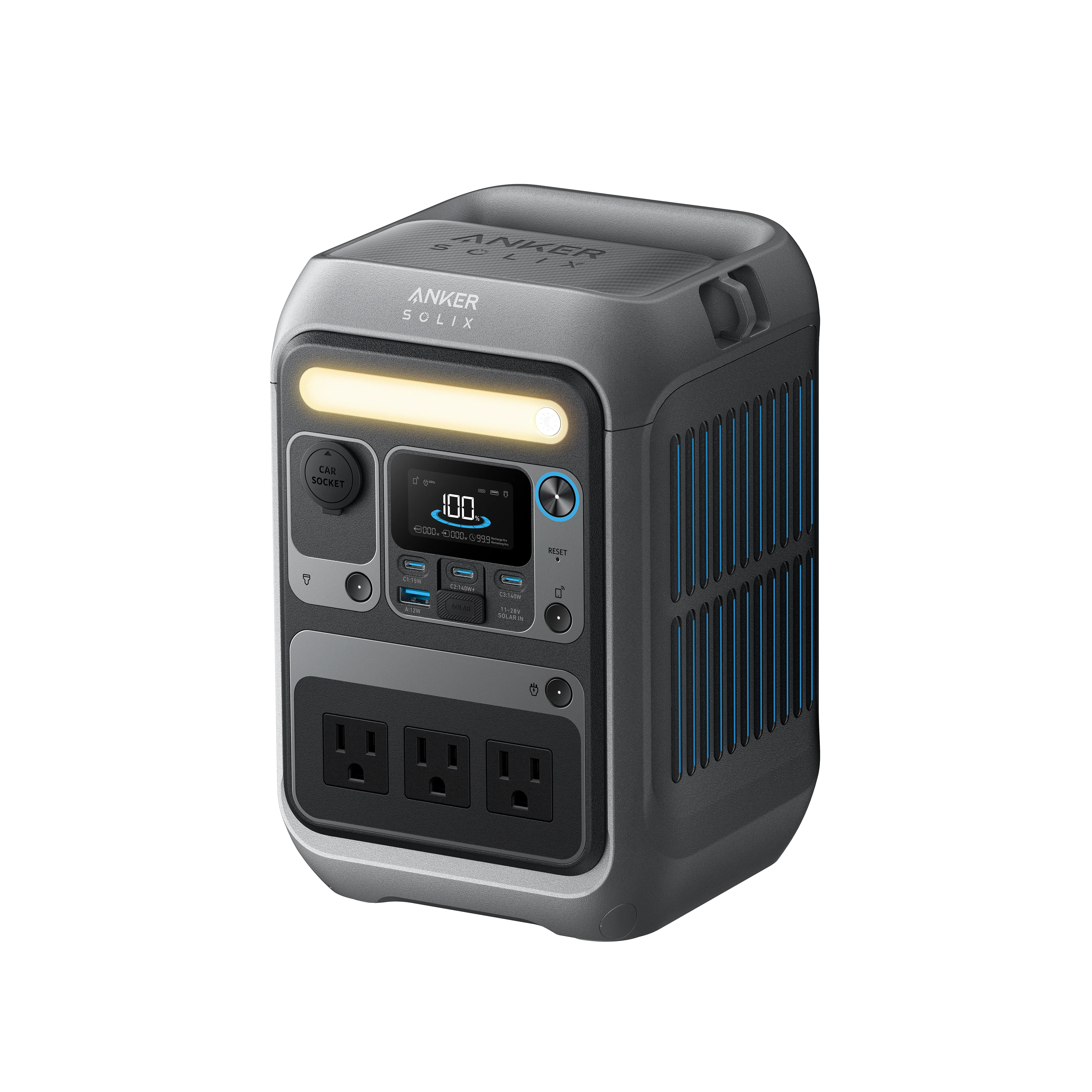
The C300 has a real case and it isn't price. It weighs 9.1 lbs to the DJI's 16.1, its USB-C ports push 140W where the DJI's stop at 100W, and it switches to battery in 10ms where the DJI takes 20. Those are the specs of an excellent desk-and-backpack unit rather than a small power station, and read that way the Anker is very good at its job.
Set expectations before you scroll, though. Of the six load scenarios on this page, five come back "neither" for both boxes: weekend camping, an eight-hour blackout, a remote workday, a tailgate, van life. Only one resolves, and it goes to the DJI.
What the Numbers Reveal
Each conclusion stated first — the numbers behind it on one line, the full analysis below.
Capacity
Run it backwards and the gap gets awkward. For the C300 to match the DJI's price per watt-hour it would have to sell for about $213 (288Wh x $0.74). It sells for $300, four-fifths of the DJI's price for a bit over half the DJI's battery.
Anker SOLIX C300: $300 for 288WhDJI Power 500: $379 for 512Whcost per watt-hour: $1.04 vs $0.74
Why it mattersSticker price is the only number on this page that favors the Anker, and it's the one that stops mattering the moment you divide it by anything.
continuous output
Ratio is a spec-sheet flourish; ceiling is what closes the relay. Motors and heating elements pull two to three times their rated draw for the first half second, and reviewers watched the DJI hold a spike well above its own rating while running a load the Anker couldn't touch continuouslyB3. The tailgate benchmark says the same thing more bluntly.
C300: 300W continuous, 600W surgePower 500: 1,000W continuous, 1,000W surge with no headroom above itTailgate Party benchmark: the DJI can start the peak load, the C300 cannotin testing the Power 500 ran a 905W load and briefly held a 1,500W spike above its 1,000W ratingB3
Why it mattersIf anything on your list has a compressor, a pump, or a heating coil, the C300 is out of the running before runtime is even discussed.
solar input
So the C300 isn't a small power station. It's a very large power bank with an outlet bolted on, and judged as that it beats the DJI outright: 140W per port charges a modern laptop faster than anything the Power 500 offers, at just over half the weight.
C300: 9.1 lbs, dual 140W USB-C, 300W AC ceilingPower 500: 16.1 lbs, 100W maximum USB-C, 1,000W AC ceilingreviewers describe the C300 as light and compact for its capacity, sized for hikes and camping tripsA2
Why it mattersIf everything you plug in ends in USB-C and it's going in a backpack, buy the Anker and stop reading about watt-hours.
The C300 is the better UPS and the DJI is the better battery, and the overnight benchmark shows which of those resolves after midnight: 320Wh is three-quarters of the DJI's usable capacity and more than everything the Anker holds. The faster transfer never gets a chance to matter, because the unit that would have performed it is already empty.
C300 switchover 10ms (line-interactive); Power 500 switchover 20ms (standby)CPAP Overnight benchmark needs 320Wh: 131% of the C300's usable stock, 74% of the DJI'sreviewers call the C300's 10ms transfer genuinely unusual at this size and price classA3
Why it mattersAnything that has to run all night goes to the DJI. Ride-through for one computer that hates a blink goes to the Anker.
The specific dimensions that decide these two units — everything else is a tie.
Lifetime Value
Selected because: $79 more up front buys 224Wh more battery and 1,000 more charge cycles, which reverses which of these is the cheap one.
cost / lifetime kWh
Cycle life is where the price gap stops being a gap. Rated for 4,000 charges against the Anker's 3,000, and moving 512Wh on each one, the Power 500 is contracted to deliver 2,048 kWh over its rated life. The C300's figure is 864 kWh. Same five-year warranty, two and a third times the energy underneath it.
Run them daily and that shows up as calendar time: about 11 years for the DJI, 8.2 for the Anker. Neither number is something to plan around, since you'll replace both for reasons that have nothing to do with cells. But it settles the per-kilowatt-hour question cleanly. Nineteen cents a lifetime kilowatt-hour against thirty-five, and the cheaper box loses that one too.
Your Life, Your Pick
Selected because: Five of the six load benchmarks come back "neither" for both units; the one that resolves goes to the Power 500.
Five of six benchmarks returning "neither" is the most useful thing this section says. A weekend of camping asks 2,100Wh, an eight-hour blackout 1,645Wh, van life 4,685Wh. These are 288Wh and 512Wh boxes. If you came here to pick a blackout unit, the blackout row alone tells you to shop above 1,645Wh and treat this page as background reading.
The one that resolves is CPAP Overnight, and it isn't close. Tailgate Party is filed as "neither" too, but read the peak column rather than the capacity one: the DJI can start that load and the C300 can't. Those are two different failures, and only one of them can be fixed by charging the unit first.
What the Specs Don't Tell You
Selected because: Surge ceiling, transfer speed and cycle life are the rows that actually separate these two, and they don't all point the same way.
rated cycles
The rows that separate these units don't vote together. Surge ceiling and cycle life go to the DJI. Transfer speed goes to the Anker, and it's the one place the C300 is something other than the smaller option. Warranty is five years either way.
Which makes this section the honest test of the verdict. Weigh those three rows equally and it's two to one for the DJI. If the transfer-speed row is the entire reason you're buying a battery at all, it's one to nothing the other way and nothing else on this page is relevant to you. Most people are in the first group. Work out which one you're in before you check out.
Portability & Form Factor
Selected because: 9.1 lbs against 16.1 is the Anker's strongest argument and the only one the DJI can't answer.
weight
Nine pounds goes into a daypack and comes back out without a thought. Sixteen is a one-handed lift you make once, set down, and don't move again until you're leaving. That's the whole portability story and it belongs to the Anker.
It compounds with the ports. Pack for a trip where the heaviest thing you'll charge is a laptop and the C300 is not merely lighter, it's faster at the actual job, since 140W per USB-C port beats the DJI's 100W ceiling. Pack for a trip where something has a plug and a motor, and none of that survives contact with a 300W outlet.
Brand Trust
Selected because: Anker has years of power-station history and a support standard that has slipped; DJI arrived in 2024 with drone-grade hardware and no long record here.
DJI has been selling power stations since 2024 and everything else for much longer, which cuts both ways. The hardware pedigree is real: automotive-grade LFP cells, 700+ battery patents out of the drone business, and a global repair network that already existed before the first power station shipped. The power-station record is four models deep, and there's no community to ask when something goes strange. Those questions land in r/dji, among roughly 250,000 drone pilots.
Anker's position is the inverse. A deep SOLIX line, an app rated 4.5 on iOS, and a support operation that used to be the reason people bought the brand at all. That standard has slipped to AI-first agents and generic first responses. Neither profile is a reason to switch your pick here, because the hardware gap between these two is wider than the brand gap. Both are reasons to keep the receipt.
Strengths & trade-offs
Anker SOLIX C300
Strengths
- +Lighter by 7 lb
Trade-offs
- –Weaker inverter (-700W) limits appliance compatibility.
- –Shorter-lived battery — rated for 3,000 charge cycles vs the Power 500's 4,000, so it wears out sooner.
DJI Power 500
Strengths
- +Costs $31 less
- +Larger battery capacity
- +Higher AC output
- +Faster solar charging
- +Rated for 4,000 charge cycles — much longer battery lifespan
Trade-offs
- –No major technical downsides compared to rival.
Will It Power Your Gear?
Scenario math and per-appliance runtimes, modeled from the spec record.
Scenario verdicts
We ran the math on seven real-world scenarios. Here's which unit survives your actual life.
SCN-01 · 2 nights · needs 2,100Wh
Weekend Camping
Two nights off-grid with essential comfort
Neither unit
Neither one camps. A weekend asks 2,100Wh and the bigger of these two doesn't hold a quarter of that once inverter losses are counted, so both are along for phone and lantern duty while something else does the actual work. If one of these is your only power source for two nights, plan the trip around 288Wh or 512Wh, not around the outlet on the front.
Battery budget usedlower = more headroom
LOAD Phone Charger 15W×6h · LED Lights 40W×8h · Box Fan 75W×14h · CPAP Machine 40W×16h
SCN-02 · 8 hours · needs 1,645Wh
8-Hour Blackout
Keep the essentials running through a night without power
Neither unit
Neither unit covers this scenario's 1,645Wh: the SOLIX C300 comes up 1,400Wh short (about 15% covered), the Power 500 1,210Wh (26%). This is well outside what either unit is for; the right answer here is a larger station, not a choice between these two.
Battery budget usedlower = more headroom
LOAD Fridge 150W×8h · Router + Modem 20W×8h · LED Lights (4 bulbs) 40W×6h · Phone Charger 15W×3h
SCN-03 · 8 hours · needs 320Wh
CPAP Overnight
Sleep therapy without interruption — the #1 medical use case
Power 500
The Power 500 takes this one, and it's the only scenario on the page either unit finishes. A night of CPAP fits inside the DJI's usable capacity with room left; it's more than the entire C300, so the Anker's faster transfer speed never gets a chance to matter. Both units are rated 25 dBA, so whichever ends up eighteen inches from your head is equally quiet about it.
Battery budget usedlower = more headroom
LOAD CPAP Machine 40W×8h
SCN-04 · 8 hours · needs 910Wh
Remote Workday
Full work day off-grid without power anxiety
Neither unit
Neither unit covers this scenario's 910Wh: the SOLIX C300 comes up 665Wh short (about 27% covered), the Power 500 475Wh (48%). Treat this as partial cover — enough for the essentials in it, not the whole list.
Battery budget usedlower = more headroom
LOAD Laptop 60W×8h · External Monitor 30W×8h · Router + Modem 20W×8h · Phone Charger 15W×2h
SCN-05 · 4 hours · needs 670Wh
Tailgate Party
Game day power for the crew
Neither unit
Neither covers the tailgate's 670Wh, but they fail differently. The Power 500 can at least start the peak load and then run out of battery; the C300 can't start it at all, because 600W of surge is the whole ceiling. Running out is a scheduling problem. Not starting is a shopping problem.
Battery budget usedlower = more headroom
LOAD Blender 400W×0.5h · LED TV (55") 80W×4h · Bluetooth Speaker 15W×4h · Phone Charger (×3) 45W×2h
SCN-06 · 24 hours · needs 4,685Wh
Van Life Daily
A full day of mobile living — the ultimate endurance test
Neither unit
Neither unit covers this scenario's 4,685Wh: the SOLIX C300 comes up 4,440Wh short (about 5% covered), the Power 500 4,250Wh (9%). This is well outside what either unit is for; the right answer here is a larger station, not a choice between these two.
Battery budget usedlower = more headroom
LOAD Mini-Fridge 150W×24h · Laptop 60W×4h · Phone Charger 15W×3h · LED Lights 40W×5h · Fan 75W×8h
SCN-07 · an afternoon · needs 100Wh
Afternoon Off-Grid
Phones and a speaker at the park, beach, or campsite — the small-unit job description
Either unit
This is the job small stations are actually for, and both do it: the SOLIX C300 finishes at 41% used, the Power 500 at 23%. At this size the decider is what rides in the bag — 9.1 lbs for the SOLIX C300 against 16.1 for the Power 500 — and price, not the leftover watt-hours.
Battery budget usedlower = more headroom
LOAD Phone Charger (×2) 30W×2h · Bluetooth Speaker 10W×4h
The Load Test
RUNTIME = (Wh × 0.85) ÷ LOAD
None of the scenarios above exactly yours? Build it. Toggle what you'd plug in; both units are tested against the combined draw.
Essentials
Comfort & Convenience
High-Draw Appliances
Test duration
8h
Continuous draw
205W
Projected runtime
For this load: Power 500 runs 2.1h vs 1.2h.
$299 list · direct from DJI
Modeled from the spec record — same math as the tables below. Methodology
Runtime by appliance
Real-world runtime estimates for common appliances, modeled at 85% inverter efficiency.¹
Essentials
The basics you need runningscale 0–29hComfort & Convenience
Makes off-grid life actually enjoyablescale 0–5.8hHigh-Draw Appliances
These reveal the real limitsscale 0–0.4h¹ Runtime = (capacity × 0.85) ÷ appliance watts. Within each group, all bars share one time scale (the group's longest runtime), so lengths are comparable across appliances; identical runtimes collapse into a single blue/orange bar. Actual runtime varies with battery age, temperature, and simultaneous loads — see methodology.
Conclusion
August 9, 2026
Verdict: the Power 500
Take the DJI Power 500 at $379. The $79 premium over the C300 buys 78% more battery (288Wh to 512Wh) and more than triples the AC ceiling, which is why the Anker's energy works out to $1.04 a watt-hour against the DJI's $0.74. It is also the only one of the two that finishes the single load benchmark on this page either unit can finish, an overnight CPAP. Buy the C300 instead only if the deciding factor is weight in a backpack, 140W USB-C charging, or a 10ms transfer for a machine that must not reboot. Those are three genuine wins, and none of them is capacity.
Editor-assigned confidence, based on cited owner research and spec analysis.
List prices as of August 9, 2026. The links below open Anker's and DJI's current prices.
$299.00 · direct from DJI
Last checked 1 day ago. Prices move — check before you buy.
or check the SOLIX C300 price$329.99 list
Written by Wenny Zheng, Portable Power Tester · Station Arena Test Desk · Updated August 9, 2026
Measured Data
Benchmark scores and the full spec record, side by side.
Benchmark scores
Not rated for both units (minimum threshold unmet): Solar Generator.
Full specifications
ᵈ Derived: price ÷ rated capacity. See the data behind our comparisons →
Comparison ToolAdd more power stations, side by sideOpen Tool →How these numbers are produced
Numeric verification
Every figure on this page traces to our spec database or arithmetic on it — no estimated numbers.
Owner claims
Statements about owner experience are cited to published reviews — see Sources & Research Notes below.
Runtime model
Runtime = (rated capacity × 0.85 inverter efficiency) ÷ device wattage. Solar recharge estimates assume panels deliver 70% of rated output. Cold weather, battery age, and stacked loads reduce real-world results.
Power Score
Computed from 14 published spec dimensions, weighted per use-case bench. Higher is better; a unit must meet a bench's minimum threshold to be rated.
See the full weight table and data sourcing on our methodology page →Class ranking (the star rating)
Each unit's star score is a category ranking, not customer reviews — no buyer opinions feed it. We score every station on size-independent quality (value, output, portability, endurance, ports, warranty, and more), then percentile-rank it against the other units in its capacity class, so a class-leading compact unit and a class-leading whole-home unit can both earn 5★. Here, SOLIX C300 rates 4.2/5 (52nd percentile of 22 Personal-class units), and Power 500 rates 4.6/5 (74th percentile of 20 Compact-class units).
How the class ranking is computed →Test Notes & Caveats
Hidden gotchas and advantages we spotted that you won't find on the product page.
Better ratio, lower ceiling
The C300 doubles its rating on surge, 300W to 600W, while the Power 500 holds nothing in reserve above its 1,000W. That flatters the Anker and shouldn't. Doubling 300W still leaves you at 600W, and an appliance doesn't check your ratio before it draws.
The one row that goes to the Anker
This is the C300's clearest win and it's a real one. Line-interactive transfer beats standby by enough that a desktop mid-write or an older NAS may notice the difference, though most consumer gear won't. If your reason for buying is one specific machine that must never reboot, this row outranks everything else here, including the capacity gap that decides the rest of the page.
Five years each, so this row is a wash
Both units carry five years, which means the cost-per-warranty-year figure beside them measures only which one costs less. It ranks the C300 ahead at $60 a year against $76. Ignore it. Same span, same coverage, and the DJI spends those five years holding 512Wh instead of 288Wh.
Battery Lifespan in Real Years
The Power 500 is rated for 4,000 cycles vs 3,000. In real life: at daily use, that's 11 vs 8.2 years. At weekend use (twice a week), it's 38 vs 29 years. One caution reading years across different sizes: a cycle is 512Wh on the Power 500 and 288Wh on the SOLIX C300, so count lifetime energy — roughly 2,048 kWh against 864 kWh over the rated life. After hitting the cycle limit, the battery doesn't die — it drops to ~80% of original capacity, which is still very usable.
Full record above — the Test Desk pick is the Power 500.
Check Power 500 price →or check the SOLIX C300 priceOwnership Analysis
What happens after you buy — true cost of ownership, brand trust, and growth potential.
Lifetime value
Service lifeyears at one full cycle per day
Lifetime energy delivered
Cost per delivered kWh
│ warranty ends · Reaching the cycle rating means ~80% capacity remains — degraded, not dead.
Analyst note
The Power 500 wins on both sticker price and long-term value. At $0.15/kWh over its lifetime, it's meaningfully cheaper to own. Clear value winner.
Delivers each lifetime kWh for $0.23 less — check the Power 500 price →
Brand trust
Anker
Ecosystem
7-8 SOLIX portable power stations across C-series (compact) and F-series (flagship), plus the X1 home energy system
Support
US-based, and historically the reason people bought Anker at all: no-hassle replacements, quickly. That standard has slipped toward AI-first agents and generic first responses, with return logistics that get complicated once a unit is heavy enough to ship as hazmat. At 9.1 lbs the C300 is at least on the easy side of that particular problem.
Community
Moderate — active Reddit (r/Anker, r/AnkerSOLIXCommunity) and growing. Benefits from Anker's massive consumer electronics brand awareness.
App experience
Rated 4.5/5 iOS (~1,100 ratings) · 4.3/5 Android
Unique strength
Anker's per-watt-hour value is genuinely strong once you get into the mid-size and larger units. The C300 is the exception that proves it. At this size you're paying for the ports and the transfer speed, not for the battery.
Worth knowing
Firmware updates have removed features without warning before. The expansion ecosystem is narrower than EcoFlow's, which is moot here since nothing in this matchup expands anyway.
DJI
Ecosystem
Four power stations, all of them since 2024: Power 500, Power 1000 Mini, Power 1000 V2, Power 2000. That's the entire history.
Support
Leveraging DJI's established global support and repair center network from the drone business. Generally positive reputation inherited from drone operations, but limited power-station-specific track record.
Community
There isn't one yet. Power-station questions get asked inside r/dji among roughly 250,000 drone pilots, which is a fine place to ask about a gimbal and a thin place to ask why your inverter is clicking.
App experience
Rated 3.5/5 iOS and Android (DJI Home app ratings reflect entire DJI ecosystem including drones/cameras, not power-station-specific). Users report the on-device screen is more reliable than the app.
Unique strength
Drone R&D showing up in a battery: 700+ patents on cells, automotive-grade LFP rated past 4,000 cycles, and published noise at the quiet end of the category at 23 to 30dB across the line. The industrial design is a step above the bracket.
Worth knowing
No built-in solar charge controller, so panels need DJI's separate proprietary adapter. The SDC fast-charge ports only pay off if you already own DJI gear. And while the newer Power 1000 V2 and Power 2000 accept battery expansion, the Power 500 does not, so what you buy is what you have.
Analyst note
One of these brands has been making power stations for years and is getting worse at answering the phone. The other has been making them since 2024 and inherited a global repair network from a drone business. Neither profile should move your pick here, because the hardware gap in this matchup is wider than the brand gap. But if you're the sort of person who actually calls support, Anker is the one with a US number and a longer memory of how this is supposed to go.
Growth path
SOLIX C300
FIXED CAPACITYFixed at 288Wh, with no expansion — so size it for your needs up front rather than planning to add capacity later.
Accepts up to 100W of solar. Limited to a single portable panel.
Adequate ports for most setups, but heavy users may want a power strip.
Power 500
FIXED CAPACITYFixed at 512Wh, with no expansion — so size it for your needs up front rather than planning to add capacity later.
Accepts up to 300W of solar. Limited to a single portable panel.
Adequate ports for most setups, but heavy users may want a power strip.
Realistic full solar rechargeat 70% of rated panel output — see methodology
Analyst note
Neither expands, and that's no knock on either — each is a complete unit at a fixed size. Buy the capacity that covers your needs now (the Power 500 gives you the larger ceiling); you can't add to either later.
What Owners Report
Patterns from published owner reports and long-term reviews — every claim cited to its source below.
Anker SOLIX C300
The field record on the C300 is thin, and what exists comes from reviewers rather than long-term owners, so read it as first impressionsA1A2A4. It's consistent as far as it goes: 288Wh, 300W continuous with 600W available on SurgePad, and two 140W USB-C ports doing the real workA1. Anker's own claim is that the unit is 30% smaller than competing stations, and the coverage backs the impression, calling it light and compact for the capacity and aimed at keeping phones and gadgets alive on hikesA2.
The standout in that coverage is the 10ms UPS transfer, described as genuinely unique at this size and price classA3. That's the spec the C300 appears to be built around, alongside reliability and compact sizeA4, which is a fair description of the buyer it suits.
“288Wh capacity with 300W output (600W with SurgePad) and dual 140W USB-C ports for fast device charging.”
Sources
ankersolix.com · trustedreviews.com · im.com.au · solarwaypoint.com · backuppowerhub.com · powerstationlab.com
DJI Power 500
The Power 500's coverage is more hands-on. In testing it ran a 905W load and briefly held a 1,500W spike above its own 1,000W rating, and reviewers found it more efficient than the larger DJI Power 1000B3. The 512Wh LFP pack is cited at 3,000 to 4,000 cycles, which the same coverage translates to roughly a ten-year lifeB1. At 7.3 kg it's called easy to transportB2, which is true measured against other power stations and less true measured against the Anker sitting next to it.
One review flagged what's actually in the box: a wall plug, and nothing else. No solar adapters, no car-charging cableB4. Budget for both if you intend to charge this anywhere other than a wall.
“A 512Wh LFP battery with up to 1,000W output; the automotive-grade LFP cells are rated up to 3,000-4,000 cycles for roughly a 10-year lifespan.”
Sources
dji.com · thesolarlab.com · techradar.com · views-sounds.com · t3.com
Sources & Research Notes
Every owner claim in this report is traceable to a published source. The bracketed references above resolve here.
Recurring owner themes
- Compact, light design; dual 140W USB-C fast charging; and a standout 10ms UPS rare at this size are the highlights. [SOLIX C300 · 3 entries]
- Light, efficient LFP unit with strong real-world output and drone-pilot appeal; the caveat is minimal included accessories. [Power 500 · 3 entries]
- A1
“288Wh capacity with 300W output (600W with SurgePad) and dual 140W USB-C ports for fast device charging.”
ankersolix.com / trustedreviews.com — SOLIX C300 review · 2026 · [positive]
- A2
“Anker claims the C300 is 30% smaller than competing power stations; reviewers call it impressively light and compact for the capacity, aimed at keeping phones and gadgets charged on hikes and camping trips.”
im.com.au / solarwaypoint.com — SOLIX C300 review · 2026 · [positive]
- A3
“Its 10ms UPS switchover is legitimately unique in this size and price class.”
backuppowerhub.com / powerstationlab.com — SOLIX C300 review · 2026 · [positive]
- A4
“Targets users who value reliability, smart features, and compact design.”
backuppowerhub.com — SOLIX C300 review · 2026 · [positive]
- B1
“A 512Wh LFP battery with up to 1,000W output; the automotive-grade LFP cells are rated up to 3,000-4,000 cycles for roughly a 10-year lifespan.”
dji.com / thesolarlab.com — Power 500 review · 2026 · [positive]
- B2
“Weighs only about 7.3 kg, making it easy to transport.”
dji.com / techradar.com — Power 500 review · 2026 · [positive]
- B3
“In testing it ran a 905W load and briefly handled a 1,500W surge above its 1,000W rating; reviewers found it outperformed the larger DJI Power 1000 in efficiency testing.”
thesolarlab.com / views-sounds.com — Power 500 review · 2026 · [positive]
- B4
“Reviews are positive overall, though one noted it ships with only a wall plug — no solar adapters or car-charging cables included.”
t3.com / techradar.com — Power 500 review · 2026 · [mixed]
Research compiled August 9, 2026.
What Owners Actually Report
Drawn from 25 comments on independent review channels — not from retailer reviews, which skew to the first week of ownership. Each line is our summary of one commenter's claim, linked to the original. We record what they said, including where it contradicts the spec sheet.
Anker SOLIX C300
14 claims from 11 comments · 9 from owners · 2 with figures
- Build quality
- 2 · 55% negative
- Other
- 3 · 0% negative
- Size & weight
- 2 · 21% negative
- Solar input
- 3 · 14% negative
- Durability
- 1 · 0% negative
What owners complain about
Returned it: temps hit 52C and above when recharging at 300-330W, with a terrible burning plastic smell.
Build qualitymeasuredowner5 agreedsource →
A 300W inverter cannot start a fridge or drive a drill, where a 600W unit can.
Inverter & surgesource →
Calls the tall tower form factor nonsense in a car camper where a flat, stable unit is needed.
Size & weightsource →
What owners praise
Prefers the Ankers for portable use in the car or beside a chair.
Size & weightowner34 agreedsource →
Better AC outlet spacing, more USB-C ports and a light; bought two after the EcoFlow issue.
Build qualityowner4 agreedsource →
Uses two Anker 300W stations to power video lights on film shoots instead of costly V-mount batteries.
Otherowner1 agreedsource →
DJI Power 500
16 claims from 14 comments · 7 from owners · 3 with figures
- Price & value
- 5 · 6% negative
- Inverter & surge
- 2 · 0% negative
- Runtime
- 3 · 32% negative
- Solar input
- 2 · 0% negative
- Durability
- 1 · 0% negative
What owners complain about
Wishes he could get one in Barbados.
Shipping6 agreedsource →
512Wh will not run a household fridge for 24 hours; maybe around six.
Runtime46 agreedsource →
550 euro in Europe without any accessories is far too high.
Price & value4 agreedsource →
What owners praise
Ran an electric blanket and streaming overnight with plenty left for morning coffee.
Runtimeowner5 agreedsource →
A semi driver runs a microwave off it in a truck with no inverter; worth its weight in gold.
Inverter & surgeowner15 agreedsource →
For $179 more than the Anker he got a far more usable product at $379.
Price & valuemeasuredowner1 agreedsource →
Claims are weighted by how specific they are, whether the commenter owns the unit, and how many readers agreed. Comments that mention a product under a rival's review count for more, because the commenter had no reason to be there. This is what buyers report, not our test results — for measurements we ran ourselves, see the methodology.
Who Should Buy Which
Buy the SOLIX C300 if you…
- →Everything you're charging ends in USB-C and it's riding in a backpack. Two 140W ports and 9.1 lbs beats 512Wh you have to carry up a trail.
- →You want a desk that never blinks. Router, NAS, a desktop mid-save. A 10ms transfer is line-interactive territory, and the AC draw on that desk is nowhere near 300W anyway.
- →You already know your list has no motors on it: phones, cameras, a laptop, a fan, a string of lights. The C300 covers all of it and you carry seven fewer pounds doing it.
Buy the Power 500 if you…
- →A CPAP, or anything else that has to still be running at 6 a.m. This is the only load on the page either unit finishes, and only the DJI finishes it.
- →Your "small" list quietly contains something with a motor or a heating element. A 1,000W ceiling starts things a 600W surge never will.
- →You fly DJI. The SDC ports fast-charge DJI drone batteries directly, which is a genuine perk inside that ecosystem and worth precisely nothing outside it.
- →You want the most watt-hours per dollar available at this size. That's the Power 500, and it isn't a narrow win.
If neither fits
Close this tab if you're sizing for a blackout, a van, or a weekend off-grid. The eight-hour blackout benchmark alone asks 1,645Wh and neither of these holds a third of that, so you want a unit whose capacity starts roughly where these two end. Going the other direction: if the heaviest thing you will ever plug in is a phone and a pair of earbuds, a USB-C power bank does that for a fraction of the money and none of the weight, and you should buy one of those instead of either box on this page.
The Bottom Line
Take the Power 500. The C300 asks you to save $79 and then charges you back for it in every unit of energy you ever pull out of the thing: nearly twice per watt-hour on the shelf, and the extra 1,000 cycles hold that same ratio all the way to the end of the cells' rated life. No feature closes that. Better ports, a faster transfer, a lighter case, stack all three and you've still bought the expensive battery.
The honest exception is small and specific. If the load is a laptop and a phone, if it's riding in a backpack, or if it's one machine that must not reboot when the lights flicker, then the C300's 140W ports, 9.1 lbs and 10ms transfer are the right answers and the DJI's extra capacity is weight you're carrying for nothing. Everyone else: that $79 is the best-spent money on this page. Buy the DJI and stop wondering whether it'll make it to morning.
Frequently Asked Questions
Answers drawn from the spec record and cited owner research.
Is the DJI Power 500 worth $79 more than the Anker SOLIX C300?
Yes, if you're buying a battery rather than a charger. That $79 is the difference between 288Wh and 512Wh and between a 300W outlet and a 1,000W one, which is a lot of hardware for a quarter more money. The only version of this question where the Anker wins is when weight and USB-C charging speed matter more to you than watt-hours.
Can the Anker C300 run a CPAP all night?
No. The overnight CPAP benchmark on this page is 320Wh and the C300 holds 288Wh before inverter losses, so it comes up short of a full night even under perfect conditions. The Power 500's 512Wh clears the same load with margin. If a CPAP is the reason you're shopping, the C300 is the wrong unit at any price.
Does the DJI Power 500 work with solar panels?
It accepts up to 300W of solar, three times the C300's 100W ceiling, but there's no built-in charge controller, so panels need DJI's separate proprietary adapter. The box itself ships with only a wall plug and no solar or car cables, so price the adapter in before you treat the higher solar figure as a win. The Anker's 100W ceiling refills its 288Wh in about three hours of nameplate sun (288Wh divided by 100W), which in practice means most of a good day.
Which one is the better UPS for a computer?
The Anker, clearly. It transfers to battery in 10ms against the DJI's 20ms, which is the line between line-interactive and standby class, and reviewers singled that spec out as unusual at this size and price. Most consumer gear rides through 20ms without noticing, but a desktop mid-write or an older NAS may not. If ride-through is the whole reason you're buying, that single row outweighs the capacity gap.
Which is better for charging a laptop?
The Anker, by a clear margin. Its USB-C ports deliver up to 140W each where the DJI tops out at 100W, which on a large laptop is the difference between charging at full speed and charging while throttled. You also carry seven fewer pounds to do it, since the C300 is 9.1 lbs against the Power 500's 16.1.
Brand matchup
Anker SOLIX vs DJI: measured across every matchup →Where to buy
Anker SOLIX C300
$329.99
$329.99 · direct from Anker
Last checked 1 day ago. Prices move — check before you buy.
DJI Power 500Pick
$299.00
$299.00 · direct from DJI
Last checked 1 day ago. Prices move — check before you buy.
Prices may vary by retailer and are subject to change.