Head-to-head test
Anker SOLIX C2000 Gen 2 vs DJI Power 500
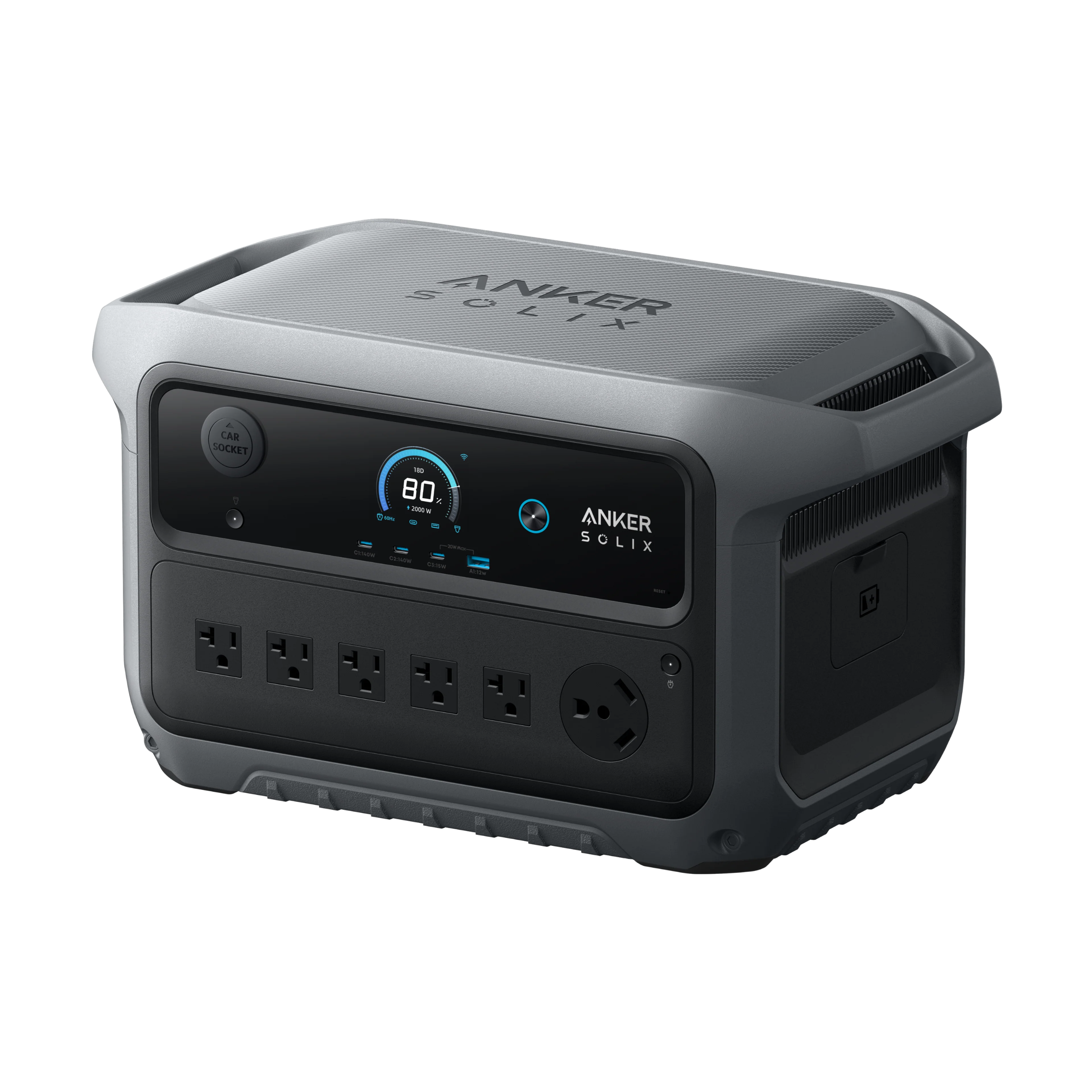
The $299 Power 500 is a battery you carry one-handed; the $1,000 SOLIX C2000 Gen 2 is the one that gets a house through an eight-hour outage, so the only question that matters is whether any single day of yours goes past 435 watt-hours.
Full profiles: Anker SOLIX C2000 Gen 2 → · DJI Power 500 →

Written by Ian SchneiderUpdated
Solar & Off-Grid Tester, Station Arena Test Desk
$999.99 · direct from Anker
Last checked 1 day ago. Prices move — check before you buy.

$299.00 · direct from DJI
Last checked 1 day ago. Prices move — check before you buy.
Spec deltas
Take the SOLIX C2000 Gen 2. It holds 2,048Wh against the Power 500's 512Wh: four times the energy for about 2.6 times the money, $1,000 against $299. The cheaper box on this page is the more expensive energy.
The Power 500 wins one column outright, and it is a real one. At 16.1 pounds it is a one-hand carry to a campsite table, while the Anker's 41.7 pounds is a two-hands, bent-knees lift out of a trunk. If the job is a CPAP for one night, or topping up drone batteries at a trailhead, the DJI does it and hands you $701 back.
Where it stops is at 435Wh usable. That is under half a remote workday (910Wh) and roughly a quarter of an eight-hour outage (1,645Wh). And one row on its spec sheet is not what it looks like: the Power 500 lists 300W of solar input, but DJI's stations have no built-in charge controller, and this one ships with a wall plug and nothing elseB4. Solar is an accessory purchase here, not a feature.
What the Numbers Reveal
Each conclusion stated first — the numbers behind it on one line, the full analysis below.
The SOLIX C2000 Gen 2 takes 800W of solar through a controller that is already onboard, so on day two of an outage it refills from the sun while the DJI waits for a socket or for an adapter you would have to go buy. That reframes the capacity gap. The Anker's 2,048Wh is a daily allowance; the Power 500's 512Wh is a total, spent once, until the grid comes back.
Power 500 lists 300W solar inputDJI's power stations have no built-in solar charge controller; solar runs through a separate proprietary adapterThe Power 500 ships with only a wall plug, no solar adapters and no car-charging cableB4
Why it mattersIf you are buying for outages or off-grid days, do not read the DJI's solar row as a capability you already own.
continuous output
Do not lean on that surge figure in either direction. In testing the Power 500 ran a 905W load and briefly handled 1,500W, above its own 1,000W ratingB3, which says the published number is a floor rather than a measurement. The continuous ratings settle it anyway: 2,400W against 1,000W is a gap no surge asterisk closes.
SOLIX C2000 Gen 2: 2,400W continuous, 4,000W surgePower 500: 1,000W continuous, with its published surge listed at the same 1,000WFridge and AC compressors briefly draw 2-3x their rated wattage at startup
Why it mattersIf a fridge, a well pump or a circular saw is on your list, buy the 2,400W continuous rating and stop reading surge specs.
Capacity
The Anker spends 52% of its usable capacity on that same workday and 94% on an eight-hour outage, so it is not overkill on either day. It is the one that finishes. Buying a second Power 500 to close the gap costs another $299 and leaves you with two sealed boxes and no way to run one load off both, because 512Wh is the ceiling and there is no expansion.
$299 for 512Wh against $1,000 for 2,048Wh435Wh usable on the Power 500 after inverter deratingA remote workday profile draws 910Wh
Why it mattersIf any single day on your list clears 435Wh, the $701 is not a saving. It is a deferred second purchase.
weight
Night two is where it ends. 115Wh does not start a second night, while the Anker's 1,741Wh usable covers five of them at 320Wh each. The real line between these two is not capacity against portability. It is one night against two.
Power 500: 16.1 lbs. SOLIX C2000 Gen 2: 41.7 lbsA CPAP night draws 320Wh; the Power 500 has 435Wh usable435Wh minus 320Wh leaves 115Wh after one night
Why it mattersIf your worst case is a single night, take the DJI and the $701. If a two-day outage is on the table, the weight stops being the point.
The specific dimensions that decide these two units — everything else is a tie.
Runtime: Will It Power Your Gear?
Selected because: After the same 85% inverter derate, the Anker has 1,741Wh to spend and the DJI has 435Wh.
continuous output
Both capacities lose the same 15% before you get to use them, and the shape of this matchup shows up in what is left. 2,048Wh becomes 1,741Wh usable. 512Wh becomes 435Wh. Percentages are fair between them, but the floor is not: 435Wh is one CPAP night at 320Wh with 115Wh to spare, and after that it is a brick until you find a socket.
The Anker's headroom is not abstract, and it is not infinite either. On the eight-hour outage profile it finishes with 96Wh left of its 1,741Wh, a 94% pass. Thin still means finished. The Power 500 gets through about a quarter of that same 1,645Wh night.
Your Life, Your Pick
Selected because: Three of the six profiles land above the Power 500's 435Wh usable and below the Anker's 1,741Wh, which is where this gets decided.
Three of the six profiles fall straight into the gap between these units: a tailgate at 670Wh, a remote workday at 910Wh, an eight-hour outage at 1,645Wh. Every one is more than the Power 500's 435Wh usable and less than the Anker's 1,741Wh. That is a tidy way of saying the Anker was built for this list and the DJI was built for something shorter.
The two extremes are honest about themselves. Weekend camping at 2,100Wh leaves the Anker at 83% of the job and the DJI at 21%; van life at 4,685Wh drops them to 37% and 9%. Neither unit is the answer there, and no amount of reading this page will change that.
Portability & Form Factor
Selected because: 16.1 pounds against 41.7 is the one column the Power 500 wins outright.
weight
41.7 pounds is a two-hands, bent-knees lift and a deliberate walk to wherever it is going to sit for the weekend. 16.1 pounds you pick up on the way past. Reviewers did flag the Gen 2 as substantially lighter than the original C2000A5, which is real progress and still not the same species as a box you carry with one arm.
That difference has a natural buyer: the drone pilot topping up batteries at a trailhead, or anyone whose station lives in a car and comes out for an afternoonB2. It stops being an advantage the moment the unit's actual job is to sit on a basement floor and wait for the power to go out.
What the Specs Don't Tell You
Selected because: The surge card and the warranty card both need a second look, and one of them says nothing at all.
The warranty card is the one to ignore. Both units carry five years on the same terms. Dividing warranty years by purchase price makes the cheaper unit look better covered, but that is just the price difference wearing a different unit.
The surge card points the right way for a shaky reason. The Power 500's published peak is exactly its continuous rating, 1,000W, and a peak that matches the continuous figure to the watt usually means the two were never separated out. Reviewers pushed it to 1,500W briefly under testB3, so the sheet is probably understating it. What is not in doubt is the continuous number: 2,400W against 1,000W, with a 4,000W ceiling sitting behind the Anker's. Buy on the rating you can verify.
Brand Trust
Selected because: DJI's power stations date to 2024 and ship without an onboard solar controller; Anker's ecosystem is mature but its support is the reputation trending the wrong way.
DJI has been building power stations since 2024, which is recent enough that the long-term field record does not exist yet. The hardware pedigree is real, with 700+ battery patents and a global repair network carried over from the drone business. The power-specific inexperience shows up in the design instead: no built-in solar charge controller, and SDC fast-charging ports that only pay off for someone who already owns DJI gear.
Anker's problem is the mirror image. The catalogue and the expansion ecosystem are mature, but support has drifted from the no-hassle replacements the brand was built on toward AI-driven first-line responses and hazmat return logistics on heavy units. Neither of these should flip your decision. Both are reasons to keep the receipt.
Strengths & trade-offs
Anker SOLIX C2000 Gen 2
Strengths
- +Larger battery capacity
- +Higher AC output
- +Faster solar charging
Trade-offs
- –Substantially more expensive (+$701) than the Power 500.
- –Significantly heavier (+25.6 lbs), making it harder to move.
DJI Power 500
Strengths
- +Costs $701 less
- +Lighter by 25.6 lb
Trade-offs
- –Weaker inverter (-1,400W) limits appliance compatibility.
- –Sealed capacity — the SOLIX C2000 Gen 2 can add batteries to grow past 512Wh; this one can't.
Will It Power Your Gear?
Scenario math and per-appliance runtimes, modeled from the spec record.
Scenario verdicts
We ran the math on six real-world scenarios. Here's which unit survives your actual life.
SCN-01 · 2 nights · needs 2,100Wh
Weekend Camping
Two nights off-grid with essential comfort
Neither unit
Neither unit covers this scenario's 2,100Wh: the SOLIX C2000 Gen 2 comes up 359Wh short (about 83% covered), the Power 500 1,665Wh (21%). This is well outside what either unit is for; the right answer here is a larger station, not a choice between these two.
Battery budget usedlower = more headroom
LOAD Phone Charger 15W×6h · LED Lights 40W×8h · Box Fan 75W×14h · CPAP Machine 40W×16h
SCN-02 · 8 hours · needs 1,645Wh
8-Hour Blackout
Keep the essentials running through a night without power
SOLIX C2000 Gen 2
The Anker finishes this night with 96Wh left of its 1,741Wh usable, a 94% pass, and that is worth saying out loud rather than burying. Thin still means finished. The Power 500's 435Wh usable covers roughly a quarter of the 1,645Wh this night asks for, and no amount of light weight closes that.
Battery budget usedlower = more headroom
LOAD Fridge 150W×8h · Router + Modem 20W×8h · LED Lights (4 bulbs) 40W×6h · Phone Charger 15W×3h
SCN-03 · 8 hours · needs 320Wh
CPAP Overnight
Sleep therapy without interruption — the #1 medical use case
Power 500
Both cover the night, so the question is what you are paying to cover it. A CPAP night is 320Wh; the Power 500 gets there for $299, while the Anker spends $1,000 to cover the same night five times over. Take the cheap one. Just know that 115Wh is what is left on the DJI at sunrise, so if the outage runs into a second night the calculation inverts.
Battery budget usedlower = more headroom
LOAD CPAP Machine 40W×8h
SCN-04 · 8 hours · needs 910Wh
Remote Workday
Full work day off-grid without power anxiety
SOLIX C2000 Gen 2
910Wh is where the Power 500 stops being an option. It has 435Wh usable, a little under half what the day asks for, so you would be hunting for a socket by the afternoon. The Anker spends 52% of its usable capacity on the same day, which means you close the laptop without having thought about the battery once.
Battery budget usedlower = more headroom
LOAD Laptop 60W×8h · External Monitor 30W×8h · Router + Modem 20W×8h · Phone Charger 15W×2h
SCN-05 · 4 hours · needs 670Wh
Tailgate Party
Game day power for the crew
SOLIX C2000 Gen 2
This is the cruel one for the DJI. A tailgate is exactly the afternoon you want the 16-pound box for, and 670Wh is exactly where its 435Wh usable runs out. The Anker covers it at 38% of usable capacity, which is a lot of margin for a party, and then you carry 41.7 pounds back to the car.
Battery budget usedlower = more headroom
LOAD Blender 400W×0.5h · LED TV (55") 80W×4h · Bluetooth Speaker 15W×4h · Phone Charger (×3) 45W×2h
SCN-06 · 24 hours · needs 4,685Wh
Van Life Daily
A full day of mobile living — the ultimate endurance test
Neither unit
Neither unit covers this scenario's 4,685Wh: the SOLIX C2000 Gen 2 comes up 2,944Wh short (about 37% covered), the Power 500 4,250Wh (9%). This is well outside what either unit is for; the right answer here is a larger station, not a choice between these two.
Battery budget usedlower = more headroom
LOAD Mini-Fridge 150W×24h · Laptop 60W×4h · Phone Charger 15W×3h · LED Lights 40W×5h · Fan 75W×8h
The Load Test
RUNTIME = (Wh × 0.85) ÷ LOAD
None of the scenarios above exactly yours? Build it. Toggle what you'd plug in; both units are tested against the combined draw.
Essentials
Comfort & Convenience
High-Draw Appliances
Test duration
8h
Continuous draw
205W
Projected runtime
For this load: SOLIX C2000 Gen 2 runs 8.5h vs 2.1h.
$999.99 list · direct from Anker
Modeled from the spec record — same math as the tables below. Methodology
Runtime by appliance
Real-world runtime estimates for common appliances, modeled at 85% inverter efficiency.¹
Essentials
The basics you need runningscale 0–116.1hComfort & Convenience
Makes off-grid life actually enjoyablescale 0–23.2hHigh-Draw Appliances
These reveal the real limitsscale 0–1.7h¹ Runtime = (capacity × 0.85) ÷ appliance watts. Within each group, all bars share one time scale (the group's longest runtime), so lengths are comparable across appliances; identical runtimes collapse into a single blue/orange bar. Actual runtime varies with battery age, temperature, and simultaneous loads — see methodology.
Conclusion
August 9, 2026
Verdict: the SOLIX C2000 Gen 2, on Power Score margin
Take the SOLIX C2000 Gen 2 unless your entire load list fits inside 435 watt-hours a day. That is the Power 500's real capacity after inverter losses, and it is under half of what a remote workday asks for (910Wh) and about a quarter of an eight-hour outage (1,645Wh). The Anker clears both, runs 2,400W continuous against the DJI's 1,000W, and takes 800W of solar through a charge controller that is already onboard. The Power 500's 300W solar row needs a separate proprietary adapter it does not ship with, so on day two of an outage the DJI is waiting for a wall socket. Two things genuinely favor it: 16.1 pounds against 41.7, and $299 against $1,000. If your worst night is a CPAP and a phone, that $701 buys you nothing you will use.
Editor-assigned confidence, based on cited owner research and spec analysis.
List prices as of August 9, 2026. The links below open Anker's and DJI's current prices.
$999.99 · direct from Anker
Last checked 1 day ago. Prices move — check before you buy.
or check the Power 500 price$299.00 list
Written by Ian Schneider, Solar & Off-Grid Tester · Station Arena Test Desk · Updated August 9, 2026
Measured Data
Benchmark scores and the full spec record, side by side.
Benchmark scores
Not rated for both units (minimum threshold unmet): RV Living, Home Backup, Food Truck.
Full specifications
ᵈ Derived: price ÷ rated capacity. See the data behind our comparisons →
Comparison ToolAdd more power stations, side by sideOpen Tool →How these numbers are produced
Numeric verification
Every figure on this page traces to our spec database or arithmetic on it — no estimated numbers.
Owner claims
Statements about owner experience are cited to published reviews — see Sources & Research Notes below.
Runtime model
Runtime = (rated capacity × 0.85 inverter efficiency) ÷ device wattage. Solar recharge estimates assume panels deliver 70% of rated output. Cold weather, battery age, and stacked loads reduce real-world results.
Power Score
Computed from 14 published spec dimensions, weighted per use-case bench. Higher is better; a unit must meet a bench's minimum threshold to be rated.
See the full weight table and data sourcing on our methodology page →Class ranking (the star rating)
Each unit's star score is a category ranking, not customer reviews — no buyer opinions feed it. We score every station on size-independent quality (value, output, portability, endurance, ports, warranty, and more), then percentile-rank it against the other units in its capacity class, so a class-leading compact unit and a class-leading whole-home unit can both earn 5★. Here, SOLIX C2000 Gen 2 rates 4.1/5 (48th percentile of 26 Large-class units), and Power 500 rates 4.6/5 (74th percentile of 20 Compact-class units).
How the class ranking is computed →Test Notes & Caveats
Hidden gotchas and advantages we spotted that you won't find on the product page.
Sealed at 512Wh, and the Ceiling Is Not the Problem
The Power 500 takes no expansion batteries, which is the least surprising thing about a 16-pound box. Nobody grows a 512Wh station into home backup. The number that should concern you is the floor: 435Wh usable is already less than a remote workday's 910Wh, so fixed capacity here means fixed below the line, not capped above it. The Anker starts at 2,048Wh and can add batteries, which only matters if you expect to climb.
Surge: The Anker Wins, but Read the DJI's Number Carefully
The Power 500's published peak is exactly its continuous rating, 1,000W, which is not how surge specs usually behave. A peak that matches the continuous figure to the watt generally means the two were never separated out, so read it as unverified rather than as a measured zero-headroom inverter. The direction holds either way. Motors and compressors pull 2-3x their rated draw for the first instant, and the Anker answers with 2,400W continuous. If you are starting a fridge, buy on that continuous rating; the 4,000W ceiling behind it is headroom you are unlikely to test.
10ms vs 20ms: Both Are Fast Enough
The Anker cuts over in 10 milliseconds and the DJI in 20, and both sit inside what a desktop PC, a router, a NAS or a CPAP will ride through without noticing. The difference is real on paper and invisible in a living room. Let anything else on this page decide it.
Warranty: Identical, and That Is the Answer
Both units carry a five-year warranty on the same terms, so this card decides nothing. Dividing warranty years by purchase price makes the cheaper unit look better covered, but it is not better covered. That is the price difference wearing a different unit. Five years each. Move on.
Full record above — the Test Desk pick is the SOLIX C2000 Gen 2.
Check SOLIX C2000 Gen 2 price →or check the Power 500 priceOwnership Analysis
What happens after you buy — true cost of ownership, brand trust, and growth potential.
Lifetime value
Service lifeyears at one full cycle per day
Lifetime energy delivered
Cost per delivered kWh
│ warranty ends · Reaching the cycle rating means ~80% capacity remains — degraded, not dead.
Analyst note
The Power 500 is cheaper to buy, but the SOLIX C2000 Gen 2 is cheaper to own. At $0.12/kWh over its lifetime vs $0.15/kWh, the SOLIX C2000 Gen 2's higher cycle life and capacity make each dollar go further over the years. One thing to know reading the table: both carry the same 4,000-cycle rating, so the lifetime rows are sticker price and capacity in disguise — the wear horizon is identical and decides nothing here.
Brand trust
Anker
Ecosystem
7-8 SOLIX portable power stations across C-series (compact) and F-series (flagship), plus the X1 home energy system
Support
US-based support. Historically known for incredible no-hassle replacements, but recent reports describe AI-driven support agents giving generic responses and complex return logistics for heavy units (hazmat shipping). The Anker brand reputation is still strong, but SOLIX-specific support quality is trending down.
Community
Moderate — active Reddit (r/Anker, r/AnkerSOLIXCommunity) and growing. Benefits from Anker's massive consumer electronics brand awareness.
App experience
Rated 4.5/5 iOS (~1,100 ratings) · 4.3/5 Android
Unique strength
Parent brand trust from Anker's consumer electronics dominance. InfiniPower technology for long cycle life. Strong $/Wh value in the mid-size and larger units — the S2000, F2600 and C1000 are among the better buys per watt-hour in the catalog.
Worth knowing
Support quality appears to be declining from its historically excellent level. Firmware updates have removed features without warning. Expansion ecosystem is smaller than EcoFlow's.
DJI
Ecosystem
New entrant (2024) — five power station models to date: Power 500, Power 1000 (since superseded by the V2 but still sold), Power 1000 V2, Power 1000 Mini, Power 2000. Buying a "Power 1000" listing? Check which revision it actually ships.
Support
Leveraging DJI's established global support and repair center network from the drone business. Generally positive reputation inherited from drone operations, but limited power-station-specific track record.
Community
No dedicated power station community yet. Discussions happen within r/dji (~250K members, mostly drone users). Very small power-specific presence on Facebook and forums.
App experience
Rated 3.5/5 iOS and Android (DJI Home app ratings reflect entire DJI ecosystem including drones/cameras, not power-station-specific). Users report the on-device screen is more reliable than the app.
Unique strength
Runs quiet — 23-30dB published on most of the range (manufacturer best-case figures), at the quiet end of the category; our record carries no figure for the Power 1000 V2. Fast wall charging, quickest on the Power 1000 V2 at ~56 min — that figure is the V2's, not the whole line's. 700+ battery patents from drone R&D. SDC ports for ultra-fast DJI drone charging. Premium industrial design and build quality. LFP batteries rated for 4,000+ cycles.
Worth knowing
A recent entrant to power stations, arriving long after the established players, so there is less long-term field data than for EcoFlow, Jackery or BLUETTI — though DJI brings a deep hardware track record from drones. No built-in solar charge controller (requires a separate proprietary adapter). SDC ports are proprietary to the DJI ecosystem, so their fast-charging advantage mostly benefits people who already own DJI gear. Battery expansion is available on the newer Power 2000 and Power 1000 V2, but not on the earlier Power 1000 or Power 500 — check the specific model.
Analyst note
Two opposite risk profiles. Anker has the mature catalogue and the declining support story; DJI has the deep hardware pedigree and almost no power-station track record, because the line only dates to 2024. Neither should move your decision here. The capacity numbers already did.
Growth path
SOLIX C2000 Gen 2
EXPANDABLESupports Anker expansion batteries, so you can add capacity later without replacing the base unit — useful if your needs may climb past 2,048Wh.
Accepts up to 800W of solar. Suitable for a 1-2 panel setup.
Generous port selection supports complex multi-device setups.
Expansion batteries are Anker-specific. You're investing in the Anker ecosystem.
Power 500
FIXED CAPACITYFixed at 512Wh, with no expansion — so size it for your needs up front rather than planning to add capacity later.
Accepts up to 300W of solar. Limited to a single portable panel.
Adequate ports for most setups, but heavy users may want a power strip.
Realistic full solar rechargeat 70% of rated panel output — see methodology
Analyst note
The Power 500 is sealed at 512Wh, which is fine if that covers you. The SOLIX C2000 Gen 2 starts at 2,048Wh and can grow beyond it with Anker expansion batteries — real headroom the Power 500 doesn't have if your needs climb toward partial-home backup.
What Owners Report
Patterns from published owner reports and long-term reviews — every claim cited to its source below.
Anker SOLIX C2000 Gen 2
The review record on the C2000 Gen 2 is unusually clean. Reviewers describe fans that never rise above a background whirr even at full powerA1, plug-and-play setup with no firmware ritual and no odd voltage dropsA2, and Bluetooth or Wi-Fi monitoring in the Anker app that they actually found usefulA3. One review called it among the most attractive 2kWh stations on the market, with few points of criticismA4.
The caveat is where that praise comes from. It is hands-on review coverage rather than six-month owner reports, so what you are reading is high-quality first impressions and not a durability recordA1A4. Reviewers did note the Gen 2 shed a large amount of weight against the original C2000A5.
“Even at full power it's far quieter than any other powerful Anker station tested — the fans never rise above a subdued, easily-backgrounded whirr, working largely silently and only occasionally reaching a pleasantly quiet ~35 dB at 1 m under high load.”
Sources
notebookcheck.net · thesolarlab.com · trustedreviews.com · androidguys.com
DJI Power 500
Field data on the Power 500 is thin and recent, and what exists comes from reviewers rather than long-term ownersB1B4. The strongest data point is a good one: in testing it ran a 905W load, briefly handled 1,500W above its 1,000W rating, and out-measured the larger DJI Power 1000 on efficiencyB3.
The recurring complaint is the box, not the battery. It ships with a wall plug and nothing else, no solar adapters and no car-charging cableB4, which is the practical face of the missing charge controller. DJI cites automotive-grade LFP cells at 3,000 to 4,000 cycles for roughly a ten-year lifeB1; our spec table carries the top of that band, so read 4,000 cycles as the optimistic end rather than the number.
“A 512Wh LFP battery with up to 1,000W output; the automotive-grade LFP cells are rated up to 3,000-4,000 cycles for roughly a 10-year lifespan.”
Sources
dji.com · thesolarlab.com · techradar.com · views-sounds.com · t3.com
Sources & Research Notes
Every owner claim in this report is traceable to a published source. The bracketed references above resolve here.
Recurring owner themes
- Reviewers consistently praise quiet operation, fast charging, premium build, and no-fuss plug-and-play simplicity. [SOLIX C2000 Gen 2 · 3 entries]
- Light, efficient LFP unit with strong real-world output and drone-pilot appeal; the caveat is minimal included accessories. [Power 500 · 3 entries]
- A1
“Even at full power it's far quieter than any other powerful Anker station tested — the fans never rise above a subdued, easily-backgrounded whirr, working largely silently and only occasionally reaching a pleasantly quiet ~35 dB at 1 m under high load.”
notebookcheck.net / thesolarlab.com — Anker SOLIX C2000 Gen 2 review · 2026 · [positive]
- A2
“Really simple to use — no need to download firmware or deal with weird voltage drops; you just turn it on, plug in, and go. Rapid charging and premium build.”
trustedreviews.com / thesolarlab.com — Anker SOLIX C2000 Gen 2 review · 2026 · [positive]
- A3
“The Anker Solix app is a good way to monitor the station during charging and use over Bluetooth or Wi-Fi; reviewers appreciated the monitoring functionality.”
androidguys.com — Anker SOLIX C2000 Gen 2 review · 2026 · [positive]
- A4
“Delivers a convincing performance with few points of criticism — undoubtedly one of the most attractive 2 kWh power stations on the market.”
notebookcheck.net — Anker SOLIX C2000 Gen 2 review · 2026 · [positive]
- A5
“Substantially lighter than its predecessor — the Gen 2 shed a large amount of weight versus the original C2000, making it notably easier to carry for its capacity.”
notebookcheck.net — '11.6 kg lighter than its predecessor' review · 2026 · [positive]
- B1
“A 512Wh LFP battery with up to 1,000W output; the automotive-grade LFP cells are rated up to 3,000-4,000 cycles for roughly a 10-year lifespan.”
dji.com / thesolarlab.com — Power 500 review · 2026 · [positive]
- B2
“Weighs only about 7.3 kg, making it easy to transport.”
dji.com / techradar.com — Power 500 review · 2026 · [positive]
- B3
“In testing it ran a 905W load and briefly handled a 1,500W surge above its 1,000W rating; reviewers found it outperformed the larger DJI Power 1000 in efficiency testing.”
thesolarlab.com / views-sounds.com — Power 500 review · 2026 · [positive]
- B4
“Reviews are positive overall, though one noted it ships with only a wall plug — no solar adapters or car-charging cables included.”
t3.com / techradar.com — Power 500 review · 2026 · [mixed]
Research compiled August 9, 2026.
What Owners Actually Report
Drawn from 22 comments on independent review channels — not from retailer reviews, which skew to the first week of ownership. Each line is our summary of one commenter's claim, linked to the original. We record what they said, including where it contradicts the spec sheet.
Anker SOLIX C2000 Gen 2
15 claims from 8 comments · 11 from owners · 4 with figures
- Expandability
- 2 · 0% negative
- Size & weight
- 1 · 0% negative
- Price & value
- 3 · 0% negative
- Idle drain
- 2 · 0% negative
- App & firmware
- 1 · 0% negative
What owners complain about
Says the 800W max claim is limited by a 60V, 17A window, so real peak input is well under the rating.
Solar input2 agreedsource →
What owners praise
DJI Power 500
16 claims from 14 comments · 7 from owners · 3 with figures
- Price & value
- 5 · 6% negative
- Inverter & surge
- 2 · 0% negative
- Runtime
- 3 · 32% negative
- Solar input
- 2 · 0% negative
- Durability
- 1 · 0% negative
What owners complain about
Wishes he could get one in Barbados.
Shipping6 agreedsource →
512Wh will not run a household fridge for 24 hours; maybe around six.
Runtime46 agreedsource →
550 euro in Europe without any accessories is far too high.
Price & value4 agreedsource →
What owners praise
Ran an electric blanket and streaming overnight with plenty left for morning coffee.
Runtimeowner5 agreedsource →
A semi driver runs a microwave off it in a truck with no inverter; worth its weight in gold.
Inverter & surgeowner15 agreedsource →
For $179 more than the Anker he got a far more usable product at $379.
Price & valuemeasuredowner1 agreedsource →
Claims are weighted by how specific they are, whether the commenter owns the unit, and how many readers agreed. Comments that mention a product under a rival's review count for more, because the commenter had no reason to be there. This is what buyers report, not our test results — for measurements we ran ourselves, see the methodology.
Who Should Buy Which
Buy the SOLIX C2000 Gen 2 if you…
- →You want the fridge, the lights and the router still working eight hours into an outage. The Anker finishes that 1,645Wh night. Nothing about 435Wh usable gets the DJI close.
- →You work from a cabin, a job site or a driveway, and a full day costs you around 910Wh. That is 52% of the Anker's usable capacity, so you are not nursing it.
- →You want solar to be something you do rather than something you shop for: 800W of input through a controller that is already onboard.
- →Your needs point upward. The C2000 Gen 2 takes expansion batteries, so 2,048Wh is a starting point instead of a ceiling.
Buy the Power 500 if you…
- →Your worst night is a CPAP and a phone. 320Wh against 435Wh usable covers it, and you keep $701.
- →The station lives in a car and comes out for afternoons. 16.1 pounds is a one-hand carry; a 41.7-pound box changes how often you bother.
- →You already fly DJI. The SDC ports are proprietary, which is a drawback for everyone except the person with the drone batteries.
If neither fits
If your day looks like the van-life profile at 4,685Wh, or even a full weekend camp at 2,100Wh, close both tabs. The Anker covers 37% and 83% of those; the DJI covers 9% and 21%. You want a station sized past that daily draw, or the C2000 Gen 2 with an expansion battery already on it, and you want to price that as one purchase rather than discover it as two.
The Bottom Line
Take the SOLIX C2000 Gen 2. Four times the energy for 2.6 times the money is the arithmetic, but the reason is narrower than that: 435Wh usable is under half a remote workday and about a quarter of an eight-hour outage, and no amount of light weight fixes a battery that is empty. Add the solar row that needs an adapter it does not come with, and the DJI's backup case thins out fast.
The Power 500 keeps one honest claim, and it deserves respect. If your worst night is a CPAP and a phone charger, it covers it, it weighs 16.1 pounds, and it leaves $701 in your pocket. Anything past that single night and you are standing in a dark kitchen holding a very well-built brick.
Frequently Asked Questions
Answers drawn from the spec record and cited owner research.
Is the DJI Power 500 enough for a power outage?
For one quiet night, yes. It has 435Wh usable after inverter losses, which covers a 320Wh CPAP night with 115Wh left over. For a standard eight-hour outage load of 1,645Wh it is not close, and it cannot refill from solar without an adapter it does not ship with. Think of it as one night, not as backup.
Can the DJI Power 500 charge from solar?
Not out of the box. DJI's power stations have no built-in solar charge controller, so solar runs through a separate proprietary adapter, and the Power 500 ships with a wall plug and nothing else. The 300W figure is what that adapter allows, not what the unit does on its own. The SOLIX C2000 Gen 2 takes 800W of solar with the controller already onboard.
Can the DJI Power 500 run a refrigerator?
It is the risky one. Its inverter is rated 1,000W continuous and its published surge is the same 1,000W, while compressors briefly pull 2-3x their rated draw at startup. Reviewers did see it hold 1,500W briefly in testing, so the sheet is probably conservative, but you would be relying on that. The Anker runs 2,400W with a 4,000W ceiling and never raises the question.
Is the Anker SOLIX C2000 Gen 2 worth $701 more than the DJI Power 500?
Yes, if any single day on your list goes past 435Wh, which is all the DJI has usable. A remote workday at 910Wh and an eight-hour outage at 1,645Wh both do. No, if your loads genuinely stay under it, in which case you are buying capacity you will never discharge. The gap is $1,000 against $299.
Which one is better for a CPAP?
The Power 500, if the outage lasts one night. A CPAP night runs about 320Wh, the DJI has 435Wh usable, so it finishes with 115Wh spare and weighs 16.1 pounds when you carry it to the bedroom. If a second night is plausible, that 115Wh will not start one, and the Anker's 1,741Wh usable covers five nights at the same draw.
Brand matchup
Anker SOLIX vs DJI: measured across every matchup →Where to buy
Anker SOLIX C2000 Gen 2Pick
$999.99
$999.99 · direct from Anker
Last checked 1 day ago. Prices move — check before you buy.
DJI Power 500
$299.00
$299.00 · direct from DJI
Last checked 1 day ago. Prices move — check before you buy.
Prices may vary by retailer and are subject to change.