Head-to-head test
Anker SOLIX C1000X Gen 2 vs Jackery HomePower 1000 Plus v2
Both hold 1,024Wh, so the question is what happens when it runs out: the Jackery lets you bolt on more battery, the Anker takes in sunlight half again as fast, and only stored watt-hours work in the middle of the night.
Full profiles: Anker SOLIX C1000X Gen 2 → · Jackery HomePower 1000 Plus v2 →

Written by Ian SchneiderUpdated
Solar & Off-Grid Tester, Station Arena Test Desk
Spec deltas
Both of these hold exactly 1,024Wh, which retires the question most people open with. Same 870Wh usable, same scenarios passed, same scenarios missed by the same margins. What separates them is what happens when the battery runs out.
The Jackery lets you add to it. It's the only one of the two that takes an expansion battery, and it backs that with a 3,600W surge ceiling against the Anker's 3,000W and a 6,000-cycle rating against 4,000. The Anker lets you refill faster instead: 600W of solar input to the Jackery's 400W, and 2,000W of continuous output to 1,800W. An extra battery works in the middle of the night. A solar input needs the sun to be up.
So take the Jackery, unless your panels already exist. At typical prices the Anker is the cheaper box by $69 and the Jackery is the cheaper one to own over its rated life, which makes price a wash and hands the decision back to the specs. They point at the Jackery for outages and at the Anker for sunny off-grid days.
What the Numbers Reveal
Each conclusion stated first — the numbers behind it on one line, the full analysis below.
solar input
They add it on different terms. An expansion battery is energy you already own, there at midnight and under a storm cloud; solar input is energy you have to catch, and only while the sun cooperates. For the blackout row, the one people buy these for, stored watt-hours are the dependable kind. The catch is that the Jackery's door needs a separately sold proprietary cable on top of the batteryB7, and it adds hours, not outputB19.
Both: 1,024Wh, 870Wh usable after the flat 85% derate8-Hour Blackout needs 1,645Wh (both 775Wh short); Weekend Camping 2,100Wh (both 1,230Wh short); Remote Workday 910Wh (both 40Wh short)Jackery supports expansion batteries; Anker is fixed at 1,024WhAnker accepts 600W of solar input; Jackery accepts 400W
Why it mattersBuying for outages, the expansion port decides this; buying for sunny off-grid days with panels you already own, the solar input does.
continuous output
Both edges are narrow and both are yes-or-no. The 200W only counts for a load labelled between 1,800W and 2,000W, and at 2,000W even 870 usable watt-hours are gone in about half an hour. The 600W only counts for a motor whose startup lands between 3,000W and 3,600W, which is exactly where a reviewer's bandsaw took the JackeryB1.
Anker: 2,000W continuous, 3,000W surge, a 1.5x ratioJackery: 1,800W continuous, 3,600W surge, a 2x ratioA 14-inch bandsaw's startup made the Jackery blink near its 3,600W ceiling; it recovered and ran the sawB1
Why it mattersAnyone with one specific heavy appliance should check its running watts against 1,800W and 2,000W and its startup watts against 3,000W and 3,600W before reading anything else here.
rated cycles
Only a daily cycler ever collects that. At twice a week both ratings run for decades. And the daily cycler is usually running on solar, the exact buyer the Anker's 600W input courts, so that buyer is trading 16.4 years for 11 in return for faster refills. Eleven years of daily cycling is not a short life. It's a fair trade, just not a free one.
Anker rated for 4,000 cycles, Jackery 6,000, both minimumsRated lifetime energy: 4,096kWh for the Anker, 6,144kWh for the Jackery; the engine scores the Jackery cheaper to ownDaily use: 11 years against 16.4; twice-weekly: 38.5 years against 57.7Anker accepts 600W of solar input; Jackery accepts 400W
Why it mattersWeekend and blackout buyers can ignore cycle life; daily solar users should count it against the Anker's faster refill rather than treat that speed as free.
The specific dimensions that decide these two units — everything else is a tie.
Growth Path
Selected because: Only the Jackery takes add-on batteries, and four of our six scenarios fail on both units for lack of watt-hours.
solar input
A sealed 1,024Wh box is a complete product right up to the night it isn't. The Anker takes no add-on battery at all, and losing the pack the original C1000X accepted is the most consistent complaint about this generation, raised by owners and the dedicated review alikeA3A10. Outgrow it and your upgrade is a second station.
The Jackery's door is real but narrow. A pack adds hours, not watts: the 1,800W continuous ceiling stays put, a point made in an editorial read of the spec sheet rather than a hands-on testB19, and the connecting cable is a proprietary part you buy separately, before the battery itselfB7. That's not a path to backing up the house. For an outage that outlasts the pack, though, more runtime on the same loads is exactly what you were short of.
Your Life, Your Pick
Selected because: Identical 1,024Wh batteries give identical results in every row, so what matters is the size of each shared miss.
Two identical batteries produce one scorecard. After the flat 85% derate each has 870Wh to spend, so CPAP and tailgate pass on both with room left over, and the other four fail on both by the same margin to the watt-hour. Not one power rating, surge figure or solar input on this page changes a single row.
The misses are the interesting part. The remote workday comes up 40Wh short, which is a shorter evening. The 8-hour blackout comes up 775Wh short, nearly half the list. The weekend campout and the van day are simply bigger than either box. The first two are where the Jackery's expansion port earns its place; the last two are where neither of these is the right size.
What the Specs Don't Tell You
Selected because: Each unit wins one power row, 2,000W continuous for the Anker and 3,600W surge for the Jackery, and only the Jackery publishes a noise figure.
rated cycles
Each unit wins one power row and loses the other. The Anker holds 2,000W continuous to the Jackery's 1,800W; the Jackery peaks at 3,600W to the Anker's 3,000W. The 200W only counts for something labelled between those two continuous figures. The 600W counts for motor startups, and one reviewer found the edge of it: a 14-inch bandsaw made the Jackery blink near its ceiling before it recovered and kept cuttingB1.
Noise is a hole in the data rather than a result. Anker publishes no figure; one review site lists it at 0 to 20dB under 200WA2, while a Home Depot owner says the fans under heavy draw get loud enough that you wouldn't sleep beside itA1. Jackery's 30dB comes from Jackery, not from any reviewer's meterB0, and the one hands-on account of it working hard describes a low hum rather than a whineB3. If it's going beside a bed, neither number is a promise.
Lifetime Value
Selected because: The Anker is the cheaper box at typical prices; the Jackery's 6,000-cycle rating makes it the cheaper one to own.
cost / lifetime kWh
The Anker is cheaper to buy and the Jackery is cheaper to own. At typical prices the Anker costs $69 less, but the Jackery is rated to deliver 6,144kWh over its life against the Anker's 4,096kWh, and per lifetime kilowatt-hour that puts the Jackery ahead.
Most buyers will never collect it. At twice-weekly use the ratings work out to 38.5 and 57.7 years, and nobody keeps a power station that long. The daily solar cycler does collect it, at 16.4 years against 11, which is the price of the Anker's faster refills for exactly the buyer who wants them. Eleven years is still a long time to own anything.
Brand Trust
Selected because: Both put their fastest charging behind a phone app, and the two apps are rated very differently.
Both of these put their best charging trick behind a phone. The Anker's 49-minute wall recharge only happens after you switch on UltraFlash in the appA5; the Jackery's emergency charging is app-only with no control on the box, which the reviewer who used it called a friction pointB4. In the outage you bought this for, both depend on a charged phone and a pairing that still works.
The apps themselves are not close. Anker's rates 4.5 out of 5 on iOS; Jackery's sits between 2.3 and 3.3, split across two apps and wanting a login even offline. The one reviewer who used the Jackery app found it paired quickly and handled timers and port toggles fineB5, so this unit may fare better than the ratings suggest. Support draws complaints at both brands, which makes the retailer's return window the warranty you'll actually use.
Strengths & trade-offs
Anker SOLIX C1000X Gen 2
Strengths
- +Costs $69 less
- +Higher AC output
- +Faster solar charging
Trade-offs
- –Sealed capacity — the HomePower 1000 Plus v2 can add batteries to grow past 1,024Wh; this one can't.
- –Shorter-lived battery — rated for 4,000 charge cycles vs the HomePower 1000 Plus v2's 6,000, so it wears out sooner.
Jackery HomePower 1000 Plus v2
Strengths
- +Lighter by 1.1 lb
- +Rated for 6,000 charge cycles — much longer battery lifespan
Trade-offs
- –No major technical downsides compared to rival.
Will It Power Your Gear?
Scenario math and per-appliance runtimes, modeled from the spec record.
Scenario verdicts
We ran the math on six real-world scenarios. Here's which unit survives your actual life.
SCN-01 · 2 nights · needs 2,100Wh
Weekend Camping
Two nights off-grid with essential comfort
Neither unit
Neither unit covers this scenario's 2,100Wh: the SOLIX C1000X Gen 2 comes up 1,230Wh short (about 41% covered), the HomePower 1000 Plus v2 1,230Wh (41%). Treat this as partial cover — enough for the essentials in it, not the whole list.
Battery budget usedlower = more headroom
LOAD Phone Charger 15W×6h · LED Lights 40W×8h · Box Fan 75W×14h · CPAP Machine 40W×16h
SCN-02 · 8 hours · needs 1,645Wh
8-Hour Blackout
Keep the essentials running through a night without power
Neither unit
Neither covers the night as sold. Identical batteries come up an identical 775Wh short of 1,645Wh, a little over half the list. Plan around the essentials or plan to recharge: the Anker refills faster from panels while the sun is up, and the Jackery can carry an extra battery for when it isn't.
Battery budget usedlower = more headroom
LOAD Fridge 150W×8h · Router + Modem 20W×8h · LED Lights (4 bulbs) 40W×6h · Phone Charger 15W×3h
SCN-03 · 8 hours · needs 320Wh
CPAP Overnight
Sleep therapy without interruption — the #1 medical use case
Either unit
Both finish the night with 550Wh to spare, so capacity decides nothing. Noise would, and the table can't settle it: Jackery publishes 30dB from its spec sheet rather than a measurement, and Anker publishes no figure at all. If it's sitting beside your bed, find a hands-on report of the one you're leaning toward before you buy.
Battery budget usedlower = more headroom
LOAD CPAP Machine 40W×8h
SCN-04 · 8 hours · needs 910Wh
Remote Workday
Full work day off-grid without power anxiety
Neither unit
Neither finishes it as sold: both come up 40Wh short of 910Wh, under 5% of the day, which is one shorter evening rather than a failure. The Jackery is the only one of the two that can take an add-on battery to close that kind of gap.
Battery budget usedlower = more headroom
LOAD Laptop 60W×8h · External Monitor 30W×8h · Router + Modem 20W×8h · Phone Charger 15W×2h
SCN-05 · 4 hours · needs 670Wh
Tailgate Party
Game day power for the crew
Either unit
Both cover game day with 200Wh in hand, and the 400W peak barely registers on either inverter. The 1.1 lb weight difference won't change your afternoon. If anything breaks the tie it's ports: the Anker carries three USB-C to the Jackery's two.
Battery budget usedlower = more headroom
LOAD Blender 400W×0.5h · LED TV (55") 80W×4h · Bluetooth Speaker 15W×4h · Phone Charger (×3) 45W×2h
SCN-06 · 24 hours · needs 4,685Wh
Van Life Daily
A full day of mobile living — the ultimate endurance test
Neither unit
Neither unit covers this scenario's 4,685Wh: the SOLIX C1000X Gen 2 comes up 3,815Wh short (about 19% covered), the HomePower 1000 Plus v2 3,815Wh (19%). This is well outside what either unit is for; the right answer here is a larger station, not a choice between these two.
Battery budget usedlower = more headroom
LOAD Mini-Fridge 150W×24h · Laptop 60W×4h · Phone Charger 15W×3h · LED Lights 40W×5h · Fan 75W×8h
The Load Test
RUNTIME = (Wh × 0.85) ÷ LOAD
None of the scenarios above exactly yours? Build it. Toggle what you'd plug in; both units are tested against the combined draw.
Essentials
Comfort & Convenience
High-Draw Appliances
Test duration
8h
Continuous draw
205W
Projected runtime
Dead heat — both run this 205W load for roughly 4.2h. Pick on price, weight, or ports.
Planning for more than this? Describe your whole setup and get it sized →
Modeled from the spec record — same math as the tables below. Methodology
Runtime by appliance
Real-world runtime estimates for common appliances, modeled at 85% inverter efficiency.¹
Essentials
The basics you need runningscale 0–58hComfort & Convenience
Makes off-grid life actually enjoyablescale 0–11.6hHigh-Draw Appliances
These reveal the real limitsscale 0–0.9h¹ Runtime = (capacity × 0.85) ÷ appliance watts. Within each group, all bars share one time scale (the group's longest runtime), so lengths are comparable across appliances; identical runtimes collapse into a single blue/orange bar. Actual runtime varies with battery age, temperature, and simultaneous loads — see methodology.
Conclusion
October 11, 2026
Verdict: the Jackery HomePower 1000 Plus v2
Take the Jackery. The batteries are identical at 1,024Wh, so this comes down to what each does at the edges, and the Jackery's edges are the ones a 1kWh owner hits first: it's the only one you can add a battery to when a blackout outlasts the pack, it peaks at 3,600W against 3,000W for motor startups, and it's rated for 6,000 cycles to 4,000. The Anker's honest answer is sunlight, 600W of solar input to 400W, plus 200W more continuous output. If your panels already exist, that wins it. At typical prices the two sit $69 apart, too close for price to pick for you in either direction. What holds this at a 6: the Jackery has no owner data yet, only two week-long reviews on supplied unitsB0B18, and its expansion path starts with a proprietary cable sold separatelyB7.
Editor-assigned confidence, based on cited owner research and spec analysis.
List prices as of October 11, 2026. The links below open Anker's and Jackery's current prices.
$669.00 · direct from Jackery
Last checked 16 days ago. Prices move — check before you buy.
or check the SOLIX C1000X Gen 2 price$699.99 list
Written by Ian Schneider, Solar & Off-Grid Tester · Station Arena Test Desk · Updated October 11, 2026
Black Friday · 38 days out
Prices to beat:SOLIX C1000X Gen 2 $600HomePower 1000 Plus v2 $669
We have never seen either discounted, so any real cut would be a first.
Measured Data
Benchmark scores and the full spec record, side by side.
Benchmark scores
Full specifications
ᵈ Derived: price ÷ rated capacity. See the data behind our comparisons →
Comparison ToolAdd more power stations, side by sideOpen Tool →How these numbers are produced
Numeric verification
Every figure on this page traces to our spec database or arithmetic on it — no estimated numbers.
Owner claims
Statements about owner experience are cited to published reviews — see Sources & Research Notes below.
Runtime model
Runtime = (rated capacity × 0.85 inverter efficiency) ÷ device wattage. Solar recharge estimates assume panels deliver 70% of rated output. Cold weather, battery age, and stacked loads reduce real-world results.
Power Score
Computed from 14 published spec dimensions, weighted per use-case bench. Higher is better; a unit must meet a bench's minimum threshold to be rated.
See the full weight table and data sourcing on our methodology page →Class ranking (the star rating)
Each unit's star score is a category ranking, not customer reviews — no buyer opinions feed it. We score every station on size-independent quality (value, output, portability, endurance, ports, warranty, and more), then percentile-rank it against the other units in its capacity class, so a class-leading compact unit and a class-leading whole-home unit can both earn 5★. Here, SOLIX C1000X Gen 2 rates 4.0/5 (38th percentile of 27 Everyday-class units), and HomePower 1000 Plus v2 rates 4.7/5 (85th percentile of 27 Everyday-class units).
How the class ranking is computed →Test Notes & Caveats
Hidden gotchas and advantages we spotted that you won't find on the product page.
SOLIX C1000X Gen 2: Sealed at 1,024Wh
What you buy is the ceiling. The Anker takes no expansion battery, so if 1,024Wh stops covering you, the upgrade is a second station. The Jackery starts at the same 1,024Wh and can add Jackery packs, which buys longer runtimes on the same loads rather than more output. If 1,024Wh covers your list today and will next year, sealed costs you nothing.
600W More Room for Motor Startups
The Jackery peaks at 3,600W on an 1,800W continuous rating, a 2x ratio; the Anker peaks at 3,000W on 2,000W, a 1.5x ratio. Motors pull two to three times their running draw for an instant at startup, and the ceiling is what decides whether they start. Check the startup draw of your heaviest motor: under 3,000W, both are rated to start it; between 3,000W and 3,600W, only the Jackery is.
Five Years Each, One With Paperwork
Both records carry five years. Jackery's is three years plus two more once you register the unit; Anker's record states five plainly. Register the Jackery the week it arrives and coverage stops being a difference between these two.
Where the Cycle Gap Actually Bites
6,000 rated cycles against 4,000, both minimums. At twice-weekly use that's decades on either, so most owners never collect the difference. Cycle daily, the way a solar setup does, and it's 16.4 years against 11. Even then a battery at its cycle rating doesn't die; it holds less and keeps working.
SOLIX C1000X Gen 2: No Published Noise Figure
Jackery publishes 30dB for its unit, a spec-sheet figure rather than a measurement. Anker publishes nothing, which isn't evidence the Anker is louder; it means there's nothing to hold it to. If this is going beside a bed for a CPAP, look for hands-on reports of the Anker at low load before you decide.
Full record above — the Test Desk pick is the HomePower 1000 Plus v2.
Check HomePower 1000 Plus v2 price →or check the SOLIX C1000X Gen 2 priceOwnership Analysis
What happens after you buy — true cost of ownership, brand trust, and growth potential.
Lifetime value
Service lifeyears at one full cycle per day
Lifetime energy delivered
Cost per delivered kWh
│ warranty ends · Reaching the cycle rating means ~80% capacity remains — degraded, not dead.
Analyst note
The SOLIX C1000X Gen 2 is cheaper to buy, but the HomePower 1000 Plus v2 is cheaper to own. At $0.11/kWh over its lifetime vs $0.15/kWh, the HomePower 1000 Plus v2's higher cycle life and capacity make each dollar go further over the years.
Brand trust
Anker
Ecosystem
7-8 SOLIX portable power stations across C-series (compact) and F-series (flagship), plus the X1 home energy system
Support
US-based, and Anker's no-hassle replacement reputation is a real reason people buy the brand. On the SOLIX line it's under strain: AI-first first contact, and heavy units that ship back as hazmat freight.
Community
Moderate — active Reddit (r/Anker, r/AnkerSOLIXCommunity) and growing. Benefits from Anker's massive consumer electronics brand awareness.
App experience
Rated 4.5/5 iOS (~1,100 ratings) · 4.3/5 Android
Unique strength
Parent-brand trust from Anker's consumer electronics business, and an app rated 4.5 out of 5 on iOS. InfiniPower is Anker's longevity pitch, though on this pair it's the Jackery carrying the higher cycle rating.
Worth knowing
Firmware updates have removed features without warning, and the expansion ecosystem is smaller than EcoFlow's. On this model it doesn't exist at all.
Jackery
Ecosystem
12-15+ models across Explorer (portable) and HomePower (home backup) series, plus SolarSaga panel ecosystem and innovative form factors
Support
US-based and the weakest part of the Jackery pitch: slow or scripted responses, strict receipt requirements on warranty claims, and refurbished replacements for units that failed new. The fix is boring and effective: buy from Costco or Amazon so the return window belongs to someone with a returns desk.
Community
Smallest community of the major brands — Reddit r/Jackery has ~2,000 members. YouTube presence is solid due to brand recognition.
App experience
Rated 2.3-3.3/5 iOS and Android — the weakest app experience of the major brands. Multiple confusing apps (Jackery app vs Jackery Home) and mandatory login even offline.
Unique strength
The widest retail distribution in the category. You can buy one at Costco, Home Depot, Best Buy or Amazon, which means you can also walk it back into a building.
Worth knowing
The app is the weakest of the major brands, split between the Jackery and Jackery Home apps and wanting a login even offline. On this unit that matters more than usual, because emergency charging lives inside it.
Analyst note
Anker has the better-rated app and the longer goodwill; Jackery has the bigger checkout counter. Both support teams draw the same complaints, so the practical move is identical either way: buy from a retailer whose return policy you'd actually use, and register the unit the day it lands.
Growth path
SOLIX C1000X Gen 2
FIXED CAPACITYFixed at 1,024Wh, with no expansion — so size it for your needs up front rather than planning to add capacity later.
Accepts up to 600W of solar. Suitable for a 1-2 panel setup.
Adequate ports for most setups, but heavy users may want a power strip.
HomePower 1000 Plus v2
EXPANDABLESupports Jackery expansion batteries, so you can add capacity later without replacing the base unit — useful if your needs may climb past 1,024Wh.
Accepts up to 400W of solar. Suitable for a 1-2 panel setup.
Adequate ports for most setups, but heavy users may want a power strip.
Expansion batteries are Jackery-specific. You're investing in the Jackery ecosystem.
Realistic full solar rechargeat 70% of rated panel output — see methodology
Analyst note
The SOLIX C1000X Gen 2 is sealed at 1,024Wh, which is fine if that covers you. The HomePower 1000 Plus v2 starts at 1,024Wh and can grow beyond it with Jackery expansion batteries — though at this size expansion means longer runtimes on the same loads, not a path to home backup. More hours, not more house.
What Owners Report
Patterns from published owner reports and long-term reviews — every claim cited to its source below.
Anker SOLIX C1000X Gen 2
Field data on this exact SKU is thin, and what exists is close-paraphrased from retailer review pages rather than verbatim postsA0. The praise centers on recharge: it arrives nearly full and refills from the wall genuinely fastA4, though the 49-minute headline needs UltraFlash switched on in the app firstA5. A handful of reviews mention occasional charging hiccups without saying what went wrongA9.
Noise depends on load: near-silent idling or trickle-chargingA2, loud enough under heavy draw that one owner wouldn't run it in the bedroomA1. The most consistent complaint isn't about performance. It's that this generation dropped the external expansion battery the original C1000X took, flagged by owners and the dedicated review bothA3A10. One owner noted the handle is fine for short moves but wants two hands over any real distanceA6.
“Near-silent under light loads — rated 0 to 20dB under 200W — quiet enough for an office or bedroom when it's just sitting idle or trickle-charging.”
Sources
backuppowerhub.com
Jackery HomePower 1000 Plus v2
There is no owner data on this Jackery yet. Everything known comes from two hands-on reviews on supplied units, about a week of use each, rather than from anyone who bought oneB0B18. Read what follows as launch-window first impressions.
Within that limit, both reviewers found the inverter more capable than its label. A 12,000 BTU window air conditioner ran for hours without troubling itB13, a dishwasher and a compact washer went through full cyclesB14B15, and one reviewer pushed it a little past 1,800W continuous and drained it to 1%B12. The only stumble was a 14-inch bandsaw's startup, which it recovered fromB1. Fans come on quickly under heavy draw but hold a low humB3, and the fold-down handle and just-under-24-pound weight drew praise from both, with one wishing for a shoulder strapB8B16. Nobody has timed the switchover or a wall charge, measured a decibel, or taken it into the coldB0.
“The power station finally blinked when I attempted to run a 14-inch bandsaw, where the surge wattage must have gotten close to the 3,600W maximum it's rated for. Even still, the unit recovered and got the saw humming along.”
Sources
gearjunkie.com · cleantechnica.com · gearbrain.com
Sources & Research Notes
Every owner claim in this report is traceable to a published source. The bracketed references above resolve here.
Recurring owner themes
- Fans are near-silent at light loads but become loud enough to disturb sleep once output or AC charge current climbs. [SOLIX C1000X Gen 2 · 2 entries]
- Losing the external expansion-battery option available on the original C1000X is the most consistent point of disappointment, raised by both owners and the dedicated review. [SOLIX C1000X Gen 2 · 2 entries]
- Fast, reliable AC recharge and an out-of-box-ready charge level are the headline praise, though the full 49-minute figure requires manually enabling UltraFlash in the app, and a minority of owners mention occasional charging hiccups. [SOLIX C1000X Gen 2 · 3 entries]
- Two independent week-long hands-on tests both found the 1,800W inverter has real headroom: shop tools, a 12,000 BTU window AC, a dishwasher and kitchen appliances all ran without strain, and one reviewer pushed past the 1,800W rating and drained to 1%. [HomePower 1000 Plus v2 · 5 entries]
- The only load that made the unit stumble was a 14-inch bandsaw's startup surge, which it recovered from; nothing else in either test approached the surge ceiling. [HomePower 1000 Plus v2 · 2 entries]
- The Jackery app pairs easily and adds remote control, timers and time-of-use scheduling, but Emergency Charging is app-only with no hardware control, which the reviewer called a friction point. [HomePower 1000 Plus v2 · 2 entries]
- Both reviewers rated portability and the fold-down handle a genuine advantage at roughly 24 lb, though one wanted a shoulder strap for carrying it any distance. [HomePower 1000 Plus v2 · 2 entries]
- Buying into the expansion path carries caveats reviewers flagged independently: a $70 proprietary expansion cable, and expansion that adds kWh without lifting the 1,800W continuous ceiling. [HomePower 1000 Plus v2 · 2 entries]
- GearJunkie's spec table and pros list carry figures that match the non-Plus HomePower 1000 v2 (three AC outlets, USB-C 100W, 1,500W sustained, 4,000+ cycles, 23 lb 6.4 oz), while CleanTechnica's independently stated figures match Jackery's manual (four outlets, 1,800W/3,600W, 6,000 cycles, 23.8 lb). Do not adjudicate specs from GearJunkie. [HomePower 1000 Plus v2 · 2 entries]
- Everything available is a launch-window first impression on a supplied sample after about a week. No timed UPS switchover, no timed wall-charge, no measured dB, no idle drain, no cold weather, no longevity. [HomePower 1000 Plus v2 · 3 entries]
- A1
“Under heavy load the fans kick on and get loud enough that you wouldn't want it running in the room while sleeping.”
Home Depot — Anker SOLIX C1000X Gen2 (2,000W/1,024Wh) customer reviews · unknown · [negative]
- A2
“Near-silent under light loads — rated 0 to 20dB under 200W — quiet enough for an office or bedroom when it's just sitting idle or trickle-charging.”
backuppowerhub.com — Anker SOLIX C1000X Gen 2 Review (Dark Grey Flagship Refreshed) · 2026 · [positive]
- A3
“Some owners were disappointed this generation dropped the external expansion-battery option that the original C1000X had, leaving capacity fixed no matter what.”
Home Depot — Anker SOLIX C1000X Gen2 (2,000W/1,024Wh) customer reviews · unknown · [negative]
- A4
“Arrived nearly fully charged and was easy to use right out of the box; recharge from empty to full at the wall is genuinely fast, which matters when you only get a short window of power.”
Best Buy — Anker SOLIX C1000X Gen2 (SOLIX-65-PS) customer reviews · unknown · [positive]
- A5
“The 49-minute headline recharge only happens once you go into the Anker app and switch on UltraFlash mode — it isn't how the unit charges by default.”
backuppowerhub.com — Anker SOLIX C1000X Gen 2 Review · 2026 · [mixed]
- A6
“Display is bright enough to read outdoors and ports are clearly labeled so cables stay untangled; the carry handle is fine for short moves but you'll want two hands over any real distance.”
Best Buy — Anker SOLIX C1000X Gen2 (SOLIX-65-PS) customer reviews · unknown · [positive]
- A9
“A handful of reviews mentioned occasional charging hiccups, though these weren't detailed further.”
Home Depot — Anker SOLIX C1000X Gen2 (2,000W/1,024Wh) customer reviews · unknown · [mixed]
- A10
“Does not support an external expansion battery module — capacity is fixed at 1,024Wh with no upgrade path, unlike the original C1000X's optional add-on pack.”
backuppowerhub.com — Anker SOLIX C1000X Gen 2 Review · 2026 · [negative]
- B1
“The power station finally blinked when I attempted to run a 14-inch bandsaw, where the surge wattage must have gotten close to the 3,600W maximum it's rated for. Even still, the unit recovered and got the saw humming along.”
gearjunkie.com — "Can It Run a Bandsaw? Testing the Jackery HomePower 1000 Plus V2 in an Off-Grid Shop: Review" (Nick Belcaster) · 2026-08 · [mixed]
- B3
“Even under those heavy startup loads, fan noise remained surprisingly subdued. Cooling fans kick in quickly under sustained high draws, but they maintain a low-frequency hum rather than a whine, allowing you to work nearby or keep it running in a living area without distraction.”
gearjunkie.com — "Can It Run a Bandsaw? Testing the Jackery HomePower 1000 Plus V2 in an Off-Grid Shop: Review" (Nick Belcaster) · 2026-08 · [positive]
- B4
“The ability to emergency charge the unit is a real boon, but it's only available to use through the Jackery app. Not the worst thing in the world, but requiring the app to toggle some functionality doesn't excite me.”
gearjunkie.com — "Can It Run a Bandsaw? Testing the Jackery HomePower 1000 Plus V2 in an Off-Grid Shop: Review" (Nick Belcaster) · 2026-08 · [negative]
- B5
“I found the Jackery app to pair quickly and to be easy to use. From the app, you can control the unit remotely, including toggling ports on and off and setting timers for when you would like certain appliances to come on and off.”
gearjunkie.com — "Can It Run a Bandsaw? Testing the Jackery HomePower 1000 Plus V2 in an Off-Grid Shop: Review" (Nick Belcaster) · 2026-08 · [positive]
- B6
“Jackery's choice to use the DC8020 ports instead of industry-standard XT60/XT60i connections makes things just a little harder for those who make a lot of power from the sun... it does mean adapting whatever is coming out of your panel.”
gearjunkie.com — "Can It Run a Bandsaw? Testing the Jackery HomePower 1000 Plus V2 in an Off-Grid Shop: Review" (Nick Belcaster) · 2026-08 · [negative]
- B7
“Those considering buying the Home Power 1000 Plus V2 with the intention of expanding it down the road should be aware: the expansion cable from Jackery is a proprietary design and will run you $70.”
gearjunkie.com — "Can It Run a Bandsaw? Testing the Jackery HomePower 1000 Plus V2 in an Off-Grid Shop: Review" (Nick Belcaster) · 2026-08 · [negative]
- B8
“Jackery managed to trim down the overall shell size while adopting a flush, fold-down handle up top. At just under 24 pounds, it drops into a vehicle trunk or gear closet far easier than older 1kWh blocks.”
gearjunkie.com — "Can It Run a Bandsaw? Testing the Jackery HomePower 1000 Plus V2 in an Off-Grid Shop: Review" (Nick Belcaster) · 2026-08 · [positive]
- B12
“The battery also seems to be conservatively rated, having already taken it to a little above the 1800 W continuous rating and run the capacity all the way down to 1%.”
cleantechnica.com — "Jackery Adds Capability & Expandability To New HomePower 1000 Plus v2 Portable Battery" (Larry Evans) · 2026-08 · [positive]
- B13
“I ran a 12,000 BTU Midea U window air conditioner for hours... However, it offered so little challenge to the battery that I got bored and tried it on something else.”
cleantechnica.com — "Jackery Adds Capability & Expandability To New HomePower 1000 Plus v2 Portable Battery" (Larry Evans) · 2026-08 · [positive]
- B14
“I washed a load of laundry with our compact washing machine, but it didn't present much of a challenge. In the kitchen, I used it with my rice cooker and Vitamix blender, and the battery didn't break a sweat.”
cleantechnica.com — "Jackery Adds Capability & Expandability To New HomePower 1000 Plus v2 Portable Battery" (Larry Evans) · 2026-08 · [positive]
- B15
“I just ran my dishwasher on normal mode with the battery and, while water heating is energy intensive, the HomePower 1000 Plus v2 seems up to the task.”
cleantechnica.com — "Jackery Adds Capability & Expandability To New HomePower 1000 Plus v2 Portable Battery" (Larry Evans) · 2026-08 · [positive]
- B16
“The handle seems sturdy and is relatively comfortable. The portability gives the battery a lot of flexibility in how it is used. However, a shoulder strap or custom backpack would be useful to take it on the go.”
cleantechnica.com — "Jackery Adds Capability & Expandability To New HomePower 1000 Plus v2 Portable Battery" (Larry Evans) · 2026-08 · [mixed]
- B18
“I received a HomePower 1000 Plus v2 last week for evaluation and haven't had the ability to test it fully yet... Jackery supplied me with the main unit, without the accompanying solar panels or expansion batteries.”
cleantechnica.com — "Jackery Adds Capability & Expandability To New HomePower 1000 Plus v2 Portable Battery" (Larry Evans). Reviewer's own disclosure of sample supply and limited test scope. · 2026-08 · [mixed]
- B19
“Capacity expansion does not raise the main unit's 1,800W continuous output. [The base model is] better suited to keeping selected essentials running than backing up an entire house.”
gearbrain.com — "Jackery HomePower 1000 Plus V2: What Buyers Should Know" (Mark Westlake). NOTE: GearBrain explicitly states it has NOT conducted hands-on testing; this is editorial analysis of the spec sheet, not field experience. · 2026-08 · [mixed]
Research compiled October 11, 2026.
Who Should Buy Which
Buy the SOLIX C1000X Gen 2 if you…
- →Your panels already exist and add up to 600W. That's 200W more input than the Jackery accepts, most of an hour off every sunny refill from empty, and the Jackery would also need its DC8020 solar port adapted to your panelsB6.
- →There's one appliance in your plan labelled between 1,800W and 2,000W. The Anker's 2,000W continuous rating is the one power row where it leads.
- →You want the fastest wall refill you can get before a storm arrives, and you don't mind opening the app to switch on UltraFlashA5.
Buy the HomePower 1000 Plus v2 if you…
- →You're buying for outages and 1,024Wh already looks tight against your list. It's the only one of the two you can add a battery to, proprietary cable and allB7.
- →There's a motor in the plan, a shop tool or a pump with a hard startup. The 3,600W ceiling gives it 600W more room than the Anker's 3,000W.
- →You'll cycle it every day for years. A 6,000-cycle rating against 4,000 works out to roughly five more years of daily use.
If neither fits
If the list is a real weekend of camping or a van you live in, close this tab. Weekend camping wants 2,100Wh and each of these comes up 1,230Wh short; a van day wants 4,685Wh, more than five times what either delivers usable. Start in the 2kWh class for the campsite and go bigger still for the van.
The Bottom Line
Take the Jackery. Same battery, but it's the one that can grow when a blackout outlasts the pack, the one with 600W more room for a motor's startup, and the one rated for 2,000 more cycles. Price doesn't argue with any of that; the two sit too close together for it to.
The honest reason to buy the Anker is sunlight. If your panels already exist, 600W of input against 400W hands back most of an hour every sunny day, and that's worth more than an expansion door you may never open. Everyone else should buy the box with the door.
Frequently Asked Questions
Answers drawn from the spec record and cited owner research.
Which is better, the Anker SOLIX C1000X Gen 2 or the Jackery HomePower 1000 Plus v2?
The Jackery, narrowly. Both hold 1,024Wh, but only the Jackery takes add-on batteries, it peaks at 3,600W against 3,000W, and it's rated for 6,000 cycles against 4,000. The Anker is the pick if you already own panels that can feed its 600W solar input, or you need its 2,000W continuous output.
Can you add an expansion battery to the Anker SOLIX C1000X Gen 2?
No. This generation is sealed at 1,024Wh, and dropping the add-on pack the original C1000X accepted is the most common complaint about it. If you might outgrow 1,024Wh, the Jackery is the one with a way to grow, though its expansion cable is a proprietary part sold separately.
Which one recharges faster from solar panels?
The Anker. It accepts 600W of solar to the Jackery's 400W, so at full rated input it refills 1,024Wh from empty in under two hours against more than two and a half. The Jackery also uses DC8020 solar connectors rather than XT60, so your panels need adapting to it.
How long will either one last in a power outage?
The same for both: 870Wh usable after the flat 85% derate. Our 8-hour blackout list needs 1,645Wh, so each covers a little over half of it and comes up 775Wh short. Trim the list to essentials or plan a mid-outage recharge, and if you want stored energy to close the gap, only the Jackery can add a battery.
Do both have a 5-year warranty?
Both records carry five years, on different terms. Jackery's is three years plus two more once you register the unit; Anker's record states five plainly. Register the Jackery the week it arrives and the two are level.
Where to buy
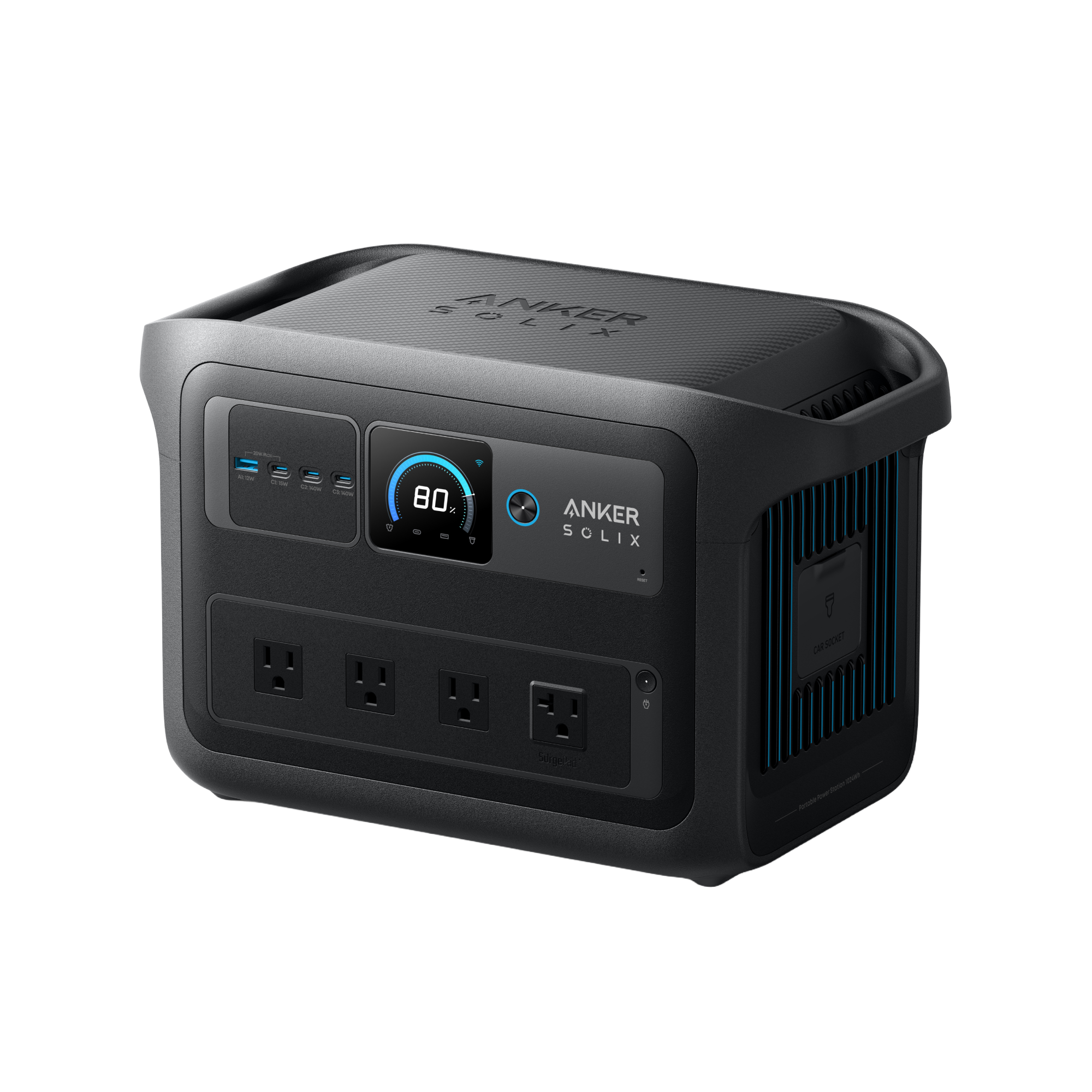
Anker SOLIX C1000X Gen 2
$699.99
$699.99 · direct from Anker
Last checked 16 days ago. Prices move — check before you buy.

Jackery HomePower 1000 Plus v2Pick
$669.00
$669.00 · direct from Jackery
Last checked 16 days ago. Prices move — check before you buy.
Prices may vary by retailer and are subject to change.