Head-to-head test
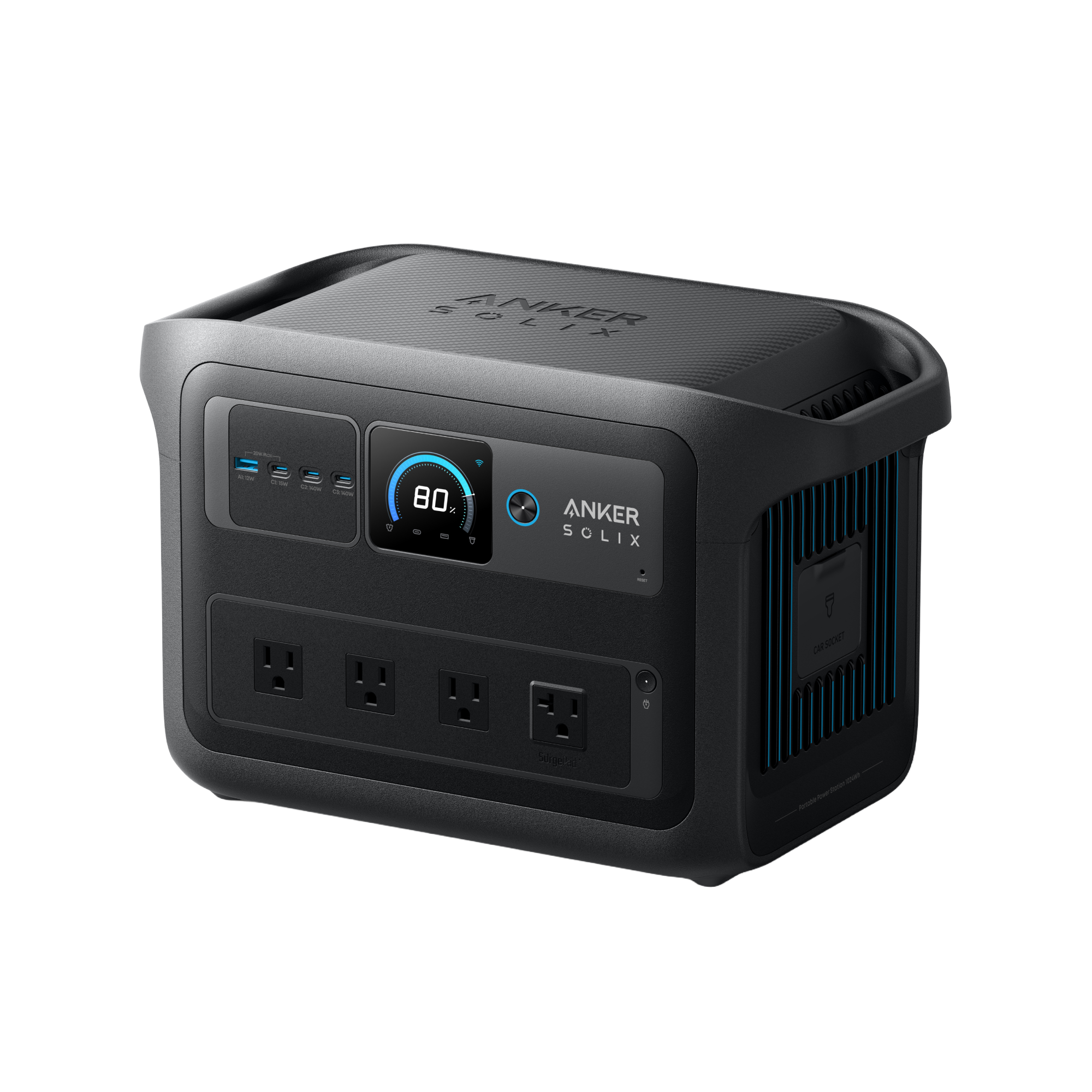
Anker SOLIX C1000X Gen 2 vs DJI Power 1000
The cheaper box is also the stronger one — the DJI undercuts the Anker on price while out-speccing it on output, surge, solar, and noise, so the Anker has to win on the one thing it does better: UPS speed.
Full profiles: Anker SOLIX C1000X Gen 2 → · DJI Power 1000 →

Written by Ian SchneiderUpdated
Solar & Off-Grid Tester, Station Arena Test Desk
Spec deltas
The DJI Power 1000 is the cheaper unit here at $699 against the Anker's $799.99, and it is also the more powerful one — 2,200W continuous to the Anker's 2,000W, a 4,400W surge ceiling to the Anker's 3,000W, and 800W of solar to 600W. That combination is unusual enough to state plainly: you pay less and get more inverter.
The Anker C1000X Gen 2 answers in two places. It switches over in a true line-interactive 10ms where the DJI is standby at 20msA7, and it is nearly four pounds lighter at 24.9 against 28.7. Both matter to specific buyers.
The DJI is also the quiet one, rated 23 dB and reviewed as whisper-quietB1, while Anker never published a noise figure for the C1000X Gen 2 at all. For most people this decision is short. For the one running a desktop on backup, it is not.
What the Numbers Reveal
Each conclusion stated first — the numbers behind it on one line, the full analysis below.
This is the one place the pricier Anker clearly out-engineers the DJI — true line-interactive switching versus standby — so a home-office or home-server buyer is the exact person who should pay the Anker premiumA7.
C1000X Gen 2 is line-interactive with a 10ms switchoverA7DJI Power 1000 is standby with a 20ms switchover10ms sits below the threshold where a desktop drops its session or a NAS risks a corrupt writeA7
Why it mattersIf a computer or NAS is riding this backup, take the Anker; if it is a fridge and phones, the gap never shows up.
continuous output
It is rare for the cheaper unit to also be the stronger one, but the DJI's 4,400W surge — twice its rating against the Anker's one-and-a-half — means it starts hard-surging motors the Anker might stall on, for less money.
DJI Power 1000 is $699 with 2,200W output and 4,400W surgeC1000X Gen 2 is $799.99 with 2,000W output and 3,000W surge
Why it mattersFor anyone running a fridge, a pump, or power tools, the DJI is both the cheaper and the more capable inverter.
solar input
You get 200W more solar input and near-silence, yet you cannot plug panels straight in — DJI routes solar through its own adapter — so the quietest, highest-solar box on the page is also the one with the most strings attached to actually charge from the sun.
DJI Power 1000 is rated 23 dB and reviewed as quieter than EcoFlow or BLUETTIB1it accepts 800W of solar to the Anker's 600WDJI has no built-in solar charge controller and needs a separate proprietary adapter
Why it mattersCampers who value silence will love the DJI; solar diehards should price the adapter in before they celebrate the 800W.
The specific dimensions that decide these two units — everything else is a tie.
Lifetime Value
Selected because: DJI is cheaper up front and per lifetime kWh while out-speccing the Anker.
Both are 1,024Wh, 4,000-cycle units delivering about 4,096 kWh, so the sticker decides it — and the DJI undercuts the Anker at $699 against $799.99, landing at $0.17 per lifetime kWh to the Anker's $0.20. The twist is that the cheaper unit is also the more powerful one, with more output and far more surge.
You rarely get to pay less for more inverter. The Anker has to win this matchup on qualities that do not show up in the price-per-kWh math, because it loses that math cleanly.
What the Specs Don't Tell You
Selected because: Surge favors DJI, UPS speed favors Anker, noise disclosure dings Anker.
Three flags fire and they do not all point the same way. The DJI takes the surge flag outright: 4,400W over a 2,200W rating is twice the headroom, against the Anker's 3,000W over 2,000W, so hard-starting loads are safer on the DJI.
But the UPS flag is the Anker's to claim — it transfers in a true line-interactive 10ms against the DJI's 20ms standbyA7, the gap that protects a desktop or NAS. And Anker's missing noise number is its own small ding, especially next to a DJI rated a genuinely quiet 23 dB.
Portability & Form Factor
Selected because: The Anker's tangible win: nearly four pounds lighter.
weight
The Anker's clearest physical win is the scale. At 24.9 pounds it is nearly four pounds lighter than the 28.7-pound DJI, which you feel every time it comes out of a trunk or up a flight of stairs.
If the unit moves with you often — campsite to campsite, house to car — the Anker is the easier haul. It is the one place the extra money buys something you can feel in your back.
Brand Trust
Selected because: DJI is a strong but two-year-old entrant with a proprietary-solar quirk.
DJI is the newcomer here, roughly two years into power stations after building its name on drones, and it cuts both ways. The upside is quiet, well-built hardware with drone-grade engineering; the caveat is a short track record and a real quirk — there is no built-in solar charge controller, so charging from panels means buying DJI's proprietary adapter.
Anker brings deeper category tenure and strong value, though SOLIX support has been sliding. For plug-and-play solar the Anker is less fussy; for quiet operation and raw capability, the DJI earns the look despite its youth.
Strengths & trade-offs
Anker SOLIX C1000X Gen 2
Strengths
- +Lighter by 3.8 lb
Trade-offs
- –Sealed capacity — the Power 1000 can add batteries to grow past 1,024Wh; this one can't.
DJI Power 1000
Strengths
- +Higher AC output
- +Faster solar charging
Trade-offs
- –No major technical downsides compared to rival.
Will It Power Your Gear?
Scenario math and per-appliance runtimes, modeled from the spec record.
Scenario verdicts
We ran the math on six real-world scenarios. Here's which unit survives your actual life.
SCN-01 · 2 nights · needs 2,100Wh
Weekend Camping
Two nights off-grid with essential comfort
Neither unit
Neither unit covers this scenario's 2,100Wh: the SOLIX C1000X Gen 2 comes up 1,230Wh short (about 41% covered), the Power 1000 1,230Wh (41%). Treat this as partial cover — enough for the essentials in it, not the whole list.
Battery budget usedlower = more headroom
LOAD Phone Charger 15W×6h · LED Lights 40W×8h · Box Fan 75W×14h · CPAP Machine 40W×16h
SCN-02 · 8 hours · needs 1,645Wh
8-Hour Blackout
Keep the essentials running through a night without power
Neither unit
Neither unit covers this scenario's 1,645Wh: the SOLIX C1000X Gen 2 comes up 775Wh short (about 53% covered), the Power 1000 775Wh (53%). Either gets you most of the way, so this is a scenario you plan around rather than one you should rule them out for.
Battery budget usedlower = more headroom
LOAD Fridge 150W×8h · Router + Modem 20W×8h · LED Lights (4 bulbs) 40W×6h · Phone Charger 15W×3h
SCN-03 · 8 hours · needs 320Wh
CPAP Overnight
Sleep therapy without interruption — the #1 medical use case
Either unit
A CPAP is about 40W for eight hours, so both of these cover the night at least twice over — capacity isn't the question here. What would separate them is fan noise, but SOLIX C1000X Gen 2 doesn't publish a figure, so there's nothing to hold it to. Only the SOLIX C1000X Gen 2 is still sold, so for a new buy it takes this by default; the Power 1000 is worth weighing on weight and fan noise only if you already own one.
Battery budget usedlower = more headroom
LOAD CPAP Machine 40W×8h
SCN-04 · 8 hours · needs 910Wh
Remote Workday
Full work day off-grid without power anxiety
Neither unit
This scenario needs 910Wh and neither unit quite finishes it. Both land within 5% of it — close enough that trimming one appliance, or accepting a shorter evening, gets you there on the day.
Battery budget usedlower = more headroom
LOAD Laptop 60W×8h · External Monitor 30W×8h · Router + Modem 20W×8h · Phone Charger 15W×2h
SCN-05 · 4 hours · needs 670Wh
Tailgate Party
Game day power for the crew
Either unit
Both handle game day easily. Since capacity isn't the deciding factor, weight is: at 24.9 lbs the SOLIX C1000X Gen 2 is the one you'll be glad you brought. Fan noise under load is worth a listen too — it's audible in the lulls between songs.
Battery budget usedlower = more headroom
LOAD Blender 400W×0.5h · LED TV (55") 80W×4h · Bluetooth Speaker 15W×4h · Phone Charger (×3) 45W×2h
SCN-06 · 24 hours · needs 4,685Wh
Van Life Daily
A full day of mobile living — the ultimate endurance test
Neither unit
Neither unit covers this scenario's 4,685Wh: the SOLIX C1000X Gen 2 comes up 3,815Wh short (about 19% covered), the Power 1000 3,815Wh (19%). This is well outside what either unit is for; the right answer here is a larger station, not a choice between these two.
Battery budget usedlower = more headroom
LOAD Mini-Fridge 150W×24h · Laptop 60W×4h · Phone Charger 15W×3h · LED Lights 40W×5h · Fan 75W×8h
The Load Test
RUNTIME = (Wh × 0.85) ÷ LOAD
None of the scenarios above exactly yours? Build it. Toggle what you'd plug in; both units are tested against the combined draw.
Essentials
Comfort & Convenience
High-Draw Appliances
Test duration
8h
Continuous draw
205W
Projected runtime
Dead heat — both run this 205W load for roughly 4.2h. Pick on price, weight, or ports.
Planning for more than this? Describe your whole setup and get it sized →
Modeled from the spec record — same math as the tables below. Methodology
Runtime by appliance
Real-world runtime estimates for common appliances, modeled at 85% inverter efficiency.¹
Essentials
The basics you need runningscale 0–58hComfort & Convenience
Makes off-grid life actually enjoyablescale 0–11.6hHigh-Draw Appliances
These reveal the real limitsscale 0–0.9h¹ Runtime = (capacity × 0.85) ÷ appliance watts. Within each group, all bars share one time scale (the group's longest runtime), so lengths are comparable across appliances; identical runtimes collapse into a single blue/orange bar. Actual runtime varies with battery age, temperature, and simultaneous loads — see methodology.
Conclusion
July 18, 2026
Verdict withdrawn: the Power 1000 is no longer sold
We picked the Power 1000, but it's been discontinued (DJI now points buyers to the Power 1000 V2). The SOLIX C1000X Gen 2 is still on sale, but that alone doesn't make it our pick. The comparison below is still accurate if you own either one.
Editor-assigned confidence, based on cited owner research and spec analysis.
Written by Ian Schneider, Solar & Off-Grid Tester · Station Arena Test Desk · Updated July 18, 2026
Black Friday · 38 days out
Price to beat:SOLIX C1000X Gen 2 $600
We have never seen it discounted, so any real cut would be a first.
Measured Data
Benchmark scores and the full spec record, side by side.
Benchmark scores
Full specifications
ᵈ Derived: price ÷ rated capacity. See the data behind our comparisons →
Comparison ToolAdd more power stations, side by sideOpen Tool →How these numbers are produced
Numeric verification
Every figure on this page traces to our spec database or arithmetic on it — no estimated numbers.
Owner claims
Statements about owner experience are cited to published reviews — see Sources & Research Notes below.
Runtime model
Runtime = (rated capacity × 0.85 inverter efficiency) ÷ device wattage. Solar recharge estimates assume panels deliver 70% of rated output. Cold weather, battery age, and stacked loads reduce real-world results.
Power Score
Computed from 14 published spec dimensions, weighted per use-case bench. Higher is better; a unit must meet a bench's minimum threshold to be rated.
See the full weight table and data sourcing on our methodology page →Class ranking (the star rating)
Each unit's star score is a category ranking, not customer reviews — no buyer opinions feed it. We score every station on size-independent quality (value, output, portability, endurance, ports, warranty, and more), then percentile-rank it against the other units in its capacity class, so a class-leading compact unit and a class-leading whole-home unit can both earn 5★. Here, SOLIX C1000X Gen 2 rates 4.0/5 (38th percentile of 27 Everyday-class units), and Power 1000 rates 4.3/5 (58th percentile of 27 Everyday-class units).
How the class ranking is computed →Test Notes & Caveats
Hidden gotchas and advantages we spotted that you won't find on the product page.
SOLIX C1000X Gen 2: Fixed Capacity
The SOLIX C1000X Gen 2 is sealed at 1,024Wh, and that is the ceiling. Normally the counterpoint would be that the Power 1000 can add expansion batteries, but that isn't a live option here: the Power 1000 is no longer sold, and DJI points owners to the Power 1000 V2. For a new purchase the expansion question doesn't arise between these two, so the SOLIX C1000X Gen 2's fixed 1,024Wh is simply what you get.
Surge headroom goes to the DJI
The DJI Power 1000 holds twice its continuous rating in surge (4,400W over 2,200W); the Anker holds one and a half times (3,000W over 2,000W). When a compressor or pump kicks, the DJI has more room to catch the spike — and it is the cheaper unit doing it.
The Anker's one clear win: UPS speed
The C1000X Gen 2 is line-interactive and transfers in about 10ms; the DJI is standby at around 20ms. For a fridge that gap is invisible, but for a desktop mid-save or a NAS mid-write it is the difference between nothing happening and a lost session. If sensitive electronics ride this backup, it is the reason to pay the Anker premium.
Warranty: No Difference
Both units carry the same 5-year warranty, so coverage isn't a tiebreaker here. The Power 1000's figure is a maximum rather than a guarantee — it depends on buying from DJI's own store, which is where the full five years is advertised.
SOLIX C1000X Gen 2: Noise Level Not Disclosed
The Power 1000 publishes its noise level (23dB); the SOLIX C1000X Gen 2 doesn't publish one. That isn't evidence the SOLIX C1000X Gen 2 is louder — it means there's no figure to hold it to, and no way to compare the two on this without hearing them. If you're buying for a bedroom, a CPAP, or an apartment, treat the Power 1000's 23dB as the only published number on the table — a spec-sheet figure, not a measurement — and look for hands-on reports of the SOLIX C1000X Gen 2 before deciding.
Ownership Analysis
What happens after you buy — true cost of ownership, brand trust, and growth potential.
Lifetime value
Service lifeyears at one full cycle per day
Lifetime energy delivered
Cost per delivered kWh
│ warranty ends · Reaching the cycle rating means ~80% capacity remains — degraded, not dead.
Analyst note
The Power 1000 is no longer sold, so there is no price to work its cost per kWh from, and this comparison doesn't quote one. On what you can actually buy today, the SOLIX C1000X Gen 2 works out at $0.15/kWh over its rated life. If you already own the Power 1000, the hardware comparison still holds: each delivers about 4,096 kWh over its rated life. One thing to know reading the table: both carry the same 4,000-cycle rating, so the lifetime rows are sticker price and capacity in disguise — the wear horizon is identical and decides nothing here.
Brand trust
Anker
Ecosystem
7-8 SOLIX portable power stations across C-series (compact) and F-series (flagship), plus the X1 home energy system
Support
US-based support. Historically known for incredible no-hassle replacements, but recent reports describe AI-driven support agents giving generic responses and complex return logistics for heavy units (hazmat shipping). The Anker brand reputation is still strong, but SOLIX-specific support quality is trending down.
Community
Moderate — active Reddit (r/Anker, r/AnkerSOLIXCommunity) and growing. Benefits from Anker's massive consumer electronics brand awareness.
App experience
Rated 4.5/5 iOS (~1,100 ratings) · 4.3/5 Android
Unique strength
Strong dollar-per-watt-hour value and a true line-interactive UPS that transfers in about 10ms — the detail that matters when a computer is on the other end.
Worth knowing
SOLIX-specific support has trended down from Anker's historically excellent standard, and firmware updates have quietly removed features.
DJI
Ecosystem
New entrant (2024) — five power station models to date: Power 500, Power 1000 (since superseded by the V2 but still sold), Power 1000 V2, Power 1000 Mini, Power 2000. Buying a "Power 1000" listing? Check which revision it actually ships.
Support
Leveraging DJI's established global support and repair center network from the drone business. Generally positive reputation inherited from drone operations, but limited power-station-specific track record.
Community
No dedicated power station community yet. Discussions happen within r/dji (~250K members, mostly drone users). Very small power-specific presence on Facebook and forums.
App experience
Rated 3.5/5 iOS and Android (DJI Home app ratings reflect entire DJI ecosystem including drones/cameras, not power-station-specific). Users report the on-device screen is more reliable than the app.
Unique strength
The quietest operation in the class and drone-grade build quality, with real-world output testers pushed past its rating without complaint.
Worth knowing
DJI is only about two years into power stations, and there is no built-in solar charge controller — charging from panels requires DJI's proprietary adapter.
Analyst note
DJI is the better hardware for the money if quiet and capability lead your list; Anker is the safer pick for backing up sensitive electronics and for plug-and-play solar. The deciding question is what sits on the other end of the outlet.
Growth path
SOLIX C1000X Gen 2
FIXED CAPACITYFixed at 1,024Wh, with no expansion — so size it for your needs up front rather than planning to add capacity later.
Accepts up to 600W of solar. Suitable for a 1-2 panel setup.
Adequate ports for most setups, but heavy users may want a power strip.
Power 1000
EXPANDABLESupports DJI expansion batteries, so you can add capacity later without replacing the base unit — useful if your needs may climb past 1,024Wh.
Accepts up to 800W of solar. Suitable for a 1-2 panel setup.
Adequate ports for most setups, but heavy users may want a power strip.
Expansion batteries are DJI-specific. You're investing in the DJI ecosystem.
Realistic full solar rechargeat 70% of rated panel output — see methodology
Analyst note
Growth only counts if you can still buy in, and the Power 1000 is no longer sold (DJI points owners to the Power 1000 V2). That leaves the SOLIX C1000X Gen 2: it is sealed at 1,024Wh, so buy the size that covers you now. The Power 1000's expandability still matters if you already own one, but it isn't a reason to pick it over the SOLIX C1000X Gen 2.
What Owners Report
Patterns from published owner reports and long-term reviews — every claim cited to its source below.
Anker SOLIX C1000X Gen 2
Where the C1000X Gen 2 earns its keep is the switchover. A reviewer clocks its 10ms UPS transfer as sitting below the line where a desktop drops its session or a NAS risks a corrupt writeA7, exactly the reassurance a home-office buyer wants. Buyers also note it lands nearly charged and tops up fast at the wallA4, and that the day-to-day details are right — a display bright enough to read outdoors and clearly labeled ports, though the handle is a two-hander over any real distanceA6.
The familiar caveats apply. Fan noise is near-silent under light load but climbs under heavy drawA1A2, and field data on this exact SKU is thin enough that most of it is paraphrased from retailer pages rather than long-term owners — directional, not definitive.
“Near-silent under light loads — rated 0 to 20dB under 200W — quiet enough for an office or bedroom when it's just sitting idle or trickle-charging.”
Sources
backuppowerhub.com
DJI Power 1000
The DJI's signature is silence. Reviewers describe it as whisper-quiet, quieter than comparable EcoFlow or BLUETTI units, with sound only creeping in past 1,500W and even then more a soft whoosh than a whineB1. One test pushed it to 2,400W, above its 2,200W rating, for a stretch with no shutoff and no dramaB2.
It also charges fast and quietly at the wall, and it is a favorite of drone pilots who top off DJI batteries while running the rest of their gearB3B4. The honest gap is tenure: it reviews extremely well, but DJI is new to power stations, so there is less long-haul ownership data than on the incumbents.
“Whisper-quiet operation — one of the quietest power stations in its class, nearly silent under normal loads; sound only becomes noticeable past 1,500W, and even then it's a soft whoosh rather than the high-pitched whirring you'd get from BLUETTI or EcoFlow.”
Sources
thesolarlab.com · trailandkale.com · offgridbenchmark.com · superfashion.us · dronexl.co
Sources & Research Notes
Every owner claim in this report is traceable to a published source. The bracketed references above resolve here.
Recurring owner themes
- Fans are near-silent at light loads but become loud enough to disturb sleep once output or AC charge current climbs. [SOLIX C1000X Gen 2 · 2 entries]
- Losing the external expansion-battery option available on the original C1000X is the most consistent point of disappointment, raised by both owners and the dedicated review. [SOLIX C1000X Gen 2 · 2 entries]
- Fast, reliable AC recharge and an out-of-box-ready charge level are the headline praise, though the full 49-minute figure requires manually enabling UltraFlash in the app, and a minority of owners mention occasional charging hiccups. [SOLIX C1000X Gen 2 · 3 entries]
- Standout quiet operation (quieter than EcoFlow/BLUETTI), robust real-world output above its rating, and appeal to drone pilots and campers are the consistent themes. [Power 1000 · 3 entries]
- A1
“Under heavy load the fans kick on and get loud enough that you wouldn't want it running in the room while sleeping.”
Home Depot — Anker SOLIX C1000X Gen2 (2,000W/1,024Wh) customer reviews · unknown · [negative]
- A2
“Near-silent under light loads — rated 0 to 20dB under 200W — quiet enough for an office or bedroom when it's just sitting idle or trickle-charging.”
backuppowerhub.com — Anker SOLIX C1000X Gen 2 Review (Dark Grey Flagship Refreshed) · 2026 · [positive]
- A4
“Arrived nearly fully charged and was easy to use right out of the box; recharge from empty to full at the wall is genuinely fast, which matters when you only get a short window of power.”
Best Buy — Anker SOLIX C1000X Gen2 (SOLIX-65-PS) customer reviews · unknown · [positive]
- A6
“Display is bright enough to read outdoors and ports are clearly labeled so cables stay untangled; the carry handle is fine for short moves but you'll want two hands over any real distance.”
Best Buy — Anker SOLIX C1000X Gen2 (SOLIX-65-PS) customer reviews · unknown · [positive]
- A7
“10ms UPS switchover — reviewer notes that's below the threshold where a desktop PC loses its session or a NAS drive risks corruption.”
backuppowerhub.com — Anker SOLIX C1000X Gen 2 Review · 2026 · [positive]
- B1
“Whisper-quiet operation — one of the quietest power stations in its class, nearly silent under normal loads; sound only becomes noticeable past 1,500W, and even then it's a soft whoosh rather than the high-pitched whirring you'd get from BLUETTI or EcoFlow.”
thesolarlab.com / trailandkale.com — DJI Power 1000 review · 2026 · [positive]
- B2
“Tested at 2,400W — slightly above its 2,200W output rating — for 20 minutes and handled it without loud noise or automatic shut-offs.”
offgridbenchmark.com / superfashion.us — DJI Power 1000 review · 2026 · [positive]
- B3
“AC charging takes about 70 minutes from 0% to 100% (about 50 minutes to 80%), and during full-speed charging the fan barely makes a sound.”
thesolarlab.com — DJI Power 1000 review · 2026 · [positive]
- B4
“Over a week-long camping trip it powered a 45W compressor fridge, phones, laptops, and LED lights; it's also a favorite of drone pilots for fast-charging DJI batteries while running other devices.”
offgridbenchmark.com / dronexl.co — DJI Power 1000 review · 2026 · [positive]
Research compiled July 18, 2026.
Who Should Buy Which
Buy the SOLIX C1000X Gen 2 if you…
- →The home-office or home-server buyer. Its true line-interactive 10ms switchover is a real step ahead of the DJI's 20ms standbyA7, the margin that keeps a desktop or NAS from noticing the grid dropped.
- →The person who carries the unit constantly. At 24.9 pounds it is nearly four pounds lighter than the DJI, which adds up over a weekend of moving it around.
Buy the Power 1000 if you…
- →The quiet-camp or bedroom buyer. Rated 23 dB and reviewed as whisper-quietB1, it is the unit you forget is running — and it costs $100 less than the Anker.
- →Anyone starting hard-surging gear on a budget. The 4,400W surge over a 2,200W rating gives fridges, pumps, and tools far more headroom than the Anker's 3,000W, for less money.
If neither fits
If you charge mainly off solar and want plug-and-play, weigh the DJI's proprietary-adapter requirement carefully. And if you need a full day of home backup, neither 1,024Wh unit is enough alone — that is a job for the 2,000Wh-plus class, whichever brand you prefer.
The Bottom Line
Take the DJI Power 1000 unless you are protecting a computer. It costs $100 less than the C1000X Gen 2 and still brings more output, a 4,400W surge ceiling, more solar headroom, and near-silent operation at 23 dBB1 — the unusual case where the cheaper box is also the stronger one.
The Anker's premium buys two specific things: a true line-interactive 10ms UPS that a desktop or NAS will thank you forA7, and nearly four fewer pounds to carry. If that is your buyer, pay it. If it is not, and for most camp, tailgate, and outage use it is not, the quieter and cheaper DJI is the smarter pick — just budget for its proprietary solar adapter.
Frequently Asked Questions
Answers drawn from the spec record and cited owner research.
Is the DJI Power 1000 or the Anker C1000X Gen 2 the better buy?
For most buyers the DJI, and it costs less doing it — $699 against $799.99, with more output, a much bigger surge ceiling, more solar input, and genuinely quiet operation. The Anker's case is narrower but real: a faster line-interactive UPS and a lighter body. Pick the Anker if you are backing up a computer; pick the DJI for nearly everything else.
Which has the faster UPS switchover?
The Anker. It is line-interactive at 10ms, while the DJI is standby at 20ms. For a fridge or lights the difference is invisible, but for a desktop mid-save or a NAS mid-write, the Anker's faster transfer is the one less likely to drop the session.
Does the DJI Power 1000 charge from solar like a normal power station?
Not quite. The DJI accepts 800W of solar on paper, more than the Anker's 600W, but it has no built-in solar charge controller and needs DJI's proprietary adapter to connect panels. If you want to plug standard panels straight in, the Anker is the simpler path despite its lower input.
Why is the cheaper DJI rated higher than the Anker?
Because it out-specs the Anker on most axes the score weighs — more output, more surge, more solar, quieter — while costing less. The Anker claws back points on UPS speed and weight, but not enough to close the gap. It is the rare case where the value pick is also the performance pick.
Brand matchup
Anker SOLIX vs DJI: measured across every matchup →Where to buy
Anker SOLIX C1000X Gen 2
$699.99
$699.99 · direct from Anker
Last checked 16 days ago. Prices move — check before you buy.

DJI Power 1000
Superseded — buy the V2
Prices may vary by retailer and are subject to change.