Head-to-head test
Anker 535 PowerHouse vs BLUETTI AC200MAX
These two cost the same 59 cents a watt-hour, so this was never cheap-versus-premium; it's one question: do your loads fit a box you lift with one hand, or do you need the one that takes two hands and actually finishes a blackout?
Full profiles: Anker 535 PowerHouse → · BLUETTI AC200MAX →

Written by Ian SchneiderUpdated
Solar & Off-Grid Tester, Station Arena Test Desk
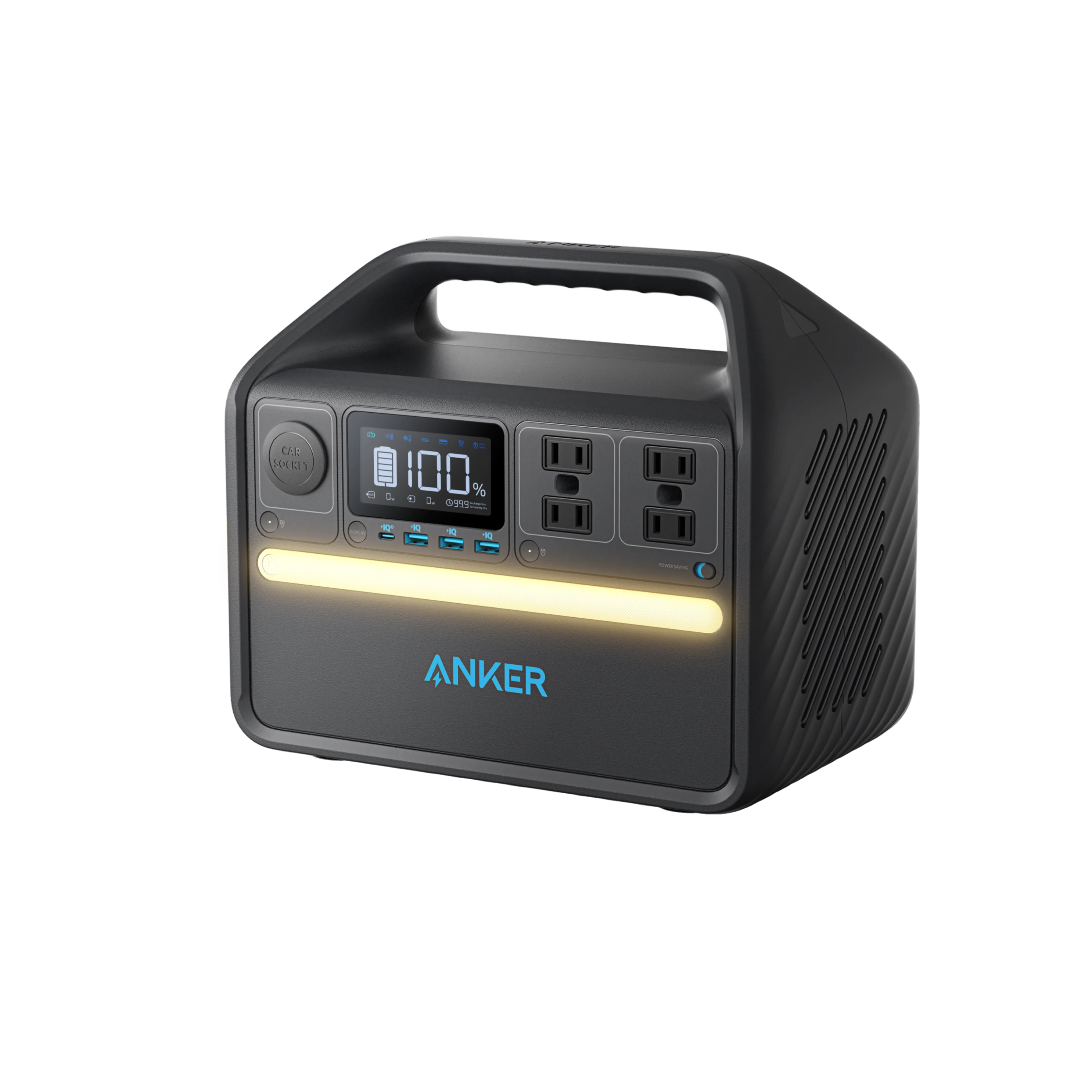
$299.99 · direct from Anker
Last checked 1 day ago. Prices move — check before you buy.

$1,199.00 · direct from BLUETTI
Last checked 1 day ago. Prices move — check before you buy.
Spec deltas
These two cost exactly the same per watt-hour, about 59 cents, which quietly removes the only reason most people set a $300 unit beside a $1,199 one. The Anker 535 PowerHouse isn't the budget choice and the BLUETTI AC200MAX isn't the premium one; they are the same value poured into 512Wh and 2,048Wh. So forget which is the better deal. The only question that decides this is how much power you actually need.
At 512Wh the 535 delivers about 435 usable watt-hours after the standard 15% usable-energy derate, enough to run a CPAP all night with reserve, or keep phones, a laptop, and a few lights alive through a weekend. Ask it to carry a full eight-hour blackout and it taps out around the quarter mark. The AC200MAX's 1,741 usable watt-hours clear that blackout and three more of the six scenarios we model; the 535 clears exactly one, the CPAP night.
So the AC200MAX is the more capable machine and, stretched over its rated life, even the marginally cheaper one to own. But it also weighs nearly four times what the 535 does, and if your loads honestly fit under the smaller unit's ceiling, you'd be paying four times the price to haul around headroom you'll never touch. Buy the AC200MAX if you need a power station; buy the 535 if what you need is a light one you can lift with one hand.
What the Numbers Reveal
Each conclusion stated first — the numbers behind it on one line, the full analysis below.
cost / lifetime kWh
Run each unit out to its rated life and the advantage quietly flips: the AC200MAX comes to 17 cents per lifetime kilowatt-hour against the 535's 20, because more capacity across more cycles spreads the purchase price over more energy. Per unit of power delivered, the big box is the cheaper one to own.
Anker 535: $300 for 512Wh, about $0.59 per watt-hourBLUETTI AC200MAX: $1,199 for 2,048Wh, about $0.59 per watt-hourLifetime cost: $0.20/kWh for the 535 (512Wh x 3,000 cycles) versus $0.17/kWh for the AC200MAX (2,048Wh x 3,500 cycles)
Why it mattersAnyone deciding on sticker price alone is answering the wrong question; both are priced identically for what they hold, so choose on how many watt-hours you'll use, not what the tag reads.
Capacity
Of the six loads we model the 535 finishes exactly one, the 320Wh CPAP night, while the AC200MAX finishes four, because it simply has the room the smaller unit never had. Where the load climbs past the 535's ceiling the money you saved is irrelevant; the unit just stops.
535 usable energy: about 435Wh (512Wh x 0.85 derate)8-Hour Blackout needs 1,645Wh; Remote Workday needs 910Wh; CPAP Overnight needs 320WhAC200MAX usable energy: about 1,741Wh (2,048Wh x 0.85)
Why it mattersIf your real draw sits under that ceiling (CPAP, devices, a laptop) take the 535 and the savings; if it doesn't, the AC200MAX isn't merely better, it's the only one that works.
weight
Add the warranty and the small unit's case sharpens: you carry it one-handed and Anker backs it a year longer, five to four. For a buyer whose power needs travel, from campsite to tailgate to a different room each week, capacity you have to wheel around is a cost, not a feature.
535 weight: 16.7 lbsAC200MAX weight: 61.9 lbsWarranty: 535 covered 5 years, AC200MAX 4 years
Why it mattersThe day-tripper, the tailgater, and the phones-and-laptop camper should take the 16.7-lb box and never think about the other one.
solar input
Recharge speed is the spec an outage actually tests, and the 535's 120W ceiling is realistically lower still, since panels rarely hit their rating and land nearer 60-75W in real sunA4. Across a cloudy multi-day blackout it may not fully refill between nights, while the AC200MAX banks a full charge in a morning.
AC200MAX solar input: 900W535 solar input: 120W, about 4.3 hours to refill 512Wh at that ceilingAC200MAX refill: 2,048Wh divided by 900W is a little over two hours of strong sun
Why it mattersIf solar is your resupply rather than a top-up, the 535's input is the bottleneck; plan on a generator or a wall outlet, or buy the AC200MAX.
The specific dimensions that decide these two units — everything else is a tie.
Lifetime Value
Selected because: Both land at the same 59 cents per watt-hour, so this isn't a value contest; it's the fact that reframes the whole decision as a sizing question.
cost / lifetime kWh
The fact that settles most of the argument is the one that's identical: the price per watt-hour is the same on both units. The 535 saves you about $899 at the register and nothing per unit of energy stored; same rate, a smaller tank. Look further out and it even tips the other way, because the AC200MAX delivers more total energy over its rated life, it spreads its purchase price thinner and ends up a hair cheaper per lifetime kilowatt-hour. Neither is the bargain, and that is the point. It frees you to stop weighing price and start weighing size.
Your Life, Your Pick
Selected because: The 535 clears one of our six modeled loads and the AC200MAX clears four, the clearest read on how far apart these two really are.
Watch where the 535 falls out. Of the six loads we model it clears exactly one, the 320Wh CPAP night, and taps out on the rest, because there is simply no more in the tank. The AC200MAX clears four of the six and misses a fifth, the 2,100Wh camping weekend, by just 359Wh: close enough that a short session on its solar would erase the gap.
The two nobody wins, the camping weekend and a 4,685Wh van-life day, aren't a knock on either unit. They're the tell that you'd want something bigger than both. Read together, the scorecard says the quiet part out loud: the 535 is a light-duty companion that happens to share a page with a power station.
Portability & Form Factor
Selected because: 16.7 lbs against 61.9 is the axis that wins the argument back for the smaller unit.
weight
This is where the 535 wins the argument back. It is a one-hand, grab-it-and-go lift, the kind of thing you carry to the campsite without a second thought. The AC200MAX is the two-hands, bend-the-knees, set-it-down-and-breathe kind, a unit that wants flat ground and a plan. If your power needs move around at all, tailgates, day trips, a different room each week, the smaller box stops being a compromise and becomes the feature. All that extra capacity is dead weight the day it lives in a closet because it is too heavy to bother hauling out.
Growth Path
Selected because: One unit is sealed at 512Wh and the other expands toward home backup, but only one kind of buyer should care.
solar input
The AC200MAX has somewhere to go; the 535 does not. It accepts BLUETTI expansion batteries, so a 2,048Wh start can climb toward partial-home backup without throwing away the base unit. The 535 is sealed at 512Wh, and what you buy is the ceiling. Here is the honest asterisk, though: at 512Wh you are unlikely to be in expansion territory in the first place, so for most buyers of the small unit the sealed design costs nothing. Expandability only earns its keep if you can genuinely see your needs climbing, and if you can, you probably should not be shopping at 512Wh at all.
What the Specs Don't Tell You
Selected because: Solar speed, app control, noise disclosure, and warranty length: the smaller print, where each unit gives a little back.
rated cycles
Three quick wins for the AC200MAX, then one point back for the 535. The bigger unit charges from solar far faster, runs from a phone app the 535 simply doesn't have, and is the only one of the two to publish a fan-noise figure at all. Now the point back, worth saying out loud: the 535 carries the longer warranty, five years to four. That won't swing a decision this lopsided, but on a page where the big box wins most of the rooms, the little one quietly owns the question of who stands behind it longer.
Strengths & trade-offs
Anker 535 PowerHouse
Strengths
- +Costs $899 less
- +Lighter by 45.2 lb
- +Longer warranty
Trade-offs
- –Weaker inverter (-1,700W) limits appliance compatibility.
- –Lacks smartphone app control for remote monitoring.
- –Sealed capacity — the AC200MAX can add batteries to grow past 512Wh; this one can't.
BLUETTI AC200MAX
Strengths
- +Larger battery capacity
- +Higher AC output
- +Faster solar charging
Trade-offs
- –Substantially more expensive (+$899) than the 535 PowerHouse.
- –Significantly heavier (+45.2 lbs), making it harder to move.
Will It Power Your Gear?
Scenario math and per-appliance runtimes, modeled from the spec record.
Scenario verdicts
We ran the math on six real-world scenarios. Here's which unit survives your actual life.
SCN-01 · 2 nights · needs 2,100Wh
Weekend Camping
Two nights off-grid with essential comfort
Neither unit
Neither unit covers this scenario's 2,100Wh: the 535 PowerHouse comes up 1,665Wh short (about 21% covered), the AC200MAX 359Wh (83%). This is well outside what either unit is for; the right answer here is a larger station, not a choice between these two.
Battery budget usedlower = more headroom
LOAD Phone Charger 15W×6h · LED Lights 40W×8h · Box Fan 75W×14h · CPAP Machine 40W×16h
SCN-02 · 8 hours · needs 1,645Wh
8-Hour Blackout
Keep the essentials running through a night without power
AC200MAX
The AC200MAX finishes an eight-hour blackout, but read the margin before you celebrate: 96Wh left over is a thin cushion, so this isn't the scenario to also plug in a space heater. The 535 covers about a quarter of it before it's done, not a shortfall you make up, just the wrong tool for a blackout.
Battery budget usedlower = more headroom
LOAD Fridge 150W×8h · Router + Modem 20W×8h · LED Lights (4 bulbs) 40W×6h · Phone Charger 15W×3h
SCN-03 · 8 hours · needs 320Wh
CPAP Overnight
Sleep therapy without interruption — the #1 medical use case
Either unit
Both coast through a 320Wh CPAP night, the 535 with about 115Wh in reserve and the AC200MAX with far more, so capacity settles nothing here. What settles it is the fan 18 inches from your head at 3 a.m., and only the AC200MAX publishes a number for it; a 40W CPAP draw is exactly the low-load regime where that figure is most trustworthy. The 535 lists none, so audition it before you count on quiet.
Battery budget usedlower = more headroom
LOAD CPAP Machine 40W×8h
SCN-04 · 8 hours · needs 910Wh
Remote Workday
Full work day off-grid without power anxiety
AC200MAX
The 535 PowerHouse doesn't finish — 435Wh usable against the 910Wh this needs leaves it 475Wh short, about 48% of the scenario covered. The AC200MAX covers it with 831Wh to spare.
Battery budget usedlower = more headroom
LOAD Laptop 60W×8h · External Monitor 30W×8h · Router + Modem 20W×8h · Phone Charger 15W×2h
SCN-05 · 4 hours · needs 670Wh
Tailgate Party
Game day power for the crew
AC200MAX
The 535 PowerHouse doesn't finish — 435Wh usable against the 670Wh this needs leaves it 235Wh short, about 65% of the scenario covered. The AC200MAX covers it with 1,071Wh to spare.
Battery budget usedlower = more headroom
LOAD Blender 400W×0.5h · LED TV (55") 80W×4h · Bluetooth Speaker 15W×4h · Phone Charger (×3) 45W×2h
SCN-06 · 24 hours · needs 4,685Wh
Van Life Daily
A full day of mobile living — the ultimate endurance test
Neither unit
Neither unit covers this scenario's 4,685Wh: the 535 PowerHouse comes up 4,250Wh short (about 9% covered), the AC200MAX 2,944Wh (37%). This is well outside what either unit is for; the right answer here is a larger station, not a choice between these two.
Battery budget usedlower = more headroom
LOAD Mini-Fridge 150W×24h · Laptop 60W×4h · Phone Charger 15W×3h · LED Lights 40W×5h · Fan 75W×8h
The Load Test
RUNTIME = (Wh × 0.85) ÷ LOAD
None of the scenarios above exactly yours? Build it. Toggle what you'd plug in; both units are tested against the combined draw.
Essentials
Comfort & Convenience
High-Draw Appliances
Test duration
8h
Continuous draw
205W
Projected runtime
For this load: AC200MAX runs 8.5h vs 2.1h.
$1,199 list · direct from BLUETTI
Modeled from the spec record — same math as the tables below. Methodology
Runtime by appliance
Real-world runtime estimates for common appliances, modeled at 85% inverter efficiency.¹
Essentials
The basics you need runningscale 0–116.1hComfort & Convenience
Makes off-grid life actually enjoyablescale 0–23.2hHigh-Draw Appliances
These reveal the real limitsscale 0–1.7h¹ Runtime = (capacity × 0.85) ÷ appliance watts. Within each group, all bars share one time scale (the group's longest runtime), so lengths are comparable across appliances; identical runtimes collapse into a single blue/orange bar. Actual runtime varies with battery age, temperature, and simultaneous loads — see methodology.
Conclusion
August 30, 2026
Verdict: the AC200MAX, on Power Score margin
Buy the AC200MAX if your loads climb past the 535's usable ceiling: a blackout with the fridge, a full remote workday, a tailgate that outlasts the game. That's where the 535 simply stops, and no price gap fixes 'not enough.' The AC200MAX clears four of our six scenarios to the 535's one, refills from solar faster despite holding four times the energy, and even costs a hair less per lifetime kilowatt-hour. The catch is real and worth stating up front: about 62 pounds to the 535's 16.7, and a year less warranty than the 535's five. If your needs genuinely live below that ceiling, meaning CPAP, phones, a laptop, a weekend of lights, none of that matters and the 535 is the smarter $300 at a quarter of the weight.
Editor-assigned confidence, based on cited owner research and spec analysis.
List prices as of August 30, 2026. The links below open Anker's and BLUETTI's current prices.
$1,199.00 · direct from BLUETTI
Last checked 1 day ago. Prices move — check before you buy.
or check the 535 PowerHouse price$299.99 list
Written by Ian Schneider, Solar & Off-Grid Tester · Station Arena Test Desk · Updated August 30, 2026
Measured Data
Benchmark scores and the full spec record, side by side.
Benchmark scores
Not rated for both units (minimum threshold unmet): RV Living, Home Backup, Solar Generator, Food Truck, Camping.
Full specifications
ᵈ Derived: price ÷ rated capacity. See the data behind our comparisons →
Comparison ToolAdd more power stations, side by sideOpen Tool →How these numbers are produced
Numeric verification
Every figure on this page traces to our spec database or arithmetic on it — no estimated numbers.
Owner claims
Statements about owner experience are cited to published reviews — see Sources & Research Notes below.
Runtime model
Runtime = (rated capacity × 0.85 inverter efficiency) ÷ device wattage. Solar recharge estimates assume panels deliver 70% of rated output. Cold weather, battery age, and stacked loads reduce real-world results.
Power Score
Computed from 14 published spec dimensions, weighted per use-case bench. Higher is better; a unit must meet a bench's minimum threshold to be rated.
See the full weight table and data sourcing on our methodology page →Class ranking (the star rating)
Each unit's star score is a category ranking, not customer reviews — no buyer opinions feed it. We score every station on size-independent quality (value, output, portability, endurance, ports, warranty, and more), then percentile-rank it against the other units in its capacity class, so a class-leading compact unit and a class-leading whole-home unit can both earn 5★. Here, 535 PowerHouse rates 3.7/5 (21st percentile of 20 Compact-class units), and AC200MAX rates 3.4/5 (4th percentile of 26 Large-class units).
How the class ranking is computed →Test Notes & Caveats
Hidden gotchas and advantages we spotted that you won't find on the product page.
AC200MAX: 61.9 lbs Is a Commitment
At 61.9 lbs, this is manageable but not fun to move. That's heavier than a large checked suitcase. How much it costs you depends on whether it rolls — wheels and a telescoping handle change the job completely at this weight, and our spec record doesn't track them, so look at the product photos before you plan on carrying it from the car.
AC200MAX: 50dB Published
50dB is about as loud as moderate rainfall. It is BLUETTI's own rating rather than a reading on a shared bench — makers differ on whether they quote a best case or a figure under load, so treat it as a starting point rather than what you would hear at a bedside. For most people, fan noise around 45dB and up is where sleep starts to suffer.
535 PowerHouse: Solar Recharge Takes 4.3h+
At its 120W rated solar ceiling, refilling the full 512Wh takes about 4.3 hours of sun — as a floor, since the rated figure assumes ideal panel angle and clear sky, and real days deliver less. Not practical as the primary charge source for daily off-grid use; treat solar as a top-up and plan on a wall outlet or generator.
535 PowerHouse: No App Control
Without app control, you have to physically walk to the 535 PowerHouse to check battery level, adjust settings, or monitor power draw. The AC200MAX lets you do all that from your phone, including getting low-battery alerts.
Sealed, but probably fine
The 535 is fixed at 512Wh with no way to add more, while the AC200MAX takes expansion batteries and can grow toward home-backup territory. The nuance: at 512Wh, most buyers never approach the ceiling, so the sealed design rarely bites. But if you can picture your needs climbing, that expandability is a genuine reason to lean AC200MAX.
Warranty: 5 Years vs 4
The 535 PowerHouse is covered for 5 years against the AC200MAX's 4 years. An underrated factor if you're keeping this unit for years.
The 535's fan is an unknown
Anker publishes no noise figure for the 535, so there's nothing to hold it to. That's not proof it's loud, just an absence of a number. The AC200MAX at least lists one. If this is going in a bedroom or next to a CPAP, that missing figure is a reason to hear the 535 in person before you commit.
Full record above — the Test Desk pick is the AC200MAX.
Check AC200MAX price →or check the 535 PowerHouse priceOwnership Analysis
What happens after you buy — true cost of ownership, brand trust, and growth potential.
Lifetime value
Service lifeyears at one full cycle per day
Lifetime energy delivered
Cost per delivered kWh
│ warranty ends · Reaching the cycle rating means ~80% capacity remains — degraded, not dead.
Analyst note
The 535 PowerHouse is cheaper to buy, but the AC200MAX is cheaper to own. At $0.17/kWh over its lifetime vs $0.2/kWh, the AC200MAX's higher cycle life and capacity make each dollar go further over the years.
Brand trust
Anker
Ecosystem
7-8 SOLIX portable power stations across C-series (compact) and F-series (flagship), plus the X1 home energy system
Support
US-based support. Historically known for incredible no-hassle replacements, but recent reports describe AI-driven support agents giving generic responses and complex return logistics for heavy units (hazmat shipping). The Anker brand reputation is still strong, but SOLIX-specific support quality is trending down.
Community
Moderate — active Reddit (r/Anker, r/AnkerSOLIXCommunity) and growing. Benefits from Anker's massive consumer electronics brand awareness.
App experience
Rated 4.5/5 iOS (~1,100 ratings) · 4.3/5 Android
Unique strength
Parent brand trust from Anker's consumer electronics dominance. InfiniPower technology for long cycle life. Strong $/Wh value in the mid-size and larger units — the S2000, F2600 and C1000 are among the better buys per watt-hour in the catalog.
Worth knowing
Anker's support was historically its calling card, and its SOLIX-specific service has slipped from that standard, with more AI-driven first responses and more friction. One saving grace specific to the 535: it's light. If a heavy unit ever needs to go back, hazmat return shipping is a saga; a 16.7-lb box is a far easier thing to send back if it comes to that.
BLUETTI
Ecosystem
One of the broadest lineups — 15-20+ models from budget (AC2A) to flagship portable (Apex 300, 2764.8Wh). Includes specialized products: vehicle solar hubs, sodium-ion cold-weather units, and balcony storage systems.
Support
BLUETTI's support is the most inconsistent in the category: email-based, subject to timezone delays, and hit-or-miss, with outcomes that swing from quick, efficient help to weeks of runaround or an offer of a discount instead of a repair. Buying direct from BLUETTI tends to go better than through a reseller. At $1,199, factor the chance of a slow support experience into the decision.
Community
Active and growing — Reddit r/bluetti has a dedicated community. Second-largest after EcoFlow in engagement.
App experience
Rated 4.5/5 iOS and Android — tied for best app experience in the category. V3.0 UI redesign was well-received.
Unique strength
Among the best capacity-to-price ratios available — several Elite and Apex units are the lowest $/Wh in the catalog. Widest product diversity including industry-firsts like sodium-ion cold-weather units and dual solar+alternator vehicle hubs. LFP across the rest of the range, though rated cycle life spans 2,500 (EB3A) to 6,000, and it varies WITHIN the Elite range rather than tracking it — the Elite 300 and Elite 200 V2 are rated 6,000 while the Elite 30 V2, Elite 10 Mini, Elite 320 and Elite 400 are rated 3,000+ and the Elite 100 V2 4,000+, so check the specific model. Dual-voltage (120V/240V) in flagships.
Worth knowing
Customer support inconsistency is the #1 risk factor. Older/discontinued units may become unrepairable — no spare parts policy for some models. Some reports of erratic communication from support agents.
Analyst note
Two different support bets. Anker's is a fading strength on an easy-to-ship unit; BLUETTI's is a known weak spot on a heavy one. Neither should decide this matchup, capacity and portability settle it long before support does, but if you want a clean warranty experience, the lighter unit is also the lower-stakes one to ever return.
Growth path
535 PowerHouse
FIXED CAPACITYFixed at 512Wh, with no expansion — so size it for your needs up front rather than planning to add capacity later.
Accepts up to 120W of solar. Limited to a single portable panel.
Adequate ports for most setups, but heavy users may want a power strip.
AC200MAX
EXPANDABLESupports BLUETTI expansion batteries, so you can add capacity later without replacing the base unit — useful if your needs may climb past 2,048Wh.
Accepts up to 900W of solar. Suitable for a 1-2 panel setup.
Generous port selection supports complex multi-device setups.
Expansion batteries are BLUETTI-specific. You're investing in the BLUETTI ecosystem.
Realistic full solar rechargeat 70% of rated panel output — see methodology
Analyst note
The 535 PowerHouse is sealed at 512Wh, which is fine if that covers you. The AC200MAX starts at 2,048Wh and can grow beyond it with BLUETTI expansion batteries — real headroom the 535 PowerHouse doesn't have if your needs climb toward partial-home backup.
What Owners Report
Patterns from published owner reports and long-term reviews — every claim cited to its source below.
Anker 535 PowerHouse
Field data on the 535 comes mostly from reviewers rather than long-term ownersA0, and what exists is consistent. It is 512Wh of LFP rated past 3,000 cycles, a claimed ten-year lifespan, and a 5-year warrantyA1, in a compact body, about 16.7 lbs, with four AC outlets, three USB-A, a USB-C, and a car socketA2. One bench review clocked 89% round-trip efficiency and noted the unit stayed cool and steady at its full 500W outputA3, encouraging for a small box that will spend its life topping up and drawing down. The one real knock is solar: input caps at 120W and realistically lands closer to 60-75W, so panel charging is slowA4.
“512Wh capacity with 500W output on LiFePO4 cells rated for 3,000+ cycles and a 10-year lifespan, backed by a 5-year warranty.”
Sources
ankersolix.com · trustedreviews.com · macrumors.com · batteryessence.com
BLUETTI AC200MAX
The AC200MAX is heavily documented, and the through-line is generational: it is the older design BLUETTI built the AC200L to improve onB0B3. Two complaints recur. Its fans run noticeably louder than the newer unit, measured well into the 50s dBA under load at a meterB1, and its AC charging is slow, roughly two hours to reach most of a charge where the AC200L does it in well under oneB2. None of that makes it a bad station. It remains a well-liked, genuinely expandable unit on LFP cells rated around 3,500 cycles, about nine years of use, under a 4-year warrantyB4. You are simply buying the previous chapter.
“The AC200MAX was a popular mid-range unit with solid capacity and an expandable battery, but its frustrations included slow charging, aging LFP chemistry, and an app that felt like an afterthought — the AC200L addresses nearly every one of these.”
Sources
diysolarforum.com · offgridbenchmark.com · firstquadcopter.com · bluettipower.eu · techradar.com
Sources & Research Notes
Every owner claim in this report is traceable to a published source. The bracketed references above resolve here.
Recurring owner themes
- Durable LFP (3,000+ cycles, 5-yr warranty), efficient, and compact for weekend camping; slow solar input is the caveat. [535 PowerHouse · 2 entries]
- The AC200MAX is the older generation — louder, slower to charge, weaker app — that the AC200L was built to improve on. [AC200MAX · 3 entries]
- A1
“512Wh capacity with 500W output on LiFePO4 cells rated for 3,000+ cycles and a 10-year lifespan, backed by a 5-year warranty.”
ankersolix.com / trustedreviews.com — 535 PowerHouse review · 2026 · [positive]
- A2
“Weighs 16.5 lbs and is compact for a 512Wh unit, with 4 AC ports, 3 USB-A, a USB-C, and a car outlet.”
macrumors.com / batteryessence.com — 535 PowerHouse review · 2026 · [positive]
- A3
“Demonstrated 89% round-trip efficiency and stayed stable and cool while delivering its full 500W AC output.”
batteryessence.com — 535 PowerHouse review · 2026 · [positive]
- A4
“AC charging to 80% takes about 2.5 hours; solar input caps at 120W (realistically 60-75W), so panel charging is slow.”
batteryessence.com — 535 PowerHouse review · 2026 · [mixed]
- B1
“The AC200MAX's fans are noticeably louder than the newer AC200L — measured well into the 50s dBA under load at 1 meter, versus the AC200L staying barely audible under moderate load.”
diysolarforum.com / offgridbenchmark.com — AC200MAX vs AC200L noise · 2026 · [negative]
- B2
“Slow AC charging is a common frustration — the AC200MAX takes roughly two hours to reach most of a charge, versus well under an hour for the AC200L.”
offgridbenchmark.com / firstquadcopter.com — AC200L vs AC200MAX · 2026 · [negative]
- B3
“The AC200MAX was a popular mid-range unit with solid capacity and an expandable battery, but its frustrations included slow charging, aging LFP chemistry, and an app that felt like an afterthought — the AC200L addresses nearly every one of these.”
offgridbenchmark.com — AC200L review / comparison · 2026 · [mixed]
- B4
“Still a solid, well-liked expandable power station with LFP chemistry rated around 3,500 cycles (roughly nine years of useful life) and a 4-year warranty, versus the AC200L's 5-year.”
bluettipower.eu / techradar.com — AC200MAX · 2026 · [mixed]
Research compiled August 30, 2026.
Who Should Buy Which
Buy the 535 PowerHouse if you…
- →The one-hand carry: you want power for phones, a laptop, a fan, and a weekend's string of lights, and you'll be moving it, car to campsite, closet to porch. 16.7 lbs at $300 is the whole pitch, and it's a good one.
- →CPAP users who car-camp: a 40W machine draws about 320Wh over a night, and the 535 has roughly 115Wh left after, so it clears the night with a bit of reserve. Just hear the fan first, since Anker publishes no noise figure.
- →Anyone who wants a durable, efficient small unit and knows their loads stay under about 435 usable watt-hours. Buying 'more' here is buying weight you'll carry and rarely use.
Buy the AC200MAX if you…
- →Home-backup buyers: a fridge, a router, lights, and phones through an eight-hour outage is inside its range. It finishes ours with 96Wh to spare, so it's real but not roomy; don't count on also plugging in a space heater. It's the only one of the two that gets there at all.
- →Anyone who might grow into it: it takes BLUETTI expansion batteries, so a 2,048Wh start can climb toward partial-home backup without buying a second unit.
- →Buyers who want solar as a real resupply: 900W of input refills it in a morning, where the 535's 120W is a top-up at best.
If neither fits
If your daily draw looks like van life, a 12V fridge, a laptop, lights, and device charging that stacks past 4,000Wh a day, neither one finishes: the AC200MAX covers about a third, the 535 under a tenth. That's a 3,000Wh-and-up station, or one you can pair with a real battery bank. And if the only reason you're eyeing the AC200MAX is that it's the cheapest 2kWh box you found, look at its successor the AC200L firstB0; it's the unit reviewers now reach for insteadB3.
The Bottom Line
Fifty-nine cents a watt-hour, both of them, so this was never a fight between a cheap unit and an expensive one. It's a question of how big a battery you need, and the honest dividing line sits right about where the 535 fills up: roughly 435 usable watt-hours. Below it, the 535 does the whole job for a quarter of the money and a quarter of the weight, and you lift it with one hand. Above it, the AC200MAX is the only one of the two that finishes, and it happens to cost a hair less per lifetime kilowatt-hour on the way.
So buy the size, not the sticker. If you need a power station, a blackout, a workday off the grid, a tailgate that outlasts the game, take the AC200MAX, 62 pounds and all. If what you need is portable power for light loads, the 535 was always the right box. The AC200MAX just makes it look small.
Frequently Asked Questions
Answers drawn from the spec record and cited owner research.
Is the Anker 535 PowerHouse big enough to run a fridge during a power outage?
Probably not for long. A fridge plus a few lights over eight hours needs around 1,645Wh, and the 535 has about 435 usable watt-hours, roughly a quarter of that. It will keep phones, a laptop, and lights going comfortably, but for fridge-through-a-blackout you want the AC200MAX or another 2,000Wh-class unit.
Why does the AC200MAX cost four times as much as the 535 if they're the same price per watt-hour?
Because it holds four times the energy. Both land at about 59 cents per watt-hour; the AC200MAX is 2,048Wh to the 535's 512Wh, so the same rate across four times the capacity is four times the price. Neither is the value pick, they're the same value at different sizes.
Is the BLUETTI AC200MAX still worth buying, or should I wait for the AC200L?
The AC200MAX is the older generation, and reviewers widely treat the AC200L as its successor, addressing its slow charging, louder fans, and weaker app. If those don't bother you and the AC200MAX is meaningfully cheaper, it's still a capable, expandable 2,048Wh station on LFP cells. If you're paying near the AC200L's price, buy the newer one.
How long does the Anker 535 take to charge from solar?
About 4.3 hours to refill its full 512Wh at the 120W solar ceiling, and that's the optimistic floor: panels rarely hit their rating, so plan on more like 60-75W in real sun and a longer day. Solar is a top-up on this unit, not a primary resupply. From a wall outlet it reaches 80% in about 2.5 hours.
Which is quieter for a bedroom or CPAP, the 535 or the AC200MAX?
There's no clean answer, because Anker doesn't publish a noise figure for the 535. The AC200MAX lists 50dB as a best-case floor, and reviewers have measured it into the 50s dBA under load, fine for a garage, borderline for a bedroom. At a 40W CPAP draw both run near their quietest, so if silence matters, audition the 535 in person before trusting an unpublished number.
Where to buy
Anker 535 PowerHouse
$299.99
$299.99 · direct from Anker
Last checked 1 day ago. Prices move — check before you buy.
BLUETTI AC200MAXPick
$1,199.00
$1,199.00 · direct from BLUETTI
Last checked 1 day ago. Prices move — check before you buy.
Prices may vary by retailer and are subject to change.