Head-to-head test
BLUETTI AC200MAX vs BLUETTI Apex 300
The Apex 300 is the only one of these two BLUETTI stations with real UPS protection, and it's also the quieter one despite nearly double the continuous output — the AC200MAX's $500 discount buys an older, louder design with a genuine gap in outage protection.
Full profiles: BLUETTI AC200MAX → · BLUETTI Apex 300 →

Written by Gunner GustafsonUpdated
Whole-Home Backup Tester, Station Arena Test Desk

$1,199.00 · direct from BLUETTI
Last checked 1 day ago. Prices move — check before you buy.
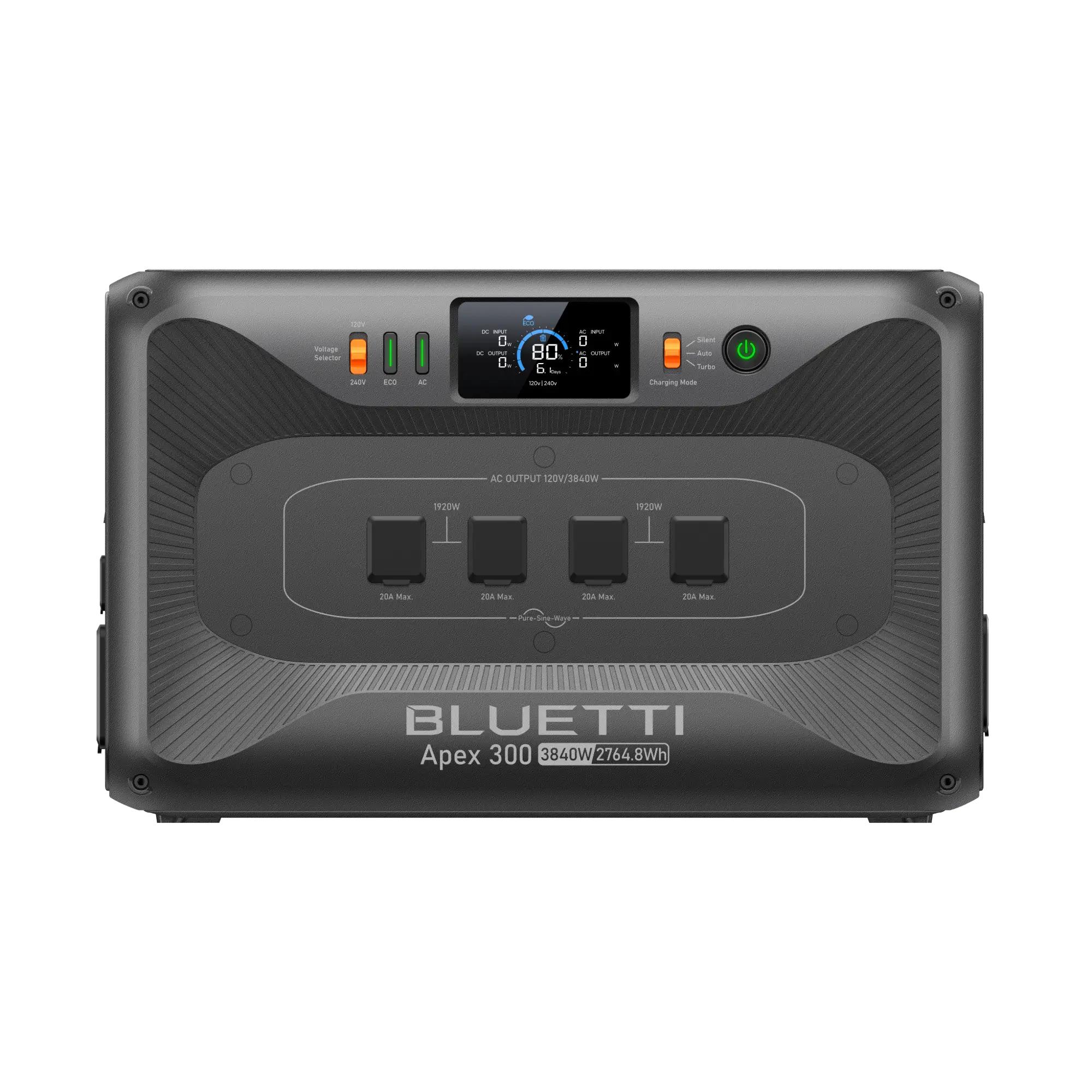
$1,499.00 · direct from BLUETTI
down from $1,699 · 12% below usual
Last checked 1 day ago. Prices move — check before you buy.
Spec deltas
The BLUETTI AC200MAX is a 2,048Wh, 2,200W station for $1,199 that weighs 61.9 lbs. The BLUETTI Apex 300 is a 2,764.8Wh, 3,840W station for $1,699 that weighs 83.78 lbs — same brand, same LFP chemistry, but rated to 3,500 cycles on the AC200MAX against 6,000-plus on the Apex 300, and a very different generation of hardware underneath.
The gap that matters most isn't capacity. BLUETTI doesn't list a switchover time for the AC200MAX at all, while the Apex 300 is rated at 10ms — fast enough to be called line-interactive rather than standby. The gotcha engine flags this directly: of these two, only the Apex 300 has real UPS protection.
The AC200MAX isn't a bad unit — it's simply the older design, and owners describe it that way: noticeably louder fans, slower AC charging, and an app that feels dated next to BLUETTI's newer lineupA1A2A3. The Apex 300 fixes most of that at a $500 premium and 21.9 more pounds.
What the Numbers Reveal
Each conclusion stated first — the numbers behind it on one line, the full analysis below.
For anything that needs to stay powered through a grid blip without a visible drop — a router, a sump pump, a CPAP machine mid-breath — that's not a nice-to-have spec, it's the one that decides whether the device notices the outage at all.
The AC200MAX has no listed switchover time (not disclosed by BLUETTI)The Apex 300 is rated at a 10ms switchover, and the gotcha engine flags it as the only one of the two with real UPS protection
Why it mattersBuyers shopping either unit specifically for home-backup UPS duty should treat this as close to disqualifying for the AC200MAX, independent of price.
continuous output
That's not a fluke of physics — it reflects the AC200MAX's older inverter and cooling design, the same generation gap owners point to when they call its fans noticeably louder than BLUETTI's current lineupA1. Buyers assuming the smaller, cheaper unit is automatically the quieter one should check the number, not the size.
The AC200MAX is rated at 50dB noise; owners describe its fans as noticeably louder than BLUETTI's newer models, measured well into the 50s dBA under loadA1The Apex 300 is rated at 45dB despite delivering 1,640W more continuous output (3,840W vs 2,200W)
Why it mattersAnyone running this near a bedroom or workspace should weigh the AC200MAX's 50dB against the Apex 300's 45dB directly rather than assuming less power means less noise.
For $60 more a year, the Apex 300 buys a full extra warranty year, 35% more capacity, and the UPS protection the AC200MAX doesn't have — a small annual premium against real functional gains, not brand markup.
The engine prices the AC200MAX at $300 per warranty-year and the Apex 300 at $360The Apex 300 carries a 5-year warranty against the AC200MAX's 4-year, and holds 716.8Wh more capacity
Why it mattersBuyers scared off by the $500 sticker gap should look at the amortized $60/year figure before ruling the Apex 300 out on price alone.
Both of these are marketed for similar camping and blackout use cases, but the weight gap effectively splits them into different jobs — the AC200MAX for a unit you load into a car yourself, the Apex 300 for one you set up once and leave.
The AC200MAX weighs 61.9 lbs; the Apex 300 weighs 83.78 lbs, a 21.9-lb increaseApex 300 owners describe it as so heavy they can hardly carry it more than a few feet or lift it onto a tableB8
Why it mattersBuyers who need to move the station regularly, not just own it, should weigh this as heavily as any spec on the sheet.
The specific dimensions that decide these two units — everything else is a tie.
What the Specs Don't Tell You
Selected because: The missing AC200MAX switchover spec and the UPS gotcha are the sharpest, most concrete differentiator in this pair.
rated cycles
BLUETTI simply doesn't publish a switchover time for the AC200MAX, and the gotcha engine calls out the Apex 300 as the only one of the two with real UPS protection at 10ms. That's the single sharpest differentiator in this comparison — it's not about how much power either can deliver, it's about whether the transfer is instant enough that a connected device never notices the outage.
The noise gap runs the opposite direction from what the specs would suggest: the AC200MAX, with less than two-thirds the Apex 300's continuous output, is rated 5dB louder. Owners of the AC200MAX describe its fans as noticeably louder than BLUETTI's newer designsA1, which lines up with the number rather than contradicting it.
Your Life, Your Pick
Selected because: Weekend Camping and the 8-Hour Blackout are clean Apex 300 wins with real margin, not marginal ones.
Weekend Camping is a clean pass/fail: it needs 2,100Wh, the AC200MAX's 2,048Wh can't quite cover it (121%), and the Apex 300 clears it comfortably at 89%. The 8-Hour Blackout follows the same shape with less drama — the AC200MAX finishes at 94%, nearly dry, while the Apex 300 lands at 70% with real reserve left for anything else plugged in.
CPAP Overnight and Tailgate Party are ties either unit covers easily, so let price and the UPS gap decide those, not capacity. Van Life Daily is out of reach for both — 269% and 199% of the job respectively — which rules out either as a full-time daily-power solution.
Lifetime Value
Selected because: The $500 sticker gap collapses to $60/year once warranty and capacity are accounted for — worth surfacing plainly.
cost / lifetime kWh
The AC200MAX is cheaper to own on paper: $300 per warranty-year against the Apex 300's $360, and $0.17 per lifetime kWh against $0.19. But the gap is smaller than the $500 price tag implies, since the Apex 300 also carries a full extra year of warranty and 716.8Wh more capacity for that money.
Worked out per year, the premium is $60 — not $500. That's a modest annual cost for a genuine generation jump: more capacity, a deeper surge ratio, and the UPS protection the AC200MAX simply doesn't have.
Portability & Form Factor
Selected because: 21.9 lbs separates them and neither unit rolls, which is worth a line for anyone carrying it often.
weight
61.9 lbs is a manageable one-person lift for most adults; 83.78 lbs is that same lift made harder, and the Apex 300's own reviewers say so directly, describing it as hard to carry more than a few feet or lift onto a table aloneB8. That's a 21.9-lb gap, about a third more weight for the extra capacity and UPS capability.
This changes who each unit actually suits. The AC200MAX fits the camper who loads gear into a car themselves; the Apex 300 fits the buyer setting up a fixed backup point — a utility room, an RV bay — once and leaving it there.
Growth Path
Selected because: Same-brand expansion path exists for both, but the Apex 300's much higher solar ceiling changes the off-grid case.
solar input
Both units support BLUETTI's expansion batteries, so neither locks you into its shipped capacity forever. Where they diverge is solar: the Apex 300 accepts up to 2,400W of panel input against the AC200MAX's 900W, a gap large enough to change how fast either recovers from empty on a sunny day.
For anyone building toward a larger off-grid or whole-home setup over time, that solar ceiling matters more than the base capacity difference — it's the spec that determines how much of your future system you can actually plug in.
Strengths & trade-offs
BLUETTI AC200MAX
Strengths
- +Costs $500 less
- +Lighter by 21.9 lb
Trade-offs
- –Weaker inverter (-1,640W) limits appliance compatibility.
- –Shorter-lived battery — rated for 3,500 charge cycles vs the Apex 300's 6,000, so it wears out sooner.
BLUETTI Apex 300
Strengths
- +Larger battery capacity
- +Higher AC output
- +Longer warranty
- +Faster solar charging
- +Rated for 6,000 charge cycles — much longer battery lifespan
Trade-offs
- –Substantially more expensive (+$500) than the AC200MAX.
- –Significantly heavier (+21.9 lbs), making it harder to move.
- –Very heavy unit that may be difficult for one person to lift.
Will It Power Your Gear?
Scenario math and per-appliance runtimes, modeled from the spec record.
Scenario verdicts
We ran the math on six real-world scenarios. Here's which unit survives your actual life.
SCN-01 · 2 nights · needs 2,100Wh
Weekend Camping
Two nights off-grid with essential comfort
Apex 300
The AC200MAX needs more than its full tank to cover this trip and can't finish it. The Apex 300 clears the same job with real capacity to spare — a pass/fail split, not a margin difference.
Battery budget usedlower = more headroom
LOAD Phone Charger 15W×6h · LED Lights 40W×8h · Box Fan 75W×14h · CPAP Machine 40W×16h
SCN-02 · 8 hours · needs 1,645Wh
8-Hour Blackout
Keep the essentials running through a night without power
Apex 300
Both technically get through it, but the AC200MAX finishes nearly empty while the Apex 300 still has meaningful reserve. If the outage runs long or you're powering extra devices, that reserve is the reason to pay more.
Battery budget usedlower = more headroom
LOAD Fridge 150W×8h · Router + Modem 20W×8h · LED Lights (4 bulbs) 40W×6h · Phone Charger 15W×3h
SCN-03 · 8 hours · needs 320Wh
CPAP Overnight
Sleep therapy without interruption — the #1 medical use case
Apex 300
A clean tie. Both units use under a fifth of their capacity on a CPAP overnight, so this alone doesn't justify the upgrade — buy on weight, noise, and UPS protection instead.
Battery budget usedlower = more headroom
LOAD CPAP Machine 40W×8h
SCN-04 · 8 hours · needs 910Wh
Remote Workday
Full work day off-grid without power anxiety
Apex 300
Both cover a laptop-monitor-router workday, with the Apex 300 finishing further from empty. If your day never approaches either unit's ceiling, the extra capacity isn't earning its keep here.
Battery budget usedlower = more headroom
LOAD Laptop 60W×8h · External Monitor 30W×8h · Router + Modem 20W×8h · Phone Charger 15W×2h
SCN-05 · 4 hours · needs 670Wh
Tailgate Party
Game day power for the crew
Either unit
Both handle a tailgate afternoon with plenty left over. The gap barely registers here, so let the other differences — weight, price, UPS — settle it.
Battery budget usedlower = more headroom
LOAD Blender 400W×0.5h · LED TV (55") 80W×4h · Bluetooth Speaker 15W×4h · Phone Charger (×3) 45W×2h
SCN-06 · 24 hours · needs 4,685Wh
Van Life Daily
A full day of mobile living — the ultimate endurance test
Neither unit
Neither unit covers this scenario's 4,685Wh: the AC200MAX comes up 2,944Wh short (about 37% covered), the Apex 300 2,335Wh (50%). Treat this as partial cover — enough for the essentials in it, not the whole list.
Battery budget usedlower = more headroom
LOAD Mini-Fridge 150W×24h · Laptop 60W×4h · Phone Charger 15W×3h · LED Lights 40W×5h · Fan 75W×8h
The Load Test
RUNTIME = (Wh × 0.85) ÷ LOAD
None of the scenarios above exactly yours? Build it. Toggle what you'd plug in; both units are tested against the combined draw.
Essentials
Comfort & Convenience
High-Draw Appliances
Test duration
8h
Continuous draw
205W
Projected runtime
For this load: Apex 300 runs 11.5h vs 8.5h.
$1,699 list · direct from BLUETTI
Modeled from the spec record — same math as the tables below. Methodology
Runtime by appliance
Real-world runtime estimates for common appliances, modeled at 85% inverter efficiency.¹
Essentials
The basics you need runningscale 0–156.7hComfort & Convenience
Makes off-grid life actually enjoyablescale 0–31.3hHigh-Draw Appliances
These reveal the real limitsscale 0–2.4h¹ Runtime = (capacity × 0.85) ÷ appliance watts. Within each group, all bars share one time scale (the group's longest runtime), so lengths are comparable across appliances; identical runtimes collapse into a single blue/orange bar. Actual runtime varies with battery age, temperature, and simultaneous loads — see methodology.
Conclusion
July 15, 2026
Verdict: the Apex 300, on Power Score margin
The Apex 300 wins on more than raw specs. BLUETTI doesn't publish a switchover time for the AC200MAX at all, and the gotcha engine flags the Apex 300 as the only one of the two with real UPS protection — that's the difference between a router or fridge staying up through a power blip and one that drops out. Add a 5dB quieter noise rating despite 1,640W more continuous output, a 2x deeper surge-to-continuous ratio, and outright wins on Weekend Camping and the 8-Hour Blackout, and the case is more than capacity. It isn't free: $500 more, 21.9 lbs heavier, and owners already flag the Apex 300 as hard to lift alone. If your loads sit inside the AC200MAX's 2,048Wh and outage protection isn't the point, the AC200MAX is the cheaper-to-own unit and stays that way.
Today the Apex 300 is $1,499, $200 under its typical $1,699. The verdict weighs typical prices, not today's. Prices checked 1 day ago.
Editor-assigned confidence, based on cited owner research and spec analysis.
List prices as of July 15, 2026. The links below open BLUETTI's current price.
$1,499.00 · direct from BLUETTI
down from $1,699 · 12% below usual
Last checked 1 day ago. Prices move — check before you buy.
or check the AC200MAX price$1,199.00 list
Written by Gunner Gustafson, Whole-Home Backup Tester · Station Arena Test Desk · Updated July 15, 2026
Measured Data
Benchmark scores and the full spec record, side by side.
Benchmark scores
Not rated for both units (minimum threshold unmet): UPS, Tailgating, Apartment Balcony.
Full specifications
ᵈ Derived: price ÷ rated capacity. See the data behind our comparisons →
Comparison ToolAdd more power stations, side by sideOpen Tool →How these numbers are produced
Numeric verification
Every figure on this page traces to our spec database or arithmetic on it — no estimated numbers.
Owner claims
Statements about owner experience are cited to published reviews — see Sources & Research Notes below.
Runtime model
Runtime = (rated capacity × 0.85 inverter efficiency) ÷ device wattage. Solar recharge estimates assume panels deliver 70% of rated output. Cold weather, battery age, and stacked loads reduce real-world results.
Power Score
Computed from 14 published spec dimensions, weighted per use-case bench. Higher is better; a unit must meet a bench's minimum threshold to be rated.
See the full weight table and data sourcing on our methodology page →Class ranking (the star rating)
Each unit's star score is a category ranking, not customer reviews — no buyer opinions feed it. We score every station on size-independent quality (value, output, portability, endurance, ports, warranty, and more), then percentile-rank it against the other units in its capacity class, so a class-leading compact unit and a class-leading whole-home unit can both earn 5★. Here, AC200MAX rates 3.4/5 (4th percentile of 26 Large-class units), and Apex 300 rates 5.0/5 (99th percentile of 26 Large-class units).
How the class ranking is computed →Test Notes & Caveats
Hidden gotchas and advantages we spotted that you won't find on the product page.
22 Extra Pounds, No Wheels to Offset It
The Apex 300 weighs about a third more than the AC200MAX. Owners already describe it as hard to carry more than a few feet or lift onto a table alone — plan on two hands or a second person, not a one-armed grab-and-go.
The More Powerful Unit Is the Quieter One
The Apex 300 is rated 45dB against the AC200MAX's 50dB, despite delivering 1,640W more continuous output. The AC200MAX's louder rating tracks with its older inverter and cooling design.
Only the Apex 300 Has UPS Protection
BLUETTI doesn't publish a switchover time for the AC200MAX at all. The Apex 300's 10ms rating is fast enough to keep sensitive electronics like routers running through a power blip without a visible drop — a capability the AC200MAX simply doesn't confirm it has.
Warranty: 5 Years vs 4
The Apex 300 is covered for 5 years against the AC200MAX's 4 years. The Apex 300's figure is a maximum rather than a guarantee — it depends on buying direct from BLUETTI or registering the unit, since reseller purchases carry a shorter term. An underrated factor if you're keeping this unit for years.
Battery Lifespan in Real Years
The Apex 300 is rated for 6,000 cycles vs 3,500. In real life: at daily use, that's 16.4 vs 9.6 years. At weekend use (twice a week), it's 58 vs 34 years. One caution reading years across different sizes: a cycle is 2,765Wh on the Apex 300 and 2,048Wh on the AC200MAX, so count lifetime energy — roughly 16,589 kWh against 7,168 kWh over the rated life. After hitting the cycle limit, the battery doesn't die — it drops to ~80% of original capacity, which is still very usable.
Full record above — the Test Desk pick is the Apex 300.
Check Apex 300 price →or check the AC200MAX priceOwnership Analysis
What happens after you buy — true cost of ownership, brand trust, and growth potential.
Lifetime value
Service lifeyears at one full cycle per day
Lifetime energy delivered
Cost per delivered kWh
│ warranty ends · Reaching the cycle rating means ~80% capacity remains — degraded, not dead.
Analyst note
The AC200MAX is cheaper to buy, but the Apex 300 is cheaper to own. At $0.1/kWh over its lifetime vs $0.17/kWh, the Apex 300's higher cycle life and capacity make each dollar go further over the years.
Growth path
AC200MAX
EXPANDABLESupports BLUETTI expansion batteries, so you can add capacity later without replacing the base unit — useful if your needs may climb past 2,048Wh.
Accepts up to 900W of solar. Suitable for a 1-2 panel setup.
Generous port selection supports complex multi-device setups.
Expansion batteries are BLUETTI-specific. You're investing in the BLUETTI ecosystem.
Apex 300
EXPANDABLESupports BLUETTI expansion batteries, so you can add capacity later without replacing the base unit — useful if your needs may climb past 2,765Wh.
Accepts up to 2,400W of solar. Enough for a serious multi-panel array.
Generous port selection supports complex multi-device setups.
Expansion batteries are BLUETTI-specific. You're investing in the BLUETTI ecosystem.
Realistic full solar rechargeat 70% of rated panel output — see methodology
Analyst note
Both expand, but the Apex 300's higher solar ceiling (2,400W vs 900W) gives it the stronger off-grid growth path — more panels can feed a bigger bank as it grows.
What Owners Report
Patterns from published owner reports and long-term reviews — every claim cited to its source below.
BLUETTI AC200MAX
The AC200MAX reads as a solid, well-liked unit that's simply showing its age. Owners describe its fans as noticeably louder than BLUETTI's newer designs, measured well into the 50s dBA under loadA1, and slow AC charging is a recurring frustration — roughly two hours to reach most of a chargeA2. The consensus is that it was a capable mid-range unit whose frustrations — slow charging, aging LFP chemistry, an app that felt like an afterthought — are exactly what BLUETTI's newer designs were built to fixA3.
That said, it's still described as a solid, well-liked expandable station, with LFP chemistry good for roughly nine years of useful life across its 3,500-cycle rating and a 4-year warrantyA4.
“The AC200MAX was a popular mid-range unit with solid capacity and an expandable battery, but its frustrations included slow charging, aging LFP chemistry, and an app that felt like an afterthought — the AC200L addresses nearly every one of these.”
Sources
diysolarforum.com · offgridbenchmark.com · firstquadcopter.com · bluettipower.eu · techradar.com
BLUETTI Apex 300
The Apex 300 is new enough that mature, long-term owner commentary barely exists yet — most available coverage is professional reviews from shortly after launch, plus a handful of real posts on BLUETTI's own community forum and a Home Assistant integration tracker. Treat this ledger as thin and early-stage.
What is consistent: multiple owners report firmware updates causing a stuck 'Backup' mode, an Error 004 charging fault, or Bluetooth disconnectsB1B2B3B4. Reviewers separately note the Apex 300 has no built-in DC or USB ports on its face — the $300 Hub D1 accessory adds them, and a $699 Hub A1 is required to parallel two unitsB7B11B12 — while calling the fans themselves relatively tame for a unit this sizeB5, even as more than one reviewer flags the 83.78-lb unit as genuinely hard to manage aloneB6B8.
“I was using Bluetti-bt until the latest Bluetti firmware update. I then started having disconnects.”
Sources & Research Notes
Every owner claim in this report is traceable to a published source. The bracketed references above resolve here.
Recurring owner themes
- The AC200MAX is the older generation — louder, slower to charge, weaker app — that the AC200L was built to improve on. [AC200MAX · 3 entries]
- Multiple owners report firmware updates causing app glitches, mode-lock issues, error codes, or Bluetooth/Home Assistant disconnects shortly after updating. [Apex 300 · 4 entries]
- Reviewers consistently flag the lack of built-in USB/DC ports as a design tradeoff requiring costly add-on accessories (Hub D1, Hub A1). [Apex 300 · 4 entries]
- The unit's extreme weight (~85 lbs) is repeatedly described as making it barely 'portable' and hard to carry alone. [Apex 300 · 2 entries]
- A1
“The AC200MAX's fans are noticeably louder than the newer AC200L — measured well into the 50s dBA under load at 1 meter, versus the AC200L staying barely audible under moderate load.”
diysolarforum.com / offgridbenchmark.com — AC200MAX vs AC200L noise · 2026 · [negative]
- A2
“Slow AC charging is a common frustration — the AC200MAX takes roughly two hours to reach most of a charge, versus well under an hour for the AC200L.”
offgridbenchmark.com / firstquadcopter.com — AC200L vs AC200MAX · 2026 · [negative]
- A3
“The AC200MAX was a popular mid-range unit with solid capacity and an expandable battery, but its frustrations included slow charging, aging LFP chemistry, and an app that felt like an afterthought — the AC200L addresses nearly every one of these.”
offgridbenchmark.com — AC200L review / comparison · 2026 · [mixed]
- A4
“Still a solid, well-liked expandable power station with LFP chemistry rated around 3,500 cycles (roughly nine years of useful life) and a 4-year warranty, versus the AC200L's 5-year.”
bluettipower.eu / techradar.com — AC200MAX · 2026 · [mixed]
- B1
“I updated my Apex 300 to the latest firmware yesterday. Now it's stuck in 'Backup' mode... Now when I go into the app to try to change it back, it flashes to...”
BLUETTI Community forum — 'Apex 300 stuck in Backup mode after last firmware update' · 2025-11 · [negative]
- B2
“When the system reached 97% charge, I decided to install the firmware updates. After the update completed, the charging stopped and I received Error 004.”
BLUETTI Community forum — 'Error E004 Apex 300' · 2025-11 · [negative]
- B3
“I was using Bluetti-bt until the latest Bluetti firmware update. I then started having disconnects.”
GitHub bluetti-official/bluetti-home-assistant issue #95 — 'APEX 300 and Hub A! now working' · 2026-05 · [mixed]
- B4
“Problem is every time I connect to the power station it shows that I still have an update, and I need to tap to upgrade which then tells me I am up to date.”
BLUETTI Community forum — 'Check For Update App issue' · 2025-09 · [negative]
- B5
“Some units sound like small jet engines under load, but the Apex 300's fans are relatively tame.”
Techspective — 'Bluetti Apex 300 with B300K Review' · 2025-09 · [positive]
- B6
“It's heavy, no question, but the handles and modular battery design make it manageable.”
Techspective — 'Bluetti Apex 300 with B300K Review' · 2025-09 · [mixed]
- B7
“Not having DC or USB ports on the face is a tradeoff. The Hub D1 solves the problem—but it's an additional $300 accessory that you then have to bolt on after the fact.”
Techspective — 'Bluetti Apex 300 with B300K Review' · 2025-09 · [negative]
- B8
“In fact, it's so heavy I can hardly carry it more than a few feet at a time and have been unable to lift it onto a table.”
T3 — 'Bluetti Apex 300 review: transform your off-grid life' · 2025-11 · [negative]
- B11
“That Bluetti D1 Power Hub that gives you your DC and USB ports costs about $300, which is a steep price for what you're getting.”
TheSolarLab — 'Bluetti Apex 300 Review: Cheap, Practical Home Backup?' · unknown · [negative]
- B12
“Say you want to connect multiple Apex 300 power stations together, you'll need to buy the Bluetti Hub A1 Parallel Box, which retails for around $699!”
TheSolarLab — 'Bluetti Apex 300 Review: Cheap, Practical Home Backup?' · unknown · [negative]
Research compiled July 15, 2026.
What Owners Actually Report
Drawn from 79 comments on independent review channels — not from retailer reviews, which skew to the first week of ownership. Each line is our summary of one commenter's claim, linked to the original. We record what they said, including where it contradicts the spec sheet.
BLUETTI AC200MAX
76 claims from 56 comments · 54 from owners · 8 with figures
- Other
- 11 · 36% negative
- Runtime
- 7 · 11% negative
- Durability
- 7 · 75% negative
- Expandability
- 7 · 24% negative
- Solar input
- 7 · 52% negative
What owners complain about
Even the 767's loudest fan state is far quieter than the AC200MAX.
Noiseowner41 agreedsource →
Has barely used the DC outputs or the dated 12V cigarette-lighter port.
Otherowner51 agreedsource →
AC200MAX shows 0% and beeps nonstop when an external battery is on the expansion port.
Expandabilityowner3 agreedsource →
What owners praise
Runs a boat's fridge, microwave, stereo, fans and pumps for 12-16 hours on the AC200MAX.
Runtimemeasuredowner10 agreedsource →
Three years with the AC200MAX and two B230s with no complaints.
Durabilityownerafter 36 months51 agreedsource →
Has run heavy shop vacs, chop saws and water pumps on 120V and 220V.
Inverter & surgeowner51 agreedsource →
BLUETTI Apex 300
36 claims from 23 comments · 18 from owners · 6 with figures
- Price & value
- 10 · 8% negative
- Solar input
- 6 · 53% negative
- Inverter & surge
- 2 · 0% negative
- Build quality
- 2 · 0% negative
- Runtime
- 2 · 100% negative
What owners complain about
TV, router, Tablo and Firestick drain it from 100% in 7-9 hours; runtime figures are lies.
Runtimemeasuredownersource →
Dropping to a 60V PV max is a deal killer versus the 150V per string they run on the AC300.
Solar inputowner1 agreedsource →
App is portrait-only.
App & firmwareownersource →
What owners praise
Two paralleled units give 7,680W and run dryer, 2-ton AC or oven plus fridges and sump pump.
Inverter & surgemeasuredowner5 agreedsource →
$2,600 for two units plus $659 for the Hub A1 was worth the extra over the Anker.
Price & valuemeasuredowner5 agreedsource →
Three Apex 300s with a Hub A1 give him 18kW solar input and 12kW output.
Solar inputmeasuredownerafter 1 months10 agreedsource →
Claims are weighted by how specific they are, whether the commenter owns the unit, and how many readers agreed. Comments that mention a product under a rival's review count for more, because the commenter had no reason to be there. This is what buyers report, not our test results — for measurements we ran ourselves, see the methodology.
Who Should Buy Which
Buy the AC200MAX if you…
- →You need a station you can still lift and load into a car yourself, and your backup or camping use doesn't hinge on an instant, gapless power transfer.
- →Your loads top out at a CPAP overnight, a remote workday, or a tailgate afternoon — the AC200MAX's 2,048Wh covers all three with capacity to spare, and it's the cheaper unit to own.
Buy the Apex 300 if you…
- →You're buying specifically for home backup and need real UPS behavior — a router or fridge that shouldn't notice the outage — which the AC200MAX's undisclosed switchover time can't promise.
- →You want a genuine two-night camping trip covered on one battery, plus a much higher solar ceiling (2,400W vs 900W) for faster recovery from empty.
If neither fits
If your daily draw looks like Van Life Daily — around 4,685Wh a day — both of these fall short, the AC200MAX at 269% of the job and the Apex 300 at 199%. That calls for a larger flagship unit or a proper solar-plus-battery system built for full-time daily power, not a choice between these two.
The Bottom Line
This is a generation gap dressed up as a capacity gap. The Apex 300 isn't just bigger — it's the only one of the two with real UPS protection, it's quieter despite delivering far more power, and it wins the scenarios that actually stress a battery. The AC200MAX's $500 discount buys an older design with an unlisted switchover spec and fans owners already call noticeably loudA1.
Pay the $500 (really closer to $60 a year once warranty and capacity are factored in) if outage protection or a real two-night camping trip is the job. If your loads sit comfortably inside the AC200MAX's 2,048Wh and you don't need gapless backup, it's still the cheaper, lighter, perfectly capable unit to own.
Frequently Asked Questions
Answers drawn from the spec record and cited owner research.
Does the BLUETTI AC200MAX have UPS or backup power protection?
BLUETTI doesn't publish a switchover time for the AC200MAX, and the gotcha engine flags the Apex 300 as the only one of the two with real UPS protection at 10ms. If instant, gapless backup power for a router or fridge is the point of the purchase, the AC200MAX can't confirm it delivers that.
Is the BLUETTI Apex 300 worth $500 more than the AC200MAX?
The sticker gap is $500, but worked out per warranty-year it's closer to $60, since the Apex 300 also carries an extra year of coverage and 716.8Wh more capacity. For that annual premium you get real UPS protection, a deeper surge ratio, and outright wins on Weekend Camping and 8-Hour Blackout scenarios.
Which BLUETTI station is quieter, the AC200MAX or the Apex 300?
The Apex 300, at 45dB against the AC200MAX's 50dB — despite delivering 1,640W more continuous output. Owners describe the AC200MAX's fans as noticeably louder than BLUETTI's newer designs under load.
How much heavier is the Apex 300 than the AC200MAX?
21.9 lbs heavier — 83.78 lbs against 61.9 lbs, about a third more. Apex 300 reviewers describe it as hard to carry more than a few feet or lift onto a table alone, so plan on two hands, or a second person, rather than frequent one-armed loading and unloading.
Can either the AC200MAX or Apex 300 expand its capacity later?
Yes, both accept BLUETTI expansion batteries, so the shipped capacity isn't a permanent ceiling for either. The Apex 300 also accepts more than double the solar input (2,400W vs 900W), which matters more for buyers planning to grow into a larger off-grid setup over time.
Where to buy
BLUETTI AC200MAX
$1,199.00
$1,199.00 · direct from BLUETTI
Last checked 1 day ago. Prices move — check before you buy.
BLUETTI Apex 300Pick
$1,499.00
$1,499.00 · direct from BLUETTI
down from $1,699 · 12% below usual
Last checked 1 day ago. Prices move — check before you buy.
Prices may vary by retailer and are subject to change.