Head-to-head test
Goal Zero Yeti 700 vs Jackery Explorer 600 Plus
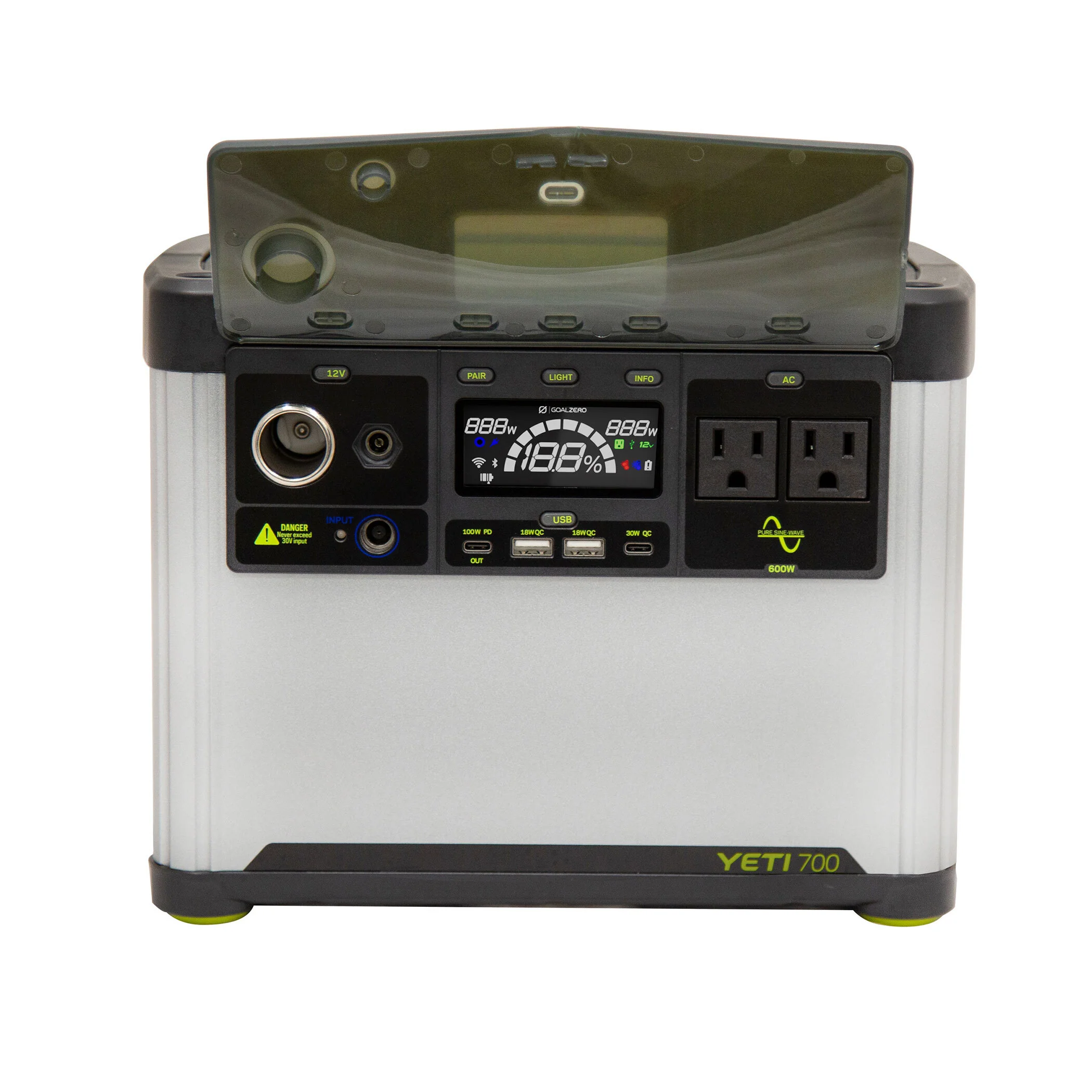
The Yeti 700's extra $271 buys cycle life you'll never reach, and costs you 200W of inverter you'll hit in the first week.
Full profiles: Goal Zero Yeti 700 → · Jackery Explorer 600 Plus →

Written by Wenny ZhengUpdated
Portable Power Tester, Station Arena Test Desk
$699.95 · direct from Goal Zero
Last checked 1 day ago. Prices move — check before you buy.

$429.00 · direct from Jackery
Last checked 14 days ago. Prices move — check before you buy.
Spec deltas
$429 against $700, and the cheaper unit has the bigger inverter. The Jackery Explorer 600 Plus runs 800W continuous with 1,600W on surge. The Goal Zero Yeti 700 runs 600W with 1,000W. You're being asked to pay 63% more for a box that starts fewer things.
Goal Zero's case is that the Yeti lasts longer, and it does. It's rated for 4,000 charge cycles against 3,000, on a 677Wh pack against 632Wh, and it carries a published IPX4 ratingA2. Multiply cycles by capacity and the Yeti moves 2,708 kWh across its life to the Jackery's 1,896. That's 43% more energy for 63% more money, which is a durability premium priced above what durability is worth.
The rest is close enough to set aside. Both take 200W of solar, both carry 100W USB-C, both are rated at 20ms on switchover, both come with a five-year warranty. Where these two genuinely differ, the Jackery takes nearly every line, and the two it loses on, 45Wh of capacity and 1,000 charge cycles, are the two that matter least in a box this size.
What the Numbers Reveal
Each conclusion stated first — the numbers behind it on one line, the full analysis below.
rated cycles
Spread those cycles across the way people actually use a 600Wh box and the premium gets worse. Weekend use puts the Yeti at 38.5 years of service and the Jackery at 28.8. Goal Zero is charging extra for the decade that begins after the unit has become a spare in the garage, and it collects that money today.
Yeti 700: 4,000 cycles on a 677Wh pack, or 2,708 kWh of lifetime energyExplorer 600 Plus: 3,000 cycles on a 632Wh pack, or 1,896 kWhThe prices are $700 and $429
Why it mattersAnyone buying the Yeti because it'll last longer is paying a premium for years they won't be present for.
continuous output
Surge is where that bites, because motors and compressors pull a multiple of their rated draw for the first fraction of a second. Jackery's cushion is double its running rating. Goal Zero's is 1.67 times. Stored energy can't rescue a device the inverter won't take, and these two hold nearly the same energy anyway.
Yeti 700: 600W continuous, 1,000W surgeExplorer 600 Plus: 800W continuous, 1,600W surgeThe 800W inverter is singled out as handling small appliances, portable fridges and CPAP machinesB1
Why it mattersIf anything with a compressor is on your list, the extra money buys the unit more likely to say no.
Only one of these tells you what that sounds like. 30 dBA is a number you can hold up against your own bedroom before you spend anything. A blank is a number you collect at 2 a.m., with the box eighteen inches from your ear and a mask on your face.
CPAP Overnight is the only profile both units clear, at 320WhIt draws 56% of the Yeti's usable capacity and 60% of the Jackery'sJackery publishes 30 dBA; Goal Zero publishes no noise figure for the Yeti 700
Why it mattersAnyone buying for a medical load should price the missing figure as a cost, not as an unknown that might break their way.
So the 45Wh the Yeti holds over the Jackery is 7% of an answer to a question that needs three to eight times what either one stores. If capacity is the thing keeping you up at night, choosing more carefully between these two doesn't touch it. The next class up does.
Weekend Camping needs 2,100Wh, the 8-hour blackout needs 1,645Wh, and a van-life day needs 4,685WhThose profiles demand 365%, 286% and 814% of the Yeti's usable capacityThe two packs are 45Wh apart, about 7%
Why it mattersAnyone shopping outage or van backup should stop comparing these two and size up instead.
The specific dimensions that decide these two units — everything else is a tie.
Lifetime Value
Selected because: The Yeti moves 43% more energy across its life and asks 63% more money for it, which is this matchup in a single ratio.
cost / lifetime kWh
Goal Zero is selling the back half of a lifespan you won't be there for. Four thousand cycles on a 677Wh pack works out to 38.5 years of weekend use. Three thousand on 632Wh works out to 28.8. Both figures are science fiction for a box this size, and the cells will still be healthy long after the ports, the app and the warranty department have all moved on.
The per-kilowatt-hour math confirms what the price tag implies. Twenty-six cents a lifetime kilowatt-hour for the Yeti, twenty-three for the Jackery. The longer-lived unit is also the more expensive one to own, which is the exact opposite of how a durability premium is supposed to work. Measured against the warranty you can actually file under, it's $140 a year against $86.
Runtime: Will It Power Your Gear?
Selected because: 45Wh separates these packs, so runtime is close to a wash and the decision moves to what each inverter will start.
continuous output
Whatever you plug in, these two run it for about the same stretch. 677Wh against 632Wh is a 7% spread, close enough that the runtime column is a formality on every load. The interesting question in this class was never how long. It's what turns on at all.
That's where they split. The Yeti stops at 600W continuous and the Jackery keeps going to 800W, so there's a whole band of devices one accepts and the other declines. No amount of stored energy rescues a load the inverter refuses.
What the Specs Don't Tell You
Selected because: Jackery holds 1,600W of surge to the Yeti's 1,000W, and only one of these two publishes a noise figure.
rated cycles
Startup is where the two inverters really separate. The Jackery holds double its running rating on the spike: 800W continuous, 1,600W surge. The Yeti's cushion is 1,000W over a 600W rating, or 1.67 times. Motors and compressors don't draw their rated wattage when they kick on, they draw a multiple of it, and the thinner cushion is the one that trips.
The other card in this section is a blank. Jackery rates the Explorer 600 Plus at 30 dBA. Goal Zero publishes nothing for the Yeti 700, which isn't proof that it's loud. It's a number you'll be finding out for yourself, at whatever hour the fan decides to answer the question.
Brand Trust
Selected because: Both brands have real support problems on record, which makes where you buy it matter nearly as much as which one you buy.
Neither brand comes out of this clean. Goal Zero has the heritage and a Salt Lake City address, but the support that used to justify its pricing has thinned badly: long waits, email left unanswered for weeks, and the official community forums shut down. Jackery's warranty process has its own friction, with scripted responses, strict receipt requirements, and refurbished units sent back in place of ones that failed outright.
So treat the storefront as part of the purchase. Neither app is a reason to pick a side. Jackery's sits at 2.3 to 3.3 stars, and Goal Zero's 4.4 comes with recurring connectivity and stability problems. What Jackery does have is shelf space: Costco, Home Depot, Best Buy, Amazon. If a unit dies in month seven, the return counter you'll actually stand at is a shorter trip than either manufacturer's inbox.
Strengths & trade-offs
Goal Zero Yeti 700
Strengths
- +Larger battery capacity
- +Rated for 4,000 charge cycles — much longer battery lifespan
Trade-offs
- –Substantially more expensive (+$271) than the Explorer 600 Plus.
Jackery Explorer 600 Plus
Strengths
- +Costs $271 less
- +Lighter by 4.2 lb
- +Higher AC output
Trade-offs
- –Shorter-lived battery — rated for 3,000 charge cycles vs the Yeti 700's 4,000, so it wears out sooner.
Will It Power Your Gear?
Scenario math and per-appliance runtimes, modeled from the spec record.
Scenario verdicts
We ran the math on six real-world scenarios. Here's which unit survives your actual life.
SCN-01 · 2 nights · needs 2,100Wh
Weekend Camping
Two nights off-grid with essential comfort
Neither unit
Neither unit covers this scenario's 2,100Wh: the Yeti 700 comes up 1,525Wh short (about 27% covered), the Explorer 600 Plus 1,563Wh (26%). Treat this as partial cover — enough for the essentials in it, not the whole list.
Battery budget usedlower = more headroom
LOAD Phone Charger 15W×6h · LED Lights 40W×8h · Box Fan 75W×14h · CPAP Machine 40W×16h
SCN-02 · 8 hours · needs 1,645Wh
8-Hour Blackout
Keep the essentials running through a night without power
Neither unit
Neither one carries this night, and that's a sizing fact rather than a defect. The profile wants 1,645Wh and these are 677Wh and 632Wh boxes before inverter losses come out. What they will do is hold up phones, a router, lights and a medical device until morning. Planning for a whole-house outage means shopping past that 1,645Wh number, not choosing more carefully between these two.
Battery budget usedlower = more headroom
LOAD Fridge 150W×8h · Router + Modem 20W×8h · LED Lights (4 bulbs) 40W×6h · Phone Charger 15W×3h
SCN-03 · 8 hours · needs 320Wh
CPAP Overnight
Sleep therapy without interruption — the #1 medical use case
Either unit
Both clear this one comfortably. The night draws 320Wh, which is 56% of what the Yeti holds after losses and 60% of the Jackery's, so you wake with roughly 40% left either way. Capacity has stopped being the question. What's left is the box eighteen inches from your head, and only one of them publishes a noise figure: 30 dBA for the Jackery, nothing for the Yeti. That's the tiebreak, and it isn't a flattering one.
Battery budget usedlower = more headroom
LOAD CPAP Machine 40W×8h
SCN-04 · 8 hours · needs 910Wh
Remote Workday
Full work day off-grid without power anxiety
Neither unit
Neither unit covers this scenario's 910Wh: the Yeti 700 comes up 335Wh short (about 63% covered), the Explorer 600 Plus 373Wh (59%). Either gets you most of the way, so this is a scenario you plan around rather than one you should rule them out for.
Battery budget usedlower = more headroom
LOAD Laptop 60W×8h · External Monitor 30W×8h · Router + Modem 20W×8h · Phone Charger 15W×2h
SCN-05 · 4 hours · needs 670Wh
Tailgate Party
Game day power for the crew
Neither unit
Closest call on the board and both still come up short. The profile wants 670Wh, and neither pack holds that much once inverter losses are subtracted. Bring the Jackery anyway: 800W continuous with 1,600W on surge covers more of what gets plugged in on a tailgate than 600W and 1,000W does, and it's 3.2 lb less to carry back to the truck.
Battery budget usedlower = more headroom
LOAD Blender 400W×0.5h · LED TV (55") 80W×4h · Bluetooth Speaker 15W×4h · Phone Charger (×3) 45W×2h
SCN-06 · 24 hours · needs 4,685Wh
Van Life Daily
A full day of mobile living — the ultimate endurance test
Neither unit
Neither unit covers this scenario's 4,685Wh: the Yeti 700 comes up 4,110Wh short (about 12% covered), the Explorer 600 Plus 4,148Wh (11%). This is well outside what either unit is for; the right answer here is a larger station, not a choice between these two.
Battery budget usedlower = more headroom
LOAD Mini-Fridge 150W×24h · Laptop 60W×4h · Phone Charger 15W×3h · LED Lights 40W×5h · Fan 75W×8h
The Load Test
RUNTIME = (Wh × 0.85) ÷ LOAD
None of the scenarios above exactly yours? Build it. Toggle what you'd plug in; both units are tested against the combined draw.
Essentials
Comfort & Convenience
High-Draw Appliances
Test duration
8h
Continuous draw
205W
Projected runtime
For this load: Yeti 700 runs 2.8h vs 2.6h.
$699.95 list · direct from Goal Zero
Modeled from the spec record — same math as the tables below. Methodology
Runtime by appliance
Real-world runtime estimates for common appliances, modeled at 85% inverter efficiency.¹
Essentials
The basics you need runningscale 0–38.4hComfort & Convenience
Makes off-grid life actually enjoyablescale 0–7.7hHigh-Draw Appliances
These reveal the real limits¹ Runtime = (capacity × 0.85) ÷ appliance watts. Within each group, all bars share one time scale (the group's longest runtime), so lengths are comparable across appliances; identical runtimes collapse into a single blue/orange bar. Actual runtime varies with battery age, temperature, and simultaneous loads — see methodology.
Conclusion
August 2, 2026
Verdict: the Explorer 600 Plus
Buy the Explorer 600 Plus. It holds within 7% of the Yeti's energy (632Wh against 677Wh), runs 800W continuous to the Yeti's 600W, holds 1,600W of surge to its 1,000W, weighs 3.2 lb less, publishes its fan noise at 30 dBA, and costs $429 against $700. Goal Zero's counter is 4,000 charge cycles to Jackery's 3,000, which is real, and which works out to 38.5 years of weekend service against 28.8. Neither of those figures describes a decision anyone actually gets to make. The one honest reason to pay Goal Zero's price is the Yeti's published IPX4 ratingA2: if this box is going to sit outside in the weather rather than in a trunk, that's worth something. Everyone else gets the stronger inverter for less money.
Editor-assigned confidence, based on cited owner research and spec analysis.
List prices as of August 2, 2026. The links below open Goal Zero's and Jackery's current prices.
$429.00 · direct from Jackery
Last checked 14 days ago. Prices move — check before you buy.
or check the Yeti 700 price$699.95 list
Written by Wenny Zheng, Portable Power Tester · Station Arena Test Desk · Updated August 2, 2026
Measured Data
Benchmark scores and the full spec record, side by side.
Benchmark scores
Full specifications
ᵈ Derived: price ÷ rated capacity. See the data behind our comparisons →
Comparison ToolAdd more power stations, side by sideOpen Tool →How these numbers are produced
Numeric verification
Every figure on this page traces to our spec database or arithmetic on it — no estimated numbers.
Owner claims
Statements about owner experience are cited to published reviews — see Sources & Research Notes below.
Runtime model
Runtime = (rated capacity × 0.85 inverter efficiency) ÷ device wattage. Solar recharge estimates assume panels deliver 70% of rated output. Cold weather, battery age, and stacked loads reduce real-world results.
Power Score
Computed from 14 published spec dimensions, weighted per use-case bench. Higher is better; a unit must meet a bench's minimum threshold to be rated.
See the full weight table and data sourcing on our methodology page →Class ranking (the star rating)
Each unit's star score is a category ranking, not customer reviews — no buyer opinions feed it. We score every station on size-independent quality (value, output, portability, endurance, ports, warranty, and more), then percentile-rank it against the other units in its capacity class, so a class-leading compact unit and a class-leading whole-home unit can both earn 5★. Here, Yeti 700 rates 3.6/5 (16th percentile of 20 Compact-class units), and Explorer 600 Plus rates 4.0/5 (42nd percentile of 20 Compact-class units).
How the class ranking is computed →Test Notes & Caveats
Hidden gotchas and advantages we spotted that you won't find on the product page.
Surge headroom: double against 1.67 times
The Explorer 600 Plus holds 1,600W on startup over an 800W running rating, exactly double. The Yeti 700 holds 1,000W over 600W, or 1.67 times. Compressors and motors don't ask politely when they kick on, they pull a multiple of their rated draw for a fraction of a second, and the unit with the thinner cushion is the one that trips.
Warranty: No Difference
Both units carry the same 5-year warranty, so coverage isn't a tiebreaker here. The Explorer 600 Plus's figure is a maximum rather than a guarantee — it depends on registering the unit with Jackery, which is what extends the base term to the full period. Worth saying because the per-dollar framing can suggest otherwise: the Explorer 600 Plus works out at 11.7 years of cover per $1,000 spent against the Yeti 700's 7.1, but that spread is the price gap, not the terms.
The Jackery loses this one
Goal Zero's 4,000-cycle rating beats Jackery's 3,000, and on the slightly larger pack: 11 years of daily cycling against 8.2. That's the Yeti's best card and we're not going to pretend otherwise. It's just that both numbers land far past the five-year warranty, in a decade where a 600Wh box is a spare rather than a main unit.
The Yeti 700 doesn't publish a noise figure
Jackery rates the Explorer 600 Plus at 30 dBA. Goal Zero publishes nothing for the Yeti 700. That isn't evidence it's loud, it's evidence you'll be finding out after the box is already in your bedroom. For a unit whose best night is running a CPAP two feet from a sleeping person, a missing number is a real cost.
Full record above — the Test Desk pick is the Explorer 600 Plus.
Check Explorer 600 Plus price →or check the Yeti 700 priceOwnership Analysis
What happens after you buy — true cost of ownership, brand trust, and growth potential.
Lifetime value
Service lifeyears at one full cycle per day
Lifetime energy delivered
Cost per delivered kWh
│ warranty ends · Reaching the cycle rating means ~80% capacity remains — degraded, not dead.
Analyst note
Both units have similar long-term ownership costs ($0.26/kWh vs $0.23/kWh). The price difference is what you see on the sticker — neither is a hidden bargain or rip-off.
Brand trust
Goal Zero
Ecosystem
Focused — a compact current line (6th-gen Yeti and Yeti Pro series), the previous-gen X series now out of stock across every model on Goal Zero's own store (checked 2026-09-13: 200X, 500X, 1000X, 1500X, 3000X, 6000X, some listed only as open-box), so buying one new means finding retailer stock, Sherpa power banks for the under-100Wh tier, plus Alta coolers, Nomad/Ranger solar panels, and vehicle integration kits
Support
Salt Lake City based, and for years that was the reason to pay Goal Zero's prices. It isn't anymore. Long waits, email that goes unanswered for weeks, and the official community forums shut down on the people who'd been using them longest.
Community
Small but loyal — strong following in overlanding and preparedness communities. Official community forums were recently shuttered, frustrating long-time users.
App experience
Rated 4.4/5 iOS (~1,200 ratings) but recent reviews skew negative — recurring connectivity issues, crashes, and stability problems.
Unique strength
The oldest name in portable power, with ruggedized IPX4 hardware and a Yeti-Ready ecosystem of coolers, lights and vehicle kits nobody else matches.
Worth knowing
The most expensive brand per watt-hour in the category, and the premium support that used to justify that position has thinned out.
Jackery
Ecosystem
12-15+ models across Explorer (portable) and HomePower (home backup) series, plus SolarSaga panel ecosystem and innovative form factors
Support
US-based but slow and scripted, with strict receipt requirements on warranty claims and refurbished replacements sent for units that failed outright. Buying from Costco or Amazon buys you a return policy that actually works.
Community
Smallest community of the major brands — Reddit r/Jackery has ~2,000 members. YouTube presence is solid due to brand recognition.
App experience
Rated 2.3-3.3/5 iOS and Android — the weakest app experience of the major brands. Multiple confusing apps (Jackery app vs Jackery Home) and mandatory login even offline.
Unique strength
Distribution. Costco, Home Depot, Best Buy, Amazon. The Toyota of power stations: proven, dependable, and on a shelf within driving distance.
Worth knowing
The app is the weakest of the major brands at 2.3 to 3.3 stars, split across two confusing apps and a mandatory login even when you're offline.
Analyst note
Neither support desk is a reason to buy. Goal Zero has the heritage and the ruggedized hardware; Jackery has shelf space at four national retailers, which is the more useful thing to own when a unit fails in month seven.
Growth path
Yeti 700
FIXED CAPACITYFixed at 677Wh, with no expansion — so size it for your needs up front rather than planning to add capacity later.
Accepts up to 200W of solar. Limited to a single portable panel.
Adequate ports for most setups, but heavy users may want a power strip.
Explorer 600 Plus
FIXED CAPACITYFixed at 632Wh, with no expansion — so size it for your needs up front rather than planning to add capacity later.
Accepts up to 200W of solar. Limited to a single portable panel.
Limited ports. You'll likely need a power strip or splitter.
Realistic full solar rechargeat 70% of rated panel output — see methodology
Analyst note
Neither expands, and that's no knock on either — each is a complete unit at a fixed size. Buy the capacity that covers your needs now (the Yeti 700 gives you the larger ceiling); you can't add to either later.
What Owners Report
Patterns from published owner reports and long-term reviews — every claim cited to its source below.
Goal Zero Yeti 700
Field coverage on the Yeti 700 is thin, and what exists reads like a spec sheet with adjectives: a sixth-generation 677Wh unit on LiFePO4 rated past 4,000 cyclesA1, IPX4 and built to take temperature extremesA2, part of Goal Zero's modern LFP replacement for the older NMC X-seriesA4. The most useful outside read calls it lightweight and simple and squarely aimed at quick camping trips and device charging, while saying plainly that it isn't the most powerful or capable unit in the roomA3.
That's a fair summary, and it's also the problem. The qualities the Yeti gets credit for, small and simple and easy to carryA3, are qualities the Jackery has too, at 16.1 lb and $429.
“A 6th-generation 677Wh compact power station on upgraded LiFePO4 chemistry rated for 4,000+ cycles — daily use for over 10 years.”
Sources
goalzero.com · amazon.com · campingsolar.us · outdoorgearlab.com
Jackery Explorer 600 Plus
Owners of the Explorer 600 Plus keep landing on the same three things: it charges fast, the app works, and it feels well made for how little it weighsB2B4. The 800W inverter is what the coverage singles out for this class, handling small appliances, portable fridges and CPAP machines without dramaB1. The most concrete field data point on either unit here is one owner's four-hour DJ gig, running two speakers, a wireless mic, a laptop and a controller, which ended with 65% still in the tankB3. That's not a night you'd predict a 632Wh box would shrug off.
Worth flagging one tension in that record. Owners of this specific unit like the appB2, while Jackery's app ratings across the whole line sit at 2.3 to 3.3 stars. Buy this for the hardware and treat the software as a bonus if it behaves.
“Its 800W pure sine wave inverter can handle small appliances, portable fridges, CPAP machines, and most electronics with ease.”
Sources
bestgeneratorsolar.com · jackery.com · bestbuy.com · homedepot.com · solarwaypoint.com
Sources & Research Notes
Every owner claim in this report is traceable to a published source. The bracketed references above resolve here.
Recurring owner themes
- Modern LFP (4,000+ cycles), IPX4 ruggedness, and light, simple portability are the highlights; modest power and capacity. [Yeti 700 · 3 entries]
- Strong 800W output for the class, fast charging, a well-received app among owners of this unit, and compact well-made build are the consistent praise. [Explorer 600 Plus · 3 entries]
- A1
“A 6th-generation 677Wh compact power station on upgraded LiFePO4 chemistry rated for 4,000+ cycles — daily use for over 10 years.”
goalzero.com / amazon.com — Yeti 700 · 2026 · [positive]
- A2
“Carries an IPX4 water-resistance rating and can handle extreme temperatures — a rugged, outdoor-ready design.”
goalzero.com / campingsolar.us — Yeti 700 review · 2026 · [positive]
- A3
“Ideal for quick camping trips and device charging — not the most powerful or capable, but lightweight and simple, appealing to portability-focused users.”
outdoorgearlab.com — Yeti 700 review · 2026 · [mixed]
- A4
“Part of Goal Zero's 6th-gen LiFePO4 Yeti family — a modern LFP replacement for the older NMC X-series.”
goalzero.com — Yeti 6th-gen family · 2026 · [positive]
- B1
“Its 800W pure sine wave inverter can handle small appliances, portable fridges, CPAP machines, and most electronics with ease.”
bestgeneratorsolar.com / jackery.com — Explorer 600 Plus buyer's guide · 2026 · [positive]
- B2
“Owners report it charges fast, and rate the app well in retail reviews of this unit — against a line-wide store average that is the lowest of the major brands, so read this as sentiment about the Explorer 600 Plus rather than about Jackery software generally. A reliable, convenient camping companion with a compact, lightweight design that feels durable and well-made.”
bestbuy.com / homedepot.com owner reviews — Explorer 600 Plus · 2026 · [positive]
- B3
“One owner ran it for a 4-hour DJ gig with two speakers, a wireless microphone, a laptop, and a controller and ended with 65% charge.”
bestbuy.com owner review — Explorer 600 Plus · 2026 · [positive]
- B4
“LiFePO4 chemistry rated for 3,000+ life cycles, lasting roughly 5-10 years depending on use; among the smaller, lighter units in its class with a foldable handle.”
bestgeneratorsolar.com / solarwaypoint.com — Explorer 600 Plus review · 2026 · [positive]
Research compiled August 2, 2026.
Who Should Buy Which
Buy the Yeti 700 if you…
- →The unit is going to live outside. Roof rack, truck bed, a campsite in the rain: the published IPX4 ratingA2 is the one thing on this page you can't get for less.
- →You already run Goal Zero panels, a Yeti-Ready cooler or the vehicle kit, and you want the whole setup speaking the same language.
- →Your loads are genuinely small. Phones, laptops, lights, a CPAP, nothing that ever approaches 600W, and you'd rather have the extra 45Wh and the longer cycle rating than the extra inverter.
Buy the Explorer 600 Plus if you…
- →You want the most capable box in the 600Wh class for the money: 800W continuous, 1,600W surge, 16.1 lb, $429.
- →Something with a compressor is on your list. A portable fridge, a pump, anything that spikes hard on startup wants double the running rating in reserve rather than 1.67 times it.
- →It's going next to your bed. A CPAP night takes 60% of what it holds, and at 30 dBA you know before you buy what you're inviting into the room.
- →You'd rather have a return counter than a warranty email thread, which means buying it at Costco, Best Buy or Home Depot.
If neither fits
Anyone shopping this to ride out a real outage or to run a van should close both tabs. The 8-hour blackout profile wants 1,645Wh and a van-life day wants 4,685Wh, three to eight times the usable energy either of these holds. That's a class problem, not a model problem. Size up to something built past that 1,645Wh figure and stop comparing 600Wh boxes.
The Bottom Line
Take the Explorer 600 Plus. It stores within 7% of the Yeti's energy, starts more of what you'll plug into it, weighs 3.2 lb less, tells you how loud it is, and leaves the difference in your pocket.
Goal Zero's case rests on lasting longer, and the Yeti does last longer: 43% more energy across its life. It also costs 63% more to buy, so the durability is priced above what it's worth, and it arrives in a decade you'll be spending on a different power station. Buy the Yeti if it's going to sit outside in the weather and the IPX4 ratingA2 is doing real work. Otherwise this one settles itself at the checkout page.
Frequently Asked Questions
Answers drawn from the spec record and cited owner research.
Is the Goal Zero Yeti 700 worth the extra money over the Jackery Explorer 600 Plus?
Only if it's going to live outdoors. The Yeti's published IPX4 rating and 4,000-cycle rating are real advantages, but the Jackery costs $429 to the Yeti's $700 and hands you a bigger inverter for it: 800W continuous and 1,600W surge against 600W and 1,000W. The extra durability translates to 38.5 years of weekend service against 28.8, which is not a difference anyone collects on.
Can the Jackery Explorer 600 Plus run a portable fridge?
Yes, and it's the better of these two for the job. The 800W inverter carries 1,600W of surge, double its running rating, which is exactly the reserve a compressor tests the instant it kicks on. The Yeti 700's 1,000W ceiling over a 600W rating is a thinner cushion for the same work.
Will either of these keep my house running during a blackout?
No. An 8-hour blackout profile calls for 1,645Wh, and these hold 677Wh and 632Wh before inverter losses come out. What they'll do is keep phones, a router, lights and a medical device going through the night, which is the honest use for this class. Whole-house backup means shopping past that 1,645Wh figure, not choosing more carefully between these two.
How long will the Jackery Explorer 600 Plus battery last?
It's rated for 3,000 LiFePO4 cycles, which is 8.2 years at a full cycle every single day, and far longer in real life because almost nobody cycles a 600Wh unit daily. The Yeti 700's 4,000 cycles push the same figure to 11 years. Both ratings run well past the five-year warranty either brand offers.
Which is quieter, the Yeti 700 or the Explorer 600 Plus?
Jackery rates the Explorer 600 Plus at 30 dBA. Goal Zero doesn't publish a figure for the Yeti 700, so there's no clean comparison to make, only the fact that one of them lets you check before you spend. If the unit is going beside your bed to run a CPAP, that missing number is the whole answer.
Where to buy
Goal Zero Yeti 700
$699.95
$699.95 · direct from Goal Zero
Last checked 1 day ago. Prices move — check before you buy.
Jackery Explorer 600 PlusPick
$429.00
$429.00 · direct from Jackery
Last checked 14 days ago. Prices move — check before you buy.
Prices may vary by retailer and are subject to change.