Head-to-head test
Goal Zero Yeti 700 vs Jackery Explorer 300
Buy on whether your load has a deadline: the Yeti 700 clears a 320Wh overnight with 255Wh still in the pack, the Explorer 300 stops 71Wh short of the same night, and no price difference turns 78% of a night into a night.
Full profiles: Goal Zero Yeti 700 → · Jackery Explorer 300 →

Written by Wenny ZhengUpdated
Portable Power Tester, Station Arena Test Desk
Spec deltas
Seventy-one watt-hours settle this one. A CPAP night in our scenario set draws 320Wh, and the Explorer 300 carries 249Wh of usable energy behind its 293Wh nameplate once the flat 85% derate the engine applies to every unit is taken off, so it gets about 78% of the way to morning and then quits. The Yeti 700 finishes the same night at 56% used.
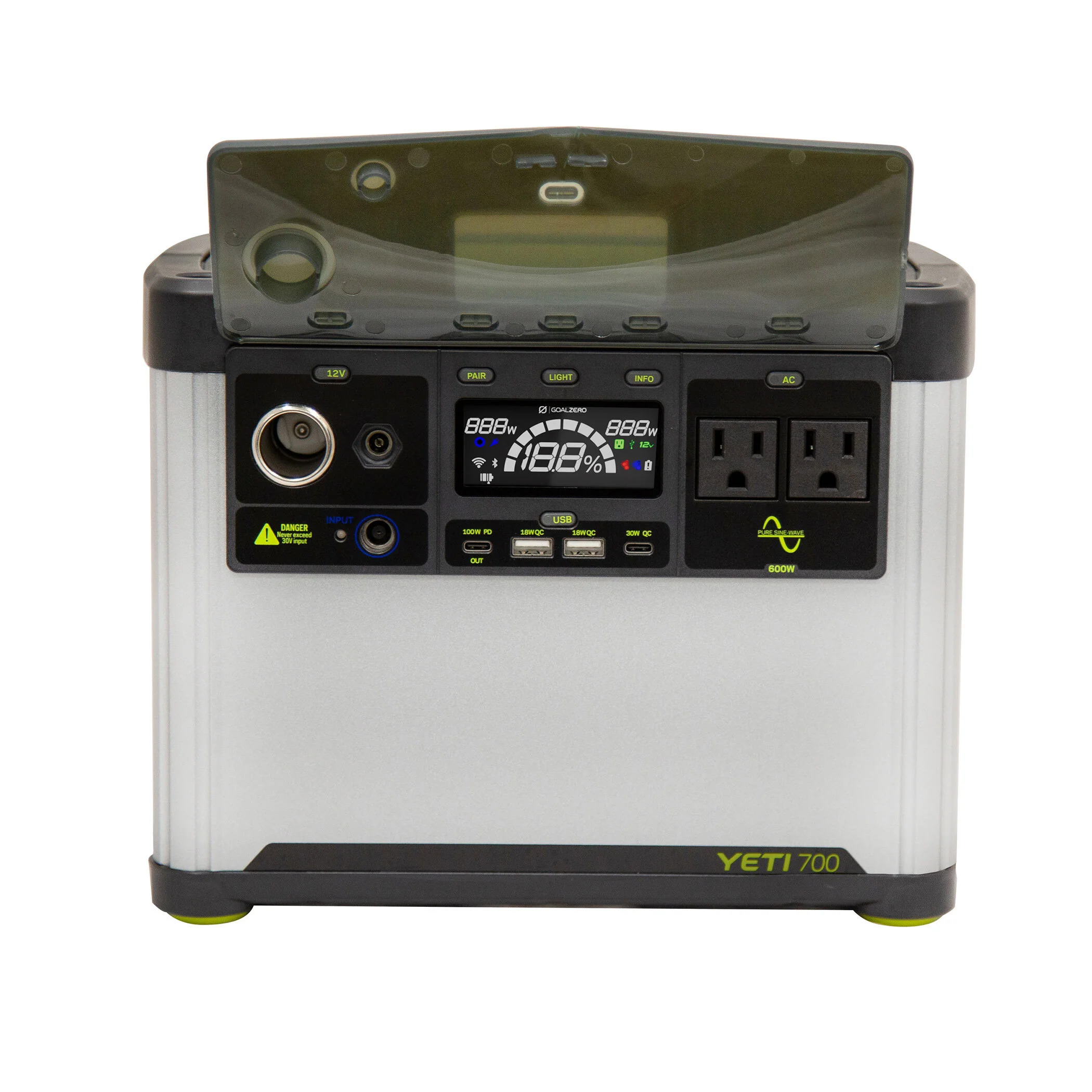
Strip that away and these two are the same shape of product, which is why they get cross-shopped. Both give you two AC outlets, two USB-A ports and a single 12V car socket. Neither expands, so what you buy is what you own. And both are far too small for the scenarios buyers think they're shopping for: the weekend camping list runs 2,100Wh and a van-life day 4,685Wh, and neither unit covers a third of either.
So the question is which end of the small-station job you're buying for. The Yeti 700 costs $411 more and weighs 20.3 lbs against 7.1, and in exchange you get a night that finishes, a pass-through mode, and five times the rated cycles. If your honest use case is an afternoon in a camp chair, that's a lot of money and thirteen pounds spent on a deadline you don't have.
What the Numbers Reveal
Each conclusion stated first — the numbers behind it on one line, the full analysis below.
The Yeti 700's 575Wh usable covers the same night at 56% used with 255Wh left over, which isn't a second night but is a comfortable morning. So these two aren't points on a spectrum here. One sits on the finishing side of a hard line and the other doesn't, and that gap can never be closed later, because neither unit accepts an expansion battery.
Explorer 300: 293Wh nameplate, 249Wh usable after the flat 85% derate the scenario engine applies to every unitCPAP Overnight needs 320Wh; the Explorer 300 ends 71Wh short, about 78% of the night coveredOne owner recharged electronics daily and ran low-wattage devices for about two weeks before the charge ran lowB4
Why it mattersAnyone buying for a CPAP, a modem, a monitor or anything else that has to be alive at 6 a.m. can stop reading here and get the Yeti 700.
rated cycles
The daily-use columns show where that comes from: 800 cycles at one a day runs out in a bit over two years, which is roughly when the Explorer 300's two-year warranty does, while the Yeti 700 reaches the end of its five-year term with most of its 11 years unspent. Neither pack dies at the cycle limit (the rating is a floor, and the cells fall to about 80% of original capacity), but one of these is priced like a purchase and the other like a rental.
Explorer 300 is the cheaper watt-hour on the shelf: $.88 per Wh against the Yeti 700's $1.03800 rated cycles at 293Wh is 234 kWh of lifetime energy; 4,000 cycles at 677Wh is 2,708 kWhAt daily use the engine puts the Explorer 300 at 2.2 years and the Yeti 700 at 11; the warranty terms are 2 years and 5
Why it mattersIf it will cycle most days, buy the Yeti 700 even though the sticker stings. If it comes out six times a year, the Explorer 300's 7.7 years at weekend use is more life than you'll ask of it.
solar input
That kills the usual argument for going small off-grid, which is that a little pack is easier to keep topped up. Both refill inside one good afternoon. The only thing size changes out there is the buffer you carry into a cloudy day: a whole night of it on the Yeti 700, an afternoon on the Explorer 300.
Yeti 700: 200W of solar input into 677WhExplorer 300: 100W of solar input into 293Wh
Why it mattersIf a panel is part of the plan, ignore refill time and buy the buffer. It's the only part of this a cloudy Tuesday touches.
At a desk that combination compounds. 100W charges a laptop at full speed while the second C port takes a phone, and the pass-through means the desktop and the modem don't reboot when the street goes dark. On the Explorer 300 the laptop charges slowly on the only C port there is, and a blackout is just a blackout.
Same face on both: 2 AC outlets, 2 USB-A ports and one 12V car socket eachUSB-C: two ports carrying 100W on the Yeti 700, one carrying 60W on the Explorer 300The Yeti 700 publishes a UPS transfer time of no worse than 20ms; the Explorer 300's sheet claims no UPS mode at all
Why it mattersHome-office buyers should treat the Yeti 700 as a UPS with a battery attached and buy it for that. A camper charging phones will never notice the difference.
The specific dimensions that decide these two units — everything else is a tie.
Your Life, Your Pick
Selected because: Five of these seven scenarios are too big for both units, which leaves two that decide anything: the 320Wh overnight the Yeti 700 finishes and the Explorer 300 misses by 71Wh, and the 100Wh afternoon both handle easily.
Read that column of neither verdicts as information rather than disappointment. These are 293Wh and 677Wh boxes, and the scenarios saying no are asking for 910Wh, 1,645Wh, 2,100Wh and 4,685Wh. What the grid is telling you is that this pair handles one-device, one-session jobs, and then, right at the bottom of the range, which of the two gets through a night.
The Tailgate Party row is worth reading twice, because it fails for a reason that has nothing to do with battery size. The Explorer 300 starts the 400W load on 500W of surge, then its 300W continuous rating takes over and can't hold it, so you get a few seconds of success and no warning. The Yeti 700 runs 400W comfortably inside its 600W and fails the other way, 95Wh short of the 670Wh the afternoon needs. Same verdict, two different lessons: one unit can't hold the load, the other can't hold it long enough.
Lifetime Value
Selected because: The two tickets buy very different amounts of delivered energy: 2,708 kWh over the Yeti 700's 4,000 rated cycles against 234 kWh over the Explorer 300's 800.
cost / lifetime kWh
The spread isn't really about price, it's about what a cycle is worth. A cycle on the Yeti 700 moves 677Wh and there are 4,000 of them; a cycle on the Explorer 300 moves 293Wh and there are 800. That's the entire cost-per-kilowatt-hour story, and it traces back to chemistry: our record has this catalogue key as the base Explorer 300 on lithium-ion cells rather than the LFP the Yeti 700 runsB0A1.
None of that reaches an occasional user, though. At weekend use the engine puts the Explorer 300 at 7.7 years of rated life, which is a longer ownership than most people give a small power station, and its two years of cover spans the window where manufacturing faults actually surface. The five-year term on the Yeti 700 is buying something different: permission to treat the thing as infrastructure.
Portability & Form Factor
Selected because: 7.1 lbs against 20.3 is the Explorer 300's whole case, and the one spec where the cheaper unit wins outright.
weight
Seven pounds goes in the bag you already packed. Twenty goes in the car on purpose. The Explorer 300 at 7.1 lbs is the one you carry to the far end of a beach without thinking about it, and the Yeti 700 at 20.3 is a deliberate, one-handed-but-you-feel-it lift from the trunk to the site, and a nuisance on a trail.
The catch is that the lightness and the short night are the same fact. There's less battery in the box, which is why it fits in the bag and why it stops before morning. Portability settles this only if your trips are short enough that the shortfall never arrives, so be honest about that before the weight wins the argument for you.
What the Specs Don't Tell You
Selected because: Every published extra here sits on the Yeti 700's side except one: the only noise figure on the table belongs to the Explorer 300.
rated cycles
Every published extra on this page sits with the Yeti 700, from app monitoring to a transfer-time ceiling to five years of cover, with exactly one exception, and it's the one that should give a bedroom buyer pause. The only noise figure on the table belongs to the Explorer 300. Our record carries none at all for the unit we're recommending.
That matters more than it looks, because the job the Yeti 700 wins is the overnight one, and the overnight one happens 18 inches from your head. We can tell you it finishes the night. We can't tell you what it sounds like at 3 a.m., and a missing number is not a quiet one.
Strengths & trade-offs
Goal Zero Yeti 700
Strengths
- +Larger battery capacity
- +Higher AC output
- +Longer warranty
- +Faster solar charging
- +Rated for 4,000 charge cycles — much longer battery lifespan
Trade-offs
- –Substantially more expensive (+$411) than the Explorer 300.
- –Significantly heavier (+13.2 lbs), making it harder to move.
Jackery Explorer 300
Strengths
- +Costs $411 less
- +Lighter by 13.2 lb
Trade-offs
- –Lacks smartphone app control for remote monitoring.
- –Shorter-lived battery — rated for 800 charge cycles vs the Yeti 700's 4,000, so it wears out sooner.
Will It Power Your Gear?
Scenario math and per-appliance runtimes, modeled from the spec record.
Scenario verdicts
We ran the math on seven real-world scenarios. Here's which unit survives your actual life.
SCN-01 · 2 nights · needs 2,100Wh
Weekend Camping
Two nights off-grid with essential comfort
Neither unit
Neither unit covers this scenario's 2,100Wh: the Yeti 700 comes up 1,525Wh short (about 27% covered), the Explorer 300 1,851Wh (12%). This is well outside what either unit is for; the right answer here is a larger station, not a choice between these two.
Battery budget usedlower = more headroom
LOAD Phone Charger 15W×6h · LED Lights 40W×8h · Box Fan 75W×14h · CPAP Machine 40W×16h
SCN-02 · 8 hours · needs 1,645Wh
8-Hour Blackout
Keep the essentials running through a night without power
Neither unit
Neither of these is your outage plan. The list here comes to 1,645Wh, more than twice the Yeti 700's entire nameplate, and coverage works out at about a third for the Yeti 700 and about 15% for the Explorer 300. What the Yeti 700 can do in a blackout is narrower and genuinely useful: keep one thing alive, the modem or a CPAP or a laptop, and switch over fast enough that it never reboots. Buy it for that job, not for this list.
Battery budget usedlower = more headroom
LOAD Fridge 150W×8h · Router + Modem 20W×8h · LED Lights (4 bulbs) 40W×6h · Phone Charger 15W×3h
SCN-03 · 8 hours · needs 320Wh
CPAP Overnight
Sleep therapy without interruption — the #1 medical use case
Yeti 700
A CPAP that quits at 4 a.m. isn't 78% of a good night, and 78% of this 320Wh night is what the Explorer 300 covers. The Yeti 700 gets through it with 255Wh still in the pack, which isn't a second night but is enough margin that an afternoon nap the next day isn't a gamble. Of the seven scenarios here, this is the only one where the two units land on opposite sides of a line.
Battery budget usedlower = more headroom
LOAD CPAP Machine 40W×8h
SCN-04 · 8 hours · needs 910Wh
Remote Workday
Full work day off-grid without power anxiety
Neither unit
Neither unit covers this scenario's 910Wh: the Yeti 700 comes up 335Wh short (about 63% covered), the Explorer 300 661Wh (27%). Treat this as partial cover — enough for the essentials in it, not the whole list.
Battery budget usedlower = more headroom
LOAD Laptop 60W×8h · External Monitor 30W×8h · Router + Modem 20W×8h · Phone Charger 15W×2h
SCN-05 · 4 hours · needs 670Wh
Tailgate Party
Game day power for the crew
Neither unit
The Explorer 300's two power ratings part company here. Its 500W of surge starts the 400W load, then the 300W continuous rating takes over and can't hold it, so the battery never gets a vote and you get a few seconds of success. The Yeti 700 runs 400W comfortably inside its 600W and fails the other way instead, 95Wh short of the 670Wh the afternoon needs. Two different nos, and the Yeti 700's is the one you could fix by shortening the party.
Battery budget usedlower = more headroom
LOAD Blender 400W×0.5h · LED TV (55") 80W×4h · Bluetooth Speaker 15W×4h · Phone Charger (×3) 45W×2h
SCN-06 · 24 hours · needs 4,685Wh
Van Life Daily
A full day of mobile living — the ultimate endurance test
Neither unit
Neither unit covers this scenario's 4,685Wh: the Yeti 700 comes up 4,110Wh short (about 12% covered), the Explorer 300 4,436Wh (5%). This is well outside what either unit is for; the right answer here is a larger station, not a choice between these two.
Battery budget usedlower = more headroom
LOAD Mini-Fridge 150W×24h · Laptop 60W×4h · Phone Charger 15W×3h · LED Lights 40W×5h · Fan 75W×8h
SCN-07 · an afternoon · needs 100Wh
Afternoon Off-Grid
Phones and a speaker at the park, beach, or campsite — the small-unit job description
Either unit
Both units do this one without breathing hard: the Yeti 700 ends at 17% used, the Explorer 300 at 40%. Leftover watt-hours decide nothing at this size, which leaves the thirteen pounds between them (20.3 against 7.1) and the cheaper ticket, and both of those point at the Explorer 300. This is the row it was drawn for, and a reminder that the right unit is the one sized for the job you actually do.
Battery budget usedlower = more headroom
LOAD Phone Charger (×2) 30W×2h · Bluetooth Speaker 10W×4h
The Load Test
RUNTIME = (Wh × 0.85) ÷ LOAD
None of the scenarios above exactly yours? Build it. Toggle what you'd plug in; both units are tested against the combined draw.
Essentials
Comfort & Convenience
High-Draw Appliances
Test duration
8h
Continuous draw
205W
Projected runtime
For this load: Yeti 700 runs 2.8h vs 1.2h.
Sold on Amazon
Planning for more than this? Describe your whole setup and get it sized →
Modeled from the spec record — same math as the tables below. Methodology
Runtime by appliance
Real-world runtime estimates for common appliances, modeled at 85% inverter efficiency.¹
Essentials
The basics you need runningscale 0–38.4hComfort & Convenience
Makes off-grid life actually enjoyablescale 0–7.7hHigh-Draw Appliances
These reveal the real limits¹ Runtime = (capacity × 0.85) ÷ appliance watts. Within each group, all bars share one time scale (the group's longest runtime), so lengths are comparable across appliances; identical runtimes collapse into a single blue/orange bar. Actual runtime varies with battery age, temperature, and simultaneous loads — see methodology.
Conclusion
September 19, 2026
Verdict: the Yeti 700, on Power Score margin
Take the Yeti 700 if anything you plug in has to still be running when you wake up. It is the only one of the two that finishes the 320Wh overnight scenario, the only one with a published UPS transfer ceiling, and over its rated life it delivers energy at roughly a quarter of the Explorer 300's cost per kilowatt-hour. The Explorer 300 isn't a bad box, it's a smaller one: 7.1 lbs, cheaper by $411, and exactly right for an afternoon of phones, a speaker and a camera battery. What it isn't is an overnight unit, and because neither of these expands, you can't buy the small one now and fix that later.
Editor-assigned confidence, based on cited owner research and spec analysis.
List prices as of September 19, 2026. The links below open Goal Zero's and Jackery's current prices.
Sold on Amazon · today’s price is on the listing
or check the Explorer 300 price$289.00 list
Written by Wenny Zheng, Portable Power Tester · Station Arena Test Desk · Updated September 19, 2026
Black Friday · 38 days out
Price to beat:Explorer 300 $189
The lowest we have recorded. A Black Friday price above it is a sale this unit has already had.
Measured Data
Benchmark scores and the full spec record, side by side.
Benchmark scores
Not rated for both units (minimum threshold unmet): UPS, CPAP, Solar Generator.
Full specifications
ᵈ Derived: price ÷ rated capacity. See the data behind our comparisons →
Comparison ToolAdd more power stations, side by sideOpen Tool →How these numbers are produced
Numeric verification
Every figure on this page traces to our spec database or arithmetic on it — no estimated numbers.
Owner claims
Statements about owner experience are cited to published reviews — see Sources & Research Notes below.
Runtime model
Runtime = (rated capacity × 0.85 inverter efficiency) ÷ device wattage. Solar recharge estimates assume panels deliver 70% of rated output. Cold weather, battery age, and stacked loads reduce real-world results.
Power Score
Computed from 14 published spec dimensions, weighted per use-case bench. Higher is better; a unit must meet a bench's minimum threshold to be rated.
See the full weight table and data sourcing on our methodology page →Class ranking (the star rating)
Each unit's star score is a category ranking, not customer reviews — no buyer opinions feed it. We score every station on size-independent quality (value, output, portability, endurance, ports, warranty, and more), then percentile-rank it against the other units in its capacity class, so a class-leading compact unit and a class-leading whole-home unit can both earn 5★. Here, Yeti 700 rates 3.6/5 (16th percentile of 20 Compact-class units), and Explorer 300 rates 3.6/5 (17th percentile of 24 Personal-class units).
How the class ranking is computed →Test Notes & Caveats
Hidden gotchas and advantages we spotted that you won't find on the product page.
Explorer 300: No App Control
Without app control, you have to physically walk to the Explorer 300 to check battery level, adjust settings, or monitor power draw. The Yeti 700 lets you do all that from your phone, including getting low-battery alerts.
One of them can sit between the wall and the router
Plug the Yeti 700 into the wall and your gear into the Yeti 700, and when the grid drops it takes the load over. Goal Zero publishes that handover as no worse than 20ms, a spec-sheet ceiling rather than a stopwatch reading of ours, and that's inside what a modem, a NAS or a CPAP will tolerate. The fussiest desktop power supplies sit right about at that line, so don't stake an unsaved project on it. The Explorer 300 claims no UPS mode at all, so anything plugged into it rides out a blackout for as long as it takes you to walk over and notice.
Warranty: 5 Years vs 2
The Yeti 700 is covered for 5 years against the Explorer 300's 2 years. An underrated factor if you're keeping this unit for years.
Battery Lifespan in Real Years
The Yeti 700 is rated for 4,000 cycles vs 800. In real life: at daily use, that's 11 vs 2.2 years. At weekend use (twice a week), it's 38 vs 8 years. One caution reading years across different sizes: a cycle is 677Wh on the Yeti 700 and 293Wh on the Explorer 300, so count lifetime energy — roughly 2,708 kWh against 234 kWh over the rated life. After hitting the cycle limit, the battery doesn't die — it drops to ~80% of original capacity, which is still very usable.
The only published noise number belongs to the other unit
Jackery lists the Explorer 300 at 36dB, and our record carries no figure at all for the Yeti 700. Those aren't two numbers with a gap between them: one is a spec-sheet value of the kind makers publish as a best case, often in a capped quiet mode, and the other is a blank. It lands awkwardly for us, because the job the Yeti 700 wins here is the overnight one, 18 inches from a sleeping head, and that's exactly where we can't hand you a number. If it's going in a bedroom, treat the 36 as published rather than measured, and go find hands-on reports of the Yeti 700's fan before you spend.
Full record above — the Test Desk pick is the Yeti 700.
Check Yeti 700 price →or check the Explorer 300 priceOwnership Analysis
What happens after you buy — true cost of ownership, brand trust, and growth potential.
Lifetime value
Service lifeyears at one full cycle per day
Lifetime energy delivered
Cost per delivered kWh
│ warranty ends · Reaching the cycle rating means ~80% capacity remains — degraded, not dead.
Analyst note
The Explorer 300 is cheaper to buy, but the Yeti 700 is cheaper to own. At $0.26/kWh over its lifetime vs $1.23/kWh, the Yeti 700's higher cycle life and capacity make each dollar go further over the years.
Delivers each lifetime kWh for $0.97 less — check the Yeti 700 price →
Brand trust
Goal Zero
Ecosystem
A short, deliberate line rather than a catalogue: the current 6th-generation Yeti stations with the Yeti Pro tier above them, Sherpa power banks below, Nomad and Ranger solar panels, Alta coolers, and vehicle integration kits. The Yeti 700 is a current 6th-gen LFP unit, so it sits inside that line rather than at the tail of an older one, and the accessories it plugs into are the ones Goal Zero is still selling.
Support
US-based company (Salt Lake City, owned by NRG Energy). Historically considered premium support, but 2025-2026 reports describe long wait times, unresponsive email communication, and tickets going unaddressed for weeks. The "premium support justifies premium pricing" argument is weakening.
Community
Small but loyal — strong following in overlanding and preparedness communities. Official community forums were recently shuttered, frustrating long-time users.
App experience
Rated 4.4/5 iOS (~1,200 ratings) but recent reviews skew negative — recurring connectivity issues, crashes, and stability problems.
Unique strength
Pioneer of the portable power market — strongest brand heritage. US-based company with ruggedized, weather-resistant designs (IP ratings vary by model). Integrated "Yeti-Ready" ecosystem with coolers, lights, and vehicle kits.
Worth knowing
Typically the priciest brand per watt-hour — though individual pairings vary, and on some pages the Yeti is the cheaper energy. Support quality has declined from its "premium" standard. Perceived as competitively stagnant vs. faster-innovating Chinese competitors. Reliability reports on newer models are concerning.
Jackery
Ecosystem
12-15+ models across Explorer (portable) and HomePower (home backup) series, plus SolarSaga panel ecosystem and innovative form factors
Support
US-based support but widely criticized. Reddit reports describe slow/dismissive responses, scripted AI agents, strict receipt requirements for warranty claims, and refurbished replacements for clearly defective units. Strongly recommended: buy from Costco or Amazon for return protection.
Community
Smallest community of the major brands — Reddit r/Jackery has ~2,000 members. YouTube presence is solid due to brand recognition.
App experience
Rated 2.3-3.3/5 iOS and Android — the weakest app experience of the major brands. Multiple confusing apps (Jackery app vs Jackery Home) and mandatory login even offline.
Unique strength
Highest brand recognition and widest retail distribution (Costco, Home Depot, Best Buy, Amazon). The "Toyota" of power stations — dependable, proven, wide availability. Innovative form factors like the Solar Gazebo and Solar Mars Bot.
Worth knowing
A couple of older models still ship NMC chemistry with a shorter rated lifespan, so check the cycle rating on the specific unit — though most of the current line has moved to LFP. Generally perceived as overpriced for the specs offered compared to newer competitors. App experience is significantly behind rivals.
Analyst note
The practical difference between these two brands at this size is where you buy. Goal Zero sells through its own store and a dealer network; Jackery is on the shelf at the big-box retailers, which puts a return desk between you and a lemon. That's worth real money against a two-year warranty and rather less against a five-year one. Support isn't a differentiator here in either direction.
Growth path
Yeti 700
FIXED CAPACITYFixed at 677Wh, with no expansion — so size it for your needs up front rather than planning to add capacity later.
Accepts up to 200W of solar. Limited to a single portable panel.
Adequate ports for most setups, but heavy users may want a power strip.
Explorer 300
FIXED CAPACITYFixed at 293Wh, with no expansion — so size it for your needs up front rather than planning to add capacity later.
Accepts up to 100W of solar. Limited to a single portable panel.
Limited ports. You'll likely need a power strip or splitter.
Realistic full solar rechargeat 70% of rated panel output — see methodology
Analyst note
Neither expands, and that's no knock on either — each is a complete unit at a fixed size. Buy the capacity that covers your needs now (the Yeti 700 gives you the larger ceiling); you can't add to either later.
What Owners Report
Patterns from published owner reports and long-term reviews — every claim cited to its source below.
Goal Zero Yeti 700
Field evidence on the Yeti 700 is thin, and what exists is reviewer-sourced rather than long-term ownersA0. OutdoorGearLab puts it squarely in the quick-trip-and-devices class, light and simple rather than powerfulA3, which is what every number on this page says too. The ruggedness claim has slightly better backing: an IPX4 rating and tolerance for temperature extremes turn up in review coverage alongside Goal Zero's own materialA2. Treat the 4,000-cycle rating as a published figure rather than something anyone has ridden out in the fieldA1A4.
“A 6th-generation 677Wh compact power station on upgraded LiFePO4 chemistry rated for 4,000+ cycles — daily use for over 10 years.”
Sources
goalzero.com · amazon.com · campingsolar.us · outdoorgearlab.com
Jackery Explorer 300
The Explorer 300's reports are short and all point one way: one owner ran phones, a speaker, a fan and an air mattress through a camping trip with no trouble, calling it easy, light and quietB3, and another recharged electronics daily and ran low-wattage devices for about two weeks before the charge ran lowB4. Both describe the same kind of use: small loads, no deadline, plenty of chances to top up.
One warning about reading reviews for this unit. Our ledger carries two entries researched against the Explorer 300 Plus, a separate and newer unit, and we've kept them off this pageB0. If a review you're reading quotes a different capacity, weight or cycle rating than the table above, it's describing the Plus.
“288Wh capacity with 300W output on LiFePO4 chemistry rated for 3,000+ cycles — over a decade of daily use, a major upgrade from the older lithium-ion Explorer 300 (500 cycles).”
Sources
powerstationlab.com · batteryskills.com · voltagebasics.com · rv.com · bestbuy.com
Sources & Research Notes
Every owner claim in this report is traceable to a published source. The bracketed references above resolve here.
Recurring owner themes
- Modern LFP (4,000+ cycles), IPX4 ruggedness, and light, simple portability are the highlights; modest power and capacity. [Yeti 700 · 3 entries]
- Light weight, LFP 3,000-cycle longevity, quiet operation, and easy portability are the consistent praise for this small unit. [Explorer 300 · 3 entries]
- A1
“A 6th-generation 677Wh compact power station on upgraded LiFePO4 chemistry rated for 4,000+ cycles — daily use for over 10 years.”
goalzero.com / amazon.com — Yeti 700 · 2026 · [positive]
- A2
“Carries an IPX4 water-resistance rating and can handle extreme temperatures — a rugged, outdoor-ready design.”
goalzero.com / campingsolar.us — Yeti 700 review · 2026 · [positive]
- A3
“Ideal for quick camping trips and device charging — not the most powerful or capable, but lightweight and simple, appealing to portability-focused users.”
outdoorgearlab.com — Yeti 700 review · 2026 · [mixed]
- A4
“Part of Goal Zero's 6th-gen LiFePO4 Yeti family — a modern LFP replacement for the older NMC X-series.”
goalzero.com — Yeti 6th-gen family · 2026 · [positive]
- B3
“One owner powered phones, a speaker, a fan, and an air mattress on a camping trip with no issues, calling it super easy to use, lightweight, and quiet.”
bestbuy.com owner reviews — Explorer 300 Plus · 2026 · [positive]
- B4
“Another owner recharged multiple electronics daily and ran small-wattage devices for about two weeks before reaching a low charge.”
bestbuy.com owner reviews — Explorer 300 Plus · 2026 · [positive]
Research compiled September 19, 2026.
Who Should Buy Which
Buy the Yeti 700 if you…
- →Anyone whose load has a deadline: a CPAP through the night, a modem and router that shouldn't drop, a camera that has to be recording at dawn. It's the only one of the two that finishes the 320Wh overnight scenario, and the only one with a published transfer time.
- →The desk worker who wants one box behind the whole setup. 100W on USB-C charges a laptop at full speed with a phone still on the second C port, and the pass-through keeps a desktop from rebooting when the street flickers.
- →The buyer who'll use it constantly for years. 4,000 cycles at 677Wh is the difference between a thing you own and a thing you replace, and five years of cover says the maker expects that too.
Buy the Explorer 300 if you…
- →The day-trip user. 7.1 lbs of phones, headlamps, a speaker and a camera battery, carried to wherever you're sitting and home before dinner. The 100Wh afternoon load leaves it at 40% used, which is the job it was drawn for.
- →The first-timer who isn't sure they'll use one. It's the cheaper mistake by $411, it comes off a big-box shelf with a return desk behind it, and at weekend use its rated life runs well past most people's interest in the hobby.
If neither fits
Anyone shopping for real home backup should close this page. The eight-hour blackout list runs 1,645Wh, more than twice the Yeti 700's entire nameplate, and a van-life day runs 4,685Wh. Neither of these is a smaller version of what you want, they're a different product, so look at stations several times this size with a continuous rating well past what either offers here. Same goes for anyone who needs a 400W appliance running for hours rather than minutes.
The Bottom Line
Take the Yeti 700. One of these two finishes a night and the other gets about three-quarters of the way there, and three-quarters of a night is a failure with a number attached. Everything else on the page agrees with that one result: five times the rated cycles, five years of cover instead of two, and a pass-through that keeps the modem up when the street goes dark.
The counter-case is short and it's real. The Explorer 300 is a third of the weight, it's cheaper by $411, and if your loads are all afternoon-shaped it'll outlast your interest in owning one. Buy it for the day bag with a clear head. Just don't buy it for a night, because neither of these lets you add the battery you'd need later.
Frequently Asked Questions
Answers drawn from the spec record and cited owner research.
Can the Jackery Explorer 300 run a CPAP all night?
Not in our scenario set. A CPAP night there draws 320Wh and the Explorer 300 has 249Wh usable, so it covers about 78% of the night and stops before morning. The Yeti 700 finishes the same night with 255Wh in reserve. If a machine has to run until you wake up, price stops being the question.
Is the Goal Zero Yeti 700 worth $411 more than the Explorer 300?
If it will cycle regularly or carry something that can't stop, yes. Over its rated life it delivers energy at about a quarter of the Explorer 300's cost per kilowatt-hour, and it's the only one of the two with a pass-through mode. If it comes out a few afternoons a year to charge phones, no: you'd be paying for a night you never need and hauling 20.3 lbs to do it.
Which one is better for camping?
For a day out, the Explorer 300, and it isn't close: 7.1 lbs against 20.3 for a 100Wh load neither unit notices. For a full weekend, neither. Our weekend camping list comes to 2,100Wh and the Yeti 700 covers about 27% of it, so powering a weekend rather than an afternoon means buying bigger than both.
Does the Jackery Explorer 300 have a UPS or battery backup mode?
Our record lists none and its sheet claims none. The Yeti 700 does: it sits between the wall and your gear and hands over on a published transfer time of no worse than 20ms, which is a spec-sheet ceiling rather than a figure anyone clocked. That's inside what a modem, a router or a CPAP will tolerate, though the fussiest desktop power supplies sit right about at that line.
Is this the Explorer 300 or the Explorer 300 Plus?
The base Explorer 300: 293Wh on lithium-ion cells, 7.1 lbs, rated for 800 cycles. The Plus is a separate, newer unit whose capacity, weight and cycle life are all different, so we don't quote its figures here. Check which one a review or a listing is actually describing before you buy on the strength of it.
Where to buy
Goal Zero Yeti 700Pick
Sold on Amazon · today’s price is on the listing

Jackery Explorer 300
$289.00
$289.00 · direct from Jackery
Last checked 16 days ago. Prices move — check before you buy.
Prices may vary by retailer and are subject to change.