Head-to-head test
Goal Zero Yeti 500 vs Jackery Explorer 5000 Plus Double Kit
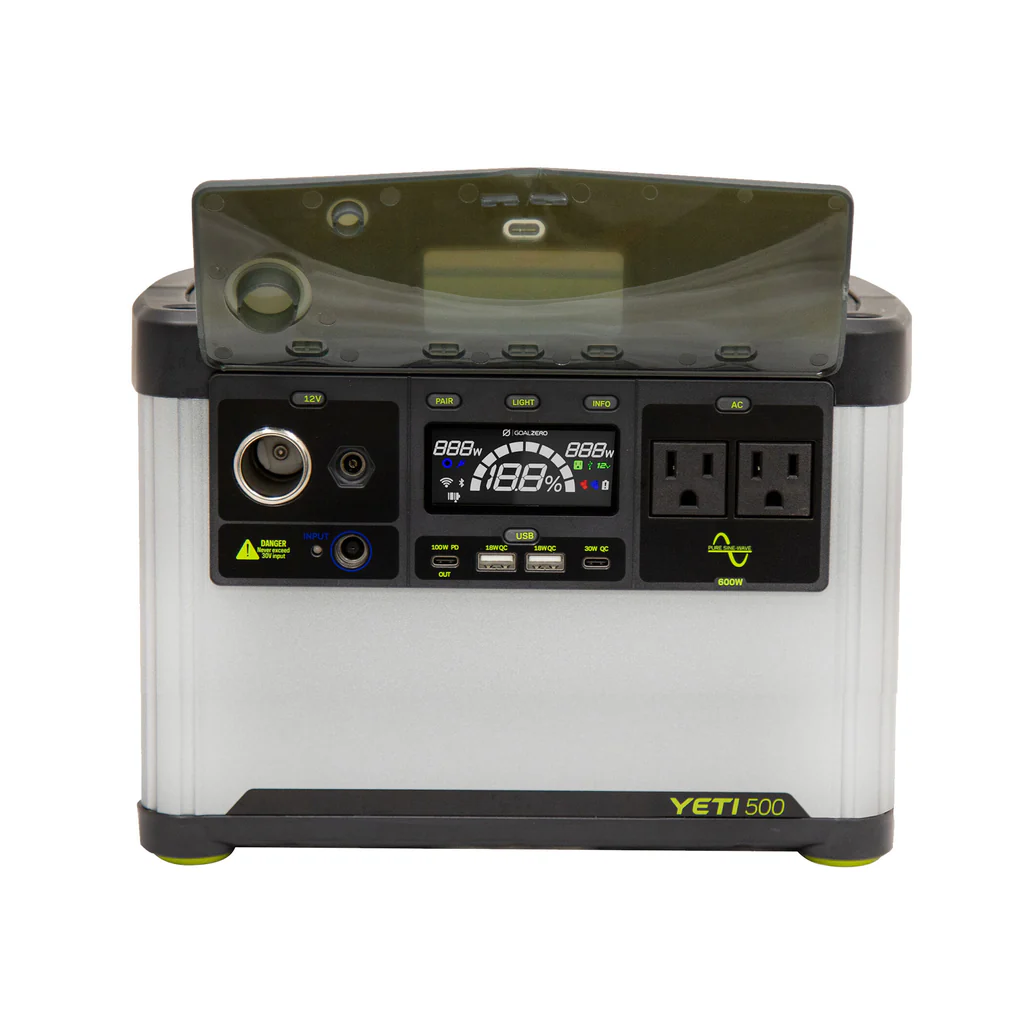
Whether your power has to travel settles this one before any other number gets a vote: 424Wh you lift with one hand and carry to the tent, against 8,568Wh sitting in two boxes that never leave the room you put them in.
Full profiles: Goal Zero Yeti 500 → · Jackery Explorer 5000 Plus Double Kit →

Written by Gunner GustafsonUpdated
Whole-Home Backup Tester, Station Arena Test Desk
$499.95 · direct from Goal Zero
Last checked 1 day ago. Prices move — check before you buy.

$6,289.00 · direct from Jackery
Last checked 1 day ago. Prices move — check before you buy.
Spec deltas
The Yeti 500 costs $500 and weighs 16.1 lbs. The Explorer 5000 Plus Double Kit costs $6,289 and weighs 269 lbs spread across two boxes. Nobody cross-shops these on merit. You arrive at this page already belonging to one of them, and the useful thing this page can do is tell you which.
Capacity is where it stops being a price question. The Yeti 500 holds 499Wh, which the flat 85% derate this site applies to every unit turns into 424Wh you can actually spend. The kit holds 10,080Wh, or 8,568Wh on the same basis. Five of the six load scenarios below ask for more than 424Wh, so on those rows the Yeti 500 is not the cheaper option. It is the one that does not finish.
The kit's answer to the other half of the page is that it does not come along. It is rated stationary, and 269 lbs is a two-person job even split between the two boxes. So on the camping weekend and the tailgate, the two rows where people actually spend a Saturday, neither unit wins. If that is your Saturday, the honest recommendation is a mid-size box with wheels, and you can close this tab happy.
What the Numbers Reveal
Each conclusion stated first — the numbers behind it on one line, the full analysis below.
Press on its one win and it thins out. 104Wh of reserve at that same 40W draw is about two and a half more hours (104 divided by 40), so the CPAP row is one night with margin, not two nights. Add a fridge or a second day and the Yeti 500's answer is no, and a no at $500 is more expensive than a yes at any price.
Yeti 500: 499Wh nameplate, 424Wh usable after the flat 85% derateThe six load rows on this page: 320Wh CPAP night, 670Wh tailgate, 910Wh remote workday, 1,645Wh eight-hour blackout, 2,100Wh camping weekend, 4,685Wh van life dayThe CPAP night leaves the Yeti 500 with 104Wh in reserve; the workday leaves it 486Wh short
Why it mattersIf your real daily draw sits above the Yeti 500's 424Wh, stop comparing these two and start comparing mid-size units against the kit.
That advantage is only collectable by actually drawing 40,320 kWh, and at weekend cadence neither unit runs out of cycles for 38.5 years. So the per-kWh column is describing a machine in hard daily service. Buy the kit for weekends and the $5,789 you paid over the Yeti 500 ($6,289 minus $500) is buying energy you will never draw, at a rate you will never realize.
Cost per lifetime kWh: 16 cents for the Double Kit, 25 cents for the Yeti 500Both packs carry the same 4,000-cycle minimum ratingLifetime energy: 40,320 kWh for the kit, 1,996 kWh for the Yeti 500At weekend use, both take 38.5 years to exhaust those cycles
Why it mattersIf the unit will spend most of its life at rest, ignore cost per lifetime kWh entirely and price the capacity you will actually use.
solar input
The kit inverts the constraint. At its 8,000W ceiling the full 10,080Wh goes back in well under two hours (10,080 divided by 8,000), so the limit becomes how much panel you own rather than the box. Across a multi-day outage the Yeti 500 is something you tend all day and the kit is something you refill in a morning. Recharge ceiling, not capacity, is the spec that decides long outages.
Yeti 500: 200W solar input ceiling into 499WhDouble Kit: 8,000W solar input ceiling into 10,080WhThe eight-hour blackout row needs 1,645Wh
Why it mattersBuying for outages that run past one day? Judge the input ceiling first, and the Yeti 500's 200W rules it out of that job whatever it costs.
The specific dimensions that decide these two units — everything else is a tie.
Portability & Form Factor
Selected because: It is the only axis here that disqualifies a unit outright: 16.1 lbs against 269 lbs split between two boxes, one of them rated to stay put.
weight
269 lbs arrives as two boxes, not one, so the number that governs your afternoon is about 135 lbs a side (269 divided by 2). That is the difference between impossible and one bad hour with a friend and a hand truck, and you pay it once: the kit is rated stationary, so you are choosing a spot in the house rather than buying a piece of gear. The Yeti 500 at 16.1 lbs is the other extreme. Trunk to tent to closet shelf, one hand, no plan.
This is also why the scenario table has two rows with nobody standing in the winner's column. A tailgate and a camping weekend both require the unit to get into a vehicle, and the only one of these that can is 246Wh and 1,676Wh short of them. Weight does not lose you a spec comparison. It removes you from the scenario.
Your Life, Your Pick
Selected because: Five of the six load rows ask for more than the Yeti 500's 424Wh usable, and two of them are rows neither unit wins.
The Yeti 500's workday ends at lunch. 424Wh usable against the 910Wh a remote workday asks for is 47% of the day, and that is the human way to read every row on this table: not that it loses, but that you get partway and then go hunting for an outlet.
The kit wins the three rows it is allowed to enter, and one of them deserves a pause. Van life at 4,685Wh a day leaves it 3,883Wh in reserve, its thinnest margin on the page, which tells you roughly how big a load has to get before this much battery is doing real work. Below that line you are paying for headroom to sit idle.
Lifetime Value
Selected because: The kit is the cheaper energy at 16 cents per lifetime kWh against 25, and the reason behind that decides whether it matters to you.
cost / lifetime kWh
The five-year warranty is identical on both, which makes the per-dollar version of it a trap. Five years works out to 10 years of coverage per $1,000 spent on the Yeti 500 against 0.8 on the kit, and that spread is the price gap in a warranty's clothing. The terms are the same, with one condition attached on the Jackery side.
What the ownership math really says is that neither of these is the thing that fails first. At daily use both are rated to reach 11 years before the cells are spent, and at weekend cadence you would be handing them down. Cost of ownership is not the axis on this page. Capacity you will actually use is.
What the Specs Don't Tell You
Selected because: Three of the four cards below are about things a spec table cannot show: a mass that arrives in two pieces, a fan nobody published a figure for, and a warranty year you have to claim.
Every card in this section is about the kind of number rather than its size. One figure is missing, because Goal Zero publishes no dB level for the Yeti 500. One is a best case, which is what Jackery's 30dB is. One is conditional, the fifth warranty year. And one arrives in two pieces, the 269 lbs. None of them is untrue, and none of them means what a spec table implies it means.
That matters most if the unit is going in a bedroom. The only published noise figure on this page belongs to the 269 lb pair that is not going in a bedroom, and the 16 lb box that is has no figure at all. Treat that as a reason to find somebody who has heard one running, not as a reason to assume the worst.
Strengths & trade-offs
Goal Zero Yeti 500
Strengths
- +Costs $5,789.1 less
- +Lighter by 252.9 lb
Trade-offs
- –Weaker inverter (-13,900W) limits appliance compatibility.
- –Sealed capacity — the Explorer 5000 Plus Double Kit can add batteries to grow past 499Wh; this one can't.
Jackery Explorer 5000 Plus Double Kit
Strengths
- +Larger battery capacity
- +Higher AC output
- +Faster solar charging
Trade-offs
- –Substantially more expensive (+$5,789.1) than the Yeti 500.
- –Significantly heavier (+252.9 lbs), making it harder to move.
- –Very heavy unit that may be difficult for one person to lift.
Will It Power Your Gear?
Scenario math and per-appliance runtimes, modeled from the spec record.
Scenario verdicts
We ran the math on six real-world scenarios. Here's which unit survives your actual life.
SCN-01 · 2 nights · needs 2,100Wh
Weekend Camping
Two nights off-grid with essential comfort
Neither unit
Two nights at 2,100Wh is where both of these fall out of the running. The Yeti 500 covers about a fifth of it and finishes 1,676Wh short. The kit has 8,568Wh usable and is rated to stay in the house. Nobody wins a weekend you can neither carry nor complete.
Battery budget usedlower = more headroom
LOAD Phone Charger 15W×6h · LED Lights 40W×8h · Box Fan 75W×14h · CPAP Machine 40W×16h
SCN-02 · 8 hours · needs 1,645Wh
8-Hour Blackout
Keep the essentials running through a night without power
Explorer 5000 Plus Double Kit
Both units promise a switchover no worse than 20ms, so your router does not notice the grid drop either way. The difference shows up about two hours in: 1,645Wh across eight hours averages 206W, and 424Wh usable runs out at roughly that two-hour mark, 1,221Wh short of the evening. The kit is still holding 6,923Wh when the lights come back.
Battery budget usedlower = more headroom
LOAD Fridge 150W×8h · Router + Modem 20W×8h · LED Lights (4 bulbs) 40W×6h · Phone Charger 15W×3h
SCN-03 · 8 hours · needs 320Wh
CPAP Overnight
Sleep therapy without interruption — the #1 medical use case
Either unit
Both cover a 40W machine for eight hours without effort, so capacity settles nothing here. The leftovers do: 104Wh on the Yeti 500 is about two and a half more hours at that draw, which is one night with margin rather than a weekend of them. The kit brings another 253 lbs (269 against 16.1) and 8,248Wh of reserve you will never touch at a bedside. The spec that would actually decide a bedside unit, fan noise, has no published figure on the Yeti 500 side at all.
Battery budget usedlower = more headroom
LOAD CPAP Machine 40W×8h
SCN-04 · 8 hours · needs 910Wh
Remote Workday
Full work day off-grid without power anxiety
Explorer 5000 Plus Double Kit
The Yeti 500 gets you to lunch. 424Wh usable against a 910Wh workday is 47% of the day, so the afternoon goes to outlet-hunting. The kit ends the day with 7,658Wh still in reserve, which tells you it is the wrong tool for a desk and the right one for a building.
Battery budget usedlower = more headroom
LOAD Laptop 60W×8h · External Monitor 30W×8h · Router + Modem 20W×8h · Phone Charger 15W×2h
SCN-05 · 4 hours · needs 670Wh
Tailgate Party
Game day power for the crew
Neither unit
The Yeti 500 is not outmuscled here. A 400W peak sits inside its 500W continuous rating, so it starts and holds everything on the list, then runs dry 246Wh short of the 670Wh the day needs. The kit would coast through it and weighs 269 lbs. That is the whole reason this row has no winner: one can carry the load but not the day, and one cannot get to the parking lot.
Battery budget usedlower = more headroom
LOAD Blender 400W×0.5h · LED TV (55") 80W×4h · Bluetooth Speaker 15W×4h · Phone Charger (×3) 45W×2h
SCN-06 · 24 hours · needs 4,685Wh
Van Life Daily
A full day of mobile living — the ultimate endurance test
Explorer 5000 Plus Double Kit
4,685Wh a day is the first load on this page big enough to justify the kit, and even then it ends the day with 3,883Wh left, its thinnest margin here. The Yeti 500 covers 9% of it, which is a charging accessory in a van rather than a power system. Worth saying plainly: 269 lbs of battery in a vehicle is a build decision about weight and mounting, not a purchase you make on a Tuesday.
Battery budget usedlower = more headroom
LOAD Mini-Fridge 150W×24h · Laptop 60W×4h · Phone Charger 15W×3h · LED Lights 40W×5h · Fan 75W×8h
The Load Test
RUNTIME = (Wh × 0.85) ÷ LOAD
None of the scenarios above exactly yours? Build it. Toggle what you'd plug in; both units are tested against the combined draw.
Essentials
Comfort & Convenience
High-Draw Appliances
Test duration
8h
Continuous draw
205W
Projected runtime
For this load: Explorer 5000 Plus Double Kit runs 41.8h vs 2.1h.
$6,289 list · direct from Jackery
Modeled from the spec record — same math as the tables below. Methodology
Runtime by appliance
Real-world runtime estimates for common appliances, modeled at 85% inverter efficiency.¹
Essentials
The basics you need runningscale 0–571.2hComfort & Convenience
Makes off-grid life actually enjoyablescale 0–114.2hHigh-Draw Appliances
These reveal the real limitsscale 0–8.6h¹ Runtime = (capacity × 0.85) ÷ appliance watts. Within each group, all bars share one time scale (the group's longest runtime), so lengths are comparable across appliances; identical runtimes collapse into a single blue/orange bar. Actual runtime varies with battery age, temperature, and simultaneous loads — see methodology.
Conclusion
September 13, 2026
Verdict: the Explorer 5000 Plus Double Kit, on Power Score margin
Call it a tie, because these two never competed. The Yeti 500 is a 16.1 lb box with 424Wh of usable energy; the Double Kit is a 269 lb pair holding 8,568Wh, rated as a stationary appliance. No price argument moves either one into the other's job, so apply the test instead. If it has to travel, the kit is disqualified before you read a spec, and $500 buys a unit that covers a 320Wh CPAP night with 104Wh in reserve. If it never moves and your daily draw runs into kilowatt-hours, the Yeti 500 fails five of the six scenarios on this page and the difference in price is buying capability you actually need. What you should not do is split the difference in your head. The two rows where a normal weekend lives, the 2,100Wh camping trip and the 670Wh tailgate, are rows both of these lose, and the answer there is a single mid-size unit with wheels, which is a different page.
Editor-assigned confidence, based on cited owner research and spec analysis.
Written by Gunner Gustafson, Whole-Home Backup Tester · Station Arena Test Desk · Updated September 13, 2026
Measured Data
Benchmark scores and the full spec record, side by side.
Benchmark scores
Not rated for both units (minimum threshold unmet): UPS, Home Backup, CPAP, Solar Generator, Tailgating, Food Truck, Apartment Balcony, Camping.
Full specifications
ᵈ Derived: price ÷ rated capacity. See the data behind our comparisons →
Comparison ToolAdd more power stations, side by sideOpen Tool →How these numbers are produced
Numeric verification
Every figure on this page traces to our spec database or arithmetic on it — no estimated numbers.
Owner claims
Statements about owner experience are cited to published reviews — see Sources & Research Notes below.
Runtime model
Runtime = (rated capacity × 0.85 inverter efficiency) ÷ device wattage. Solar recharge estimates assume panels deliver 70% of rated output. Cold weather, battery age, and stacked loads reduce real-world results.
Power Score
Computed from 14 published spec dimensions, weighted per use-case bench. Higher is better; a unit must meet a bench's minimum threshold to be rated.
See the full weight table and data sourcing on our methodology page →Class ranking (the star rating)
Each unit's star score is a category ranking, not customer reviews — no buyer opinions feed it. We score every station on size-independent quality (value, output, portability, endurance, ports, warranty, and more), then percentile-rank it against the other units in its capacity class, so a class-leading compact unit and a class-leading whole-home unit can both earn 5★. Here, Yeti 500 rates 4.5/5 (71st percentile of 22 Personal-class units), and Explorer 5000 Plus Double Kit rates 4.4/5 (64th percentile of 29 Whole-Home / Off-Grid-class units).
How the class ranking is computed →Test Notes & Caveats
Hidden gotchas and advantages we spotted that you won't find on the product page.
269 lbs, But Never in One Piece
The Double Kit is two units, so nobody is lifting 269 lbs. The figure that governs your afternoon is about 135 lbs a side (269 divided by 2), which is a two-person stair job you do once rather than an impossibility. After that it is sited: the kit is rated stationary, so pick the spot as if you were installing an appliance. For contrast, the Yeti 500's 16.1 lbs is the only part of this comparison you can solve with one hand.
Sealed at 499Wh, and That Is Mostly Fine
True, the Yeti 500 does not expand: what you buy is the ceiling. But the growth path on the other side of this page starts at more than twelve times the price ($6,289 against $500), so outgrowing a 499Wh box means buying a different unit either way. Judge the Yeti 500 on whether 424Wh usable does the job you have today, not on a capacity ladder it was never going to climb.
Warranty: No Difference
Both units carry the same 5-year warranty, so coverage isn't a tiebreaker here. The Explorer 5000 Plus Double Kit's figure is a maximum rather than a guarantee — it depends on registering the unit with Jackery, which is what extends the base term to the full period. Worth saying because the per-dollar framing can suggest otherwise: the Yeti 500 works out at 10 years of cover per $1,000 spent against the Explorer 5000 Plus Double Kit's 0.8, but that spread is the price gap, not the terms.
Yeti 500: Noise Level Not Disclosed
The Explorer 5000 Plus Double Kit publishes its noise level (30dB); the Yeti 500 doesn't publish one. That isn't evidence the Yeti 500 is louder — it means there's no figure to hold it to, and no way to compare the two on this without hearing them. If you're buying for a bedroom, a CPAP, or an apartment, treat the Explorer 5000 Plus Double Kit's 30dB as the only published number on the table — a spec-sheet figure, not a measurement — and look for hands-on reports of the Yeti 500 before deciding.
Ownership Analysis
What happens after you buy — true cost of ownership, brand trust, and growth potential.
Lifetime value
Service lifeyears at one full cycle per day
Lifetime energy delivered
Cost per delivered kWh
│ warranty ends · Reaching the cycle rating means ~80% capacity remains — degraded, not dead.
Analyst note
The Yeti 500 is cheaper to buy, but the Explorer 5000 Plus Double Kit is cheaper to own. At $0.16/kWh over its lifetime vs $0.25/kWh, the Explorer 5000 Plus Double Kit's higher cycle life and capacity make each dollar go further over the years. One thing to know reading the table: both carry the same 4,000-cycle rating, so the lifetime rows are sticker price and capacity in disguise — the wear horizon is identical and decides nothing here.
Brand trust
Goal Zero
Ecosystem
Focused — a compact current line (6th-gen Yeti and Yeti Pro series), the previous-gen X series now out of stock across every model on Goal Zero's own store (checked 2026-09-13: 200X, 500X, 1000X, 1500X, 3000X, 6000X, some listed only as open-box), so buying one new means finding retailer stock, Sherpa power banks for the under-100Wh tier, plus Alta coolers, Nomad/Ranger solar panels, and vehicle integration kits
Support
US-based in Salt Lake City and owned by NRG Energy, and historically the brand people paid extra for on service. That has slipped through 2025 and 2026: long waits, email that goes unanswered, tickets sitting for weeks. The official community forums were shut down too, which removed the place owners used to help each other.
Community
Small but loyal — strong following in overlanding and preparedness communities. Official community forums were recently shuttered, frustrating long-time users.
App experience
Rated 4.4/5 iOS (~1,200 ratings) but recent reviews skew negative — recurring connectivity issues, crashes, and stability problems.
Unique strength
The oldest name in portable power, with ruggedized, weather-resistant designs and a Yeti-Ready ecosystem of coolers, lights and vehicle kits that nothing else in the category matches.
Worth knowing
Goal Zero is usually the priciest energy per watt-hour, and on this page it is: about $1.00 per watt-hour against 62 cents. Pay that for the 16 lb form factor, not for the support story.
Jackery
Ecosystem
Twelve to fifteen-plus models across the Explorer and HomePower lines with the SolarSaga panel family behind them, so the expansion path and the panels are one catalogue decision rather than two.
Support
US-based support with a poor record: scripted replies, strict receipt requirements on warranty claims, and refurbished replacements for units that failed new. The practical workaround is where you buy it, not who you call.
Community
Smallest community of the major brands — Reddit r/Jackery has ~2,000 members. YouTube presence is solid due to brand recognition.
App experience
Rated 2.3-3.3/5 iOS and Android — the weakest app experience of the major brands. Multiple confusing apps (Jackery app vs Jackery Home) and mandatory login even offline.
Unique strength
Highest brand recognition and widest retail distribution (Costco, Home Depot, Best Buy, Amazon). The "Toyota" of power stations — dependable, proven, wide availability. Innovative form factors like the Solar Gazebo and Solar Mars Bot.
Worth knowing
The app is the weakest of the major brands, with two overlapping apps and a mandatory login even offline. On a stationary backup unit that costs you less than it would on something you travel with.
Analyst note
On a $6,289 purchase the return desk matters more than the badge. Neither brand's support is a selling point, and the difference is distribution: Jackery sells through Costco, Home Depot, Best Buy and Amazon, so a bad unit can become a return instead of a ticket. Buy the kit where the retailer's policy is stronger than the warranty department, and buy the Yeti 500 knowing that at $500 a failure is an annoyance rather than a crisis.
Growth path
Yeti 500
FIXED CAPACITYFixed at 499Wh, with no expansion — so size it for your needs up front rather than planning to add capacity later.
Accepts up to 200W of solar. Limited to a single portable panel.
Adequate ports for most setups, but heavy users may want a power strip.
Explorer 5000 Plus Double Kit
EXPANDABLESupports Jackery expansion batteries, so you can add capacity later without replacing the base unit — useful if your needs may climb past 10,080Wh.
Accepts up to 8,000W of solar. Enough for a serious multi-panel array.
Generous port selection supports complex multi-device setups.
Expansion batteries are Jackery-specific. You're investing in the Jackery ecosystem.
Realistic full solar rechargeat 70% of rated panel output — see methodology
Analyst note
The Yeti 500 is sealed at 499Wh, which is fine if that covers you. The Explorer 5000 Plus Double Kit starts at 10,080Wh and can grow beyond it with Jackery expansion batteries — real headroom the Yeti 500 doesn't have if your needs climb toward partial-home backup.
What Owners Report
Patterns from published owner reports and long-term reviews — every claim cited to its source below.
Goal Zero Yeti 500
The field record on the Yeti 500 is thin and mostly documentary, so read it as a rating rather than a reputation. The number that matters is cycle life: this LFP unit is rated 4,000+ cycles, which Goal Zero frames as daily use for over ten years to 80% capacity at 75FA1. If you have seen a figure of roughly 500 cycles attached to this name, that belongs to the older NMC Yeti 500X rather than this unit, and listings do conflate the twoA0A3.
The longest published look at it is 180-plus charge and discharge cycles with minimal observed degradationA4. Encouraging, and also under 5% of the rated life (180 of 4,000), so it confirms that nothing broke early rather than that the rating holds. Goal Zero's own material pitches the unit as outage backup able to run a full-size refrigerator for up to six hoursA2, which is a manufacturer claim rather than a tested result. Note what it implies either way: your fridge, not your fridge plus the evening.
“The Yeti 500's LiFePO4 battery is rated for 4,000+ cycles, meaning daily use for over 10 years (to 80% capacity at 75F).”
Sources
goalzero.com · rei.com · propaneva.com · portablepowernerd.com
Jackery Explorer 5000 Plus Double Kit
There is no field evidence for the Double Kit itself. Every entry in our file describes the single Explorer 5000 Plus, the same hardware as one half of the pair but unverified in the paired configuration, and several of the customer quotes sit on Jackery's own product pageB0B5B6. Read all of it as evidence about one box, brand-filtered in places, not as a report on the thing this page prices.
Within that limit, the build draws consistent praise, specifically the wheels and the sliding handle that make a heavy unit movableB1B7B9, and UPS switchover is described as seamless in more than one accountB4B8. Two cautions carry more weight than the praise. Seamless whole-house backup needs Jackery's separate Smart Transfer Switch, which is not includedB14, and one review recorded the single unit struggling to start a 10,000W-surge air conditioner that settles at 3,000W once runningB2. That is one box's result, not the pair's, and the source could not be confirmed to this model, so treat it as a reason to check your own worst motor rather than as a spec.
On noise and standby the same caution applies with more force. A measured review logged 42 to 43dB while charging on AC and nothing at all on solarB12, which sits above the 30dB on the spec sheet, and one reviewer measured roughly 58W of idle draw with the inverter on and no load while others describe slow drain when Wi-Fi and Bluetooth stay onB3B10. None of that is verified on the pair. The review base is genuinely shallow: one write-up notes only three Amazon reviews for the modelB15, and one video reviewer opens by saying he has mixed feelings about itB13.
“This thing has real wheels, a solid suitcase handle that is actually one of the sturdiest sliding handles we've ever seen on a power station.”
Sources
thesolarlab.com · jackery.com · poweraic.com · hobotech.tv · batteryskills.com
Sources & Research Notes
Every owner claim in this report is traceable to a published source. The bracketed references above resolve here.
Recurring owner themes
- High 4,000+ cycle LFP rating and outage-backup capability (including running a fridge for hours) are the standout points. [Yeti 500 · 2 entries]
- Reviewers consistently praise build quality, wheels/handle design, and quiet operation for a unit this size. [Explorer 5000 Plus Double Kit · 3 entries]
- UPS/EPS switchover is repeatedly reported as seamless/flawless with no noticeable flicker. [Explorer 5000 Plus Double Kit · 2 entries]
- Some owners note standby/idle drain concerns tied to leaving Wi-Fi/Bluetooth on, though measured idle draw was called 'solid' by one professional reviewer. [Explorer 5000 Plus Double Kit · 2 entries]
- Reviewers flag that true whole-home seamless backup requires the separate Smart Transfer Switch, which isn't automatic/included by default and adds cost/complexity. [Explorer 5000 Plus Double Kit · 1 entries]
- A1
“The Yeti 500's LiFePO4 battery is rated for 4,000+ cycles, meaning daily use for over 10 years (to 80% capacity at 75F).”
goalzero.com / rei.com — Yeti 500 LFP · 2026 · [positive]
- A2
“Acts as a backup power supply when the grid drops — you can plug a full-size refrigerator directly in for up to six hours of runtime to prevent food waste.”
goalzero.com — Yeti 500 backup · 2026 · [positive]
- A3
“Weighs about 16 lbs, upgraded to LiFePO4 battery technology from the older NMC-based Yeti 500X.”
goalzero.com / propaneva.com — Yeti 500 review · 2026 · [mixed]
- A4
“One 2026 reviewer completed 180+ charge/discharge cycles with minimal observed degradation.”
portablepowernerd.com — Yeti 500 long-term review · 2026 · [positive]
- B1
“This thing has real wheels, a solid suitcase handle that is actually one of the sturdiest sliding handles we've ever seen on a power station.”
thesolarlab.com — Jackery Explorer 5000 Plus Review: Worth Buying? · unknown · [positive]
- B2
“it struggled to start a 10,000W surge air conditioner (which drops to a continuous power draw of 3,000W once it's up and running)”
thesolarlab.com — Jackery Explorer 5000 Plus Review: Worth Buying? · unknown · [mixed]
- B3
“The idle power draw was also solid, sitting around 58W per hour when we turned the inverter on and let it run through a full charge without any sort of load”
thesolarlab.com — Jackery Explorer 5000 Plus Review: Worth Buying? · unknown · [positive]
- B4
“The (Uninterrupted Power Supply) UPS mode also worked seamlessly, so you can set it up in a way that will allow outages to go mostly unnoticed.”
thesolarlab.com — Jackery Explorer 5000 Plus Review: Worth Buying? · unknown · [positive]
- B5
“Very happy with the purchase! ... The unit is of outstanding quality and came packaged professionally.”
jackery.com product page — customer review on Explorer 5000 Plus listing · unknown · [positive]
- B6
“Solar charging was straight forward with surprisingly good results in less than ideal conditions.”
jackery.com product page — customer review on Explorer 5000 Plus listing · unknown · [positive]
- B7
“The Explorer, although quite heavy, moves easily given the wheels and handle.”
jackery.com product page — customer review on Explorer 5000 Plus listing · unknown · [positive]
- B8
“Tested UPS mode and power switch was quick! ... Tested regular backup and UPS mode. Both worked flawless.”
jackery.com product page — customer review re: STS installation · unknown · [positive]
- B9
“Very well built… very little noise, great power, solidly built.”
poweraic.com — Jackery Explorer 5000 Plus Solar Generator review of 2025 · 2025-07 · [positive]
- B10
“Some report slow sapping when Wi‑Fi and Bluetooth stay on.”
poweraic.com — Jackery Explorer 5000 Plus Solar Generator review of 2025 · 2025-07 · [negative]
- B12
“Charging fan noise db: AC max 43db ; AC min 42db ; Solar 0db”
hobotech.tv — The BIGGEST Jackery EVER! Explorer 5000 Plus Home Backup Solar Generator (measured review) · 2024-11 · [positive]
- B13
“I have mixed feelings about the Explorer 5000. Let me explain.”
hobotech.tv — The BIGGEST Jackery EVER! Explorer 5000 Plus Home Backup Solar Generator · 2024-11 · [mixed]
- B14
“No Automatic Transfer Switch Included ... requiring manual intervention to switch power during an outage.”
batteryskills.com — Jackery Explorer 5000 Plus 5000Wh Review · 2025-10 · [negative]
- B15
“Minimal Review History – With only 3 Amazon reviews, long-term reliability data for this renewed model is limited.”
batteryskills.com — Jackery Explorer 5000 Plus Portable Power Station Review · 2026-03 · [negative]
Research compiled September 13, 2026.
Who Should Buy Which
Buy the Yeti 500 if you…
- →You are loading a car for two nights and the list is phones, a light string, a laptop and a CPAP. 424Wh usable covers the 320Wh night, and at 16.1 lbs you carry it in from the driveway without thinking about it.
- →You want something that lives in a closet until the power cuts, then gets carried to wherever the router and the phones are. Both units promise a switchover no worse than 20ms, so the small one holds your desk through a blip exactly as well as the pair does.
- →Your honest constraint is stairs, or a back, or a single trip. 16.1 lbs solves that permanently, and nothing else on this page solves it at all.
Buy the Explorer 5000 Plus Double Kit if you…
- →You are backing up a house you do not intend to move. The 1,645Wh eight-hour outage leaves 6,923Wh still in the pack, and a 4,685Wh van life day still leaves 3,883Wh.
- →Your worry is starting things rather than running them. 14,400W continuous across the pair with 28,800W of surge behind it is a different class of headroom from a 500W box with 1,000W of peak.
- →You will accept a stationary appliance and 8,000W worth of panel ambition, and you will register the unit in the first week so the fifth warranty year actually exists.
If neither fits
Skip both if your weekend is the 2,100Wh kind, with a fridge running and two nights of lights and charging. The Yeti 500 finishes 1,676Wh short of it, and the Double Kit has 8,568Wh usable but is rated to stay home, which is exactly why the scenario table shows no winner there or at the 670Wh tailgate. What you want is the middle of the market this page does not contain: one unit that covers that 2,100Wh weekend and still fits in a trunk, with wheels and a handle. Buy that and spend the difference on a decent panel.
The Bottom Line
Call it a draw, then break the draw on one question: does the power have to travel? If it does, the Double Kit was never a candidate, and the Yeti 500 is a genuinely good 16 lb box for one night of a small list. If it does not, and your daily draw runs to kilowatt-hours, the Yeti 500 fails five of the six rows on this page, and no price turns a unit that does not finish into the cheaper one.
The trap is the middle, which is where most readers actually live. A camping weekend and a tailgate both need a unit that can get into the car and still be running at bedtime, and neither of these does both. If that is you, the best thing this page can do is point you at a mid-size unit with wheels. If you are at one of the two extremes, you already know which box is yours. Go get it.
Frequently Asked Questions
Answers drawn from the spec record and cited owner research.
Is the Goal Zero Yeti 500 enough to get through a power outage?
For a short one with a small list, yes. For the eight-hour outage this page models at 1,645Wh, no: 424Wh usable leaves it 1,221Wh short, about a quarter of the evening. It will hold up a router, phones and lights, and Goal Zero rates it to run a full-size refrigerator for up to six hours as a manufacturer claim. It will not carry a household evening on its own.
Why is the Explorer 5000 Plus Double Kit cheaper per kilowatt-hour when it costs twelve times as much?
Because both packs carry the same 4,000-cycle minimum rating and the kit spreads it across twenty times the capacity: 40,320 lifetime kWh against 1,996. That works out to 16 cents per lifetime kWh against 25. The catch is that you only collect the difference by actually cycling the pack, and at weekend use neither unit runs out of cycles for 38.5 years.
How many cycles does the Yeti 500 really last?
The LFP Yeti 500 is rated 4,000+ cycles, which Goal Zero translates as daily use for more than ten years to 80% capacity. A figure of roughly 500 cycles also circulates under this name, but it belongs to the older NMC Yeti 500X and some listings mix the two up. The longest published look at the LFP unit is 180-plus cycles with minimal degradation, which is early days against a 4,000-cycle rating.
Is the Jackery Explorer 5000 Plus Double Kit quiet?
Jackery publishes 30dB, and that is the kind of figure makers state as a best case rather than a level under load. One measured review of the single unit logged 42 to 43dB while charging on AC and silence on solar, and that source could not be confirmed to the paired kit. Goal Zero publishes nothing at all for the Yeti 500, so there is no paper comparison to make between them here.
Can the Yeti 500 run a CPAP all night?
Yes, with margin, though not a lot of it. At the 40W this page budgets, eight hours is 320Wh against 424Wh usable, leaving about 104Wh, or roughly two and a half more hours at the same draw. Budget from your own machine's label rather than that 40W assumption, especially if it heats a humidifier. And remember nobody has published a fan-noise figure for this unit, so if it sleeps beside you, find a hands-on account first.
Related comparisons
Where to buy
Goal Zero Yeti 500
$499.95
$499.95 · direct from Goal Zero
Last checked 1 day ago. Prices move — check before you buy.
Jackery Explorer 5000 Plus Double Kit
$6,289.00
$6,289.00 · direct from Jackery
Last checked 1 day ago. Prices move — check before you buy.
Prices may vary by retailer and are subject to change.