Head-to-head test
Goal Zero Yeti 300 vs Jackery Explorer 600 v2
Four-tenths of a pound separates these two on the scale, and 343 watt-hours separates them everywhere else.
Full profiles: Goal Zero Yeti 300 → · Jackery Explorer 600 v2 →

Written by Wenny ZhengUpdated
Portable Power Tester, Station Arena Test Desk
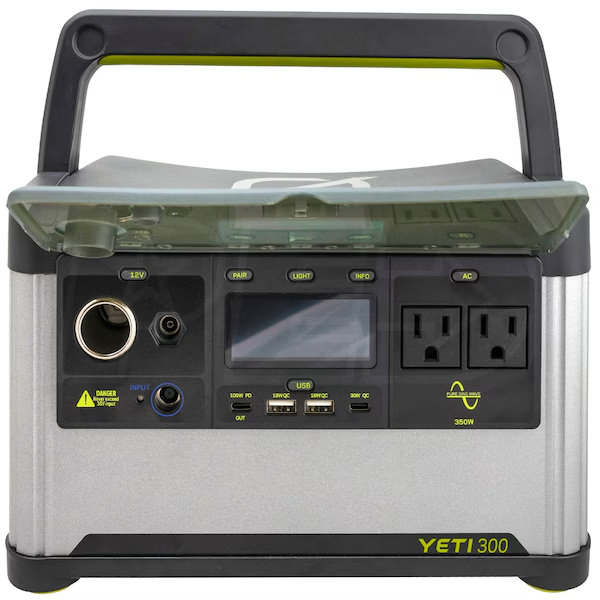
$349.95 · direct from Goal Zero
Last checked 1 day ago. Prices move — check before you buy.

$499.00 · direct from Jackery
Last checked 1 day ago. Prices move — check before you buy.
Spec deltas
Buy the Explorer 600 v2. These two weigh 13.7 and 14.1 pounds, which in a trunk or on a shoulder is the same weight, and one of them holds 640Wh while the other holds 297Wh. Divide it out: 21.7 watt-hours per pound against 45.4. Same armful, roughly double the energy.
The money reads the same way. $499 against $350, and the gap buys more than twice the battery, which makes it the cheapest capacity anywhere on this page.
The Yeti 300 has real cards and the price is the smallest of them. Our record credits it with IP54 dust and water resistance and a 0-100% recharge in 50 minutesA2, and it's rated for 4,000 cycles against 3,000. What it doesn't have is room. After the flat 85% derate the engine applies to every unit, it has 252Wh of working energy, which is less than the smallest load this page models. All six scenarios below are out of its reach, and five of the six are out of the Explorer's too.
What the Numbers Reveal
Each conclusion stated first — the numbers behind it on one line, the full analysis below.
weight
Price makes that worse rather than better. The $149 between them ($499 against $350) buys 343Wh, which works out to about 43 cents per added watt-hour, while the Yeti prices its own capacity at $1.18 per Wh. You're paying nearly three times the rate (43 cents against $1.18) to save four-tenths of a pound.
Yeti 300: 297Wh at 13.7 lbs, $350Explorer 600 v2: 640Wh at 14.1 lbs, $499Yeti 300 cost per Wh: $1.18
Why it mattersAnyone who picked the Yeti because the smaller number sounded like the more portable unit should look at the scale, then at the receipt, and pick again.
Capacity
The cycle count is the Yeti's best-looking number and it's the one that dies under multiplication. It may also be the conservative half of a disagreement: reviewers put the Explorer's LFP lifespan above the figure carried in some spec listingsB2, and our 3,000 is deliberately the low reading rather than the marketed one. Cost per lifetime kilowatt-hour lands at 29 cents against 26, which is level. That matters because longevity was the row the Yeti was supposed to win outright.
Yeti 300 rated 4,000 cycles at 297WhExplorer 600 v2 rated 3,000 cycles at 640WhCost per lifetime kWh: $0.29 against $0.26
Why it mattersDon't pay for the Yeti on lifespan. Buy it for the weatherproofing or the price, or don't buy it.
The next rung up is Tailgate Party at 670Wh, which the Explorer misses by 126Wh, so there's nothing modelled between 320Wh and 670Wh where this size class competes. The buyer these two are actually built for is the one the scenarios never describe: 4-6 hours of laptop, or 20-30 phone charges, and a lightA3. The board's floor sits above the whole product class, which is a fact about the board, not a verdict on either unit.
The smallest load modelled on this page is CPAP Overnight at 320WhYeti 300 usable: 252Wh after the flat 85% derateExplorer 600 v2 usable: 544Wh
Why it mattersIf any of the six scenarios below is your evening, close this page and shop for a station sized to it. The blackout profile alone asks 1,645Wh.
continuous output
It's academic on that scenario, since the Yeti is 418Wh short of the 670Wh it needs regardless. It generalises badly though: the Yeti's headroom above 350W is a surge allowance, not a running one, and our record has exactly that failure on tape, a shutdown about two minutes into a coffee maker run near its rated limitA3. The Explorer takes the same 400W inside its 500W continuous rating and never touches its surge.
Yeti 300: 350W continuous, 600W surgeTailgate Party's peak draw is 400WExplorer 600 v2: 500W continuous, 1,000W surge
Why it mattersIf anything on your list pulls more than 350W for longer than a moment, the Yeti is out on the inverter before capacity gets a say.
The specific dimensions that decide these two units — everything else is a tie.
Runtime: Will It Power Your Gear?
Selected because: 640Wh against 297Wh is the only spec here with a real gap in it, and it sets everything else on the page.
continuous output
640Wh against 297Wh is the only number on this page that changes an evening. Derated at the flat 85% the engine applies to every unit, that's 544Wh and 252Wh of working energy. The derate is a fixed constant rather than a measurement of either inverter, so it takes the same proportional bite out of both and leaves the gap exactly where the nameplates put it.
The catch runs the other way on refill, and it's worth naming before you buy the bigger box. Both units cap solar input at 200W, so from empty the Explorer wants 3.2 hours at that full rated figure against the Yeti's 1.5 (640 divided by 200, and 297 divided by 200), and no panel holds its rating all day. Our record also credits the Yeti with a 0-100% recharge in 50 minutesA2, with no published AC input figure on the Explorer to hold against it. Bigger battery, longer wait.
Portability & Form Factor
Selected because: 13.7 lbs against 14.1 is four-tenths of a pound, so the smaller battery buys you nothing you can feel.
weight
Four-tenths of a pound is the entire portability argument, and it evaporates the moment both units are on a scale. 13.7 lbs and 14.1 lbs is the same lift, the same one-hand carry from the tailgate to the picnic table, the same footprint in the trunk. Reviewers call the Explorer the lightest thing in its capacity classB1, and the Yeti's build earns consistent praise for rubberized corners and a handle that feels like someone had carried oneA2.
There is one portability spec the Yeti wins, and it wins by default: our record carries an ingress rating for it, IP54, and none at all for the ExplorerA2. If this unit is going to live on a boat deck, a jobsite, or under a tent fly in the rain, that absence outranks the capacity gap. Anywhere dry, it's a spec looking for a job.
Your Life, Your Pick
Selected because: The smallest load modelled here is 320Wh and the Yeti 300 has 252Wh usable, so the board's floor sits above one of these units entirely.
The floor of this board is 320Wh, the CPAP night, and the Yeti 300 has 252Wh usable. It loses all six scenarios and not one of them is close, which says less about the Yeti than about the board: nothing modelled here is sized for a 297Wh unit. The Explorer finishes the CPAP night with 224Wh in hand and misses the other five.
Read the five misses by size rather than by the near-identical wording they get. Remote Workday is the near one, where the Explorer covers 544Wh of the 910Wh asked. Tailgate Party is 126Wh short. Weekend Camping wants 2,100Wh and the blackout profile 1,645Wh, more than two and a half times the Explorer's entire nameplate (1,645 divided by 640). Van Life Daily asks 4,685Wh and belongs to a different category of product. A miss is not a miss is not a miss.
Lifetime Value
Selected because: 4,000 cycles against 3,000 sounds decisive until you multiply by capacity: 1,188 kWh against 1,920 kWh.
cost / lifetime kWh
The Yeti's 4,000 cycles against 3,000 is the one row where it leads, and multiplying by capacity ends the argument: 4,000 x 297Wh is 1,188 kWh of lifetime energy, 3,000 x 640Wh is 1,920 kWh. Cost per lifetime kilowatt-hour comes out 29 cents to 26, close enough that nobody should decide anything on it.
Treat the 11-years-against-8.2-years framing beside it with care. Those figures are cycles divided by how often you use the thing and carry no capacity term at all, so two units with a threefold capacity gap would print the same lifespan. The Yeti reaches more birthdays. The Explorer moves more energy before it gets to them.
What the Specs Don't Tell You
Selected because: Three cards fire, two of them are non-differences, and the third is about a noise figure only one unit publishes.
rated cycles
Two of the three cards are non-differences with a suit on: identical 5-year warranties, and a cycle-life card whose real content is the lifetime-energy arithmetic above. The third is worth a beat. The Explorer publishes 30dB, the Yeti publishes nothing, and the card reads that silence as a point against the Yeti. It isn't one. One manufacturer chose to print a number and the other didn't, we have measured neither, and the printed figure arrives with no load or mode attached to it.
Strengths & trade-offs
Goal Zero Yeti 300
Strengths
- +Costs $149.1 less
- +Lighter by 0.4 lb
Trade-offs
- –Shorter-lived battery — rated for 4,000 charge cycles vs the Explorer 600 v2's 6,000, so it wears out sooner.
Jackery Explorer 600 v2
Strengths
- +Larger battery capacity
- +Higher AC output
- +Rated for 6,000 charge cycles — much longer battery lifespan
Trade-offs
- –Substantially more expensive (+$149.1) than the Yeti 300.
Will It Power Your Gear?
Scenario math and per-appliance runtimes, modeled from the spec record.
Scenario verdicts
We ran the math on seven real-world scenarios. Here's which unit survives your actual life.
SCN-01 · 2 nights · needs 2,100Wh
Weekend Camping
Two nights off-grid with essential comfort
Neither unit
Neither unit is in this conversation. A modelled camping weekend wants 2,100Wh; the Yeti 300 brings 252Wh of usable energy and the Explorer 600 v2 brings 544Wh, leaving them 1,848Wh and 1,556Wh short. These are day-trip batteries being asked to do a weekend, and the honest answer is a bigger station rather than a choice between two small ones.
Battery budget usedlower = more headroom
LOAD Phone Charger 15W×6h · LED Lights 40W×8h · Box Fan 75W×14h · CPAP Machine 40W×16h
SCN-02 · 8 hours · needs 1,645Wh
8-Hour Blackout
Keep the essentials running through a night without power
Neither unit
Neither covers it, and the two misses are not the same size. The profile needs 1,645Wh: the Yeti 300 is 1,393Wh short and the Explorer 600 v2 is 1,101Wh short, so even the better of the two stops with roughly two-thirds of the outage still ahead of it (1,101 of 1,645). There is no reserve for a second night here because neither unit finishes the first one. If backup is the reason you're shopping, this is the wrong shelf.
Battery budget usedlower = more headroom
LOAD Fridge 150W×8h · Router + Modem 20W×8h · LED Lights (4 bulbs) 40W×6h · Phone Charger 15W×3h
SCN-03 · 8 hours · needs 320Wh
CPAP Overnight
Sleep therapy without interruption — the #1 medical use case
Explorer 600 v2
The Explorer 600 v2 takes this one, and it's the only scenario on the board either unit finishes. The night is scored at 320Wh; the Explorer has 544Wh usable and ends with 224Wh in hand, while the Yeti 300's 252Wh falls 68Wh short and gives out before morning. Be precise about that leftover though: 544Wh against 320Wh a night is 1.7 nights of CPAP, not two. Recharge daily and it's a non-issue.
Battery budget usedlower = more headroom
LOAD CPAP Machine 40W×8h
SCN-04 · 8 hours · needs 910Wh
Remote Workday
Full work day off-grid without power anxiety
Neither unit
Partial cover, and only one of the two partials is worth having. The day is scored at 910Wh: the Explorer 600 v2's 544Wh usable reaches 60% of it, the Yeti 300's 252Wh reaches 28%. Neither finishes the day. One of them gets you three-fifths of the way and the other barely over a quarter, which is the difference between rationing the afternoon and not starting.
Battery budget usedlower = more headroom
LOAD Laptop 60W×8h · External Monitor 30W×8h · Router + Modem 20W×8h · Phone Charger 15W×2h
SCN-05 · 4 hours · needs 670Wh
Tailgate Party
Game day power for the crew
Neither unit
Neither covers it, and the stated reason for the Yeti 300 needs correcting. The scenario's 400W peak sits above the Yeti's 350W continuous rating but under its 600W surge, so that load starts and then drops out rather than refusing to start. It makes no difference to the outcome, since the Yeti is 418Wh short of the scenario's 670Wh either way. The Explorer 600 v2 runs 400W comfortably inside its 500W continuous rating and still finishes 126Wh short, which is the most annoying result on this board: close enough to feel like it should have worked.
Battery budget usedlower = more headroom
LOAD Blender 400W×0.5h · LED TV (55") 80W×4h · Bluetooth Speaker 15W×4h · Phone Charger (×3) 45W×2h
SCN-06 · 24 hours · needs 4,685Wh
Van Life Daily
A full day of mobile living — the ultimate endurance test
Neither unit
Neither, by a margin that makes the comparison pointless. A van's modelled daily draw is 4,685Wh; the Yeti 300 is 4,433Wh short and the Explorer 600 v2 is 4,141Wh short. That shortfall is more than seven times the Explorer's entire nameplate (4,685 divided by 640). This is a wiring-and-battery-bank question, not a portable-power-station question.
Battery budget usedlower = more headroom
LOAD Mini-Fridge 150W×24h · Laptop 60W×4h · Phone Charger 15W×3h · LED Lights 40W×5h · Fan 75W×8h
SCN-07 · an afternoon · needs 100Wh
Afternoon Off-Grid
Phones and a speaker at the park, beach, or campsite — the small-unit job description
Either unit
This is the job small stations are actually for, and both do it: the Yeti 300 finishes at 40% used, the Explorer 600 v2 at 18%. At this size the decider is what rides in the bag — 13.7 lbs for the Yeti 300 against 14.1 for the Explorer 600 v2 — and price, not the leftover watt-hours.
Battery budget usedlower = more headroom
LOAD Phone Charger (×2) 30W×2h · Bluetooth Speaker 10W×4h
The Load Test
RUNTIME = (Wh × 0.85) ÷ LOAD
None of the scenarios above exactly yours? Build it. Toggle what you'd plug in; both units are tested against the combined draw.
Essentials
Comfort & Convenience
High-Draw Appliances
Test duration
8h
Continuous draw
205W
Projected runtime
For this load: Explorer 600 v2 runs 2.7h vs 1.2h.
$499 list · direct from Jackery
Modeled from the spec record — same math as the tables below. Methodology
Runtime by appliance
Real-world runtime estimates for common appliances, modeled at 85% inverter efficiency.¹
Essentials
The basics you need runningscale 0–36.3hComfort & Convenience
Makes off-grid life actually enjoyablescale 0–7.3hHigh-Draw Appliances
These reveal the real limits¹ Runtime = (capacity × 0.85) ÷ appliance watts. Within each group, all bars share one time scale (the group's longest runtime), so lengths are comparable across appliances; identical runtimes collapse into a single blue/orange bar. Actual runtime varies with battery age, temperature, and simultaneous loads — see methodology.
Conclusion
August 9, 2026
Verdict: the Explorer 600 v2, on Power Score margin
Take the Explorer 600 v2. It holds 640Wh to the Yeti 300's 297Wh and asks for four-tenths of a pound more to carry it (14.1 lbs against 13.7), so the tradeoff you expect from the smaller unit never actually arrives. The Yeti's one leading row, 4,000 cycles against 3,000, doesn't survive multiplication: 4,000 x 297Wh is 1,188 kWh of lifetime energy against 1,920 kWh from 3,000 x 640Wh. Two things would still send you the other way. A hard $350 ceiling, or a unit that's going to get rained on, since the Yeti carries an IP54 rating in our recordA2 and the Explorer carries none. Otherwise this is the Explorer at $499, and it isn't close.
Editor-assigned confidence, based on cited owner research and spec analysis.
List prices as of August 9, 2026. The links below open Goal Zero's and Jackery's current prices.
$499.00 · direct from Jackery
Last checked 1 day ago. Prices move — check before you buy.
or check the Yeti 300 price$349.95 list
Written by Wenny Zheng, Portable Power Tester · Station Arena Test Desk · Updated August 9, 2026
Measured Data
Benchmark scores and the full spec record, side by side.
Benchmark scores
Full specifications
ᵈ Derived: price ÷ rated capacity. See the data behind our comparisons →
Comparison ToolAdd more power stations, side by sideOpen Tool →How these numbers are produced
Numeric verification
Every figure on this page traces to our spec database or arithmetic on it — no estimated numbers.
Owner claims
Statements about owner experience are cited to published reviews — see Sources & Research Notes below.
Runtime model
Runtime = (rated capacity × 0.85 inverter efficiency) ÷ device wattage. Solar recharge estimates assume panels deliver 70% of rated output. Cold weather, battery age, and stacked loads reduce real-world results.
Power Score
Computed from 14 published spec dimensions, weighted per use-case bench. Higher is better; a unit must meet a bench's minimum threshold to be rated.
See the full weight table and data sourcing on our methodology page →Class ranking (the star rating)
Each unit's star score is a category ranking, not customer reviews — no buyer opinions feed it. We score every station on size-independent quality (value, output, portability, endurance, ports, warranty, and more), then percentile-rank it against the other units in its capacity class, so a class-leading compact unit and a class-leading whole-home unit can both earn 5★. Here, Yeti 300 rates 3.7/5 (24th percentile of 22 Personal-class units), and Explorer 600 v2 rates 4.2/5 (53rd percentile of 20 Compact-class units).
How the class ranking is computed →Test Notes & Caveats
Hidden gotchas and advantages we spotted that you won't find on the product page.
Warranty: No Difference
Both units carry the same 5-year warranty, so coverage isn't a tiebreaker here. The Explorer 600 v2's figure is a maximum rather than a guarantee — it depends on registering the unit with Jackery, which is what extends the base term to the full period. Worth saying because the per-dollar framing can suggest otherwise: the Yeti 300 works out at 14.3 years of cover per $1,000 spent against the Explorer 600 v2's 10, but that spread is the price gap, not the terms.
4,000 Cycles, 1,188 kWh
Cycles are half the sum. 4,000 x 297Wh gives the Yeti 300 about 1,188 kWh across its rated life; 3,000 x 640Wh gives the Explorer 600 v2 about 1,920 kWh. The Yeti reaches more charge cycles and moves 38% less energy getting there. The year figures alongside are cycles divided by how often you use the unit and carry no capacity term at all, so read them as a schedule rather than as value.
One Published Number, No Measurement Behind Either
The Explorer 600 v2 lists 30dB and the Yeti 300 lists nothing, which is a difference in disclosure practice rather than in noise. A missing figure is not evidence of a loud fan, and the printed one arrives with no stated load or mode attached to it. We have measured neither unit. If this is going next to a bed, treat both as unknown and find hands-on audio before you spend.
Full record above — the Test Desk pick is the Explorer 600 v2.
Check Explorer 600 v2 price →or check the Yeti 300 priceOwnership Analysis
What happens after you buy — true cost of ownership, brand trust, and growth potential.
Lifetime value
Service lifeyears at one full cycle per day
Lifetime energy delivered
Cost per delivered kWh
│ warranty ends · Reaching the cycle rating means ~80% capacity remains — degraded, not dead.
Analyst note
The Yeti 300 is cheaper to buy, but the Explorer 600 v2 is cheaper to own. At $0.13/kWh over its lifetime vs $0.29/kWh, the Explorer 600 v2's higher cycle life and capacity make each dollar go further over the years.
Delivers each lifetime kWh for $0.16 less — check the Explorer 600 v2 price →
Brand trust
Goal Zero
Ecosystem
Focused — a compact current line (6th-gen Yeti and Yeti Pro series), the previous-gen X series now out of stock across every model on Goal Zero's own store (checked 2026-09-13: 200X, 500X, 1000X, 1500X, 3000X, 6000X, some listed only as open-box), so buying one new means finding retailer stock, Sherpa power banks for the under-100Wh tier, plus Alta coolers, Nomad/Ranger solar panels, and vehicle integration kits
Support
US-based company (Salt Lake City, owned by NRG Energy). Historically considered premium support, but 2025-2026 reports describe long wait times, unresponsive email communication, and tickets going unaddressed for weeks. The "premium support justifies premium pricing" argument is weakening.
Community
Small but loyal — strong following in overlanding and preparedness communities. Official community forums were recently shuttered, frustrating long-time users.
App experience
Rated 4.4/5 iOS (~1,200 ratings) but recent reviews skew negative — recurring connectivity issues, crashes, and stability problems.
Unique strength
Pioneer of the portable power market — strongest brand heritage. US-based company with ruggedized, weather-resistant designs (IP ratings vary by model). Integrated "Yeti-Ready" ecosystem with coolers, lights, and vehicle kits.
Worth knowing
The note about the lowest watt-hours per dollar isn't a generalisation on this page, it's this page. $1.18 per Wh against $0.78 is the Goal Zero premium showing up on the receipt, and a ruggedized, weather-resistant build is what it buys.
Jackery
Ecosystem
12-15+ models across Explorer (portable) and HomePower (home backup) series, plus SolarSaga panel ecosystem and innovative form factors
Support
US-based support but widely criticized. Reddit reports describe slow/dismissive responses, scripted AI agents, strict receipt requirements for warranty claims, and refurbished replacements for clearly defective units. Strongly recommended: buy from Costco or Amazon for return protection.
Community
Smallest community of the major brands — Reddit r/Jackery has ~2,000 members. YouTube presence is solid due to brand recognition.
App experience
Rated 2.3-3.3/5 iOS and Android — the weakest app experience of the major brands. Multiple confusing apps (Jackery app vs Jackery Home) and mandatory login even offline.
Unique strength
Highest brand recognition and widest retail distribution (Costco, Home Depot, Best Buy, Amazon). The "Toyota" of power stations — dependable, proven, wide availability. Innovative form factors like the Solar Gazebo and Solar Mars Bot.
Worth knowing
The line-wide caution about older NMC chemistry settles nothing about this unit. Check the Explorer 600 v2's own cycle rating rather than the brand-level one, which is exactly what that caveat is telling you to do.
Analyst note
Support isn't a tiebreaker here, because our brand assessment is unflattering about both. Goal Zero's premium-support reputation has been eroding and its official forums are gone; Jackery's draws steady criticism, with the standing advice being to buy through a retailer that has its own returns policy. Buy either one from somewhere you can send it back to, and treat the matching 5-year warranties as paperwork rather than as a plan.
Growth path
Yeti 300
FIXED CAPACITYFixed at 297Wh, with no expansion — so size it for your needs up front rather than planning to add capacity later.
Accepts up to 200W of solar. Limited to a single portable panel.
Adequate ports for most setups, but heavy users may want a power strip.
Explorer 600 v2
FIXED CAPACITYFixed at 640Wh, with no expansion — so size it for your needs up front rather than planning to add capacity later.
Accepts up to 200W of solar. Limited to a single portable panel.
Limited ports. You'll likely need a power strip or splitter.
Realistic full solar rechargeat 70% of rated panel output — see methodology
Analyst note
Neither expands, and that's no knock on either — each is a complete unit at a fixed size. Buy the capacity that covers your needs now (the Explorer 600 v2 gives you the larger ceiling); you can't add to either later.
What Owners Report
Patterns from published owner reports and long-term reviews — every claim cited to its source below.
Goal Zero Yeti 300
The record on the Yeti 300 is reviews, not long-term owners. Four entries, all of them from review sites or the manufacturer, none from anyone who has lived with it through a seasonA1A2A3A4. What they agree on is the hardware: 13.7 lbs, IP54, rubberized corners, a sturdy handle, and a 0-100% recharge in 50 minutes, behind a 350W pure sine inverter with 600W of surge and a 4,000-cycle LFP packA1A2.
The complaints are the same complaint twice. The 297Wh pack is good for 4-6 hours of laptop or 20-30 phone charges and no more, and one reviewer had it shut down about two minutes into a coffee maker run near its rated limitA3. The price draws a shrug as well, with one entry calling $350 a sting for the capacityA4. Nobody in the record disputes that it's a good small unit. They dispute that it's worth the money.
“A 297Wh LiFePO4 pack behind a 350W pure sine inverter (600W surge), rated 4,000 cycles — Goal Zero backs it with a long service life rather than raw output.”
Sources
goalzero.com · batteryskills.com · campingsolar.us · trailandkale.com · the-gadgeteer.com
Jackery Explorer 600 v2
The Explorer 600 v2's ledger is thinner than four entries makes it sound, since three of them trace back to the same review outlet, and exactly one summarises owner feedback at all: affordable, light, easy to carry, easy to operateB3. That's a pleasant sentence and it is not field experience. This unit is new enough that nobody has reported back from year three.
Two entries do change a buying decision. Reviewers describe the v2 as the lightest station in its capacity class and put its LFP rating above the figure some spec listings carryB1B2, which means our 3,000 cycles is the conservative reading rather than the marketed one. And its rated AC output isn't consistent across listings, with some showing 600W where ours shows 500WB4. Every output judgment on this page uses 500W, so the Explorer is being scored on the pessimistic figure throughout. It wins anyway.
“The world's lightest 600Wh-class power station at about 14 lbs — roughly 23% smaller than similar-capacity models.”
Sources
backuppowerhub.com · jackery.com · bestecosolar.com · mrsolar.com
Sources & Research Notes
Every owner claim in this report is traceable to a published source. The bracketed references above resolve here.
Recurring owner themes
- Modern LFP (4,000+ cycles), IP54 ruggedness, and fast charging are the praise; small capacity and high price are the caveats. [Yeti 300 · 3 entries]
- Standout light weight (world's lightest 600Wh-class), a newer stable LFP battery, and easy operation are the praise; rated output and cycle figures vary across sources. [Explorer 600 v2 · 3 entries]
- A1
“A 297Wh LiFePO4 pack behind a 350W pure sine inverter (600W surge), rated 4,000 cycles — Goal Zero backs it with a long service life rather than raw output.”
goalzero.com / batteryskills.com — Yeti 300 review · 2026 · [positive]
- A2
“At 13.7 lbs, meets IP54 for dust and water resistance, with top-tier build quality — rubberized corners and a sturdy handle; recharges 0-100% in 50 minutes.”
campingsolar.us / trailandkale.com — Yeti 300 review · 2026 · [positive]
- A3
“The 297Wh capacity limits it to lighter-duty use — 4-6 hours on a laptop or 20-30 phone charges — and it struggled near its 300W limit, shutting down after 2 minutes with a coffee maker.”
batteryskills.com — Yeti 300 review · 2026 · [mixed]
- A4
“A modern LFP (not NMC) rugged compact unit, though at $349.95 the price stings for the capacity.”
the-gadgeteer.com — Yeti 300 review · 2026 · [mixed]
- B1
“The world's lightest 600Wh-class power station at about 14 lbs — roughly 23% smaller than similar-capacity models.”
backuppowerhub.com / jackery.com — Explorer 600 v2 review · 2026 · [positive]
- B2
“Uses a shift to LFP (LiFePO4) chemistry that is chemically more stable and far less prone to overheating, engineered with a rating for well over a decade of lifespan — higher than the figure in some spec listings.”
backuppowerhub.com / bestecosolar.com — Explorer 600 v2 review · 2026 · [positive]
- B3
“Owner feedback highlights that it is affordable, lightweight, easy to carry, and easy to operate.”
backuppowerhub.com — Explorer 600 v2 owner feedback · 2026 · [positive]
- B4
“Listed AC output varies by source — some cite a 600W rating where others show 500W — so its rated output figure is not fully consistent across listings.”
mrsolar.com / jackery.com — Explorer 600 v2 listings · 2026 · [mixed]
Research compiled August 9, 2026.
Who Should Buy Which
Buy the Yeti 300 if you…
- →Your unit is going to get rained on. IP54 is the only ingress rating anywhere in this matchupA2, and on a boat deck or a jobsite that outranks the capacity gap.
- →Your load list genuinely ends at a laptop and phones. 4-6 hours of laptop or 20-30 phone charges is a real day for plenty of peopleA3, and the extra $149 buys headroom you'd never touch.
- →You need it full again before you leave the house. A 0-100% in 50 minutesA2 is the Yeti's quietest advantage, and there's no published AC input figure on the Explorer to answer it with.
Buy the Explorer 600 v2 if you…
- →You run a CPAP. It's the only modelled night either unit finishes: 544Wh usable against the 320Wh the scenario asks, ending with 224Wh spare. The Yeti falls 68Wh short, which is the tail of the night rather than the whole of it, and the tail is when you're asleep.
- →You want one box to cover a working day away from an outlet. 544Wh of the 910Wh a remote workday models isn't the whole list, but it's the part of the list you'd actually miss.
- →You're eyeing the Yeti while quietly planning to buy a second one later. Neither unit expands, so the second unit is the only plan available. Buy the bigger one once and skip the step.
If neither fits
Anyone whose evening looks like the scenarios on this page should close the tab cheerfully. A modelled 8-hour blackout wants 1,645Wh and the larger of these two holds 640Wh. A van's daily draw wants 4,685Wh. Neither of these is a home-backup unit or a fridge unit, and buying one to be a mediocre version of both is how people end up owning three power stations. Shop the class where 1,645Wh is the starting point, not the fantasy.
The Bottom Line
Take the Explorer 600 v2. You pay four-tenths of a pound in weight and $149 in money, and what comes back is more than twice the battery. Everything else on the page is either identical (the same 200W solar ceiling, the same 100W USB-C, the same 5-year warranty) or resolves in the same direction, including the cycle-life row the Yeti appears to win until you multiply it by capacity.
The Yeti 300 is a good small box with one card worth real respect: it's the only unit here with an ingress ratingA2, and the loudest complaint in its own record is the price rather than the productA4. If it's going to live outdoors, buy it. If it's going to live in a closet until the lights go out, buy the one that holds 640Wh, and go in knowing that neither of them is the unit for the night you're picturing.
Frequently Asked Questions
Answers drawn from the spec record and cited owner research.
Is the Jackery Explorer 600 v2 worth $149 more than the Goal Zero Yeti 300?
Yes, on the arithmetic. $499 against $350 buys 343Wh of extra capacity (640Wh against 297Wh), which is about 43 cents per added watt-hour, against the $1.18 per Wh the Yeti charges for the capacity it already has. The two reasons to take the Yeti anyway are a hard budget ceiling at $350, or the IP54 rating our record gives it.
Can the Goal Zero Yeti 300 run a CPAP overnight?
Not on this page's model of one. A CPAP night is scored at 320Wh and the Yeti has 252Wh usable after the flat 85% derate, so it's 68Wh short and quits before morning. The Explorer 600 v2 covers it with 224Wh spare, which is 1.7 nights on a charge (544 divided by 320), not two, so plan on recharging daily either way.
Which is more portable, the Yeti 300 or the Explorer 600 v2?
Neither, in any way you'd notice. 13.7 lbs against 14.1 lbs is four-tenths of a pound, a one-hand carry either way. Reviewers describe the Explorer as the lightest station in its capacity class; the Yeti is simply a smaller battery in a similarly sized box, so you carry the same thing and get 297Wh instead of 640Wh.
Does the Yeti 300's 4,000-cycle rating mean it lasts longer than the Jackery?
It reaches more charge cycles and delivers less energy getting there. 4,000 x 297Wh is 1,188 kWh over the Yeti's rated life; 3,000 x 640Wh is 1,920 kWh over the Explorer's. Cost per lifetime kilowatt-hour works out at 29 cents against 26, which is a wash, and reviewers put the Explorer's rating above the 3,000 our database uses.
Will either of these get my house through a power outage?
No. The blackout profile here needs 1,645Wh, and the Yeti has 252Wh usable while the Explorer has 544Wh, leaving them 1,393Wh and 1,101Wh short. These are laptop, phone and CPAP units, not backup units. For an outage, shop for a station sized to that 1,645Wh instead of choosing between these two.
Where to buy
Goal Zero Yeti 300
$349.95
$349.95 · direct from Goal Zero
Last checked 1 day ago. Prices move — check before you buy.
Jackery Explorer 600 v2Pick
$499.00
$499.00 · direct from Jackery
Last checked 1 day ago. Prices move — check before you buy.
Prices may vary by retailer and are subject to change.