Head-to-head test
Goal Zero Yeti 1500X vs Goal Zero Yeti 500X
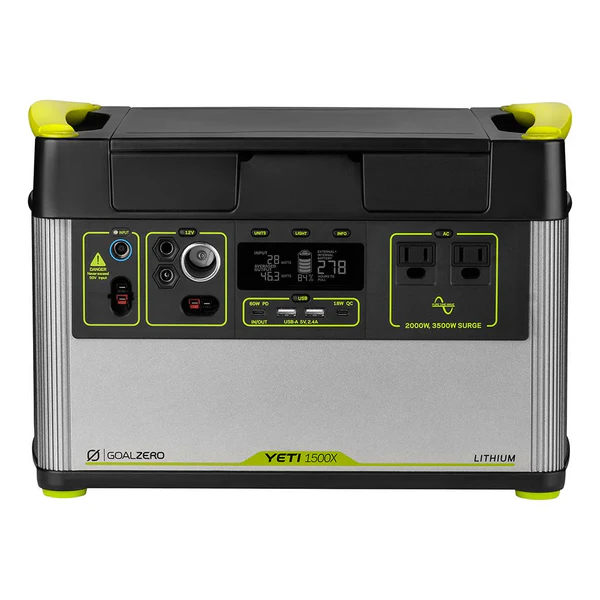
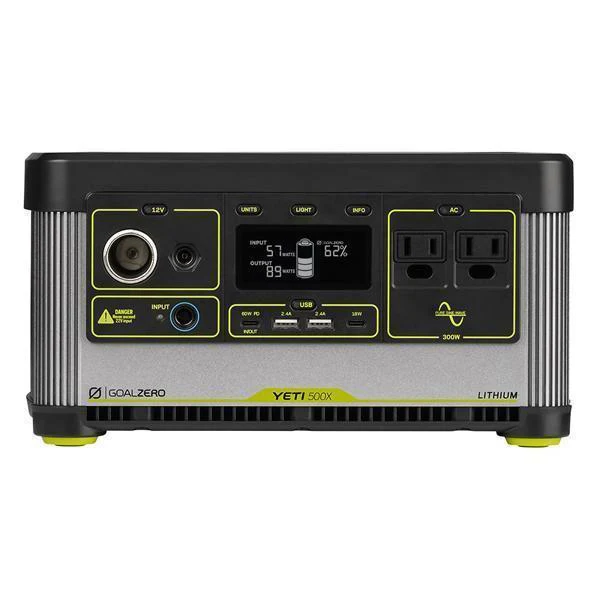
The 500X isn't a small 1500X. It's a 300W device charger, and the only question that settles this page is whether anything you plan to plug in draws more than that.
Full profiles: Goal Zero Yeti 1500X → · Goal Zero Yeti 500X →

Written by Ian SchneiderUpdated
Solar & Off-Grid Tester, Station Arena Test Desk
$1,124.89 · direct from Goal Zero
Last checked 1 day ago. Prices move — check before you buy.
$499.95 · direct from Goal Zero
Last checked 1 day ago. Prices move — check before you buy.
Spec deltas
The Yeti 500X can't start a tailgate load. That isn't a capacity problem, it's a 300W inverter: the engine's 670Wh tailgate profile asks for a peak the 500X won't pass, while the 1500X's 2,000W inverter and 3,500W surge don't notice it. Before you weigh $1,125 against $500, write down what you actually intend to plug in.
These two share more than the model numbers suggest. Same 500-cycle rating, same two-year warranty, same 60W USB-C port, same 25ms switchover. What the money changes is capacity (1,516Wh against 497Wh), the inverter (2,000W against 300W), solar input (600W against 120W) and weight (45.6 lb against 12.9 lb).
The odd part is that the big one is the better deal per unit of energy. $0.74 per watt-hour against $1.01, and $1.48 per lifetime kilowatt-hour against $2.01. The 500X is the cheaper purchase and the more expensive electricity.
What the Numbers Reveal
Each conclusion stated first — the numbers behind it on one line, the full analysis below.
solar input
Any outage worth planning for is a recharge problem rather than a capacity problem, because 1,645Wh already exceeds both batteries. Give each one a good solar day and the 1500X banks its whole 1,516Wh before lunch while the 500X spends the afternoon recovering 497Wh. The small unit's limit isn't the tank. It's the straw.
Yeti 1500X: 600W maximum solar input, 1,516Wh capacityYeti 500X: 120W maximum solar input, 497Wh capacityThe 8-Hour Blackout profile needs 1,645Wh, more than either unit holds
Why it mattersIf you're buying for outages that run past sunset, the 120W input is the spec that fails you, not the 497Wh.
continuous output
Draw the line at 300W and the 500X's job description writes itself: laptops, phones, a CPAP, lights, and nothing that starts a motor or heats an element. A compressor pulls several times its running wattage in the first second, and the 500X has 600W of surge to answer with. Capacity never enters the argument.
Yeti 500X: 300W continuous, 600W surgeYeti 1500X: 2,000W continuous, 3,500W surgeTailgate Party (670Wh): the engine says the 500X can't power the load's peak and the 1500X can
Why it mattersLook up the wattage of the one appliance you're buying this for. Over 300W and the 500X is out before price is discussed.
Capacity
That lands at $1.48 per lifetime kilowatt-hour against $2.01. Every unit of energy that ever leaves the 500X costs about a third more than one from the 1500X, and there are exactly a third as many of them to leave.
$1,125 buys 1,516Wh at $0.74 per watt-hour; $500 buys 497Wh at $1.01 per watt-hourBoth units are rated for 500 cyclesLifetime energy: 758 kWh for the 1500X, 249 kWh for the 500X
Why it mattersIf sticker price is doing the deciding for you, understand that you're paying more per watt-hour for the privilege of spending less today.
Cycle one of these every day and you're shopping again in about a year and a half, which falls inside the two-year warranty. Run it on the weekend pattern and the same 500 cycles stretch to 4.8 years, at which point you can stop thinking about the number entirely.
Both units are rated for 500 cyclesThe same 500 cycles work out to 1.4 years at daily cycling, 4.8 years on the weekend pattern and 9.6 years at weekly use, identically for bothReviewers place both in the 500-cycle NMC generation and call it a structural disadvantage against current LiFePO4 unitsA1B4
Why it mattersDaily off-grid users should skip both and shop LiFePO4; weekend campers and blackout buyers can ignore cycle life here and decide on the inverter.
The specific dimensions that decide these two units — everything else is a tie.
Runtime: Will It Power Your Gear?
Selected because: the useful difference isn't 1,516Wh against 497Wh, it's whether a 300W inverter will pass the load at all.
continuous output
Runtime tables flatter the 500X, because a table assumes the load is already running. The 300W inverter is the gate standing in front of every row: under it the 500X does honest work, over it there's no runtime to calculate. The 1500X's 2,000W inverter and 3,500W surge move that gate far enough back that you stop thinking about it.
Where the 500X is comfortable, it's genuinely comfortable. A CPAP night draws 320Wh, which the engine puts at 76% of the 500X and 25% of the 1500X. One night is one night on either unit. The difference arrives on night two, when the 500X is empty and the 1500X still has two more in it.
Your Life, Your Pick
Selected because: the engine's load profiles are where the 500X's 300W ceiling stops being abstract: it can't start the 670Wh tailgate.
Three of the six profiles come back 'neither,' and that's the honest headline. A camping weekend (2,100Wh), an eight-hour blackout (1,645Wh) and a van-life day (4,685Wh) are all larger than either battery. Neither of these is a whole-weekend or whole-house answer, and any page that implies otherwise is selling.
The three that do resolve go to the 1500X for two different reasons. The remote workday (910Wh) is capacity: the 500X runs the load and quits less than halfway through, at 215% of what it can deliver. The tailgate (670Wh) is the inverter: the 500X can't power the peak at all. Losing on capacity means buy a bigger one. Losing on peak means buy a different one.
Lifetime Value
Selected because: the cheaper box delivers the more expensive energy, at $2.01 per lifetime kilowatt-hour against $1.48.
cost / lifetime kWh
Both boxes carry the same 500-cycle rating, which turns lifetime value into arithmetic anyone can check: 1,516Wh times 500 is 758 kWh, and 497Wh times 500 is 249 kWh. Same working life, three times the energy, two and a quarter times the money.
The warranty line reads $562 a year against $250, but with two identical two-year warranties that figure is just the price divided in half. It measures what you're risking, not what you're getting. The number measuring what you're getting is $1.48 against $2.01 per kilowatt-hour delivered, and it points the opposite way from the sticker.
Portability & Form Factor
Selected because: 12.9 pounds against 45.6 is the 500X's one clean win, and for some buyers it's the entire decision.
weight
12.9 pounds is a one-hand carry from the closet to the tent and back, and it's the one contest the 500X wins outright. Reviewers single out how compact it is for its capacity, and rate the build alongside itB2.
45.6 pounds is the other kind of carry. Both hands, a straight back, and a decision about which trip it makes rather than whether it comes along. That's the trade in a sentence: the 500X goes where you go, the 1500X goes where you put it.
Growth Path
Selected because: only one of these can grow, and it's worth knowing why that costs the sealed one less than it appears to.
solar input
The 1500X accepts Goal Zero expansion batteries, so 1,516Wh is a floor rather than a ceiling. That's the right property to own if there's any chance your needs climb toward partial-home backup, because the alternative is buying a second unit and running two.
The 500X is sealed at 497Wh, and that's a smaller loss than the spec sheet implies. Think about what expansion would actually buy: more watt-hours behind the same 300W inverter. You still couldn't plug in anything you can't plug in today. The 500X's ceiling was never the battery.
Strengths & trade-offs
Goal Zero Yeti 1500X
Strengths
- +Larger battery capacity
- +Higher AC output
- +Faster solar charging
Trade-offs
- –Substantially more expensive (+$624.9) than the Yeti 500X.
- –Significantly heavier (+32.7 lbs), making it harder to move.
Goal Zero Yeti 500X
Strengths
- +Costs $624.9 less
- +Lighter by 32.7 lb
Trade-offs
- –Weaker inverter (-1,700W) limits appliance compatibility.
- –Lacks smartphone app control for remote monitoring.
- –Sealed capacity — the Yeti 1500X can add batteries to grow past 497Wh; this one can't.
Will It Power Your Gear?
Scenario math and per-appliance runtimes, modeled from the spec record.
Scenario verdicts
We ran the math on six real-world scenarios. Here's which unit survives your actual life.
SCN-01 · 2 nights · needs 2,100Wh
Weekend Camping
Two nights off-grid with essential comfort
Neither unit
Neither unit covers a weekend. 2,100Wh is 163% of what the 1500X can deliver and 497% of the 500X, so the honest question is how much of the trip each one carries: roughly three-fifths for the 1500X, about a fifth for the 500X. If you camp where the sun reaches you, the 1500X's 600W solar input is what closes that gap. The 500X's 120W doesn't.
Battery budget usedlower = more headroom
LOAD Phone Charger 15W×6h · LED Lights 40W×8h · Box Fan 75W×14h · CPAP Machine 40W×16h
SCN-02 · 8 hours · needs 1,645Wh
8-Hour Blackout
Keep the essentials running through a night without power
Neither unit
Nobody wins this one. The profile wants 1,645Wh, more than the 1500X holds, so the realistic reading is about six of the eight hours from the 1500X and about two from the 500X. Both can start the loads. Only one gets you to bedtime.
Battery budget usedlower = more headroom
LOAD Fridge 150W×8h · Router + Modem 20W×8h · LED Lights (4 bulbs) 40W×6h · Phone Charger 15W×3h
SCN-03 · 8 hours · needs 320Wh
CPAP Overnight
Sleep therapy without interruption — the #1 medical use case
Either unit
Both get you through the night, so this is about margin rather than survival. 320Wh is 76% of the 500X and 25% of the 1500X: one night against four on a single charge. For a one-night outage the 500X is enough. For the kind of storm that takes a pole down, the 1500X is the one that doesn't need the weather to cooperate.
Battery budget usedlower = more headroom
LOAD CPAP Machine 40W×8h
SCN-04 · 8 hours · needs 910Wh
Remote Workday
Full work day off-grid without power anxiety
Yeti 1500X
The Yeti 500X doesn't finish — 422Wh usable against the 910Wh this needs leaves it 488Wh short, about 47% of the scenario covered. The Yeti 1500X covers it with 379Wh to spare.
Battery budget usedlower = more headroom
LOAD Laptop 60W×8h · External Monitor 30W×8h · Router + Modem 20W×8h · Phone Charger 15W×2h
SCN-05 · 4 hours · needs 670Wh
Tailgate Party
Game day power for the crew
Yeti 1500X
The 500X loses this before it starts. The load's peak sits above what a 300W inverter will pass, so its 159% capacity shortfall never even comes up for discussion. The 1500X takes the peak on a 2,000W inverter and spends 52% of its usable energy on the 670Wh. Anyone plugging in a griddle or a compressor can stop reading here.
Battery budget usedlower = more headroom
LOAD Blender 400W×0.5h · LED TV (55") 80W×4h · Bluetooth Speaker 15W×4h · Phone Charger (×3) 45W×2h
SCN-06 · 24 hours · needs 4,685Wh
Van Life Daily
A full day of mobile living — the ultimate endurance test
Neither unit
Both are out, and not narrowly. A van-life day asks 4,685Wh, more than three times what the 1500X delivers and eleven times the 500X. Worse, that's a load you'd be cycling every single day against a 500-cycle rating. The right answer to this scenario is a different chemistry, not a different Yeti.
Battery budget usedlower = more headroom
LOAD Mini-Fridge 150W×24h · Laptop 60W×4h · Phone Charger 15W×3h · LED Lights 40W×5h · Fan 75W×8h
The Load Test
RUNTIME = (Wh × 0.85) ÷ LOAD
None of the scenarios above exactly yours? Build it. Toggle what you'd plug in; both units are tested against the combined draw.
Essentials
Comfort & Convenience
High-Draw Appliances
Test duration
8h
Continuous draw
205W
Projected runtime
For this load: Yeti 1500X runs 6.3h vs 2.1h.
$1,124.89 list · direct from Goal Zero
Modeled from the spec record — same math as the tables below. Methodology
Runtime by appliance
Real-world runtime estimates for common appliances, modeled at 85% inverter efficiency.¹
Essentials
The basics you need runningscale 0–85.9hComfort & Convenience
Makes off-grid life actually enjoyablescale 0–17.2hHigh-Draw Appliances
These reveal the real limitsscale 0–1.3h¹ Runtime = (capacity × 0.85) ÷ appliance watts. Within each group, all bars share one time scale (the group's longest runtime), so lengths are comparable across appliances; identical runtimes collapse into a single blue/orange bar. Actual runtime varies with battery age, temperature, and simultaneous loads — see methodology.
Conclusion
August 1, 2026
Verdict: the Yeti 1500X, on Power Score margin
Take the Yeti 1500X at $1,125 unless your entire load list stays under 300W. It holds 1,516Wh against 497Wh and runs a 2,000W inverter against 300W, so the extra $625 buys three times the battery and nearly seven times the outlet for two and a quarter times the money. Both are rated for the same 500 cycles, which makes the value math simple: $1.48 per lifetime kilowatt-hour against $2.01. The 500X earns its place only as a device charger you carry, at 12.9 pounds, for laptops and phones and a CPAP and nothing with a compressor in it.
Editor-assigned confidence, based on cited owner research and spec analysis.
List prices as of August 1, 2026. The links below open Goal Zero's current price.
$1,124.89 · direct from Goal Zero
Last checked 1 day ago. Prices move — check before you buy.
or check the Yeti 500X price$499.95 list
Written by Ian Schneider, Solar & Off-Grid Tester · Station Arena Test Desk · Updated August 1, 2026
Measured Data
Benchmark scores and the full spec record, side by side.
Benchmark scores
Not rated for both units (minimum threshold unmet): RV Living, Home Backup, Solar Generator, Tailgating, Food Truck.
Full specifications
ᵈ Derived: price ÷ rated capacity. See the data behind our comparisons →
Comparison ToolAdd more power stations, side by sideOpen Tool →How these numbers are produced
Numeric verification
Every figure on this page traces to our spec database or arithmetic on it — no estimated numbers.
Owner claims
Statements about owner experience are cited to published reviews — see Sources & Research Notes below.
Runtime model
Runtime = (rated capacity × 0.85 inverter efficiency) ÷ device wattage. Solar recharge estimates assume panels deliver 70% of rated output. Cold weather, battery age, and stacked loads reduce real-world results.
Power Score
Computed from 14 published spec dimensions, weighted per use-case bench. Higher is better; a unit must meet a bench's minimum threshold to be rated.
See the full weight table and data sourcing on our methodology page →Class ranking (the star rating)
Each unit's star score is a category ranking, not customer reviews — no buyer opinions feed it. We score every station on size-independent quality (value, output, portability, endurance, ports, warranty, and more), then percentile-rank it against the other units in its capacity class, so a class-leading compact unit and a class-leading whole-home unit can both earn 5★. Here, Yeti 1500X rates 3.3/5 (1st percentile of 27 Everyday-class units), and Yeti 500X rates 3.5/5 (14th percentile of 22 Personal-class units).
How the class ranking is computed →Test Notes & Caveats
Hidden gotchas and advantages we spotted that you won't find on the product page.
The app is a convenience, not a reason
The 500X has no app, and that matters less than the card suggests. What an app mostly tells you is state of charge, which the 500X shows on its own display. Flipping an AC outlet on from across the campsite is a genuinely nice thing to have on the bigger unit. It isn't why the bigger unit wins.
Fixed at 497Wh, and it barely costs it anything
The 500X can't take expansion batteries. Before counting that as a loss, look at what expansion would buy here: more watt-hours behind the same 300W inverter, and still nothing new you could plug in. The 500X's real ceiling is the outlet, and no battery fixes an outlet. The 1500X's expansion is the kind that changes what a unit can do, because it already has the inverter to spend the extra energy through.
Surge Power: Ratio and Ceiling Disagree
The Yeti 500X holds the higher surge-to-continuous ratio (4× vs 1.8×), but the Yeti 1500X holds the higher absolute surge ceiling — 3,500W against 1,200W. These measure different things. The ratio says how much headroom an inverter keeps above its own rating; the ceiling says how big a startup spike it can actually swallow. A motor draws a number of watts at switch-on, not a multiple of someone else's rating, so on raw starting ability the Yeti 1500X is the stronger unit here — while the Yeti 500X is the one running further below its own limit at steady state.
Two years each, so this line is just division
Identical two-year warranties make the per-year figures ($562 against $250) a restatement of price rather than a measure of coverage. The number worth noticing sits next to it: 500 cycles is about 1.4 years of daily use, so anyone cycling daily reaches the rated 80% capacity point while the warranty is still in force. Neither unit was built to be drained every day.
Full record above — the Test Desk pick is the Yeti 1500X.
Check Yeti 1500X price →or check the Yeti 500X priceOwnership Analysis
What happens after you buy — true cost of ownership, brand trust, and growth potential.
Lifetime value
Service lifeyears at one full cycle per day
Lifetime energy delivered
Cost per delivered kWh
│ warranty ends · Reaching the cycle rating means ~80% capacity remains — degraded, not dead.
Analyst note
The Yeti 500X is cheaper to buy, but the Yeti 1500X is cheaper to own. At $1.48/kWh over its lifetime vs $2.01/kWh, the Yeti 1500X's higher cycle life and capacity make each dollar go further over the years. One thing to know reading the table: both carry the same 500-cycle rating, so the lifetime rows are sticker price and capacity in disguise — the wear horizon is identical and decides nothing here.
Delivers each lifetime kWh for $0.53 less — check the Yeti 1500X price →
Growth path
Yeti 1500X
EXPANDABLESupports Goal Zero expansion batteries, so you can add capacity later without replacing the base unit — useful if your needs may climb past 1,516Wh.
Accepts up to 600W of solar. Suitable for a 1-2 panel setup.
Adequate ports for most setups, but heavy users may want a power strip.
Expansion batteries are Goal Zero-specific. You're investing in the Goal Zero ecosystem.
Yeti 500X
FIXED CAPACITYFixed at 497Wh, with no expansion — so size it for your needs up front rather than planning to add capacity later.
Accepts up to 120W of solar. Limited to a single portable panel.
Limited ports. You'll likely need a power strip or splitter.
Realistic full solar rechargeat 70% of rated panel output — see methodology
Analyst note
The Yeti 500X is sealed at 497Wh, which is fine if that covers you. The Yeti 1500X starts at 1,516Wh and can grow beyond it with Goal Zero expansion batteries — though at this size expansion means longer runtimes on the same loads, not a path to home backup. More hours, not more house.
What Owners Report
Patterns from published owner reports and long-term reviews — every claim cited to its source below.
Goal Zero Yeti 1500X
Field material on the 1500X comes mostly from reviewers rather than long-term owners, and it converges: a dense, quiet, well-built enclosure with durable port covers that has held up under sustained use in vehicle installs and off-grid structuresA2, plus a real remote app giving live analytics and letting you switch AC outlets from a distanceA3. Feedback on that app's reliability has been mixed over the yearsA3.
The criticisms are structural rather than complaints about defects. The NMC chemistry is rated 500 cycles to 80% capacity, which reviewers translate to roughly three to five years of typical use and a disadvantage against the current LiFePO4 waveA1, and both slow AC charging and persistent premium pricing are held against itA4.
“A quiet, capacious power station with a dense, durable enclosure and durable port covers that has held up under sustained use in vehicle installs and off-grid structures.”
Sources
portablepowerauthority.com · bestgeneratorsolar.com · pcworld.com · offgridweb.com · makeuseof.com · batteryskills.com · digitalcameraworld.com
Goal Zero Yeti 500X
The 500X's reputation is small and dependable. At 12.9 lbs it's called one of the most compact units of its capacity, with portability and build quality both praisedB2, and Best Buy owners report running two laptops, a Nintendo Switch, an iPad and several phones off it without troubleB3. That's precisely the load class a 300W inverter was built for.
The catch is generational. It's an older Li-NMC design rated for 500 cycles to 80% capacityB1, and a newer LFP Yeti 500 has since replaced it with a far higher cycle ratingB4. Nothing in the field reports says this unit misbehaves. They say it's the previous generation.
“Weighs 12.9 lbs and is one of the most compact 505Wh power stations, with praised portability and build quality.”
Sources
nomadwatts.com · bestbuy.com · yuenx.com · survival-kompass.de · portablepowernerd.com
Sources & Research Notes
Every owner claim in this report is traceable to a published source. The bracketed references above resolve here.
Recurring owner themes
- Praised for build quality, quiet operation, and a capable remote app; held back by 500-cycle NMC chemistry, slow AC charging, and premium pricing versus modern LFP units. [Yeti 1500X · 3 entries]
- Compact, well-built, and reliable for small devices, but held back by 500-cycle NMC chemistry vs newer LFP. [Yeti 500X · 3 entries]
- A1
“Uses lithium NMC chemistry rated for 500 cycles to 80% capacity — roughly 3-5 years before noticeable degradation with typical use — which puts it at a structural disadvantage against the current wave of LiFePO4 competitors.”
portablepowerauthority.com / bestgeneratorsolar.com — Yeti 1500X review · 2025-2026 · [negative]
- A2
“A quiet, capacious power station with a dense, durable enclosure and durable port covers that has held up under sustained use in vehicle installs and off-grid structures.”
pcworld.com / offgridweb.com — Yeti 1500X review · 2025-2026 · [positive]
- A3
“Bluetooth and WiFi app control via the Yeti app provides detailed real-time analytics and full remote control — turning AC outlets on/off, monitoring solar input, checking battery status from a distance — though owner feedback on app reliability has been mixed over the years.”
makeuseof.com / batteryskills.com — Yeti 1500X review · 2025-2026 · [mixed]
- A4
“Relatively slow AC charging and persistent premium pricing weigh against it in 2025-2026.”
bestgeneratorsolar.com / digitalcameraworld.com — Yeti 1500X review · 2025-2026 · [negative]
- B1
“A 505Wh Li-ion NMC battery rated for 500 charge cycles to 80% capacity, with a 300W continuous inverter (350W surge, 2,000W peak).”
nomadwatts.com / bestbuy.com — Yeti 500X review · 2026 · [negative]
- B2
“Weighs 12.9 lbs and is one of the most compact 505Wh power stations, with praised portability and build quality.”
yuenx.com / survival-kompass.de — Yeti 500X review · 2026 · [positive]
- B3
“Owners report reliably charging multiple devices — two laptops, a Nintendo Switch, an iPad, and multiple phones — without problems.”
bestbuy.com owner reviews — Yeti 500X · 2026 · [positive]
- B4
“An older NMC design; a newer LFP Yeti 500 has since replaced it with a far higher cycle rating.”
portablepowernerd.com — Yeti 500X/500 review · 2026 · [mixed]
Research compiled August 1, 2026.
Who Should Buy Which
Buy the Yeti 1500X if you…
- →You're building a blackout kit around a fridge or a sump pump. The 2,000W inverter and 3,500W surge are the entire reason to be on this page, and 600W of solar input means the next clear morning genuinely refills it.
- →Your tailgate or jobsite list has anything over 300W on it. The 500X can't start it, which makes the capacity comparison moot.
- →You'd rather keep the option to add expansion batteries than commit to a final size today.
- →You're the kind of buyer who checks the math: $0.74 per watt-hour against $1.01 means the pricier box is the cheaper energy.
Buy the Yeti 500X if you…
- →Everything you own that needs power has a brick, not a plug. Laptops, phones, a tablet, a Switch. Owners run exactly that mix without problemsB3.
- →You'll be carrying it. 12.9 pounds goes one-handed into a tent, a canoe or a hotel room, and the 1500X is a two-hands lift you leave in the truck.
- →You want a CPAP through one night and nothing more. 320Wh is 76% of the 500X, which is enough, and the savings are real.
If neither fits
If you're cycling a battery every day, whether that's van life, an off-grid cabin or a work trailer, buy neither. Both are rated for 500 cycles, about 1.4 years at that pace, and both belong to the NMC generation that current LiFePO4 units leave behind on longevityA1B4. The same applies if you actually want to cover an eight-hour blackout: that profile asks 1,645Wh and the larger of these two holds 1,516Wh. Shop a LiFePO4 unit with more capacity than either and a cycle rating measured in thousands.
The Bottom Line
Take the 1500X unless everything you plan to plug in draws under 300W. The tailgate profile is the whole argument in miniature: the 500X doesn't run short there, it never starts, and no amount of battery repairs a 300W ceiling. Add that the bigger unit is also cheaper per watt-hour and cheaper per lifetime kilowatt-hour, and the price gap stops reading as a premium.
The 500X keeps one clean win and it's a real one. At 12.9 pounds it goes where you go, and for a laptops-and-phones kit or a single CPAP night that's the sensible buy. Everyone else is shopping for an inverter, and only one of these two has one.
Frequently Asked Questions
Answers drawn from the spec record and cited owner research.
Is the Yeti 1500X worth more than twice the price of the 500X?
Yes, if you'll use the inverter. $1,125 against $500 buys three times the capacity and nearly seven times the continuous output, which works out to $0.74 per watt-hour against $1.01. The one version of this question where the 500X wins is the one where your whole load list stays under 300W.
Can the Yeti 500X run a refrigerator?
Assume no. It's a 300W continuous inverter with 600W of surge, and a compressor draws several times its running wattage the instant it kicks on. The engine's own tailgate profile is a load the 500X can't even start. The 1500X, at 2,000W continuous and 3,500W surge, is the one to ask this question about.
How fast do these recharge from solar?
The 1500X accepts 600W, so its 1,516Wh comes back in about 2.5 hours of strong sun from empty. The 500X accepts 120W, so its 497Wh takes about four hours. The smaller battery is the slower refill, which is backwards from what most people expect and matters most in a multi-day outage.
How long will a Goal Zero Yeti 1500X or 500X last?
Both are rated for 500 cycles to 80% capacity, so it turns entirely on how often you drain them. Daily use is about 1.4 years, the weekend pattern is 4.8 years and once-a-week use is 9.6. Reviewers treat that 500-cycle NMC generation as the main structural weakness of both units against newer LiFePO4 designs.
Which Goal Zero is better for a CPAP?
Either gets you through one night; the 1500X gets you through four. A CPAP night draws about 320Wh, which is 76% of the 500X and 25% of the 1500X. Buying for a single camping trip or a one-night outage, the 500X saves you $625. Buying for the storm that keeps the power off for three days, that's the 1500X.
Where to buy
Goal Zero Yeti 1500XPick
$1,124.89
$1,124.89 · direct from Goal Zero
Last checked 1 day ago. Prices move — check before you buy.
Goal Zero Yeti 500X
$499.95
$499.95 · direct from Goal Zero
Last checked 1 day ago. Prices move — check before you buy.
Prices may vary by retailer and are subject to change.