Head-to-head test
Goal Zero Yeti 1000 (6th Gen) vs Jackery HomePower 1000 Plus v2
These two hold within 36 watt-hours of each other and answer every load the same way, so the only live question is what the Yeti's extra $531 buys, and the honest answer is one very fast solar port.
Full profiles: Goal Zero Yeti 1000 (6th Gen) → · Jackery HomePower 1000 Plus v2 →

Written by Ian SchneiderUpdated
Solar & Off-Grid Tester, Station Arena Test Desk
Spec deltas
The Jackery holds more energy than the Goal Zero and costs $531 less: 1,024Wh at $669 against 988Wh at $1,200. That's a strange sentence to write about a premium brand, and the rest of the spec sheet doesn't rescue it. Same 3,600W surge ceiling. Same 140W USB-C. The Jackery is 11.5 lbs lighter, rated to switch over in no worse than 10ms rather than 15, and it takes expansion batteries the sealed Yeti can't.
There is exactly one place the money goes somewhere real. The Yeti accepts 900W of solar input against the Jackery's 400W, which turns a full recharge from about 2.5 hours of ideal sun into about one. For a van, a trailer, or anyone whose daily rhythm is chase-the-weather-window, that is worth paying for. For a unit that lives in a closet and comes out when the power does, it is worth nothing at all.
One caveat over the whole page: neither of these has a field record. The Yeti 1000 (6th Gen) returned no independent hands-on review, forum thread or owner report across about 25 targeted searchesA0. The Jackery was announced 2026-08-27 and has two week-long hands-on tests to its name, one on a sample the company suppliedB0B18. Two is thin. Zero is thinner.
What the Numbers Reveal
Each conclusion stated first — the numbers behind it on one line, the full analysis below.
Capacity
Two HomePower 1000 Plus v2s cost $1,338, which is $138 more than one Yeti, and they put 1,740Wh of usable capacity on your floor. That clears the 1,645Wh profile outright with 95Wh left over. One Yeti at nearly the same money ends the evening 805Wh short. The premium here isn't buying a bigger battery; it's buying the same battery in a heavier case.
Yeti 1000 (6th Gen): $1,200 for 988WhHomePower 1000 Plus v2: $669 for 1,024WhThe 8-hour essentials profile wants 1,645Wh; the Yeti falls 805Wh short of it, the Jackery 775Wh
Why it mattersIf the reason you're shopping this size class is a whole-evening outage, spend the Yeti's budget on two Jackerys and actually solve it.
solar input
That's the one place the $531 buys something you can feel, and it's exactly where people who cycle a station daily live. When the load is roughly five times larger than the battery, as it is for both units in van life, you have stopped sizing capacity and started sizing throughput. A station that refills between two cloud banks does more work in a day than one holding 36 more watt-hours ever will.
Yeti 1000 (6th Gen): 988Wh with 900W maximum solar inputHomePower 1000 Plus v2: 1,024Wh with 400W maximum solar inputVan life daily wants 4,685Wh; the Yeti is 3,845Wh short of that and the Jackery 3,815Wh
Why it mattersOverlanders and daily solar cyclers are the only buyers on this page with a genuine reason to pay Goal Zero's price. Everyone else should read that 900W as a spec they'll never reach.
Cost / Wh
When two products give the same answer to every question a buyer asks, the spec sheet has stopped being a comparison and turned into a price tag. $1.21 per watt-hour against $0.65 isn't a premium for capability, because the capability is matched. It's a premium for the badge, the ruggedized case, and the charge port. Two of those three are things you'd have to want on purpose.
Capacity: 988Wh against 1,024WhCost per watt-hour: $1.21 against $0.65Across six load profiles the two units produce identical outcomes: two clear passes, one near-miss they both land on the wrong side of, and three loads neither is built for
Why it mattersIf you can't name the specific thing the Yeti does that you need, you're paying $531 for a tie.
That asymmetry isn't proof the Yeti is loud, and we won't pretend it is. It's proof you can't know, and 'you can't know' is a different purchase from 'it's fine.' If the box is going in a bedroom, a nursery, or eighteen inches from a CPAP mask, the $531 you'd save isn't the reason to take the Jackery. The reason is that somebody has actually heard it.
Goal Zero publishes no noise figure for the Yeti 1000 (6th Gen)About 25 targeted searches across press, YouTube, DIY solar forums and overlanding communities turned up no hands-on review or owner report for this exact SKUA0Jackery publishes a 30dB quiet-mode floor, and one reviewer described the HomePower's fan as a low-frequency hum rather than a whine even under heavy startup loadsB3
Why it mattersAnyone buying for a room they sleep in shouldn't make this call from the Yeti's spec sheet, because the spec sheet is silent on the one thing they care about.
The specific dimensions that decide these two units — everything else is a tie.
Lifetime Value
Selected because: $1,200 against $669 for 36Wh less capacity, which works out to $1.21 per watt-hour against $0.65.
cost / lifetime kWh
Five hundred and thirty-one dollars is the actual subject of this page, and in energy terms it buys nothing: the Yeti holds 988Wh, the Jackery 1,024, so the more expensive unit is also the slightly emptier one. Per watt-hour that's $1.21 against $0.65. The ownership math lands where you'd expect it to, at $0.30 per lifetime kilowatt-hour against $0.11.
The cycle figures underneath those lifetime numbers deserve a caveat, and it cuts against our own pick: 6,000 against 4,000 isn't a like-for-like rating, because the two aren't quoted against the same end-of-life retention point. Throw that comparison out entirely and the price case doesn't move an inch. That's the point. You don't need the longevity argument to make this call.
Runtime: Will It Power Your Gear?
Selected because: The two units answer all six load profiles identically, which is where you confirm the price gap isn't buying energy.
continuous output
Run both units through six load profiles and they answer identically every time. Both cover a CPAP night and a tailgate with room left. Both miss a remote workday by a sliver, 40Wh for the Jackery and 70Wh for the Yeti, which is a rounding error dressed up as a difference. Both fall roughly half short of an eight-hour essentials blackout. Both are nowhere near van life. Not similar. The same.
When two products give the same answer to every question, the comparison is over and the receipt decides it. There is no scenario on this page where the Yeti's extra 200W of continuous output changes an outcome, because nothing here asks for more than 400W at its peak.
Portability & Form Factor
Selected because: 35.3 lbs against 23.8, on two units that hold within 36Wh of each other.
weight
Thirty-five pounds against twenty-four, for the same energy. That's this matchup in a sentence you can feel in your lower back: the heavier unit is also the emptier one and the expensive one. Goal Zero's weight buys ruggedization and a case built for a truck bed, which is worth real money to a particular buyer and nothing at all to someone moving it from a closet to a kitchen counter.
Both hands-on tests of the Jackery led with the trimmed shell and the flush fold-down handle at just under 24 lbs, though one wanted a shoulder strap before carrying it any distanceB8B16. Nobody has picked up the Yeti 1000 (6th Gen) and written about it. The number is all anyone hasA0.
What the Specs Don't Tell You
Selected because: The UPS ratings, the expansion path and Goal Zero's undisclosed noise level are the only places these two meaningfully separate.
rated cycles
Same 3,600W surge ceiling on both, so the loads that trip inverters, a compressor's first half-second or a shop vac spinning up, meet the same wall either way. The Yeti runs 200W more continuously at 2,000W against 1,800W, which only shows up if you're pulling near the limit for a sustained stretch, and nothing in these six profiles gets close. Same 140W USB-C, too. The port rows are nearly a mirror.
The disclosure gap is the row worth actually weighing. Jackery publishes a 30dB floor for its quiet mode, which is a marketing best case rather than a measurement, but it is at least a number. Goal Zero publishes nothing for this unit, and no hands-on coverage exists to fill in for itA0. An absent figure isn't evidence of a loud fan. It's evidence that you'd be finding out after the box arrives.
Growth Path
Selected because: The Jackery starts 36Wh past the Yeti's sealed 988Wh and adds packs from there, so expansion here is headroom rather than catching up.
solar input
Expandability usually earns a shrug on units this size, because the first pack tends to just buy back capacity the rival already included. Not here. The Jackery starts at 1,024Wh, already 36Wh past the Yeti's sealed 988, so every watt-hour you add is genuine headroom instead of catching up. That's the version of expandability that's actually worth something.
What it isn't is a route to whole-house backup. Adding packs doesn't lift the 1,800W continuous ceiling, a point one spec-sheet analysis makes plainlyB19, and the expansion cable is a proprietary $70 part that the reviewer who spent a week with the unit called out by nameB7. Budget for the cable, and buy packs for longer evenings rather than bigger appliances.
Strengths & trade-offs
Goal Zero Yeti 1000 (6th Gen)
Strengths
- +Higher AC output
- +Faster solar charging
Trade-offs
- –Substantially more expensive (+$531) than the HomePower 1000 Plus v2.
- –Significantly heavier (+11.5 lbs), making it harder to move.
- –Sealed capacity — the HomePower 1000 Plus v2 can add batteries to grow past 988Wh; this one can't.
- –Shorter-lived battery — rated for 4,000 charge cycles vs the HomePower 1000 Plus v2's 6,000, so it wears out sooner.
Jackery HomePower 1000 Plus v2
Strengths
- +Costs $531 less
- +Lighter by 11.5 lb
- +Larger battery capacity
- +Rated for 6,000 charge cycles — much longer battery lifespan
Trade-offs
- –No major technical downsides compared to rival.
Will It Power Your Gear?
Scenario math and per-appliance runtimes, modeled from the spec record.
Scenario verdicts
We ran the math on six real-world scenarios. Here's which unit survives your actual life.
SCN-01 · 2 nights · needs 2,100Wh
Weekend Camping
Two nights off-grid with essential comfort
Neither unit
Neither unit covers this scenario's 2,100Wh: the Yeti 1000 (6th Gen) comes up 1,260Wh short (about 40% covered), the HomePower 1000 Plus v2 1,230Wh (41%). Treat this as partial cover — enough for the essentials in it, not the whole list.
Battery budget usedlower = more headroom
LOAD Phone Charger 15W×6h · LED Lights 40W×8h · Box Fan 75W×14h · CPAP Machine 40W×16h
SCN-02 · 8 hours · needs 1,645Wh
8-Hour Blackout
Keep the essentials running through a night without power
Neither unit
Neither of these finishes the night, and they fail by nearly the same margin: 805Wh short for the Yeti 1000 (6th Gen), 775Wh for the HomePower 1000 Plus v2, against a 1,645Wh profile. Call it half an evening each. The useful move at this size isn't picking whichever gets closer, it's noticing that two of the cheaper unit costs $1,338 and covers the whole thing with 95Wh left.
Battery budget usedlower = more headroom
LOAD Fridge 150W×8h · Router + Modem 20W×8h · LED Lights (4 bulbs) 40W×6h · Phone Charger 15W×3h
SCN-03 · 8 hours · needs 320Wh
CPAP Overnight
Sleep therapy without interruption — the #1 medical use case
Either unit
Both cover the night several times over, with 550Wh spare on the HomePower 1000 Plus v2 and 520Wh on the Yeti 1000 (6th Gen) against a 320Wh load, so capacity is settled before the question is asked. The tiebreak is everything else about a bedroom. Jackery publishes a 30dB quiet-mode floor; Goal Zero publishes no noise figure for this unit at all. That's not proof one is louder. It's the difference between a number you can check and no number at all, eighteen inches from your head.
Battery budget usedlower = more headroom
LOAD CPAP Machine 40W×8h
SCN-04 · 8 hours · needs 910Wh
Remote Workday
Full work day off-grid without power anxiety
Neither unit
Neither one quite finishes a 910Wh workday, and this is a near-miss worth reading properly rather than ruling both out for. Both nameplates clear the load at 1,024Wh and 988Wh; it's the flat 15% conversion allowance that tips them under, leaving the HomePower 1000 Plus v2 40Wh short and the Yeti 1000 (6th Gen) 70Wh. Trim one appliance, or accept a shorter evening, and either finishes the day.
Battery budget usedlower = more headroom
LOAD Laptop 60W×8h · External Monitor 30W×8h · Router + Modem 20W×8h · Phone Charger 15W×2h
SCN-05 · 4 hours · needs 670Wh
Tailgate Party
Game day power for the crew
Either unit
Both handle game day with room to spare, 200Wh left on the HomePower 1000 Plus v2 and 170Wh on the Yeti 1000 (6th Gen), and neither blinks at the 400W peak. So the spec you'll actually feel is the one in your hand on the walk from the car: 23.8 lbs against 35.3. Eleven and a half pounds, four trips across a parking lot, for the same amount of energy.
Battery budget usedlower = more headroom
LOAD Blender 400W×0.5h · LED TV (55") 80W×4h · Bluetooth Speaker 15W×4h · Phone Charger (×3) 45W×2h
SCN-06 · 24 hours · needs 4,685Wh
Van Life Daily
A full day of mobile living — the ultimate endurance test
Neither unit
Neither unit covers this scenario's 4,685Wh: the Yeti 1000 (6th Gen) comes up 3,845Wh short (about 18% covered), the HomePower 1000 Plus v2 3,815Wh (19%). This is well outside what either unit is for; the right answer here is a larger station, not a choice between these two.
Battery budget usedlower = more headroom
LOAD Mini-Fridge 150W×24h · Laptop 60W×4h · Phone Charger 15W×3h · LED Lights 40W×5h · Fan 75W×8h
The Load Test
RUNTIME = (Wh × 0.85) ÷ LOAD
None of the scenarios above exactly yours? Build it. Toggle what you'd plug in; both units are tested against the combined draw.
Essentials
Comfort & Convenience
High-Draw Appliances
Test duration
8h
Continuous draw
205W
Projected runtime
Dead heat — both run this 205W load for roughly 4.1h. Pick on price, weight, or ports.
Planning for more than this? Describe your whole setup and get it sized →
Modeled from the spec record — same math as the tables below. Methodology
Runtime by appliance
Real-world runtime estimates for common appliances, modeled at 85% inverter efficiency.¹
Essentials
The basics you need runningscale 0–58hComfort & Convenience
Makes off-grid life actually enjoyablescale 0–11.6hHigh-Draw Appliances
These reveal the real limitsscale 0–0.9h¹ Runtime = (capacity × 0.85) ÷ appliance watts. Within each group, all bars share one time scale (the group's longest runtime), so lengths are comparable across appliances; identical runtimes collapse into a single blue/orange bar. Actual runtime varies with battery age, temperature, and simultaneous loads — see methodology.
Conclusion
September 7, 2026
Verdict: the HomePower 1000 Plus v2
Buy the HomePower 1000 Plus v2. It costs $669 against $1,200, holds 36Wh more than the Yeti 1000 (6th Gen) at 1,024Wh to 988, weighs 11.5 lbs less, and hits the same 3,600W surge ceiling with the same 140W USB-C port. Put both through six load profiles and they land in exactly the same place every time, which tells you the $531 gap isn't buying energy or capability. The Yeti's one genuine advantage is solar throughput: 900W of input against 400W refills it from empty in about an hour of strong sun rather than about 2.5. If you cycle a station off panels every day and daylight is your bottleneck, that's a real reason to pay, and it's the only one on this page. Everyone else is paying $531 for a tie, in a heavier box, from the brand whose support has slipped furthest from its own reputation.
Editor-assigned confidence, based on cited owner research and spec analysis.
List prices as of September 7, 2026. The links below open Goal Zero's and Jackery's current prices.
$669.00 · direct from Jackery
Last checked 16 days ago. Prices move — check before you buy.
or check the Yeti 1000 (6th Gen) price$1,199.95 list
Written by Ian Schneider, Solar & Off-Grid Tester · Station Arena Test Desk · Updated September 7, 2026
Black Friday · 38 days out
Prices to beat:Yeti 1000 (6th Gen) $1,200HomePower 1000 Plus v2 $669
We have never seen either discounted, so any real cut would be a first.
Measured Data
Benchmark scores and the full spec record, side by side.
Benchmark scores
Not rated for both units (minimum threshold unmet): RV Living, Home Backup, Food Truck.
Full specifications
ᵈ Derived: price ÷ rated capacity. See the data behind our comparisons →
Comparison ToolAdd more power stations, side by sideOpen Tool →How these numbers are produced
Numeric verification
Every figure on this page traces to our spec database or arithmetic on it — no estimated numbers.
Owner claims
Statements about owner experience are cited to published reviews — see Sources & Research Notes below.
Runtime model
Runtime = (rated capacity × 0.85 inverter efficiency) ÷ device wattage. Solar recharge estimates assume panels deliver 70% of rated output. Cold weather, battery age, and stacked loads reduce real-world results.
Power Score
Computed from 14 published spec dimensions, weighted per use-case bench. Higher is better; a unit must meet a bench's minimum threshold to be rated.
See the full weight table and data sourcing on our methodology page →Class ranking (the star rating)
Each unit's star score is a category ranking, not customer reviews — no buyer opinions feed it. We score every station on size-independent quality (value, output, portability, endurance, ports, warranty, and more), then percentile-rank it against the other units in its capacity class, so a class-leading compact unit and a class-leading whole-home unit can both earn 5★. Here, Yeti 1000 (6th Gen) rates 4.6/5 (74th percentile of 20 Compact-class units), and HomePower 1000 Plus v2 rates 4.7/5 (85th percentile of 27 Everyday-class units).
How the class ranking is computed →Test Notes & Caveats
Hidden gotchas and advantages we spotted that you won't find on the product page.
Expansion That Actually Adds Something
This row usually earns a shrug, because a unit's first expansion battery tends to just buy back capacity its rival already included. Not this time. The HomePower 1000 Plus v2 starts at 1,024Wh, already past the Yeti 1000 (6th Gen)'s sealed 988, so every added watt-hour is headroom rather than catching up. What packs don't buy is a bigger inverter: they extend runtime on the loads you already run, not the size of the appliance you can run.
UPS Switchover: ≤10ms vs ≤15ms
Both list a UPS mode, at different rated speeds. The HomePower 1000 Plus v2 is rated ≤10ms — quick enough on paper that desktop PCs and routers should ride through, treating that as the rating it is. The Yeti 1000 (6th Gen) is rated ≤15ms — fine on paper for routers and most electronics; the fussiest PC power supplies sit right at this line. If a computer with unsaved work is the thing being protected, the stated class is worth the attention; nothing here is a lab result.
Same Five Years, Different Receipts
Five years on each box, so coverage isn't the tiebreaker, and the per-dollar framing flatters one side for the wrong reason: 7.5 years of cover per $1,000 spent on the HomePower 1000 Plus v2 against 4.2 on the Yeti 1000 (6th Gen) is the price gap talking, not the terms. The condition is the part worth acting on. Jackery's five years is three plus two more when you register, so register it the week it lands.
6,000 vs 4,000, and Not on the Same Yardstick
The two ratings aren't quoted against the same end-of-life retention point, so read the gap as directional rather than exact. Then read what either number means in years and stop worrying about it: 38.5 against 57.7 at weekend use. Nothing about this decision should turn on cycle life in either direction. The price gap and the weight gap will both matter long before the cells do.
One Published Number, One Silence
Jackery lists a 30dB floor for the HomePower 1000 Plus v2's quiet mode. Goal Zero lists nothing for the Yeti 1000 (6th Gen). That is not evidence the Yeti is louder and we won't pretend it is; it means there's no figure to hold it to and no way to compare the two without hearing them yourself. Treat the 30dB as what it is, a spec-sheet best case rather than a measurement, and treat the blank as a genuine unknown if this unit is going anywhere near a bedroom.
Full record above — the Test Desk pick is the HomePower 1000 Plus v2.
Check HomePower 1000 Plus v2 price →or check the Yeti 1000 (6th Gen) priceOwnership Analysis
What happens after you buy — true cost of ownership, brand trust, and growth potential.
Lifetime value
Service lifeyears at one full cycle per day
Lifetime energy delivered
Cost per delivered kWh
│ warranty ends · Reaching the cycle rating means ~80% capacity remains — degraded, not dead.
Analyst note
The HomePower 1000 Plus v2 wins on both sticker price and long-term value. At $0.11/kWh over its lifetime, it's meaningfully cheaper to own. Clear value winner.
Delivers each lifetime kWh for $0.19 less — check the HomePower 1000 Plus v2 price →
Brand trust
Goal Zero
Ecosystem
Focused — a compact current line (6th-gen Yeti and Yeti Pro series), the previous-gen X series now out of stock across every model on Goal Zero's own store (checked 2026-09-13: 200X, 500X, 1000X, 1500X, 3000X, 6000X, some listed only as open-box), so buying one new means finding retailer stock, Sherpa power banks for the under-100Wh tier, plus Alta coolers, Nomad/Ranger solar panels, and vehicle integration kits
Support
US-based out of Salt Lake City and historically the premium answer in this category, but that reputation has eroded: long waits, unanswered email and tickets sitting for weeks have become common enough that the premium-support-justifies-premium-price argument is hard to run now.
Community
Small and loyal, concentrated in overlanding and preparedness circles. The official community forums were recently shut down, which stung long-time users and pushed the conversation somewhere Goal Zero doesn't run.
App experience
Rated 4.4/5 iOS (~1,200 ratings) but recent reviews skew negative — recurring connectivity issues, crashes, and stability problems.
Unique strength
The pioneer of this category and still the strongest heritage in it, with ruggedized, weather-resistant designs and a Yeti-Ready ecosystem tying coolers, lights, panels and vehicle kits to one standard. If you already own that ecosystem, it's a real reason.
Worth knowing
Typically the priciest brand per watt-hour, and this page is the clearest example of it at $1.21 per watt-hour against $0.65. The app rates 4.4 out of 5 overall, but recent reviews skew toward connectivity trouble and crashes rather than the score.
Jackery
Ecosystem
12-15+ models across Explorer (portable) and HomePower (home backup) series, plus SolarSaga panel ecosystem and innovative form factors
Support
US-based and criticized anyway: slow or scripted replies, strict receipt requirements on warranty claims, and refurbished replacements offered for units that failed new. Buy it somewhere the retailer's own return policy covers you.
Community
Smallest community of the major brands — Reddit r/Jackery has ~2,000 members. YouTube presence is solid due to brand recognition.
App experience
Rated 2.3-3.3/5 iOS and Android — the weakest app experience of the major brands. Multiple confusing apps (Jackery app vs Jackery Home) and mandatory login even offline.
Unique strength
The widest retail distribution of any brand here, across Costco, Home Depot, Best Buy and Amazon, which matters more than usual when the practical support advice is to lean on the store rather than the manufacturer.
Worth knowing
The app is the weakest of the majors at 2.3 to 3.3 stars, split across two separate apps, with a mandatory login even offline. The community is the smallest of the major brands too, which is part of why so little field knowledge accumulates around any new Jackery in its first month on sale.
Analyst note
Neither support desk is a reason to choose. Goal Zero's was the category's premium standard and has slipped; Jackery's is US-based and widely criticized. Both point to the same practical advice, which is to buy where returns are easy and keep the receipt. Where they genuinely differ is what the money is for: Goal Zero sells heritage, ruggedization and an integrated ecosystem at $1.21 per watt-hour, Jackery sells distribution and price at $0.65. On this particular pairing there's no third thing the premium is buying.
Growth path
Yeti 1000 (6th Gen)
FIXED CAPACITYFixed at 988Wh, with no expansion — so size it for your needs up front rather than planning to add capacity later.
Accepts up to 900W of solar. Suitable for a 1-2 panel setup.
Generous port selection supports complex multi-device setups.
HomePower 1000 Plus v2
EXPANDABLESupports Jackery expansion batteries, so you can add capacity later without replacing the base unit — useful if your needs may climb past 1,024Wh.
Accepts up to 400W of solar. Suitable for a 1-2 panel setup.
Adequate ports for most setups, but heavy users may want a power strip.
Expansion batteries are Jackery-specific. You're investing in the Jackery ecosystem.
Realistic full solar rechargeat 70% of rated panel output — see methodology
Analyst note
The Yeti 1000 (6th Gen) is sealed at 988Wh, which is fine if that covers you. The HomePower 1000 Plus v2 starts at 1,024Wh and can grow beyond it with Jackery expansion batteries — though at this size expansion means longer runtimes on the same loads, not a path to home backup. More hours, not more house.
What Owners Report
Patterns from published owner reports and long-term reviews — every claim cited to its source below.
Goal Zero Yeti 1000 (6th Gen)
There is no field data on the Yeti 1000 (6th Gen) at all. About 25 targeted searches across indexed press, YouTube, DIY solar forums and van-life and overlanding communities produced no independent hands-on review, no forum thread and no report specific to this SKU. Every result matching 'Yeti 1000' traced back to a different sibling, the 1000 Core, the 1000X or the original 1000 Lithium, and was excluded rather than misattributed to this one. Goal Zero's own page showed a single review behind a widget whose text couldn't be read, and listed the unit as sold out when we checkedA0.
So everything this page says about the Yeti comes from its spec sheet, and that's worth stating plainly instead of filling the space. A 6th-gen refresh with no coverage is a unit whose fan nobody has heard, whose real-world charge behavior nobody has timed, and whose reliability record starts on the day you plug it in.
Jackery HomePower 1000 Plus v2
The Jackery's ledger is barely older. It was announced 2026-08-27, and a sweep of the usual subreddits, DIY forums and listing reviews found nothing from an actual owner. The only genuine hands-on sources are two tests of about a week each, one of them on a sample the company supplied and openly described as unfinishedB0B18. Two reviews is not a track record. It still beats zero.
What those two weeks produced is encouraging on the inverter. Four LED shop lights, a standing sander and an old Craftsman drill press all ran, and only a 14-inch bandsaw's startup surge made the unit stumble before it recovered and kept the saw goingB1B2. The second reviewer pushed past the 1,800W continuous rating, ran the pack down to 1%, and put a 12,000 BTU window air conditioner, a dishwasher, a compact washing machine, a rice cooker and a blender through it without strainB12B13B14B15. Fan noise stayed a low-frequency hum rather than a whine even under those startup loadsB3.
The complaints are minor and specific: Emergency Charging lives only in the app with no hardware equivalent, the solar inputs use Jackery's DC8020 connectors instead of the XT60 standard most panel owners already have, and the SOS light mode is fillerB4B6B9. The app itself paired quickly and handles timers and per-port switchingB5. One sourcing note we'll own out loud: one of the two reviews carries a spec table mixing in figures from the non-Plus HomePower 1000 v2, so we've used it for what the reviewer did and never for what this unit is rated atB11.
“The power station finally blinked when I attempted to run a 14-inch bandsaw, where the surge wattage must have gotten close to the 3,600W maximum it's rated for. Even still, the unit recovered and got the saw humming along.”
Sources
gearjunkie.com · cleantechnica.com · gearbrain.com
Sources & Research Notes
Every owner claim in this report is traceable to a published source. The bracketed references above resolve here.
Recurring owner themes
- Two independent week-long hands-on tests both found the 1,800W inverter has real headroom: shop tools, a 12,000 BTU window AC, a dishwasher and kitchen appliances all ran without strain, and one reviewer pushed past the 1,800W rating and drained to 1%. [HomePower 1000 Plus v2 · 5 entries]
- The only load that made the unit stumble was a 14-inch bandsaw's startup surge, which it recovered from; nothing else in either test approached the surge ceiling. [HomePower 1000 Plus v2 · 2 entries]
- The Jackery app pairs easily and adds remote control, timers and time-of-use scheduling, but Emergency Charging is app-only with no hardware control, which the reviewer called a friction point. [HomePower 1000 Plus v2 · 2 entries]
- Both reviewers rated portability and the fold-down handle a genuine advantage at roughly 24 lb, though one wanted a shoulder strap for carrying it any distance. [HomePower 1000 Plus v2 · 2 entries]
- Buying into the expansion path carries caveats reviewers flagged independently: a $70 proprietary expansion cable, and expansion that adds kWh without lifting the 1,800W continuous ceiling. [HomePower 1000 Plus v2 · 2 entries]
- GearJunkie's spec table and pros list carry figures that match the non-Plus HomePower 1000 v2 (three AC outlets, USB-C 100W, 1,500W sustained, 4,000+ cycles, 23 lb 6.4 oz), while CleanTechnica's independently stated figures match Jackery's manual (four outlets, 1,800W/3,600W, 6,000 cycles, 23.8 lb). Do not adjudicate specs from GearJunkie. [HomePower 1000 Plus v2 · 2 entries]
- Everything available is a launch-window first impression on a supplied sample after about a week. No timed UPS switchover, no timed wall-charge, no measured dB, no idle drain, no cold weather, no longevity. [HomePower 1000 Plus v2 · 3 entries]
- B1
“The power station finally blinked when I attempted to run a 14-inch bandsaw, where the surge wattage must have gotten close to the 3,600W maximum it's rated for. Even still, the unit recovered and got the saw humming along.”
gearjunkie.com — "Can It Run a Bandsaw? Testing the Jackery HomePower 1000 Plus V2 in an Off-Grid Shop: Review" (Nick Belcaster) · 2026-08 · [mixed]
- B2
“Four LED shop lights easily ran off the HomePower 1000 Plus V2. The heavy lifting started when I revved up a standing sander, and then again when powering my ancient Craftsman drill press.”
gearjunkie.com — "Can It Run a Bandsaw? Testing the Jackery HomePower 1000 Plus V2 in an Off-Grid Shop: Review" (Nick Belcaster) · 2026-08 · [positive]
- B3
“Even under those heavy startup loads, fan noise remained surprisingly subdued. Cooling fans kick in quickly under sustained high draws, but they maintain a low-frequency hum rather than a whine, allowing you to work nearby or keep it running in a living area without distraction.”
gearjunkie.com — "Can It Run a Bandsaw? Testing the Jackery HomePower 1000 Plus V2 in an Off-Grid Shop: Review" (Nick Belcaster) · 2026-08 · [positive]
- B4
“The ability to emergency charge the unit is a real boon, but it's only available to use through the Jackery app. Not the worst thing in the world, but requiring the app to toggle some functionality doesn't excite me.”
gearjunkie.com — "Can It Run a Bandsaw? Testing the Jackery HomePower 1000 Plus V2 in an Off-Grid Shop: Review" (Nick Belcaster) · 2026-08 · [negative]
- B5
“I found the Jackery app to pair quickly and to be easy to use. From the app, you can control the unit remotely, including toggling ports on and off and setting timers for when you would like certain appliances to come on and off.”
gearjunkie.com — "Can It Run a Bandsaw? Testing the Jackery HomePower 1000 Plus V2 in an Off-Grid Shop: Review" (Nick Belcaster) · 2026-08 · [positive]
- B6
“Jackery's choice to use the DC8020 ports instead of industry-standard XT60/XT60i connections makes things just a little harder for those who make a lot of power from the sun... it does mean adapting whatever is coming out of your panel.”
gearjunkie.com — "Can It Run a Bandsaw? Testing the Jackery HomePower 1000 Plus V2 in an Off-Grid Shop: Review" (Nick Belcaster) · 2026-08 · [negative]
- B7
“Those considering buying the Home Power 1000 Plus V2 with the intention of expanding it down the road should be aware: the expansion cable from Jackery is a proprietary design and will run you $70.”
gearjunkie.com — "Can It Run a Bandsaw? Testing the Jackery HomePower 1000 Plus V2 in an Off-Grid Shop: Review" (Nick Belcaster) · 2026-08 · [negative]
- B8
“Jackery managed to trim down the overall shell size while adopting a flush, fold-down handle up top. At just under 24 pounds, it drops into a vehicle trunk or gear closet far easier than older 1kWh blocks.”
gearjunkie.com — "Can It Run a Bandsaw? Testing the Jackery HomePower 1000 Plus V2 in an Off-Grid Shop: Review" (Nick Belcaster) · 2026-08 · [positive]
- B9
“The SOS function that follows the solid light state isn't the most helpful, but it's tacked on there anyway. I would have rather had a two-color LED and been provided with a red light for light-sensitive usage.”
gearjunkie.com — "Can It Run a Bandsaw? Testing the Jackery HomePower 1000 Plus V2 in an Off-Grid Shop: Review" (Nick Belcaster) · 2026-08 · [mixed]
- B11
“Specs table: "Ports: USB-C 30W, USB-C 100W, USB-A 18W, 3 AC plugs, 1 car"; "Weight 23 lbs., 6.4 oz."; Pros: "Better sustained AC output of 1,500W"; body: "Rated for roughly 4,000+ charge cycles before dropping to 70% capacity."”
gearjunkie.com — "Can It Run a Bandsaw? Testing the Jackery HomePower 1000 Plus V2 in an Off-Grid Shop: Review" (Nick Belcaster). DATA-INTEGRITY FLAG, not owner commentary. · 2026-08 · [mixed]
- B12
“The battery also seems to be conservatively rated, having already taken it to a little above the 1800 W continuous rating and run the capacity all the way down to 1%.”
cleantechnica.com — "Jackery Adds Capability & Expandability To New HomePower 1000 Plus v2 Portable Battery" (Larry Evans) · 2026-08 · [positive]
- B13
“I ran a 12,000 BTU Midea U window air conditioner for hours... However, it offered so little challenge to the battery that I got bored and tried it on something else.”
cleantechnica.com — "Jackery Adds Capability & Expandability To New HomePower 1000 Plus v2 Portable Battery" (Larry Evans) · 2026-08 · [positive]
- B14
“I washed a load of laundry with our compact washing machine, but it didn't present much of a challenge. In the kitchen, I used it with my rice cooker and Vitamix blender, and the battery didn't break a sweat.”
cleantechnica.com — "Jackery Adds Capability & Expandability To New HomePower 1000 Plus v2 Portable Battery" (Larry Evans) · 2026-08 · [positive]
- B15
“I just ran my dishwasher on normal mode with the battery and, while water heating is energy intensive, the HomePower 1000 Plus v2 seems up to the task.”
cleantechnica.com — "Jackery Adds Capability & Expandability To New HomePower 1000 Plus v2 Portable Battery" (Larry Evans) · 2026-08 · [positive]
- B16
“The handle seems sturdy and is relatively comfortable. The portability gives the battery a lot of flexibility in how it is used. However, a shoulder strap or custom backpack would be useful to take it on the go.”
cleantechnica.com — "Jackery Adds Capability & Expandability To New HomePower 1000 Plus v2 Portable Battery" (Larry Evans) · 2026-08 · [mixed]
- B18
“I received a HomePower 1000 Plus v2 last week for evaluation and haven't had the ability to test it fully yet... Jackery supplied me with the main unit, without the accompanying solar panels or expansion batteries.”
cleantechnica.com — "Jackery Adds Capability & Expandability To New HomePower 1000 Plus v2 Portable Battery" (Larry Evans). Reviewer's own disclosure of sample supply and limited test scope. · 2026-08 · [mixed]
- B19
“Capacity expansion does not raise the main unit's 1,800W continuous output. [The base model is] better suited to keeping selected essentials running than backing up an entire house.”
gearbrain.com — "Jackery HomePower 1000 Plus V2: What Buyers Should Know" (Mark Westlake). NOTE: GearBrain explicitly states it has NOT conducted hands-on testing; this is editorial analysis of the spec sheet, not field experience. · 2026-08 · [mixed]
Research compiled September 7, 2026.
Who Should Buy Which
Buy the Yeti 1000 (6th Gen) if you…
- →You refill from panels every day and daylight is the bottleneck. 900W of solar input against 400W takes a full recharge from about 2.5 hours of ideal sun down to about one, which is the difference between using a weather window and watching it close.
- →The unit rides in a truck bed or a trailer and gets treated like equipment. Goal Zero builds for that, and it's part of why the same energy weighs 11.5 lbs more.
- →You already own Goal Zero panels, coolers and vehicle kits and want one charging standard across the whole kit rather than a second set of adapters.
Buy the HomePower 1000 Plus v2 if you…
- →You want the most watt-hours for the money and can't name a specific reason to pay more. $669 against $1,200, for 36Wh more capacity.
- →You carry it. 23.8 lbs against 35.3, and both hands-on testers led with the fold-down handle rather than the specsB8B16.
- →The unit sleeps in the same room you do. It's the only one of the two with a published noise floor and a first-hand account of what its fan does under loadB3.
- →You expect to need more capacity later. Expansion starts from the larger base here, so packs are pure headroom rather than catching up, and budget $70 for the proprietary cableB7.
If neither fits
If the thing you're really trying to survive is a full eight-hour outage for a house, close this tab. That profile wants 1,645Wh and the better of these two brings 870Wh usable to it. Either buy two units, which for the Jackery costs $1,338 and clears the night with 95Wh to spare, or go up a size class entirely. A single 1kWh box is a comfort item during an outage, not a plan.
The Bottom Line
Buy the HomePower 1000 Plus v2. It holds 36Wh more than the Yeti 1000 (6th Gen), weighs 11.5 lbs less, hits the same 3,600W surge ceiling through the same 140W USB-C port, and costs $531 less. Run both through six load profiles and they answer every one identically, which is how you know the price gap isn't buying energy or capability.
The solar port is the honest exception and it's a real one: 900W of input refills the Yeti from empty in about an hour of strong sun against roughly two and a half for the Jackery, and if you cycle a station off panels daily that's worth paying for. Everybody else should notice what $531 actually is at this size. It's most of a second unit. Two Jackerys cost $1,338, put 1,740Wh of usable capacity on the floor, and cover an eight-hour essentials night that neither single box comes close to.
Frequently Asked Questions
Answers drawn from the spec record and cited owner research.
Why is the Goal Zero Yeti 1000 6th Gen so much more expensive?
You're paying for the brand's ruggedized build, its US base, and one genuinely superior spec: 900W of solar input against the Jackery's 400W. What you're not paying for is capacity, since the Yeti holds 988Wh to the HomePower 1000 Plus v2's 1,024. That's how you land at $1.21 per watt-hour against $0.65. Unless fast solar recharging is your actual bottleneck, the premium doesn't buy a capability you'll use.
Are there any reviews of the Yeti 1000 6th Gen yet?
None we could find. About 25 targeted searches across press, YouTube, DIY solar forums and overlanding communities returned no independent hands-on review and no owner report for this exact SKU; every 'Yeti 1000' hit was about the 1000 Core, the 1000X or the original 1000 Lithium. Goal Zero's own listing showed one review behind a widget whose text was unreadable. Treat it as a spec-sheet purchase until that changes.
Which one is better for a CPAP?
The HomePower 1000 Plus v2, largely by default. Both cover the 320Wh night easily, with 550Wh spare on the Jackery and 520Wh on the Yeti, so capacity settles nothing. What separates them is that Jackery publishes a 30dB quiet-mode floor and one reviewer described the fan as a low-frequency hum rather than a whine under heavy load, while Goal Zero publishes no noise figure at all and no hands-on account exists. Next to your pillow, a known quantity beats an unknown one.
Can I expand the Jackery, and is it worth doing?
Yes, it takes Jackery expansion batteries, and it's worth more than usual here because it starts from the larger base: 1,024Wh against the Yeti's sealed 988, so every added watt-hour is real headroom. Two caveats before you commit. The expansion cable is a proprietary $70 part, and adding capacity doesn't raise the 1,800W continuous ceiling. You're buying longer evenings, not bigger appliances.
Is the Yeti's 4,000-cycle rating a problem next to the Jackery's 6,000?
No, and not for the reason the numbers imply. The two ratings aren't quoted against the same end-of-life retention point, so treat that gap as directional rather than exact. Even at face value it's 38.5 years of weekend use against 57.7. Neither unit is going to be retired because its cells wore out, so don't let cycle life carry weight in either direction.
Related comparisons
Where to buy
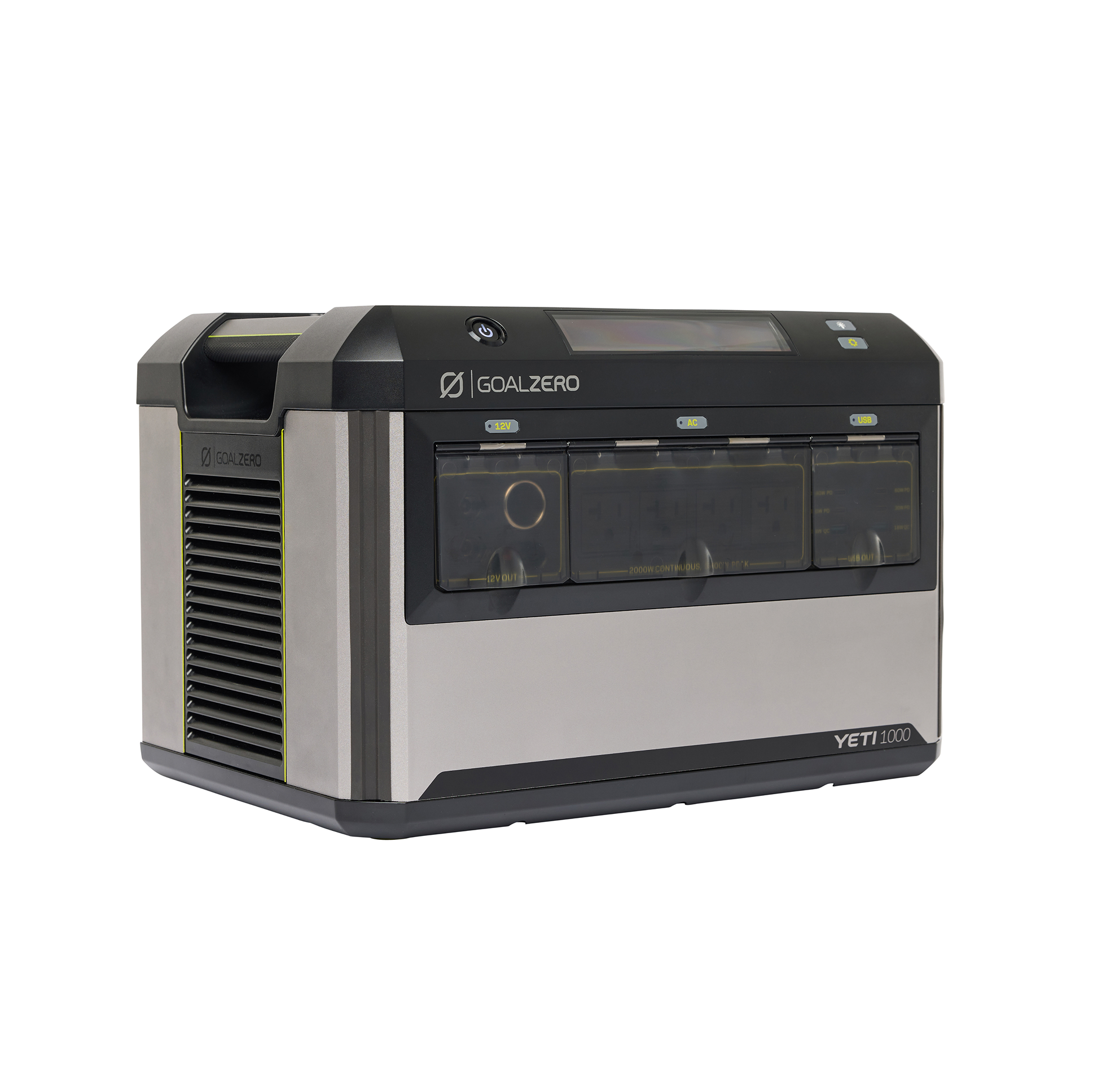
Goal Zero Yeti 1000 (6th Gen)
$1,199.95
$1,199.95 · direct from Goal Zero
Last checked 16 days ago. Prices move — check before you buy.

Jackery HomePower 1000 Plus v2Pick
$669.00
$669.00 · direct from Jackery
Last checked 16 days ago. Prices move — check before you buy.
Prices may vary by retailer and are subject to change.