Head-to-head test
EcoFlow RIVER 3 PLUS vs Anker 535 PowerHouse
The RIVER 3 PLUS wins almost every row on this page, and the 535 PowerHouse wins the only one that decides whether either box reaches morning.
Full profiles: EcoFlow RIVER 3 PLUS → · Anker 535 PowerHouse →

Written by Wenny ZhengUpdated
Portable Power Tester, Station Arena Test Desk

$299.00 · direct from EcoFlow
Last checked 1 day ago. Prices move — check before you buy.
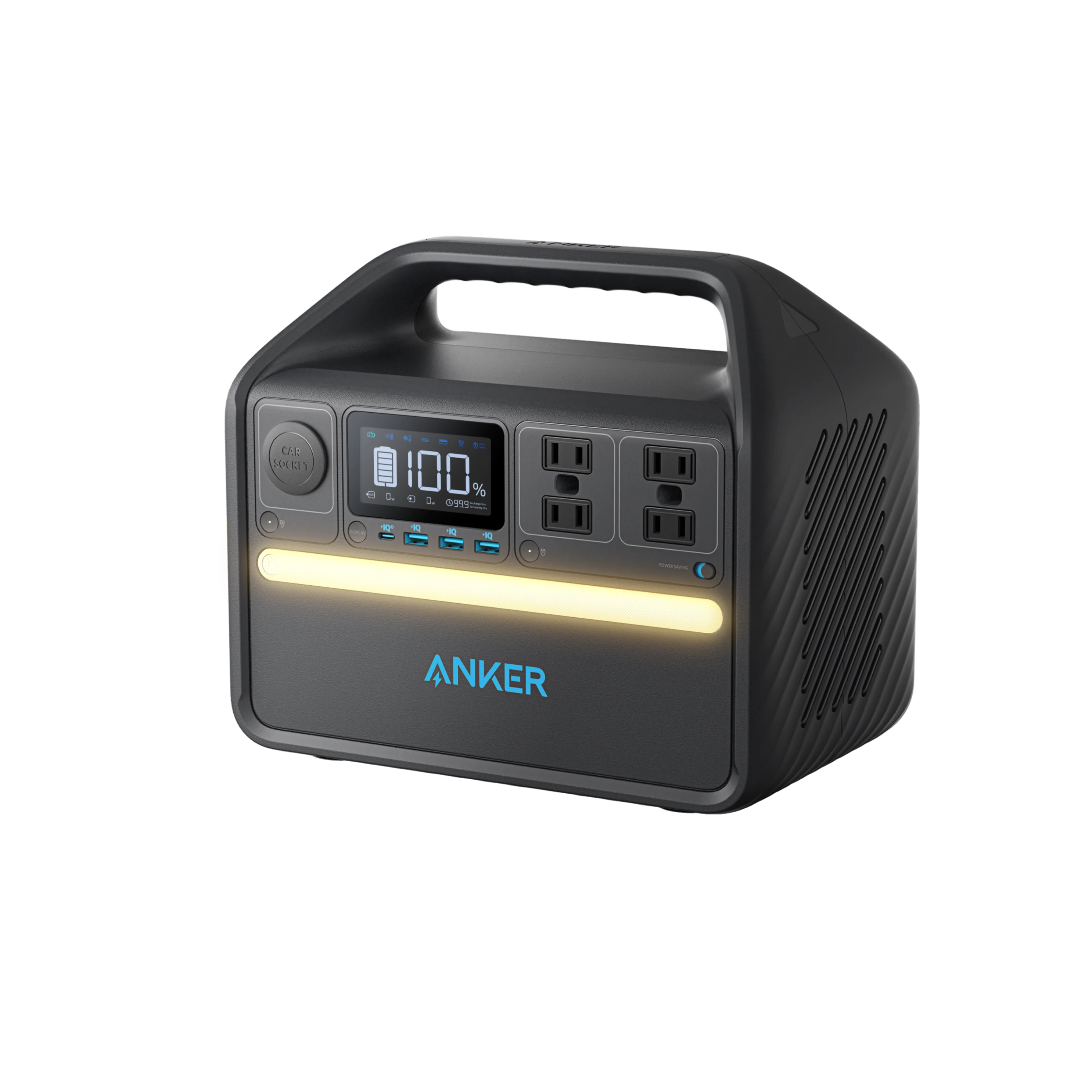
$299.99 · direct from Anker
Last checked 1 day ago. Prices move — check before you buy.
Spec deltas
Take the 535 PowerHouse. It's $300 against the RIVER 3 PLUS's $259, and for that $41 you get 512Wh instead of 286Wh, which is the only difference on this page that changes what either box can actually do.
That's annoying, because the RIVER 3 PLUS is the better-built instrument by a distance. It's 6.3 lbs lighter (10.4 against 16.7), pushes 600W where the Anker pushes 500W, publishes a 1,200W surge rating where Anker publishes none at all, takes 200W of solar to the Anker's 120W, feeds a laptop at 100W over USB-C instead of 60W, runs a 10ms UPS the Anker doesn't have, and puts a 30dB noise figure on paper where Anker leaves the line blank. It wins the PowerScore 1917 to 1813. It also loses the only scenario on this page that either unit finishes.
Before either name matters, get the scale right. Five of the six scenario loads here come back as out of reach for both units, because after the flat 85% usable derate this site applies to every unit you are choosing between 243Wh and 435Wh. That's a picnic table, a CPAP, a laptop and a phone. It is not a blackout, a van, or a weekend of camping, and no combination of these two boxes turns into one.
What the Numbers Reveal
Each conclusion stated first — the numbers behind it on one line, the full analysis below.
UPS is a bridge spec. It answers whether the machine blinks at the instant the power drops, and it says nothing about whether the machine is still running at 6 a.m. On a 286Wh battery those two questions have opposite answers, and the medical-device buyer needs the second one. The 535 PowerHouse gets to morning with 115Wh in reserve and no switchover spec at all, because it never has to switch: you were already running off it.
RIVER 3 PLUS is rated for 10ms UPS switchover; the 535 PowerHouse has no published switchover figureCPAP Overnight needs 320Wh; the RIVER 3 PLUS has 243Wh usable and comes up 77Wh shortThe 535 PowerHouse's 435Wh usable clears the same 320Wh with 115Wh spare
Why it mattersIf a CPAP is why you're shopping, skip the UPS row entirely and read the capacity row.
Capacity
You buy two things to end up level with one thing. Expandability only becomes a real advantage at the EB600 tier and its 858WhA1, and that's a second purchase you should price today rather than discover in a year. The version of this argument that works is 'I know I'm going to 858Wh.' The version that doesn't is 'it grows if I need it to,' because the first growth step mostly buys back capacity you could have had on day one for $41.
RIVER 3 PLUS is 286Wh base, expandable to 572Wh with the EB300 or 858Wh with the EB600A1535 PowerHouse ships sealed at 512Wh for $300RIVER 3 PLUS is $259 before any expansion battery, at $0.91 per Wh against the Anker's $0.59
Why it mattersAnyone choosing the EcoFlow for its growth path should look up the EB600's price before they buy the base unit, not after.
Missing a tailgate by 235Wh is an editing job. Leave the hungriest item at home and the Anker finishes your afternoon. Missing a van-life day by 4,250Wh is a category error, and the fix isn't the other unit on this page or an expansion battery, it's a different size class of product. Read the shortfall figure, not the verdict word, because the verdict word flattens a solvable gap and an unsolvable one into the same shrug.
Tailgate Party leaves the 535 PowerHouse 235Wh short of its 670Wh load, covering about 65% of itVan Life Daily leaves the same unit 4,250Wh short of its 4,685Wh load, covering about 9%Both scenarios are reported with the same 'neither unit covers this' framing
Why it mattersThe tailgater and the day-tripper are on the right page and should size to the load they'd happily drop. The van-lifer and the blackout-prepper should close it.
solar input
For a buyer whose refill plan is a folding panel rather than a wall outlet, some of the Anker's capacity advantage evaporates on the second day: it's more energy to replace through a narrower pipe. The 535 PowerHouse's honest recharge path is the 2.5-hour AC top-upB4, which is excellent if you're passing through somewhere with an outlet and useless if you aren't. The RIVER 3 PLUS's 200W input is the one place on this page where the smaller battery is the asset.
RIVER 3 PLUS accepts 200W of solar input; the 535 PowerHouse accepts 120WReviewers who measured the Anker's panel charging put it at 60-75W in practice, and AC to 80% at about 2.5 hoursB4The 535 PowerHouse holds 512Wh to the RIVER 3 PLUS's 286Wh
Why it mattersTwo nights off-grid with panels and no outlet is the scenario where the EcoFlow's smaller pack genuinely beats the Anker's bigger one.
The specific dimensions that decide these two units — everything else is a tie.
Your Life, Your Pick
Selected because: Five of the six scenario loads are out of reach for both units, and the shortfalls run from 235Wh to 4,442Wh. The size of the miss is the whole decision.
Five of these six come back as out of reach for both units, and they do not mean the same thing. The 535 PowerHouse misses the tailgate by 235Wh and the van-life day by 4,250Wh. One of those is a shopping-list edit and the other is a wrong-aisle problem, and the page reports them with the same wording. Read the shortfall number in each row before you read the word next to it.
The CPAP row is the only one either unit finishes, which makes it carry more weight than a single scenario normally should. It's also decided cleanly: 320Wh needed, 435Wh usable on the Anker with 115Wh left over, 243Wh on the EcoFlow and 77Wh short. No tiebreak was needed and none was available, since Anker publishes no noise figure to hold up against the EcoFlow's 30dB. Capacity settled it outright, which is the honest way for a scenario like this to be settled.
Growth Path
Selected because: Expandability is the main argument for the RIVER 3 PLUS, and its first expansion battery lands 60Wh past the 512Wh the 535 PowerHouse already ships with.
solar input
The expansion path is real and it's also mostly a wash. One EB300 takes the RIVER 3 PLUS from 286Wh to 572WhA1, which is 60Wh past the 512Wh the 535 PowerHouse already includes, and you've bought two boxes to get there instead of one. The EB600 route to 858WhA1 is the version that clears the Anker properly. That's the one to price out, and to price out now.
Worth saying plainly: sealed is not a mark against the 535 PowerHouse. It's a complete 512Wh unit sold as a complete 512Wh unit, and it starts ahead of the thing that grows. Expandability only counts when the expanded ceiling beats the rival, and here that takes the second-tier battery, not the first.
What the Specs Don't Tell You
Selected because: The UPS card recommends a CPAP for the unit that comes up 77Wh short of this page's CPAP load, and the Anker's 6.1-hour solar figure rests on an assumed derate rather than a measurement.
The UPS card on this page suggests plugging a CPAP into the RIVER 3 PLUS. Don't. Its 10ms rating is genuinely useful for a router or a desktop riding out a flicker, and the same page has that unit 77Wh short of an overnight CPAP load. Switchover time answers whether the device blinks. It says nothing about whether the device is still running at dawn, and for a medical machine you need both answers to be yes.
The Anker's 6.1-hour solar figure is softer than it looks. It comes from assuming a 120W port gives back 84W, and reviewers who actually measured it landed at 60-75WB4, which makes panel-only recharging slower than the card admits. The noise card, by contrast, is the honest one here: EcoFlow publishes 30dB, Anker publishes nothing, and a missing number is a missing number rather than evidence of a loud fan. Just note that the 30dB comes with no stated load, so it's a floor rather than what you'd hear at a 600W draw.
Lifetime Value
Selected because: Both units carry 3,000 cycles, so this table can only restate cost per watt-hour, and its years-of-use row prints 8.2 for both across a 226Wh capacity gap.
cost / lifetime kWh
This table can't tell you anything the price tags didn't. Both units are rated for 3,000 cycles, so cost per lifetime kWh is cost per watt-hour with the same divisor applied to both sides: $0.30 against $0.20 is the same fact as $0.91 per Wh against $0.59 per Wh, wearing a different hat. If you already read the price row, you've read this one.
The years-of-use row is worse than decorative, it's actively misleading. It prints 8.2 years of daily use for both units, because it counts cycles and has no capacity term in it at all. Two boxes separated by 226Wh (512 against 286) cannot have the same working life, since the smaller one burns a cycle faster on the same load. Take the cycle count as the shared fact it is and ignore the years.
PowerScore Breakdown
Selected because: The RIVER 3 PLUS leads 1917 to 1813 while losing the only scenario either unit finishes.
overall power score
The PowerScore has the RIVER 3 PLUS ahead, 1917 to 1813, and it isn't wrong. Count the rows it's counting: more continuous output at 600W to 500W, a published 1,200W surge rating where Anker publishes none, more solar input at 200W to 120W, faster USB-C at 100W to 60W, a 10ms UPS the other unit doesn't have, app control, a published noise figure, and 10.4 lbs to carry against 16.7. That's a clean sweep of everything except the number of watt-hours in the box.
Which is the trouble with reading a composite on a pair this small. That gap is what you get when one unit takes eight narrow rows, and the score has no way to know the ninth row is the only one anybody notices at 2 a.m. Use it to understand what the RIVER 3 PLUS is good at. Don't use it to pick.
Strengths & trade-offs
EcoFlow RIVER 3 PLUS
Strengths
- +Costs $41 less
- +Lighter by 6.3 lb
- +Higher AC output
- +Faster solar charging
Trade-offs
- –No major technical downsides compared to rival.
Anker 535 PowerHouse
Strengths
- +Larger battery capacity
Trade-offs
- –Lacks smartphone app control for remote monitoring.
Will It Power Your Gear?
Scenario math and per-appliance runtimes, modeled from the spec record.
Scenario verdicts
We ran the math on seven real-world scenarios. Here's which unit survives your actual life.
SCN-01 · 2 nights · needs 2,100Wh
Weekend Camping
Two nights off-grid with essential comfort
Neither unit
Two nights of camping wants 2,100Wh, and these two hold 243Wh and 435Wh usable. The 535 PowerHouse is 1,665Wh short and the RIVER 3 PLUS 1,857Wh short, so this isn't a near miss you plan around by packing carefully. What both of these are genuinely for is topping up devices at the picnic table, not powering a camp. If the camp is the job, this is the wrong size class and no expansion battery fixes it.
Battery budget usedlower = more headroom
LOAD Phone Charger 15W×6h · LED Lights 40W×8h · Box Fan 75W×14h · CPAP Machine 40W×16h
SCN-02 · 8 hours · needs 1,645Wh
8-Hour Blackout
Keep the essentials running through a night without power
Neither unit
Neither one gets you through this. The scenario wants 1,645Wh; the larger of the two holds 435Wh usable and comes up 1,210Wh short, and the RIVER 3 PLUS is 1,402Wh short. The cruel detail is that the RIVER 3 PLUS is the only unit here that can catch an outage the instant it starts, at a rated 10ms, and it's the one with the smaller battery to ride it out with. Ten milliseconds of seamlessness buys you nothing if the reserve behind it is 243Wh. Treat 1,645Wh as the floor and shop above it.
Battery budget usedlower = more headroom
LOAD Fridge 150W×8h · Router + Modem 20W×8h · LED Lights (4 bulbs) 40W×6h · Phone Charger 15W×3h
SCN-03 · 8 hours · needs 320Wh
CPAP Overnight
Sleep therapy without interruption — the #1 medical use case
535 PowerHouse
The 535 PowerHouse is the only unit on this page that finishes a night: 435Wh usable against the 320Wh this load wants, with 115Wh still in hand. The RIVER 3 PLUS stops 77Wh short, which in practice means it goes quiet before your alarm rather than after it. Nothing else broke this, and nothing else could have. Anker publishes no noise figure to weigh against the EcoFlow's 30dB, so capacity decided it outright. If you're buying on this row, go hunting for a hands-on noise report on the Anker before you commit.
Battery budget usedlower = more headroom
LOAD CPAP Machine 40W×8h
SCN-04 · 8 hours · needs 910Wh
Remote Workday
Full work day off-grid without power anxiety
Neither unit
910Wh is the target and neither reaches it. The 535 PowerHouse covers about 48% and the RIVER 3 PLUS about 27%, leaving them 475Wh and 667Wh short respectively. If your day is a laptop and a phone you'll never see that ceiling on either. If it's a monitor and a kettle as well, the Anker gets you meaningfully further. One spec pushes back the other way: the RIVER 3 PLUS delivers 100W over USB-C to the Anker's 60W, so if a laptop is the load, it feeds it at full speed where the Anker throttles it.
Battery budget usedlower = more headroom
LOAD Laptop 60W×8h · External Monitor 30W×8h · Router + Modem 20W×8h · Phone Charger 15W×2h
SCN-05 · 4 hours · needs 670Wh
Tailgate Party
Game day power for the crew
Neither unit
This is the closest either unit comes to a real job. The 535 PowerHouse covers about 65% of the 670Wh list, 235Wh short, which is less a failure than an editing task: drop the hungriest item and the afternoon is covered. The RIVER 3 PLUS covers about 36% and is 427Wh short, a bigger edit. Both will run small electronics for hours. Neither will run whatever the biggest thing on your list is, so decide now which item that is.
Battery budget usedlower = more headroom
LOAD Blender 400W×0.5h · LED TV (55") 80W×4h · Bluetooth Speaker 15W×4h · Phone Charger (×3) 45W×2h
SCN-06 · 24 hours · needs 4,685Wh
Van Life Daily
A full day of mobile living — the ultimate endurance test
Neither unit
4,685Wh a day against 435Wh and 243Wh usable. The 535 PowerHouse covers about 9% of it and the RIVER 3 PLUS about 5%, and choosing between them moves the needle by nothing that matters: the gap is still 4,250Wh at best. Van life needs an installed system, not a station this size. If you arrived from a van-build guide, this page has nothing for you.
Battery budget usedlower = more headroom
LOAD Mini-Fridge 150W×24h · Laptop 60W×4h · Phone Charger 15W×3h · LED Lights 40W×5h · Fan 75W×8h
SCN-07 · an afternoon · needs 100Wh
Afternoon Off-Grid
Phones and a speaker at the park, beach, or campsite — the small-unit job description
Either unit
This is the job small stations are actually for, and both do it: the RIVER 3 PLUS finishes at 41% used, the 535 PowerHouse at 23%. At this size the decider is what rides in the bag — 10.4 lbs for the RIVER 3 PLUS against 16.7 for the 535 PowerHouse — and price, not the leftover watt-hours.
Battery budget usedlower = more headroom
LOAD Phone Charger (×2) 30W×2h · Bluetooth Speaker 10W×4h
The Load Test
RUNTIME = (Wh × 0.85) ÷ LOAD
None of the scenarios above exactly yours? Build it. Toggle what you'd plug in; both units are tested against the combined draw.
Essentials
Comfort & Convenience
High-Draw Appliances
Test duration
8h
Continuous draw
205W
Projected runtime
For this load: 535 PowerHouse runs 2.1h vs 1.2h.
$299.99 list · direct from Anker
Modeled from the spec record — same math as the tables below. Methodology
Runtime by appliance
Real-world runtime estimates for common appliances, modeled at 85% inverter efficiency.¹
Essentials
The basics you need runningscale 0–29hComfort & Convenience
Makes off-grid life actually enjoyablescale 0–5.8hHigh-Draw Appliances
These reveal the real limits¹ Runtime = (capacity × 0.85) ÷ appliance watts. Within each group, all bars share one time scale (the group's longest runtime), so lengths are comparable across appliances; identical runtimes collapse into a single blue/orange bar. Actual runtime varies with battery age, temperature, and simultaneous loads — see methodology.
Conclusion
August 9, 2026
Verdict: the Anker 535 PowerHouse
The 535 PowerHouse is the default here on one number: 435Wh usable against 243Wh, which is the difference between finishing an overnight CPAP load and quitting 77Wh short of it. It's also the cheaper watt-hour, $0.59 against $0.91, despite the higher sticker at $300 to $259, and it gets further than the RIVER 3 PLUS in every scenario on this page. Two things should push you the other way, and only two. You need UPS switchover for something that must not blink, or your refill comes from a panel rather than a wall, where the RIVER 3 PLUS's 200W solar input beats the Anker's 120W. Outside those, that price gap buys the only upgrade actually on offer, because everything else the EcoFlow wins is a feature bolted to a smaller battery.
Editor-assigned confidence, based on cited owner research and spec analysis.
List prices as of August 9, 2026. The links below open EcoFlow's and Anker's current prices.
$299.99 · direct from Anker
Last checked 1 day ago. Prices move — check before you buy.
or check the RIVER 3 PLUS price$299.00 list
Written by Wenny Zheng, Portable Power Tester · Station Arena Test Desk · Updated August 9, 2026
Measured Data
Benchmark scores and the full spec record, side by side.
Benchmark scores
Not rated for both units (minimum threshold unmet): UPS, CPAP, Solar Generator.
Full specifications
ᵈ Derived: price ÷ rated capacity. See the data behind our comparisons →
Comparison ToolAdd more power stations, side by sideOpen Tool →How these numbers are produced
Numeric verification
Every figure on this page traces to our spec database or arithmetic on it — no estimated numbers.
Owner claims
Statements about owner experience are cited to published reviews — see Sources & Research Notes below.
Runtime model
Runtime = (rated capacity × 0.85 inverter efficiency) ÷ device wattage. Solar recharge estimates assume panels deliver 70% of rated output. Cold weather, battery age, and stacked loads reduce real-world results.
Power Score
Computed from 14 published spec dimensions, weighted per use-case bench. Higher is better; a unit must meet a bench's minimum threshold to be rated.
See the full weight table and data sourcing on our methodology page →Class ranking (the star rating)
Each unit's star score is a category ranking, not customer reviews — no buyer opinions feed it. We score every station on size-independent quality (value, output, portability, endurance, ports, warranty, and more), then percentile-rank it against the other units in its capacity class, so a class-leading compact unit and a class-leading whole-home unit can both earn 5★. Here, RIVER 3 PLUS rates 5.0/5 (99th percentile of 22 Personal-class units), and 535 PowerHouse rates 3.7/5 (21st percentile of 20 Compact-class units).
How the class ranking is computed →Test Notes & Caveats
Hidden gotchas and advantages we spotted that you won't find on the product page.
535 PowerHouse: Solar Recharge Takes 6.1h
That 6.1-hour figure assumes the 120W port gives back 84W of it (512Wh divided by 84W), and the derate is an assumption applied across the board rather than a measurement of this unit. The ceiling arithmetic is 512Wh divided by 120W, a bit over four hours in sun that never wavers, and outdoor sun always wavers. Anything short of that assumed 84W pushes the real figure past 6.1 hours rather than under it, so read it as a best case. The practical upshot: the 535 PowerHouse recharges from a wall, and treats a panel as a trickle that keeps you level rather than a way to refill overnight capacity in a day.
535 PowerHouse: No App Control
Without app control, you have to physically walk to the 535 PowerHouse to check battery level, adjust settings, or monitor power draw. The RIVER 3 PLUS lets you do all that from your phone, including getting low-battery alerts.
535 PowerHouse: Fixed Capacity
The 535 PowerHouse is sealed at 512Wh — a complete unit, and already larger than the RIVER 3 PLUS's 286Wh. By contrast the RIVER 3 PLUS can add expansion batteries, but that only pulls ahead if you'd grow past 512Wh.
UPS: Useful for the Router, Not for the CPAP
The RIVER 3 PLUS is rated for a 10ms switchover and the 535 PowerHouse publishes no switchover figure at all, so if you have a desktop, a modem, or a router that must not drop, the EcoFlow is the only candidate here. Read the recommendation narrowly, though. Ten milliseconds describes the handover at the moment the grid fails; it says nothing about the 243Wh usable sitting behind it, and this page's own CPAP load leaves the RIVER 3 PLUS 77Wh short of morning. A UPS that catches the outage and then quits at 4 a.m. is worse than no UPS at all for a medical device, because you planned around it.
Warranty: No Difference
Both units carry the same 5-year warranty, so coverage isn't a tiebreaker here.
535 PowerHouse: No Noise Figure Published
EcoFlow puts 30dB on the RIVER 3 PLUS's spec sheet and Anker leaves the line blank on the 535 PowerHouse. That is not evidence the Anker is louder. It means there's no number to hold it to, and no way to compare the two here without hearing them both. Worth being just as careful with the number that does exist: 30dB is a published rating with no stated load or charging mode attached, so read it as a floor at idle rather than what a unit pulling 600W sounds like. If this is going in a bedroom, an apartment, or next to a CPAP, chase down hands-on reports for the Anker rather than assuming the silence in the spec sheet means anything either way.
Full record above — the Test Desk pick is the 535 PowerHouse.
Check 535 PowerHouse price →or check the RIVER 3 PLUS priceOwnership Analysis
What happens after you buy — true cost of ownership, brand trust, and growth potential.
Lifetime value
Service lifeyears at one full cycle per day
Lifetime energy delivered
Cost per delivered kWh
│ warranty ends · Reaching the cycle rating means ~80% capacity remains — degraded, not dead.
Analyst note
The RIVER 3 PLUS is cheaper to buy, but the 535 PowerHouse is cheaper to own. At $0.2/kWh over its lifetime vs $0.3/kWh, the 535 PowerHouse's higher cycle life and capacity make each dollar go further over the years. One thing to know reading the table: both carry the same 3,000-cycle rating, so the lifetime rows are sticker price and capacity in disguise — the wear horizon is identical and decides nothing here.
Brand trust
EcoFlow
Ecosystem
Largest in portable power — 12-15 models across DELTA Pro, DELTA 3, and RIVER 3 series, plus solar panels and smart home panels
Support
US-based phone/email/chat support (1-800-368-8604). Experiences are polarized — many report hassle-free prepaid-label replacements, but others report long waits and refurbished units sent for new claims. Pro tip: buying from Costco or Amazon gives you a stronger return safety net.
Community
Largest community in the space — Reddit r/Ecoflow_community (~31K members), multiple Facebook groups, and an official community forum
App experience
Rated 4.6/5 iOS (~8,400 ratings) · 4.2/5 Android (~17,000 ratings)
Unique strength
X-Stream fast charging and the deepest catalogue in portable power are the real assets, and the RIVER 3 PLUS inherits both: a 200W solar input, app control, and a 10ms UPS on a 286Wh box are what you get from a company shipping a dozen models a year. Ignore the 180kWh modular expansion ceiling you'll see quoted for EcoFlow, though. That belongs to the DELTA Pro Ultra X and has nothing to do with the RIVER line, whose ceiling here is a single expansion battery.
Worth knowing
The October 2025 recall EcoFlow issued covers the DELTA Max 2000, a much larger and unrelated unit, with no RIVER-line action attached to it. Read it as a data point on how the company handles a fault rather than a mark against this box. The more relevant footnote for a unit whose app control is part of the pitch is the subscription paywall EcoFlow trialled for advanced app features in early 2025 and shelved after the community pushed back.
Anker
Ecosystem
7-8 SOLIX portable power stations across C-series (compact) and F-series (flagship), plus the X1 home energy system
Support
US-based support. Historically known for incredible no-hassle replacements, but recent reports describe AI-driven support agents giving generic responses and complex return logistics for heavy units (hazmat shipping). The Anker brand reputation is still strong, but SOLIX-specific support quality is trending down.
Community
Moderate — active Reddit (r/Anker, r/AnkerSOLIXCommunity) and growing. Benefits from Anker's massive consumer electronics brand awareness.
App experience
Rated 4.5/5 iOS (~1,100 ratings) · 4.3/5 Android
Unique strength
Anker's reputation for value per watt-hour usually gets attached to its larger stations, but the 535 PowerHouse is the clearest example of it on this page: $0.59 per Wh against $0.91, on LFP cells rated for the same 3,000 cycles and the same 5-year warranty as the EcoFlow. What you're buying into is the parent brand's consumer-electronics track record rather than a power ecosystem, which is fine for a unit that will never join a system.
Worth knowing
The expansion ecosystem is smaller than EcoFlow's, which is academic here since this unit doesn't expand at all. The 535 PowerHouse is also a legacy model in Anker's line rather than a current-generation one, so weigh the app column accordingly: there's no app control on this unit to lose to a firmware change, and no firmware roadmap to wait on either.
Analyst note
Two different bets, and at this size they cash out in opposite directions. EcoFlow builds the deeper ecosystem and, unquestionably, the more capable small box. Anker built the cheaper watt-hour and, in this particular pairing, the bigger one. Neither brand's platform story counts for much at $300, because you're buying one unit that will almost certainly never join a system.
Growth path
RIVER 3 PLUS
EXPANDABLESupports EcoFlow expansion batteries, so you can add capacity later without replacing the base unit — useful if your needs may climb past 286Wh.
Accepts up to 200W of solar. Limited to a single portable panel.
Adequate ports for most setups, but heavy users may want a power strip.
Expansion batteries are EcoFlow-specific. You're investing in the EcoFlow ecosystem.
535 PowerHouse
FIXED CAPACITYFixed at 512Wh, with no expansion — so size it for your needs up front rather than planning to add capacity later.
Accepts up to 120W of solar. Limited to a single portable panel.
Adequate ports for most setups, but heavy users may want a power strip.
Realistic full solar rechargeat 70% of rated panel output — see methodology
Analyst note
Don't read the RIVER 3 PLUS's expandability as a straight win here: it starts at 286Wh, below the 535 PowerHouse's 512Wh, so a first expansion battery largely buys back capacity the 535 PowerHouse already includes. It only pulls ahead if you'd grow past 512Wh — short of that, the 535 PowerHouse's larger fixed capacity is the simpler value.
What Owners Report
Patterns from published owner reports and long-term reviews — every claim cited to its source below.
EcoFlow RIVER 3 PLUS
There's no owner record here worth the name. What exists for the RIVER 3 PLUS comes from review sites rather than people who've lived with oneA1A2A3A4, and most of it hands the spec sheet back to you: 3,000 cycles restated as roughly ten years to 80% capacityA4, 10.4 lbs restated as highly portableA3. Useful for confirming the numbers, useless for learning what breaks.
The one substantive claim is the quiet. Sub-30dB operation gets called remarkable, quieter than a refrigeratorA2, but no load and no charging mode is attached to that, and a station's fan at 600W is a different animal from its fan at idle. One conflict to know about before you plan a panel array: the same review that documents the expansion path lists 220W of solar inputA1 against the 200W our spec carries. Don't size a panel to the watt off either figure.
“286Wh base, expandable to 572Wh (EB300) or 858Wh (EB600), with a genuine 600W inverter (1,200W X-Boost) and 220W solar input — twice the inverter and solar of the base RIVER 3.”
Sources
ecoflow.com · bestgeneratorsolar.com · thepowerpick.com · storagereview.com · phonearena.com · greenreviewshub.com
Anker 535 PowerHouse
The 535 PowerHouse's record is thinner still and just as review-sourcedB1B2B3B4, but it holds the single most useful measurement on this page. One bench test put it at 89% round-trip efficiency while it held its full 500W output and stayed coolB3. Round-trip efficiency isn't the same quantity as the 85% usable derate the scenario table applies, but it points the same direction and lands above it: 512Wh at 89% is 456Wh against the 435Wh the table assumes. If anything, the Anker's scenario numbers on this page are conservative.
The other field-shaped note is charging. About two and a half hours to 80% on AC, against solar that lands at 60-75W in practice despite a 120W port ratingB4. That's the shape of the unit: fast to refill where there's an outlet, slow where there isn't. Nobody in this record has published a decibel figure for it, so if you're buying it to sleep beside, that's the question to go hunting for.
“512Wh capacity with 500W output on LiFePO4 cells rated for 3,000+ cycles and a 10-year lifespan, backed by a 5-year warranty.”
Sources
ankersolix.com · trustedreviews.com · macrumors.com · batteryessence.com
Sources & Research Notes
Every owner claim in this report is traceable to a published source. The bracketed references above resolve here.
Recurring owner themes
- Expandable capacity, doubled inverter and solar over the base RIVER 3, remarkable sub-30dB quiet, and light weight are the praise. [RIVER 3 PLUS · 3 entries]
- Durable LFP (3,000+ cycles, 5-yr warranty), efficient, and compact for weekend camping; slow solar input is the caveat. [535 PowerHouse · 2 entries]
- A1
“286Wh base, expandable to 572Wh (EB300) or 858Wh (EB600), with a genuine 600W inverter (1,200W X-Boost) and 220W solar input — twice the inverter and solar of the base RIVER 3.”
ecoflow.com / bestgeneratorsolar.com — RIVER 3 Plus review · 2026 · [positive]
- A2
“Sub-30dB operation is genuinely remarkable — quieter than a library and than most refrigerators.”
thepowerpick.com — RIVER 3 Plus review · 2026 · [positive]
- A3
“Weighs about 10.4 lbs and is highly portable; a small-format station that grows with you, able to briefly run a coffee maker, microwave, or space heater.”
storagereview.com / phonearena.com — RIVER 3 Plus review · 2026 · [positive]
- A4
“LiFePO4 rated for 3,000 charge cycles — around 10 years of everyday use before capacity drops to 80%.”
greenreviewshub.com / bestgeneratorsolar.com — RIVER 3 Plus review · 2026 · [positive]
- B1
“512Wh capacity with 500W output on LiFePO4 cells rated for 3,000+ cycles and a 10-year lifespan, backed by a 5-year warranty.”
ankersolix.com / trustedreviews.com — 535 PowerHouse review · 2026 · [positive]
- B2
“Weighs 16.5 lbs and is compact for a 512Wh unit, with 4 AC ports, 3 USB-A, a USB-C, and a car outlet.”
macrumors.com / batteryessence.com — 535 PowerHouse review · 2026 · [positive]
- B3
“Demonstrated 89% round-trip efficiency and stayed stable and cool while delivering its full 500W AC output.”
batteryessence.com — 535 PowerHouse review · 2026 · [positive]
- B4
“AC charging to 80% takes about 2.5 hours; solar input caps at 120W (realistically 60-75W), so panel charging is slow.”
batteryessence.com — 535 PowerHouse review · 2026 · [mixed]
Research compiled August 9, 2026.
Who Should Buy Which
Buy the RIVER 3 PLUS if you…
- →You're backing a router, a modem, or a desktop that must not blink. A 10ms switchover against no published switchover spec at all is the one thing on this page the Anker cannot answer with capacity.
- →Your refill comes from a panel, not a wall. 200W of solar input against 120W is the single spec where holding less energy is an advantage: there's less to put back and a wider pipe to put it back through.
- →You want a laptop charged at full speed off a small box. 100W over USB-C against 60W is the difference between a laptop gaining charge while you work and one that just bleeds slower.
- →You carry it far more often than you drain it. 10.4 lbs against 16.7 lbs isn't a two-person lift either way, but it's the gap between a bag you forget you're carrying and one you don't.
Buy the 535 PowerHouse if you…
- →The CPAP, and this is the strongest case on the page. 435Wh usable against 320Wh needed, 115Wh still in hand at sunrise, where the RIVER 3 PLUS stops 77Wh short. Go find a hands-on noise report first, because Anker doesn't publish one.
- →A tailgate, a picnic table, a long afternoon in a parking lot with speakers and phones. The Anker covers about 65% of the tailgate load to the EcoFlow's 36%, and 65% of a list is a list you can trim.
- →You want the most watt-hours per dollar and you don't care about the feature column. $0.59 per Wh against $0.91, with identical 3,000-cycle cells and identical 5-year warranties behind both.
If neither fits
Anyone whose actual list includes an eight-hour blackout, a van-life day, or a weekend of camping should close this page and start a size class up. The blackout scenario alone wants 1,645Wh, more than three times the 512Wh the larger of these two holds, and it leaves that unit 1,210Wh short. Camping is worse and van life is far worse. You cannot close a gap like that with the other unit here or with an expansion battery, so don't try: shop units whose capacity starts where these two top out.
The Bottom Line
Take the 535 PowerHouse. The RIVER 3 PLUS is the more interesting box and it wins nearly every row you'd scan on a spec table, but the row it loses is the one that decides whether the machine beside your bed is still running at sunrise. 435Wh usable against 243Wh is the entire argument, and the $41 between $300 and $259 is what it costs to be on the right side of it.
Buy the RIVER 3 PLUS instead if you can name the feature you need it for: a 10ms UPS for something that must not blink, or 200W of solar because there's no wall where you're going. Those are real reasons and they are the only two. If your reason is that it grows later, go price the EB600 before you buy anything, because the first battery only gets you level.
Frequently Asked Questions
Answers drawn from the spec record and cited owner research.
Is the Anker 535 PowerHouse big enough to run a CPAP all night?
Yes. Against the 320Wh this site's CPAP scenario assumes, the 535 PowerHouse has 435Wh usable and finishes with 115Wh spare. The RIVER 3 PLUS doesn't make it: 243Wh usable leaves it 77Wh short, which means it quits before your alarm rather than after it. The one caveat is that Anker publishes no noise figure for this unit, so if it's living on your nightstand, find someone who has heard it.
Can either of these run my house during a power outage?
No, and it isn't close. The eight-hour blackout scenario needs 1,645Wh; the 535 PowerHouse is 1,210Wh short of it and the RIVER 3 PLUS is 1,402Wh short. Both of these are personal-electronics boxes: phones, laptops, a CPAP, a router. If whole-home or even partial-home backup is the goal, treat 1,645Wh as your floor and shop above it.
Is the RIVER 3 PLUS's expandability actually worth paying for?
Only at the second tier. The EB300 battery takes it to 572Wh, which is 60Wh past the 512Wh the Anker ships with, so you've bought two boxes to draw level with one. The EB600 route to 858Wh genuinely clears it. If you know you're going there, the RIVER 3 PLUS is a reasonable starting point; if you're just hedging, the Anker's fixed 512Wh is the cheaper way to hold that much energy.
Why does the EcoFlow score higher if the Anker wins the comparison?
The PowerScore is a whole-unit composite, and the RIVER 3 PLUS wins nearly every non-capacity spec: output, surge, solar input, USB-C speed, UPS, app, weight, published noise. That's what 1917 to 1813 is measuring. The scenario table asks a narrower and more practical question, which is whether the unit finishes the load, and there the 226Wh capacity gap (512 against 286) decides everything.
Which one is quieter, the RIVER 3 PLUS or the 535 PowerHouse?
Nobody can honestly tell you. EcoFlow publishes 30dB for the RIVER 3 PLUS and Anker publishes nothing for the 535 PowerHouse, and an absent figure is not the same as a loud one. Treat the 30dB as a floor rather than a promise, too, since it comes with no stated load, and a unit drawing 600W is not the same unit that produced that number.
Where to buy
EcoFlow RIVER 3 PLUS
$299.00
$299.00 · direct from EcoFlow
Last checked 1 day ago. Prices move — check before you buy.
Anker 535 PowerHousePick
$299.99
$299.99 · direct from Anker
Last checked 1 day ago. Prices move — check before you buy.
Prices may vary by retailer and are subject to change.