Head-to-head test
EcoFlow RIVER 3 MAX PLUS WIRELESS vs Anker SOLIX C1000 Gen 2
One of these is a bigger battery, the other is a bigger machine, and the machine is the one that costs $69 less.
Full profiles: EcoFlow RIVER 3 MAX PLUS WIRELESS → · Anker SOLIX C1000 Gen 2 →

Written by Ian SchneiderUpdated
Solar & Off-Grid Tester, Station Arena Test Desk

No longer sold
EcoFlow has discontinued the RIVER 3 Max Plus Wireless. Our recommended replacement is the DELTA 3 Classic — the same 1kWh-class capacity with a 1,800W inverter to this unit's 600W, usually for less money. You do give up the built-in wireless charging pad.
DELTA 3 Classic · $559.00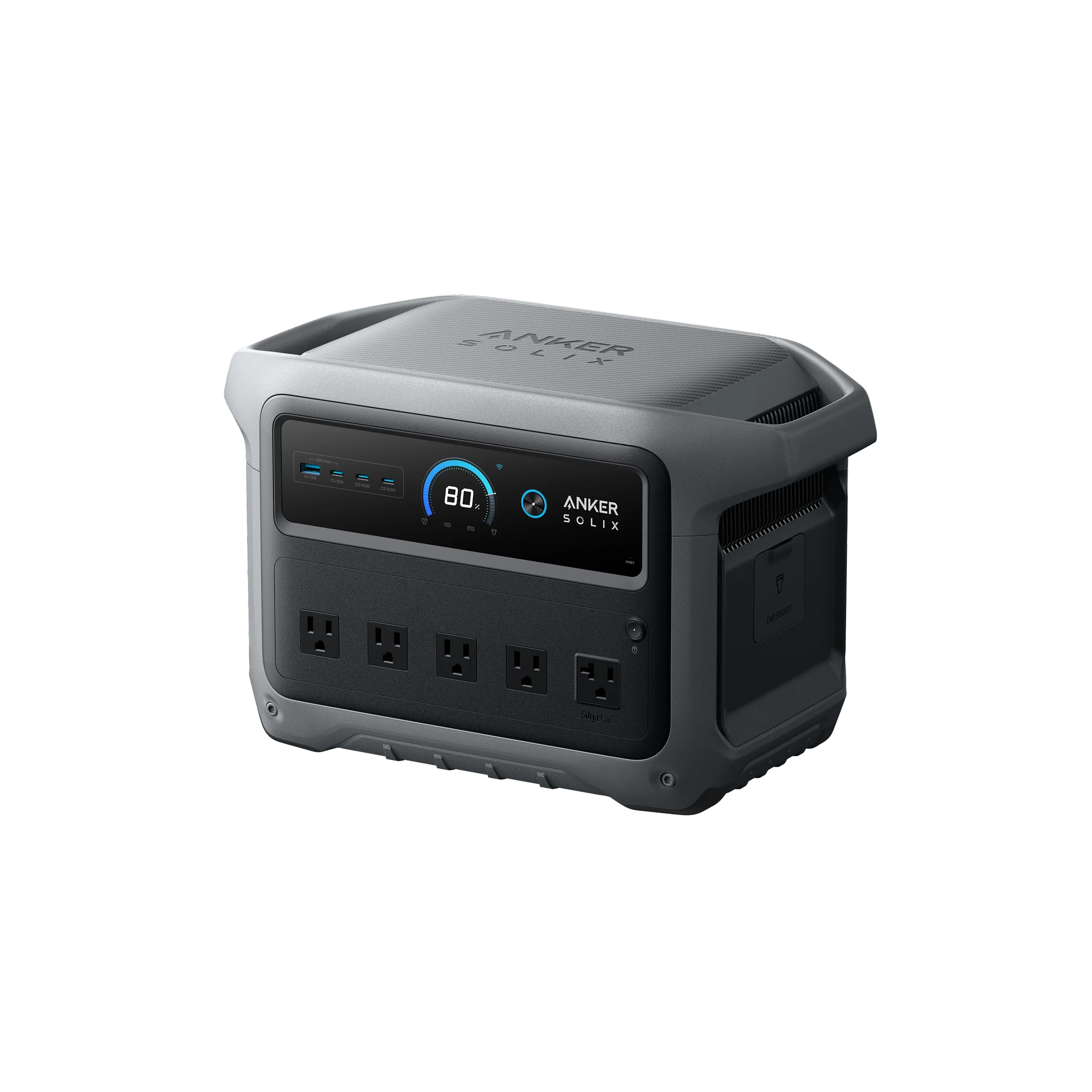
$529.99 · direct from Anker
Last checked 1 day ago. Prices move — check before you buy.
Spec deltas
The Anker SOLIX C1000 Gen 2 costs $530 and runs 2,000W continuous. The EcoFlow RIVER 3 MAX PLUS WIRELESS costs $599 and runs 600W. Everything else here is a footnote to those four numbers, because the EcoFlow's one real advantage, 1,196Wh against 1,024Wh, is energy that can only leave the box through a 600W door.
That 172Wh does buy something in the specific case where your day is planned, fixed and unpluggable. Derate both for inverter losses and you're comparing 1,017Wh of usable energy against 870Wh, which is why the EcoFlow takes three of the six scenario profiles below. Look at what it takes them by, though. A CPAP night is 31% used against 37%: both units coast. Only the 910Wh workday actually changes hands.
The EcoFlow is the lighter box at 20.8 lbs against 24.9, and it's rated quieter at idle. Those are real, and they're what the extra money buys. But if anything on your load list draws over 600W, a kettle, a microwave, a space heater, a corded saw, the capacity comparison never gets a chance to matter.
What the Numbers Reveal
Each conclusion stated first — the numbers behind it on one line, the full analysis below.
continuous output
One of those is a rounding error and the other is a category change. Reviewers note the Anker clears a 1,500W space heater with room leftB3, while reviewers of the RIVER 3 Max Plus say plainly that it won't run a high-power hairdryer or a microwaveA4. So the EcoFlow's extra energy is energy you're only permitted to spend slowly, and the appliances people actually buy these boxes for during an outage are wattage problems, not capacity problems.
RIVER 3 MAX PLUS WIRELESS: 1,196Wh, 600W continuous, 1,200W surge, $599SOLIX C1000 Gen 2: 1,024Wh, 2,000W continuous, 3,000W surge, $530Reviewers put the C1000 Gen 2's continuous output above a 1,500W space heater with headroom to spareB3
Why it mattersIf one single item on your list draws more than 600W, stop comparing capacity: the EcoFlow can't run it at any state of charge.
solar input
Expansion widens that gap rather than closing it. Both units take extra batteries, but every watt-hour you bolt onto the EcoFlow still refills through the same 200W input, so its growth path works against its recharge path. The Anker's 600W input is the one that scales with the bank behind it.
200W maximum solar input on the RIVER 3 MAX PLUS WIRELESS against 600W on the C1000 Gen 21,196Wh and 1,024Wh of rated capacityBoth units support expansion batteries
Why it mattersAnyone who plans to add a battery later, or who lives off panels rather than wall outlets, should take the Anker and stop thinking about it.
Then check what 40Wh costs to replace: at the Anker's rated 600W input that's four minutes of sun (40 divided by 600 of an hour), or a few minutes on a wall socket. The shortfall is real on a spec sheet and close to imaginary anywhere there's daylight or an outlet. Where it bites is the day that has neither, and on that day it's absolute: one unit clocks off, one doesn't.
Usable energy runs about 85% of rated: 1,017Wh for the EcoFlow, 870Wh for the AnkerThe remote workday profile draws 910Wh600W maximum solar input on the C1000 Gen 2
Why it mattersBuy the EcoFlow if your longest day is a fixed load with nowhere to top up. Everyone else can treat this as noise.
rated cycles
Cycle life settles nothing here, because both batteries outlast their five-year warranty by decades on any realistic pattern of use. What survives the deflation is the plain part: one box costs less up front and does considerably more with it. Four cents per kilowatt-hour is a garnish on that, not a reason.
$599 across 3,000 cycles of 1,196Wh is 3,588 kWh of lifetime throughput at 17 cents each$530 across 4,000 cycles of 1,024Wh is 4,096 kWh at 13 cents eachBoth carry a 5-year warranty, and at weekend use those cycle counts run 28.8 and 38.5 years
Why it mattersDon't let the lifetime-cost row cast the deciding vote. The output and solar rows are the ones separating these two.
The specific dimensions that decide these two units — everything else is a tie.
Runtime: Will It Power Your Gear?
Selected because: What decides this pair isn't how long either one lasts, it's that one inverter stops at 600W and the other at 2,000W.
continuous output
Runtime is the wrong question for this pair. The right one is what you're allowed to switch on while it runs. The EcoFlow's 1,017Wh of usable energy will feed a laptop, a router, a CPAP and a string of lights through a very long evening without complaint.
Ask it for a 1,500W load and the runtime becomes zero, because the inverter never starts. The Anker's 2,000W ceiling changes the shape of the question rather than the length of the answer: it runs the heavy thing, and then 870Wh usable tells you for how long. Briefly, at that draw. Briefly is still the difference between reheating dinner and not.
Your Life, Your Pick
Selected because: 1,017Wh of usable energy against 870Wh changes the answer in exactly one of these six profiles, and it's worth knowing which one.
Three of six go to the EcoFlow, and the margins matter more than the count. It wins the CPAP night by using 31% of itself instead of 37%, and the tailgate at 66% against 77%. Those aren't wins so much as two units finishing the same job with the lights still on.
One profile genuinely turns: the 910Wh remote workday, 90% against 105%, where the Anker stops short of the end of the day. And three of the six are past both boxes entirely, the 1,645Wh blackout, the 2,100Wh camping weekend and the 4,685Wh van-life day. If your real week looks like those, this comparison isn't the one you should be reading.
Growth Path
Selected because: Both take expansion batteries; only one of them takes 600W of solar to refill what you added.
solar input
Both accept expansion batteries, so on paper this section is a draw. It isn't, because a bigger bank still has to be refilled, and the two units refill at wildly different rates: 600W of solar into the Anker, 200W into the EcoFlow.
That asymmetry compounds as you grow. Add capacity to the C1000 Gen 2 and the panel array you can hang off it grows with it. Add capacity to the RIVER 3 MAX PLUS WIRELESS and the refill window stretches while the input stays exactly where it was. Expandability only counts if the expanded thing is still usable, and a bank you can't refill in a day isn't.
What the Specs Don't Tell You
Selected because: The EcoFlow has the better surge ratio and the lower surge ceiling, and only one of those is something you can plug into.
rated cycles
The surge figures reward a close read, and they reward it in the opposite direction to first impressions. The EcoFlow doubles from 600W to 1,200W. The Anker stretches from 2,000W to 3,000W, a smaller multiple off a much higher base. The ratio flatters the EcoFlow, and the ratio is not the thing you plug into.
A fridge compressor or a corded tool doesn't ask for a multiple of rated output. It asks for a specific number of watts at the instant it starts, and 1,200W is a low ceiling for that instant. Read the ceiling.
Lifetime Value
Selected because: 13 cents against 17 cents per lifetime kilowatt-hour, on two batteries that both outlast their five-year warranties several times over.
cost / lifetime kWh
13 cents a lifetime kilowatt-hour against 17, on the box that also asks less up front. That's the entire finance argument, and it's smaller than it looks.
Both units are warranted five years, and both would take decades of weekend use to exhaust their cells: 28.8 years for the EcoFlow, 38.5 for the Anker. Numbers that large stop being predictions and start being trivia. The only line in this section with any grip is $110 a year against $120, and even that is the up-front difference wearing a costume.
Strengths & trade-offs
EcoFlow RIVER 3 MAX PLUS WIRELESS
Strengths
- +Lighter by 4.1 lb
- +Larger battery capacity
Trade-offs
- –Weaker inverter (-1,400W) limits appliance compatibility.
- –Shorter-lived battery — rated for 3,000 charge cycles vs the SOLIX C1000 Gen 2's 4,000, so it wears out sooner.
Anker SOLIX C1000 Gen 2
Strengths
- +Costs $69 less
- +Higher AC output
- +Faster solar charging
- +Rated for 4,000 charge cycles — much longer battery lifespan
Trade-offs
- –No major technical downsides compared to rival.
Will It Power Your Gear?
Scenario math and per-appliance runtimes, modeled from the spec record.
Scenario verdicts
We ran the math on six real-world scenarios. Here's which unit survives your actual life.
SCN-01 · 2 nights · needs 2,100Wh
Weekend Camping
Two nights off-grid with essential comfort
Neither unit
A 2,100Wh weekend runs 207% of what the EcoFlow can usably deliver and 241% of the Anker, so neither one gets you to Sunday on a single charge. This is a panel problem, not a capacity problem, which is where the Anker's 600W of solar input against the EcoFlow's 200W starts to matter. Neither wins the weekend outright; only one of them can claw back a real chunk of the deficit while you sit there.
Battery budget usedlower = more headroom
LOAD Phone Charger 15W×6h · LED Lights 40W×8h · Box Fan 75W×14h · CPAP Machine 40W×16h
SCN-02 · 8 hours · needs 1,645Wh
8-Hour Blackout
Keep the essentials running through a night without power
Neither unit
1,645Wh over eight hours is 162% of the EcoFlow's usable energy and 189% of the Anker's, so neither covers the full outage. What they will do is keep the fridge, the router, the phones and a lamp going for a good part of the night, and the question shifts to which loads you can start at all: 600W continuous against 2,000W. Neither finishes the blackout alone. One of them runs more of your house while it lasts.
Battery budget usedlower = more headroom
LOAD Fridge 150W×8h · Router + Modem 20W×8h · LED Lights (4 bulbs) 40W×6h · Phone Charger 15W×3h
SCN-03 · 8 hours · needs 320Wh
CPAP Overnight
Sleep therapy without interruption — the #1 medical use case
RIVER 3 MAX PLUS WIRELESS
A CPAP asks for 320Wh, which both units treat as a rounding error at 31% and 37% used. The EcoFlow takes it on the margin and also on the spec you'll actually notice at 3 a.m., rated 30dB against 35dB with the box sitting on the nightstand. Capacity isn't what decides this night. The fan is.
Battery budget usedlower = more headroom
LOAD CPAP Machine 40W×8h
SCN-04 · 8 hours · needs 910Wh
Remote Workday
Full work day off-grid without power anxiety
RIVER 3 MAX PLUS WIRELESS
910Wh is the one profile where the capacity gap changes the outcome instead of the margin. The EcoFlow ends the day at 90% used, while the Anker lands at 105%, stopping roughly 40Wh short of clocking off. If there's a socket or a panel anywhere in that day, the Anker closes that at its 600W input in minutes. If there genuinely isn't, the EcoFlow is the one that gets you to five o'clock.
Battery budget usedlower = more headroom
LOAD Laptop 60W×8h · External Monitor 30W×8h · Router + Modem 20W×8h · Phone Charger 15W×2h
SCN-05 · 4 hours · needs 670Wh
Tailgate Party
Game day power for the crew
RIVER 3 MAX PLUS WIRELESS
Both handle game day; the RIVER 3 MAX PLUS WIRELESS keeps more in reserve (66% used vs 77%). Tailgating is a light load, though, so the number you'll feel is weight: 20.8 lbs for the RIVER 3 MAX PLUS WIRELESS against 24.9 lbs for the SOLIX C1000 Gen 2, from the trunk to the setup spot.
Battery budget usedlower = more headroom
LOAD Blender 400W×0.5h · LED TV (55") 80W×4h · Bluetooth Speaker 15W×4h · Phone Charger (×3) 45W×2h
SCN-06 · 24 hours · needs 4,685Wh
Van Life Daily
A full day of mobile living — the ultimate endurance test
Neither unit
Neither unit covers this scenario's 4,685Wh: the RIVER 3 MAX PLUS WIRELESS comes up 3,668Wh short (about 22% covered), the SOLIX C1000 Gen 2 3,815Wh (19%). This is well outside what either unit is for; the right answer here is a larger station, not a choice between these two.
Battery budget usedlower = more headroom
LOAD Mini-Fridge 150W×24h · Laptop 60W×4h · Phone Charger 15W×3h · LED Lights 40W×5h · Fan 75W×8h
The Load Test
RUNTIME = (Wh × 0.85) ÷ LOAD
None of the scenarios above exactly yours? Build it. Toggle what you'd plug in; both units are tested against the combined draw.
Essentials
Comfort & Convenience
High-Draw Appliances
Test duration
8h
Continuous draw
205W
Projected runtime
For this load: RIVER 3 MAX PLUS WIRELESS runs 5h vs 4.2h.
Modeled from the spec record — same math as the tables below. Methodology
Runtime by appliance
Real-world runtime estimates for common appliances, modeled at 85% inverter efficiency.¹
Essentials
The basics you need runningscale 0–67.8hComfort & Convenience
Makes off-grid life actually enjoyablescale 0–13.6hHigh-Draw Appliances
These reveal the real limitsscale 0–0.9h¹ Runtime = (capacity × 0.85) ÷ appliance watts. Within each group, all bars share one time scale (the group's longest runtime), so lengths are comparable across appliances; identical runtimes collapse into a single blue/orange bar. Actual runtime varies with battery age, temperature, and simultaneous loads — see methodology.
Conclusion
August 9, 2026
Verdict: the SOLIX C1000 Gen 2
Buy the SOLIX C1000 Gen 2. At $530 it undercuts the RIVER 3 MAX PLUS WIRELESS by $69 while running 2,000W continuous against 600W, accepting 600W of solar against 200W, and carrying 4,000 cycles against 3,000. What you give up is 172Wh of capacity and about four pounds of carrying weight, and that costs you exactly one of the six load profiles here: a fixed 910Wh remote workday, which the Anker misses by 40Wh. If there's an outlet or a panel anywhere in that day, the miss evaporates. The one genuine reason to pause is sound, since fan noise under load is the most consistent complaint in its fileB2.
Editor-assigned confidence, based on cited owner research and spec analysis.
List prices as of August 9, 2026. The links below open EcoFlow's and Anker's current prices.
$529.99 · direct from Anker
Last checked 1 day ago. Prices move — check before you buy.
or check the RIVER 3 MAX PLUS WIRELESS price$599.00 list
Written by Ian Schneider, Solar & Off-Grid Tester · Station Arena Test Desk · Updated August 9, 2026
Measured Data
Benchmark scores and the full spec record, side by side.
Benchmark scores
Not rated for both units (minimum threshold unmet): RV Living, Home Backup, Food Truck.
Full specifications
ᵈ Derived: price ÷ rated capacity. See the data behind our comparisons →
Comparison ToolAdd more power stations, side by sideOpen Tool →How these numbers are produced
Numeric verification
Every figure on this page traces to our spec database or arithmetic on it — no estimated numbers.
Owner claims
Statements about owner experience are cited to published reviews — see Sources & Research Notes below.
Runtime model
Runtime = (rated capacity × 0.85 inverter efficiency) ÷ device wattage. Solar recharge estimates assume panels deliver 70% of rated output. Cold weather, battery age, and stacked loads reduce real-world results.
Power Score
Computed from 14 published spec dimensions, weighted per use-case bench. Higher is better; a unit must meet a bench's minimum threshold to be rated.
See the full weight table and data sourcing on our methodology page →Class ranking (the star rating)
Each unit's star score is a category ranking, not customer reviews — no buyer opinions feed it. We score every station on size-independent quality (value, output, portability, endurance, ports, warranty, and more), then percentile-rank it against the other units in its capacity class, so a class-leading compact unit and a class-leading whole-home unit can both earn 5★. Here, RIVER 3 MAX PLUS WIRELESS rates 3.6/5 (15th percentile of 27 Everyday-class units), and SOLIX C1000 Gen 2 rates 4.9/5 (96th percentile of 27 Everyday-class units).
How the class ranking is computed →Test Notes & Caveats
Hidden gotchas and advantages we spotted that you won't find on the product page.
The ratio flatters the wrong unit
On paper the EcoFlow has the better surge headroom: 600W continuous doubling to 1,200W, against the Anker going from 2,000W to only 3,000W. That's a 2x multiple against 1.5x, and it's the wrong number to read. A fridge compressor or a corded tool doesn't ask for a multiple of rated output, it asks for a specific number of watts at the instant it starts, and 1,200W is a low ceiling for that instant. Read the ceiling, not the ratio.
Warranty: No Difference
Both units carry the same 5-year warranty, so coverage isn't a tiebreaker here.
Cycle life you'll never collect on
4,000 cycles against 3,000 sounds like a third more unit for your money. Converted to calendar time at weekend use it's 38.5 years against 28.8, on hardware warranted for five. Both cells will outlast the app, the ports and your interest in owning the thing. Cycle life isn't wrong here, it's just not a tiebreak. Spend the attention on the output and solar rows instead.
Full record above — the Test Desk pick is the SOLIX C1000 Gen 2.
Check SOLIX C1000 Gen 2 price →or check the RIVER 3 MAX PLUS WIRELESS priceOwnership Analysis
What happens after you buy — true cost of ownership, brand trust, and growth potential.
Lifetime value
Service lifeyears at one full cycle per day
Lifetime energy delivered
Cost per delivered kWh
│ warranty ends · Reaching the cycle rating means ~80% capacity remains — degraded, not dead.
Analyst note
The SOLIX C1000 Gen 2 wins on both sticker price and long-term value. At $0.13/kWh over its lifetime, it's meaningfully cheaper to own. Clear value winner.
Brand trust
EcoFlow
Ecosystem
Largest in portable power — 12-15 models across DELTA Pro, DELTA 3, and RIVER 3 series, plus solar panels and smart home panels
Support
US-based phone/email/chat support (1-800-368-8604). Experiences are polarized — many report hassle-free prepaid-label replacements, but others report long waits and refurbished units sent for new claims. Pro tip: buying from Costco or Amazon gives you a stronger return safety net.
Community
Largest community in the space — Reddit r/Ecoflow_community (~31K members), multiple Facebook groups, and an official community forum
App experience
Rated 4.6/5 iOS (~8,400 ratings) · 4.2/5 Android (~17,000 ratings)
Unique strength
Fastest-charging technology (X-Stream), deepest product ecosystem, and most active innovation cadence. At the very top of the range, the DELTA Pro Ultra platform stacks batteries and inverters into whole-home backup — a flagship path, not a line-wide feature.
Worth knowing
EcoFlow runs the deepest ecosystem in portable power and the fastest release cadence, which genuinely helps if you intend to build outward over time. Weigh that against the October 2025 DELTA Max 2000 recall over overheating, and a support record that reads as polarized rather than poor: prepaid replacement labels and quick turnarounds for some owners, long waits and refurbished units for others.
Anker
Ecosystem
7-8 SOLIX portable power stations across C-series (compact) and F-series (flagship), plus the X1 home energy system
Support
US-based support. Historically known for incredible no-hassle replacements, but recent reports describe AI-driven support agents giving generic responses and complex return logistics for heavy units (hazmat shipping). The Anker brand reputation is still strong, but SOLIX-specific support quality is trending down.
Community
Moderate — active Reddit (r/Anker, r/AnkerSOLIXCommunity) and growing. Benefits from Anker's massive consumer electronics brand awareness.
App experience
Rated 4.5/5 iOS (~1,100 ratings) · 4.3/5 Android
Unique strength
Parent brand trust from Anker's consumer electronics dominance. InfiniPower technology for long cycle life. Strong $/Wh value in the mid-size and larger units — the S2000, F2600 and C1000 are among the better buys per watt-hour in the catalog.
Worth knowing
Anker's mid-size stations are among the better buys per watt-hour in this catalog, and the parent brand's reputation was earned honestly. The catch is direction of travel. SOLIX support quality is trending down, with reports of AI-driven agents returning generic answers, awkward return logistics on heavy units, and firmware updates that have removed features without notice.
Analyst note
Buying EcoFlow means buying into a larger, faster-moving ecosystem with a support experience you can't predict in advance. Buying Anker means a stronger unit per dollar from a brand currently coasting on a support reputation it built a few years ago. Neither fact overturns the spec comparison. But if you expect to need help more than once, EcoFlow's phone line and much larger owner community are the easier place to be stuck.
Growth path
RIVER 3 MAX PLUS WIRELESS
EXPANDABLESupports EcoFlow expansion batteries, so you can add capacity later without replacing the base unit — useful if your needs may climb past 1,196Wh.
Accepts up to 200W of solar. Limited to a single portable panel.
Adequate ports for most setups, but heavy users may want a power strip.
Expansion batteries are EcoFlow-specific. You're investing in the EcoFlow ecosystem.
SOLIX C1000 Gen 2
EXPANDABLESupports Anker expansion batteries, so you can add capacity later without replacing the base unit — useful if your needs may climb past 1,024Wh.
Accepts up to 600W of solar. Suitable for a 1-2 panel setup.
Generous port selection supports complex multi-device setups.
Expansion batteries are Anker-specific. You're investing in the Anker ecosystem.
Realistic full solar rechargeat 70% of rated panel output — see methodology
Analyst note
Both expand, but the SOLIX C1000 Gen 2's higher solar ceiling (600W vs 200W) gives it the stronger off-grid growth path — more panels can feed a bigger bank as it grows.
What Owners Report
Patterns from published owner reports and long-term reviews — every claim cited to its source below.
EcoFlow RIVER 3 MAX PLUS WIRELESS
Field evidence on this exact configuration is thin, and that's worth knowing before you weigh any of it. What exists is press-review coverage rather than long-term owners, and some of it describes sibling RIVER 3 models rather than this oneA7A8. Read it as early-adopter impressions, not a service record.
What reviewers do agree on is the quiet. The RIVER 3 series is listed at 30dB and singled out as the unit that doesn't wake you the way cheaper stations with eager fans doA2A3, with the honest caveat that the fan does come up during high-power useA7. Wall recharge is quick for the size at around 2.3 hours from emptyA1, and UPS switching is reported under 10 milliseconds, so the desk doesn't blink when the grid dropsA5. One reviewer highlights the detachable mini power bank you can carry away from the unitA6. Another, writing about the base Plus model, flags that 'wireless' in the name doesn't mean a Qi pad on the lidA9, which is worth confirming with the seller if that's what you're buying it for.
“The RIVER 3 Max Plus (Wireless) can go from empty to full from mains in around 2.3 hours, which is very quick given its capacity.”
Sources
root-nation.com · backuppowerhub.com
Anker SOLIX C1000 Gen 2
The complaint to know about is fan noise, and it's the most consistent thing in the file: near-silent at low load, around 35 dB under 200W, then audibly up during fast charging or output past 1,000W, reaching about 55 dBB2. That's the price of the charging and output speed, and it's the one area where the EcoFlow is the nicer object to share a room with.
Everything else in the record is positive and consistent. A full recharge in roughly 49 minutesB1, continuous output that clears a 1,500W space heater with headroomB3, and a general read from reviewers that this is the mid-size unit to beat right nowB4. Nobody reports it failing to do what it says. They report that you can hear it doing itB2.
“Fast HyperFlash charging — a full recharge in roughly 49 minutes, noticeably quicker than the original C1000's ~58-80 minutes.”
Sources
thepowerpick.com · macrumors.com · outdoorgearlab.com · technerdo.com · mensjournal.com · powerstationadvisor.com
Sources & Research Notes
Every owner claim in this report is traceable to a published source. The bracketed references above resolve here.
Recurring owner themes
- Reviewers consistently praise the low fan noise (~30dB) as suitable for bedroom/overnight use. [RIVER 3 MAX PLUS WIRELESS · 4 entries]
- The UPS/fast-recharge combination is repeatedly cited as a practical real-world benefit for remote work and campsite hookups. [RIVER 3 MAX PLUS WIRELESS · 2 entries]
- Fast charging and higher output over the original are the standout gains; fan noise under load or fast charging is the top complaint. [SOLIX C1000 Gen 2 · 3 entries]
- A1
“The RIVER 3 Max Plus (Wireless) can go from empty to full from mains in around 2.3 hours, which is very quick given its capacity.”
Wandering Bird blog — 'REVIEW: Ecoflow River 3 Max Plus- vanlife essential or not?' · 2025-11 · [positive]
- A2
“The RIVER 3 Series is quiet. Very quiet. It's listed as only making 30dB.”
Wandering Bird blog — 'REVIEW: Ecoflow River 3 Max Plus- vanlife essential or not?' · 2025-11 · [positive]
- A3
“Some cheaper units have noisy fans that kick on frequently, which isn't ideal when you're trying to sleep.”
Wandering Bird blog — 'REVIEW: Ecoflow River 3 Max Plus- vanlife essential or not?' (comparative context, implies this unit avoids that problem) · 2025-11 · [positive]
- A4
“It won't run a high-power hairdryer or microwave, but that's true for most portable power stations unless you go for one of the big Delta units.”
Wandering Bird blog — 'REVIEW: Ecoflow River 3 Max Plus- vanlife essential or not?' · 2025-11 · [mixed]
- A5
“UPS (Uninterruptible Power Supply) switching on the RIVER 3 Plus/Max models is under 10 milliseconds... your devices won't suddenly power off.”
Wandering Bird blog — 'REVIEW: Ecoflow River 3 Max Plus- vanlife essential or not?' · 2025-11 · [positive]
- A6
“Use the mini power bank separately when you're out exploring, without taking the entire Ecoflow unit with you.”
Wandering Bird blog — 'REVIEW: Ecoflow River 3 Max Plus- vanlife essential or not?' · 2025-11 · [positive]
- A7
“The only noticeable difference during high-power use is the increased fan noise.”
Root-Nation.com — 'EcoFlow River 3 Max Review' (covers sibling River 3 Max, mentions Max Plus family) · 2025-05 · [mixed]
- A8
“The new model is not only quieter but also smaller and lighter than the River 2 Max, despite having the same 512-watt capacity.”
Root-Nation.com — 'EcoFlow River 3 Max Review' (sibling model discussion, referencing River 3 Max/Plus family including Max Plus) · 2025-05 · [positive]
- A9
“Given that EcoFlow markets the RIVER 3 Plus with 'wireless' in its feature set... some buyers may expect a Qi wireless charging pad on top. It doesn't have one.”
BackupPowerHub.com — 'EcoFlow RIVER 3 Plus Review' (base Plus model, not Max Plus Wireless — included for contrast/confusion risk noted by owners/reviewers) · 2026-03 · [negative]
- B1
“Fast HyperFlash charging — a full recharge in roughly 49 minutes, noticeably quicker than the original C1000's ~58-80 minutes.”
thepowerpick.com / macrumors.com — Anker SOLIX C1000 Gen 2 review · 2026 · [positive]
- B2
“Fan noise is the single most common complaint — nearly silent at low load (about 35 dB under 200W), but the fans ramp up audibly during fast charging or heavy output, reaching around 55 dB at 1,000W-plus.”
outdoorgearlab.com / technerdo.com — C1000 Gen 2 review · 2026 · [negative]
- B3
“The higher continuous output crosses a useful threshold over the original — enough to run a standard 1,500W space heater with headroom to spare.”
thepowerpick.com / mensjournal.com — C1000 Gen 2 review · 2026 · [positive]
- B4
“Reviewers describe it as a refined, powerful, fast-charging update to a popular 1kWh platform, widely rated the mid-size unit to beat in 2026.”
thepowerpick.com / powerstationadvisor.com — C1000 Gen 2 review · 2026 · [positive]
Research compiled August 9, 2026.
Who Should Buy Which
Buy the RIVER 3 MAX PLUS WIRELESS if you…
- →Your load list is a laptop, a router, a CPAP and lights, nothing on it draws over 600W, and you'd rather carry 20.8 lbs than 24.9 to the campsite.
- →Your longest day is a known, fixed draw near 910Wh with no outlet and no panel at the end of it. 1,017Wh of usable energy finishes that day; 870Wh doesn't.
- →The unit sleeps in the bedroom. Rated 30dB against 35dB at idle is a small gap on paper, but the EcoFlow is the one asking less of you at 3 a.m.
This is you — check the RIVER 3 MAX PLUS WIRELESS price
Buy the SOLIX C1000 Gen 2 if you…
- →Something on your list draws serious wattage: a space heater, a kettle, a microwave, a corded tool. 2,000W continuous with a 3,000W surge ceiling is the whole reason to be here, and it's also the cheaper unit.
- →You charge from the sun. 600W of input against 200W turns a full solar day into a long morning.
- →You expect your needs to grow. Both units expand; only one of them can still refill what you've added.
- →You want the short version: it wins output, surge, solar input, cycle life and USB-C (140W against 100W), and loses capacity by 172Wh.
If neither fits
If your week looks like the camping weekend at 2,100Wh or the van-life day at 4,685Wh, both of these are the wrong size, at 207% and 461% of the EcoFlow's usable energy. Go up a class, or commit to enough panel to run the deficit down every day. And at the other end: if all you ever charge is a phone, a laptop and a camera battery, buy something much smaller and keep the difference. You'd be paying for an inverter you never switch on.
The Bottom Line
Take the SOLIX C1000 Gen 2. It's the cheaper of the two and the stronger one: 2,000W of continuous output instead of 600W, 600W of solar input instead of 200W, 4,000 cycles instead of 3,000. The RIVER 3 MAX PLUS WIRELESS answers with 172Wh more capacity and about four pounds less to carry, and that's a real answer for exactly one buyer. The person with a fixed 910Wh day, no outlet, no panel, and a load list that never crosses 600W.
Everyone else is buying a door, not a tank. The Anker's is more than three times wider, and it costs less to walk through.
Frequently Asked Questions
Answers drawn from the spec record and cited owner research.
Which is cheaper, the EcoFlow RIVER 3 MAX PLUS WIRELESS or the Anker SOLIX C1000 Gen 2?
The Anker, at $530 against $599. Per watt-hour it flips: $599 across 1,196Wh works out to 50 cents, and $530 across 1,024Wh to 54 cents, so the EcoFlow is the cheaper energy while the Anker is the cheaper machine. Since the Anker also takes output, surge, solar input and cycle life, that four-cent premium per watt-hour is money well spent.
Can the RIVER 3 MAX PLUS WIRELESS run a microwave or a space heater?
No. It's rated 600W continuous with a 1,200W surge ceiling, and reviewers make the same point plainly: it won't run a high-power hairdryer or a microwave. The SOLIX C1000 Gen 2 will, at 2,000W continuous and 3,000W surge, which reviewers describe as enough for a 1,500W space heater with headroom. If that's why you're shopping, the decision is already made.
How fast does each one recharge?
From the wall, reviewers clock the RIVER 3 Max Plus at about 2.3 hours from empty and the C1000 Gen 2 at roughly 49 minutes. From the sun the gap is wider: 1,196Wh through a 200W input is about six hours of strong light, while 1,024Wh through a 600W input is under two. In a multi-day outage that's the difference between a refill that owns your whole day and one that's finished before lunch.
Is the Anker SOLIX C1000 Gen 2 loud?
Not at light load. It's rated 35dB against the EcoFlow's 30dB, and reviewers describe it as near-silent below 200W. Push it hard and noise becomes the most common complaint in its file, with fans ramping to around 55 dB during fast charging or output past 1,000W. The practical workaround is to fast-charge it somewhere other than the room you're sitting in; it settles down again when the load drops.
Both are listed as expandable. Doesn't that make the growth path a tie?
No, because expanding and refilling are the same problem. Both take extra batteries, but the RIVER 3 MAX PLUS WIRELESS caps solar input at 200W no matter how large the bank behind it gets, while the C1000 Gen 2 takes 600W. Add capacity to the EcoFlow and you've made the refill longer without making it any faster.
Where to buy
EcoFlow RIVER 3 MAX PLUS WIRELESS
$599.00
$599.00 · direct from EcoFlow
Last checked 41 days ago. Prices move — check before you buy.
Anker SOLIX C1000 Gen 2Pick
$529.99
$529.99 · direct from Anker
Last checked 1 day ago. Prices move — check before you buy.
Prices may vary by retailer and are subject to change.