Head-to-head test
EcoFlow RIVER 2 vs Jackery Explorer 300 v2
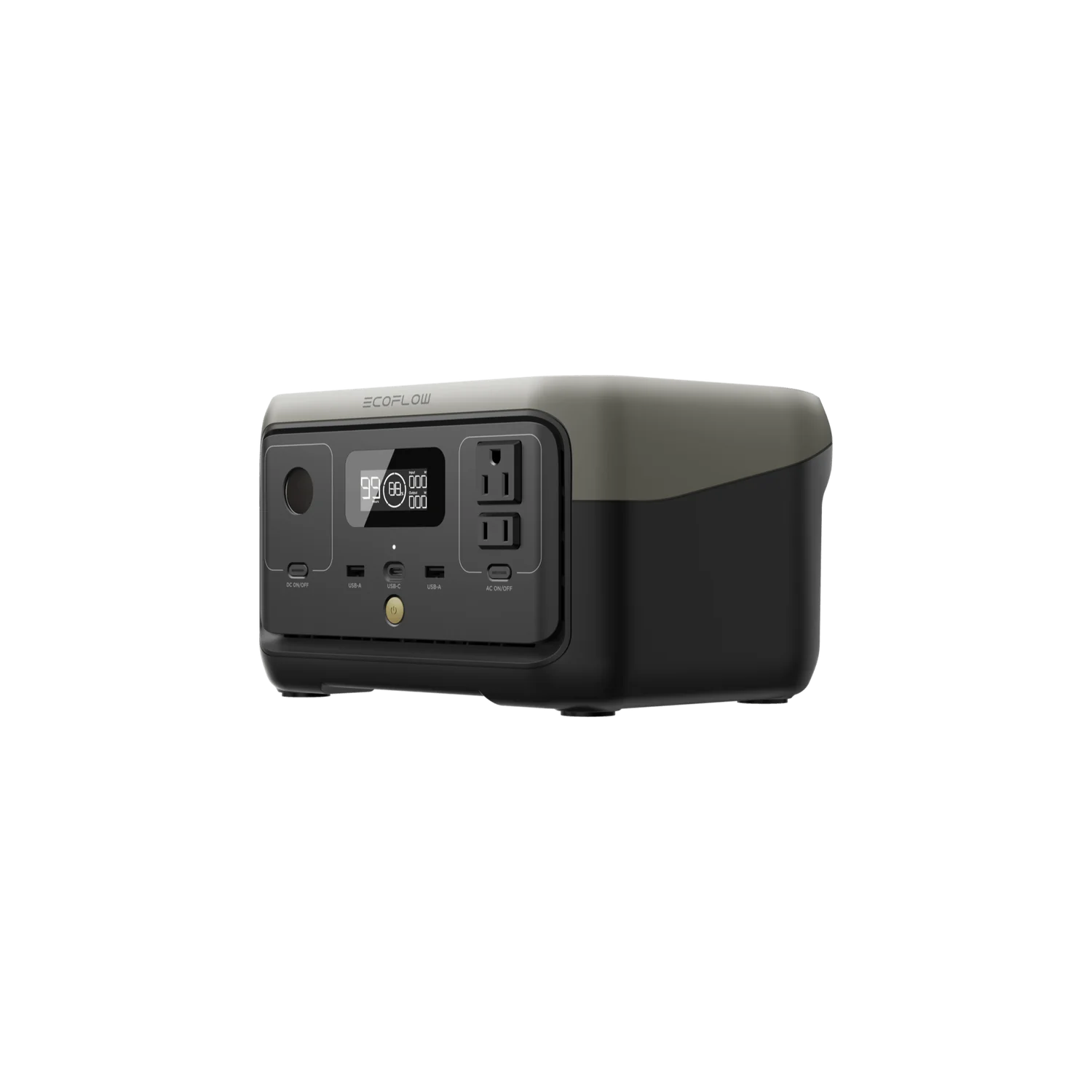
The RIVER 2 is $50 cheaper and brings EcoFlow's app, but it's the loud one with a 60W USB-C ceiling; the Explorer 300 v2 charges a laptop at a full 100W, runs quieter, and holds more, and for most small-unit buyers that's worth the extra fifty.
Full profiles: EcoFlow RIVER 2 → · Jackery Explorer 300 v2 →
Looking for a different matchup? EcoFlow RIVER 2 vs Jackery Explorer 300

Written by Wenny ZhengUpdated
Portable Power Tester, Station Arena Test Desk
Spec deltas
The RIVER 2 costs $219; the Explorer 300 v2 costs $269. The RIVER 2 is $50 cheaper and it's the one with an app, so if this were only about price it would be a short page. It isn't.
Two specs decide it. The RIVER 2 is the loud one, rated around 50 dB and, per reviewers, noticeably louder under load than the quieter RIVER 3 lineA1, and its USB-C caps at 60W where the v2 pushes a full 100W. On a box that sits on your desk and charges your laptop, those are the specs you live with, and both favor the Jackery.
The v2 backs that up with the quieter kind of edges: 32 more watt-hours (288 to 256), a faster 10ms UPS against the RIVER 2's 30, and a longer cycle rating that makes it, oddly, the cheaper unit to own over time despite the higher sticker. The RIVER 2's reply is $50 and EcoFlow's software, and for the right buyer that's enough. For most, it isn't.
What the Numbers Reveal
Each conclusion stated first — the numbers behind it on one line, the full analysis below.
The v2's quiet is unproven, since Jackery won't publish a number, but undisclosed still beats a documented 50 dB when the unit lives near your head. The RIVER 2's noise is the one hard knock neither its price nor its app buys back.
RIVER 2 is rated around 50 dB and runs louder under loadA1Explorer 300 v2 publishes no dB figuresmall units often sit on a desk or nightstand
Why it mattersIf the unit will run within earshot, a bedroom, a desk, a quiet campsite, the RIVER 2's documented loudness is the reason to spend up.
For a remote worker, that 40W gap is the difference between a laptop that gains charge during a work session and one that merely drains slower, and it's the exact use these small units get bought for.
RIVER 2 USB-C tops out at 60WExplorer 300 v2 USB-C delivers 100Wmodern laptops can pull up to 100W
Why it mattersAnyone running a laptop off this thing should read the v2's 100W USB-C as a real, daily advantage, not a spec-sheet footnote.
rated cycles
That lifetime edge is real but slow: you only bank it by cycling the unit for years, so at the register the RIVER 2 is still the cheaper box and the $50 is a genuine saving today. The v2 wins the long game; the RIVER 2 wins the receipt.
RIVER 2 is $219; Explorer 300 v2 is $269v2 is rated for 4,000 cycles to the RIVER 2's 3,000v2 holds 288Wh to the RIVER 2's 256
Why it mattersWeigh the $50 against how long you'll keep it: hold it a decade and the v2 is cheaper, flip it in a year or two and the RIVER 2's lower price is what counts.
The specific dimensions that decide these two units — everything else is a tie.
What the Specs Don't Tell You
Selected because: The noise, UPS, and noise-disclosure cards carry the whole matchup; noise is the RIVER 2's real flaw.
rated cycles
The flag cards split the honest way. The noise card lands on the RIVER 2, and it's the meaningful one: rated around 50 dB, it's the loud member of this pair, and you'll hear it under load. The UPS card favors the v2, which switches over in 10ms to the RIVER 2's 30, though for non-critical gear that's a small edge.
The one flag against the v2 is noise disclosure, and it's fair, since Jackery publishes no dB number at all. So one unit is documented loud and the other documented nothing. If quiet matters, a stated 50 is at least something you can plan around while you hope the Jackery is better.
Lifetime Value
Selected because: The pricier v2 is cheaper-to-own on paper while the RIVER 2 is cheaper at the register — worth untangling.
Here's the wrinkle: the pricier v2 is the cheaper unit to own on paper. At $0.23 per lifetime kWh against the RIVER 2's $0.29, it stretches its higher price across a 4,000-cycle battery and 288Wh and comes out ahead per unit of energy.
But that math assumes a long life, thousands of cycles, and at the register the RIVER 2 is simply $50 less. Which number matters depends on your horizon. Keep either for a decade and the v2 is the better deal; treat it as a two-year gadget and the RIVER 2's lower sticker wins, full stop.
Brand Trust
Selected because: EcoFlow's app and ecosystem are the RIVER 2's strongest card; give it a fair hearing.
This is the RIVER 2's best argument. It carries EcoFlow's app, rated 4.6 on iOS to Jackery's 2.3, and plugs into the largest ecosystem and owner community in the category, so a matching panel or a second unit is easy to add later. Jackery's counter is reach, not software: you'll find the v2 at Costco and Home Depot, and buying it there hands you a return counter more useful than either brand's warranty desk.
If app control and ecosystem sit high on your list, the RIVER 2 genuinely wins this row, and it's worth being honest that the v2's software is the weakest part of its package.
PowerScore Breakdown
Selected because: The 173-point gap confirms the hardware story but misses the app the RIVER 2 wins on.
overall power score
The v2 scores 1,675 to the RIVER 2's 1,502, a 173-point gap that mostly reflects the capacity, cycle-life, and USB-C advantages already covered. It isn't measuring the app, which is where the RIVER 2 would claw some back if the score weighed software.
Read it as confirmation of the spec-sheet story, not a separate reason: the v2 is the stronger unit on the hardware, and the number agrees.
Strengths & trade-offs
EcoFlow RIVER 2
Strengths
- +Lighter by 0.3 lb
- +Faster solar charging
Trade-offs
- –Shorter-lived battery — rated for 3,000 charge cycles vs the Explorer 300 v2's 4,000, so it wears out sooner.
Jackery Explorer 300 v2
Strengths
- +Larger battery capacity
- +Rated for 4,000 charge cycles — much longer battery lifespan
Trade-offs
- –Lacks smartphone app control for remote monitoring.
Will It Power Your Gear?
Scenario math and per-appliance runtimes, modeled from the spec record.
Scenario verdicts
We ran the math on seven real-world scenarios. Here's which unit survives your actual life.
SCN-01 · 2 nights · needs 2,100Wh
Weekend Camping
Two nights off-grid with essential comfort
Neither unit
Neither unit covers this scenario's 2,100Wh: the RIVER 2 comes up 1,882Wh short (about 10% covered), the Explorer 300 v2 1,855Wh (12%). This is well outside what either unit is for; the right answer here is a larger station, not a choice between these two.
Battery budget usedlower = more headroom
LOAD Phone Charger 15W×6h · LED Lights 40W×8h · Box Fan 75W×14h · CPAP Machine 40W×16h
SCN-02 · 8 hours · needs 1,645Wh
8-Hour Blackout
Keep the essentials running through a night without power
Neither unit
Neither unit covers this scenario's 1,645Wh: the RIVER 2 comes up 1,427Wh short (about 13% covered), the Explorer 300 v2 1,400Wh (15%). This is well outside what either unit is for; the right answer here is a larger station, not a choice between these two.
Battery budget usedlower = more headroom
LOAD Fridge 150W×8h · Router + Modem 20W×8h · LED Lights (4 bulbs) 40W×6h · Phone Charger 15W×3h
SCN-03 · 8 hours · needs 320Wh
CPAP Overnight
Sleep therapy without interruption — the #1 medical use case
Neither unit
A modeled CPAP night wants about 320Wh, and neither unit fully covers a heavy one; the v2 gets a bit closer with 288Wh to the RIVER 2's 256. But the tiebreak two feet from your pillow is noise, and here the RIVER 2 is the documented loud one at around 50 dB, while the v2 at least isn't on record as loud. For a bedside unit, quieter-and-larger beats cheaper.
Battery budget usedlower = more headroom
LOAD CPAP Machine 40W×8h
SCN-04 · 8 hours · needs 910Wh
Remote Workday
Full work day off-grid without power anxiety
Neither unit
A modeled remote workday runs about 910Wh, and both fall short of a full unplugged day, so you'll top up either way. The tiebreak is your laptop: the v2's 100W USB-C keeps it charging at full speed through the session, while the RIVER 2's 60W port lets it drain slower rather than gain. For a working day, the v2 is the one that keeps you ahead.
Battery budget usedlower = more headroom
LOAD Laptop 60W×8h · External Monitor 30W×8h · Router + Modem 20W×8h · Phone Charger 15W×2h
SCN-05 · 4 hours · needs 670Wh
Tailgate Party
Game day power for the crew
Neither unit
Neither unit can hold the 400W peak this scenario needs — the RIVER 2 on its 300W continuous rating, the Explorer 300 v2 on its 300W, so capacity never gets a say. This is the wrong size of unit for the job rather than a close call.
Battery budget usedlower = more headroom
LOAD Blender 400W×0.5h · LED TV (55") 80W×4h · Bluetooth Speaker 15W×4h · Phone Charger (×3) 45W×2h
SCN-06 · 24 hours · needs 4,685Wh
Van Life Daily
A full day of mobile living — the ultimate endurance test
Neither unit
Neither unit covers this scenario's 4,685Wh: the RIVER 2 comes up 4,467Wh short (about 5% covered), the Explorer 300 v2 4,440Wh (5%). This is well outside what either unit is for; the right answer here is a larger station, not a choice between these two.
Battery budget usedlower = more headroom
LOAD Mini-Fridge 150W×24h · Laptop 60W×4h · Phone Charger 15W×3h · LED Lights 40W×5h · Fan 75W×8h
SCN-07 · an afternoon · needs 100Wh
Afternoon Off-Grid
Phones and a speaker at the park, beach, or campsite — the small-unit job description
Either unit
This is the job small stations are actually for, and both do it: the RIVER 2 finishes at 46% used, the Explorer 300 v2 at 41%. At this size the leftover watt-hours decide nothing, and the two weigh within half a pound of each other, so the bag doesn't separate them. Only the Explorer 300 v2 is still sold, so a new purchase here is just the Explorer 300 v2; the RIVER 2 is a used-market question.
Battery budget usedlower = more headroom
LOAD Phone Charger (×2) 30W×2h · Bluetooth Speaker 10W×4h
The Load Test
RUNTIME = (Wh × 0.85) ÷ LOAD
None of the scenarios above exactly yours? Build it. Toggle what you'd plug in; both units are tested against the combined draw.
Essentials
Comfort & Convenience
High-Draw Appliances
Test duration
8h
Continuous draw
205W
Projected runtime
For this load: Explorer 300 v2 runs 1.2h vs 1.1h.
$269 list · direct from Jackery
Planning for more than this? Describe your whole setup and get it sized →
Modeled from the spec record — same math as the tables below. Methodology
Runtime by appliance
Real-world runtime estimates for common appliances, modeled at 85% inverter efficiency.¹
Essentials
The basics you need runningscale 0–16.3hComfort & Convenience
Makes off-grid life actually enjoyablescale 0–3.3hHigh-Draw Appliances
These reveal the real limits¹ Runtime = (capacity × 0.85) ÷ appliance watts. Within each group, all bars share one time scale (the group's longest runtime), so lengths are comparable across appliances; identical runtimes collapse into a single blue/orange bar. Actual runtime varies with battery age, temperature, and simultaneous loads — see methodology.
Conclusion
July 18, 2026
Verdict: the Jackery Explorer 300 v2
Take the Explorer 300 v2 unless the $50 saving is decisive for you. The RIVER 2 is the cheaper unit and it carries EcoFlow's genuinely better app, but it loses the things a small station is actually for: it's rated around 50 dB and runs noticeably louder under loadA1, its USB-C tops out at 60W where the v2 delivers a full 100W to a laptop, and it holds 32Wh less (256 to 288). The v2 also switches over faster as a UPS, 10ms to 30, and lasts more cycles. Our lifetime math even makes the pricier v2 the cheaper one to own, $0.23 per kWh to $0.29. The RIVER 2's case is real, $50 and a better app, so if you charge outdoors where noise doesn't matter and never fast-charge a laptop, buy it and pocket the difference. Everyone else is better served by the quieter, higher-capacity v2.
Editor-assigned confidence, based on cited owner research and spec analysis.
List prices as of July 18, 2026. The links below open Jackery's current price.
$279.00 · direct from Jackery
Last checked 16 days ago. Prices move — check before you buy.
Written by Wenny Zheng, Portable Power Tester · Station Arena Test Desk · Updated July 18, 2026
Black Friday · 38 days out
Price to beat:Explorer 300 v2 $269
We have never seen it discounted, so any real cut would be a first.
Measured Data
Benchmark scores and the full spec record, side by side.
Benchmark scores
Not rated for both units (minimum threshold unmet): UPS.
Full specifications
ᵈ Derived: price ÷ rated capacity. See the data behind our comparisons →
Comparison ToolAdd more power stations, side by sideOpen Tool →How these numbers are produced
Numeric verification
Every figure on this page traces to our spec database or arithmetic on it — no estimated numbers.
Owner claims
Statements about owner experience are cited to published reviews — see Sources & Research Notes below.
Runtime model
Runtime = (rated capacity × 0.85 inverter efficiency) ÷ device wattage. Solar recharge estimates assume panels deliver 70% of rated output. Cold weather, battery age, and stacked loads reduce real-world results.
Power Score
Computed from 14 published spec dimensions, weighted per use-case bench. Higher is better; a unit must meet a bench's minimum threshold to be rated.
See the full weight table and data sourcing on our methodology page →Class ranking (the star rating)
Each unit's star score is a category ranking, not customer reviews — no buyer opinions feed it. We score every station on size-independent quality (value, output, portability, endurance, ports, warranty, and more), then percentile-rank it against the other units in its capacity class, so a class-leading compact unit and a class-leading whole-home unit can both earn 5★. Here, RIVER 2 rates 3.9/5 (35th percentile of 24 Personal-class units), and Explorer 300 v2 rates 4.7/5 (83rd percentile of 24 Personal-class units).
How the class ranking is computed →Test Notes & Caveats
Hidden gotchas and advantages we spotted that you won't find on the product page.
Explorer 300 v2: No App Control
Without app control, you have to physically walk to the Explorer 300 v2 to check battery level, adjust settings, or monitor power draw. The RIVER 2 lets you do all that from your phone, including getting low-battery alerts.
10ms against 30
The v2 switches to battery in about 10 milliseconds; the RIVER 2 takes around 30. Both keep a router or PC alive through a grid drop, but the v2's faster handoff is the safer margin for anything fussy about power. It's a small edge, honestly labeled.
Warranty: No Difference
Both units carry the same 5-year warranty, so coverage isn't a tiebreaker here. The Explorer 300 v2's figure is a maximum rather than a guarantee — it depends on registering the unit with Jackery, which is what extends the base term to the full period.
Battery Lifespan in Real Years
The Explorer 300 v2 is rated for 4,000 cycles vs 3,000. In real life: at daily use, that's 11 vs 8.2 years. At weekend use (twice a week), it's 38 vs 29 years. After hitting the cycle limit, the battery doesn't die — it drops to ~80% of original capacity, which is still very usable.
Full record above — the Test Desk pick is the Explorer 300 v2.
Check Explorer 300 v2 price →Ownership Analysis
What happens after you buy — true cost of ownership, brand trust, and growth potential.
Lifetime value
Service lifeyears at one full cycle per day
Lifetime energy delivered
Cost per delivered kWh
│ warranty ends · Reaching the cycle rating means ~80% capacity remains — degraded, not dead.
Analyst note
The RIVER 2 is no longer sold, so there is no price to work its cost per kWh from, and this comparison doesn't quote one. On what you can actually buy today, the Explorer 300 v2 works out at $0.23/kWh over its rated life. If you already own the RIVER 2, the hardware comparison still holds: over its rated life the RIVER 2 delivers about 768 kWh and the Explorer 300 v2 about 1,152 kWh.
Brand trust
EcoFlow
Ecosystem
Largest in portable power — 12-15 models across DELTA Pro, DELTA 3, and RIVER 3 series, plus solar panels and smart home panels
Support
US-based phone/email/chat support (1-800-368-8604). Experiences are polarized — many report hassle-free prepaid-label replacements, but others report long waits and refurbished units sent for new claims. Pro tip: buying from Costco or Amazon gives you a stronger return safety net.
Community
Largest community in the space — Reddit r/Ecoflow_community (~31K members), multiple Facebook groups, and an official community forum
App experience
Rated 4.6/5 iOS (~8,400 ratings) · 4.2/5 Android (~17,000 ratings)
Unique strength
Fastest-charging technology (X-Stream), deepest product ecosystem, and most active innovation cadence. At the top of the range sit two whole-home paths: the TITAN line, one 5 kWh unit that grows to 30 kWh, and the DELTA Pro Ultra platform, which stacks batteries and inverters further — flagship paths, not line-wide features.
Worth knowing
Tested subscription paywalls for advanced app features in early 2025 before community backlash paused the plan. No parts or service offered out of warranty.
Jackery
Ecosystem
12-15+ models across Explorer (portable) and HomePower (home backup) series, plus SolarSaga panel ecosystem and innovative form factors
Support
US-based support but widely criticized. Reddit reports describe slow/dismissive responses, scripted AI agents, strict receipt requirements for warranty claims, and refurbished replacements for clearly defective units. Strongly recommended: buy from Costco or Amazon for return protection.
Community
Smallest community of the major brands — Reddit r/Jackery has ~2,000 members. YouTube presence is solid due to brand recognition.
App experience
Rated 2.3-3.3/5 iOS and Android — the weakest app experience of the major brands. Multiple confusing apps (Jackery app vs Jackery Home) and mandatory login even offline.
Unique strength
Highest brand recognition and widest retail distribution (Costco, Home Depot, Best Buy, Amazon). The "Toyota" of power stations — dependable, proven, wide availability. Innovative form factors like the Solar Gazebo and Solar Mars Bot.
Worth knowing
A couple of older models still ship NMC chemistry with a shorter rated lifespan, so check the cycle rating on the specific unit — though most of the current line has moved to LFP. Generally perceived as overpriced for the specs offered compared to newer competitors. App experience is significantly behind rivals.
Analyst note
EcoFlow and Jackery are close competitors. Both have established support channels and growing ecosystems. Compare their specific warranty terms and community size for your peace of mind.
Growth path
RIVER 2
FIXED CAPACITYFixed at 256Wh, with no expansion — so size it for your needs up front rather than planning to add capacity later.
Accepts up to 110W of solar. Limited to a single portable panel.
Limited ports. You'll likely need a power strip or splitter.
Explorer 300 v2
FIXED CAPACITYFixed at 288Wh, with no expansion — so size it for your needs up front rather than planning to add capacity later.
Accepts up to 100W of solar. Limited to a single portable panel.
Limited ports. You'll likely need a power strip or splitter.
Realistic full solar rechargeat 70% of rated panel output — see methodology
Analyst note
Growth only counts if you can still buy in, and the RIVER 2 is no longer sold (EcoFlow points owners to the RIVER 2 240). That leaves the Explorer 300 v2: it is sealed at 288Wh, so buy the size that covers you now. The RIVER 2's fixed 256Wh still matters if you already own one, but it isn't a reason to pick it over the Explorer 300 v2.
What Owners Report
Patterns from published owner reports and long-term reviews — every claim cited to its source below.
EcoFlow RIVER 2
Reviewers place the RIVER 2 as the older, cheaper unit on the same core platform as the RIVER 3, same 300W output, LFP chemistry, and roughly hour-long fast charge, a proven budget pickA2. The recurring caveat is refinement: it's noticeably louder under load than the RIVER 3 and lacks that generation's waterproofing, faster UPS, and quieter operationA1A3. For strictly indoor, budget-first use it's still reasonable, but you're buying the previous generation and it showsA3.
“Shares the same core platform as the RIVER 3 — 300W output, LiFePO4 chemistry, and roughly 60-minute fast charging — and remains a popular, proven budget small-format unit.”
Sources
backuppowerhub.com · ecoflow.com · versus.com
Jackery Explorer 300 v2
Hard field data on the v2 remains limited, so read its owner signal as directional. The complaint that surfaces is the charging port: it's a proprietary DC barrel jack rather than a standard connector, so hooking up a solar panel needs an extra adapter, with some perceived charging lossB4. That's a real knock against the RIVER 2's more standard input.
On the positive side, a repeat buyer running an event-rental business bought a second v2, valuing grab-and-go power without hunting for outlets on siteB1. Thin as the sample is, it fits the v2's role: a light, quick-charging box for small mobile loads.
“Uses the unit for an event rental business and made it a repeat (second) purchase — likes not having to worry about finding electrical outlets nearby at events.”
Sources
walmart.com
Sources & Research Notes
Every owner claim in this report is traceable to a published source. The bracketed references above resolve here.
Recurring owner themes
- The RIVER 2 is the older, cheaper unit on the same core platform — reasonable for budget indoor use but louder and less refined than the RIVER 3. [RIVER 2 · 2 entries]
- Buyers who use it for grab-and-go power (event work, road trips, device top-offs) like the fast charging and light weight enough to become repeat customers. [Explorer 300 v2 · 2 entries]
- The charging/accessory ecosystem is the recurring friction point — a 12V cable pictured but not included in the 'Auto Kit', and a proprietary DC7909 solar input that requires a separate adapter. [Explorer 300 v2 · 2 entries]
- A1
“The RIVER 2's spec data doesn't include a specific dB rating, and owner reports suggest it's noticeably louder under load than the newer RIVER 3.”
backuppowerhub.com — EcoFlow RIVER 2 vs RIVER 3 · 2026 · [negative]
- A2
“Shares the same core platform as the RIVER 3 — 300W output, LiFePO4 chemistry, and roughly 60-minute fast charging — and remains a popular, proven budget small-format unit.”
ecoflow.com / versus.com — RIVER 2 vs RIVER 3 · 2026 · [positive]
- A3
“For strictly indoor use where every dollar counts, the RIVER 2 is still a reasonable choice — but it lacks the RIVER 3's refinements like waterproofing, faster UPS, and quieter operation.”
backuppowerhub.com — RIVER 2 vs RIVER 3 recommendation · 2026 · [mixed]
- B1
“Uses the unit for an event rental business and made it a repeat (second) purchase — likes not having to worry about finding electrical outlets nearby at events.”
Walmart.com customer reviews — Jackery Explorer 300v2 Auto Kit listing · unknown · [positive]
- B4
“Charging port is a proprietary DC7909 jack rather than a standard connector, so solar charging needs an extra adapter — reviewer notes it adds cost/hassle and some perceived charging power loss.”
Walmart.com customer reviews — Jackery Explorer 300v2 Auto Kit listing · unknown · [negative]
Research compiled July 18, 2026.
Who Should Buy Which
Buy the RIVER 2 if you…
- →The budget buyer who charges outdoors or in a garage, where 50 dB under load doesn't matter, and wants EcoFlow's app for $50 lessA1. If noise is a non-issue for your use, the RIVER 2 is a lot of unit for the money.
- →Anyone already invested in EcoFlow's ecosystem who wants a matching small unit and the shared app. Staying in one app is worth something, and the RIVER 2 keeps you there.
Buy the Explorer 300 v2 if you…
- →The desk or bedroom user who wants the quieter unit and charges a laptop over USB-C: 100W at full speed against the RIVER 2's 60, and no documented 50 dB whine to live with.
- →The long-haul owner who'll keep it for years and wants the lower cost-per-kWh and higher capacity, $0.23 per lifetime kWh and 288Wh to the RIVER 2's 256.
If neither fits
If your real need is a fridge through an outage or a full camping weekend, neither of these 256-to-288Wh units gets close; step up to a 500Wh-plus station. And if you only ever top off phones outdoors, the cheaper RIVER 2, or even a large power bank, does that job without the extra spend.
The Bottom Line
Take the Explorer 300 v2. It wins the specs a small unit lives or dies on: it's quieter than the documented-50 dB RIVER 2A1, it charges a laptop at a full 100W to the RIVER 2's 60, it holds 32Wh more, and thanks to its longer cycle life it's even the cheaper unit to own over time at $0.23 per lifetime kWh. For a box that sits on a desk and runs your gear, that's the better package.
The RIVER 2's honest wins are its $50 lower price and EcoFlow's much better app, and they're enough for one buyer: the person charging outdoors, on a budget, who doesn't care about noise or fast USB-C. If that's you, buy it happily. If it isn't, the extra fifty buys a quieter, more capable unit you'll be glad you stretched for.
Frequently Asked Questions
Answers drawn from the spec record and cited owner research.
Is the Explorer 300 v2 worth $50 more than the RIVER 2?
For most small-unit buyers, yes. The v2 is quieter (the RIVER 2 runs around 50 dB under load), charges a laptop at a full 100W to the RIVER 2's 60W, and holds 32Wh more. The RIVER 2's case is the $50 saving and EcoFlow's better app, so if you charge outdoors and don't need fast USB-C, it's still a smart budget pick.
Which is quieter, the RIVER 2 or the Explorer 300 v2?
The RIVER 2 is the documented loud one, rated around 50 dB and noticeably louder under load than newer EcoFlow units. Jackery doesn't publish a noise figure for the v2 at all, so its quiet is unproven, but small LFP units are usually calm. If the box will sit near you, an undisclosed number is still a better bet than a stated 50 dB.
Does the RIVER 2 have a better app than the Explorer 300 v2?
Yes, clearly. The RIVER 2 uses EcoFlow's app, rated 4.6 on iOS against Jackery's 2.3, and it ties into a larger ecosystem of panels and units. App control and ecosystem are the RIVER 2's strongest advantages here, and the v2's software is the weakest part of its package.
Can I charge a laptop quickly on either one?
Faster on the v2. Its USB-C port delivers up to 100W, enough to charge most laptops at full speed, while the RIVER 2 tops out at 60W and will charge a power-hungry laptop slowly. If a laptop is your main load, the v2's port is a real, daily advantage.
Brand matchup
EcoFlow vs Jackery: measured across every matchup →Where to buy
EcoFlow RIVER 2
Left EcoFlow's store

Jackery Explorer 300 v2Pick
$279.00
$279.00 · direct from Jackery
Last checked 16 days ago. Prices move — check before you buy.
Prices may vary by retailer and are subject to change.