Head-to-head test
EcoFlow RIVER 2 vs BLUETTI AC200P L
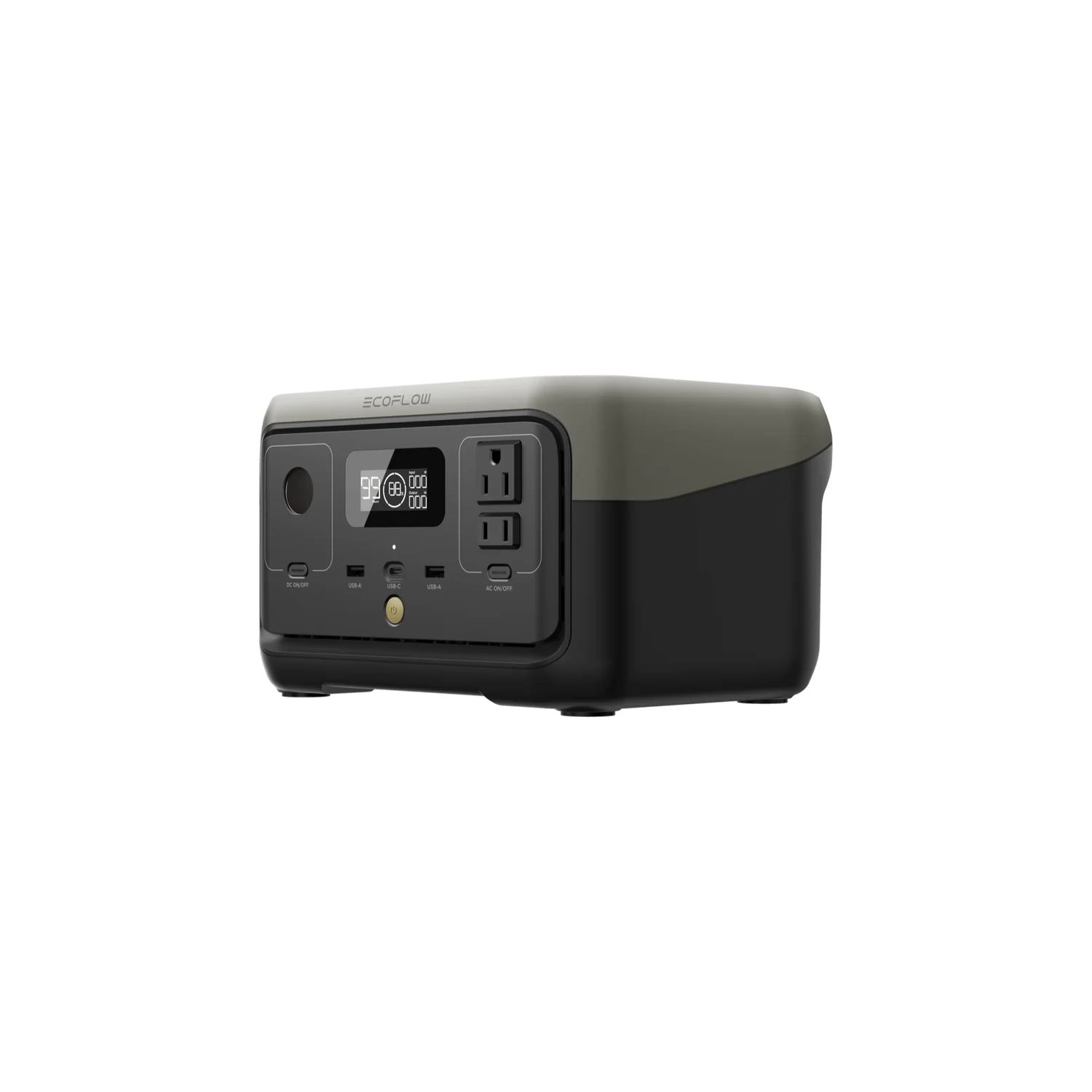
EcoFlow has stopped selling the RIVER 2, and the specs say this was never much of a fight: 256Wh against 2,304Wh is an afternoon of phones against a night of the house's essentials.
Full profiles: EcoFlow RIVER 2 → · BLUETTI AC200P L →

Written by Ian SchneiderUpdated
Solar & Off-Grid Tester, Station Arena Test Desk
Spec deltas
EcoFlow no longer sells the RIVER 2. Its store lists the RIVER 2 240 in that slot now, which means this page has exactly one unit you can put in a cart: the BLUETTI AC200P L. If you already own a RIVER 2, everything below still describes what you own. If you were choosing between the two, the choice has been made for you, and the only question left worth your time is whether 2,304Wh is the size you needed in the first place.
Nine times the battery, eight times the weight. The AC200P L holds 2,304Wh in a 63.5-lb box; the RIVER 2 holds 256Wh in one you carry in a finger hook at 7.8 lbs. Every row the RIVER 2 loses, it loses on capacity, and the two rows the AC200P L doesn't clear, it misses because the job was bigger than any 2,304Wh unit.
The catch on the live unit is evidence, not specs. Our research file for the AC200P L describes an AC200P with a different capacity, a different continuous rating, a different surge ceiling and a different solar inputB0, so there is no field record of this exact listing to lean on. That doesn't make the spec record wrong. It means the reasons to buy this one sit on the spec sheet and in BLUETTI's warranty conditions, and the satisfaction stories about the line should be read as reputation rather than testimony about this boxB1B4.
What the Numbers Reveal
Each conclusion stated first — the numbers behind it on one line, the full analysis below.
Capacity
The AC200P L runs the same night on 16% of itself and finishes with 1,638Wh spare. That is the difference between a unit that is tight for the job and a unit that is not doing the job, and a shortfall arriving at 68% is the worst kind: you are asleep when it lands.
RIVER 2: 256Wh, which the flat 15% derate this site applies to every unit turns into 218Wh usableCPAP Overnight needs 320WhAC200P L: 2,304Wh, or 1,958Wh usable on the same derate
Why it mattersIf a medical device is why you're shopping, the small column was never a candidate. Size for the whole night with room over, not to the edge.
continuous output
A ratio describes an inverter's relationship with itself. A compressor draws watts at switch-on, not a multiple of someone else's rating, and on the number that decides whether a motor actually spins the AC200P L has six times the ceiling. The flattering spec and the useful one point in opposite directions here.
RIVER 2: 300W continuous, 600W surgeAC200P L: 2,400W continuous, 3,600W surgeTailgate Party peaks at 400W
Why it mattersAnyone starting a fridge, a pump or a power tool should read the surge ceiling and ignore the ratio.
weight
So the case for a 7.8-lb unit is real, and this page can't sell it to you. EcoFlow has retired the RIVER 2 and put the RIVER 2 240 in its place, which means the buyer whose honest load is phones, a speaker and a laptop lid should be shopping that unit rather than weighing this matchup.
RIVER 2: 7.8 lbsAC200P L: 63.5 lbsAfternoon Off-Grid needs 100Wh; the RIVER 2 finishes it at 46% used, the AC200P L at 5% with 1,858Wh untouched
Why it mattersIf your load is an afternoon, buy small and current. Buying the AC200P L to cover an afternoon is buying a 63.5-lb insurance policy you will leave in the garage.
solar input
That is what makes the AC200P L an outage unit rather than a large battery. One overnight leaves it 313Wh, which is thin, but a morning of sun puts the pack back before lunch and day two becomes a real possibility. The RIVER 2's 110W ceiling is slow relative to a pack that was never going to finish day one.
AC200P L: 2,304Wh with up to 1,200W of solar inputRIVER 2: 256Wh with up to 110W of solar input8-Hour Blackout needs 1,645Wh; the AC200P L finishes it with 313Wh left
Why it mattersMulti-day outage buyers should read solar input as hard as they read capacity. It is the spec that decides whether there is a second day.
The specific dimensions that decide these two units — everything else is a tie.
Your Life, Your Pick
Selected because: The RIVER 2 finishes exactly one of the seven rows, the 100Wh afternoon, while the AC200P L clears everything up to the 1,645Wh blackout.
The RIVER 2 clears exactly one row: 100Wh across an afternoon, which it finishes at 46% used. Everywhere else it isn't close. The CPAP night leaves it 102Wh short, the remote workday 692Wh short, the tailgate 452Wh short, and the tailgate is the one where it can start the 400W load and then hand it straight back when the 300W continuous rating takes over.
Read the two rows marked neither as a warning about the AC200P L, not the RIVER 2. A loaded camping weekend at 2,100Wh puts it 142Wh under the line once the flat 15% derate this site applies to every unit comes off the 2,304Wh nameplate, and a full van day at 4,685Wh leaves it 2,727Wh short. That isn't a knock on the unit; it's the ceiling of the class. If either of those is your actual week, the answer is a bigger station or expansion batteries, not a closer reading of this page.
Portability & Form Factor
Selected because: 7.8 lbs against 63.5 lbs is the one axis the smaller unit wins outright, and it is the reason both sizes exist.
weight
At 7.8 lbs the RIVER 2 goes to the picnic table in one hand, on the same trip as the cooler. At 63.5 lbs the AC200P L is a two-hands, bent-knees lift out of a trunk, and our spec record doesn't track whether it rolls, so check the product photos before you plan on carrying it anywhere from the car.
Weight is the only axis where the small unit wins outright, and it's worth being honest about what that win is worth: nothing at all, if the job needs more than 218Wh. Portability is not a feature you can spend on a CPAP night. It is what you accept instead of capacity, and on this pair the trade is about as stark as it gets.
What the Specs Don't Tell You
Selected because: Seven cards fire here; the ones to read are the surge ceiling, the UPS transfer classes of no worse than 20ms against no worse than 30ms, and the RIVER 2 publishing no noise figure at all.
The surge cards are the pair to read twice. The RIVER 2 keeps the better headroom above its own rating, and the AC200P L swallows a startup spike six times larger. Only one of those facts starts a fridge.
The UPS line is close behind. Both units list a UPS mode, rated no worse than 20ms on the AC200P L and no worse than 30ms on the RIVER 2, and neither figure is a measurement; they are ceilings the makers publish. A desktop with unsaved work may well not ride through the longer one. On noise, only the AC200P L publishes a number at all, and the RIVER 2's silence there is not evidence either way. It just means there is nothing to hold it to.
Brand Trust
Selected because: One unit has left its maker's range and the other is the one you would actually be shipping back if something failed, so support terms carry more weight here than usual.
Buy the AC200P L direct from BLUETTI, or register it the day it arrives. The five-year term on our record is a conditional maximum rather than the default, reseller purchases carry a shorter one, and BLUETTI runs the most inconsistent support desk in the category: some claims resolve quickly, others turn into weeks of email with a China-timezone lag between replies, and some owners get offered a discount on a new unit instead of a repair. Buying direct is the cheapest thing you can do to improve those odds.
The RIVER 2's brand question changed the day it left production. EcoFlow offers no parts or service outside the warranty period, so an older RIVER 2 is a unit you own in every sense of the word. That isn't a reason to avoid EcoFlow, whose community is the largest in the category and genuinely useful for questions. It is a reason to be realistic about a discontinued model's second half of life.
Strengths & trade-offs
EcoFlow RIVER 2
Strengths
- +Lighter by 55.7 lb
Trade-offs
- –Weaker inverter (-2,100W) limits appliance compatibility.
- –Sealed capacity — the AC200P L can add batteries to grow past 256Wh; this one can't.
BLUETTI AC200P L
Strengths
- +Larger battery capacity
- +Higher AC output
- +Faster solar charging
Trade-offs
- –Significantly heavier (+55.7 lbs), making it harder to move.
Will It Power Your Gear?
Scenario math and per-appliance runtimes, modeled from the spec record.
Scenario verdicts
We ran the math on seven real-world scenarios. Here's which unit survives your actual life.
SCN-01 · 2 nights · needs 2,100Wh
Weekend Camping
Two nights off-grid with essential comfort
Neither unit
Neither unit finishes the full list. The RIVER 2 covers about a tenth of the 2,100Wh this needs, which puts it out of the conversation entirely. The AC200P L is the near miss: its 2,304Wh nameplate clears the load, but after the flat 15% derate applied to every unit here it lands 142Wh under. In practice that is a weekend where you drop one appliance or catch a few hours of sun, not a weekend where the lights go out.
Battery budget usedlower = more headroom
LOAD Phone Charger 15W×6h · LED Lights 40W×8h · Box Fan 75W×14h · CPAP Machine 40W×16h
SCN-02 · 8 hours · needs 1,645Wh
8-Hour Blackout
Keep the essentials running through a night without power
AC200P L
The RIVER 2 doesn't finish — 218Wh usable against the 1,645Wh this needs leaves it 1,427Wh short, about 13% of the scenario covered. The AC200P L covers it with 313Wh to spare.
Battery budget usedlower = more headroom
LOAD Fridge 150W×8h · Router + Modem 20W×8h · LED Lights (4 bulbs) 40W×6h · Phone Charger 15W×3h
SCN-03 · 8 hours · needs 320Wh
CPAP Overnight
Sleep therapy without interruption — the #1 medical use case
AC200P L
The AC200P L takes this one without noticing, 320Wh out of 1,958Wh usable, finishing with 1,638Wh spare. The RIVER 2 gets about two-thirds of the way and stops 102Wh short, which is the worst possible way to fail a medical load. Not at bedtime, when you could still do something about it, but at the hour when you are asleep.
Battery budget usedlower = more headroom
LOAD CPAP Machine 40W×8h
SCN-04 · 8 hours · needs 910Wh
Remote Workday
Full work day off-grid without power anxiety
AC200P L
The RIVER 2 doesn't finish — 218Wh usable against the 910Wh this needs leaves it 692Wh short, about 24% of the scenario covered. The AC200P L covers it with 1,048Wh to spare.
Battery budget usedlower = more headroom
LOAD Laptop 60W×8h · External Monitor 30W×8h · Router + Modem 20W×8h · Phone Charger 15W×2h
SCN-05 · 4 hours · needs 670Wh
Tailgate Party
Game day power for the crew
AC200P L
The AC200P L runs the whole afternoon and has 1,288Wh left at the end of it. The RIVER 2's problem here is not the total, it is the 400W peak: 600W of surge gets the load moving, then the 300W continuous rating takes it straight back. A unit that starts your appliance and then quits on it, in front of a parking lot full of people, is worse than one that never tried.
Battery budget usedlower = more headroom
LOAD Blender 400W×0.5h · LED TV (55") 80W×4h · Bluetooth Speaker 15W×4h · Phone Charger (×3) 45W×2h
SCN-06 · 24 hours · needs 4,685Wh
Van Life Daily
A full day of mobile living — the ultimate endurance test
Neither unit
Neither unit covers this scenario's 4,685Wh: the RIVER 2 comes up 4,467Wh short (about 5% covered), the AC200P L 2,727Wh (42%). This is well outside what either unit is for; the right answer here is a larger station, not a choice between these two.
Battery budget usedlower = more headroom
LOAD Mini-Fridge 150W×24h · Laptop 60W×4h · Phone Charger 15W×3h · LED Lights 40W×5h · Fan 75W×8h
SCN-07 · an afternoon · needs 100Wh
Afternoon Off-Grid
Phones and a speaker at the park, beach, or campsite — the small-unit job description
Either unit
Both cover this one, and it is the only row where the small unit's design makes sense: 100Wh of phones and a speaker leaves the RIVER 2 at 46% used and the AC200P L sitting on 1,858Wh it will never touch. If this is genuinely your job, you would be carrying 63.5 lbs to use a twentieth of a battery, which is a bad trade and also one this page can no longer offer you the other side of, since EcoFlow has retired the RIVER 2.
Battery budget usedlower = more headroom
LOAD Phone Charger (×2) 30W×2h · Bluetooth Speaker 10W×4h
The Load Test
RUNTIME = (Wh × 0.85) ÷ LOAD
None of the scenarios above exactly yours? Build it. Toggle what you'd plug in; both units are tested against the combined draw.
Essentials
Comfort & Convenience
High-Draw Appliances
Test duration
8h
Continuous draw
205W
Projected runtime
For this load: AC200P L runs 9.6h vs 1.1h.
$1,099 list · direct from BLUETTI
Planning for more than this? Describe your whole setup and get it sized →
Modeled from the spec record — same math as the tables below. Methodology
Runtime by appliance
Real-world runtime estimates for common appliances, modeled at 85% inverter efficiency.¹
Essentials
The basics you need runningscale 0–130.6hComfort & Convenience
Makes off-grid life actually enjoyablescale 0–26.1hHigh-Draw Appliances
These reveal the real limitsscale 0–2h¹ Runtime = (capacity × 0.85) ÷ appliance watts. Within each group, all bars share one time scale (the group's longest runtime), so lengths are comparable across appliances; identical runtimes collapse into a single blue/orange bar. Actual runtime varies with battery age, temperature, and simultaneous loads — see methodology.
Conclusion
September 19, 2026
Verdict: the AC200P L, on Power Score margin
The AC200P L wins because it is the only unit here you can order, and because it finishes the jobs the RIVER 2 starts. EcoFlow has retired the RIVER 2 and lists the RIVER 2 240 in its place, so the recommendation has one live candidate by default, but the scenario rows would have landed here anyway. The RIVER 2's 218Wh of usable energy covers about two-thirds of a CPAP night and roughly a quarter of a remote workday; the AC200P L's 1,958Wh covers both, plus an eight-hour blackout with 313Wh still in reserve. At $1,099 you are buying a 63.5-lb box, a 2,304Wh battery and a 1,200W solar input, and the honest caveat is that our field record describes a differently rated AC200P rather than this listingB0. Buy it on its specs and BLUETTI's terms, not on its reviews.
Editor-assigned confidence, based on cited owner research and spec analysis.
List prices as of September 19, 2026. The links below open BLUETTI's current price.
$1,199.00 · direct from BLUETTI
Last checked 28 days ago. Prices move — check before you buy.
Written by Ian Schneider, Solar & Off-Grid Tester · Station Arena Test Desk · Updated September 19, 2026
Black Friday · 26 days out
Price to beat:AC200P L $999
The lowest we have recorded. A Black Friday price above it is a sale this unit has already had.
Measured Data
Benchmark scores and the full spec record, side by side.
Benchmark scores
Not rated for both units (minimum threshold unmet): UPS, RV Living, Home Backup, CPAP, Solar Generator, Food Truck, Camping.
Full specifications
ᵈ Derived: price ÷ rated capacity. See the data behind our comparisons →
Comparison ToolAdd more power stations, side by sideOpen Tool →How these numbers are produced
Numeric verification
Every figure on this page traces to our spec database or arithmetic on it — no estimated numbers.
Owner claims
Statements about owner experience are cited to published reviews — see Sources & Research Notes below.
Runtime model
Runtime = (rated capacity × 0.85 inverter efficiency) ÷ device wattage. Solar recharge estimates assume panels deliver 70% of rated output. Cold weather, battery age, and stacked loads reduce real-world results.
Power Score
Computed from 14 published spec dimensions, weighted per use-case bench. Higher is better; a unit must meet a bench's minimum threshold to be rated.
See the full weight table and data sourcing on our methodology page →Class ranking (the star rating)
Each unit's star score is a category ranking, not customer reviews — no buyer opinions feed it. We score every station on size-independent quality (value, output, portability, endurance, ports, warranty, and more), then percentile-rank it against the other units in its capacity class, so a class-leading compact unit and a class-leading whole-home unit can both earn 5★. Here, RIVER 2 rates 3.9/5 (38th percentile of 25 Personal-class units), and AC200P L rates 3.7/5 (22nd percentile of 28 Large-class units).
How the class ranking is computed →Test Notes & Caveats
Hidden gotchas and advantages we spotted that you won't find on the product page.
63.5 lbs Against 7.8: Eight Times the Lift
At 7.8 lbs the RIVER 2 goes in one hand alongside the cooler. At 63.5 lbs the AC200P L is a two-hands, bent-knees lift out of a trunk, roughly eight times the mass for nine times the energy. Our spec record does not track whether this one has wheels and a telescoping handle, which change the job completely at this weight, so look at the product photos before you plan on moving it from the car to a campsite.
AC200P L: 50dB Published
50dB is about as loud as moderate rainfall. It is BLUETTI's own rating rather than a reading on a shared bench — makers differ on whether they quote a best case or a figure under load, so treat it as a starting point rather than what you would hear at a bedside. For most people, fan noise around 45dB and up is where sleep starts to suffer.
Fixed at 256Wh, Expandable Past 2,304Wh
Sealed is not a flaw on the RIVER 2; it is what a 256Wh unit is. You buy that class for the 7.8 lbs, and nobody bolts expansion batteries onto a box they carry in one hand. The question this card actually raises is about the AC200P L: its 2,304Wh base is the first thing it has over the RIVER 2, and its expansion batteries only matter to the buyer who outgrows that. The van-life row is where that buyer shows up. A 4,685Wh daily load leaves the AC200P L 2,727Wh short, and expansion, rather than a different base unit, is the answer to it.
AC200P L: Power Lifting to 3,600W
The AC200P L has BLUETTI's Power Lifting mode, which runs a resistive appliance rated up to 3,600W from its 2,400W inverter. It does that by delivering less power than the appliance asks for, not more than the inverter has: the heater still works, it just heats more slowly. Two things follow. BLUETTI scopes the mode to purely resistive loads — a heater, a kettle, an incandescent lamp — so it does nothing for a fridge compressor, a pump or a power tool; for motor loads the figure to read is the AC200P L's separate 3,600W surge peak, not this one. And it is not a reason to size down, because running a load that big from 2,304Wh is a short session either way. Genuinely useful if a heater or a kettle is why you're buying; beside the point otherwise. The RIVER 2 publishes no equivalent.
Surge Power: Ratio and Ceiling Disagree
The RIVER 2 holds the higher surge-to-continuous ratio (2× vs 1.5×), but the AC200P L holds the higher absolute surge ceiling — 3,600W against 600W. These measure different things. The ratio says how much headroom an inverter keeps above its own rating; the ceiling says how big a startup spike it can actually swallow. A motor draws a number of watts at switch-on, not a multiple of someone else's rating, so on raw starting ability the AC200P L is the stronger unit here — while the RIVER 2 is the one running further below its own limit at steady state.
UPS Switchover: ≤20ms vs ≤30ms
Both list a UPS mode, at different rated speeds. The AC200P L is rated ≤20ms — fine on paper for routers and most electronics; the fussiest PC power supplies sit right at this line. The RIVER 2 is rated ≤30ms — a transfer this long is one many desktops will NOT ride through, so plan on reboots for sensitive gear. If a computer with unsaved work is the thing being protected, the stated class is worth the attention; nothing here is a lab result.
Warranty: Same Term, Different Conditions
Both records carry five years, so length is not a tiebreaker here. The conditions are. BLUETTI's five is a conditional maximum rather than a default: it holds when you buy direct or register the unit, and reseller purchases carry a shorter term, which makes where you buy the AC200P L part of what you are buying. The RIVER 2's five years is stated plainly on our record, and the wrinkle there is what happens afterwards. EcoFlow offers no parts or service out of warranty, and the model has left the range, so a RIVER 2 past its term is a unit you keep running by owning a spare rather than by calling support.
RIVER 2: Noise Level Not Disclosed
The AC200P L publishes its noise level (50dB); the RIVER 2 doesn't publish one. That isn't evidence the RIVER 2 is louder — it means there's no figure to hold it to, and no way to compare the two on this without hearing them. If you're buying for a bedroom, a CPAP, or an apartment, treat the AC200P L's 50dB as the only published number on the table — a spec-sheet figure, not a measurement — and look for hands-on reports of the RIVER 2 before deciding.
Full record above — the Test Desk pick is the AC200P L.
Check AC200P L price →Ownership Analysis
What happens after you buy — true cost of ownership, brand trust, and growth potential.
Lifetime value
Service lifeyears at one full cycle per day
Lifetime energy delivered
Cost per delivered kWh
│ warranty ends · Reaching the cycle rating means ~80% capacity remains — degraded, not dead.
Analyst note
The RIVER 2 is no longer sold, so there is no price to work its cost per kWh from, and this comparison doesn't quote one. On what you can actually buy today, the AC200P L works out at $0.16/kWh over its rated life. If you already own the RIVER 2, the hardware comparison still holds: over its rated life the RIVER 2 delivers about 768 kWh and the AC200P L about 6,912 kWh. One thing to know reading the table: both carry the same 3,000-cycle rating, so the lifetime rows are sticker price and capacity in disguise — the wear horizon is identical and decides nothing here.
Brand trust
EcoFlow
Ecosystem
Largest in portable power — 12-15 models across DELTA Pro, DELTA 3, and RIVER 3 series, plus solar panels and smart home panels
Support
US-based phone/email/chat support (1-800-368-8604). Experiences are polarized — many report hassle-free prepaid-label replacements, but others report long waits and refurbished units sent for new claims. Pro tip: buying from Costco or Amazon gives you a stronger return safety net.
Community
Largest community in the space — Reddit r/Ecoflow_community (~31K members), multiple Facebook groups, and an official community forum
App experience
Rated 4.6/5 iOS (~8,400 ratings) · 4.2/5 Android (~17,000 ratings)
Unique strength
Fastest-charging technology (X-Stream), deepest product ecosystem, and most active innovation cadence. At the top of the range sit two whole-home paths: the TITAN line, one 5 kWh unit that grows to 30 kWh, and the DELTA Pro Ultra platform, which stacks batteries and inverters further — flagship paths, not line-wide features.
Worth knowing
The RIVER 2 has left EcoFlow's range, and EcoFlow offers no parts or service outside the warranty period. The ecosystem around it is still the largest in portable power and the community the most active in the category, which helps with questions and not at all with a failed unit at year six.
BLUETTI
Ecosystem
One of the broadest lineups — 15-20+ models from budget (AC2A) to flagship portable (Apex 300, 2764.8Wh). Includes specialized products: vehicle solar hubs, sodium-ion cold-weather units, and balcony storage systems.
Support
The most inconsistent support desk in the category, and the fix is mostly in your hands: buy direct from BLUETTI rather than through a marketplace. Service runs on email with a China-timezone lag, and experiences split hard, from claims that resolve smoothly to weeks of troubleshooting, or an offer of a discount on a new unit in place of a repair. Buying direct settles the warranty question at the same time.
Community
Active and growing — Reddit r/bluetti has a dedicated community. Second-largest after EcoFlow in engagement.
App experience
Rated 4.5/5 iOS and Android — tied for best app experience in the category. V3.0 UI redesign was well-received.
Unique strength
Among the best capacity-to-price ratios available — several Elite and Apex units are the lowest $/Wh in the catalog. Widest product diversity including industry-firsts like sodium-ion cold-weather units and dual solar+alternator vehicle hubs. LFP across the rest of the range, though rated cycle life spans 2,500 (EB3A) to 6,000, and it varies WITHIN the Elite range rather than tracking it — the Elite 300 and Elite 200 V2 are rated 6,000 while the Elite 30 V2, Elite 10 Mini, Elite 320 and Elite 400 are rated 3,000+ and the Elite 100 V2 4,000+, so check the specific model. Dual-voltage (120V/240V) in flagships.
Worth knowing
Customer support inconsistency is the #1 risk factor. Older/discontinued units may become unrepairable — no spare parts policy for some models. Some reports of erratic communication from support agents.
Analyst note
EcoFlow brings the bigger ecosystem and the busier community; BLUETTI brings the better capacity per dollar and the more uneven service desk. On this page the contrast is mostly academic, since only the BLUETTI is in production. What it means in practice is simple: buy the AC200P L direct, register it, and keep the paperwork somewhere you will find it.
Growth path
RIVER 2
FIXED CAPACITYFixed at 256Wh, with no expansion — so size it for your needs up front rather than planning to add capacity later.
Accepts up to 110W of solar. Limited to a single portable panel.
Limited ports. You'll likely need a power strip or splitter.
AC200P L
EXPANDABLESupports BLUETTI expansion batteries, so you can add capacity later without replacing the base unit — useful if your needs may climb past 2,304Wh.
Accepts up to 1,200W of solar. Enough for a serious multi-panel array.
Adequate ports for most setups, but heavy users may want a power strip.
Expansion batteries are BLUETTI-specific. You're investing in the BLUETTI ecosystem.
Realistic full solar rechargeat 70% of rated panel output — see methodology
Analyst note
Growth only counts if you can still buy in, and the RIVER 2 is no longer sold (EcoFlow points owners to the RIVER 2 240). That leaves the AC200P L: it starts at 2,304Wh and takes BLUETTI expansion batteries, so the ceiling moves if your needs do. The RIVER 2's fixed 256Wh still matters if you already own one, but it isn't a reason to pick it over the AC200P L.
What Owners Report
Patterns from published owner reports and long-term reviews — every claim cited to its source below.
EcoFlow RIVER 2
The field record on the RIVER 2 is thin and mostly comparative. What exists comes from review sites and EcoFlow's own comparison material rather than long-term owner forums, and most of it discusses the RIVER 2 against the newer RIVER 3A0. Take all of it as directional.
What it says is at least consistent. The RIVER 2 shares the RIVER 3's core platform, 300W output and LiFePO4 cells, with roughly an hour to fast-charge, and it has a long run as a proven budget unit behind itA2. The two critical notes both come from the same comparison write-up, so treat them as one voice rather than a chorus: no published dB figure and an impression that it runs noticeably louder under load than the RIVER 3A1, and a recommendation that confines it to strictly indoor use where every dollar counts, since it lacks the newer unit's waterproofing, faster UPS and quieter operationA3.
“Shares the same core platform as the RIVER 3 — 300W output, LiFePO4 chemistry, and roughly 60-minute fast charging — and remains a popular, proven budget small-format unit.”
Sources
backuppowerhub.com · ecoflow.com · versus.com
BLUETTI AC200P L
There is no field record for this unit. Our research file for the AC200P L describes an AC200P with a different capacity, a different continuous rating, a different surge ceiling and a different solar input from the listing on this pageB0, and the same material puts the pack above 3,500 cycles where our spec record carries 3,000B2, which is a second sign it is describing a different box. None of that makes our spec record wrong. It does mean nobody in our evidence file has lived with the unit you would be buying.
What the line-level material supports is character, not specs. The AC200P family reviews well, around 4.5 stars across 890-plus Amazon ratings, with capacity, feature count and easy solar hookup drawing the praiseB1, and it carries a standing reputation as the value pick in high-capacity power rather than the lightest or the fastest to chargeB3. The recurring negative is worth knowing too: a minority of buyers reported defective units, and most of those reported BLUETTI's support responsive about sorting them outB4. All three entries are flagged in our file as possibly describing a sibling SKU, so read them as reputation, not as a report on this listing.
“Owners largely love it — around 4.5 stars across 890+ Amazon reviews for the AC200P line, praised for high capacity, feature count, and easy solar-panel connection.”
Sources
survivalcreation.com · thepowerpick.com · thetechnologyman.com · reviewed.com · techradar.com
Sources & Research Notes
Every owner claim in this report is traceable to a published source. The bracketed references above resolve here.
Recurring owner themes
- The RIVER 2 is the older, cheaper unit on the same core platform — reasonable for budget indoor use but louder and less refined than the RIVER 3. [RIVER 2 · 2 entries]
- Strong owner satisfaction and value reputation for the AC200P line, tempered by slow charging and occasional defective-unit reports. [AC200P L · 3 entries]
- A1
“The RIVER 2's spec data doesn't include a specific dB rating, and owner reports suggest it's noticeably louder under load than the newer RIVER 3.”
backuppowerhub.com — EcoFlow RIVER 2 vs RIVER 3 · 2026 · [negative]
- A2
“Shares the same core platform as the RIVER 3 — 300W output, LiFePO4 chemistry, and roughly 60-minute fast charging — and remains a popular, proven budget small-format unit.”
ecoflow.com / versus.com — RIVER 2 vs RIVER 3 · 2026 · [positive]
- A3
“For strictly indoor use where every dollar counts, the RIVER 2 is still a reasonable choice — but it lacks the RIVER 3's refinements like waterproofing, faster UPS, and quieter operation.”
backuppowerhub.com — RIVER 2 vs RIVER 3 recommendation · 2026 · [mixed]
- B1
“Owners largely love it — around 4.5 stars across 890+ Amazon reviews for the AC200P line, praised for high capacity, feature count, and easy solar-panel connection.”
survivalcreation.com / thepowerpick.com — BLUETTI AC200P review · 2025-2026 · [positive]
- B2
“Uses a LiFePO4 battery specced at over 3,500 life cycles — nearly a decade at one cycle per day — with an advanced BMS monitoring the system.”
survivalcreation.com / thetechnologyman.com — AC200P review · 2025-2026 · [positive]
- B3
“Framed as the best value in high-capacity power — not the lightest or fastest-charging, but delivering more usable power per dollar than most rivals.”
reviewed.com / techradar.com — BLUETTI AC200P review · 2025-2026 · [mixed]
- B4
“Some owners reported defective units, but most were satisfied with the responsiveness of BLUETTI's customer service in resolving issues.”
survivalcreation.com — AC200P owner-satisfaction summary · 2025-2026 · [mixed]
Research compiled September 19, 2026.
Who Should Buy Which
Buy the RIVER 2 if you…
- →You already own one and want to know what it covers: an afternoon of phones and a speaker at 100Wh finishes at 46% used, and that is the shape of every job it is good at.
- →You want this size and this weight rather than this capacity, a 7.8-lb box for day trips. That is a legitimate want, and the RIVER 2 is no longer the way to satisfy it. EcoFlow's RIVER 2 240 is the unit in that slot now.
- →You find one still sitting in retailer stock: the specs on this page describe it honestly, but understand you are buying a model EcoFlow has stopped supplying, with no parts or service once the five-year term is up.
Buy the AC200P L if you…
- →The blackout nobody scheduled: 1,645Wh of essentials across eight hours, finished with 313Wh in reserve and a 1,200W solar input that can refill the pack before the second night.
- →The tailgate with a 400W appliance on the table: 3,600W of surge starts it, 2,400W continuous holds it, and there are five AC outlets on the box instead of two.
- →A workday in a field: 910Wh of laptops, screens and a hotspot uses under half the pack, and the 100W USB-C port runs a modern laptop without its AC brick.
- →An RV hookup, because it is the only one of the two with a 30A RV outlet on the box.
If neither fits
Skip both if your week is bigger or smaller than this pair. A full van-life day needs 4,685Wh and leaves even the AC200P L 2,727Wh short, and a loaded camping weekend at 2,100Wh puts it 142Wh under the line, so if that is your real load you want a larger station or BLUETTI's expansion batteries planned in from day one rather than bought in a panic later. At the other end, if your honest job is an afternoon of phones and a speaker, both of these are wrong: one is 63.5 lbs of battery you would never drain, and the other is a unit EcoFlow has stopped selling. Buy a current small unit and enjoy carrying it.
The Bottom Line
Take the AC200P L, with the size question settled before you spend. EcoFlow has retired the RIVER 2, so there is one unit here you can order, and the scenario rows say it would have been the pick regardless: 218Wh usable finishes an afternoon of phones and nothing else on this page, while 1,958Wh covers the CPAP night, the workday, the tailgate and the eight-hour blackout with room left over.
The two honest catches are worth repeating. It is 63.5 lbs, which is a lift and not a carry, and our field record describes a differently rated AC200P rather than this listingB0, so you are buying a spec sheet and a warranty rather than a consensus. Buy it direct or register it on day one. And if your real load is an afternoon rather than a night, close this tab and go look at the RIVER 2 240 instead.
Frequently Asked Questions
Answers drawn from the spec record and cited owner research.
Can I still buy the EcoFlow RIVER 2?
Not from EcoFlow. It has been retired from the range and the store lists the RIVER 2 240 in its place. Retailer stock may still turn up and the specs on this page still describe the unit accurately, but the maker has moved on, and EcoFlow offers no parts or service once the warranty term is up.
Is the RIVER 2 enough to run a CPAP overnight?
No. Its 256Wh becomes about 218Wh usable after the flat 15% derate this site applies to every unit, and the overnight CPAP profile needs 320Wh, so it covers roughly two-thirds of the night and stops 102Wh short. The AC200P L runs the same night on 16% of its pack and finishes with 1,638Wh left.
Is the AC200P L overkill for weekend camping?
On our numbers it is the opposite. A loaded camping weekend adds up to 2,100Wh, and while the 2,304Wh nameplate clears that, the flat 15% derate leaves the unit 142Wh short of the full list. It will cover a trimmed list comfortably. It will not cover the whole one without a solar top-up.
How fast does the AC200P L recharge from solar?
About two hours of strong sun on paper: 2,304Wh divided by its 1,200W rated solar input. Treat that as a ceiling rather than a schedule, since panels rarely hit their rating outside clear midday conditions. It is still the spec that lets this unit work across a multi-day outage instead of a single night.
Do the owner reviews apply to this exact AC200P L?
No, and it is worth being blunt about it. The field data in our research file describes an AC200P with different capacity, output, surge and solar-input ratings than the listing here, and puts cell life above 3,500 cycles where our spec record says 3,000. Buy this one on its specs and BLUETTI's warranty conditions rather than on a star rating earned by a different box.
Brand matchup
EcoFlow vs BLUETTI: measured across every matchup →Related comparisons
Where to buy
EcoFlow RIVER 2
Left EcoFlow's store

BLUETTI AC200P LPick
$1,199.00
$1,199.00 · direct from BLUETTI
Last checked 28 days ago. Prices move — check before you buy.
Prices may vary by retailer and are subject to change.