Head-to-head test
EcoFlow RIVER 2 Max vs BLUETTI EP900 + 2×B500
This isn't a comparison, it's a fork: $289 (last listed price) buys a 13.4 lb box you carry to the car, $10,298 buys hardware an electrician wires into your house, and the only question this page can settle is which of those two errands you're actually on.
Full profiles: EcoFlow RIVER 2 Max → · BLUETTI EP900 + 2×B500 →

Written by Gunner GustafsonUpdated
Whole-Home Backup Tester, Station Arena Test Desk
Spec deltas
$289 (last listed price) against $10,298. The RIVER 2 Max is a 13.4 lb box you pick up with one hand, and the EP900 with two B500 batteries is 343 lbs of equipment that gets placed once and stays there. Nobody has ever stood in a store genuinely torn between these two.
What each one actually holds tells the same story from the other end. The RIVER 2 Max has 435Wh usable after the flat 85% factor our scenarios apply to every unit, which is one CPAP night with 115Wh to spare, or a laptop-and-router evening, and it refills in about an hourA2. The EP900 holds 8,432Wh on the same basis, pushes 7,600W continuous, and takes over from the grid in 10ms without anyone touching it.
So the useful thing this page can do is tell you which purchase you're making. If the answer to "where does it go" is the trunk, buy the RIVER 2 Max. If the answer is the garage wall, get quotes on the EP900 and budget for the install, because $10,298 covers the boxes and not the job. One published cost for an EP900 build runs roughly $14,500 to $15,000 before installationB4, and that material describes the platform in general rather than this two-battery configuration.
What the Numbers Reveal
Each conclusion stated first — the numbers behind it on one line, the full analysis below.
Collecting that two-cent advantage means pushing all 59,520 kWh through the batteries, which is 6,000 full drains of 9,920Wh. A household that genuinely does that is running off storage every day for the 16.4 years our own daily-use figure gives it. Everyone else has paid the $10,009 difference between $289 (last listed price) and $10,298 for energy they will never draw.
RIVER 2 Max: $289 (last listed price). EP900 + 2xB500: $10,298.Cost per lifetime kWh: $0.19 for the RIVER 2 Max, $0.17 for the EP900 system.EP900 system total lifetime energy: 59,520 kWh across 6,000 cycles at 9,920Wh.
Why it mattersIf the lifetime-value row is what's tugging you toward the EP900, ignore it — it's a fact about cells, not a savings claim you can bank.
continuous output
The two specs that make this system worth its money only pay off once it's tied into a panel: 7,600W continuous is house-circuit power, and a 10ms transfer protects the circuits it's wired to, not the appliances you happened to remember. Which makes this a project with a location, a licensed installer and a commissioning date, not a product you take home in a box.
EP900 + 2xB500 spec line: 343 lbs, 9,920Wh, one product record.B500 battery modules are 4,960Wh eachB2.7,600W continuous output and a 10ms transfer to battery.
Why it mattersIf you can't yet name the wall it goes on and who's wiring it, you're not shopping for this system yet — and the units you should be pricing against it are other installed systems, not a portable.
A one-night battery that refills in an hour and a twenty-six-night battery that never needs to are answers to different outages. If the grid goes down at nine and is back by six, the 435Wh box plus a wall socket the next morning is the entire solution. If your outages run for days, fast charging saves you nothing, because there's no grid to charge from — and that's the whole argument for a wired system with solar tied into it.
A CPAP night in our scenarios is 320Wh; the RIVER 2 Max has 435Wh usable and finishes with 115Wh spare.The EP900 system finishes the same night at 4% used, with 8,432Wh usable.The RIVER 2 Max recharges fully in about an hourA2.
Why it mattersCount your outages in hours or days before you count watt-hours; the duration picks the class, and the class picks the unit.
Every cost figure attached to this system either covers more equipment than what's priced here or excludes the labour, so $10,298 is a floor for the parts and tells you nothing about the finished job. That's the number people get wrong, because a portable's sticker really is the total and this one isn't.
Our captured price for this configuration is $10,298, on a baseline basis.A published cost for an EP900 build runs roughly $14,500 to $15,000, excluding installationB4.The available material covers the EP900 platform generally rather than this specific two-battery buildB1B2.
Why it mattersGet an installed quote before you compare this system to anything, or you'll be weighing a parts list against a purchase price.
The specific dimensions that decide these two units — everything else is a tie.
Portability & Form Factor
Selected because: 13.4 lbs against 343 lbs spread over an inverter and two batteries, which is the line between a purchase and a project.
weight
13.4 lbs is a one-hand carry from the trunk to the picnic table, and that's most of what the RIVER 2 Max is for. The 343 lbs opposite it isn't a heavier version of the same act. It's an inverter plus two 4,960Wh B500 modulesB2, since 9,920Wh divided by 4,960Wh is two, so the figure on the spec line is a system total across at least three chassis rather than anything anybody lifts.
The right question for the EP900 isn't whether you can move it, it's where it goes, what it's wired to, and who commissions it. Answer those three and the weight stops mattering entirely. Fail to answer them and no amount of capacity helps, because the equipment sits in a crate.
Your Life, Your Pick
Selected because: All six scenarios go to the EP900, and five of them score a permanently placed system as though it could travel.
The EP900 takes all six rows, and this is the one place on the page where our scoring model needs an asterisk: it has no class for an installed system. Weekend Camping and Tailgate Party score a permanently wired appliance as though it drove itself to the site, and their logic explicitly rewards the lighter unit. Those two rows are capacity arithmetic and nothing more. Read them, don't act on them.
The rows that mean something are the stationary ones. In the 8-hour blackout the RIVER 2 Max has 435Wh usable against 1,645Wh needed, short by 1,210Wh, which is the difference between keeping a laptop and a router alive and keeping a household running. Van Life Daily at 4,685Wh is the only travelling scenario where a wired system is a sane answer, and there the 343 lbs becomes a payload question rather than a portability one. On CPAP Overnight both units pass, so that row is decided by duration, not capacity.
Lifetime Value
Selected because: The per-kWh row calls the $10,298 system cheaper to own than the $289 (last listed price) one, at $0.17 against $0.19, and it's arithmetically right.
Seventeen cents a kilowatt-hour against nineteen. That's the table declaring a $10,298 system cheaper to own than a $289 (last listed price) one, and it isn't a glitch: the metric is price per watt-hour divided by cycle count, and 6,000 cycles beats 3,000 by more than the sticker gap costs on that particular arithmetic. Once you've read the two cents you never need them again, because they can't be collected without burning all 59,520 kWh the system is rated to deliver.
The years columns deserve the same scepticism. 16.4 years against 8.2 is cycle count at one cycle a day, with no capacity term anywhere in it, so "daily use" quietly means draining 9,920Wh every day for one machine and 512Wh for the other. Those are two different households, not two lifespans you can line up side by side.
Brand Trust
Selected because: You live with a $289 (last listed price) portable for a return window and a wired system for its 10 warranty years.
Support risk scales with what you can't return. A $289 (last listed price) portable is covered by a retailer's return window and, failing that, by buying another one. A $10,298 system wired to your house under a 10-year warranty is covered by whoever answers the email in year six, and our brand assessment puts BLUETTI's support as the least consistent in the category, heavily email-based and running on a distant timezone. It also flags that some older and discontinued BLUETTI models have become unrepairable for want of spare parts, which is a survivable annoyance on a portable and a serious problem on a wall-mounted appliance.
EcoFlow's record is polarized rather than weak by our assessment, with plenty of clean prepaid-label replacements and a real tail of long waits, plus no service offered once the 5 years are up. On a $289 (last listed price) unit that's a rounding error against the price. Buy the BLUETTI direct rather than through a third party if you go that way; on hardware this size the cleaner claim path is worth the friction.
Growth Path
Selected because: One is sealed at 512Wh and the other starts at 9,920Wh and takes more batteries, and neither fact decides anything here.
solar input
The expansion story here is real and it still doesn't decide anything. The EP900 platform takes more B500 modules, up to roughly 39.6kWh with eight of themB2, which is genuine headroom for someone building toward whole-home backup. The RIVER 2 Max is sealed at 512Wh, and that costs a $289 (last listed price) buyer nothing, because nobody grows a 512Wh portable into home backup one module at a time. You outgrow it and you buy a bigger box, and this one lives in the car afterwards.
If growth genuinely is your axis, the question isn't whether a third battery is available. It's whether you'll ever drain the first two. This build already holds 9,920Wh, and our heaviest scenario, Van Life Daily at 4,685Wh, leaves it 3,747Wh spare on the day it works hardest.
Strengths & trade-offs
EcoFlow RIVER 2 Max
Strengths
- +Lighter by 329.6 lb
Trade-offs
- –Weaker inverter (-7,100W) limits appliance compatibility.
- –Can receive complaints about fan noise under heavy load.
- –Sealed capacity — the EP900 + 2×B500 can add batteries to grow past 512Wh; this one can't.
- –Shorter-lived battery — rated for 3,000 charge cycles vs the EP900 + 2×B500's 6,000, so it wears out sooner.
BLUETTI EP900 + 2×B500
Strengths
- +Larger battery capacity
- +Higher AC output
- +Longer warranty
- +Faster solar charging
- +Rated for 6,000 charge cycles — much longer battery lifespan
Trade-offs
- –Significantly heavier (+329.6 lbs), making it harder to move.
- –Very heavy unit that may be difficult for one person to lift.
Will It Power Your Gear?
Scenario math and per-appliance runtimes, modeled from the spec record.
Scenario verdicts
We ran the math on six real-world scenarios. Here's which unit survives your actual life.
SCN-01 · 2 nights · needs 2,100Wh
Weekend Camping
Two nights off-grid with essential comfort
Neither unit
The EP900 wins a camping trip it can't attend, because our scoring has no class for a permanently placed, wired system and scores 343 lbs of it as though it drove itself to the site. Take the row as capacity arithmetic: 2,100Wh is 25% of the EP900 system, and the RIVER 2 Max has 435Wh usable and comes up 1,665Wh short of it. The 13.4 lb unit is the one that's genuinely going camping. Size the trip to it, or bring a larger portable.
Battery budget usedlower = more headroom
LOAD Phone Charger 15W×6h · LED Lights 40W×8h · Box Fan 75W×14h · CPAP Machine 40W×16h
SCN-02 · 8 hours · needs 1,645Wh
8-Hour Blackout
Keep the essentials running through a night without power
EP900 + 2×B500
This is the scenario the EP900 exists for. The RIVER 2 Max has 435Wh usable against the 1,645Wh this profile needs, short by 1,210Wh, so it keeps the router, the laptop and the phones going and leaves the rest of the house dark. The EP900 ends the eight hours at 20% used, and it started the handover in 10ms without being asked. If your blackouts look like this one and your loads are small, an extension cord and a triage list solve the shortfall for a lot less than five figures.
Battery budget usedlower = more headroom
LOAD Fridge 150W×8h · Router + Modem 20W×8h · LED Lights (4 bulbs) 40W×6h · Phone Charger 15W×3h
SCN-03 · 8 hours · needs 320Wh
CPAP Overnight
Sleep therapy without interruption — the #1 medical use case
Either unit
Both cover the night, so this row is really about night two. A CPAP night is 320Wh; the RIVER 2 Max has 435Wh usable and finishes with 115Wh left, which is one night and then a hunt for an outlet. The EP900 finishes at 4% used, and 8,432Wh usable divided by 320Wh a night is 26 nights before it needs anything. It also makes the grid-to-battery handover itself in 10ms, so nobody wakes up to plug something in. That's a genuine win, and a strange reason on its own to spend $10,298.
Battery budget usedlower = more headroom
LOAD CPAP Machine 40W×8h
SCN-04 · 8 hours · needs 910Wh
Remote Workday
Full work day off-grid without power anxiety
EP900 + 2×B500
The RIVER 2 Max doesn't finish — 435Wh usable against the 910Wh this needs leaves it 475Wh short, about 48% of the scenario covered. The EP900 + 2×B500 covers it with 7,522Wh to spare.
Battery budget usedlower = more headroom
LOAD Laptop 60W×8h · External Monitor 30W×8h · Router + Modem 20W×8h · Phone Charger 15W×2h
SCN-05 · 4 hours · needs 670Wh
Tailgate Party
Game day power for the crew
Neither unit
Neither gives you a powered game day: the EP900 + 2×B500 has the energy but is wired to the building, and the RIVER 2 Max covers about 65% of the 670Wh. One can't go; the other can't finish.
Battery budget usedlower = more headroom
LOAD Blender 400W×0.5h · LED TV (55") 80W×4h · Bluetooth Speaker 15W×4h · Phone Charger (×3) 45W×2h
SCN-06 · 24 hours · needs 4,685Wh
Van Life Daily
A full day of mobile living — the ultimate endurance test
Neither unit
4,685Wh a day is the one travelling scenario where a wired system is the sane answer, and also where 343 lbs stops being about portability and starts being about payload. The RIVER 2 Max covers under a tenth of it, 435Wh usable against 4,685Wh needed, short by 4,250Wh. The EP900 lands at 56% used with 3,747Wh spare, which is real headroom for a second cloudy day. Whether 343 lbs of equipment belongs in your van is a conversation with your weight rating, not with this table.
Battery budget usedlower = more headroom
LOAD Mini-Fridge 150W×24h · Laptop 60W×4h · Phone Charger 15W×3h · LED Lights 40W×5h · Fan 75W×8h
The Load Test
RUNTIME = (Wh × 0.85) ÷ LOAD
None of the scenarios above exactly yours? Build it. Toggle what you'd plug in; both units are tested against the combined draw.
Essentials
Comfort & Convenience
High-Draw Appliances
Test duration
8h
Continuous draw
205W
Projected runtime
For this load: EP900 + 2×B500 runs 41.1h vs 2.1h.
$10,298 list · direct from BLUETTI
Planning for more than this? Describe your whole setup and get it sized →
Modeled from the spec record — same math as the tables below. Methodology
Runtime by appliance
Real-world runtime estimates for common appliances, modeled at 85% inverter efficiency.¹
Essentials
The basics you need runningscale 0–562.1hComfort & Convenience
Makes off-grid life actually enjoyablescale 0–112.4hHigh-Draw Appliances
These reveal the real limitsscale 0–8.4h¹ Runtime = (capacity × 0.85) ÷ appliance watts. Within each group, all bars share one time scale (the group's longest runtime), so lengths are comparable across appliances; identical runtimes collapse into a single blue/orange bar. Actual runtime varies with battery age, temperature, and simultaneous loads — see methodology.
Conclusion
August 9, 2026
Verdict: the EP900 + 2×B500, on Power Score margin
There's no winner because these two aren't substitutes, and calling one would cost somebody real money. The RIVER 2 Max is a $289 (last listed price), 13.4 lb portable holding 435Wh usable after the flat 85% factor we apply to every unit. The EP900 with two B500 batteries is $10,298 and 343 lbs of hardware holding 8,432Wh on the same basis, wired into a panel and transferring to battery in 10ms whether or not anyone's home. Our scenario table hands the EP900 all six rows, and that's arithmetic about capacity, not advice: five of those six are scenarios a wired appliance can't attend. Decide the class first. If your outage is an evening and your load is a laptop, a router and a CPAP, buy the RIVER 2 Max and stop reading. If your outage is measured in days and you already know which wall it goes on, the EP900 is a real answer, but the $10,298 is hardware only, and the system you should be comparing it against is another installed system.
Editor-assigned confidence, based on cited owner research and spec analysis.
Written by Gunner Gustafson, Whole-Home Backup Tester · Station Arena Test Desk · Updated August 9, 2026
Black Friday · 38 days out
Price to beat:EP900 + 2×B500 $10,298
We have never seen it discounted, so any real cut would be a first.
Measured Data
Benchmark scores and the full spec record, side by side.
Benchmark scores
Not rated for both units (minimum threshold unmet): Home Backup, CPAP, Solar Generator, Tailgating, Food Truck, Apartment Balcony, Camping.
Full specifications
ᵈ Derived: price ÷ rated capacity. See the data behind our comparisons →
Comparison ToolAdd more power stations, side by sideOpen Tool →How these numbers are produced
Numeric verification
Every figure on this page traces to our spec database or arithmetic on it — no estimated numbers.
Owner claims
Statements about owner experience are cited to published reviews — see Sources & Research Notes below.
Runtime model
Runtime = (rated capacity × 0.85 inverter efficiency) ÷ device wattage. Solar recharge estimates assume panels deliver 70% of rated output. Cold weather, battery age, and stacked loads reduce real-world results.
Power Score
Computed from 14 published spec dimensions, weighted per use-case bench. Higher is better; a unit must meet a bench's minimum threshold to be rated.
See the full weight table and data sourcing on our methodology page →Class ranking (the star rating)
Each unit's star score is a category ranking, not customer reviews — no buyer opinions feed it. We score every station on size-independent quality (value, output, portability, endurance, ports, warranty, and more), then percentile-rank it against the other units in its capacity class, so a class-leading compact unit and a class-leading whole-home unit can both earn 5★. Here, RIVER 2 Max rates 3.7/5 (26th percentile of 20 Compact-class units), and EP900 + 2×B500 rates 3.7/5 (21st percentile of 29 Whole-Home / Off-Grid-class units).
How the class ranking is computed →Test Notes & Caveats
Hidden gotchas and advantages we spotted that you won't find on the product page.
343 lbs Is a Floor Plan, Not a Lift
The 343 lbs on the spec line is the whole system, not a box. 9,920Wh divided by 4,960Wh per B500 module is two batteries, sitting under one EP900 inverter, so that figure is spread across at least three chassis and none of them is meant to be carried anywhere. The decision it forces isn't whether you and a friend can manage it. It's where the equipment lives, what it's wired to, and who commissions it. Pick the wall before you pick the system.
Where the Machine Lives Decides the Decibels
50dB against 62dB is a real gap, but the two figures reach your ear from very different places. The RIVER 2 Max is the box on the picnic table or the nightstand, close enough that its 62dB is a conversation happening beside you. The EP900 is placed once in a utility space and stays there, so its 50dB arrives through a wall. If one of these is going near where you sleep, it's the portable, and the portable is the louder one.
Sealed at 512Wh Isn't the Flaw It Sounds Like
The RIVER 2 Max takes no expansion batteries, and at $289 (last listed price) that costs you nothing. Nobody grows a 512Wh portable into home backup a module at a time. You outgrow it, you buy a bigger box, and this one keeps living in the car. Expandability is a live question between two units in the same class, and a 13.4 lb portable and a 343 lb wired system are not in the same class.
10ms Against 30ms, But That's Not the Real Difference
The EP900 transfers to battery in 10ms and the RIVER 2 Max in 30ms. That gap isn't what separates them. A wired system covers the circuits it's tied into, whether or not anyone is home when the grid drops. The RIVER 2 Max covers exactly what you remembered to plug into it, and only once you've plugged it in. Buy the faster transfer only if something is already wired to receive it.
Warranty: 10 Years vs 5
The EP900 + 2×B500 is covered for 10 years against the RIVER 2 Max's 5 years. An underrated factor if you're keeping this unit for years.
16.4 Years and 8.2 Years Describe Two Different Households
Both figures are cycle count at one cycle a day: 6,000 cycles gives 16.4 years, 3,000 gives 8.2. Neither carries a capacity term, so "daily use" quietly means draining 9,920Wh every day for one machine and 512Wh for the other. If your day looks like the smaller number, the RIVER 2 Max's 3,000 cycles are the ones you'll actually spend and the EP900's 6,000 are a spec you'll never reach. Cycle counts compare cells. They don't compare lifespans across a capacity gap this wide.
Ownership Analysis
What happens after you buy — true cost of ownership, brand trust, and growth potential.
Lifetime value
Service lifeyears at one full cycle per day
Lifetime energy delivered
Cost per delivered kWh
│ warranty ends · Reaching the cycle rating means ~80% capacity remains — degraded, not dead.
Analyst note
The RIVER 2 Max is no longer sold, so there is no price to work its cost per kWh from, and this comparison doesn't quote one. On what you can actually buy today, the EP900 + 2×B500 works out at $0.17/kWh over its rated life. If you already own the RIVER 2 Max, the hardware comparison still holds: over its rated life the RIVER 2 Max delivers about 1,536 kWh and the EP900 + 2×B500 about 59,520 kWh.
Brand trust
EcoFlow
Ecosystem
Largest in portable power — 12-15 models across DELTA Pro, DELTA 3, and RIVER 3 series, plus solar panels and smart home panels
Support
US-based phone/email/chat support (1-800-368-8604). Experiences are polarized — many report hassle-free prepaid-label replacements, but others report long waits and refurbished units sent for new claims. Pro tip: buying from Costco or Amazon gives you a stronger return safety net.
Community
Largest community in the space — Reddit r/Ecoflow_community (~31K members), multiple Facebook groups, and an official community forum
App experience
Rated 4.6/5 iOS (~8,400 ratings) · 4.2/5 Android (~17,000 ratings)
Unique strength
EcoFlow's real signature on this unit is X-Stream fast charging, backed by the deepest catalogue in portable power. Worth flagging: the 180kWh modular expansion figure that appears in EcoFlow's brand material belongs to the DELTA Pro Ultra X, a far larger and unrelated product. The RIVER 2 Max is a sealed 512Wh unit and does not expand at all.
Worth knowing
Tested subscription paywalls for advanced app features in early 2025 before community backlash paused the plan. No parts or service offered out of warranty.
BLUETTI
Ecosystem
One of the broadest lineups — 15-20+ models from budget (AC2A) to flagship portable (Apex 300, 2764.8Wh). Includes specialized products: vehicle solar hubs, sodium-ion cold-weather units, and balcony storage systems.
Support
Our brand assessment puts BLUETTI's support as the least consistent in the category, mostly email and mostly on a distant timezone, with outcomes ranging from efficient to weeks of runaround. That's a shrug on a cheap portable and a real exposure on equipment wired into a house under a 10-year warranty. Buying direct rather than through a third party tends to produce the cleaner claim path, and on hardware this size that's worth the friction.
Community
Active and growing — Reddit r/bluetti has a dedicated community. Second-largest after EcoFlow in engagement.
App experience
Rated 4.5/5 iOS and Android — tied for best app experience in the category. V3.0 UI redesign was well-received.
Unique strength
Among the best capacity-to-price ratios available — several Elite and Apex units are the lowest $/Wh in the catalog. Widest product diversity including industry-firsts like sodium-ion cold-weather units and dual solar+alternator vehicle hubs. LFP across the rest of the range, though rated cycle life spans 2,500 (EB3A) to 6,000, and it varies WITHIN the Elite range rather than tracking it — the Elite 300 and Elite 200 V2 are rated 6,000 while the Elite 30 V2, Elite 10 Mini, Elite 320 and Elite 400 are rated 3,000+ and the Elite 100 V2 4,000+, so check the specific model. Dual-voltage (120V/240V) in flagships.
Worth knowing
Check the spare-parts position before committing. Some older and discontinued BLUETTI models have become unrepairable for want of parts, which is an annoyance on a portable you can simply replace and a much larger problem on a system that's fixed in place and tied into your electrical.
Analyst note
Neither brand's record is a reason to pick the other here, because the two purchases carry completely different exposure. A $289 (last listed price) portable is protected by a retailer's return window and, failing that, by buying another one. A $10,298 installed system is protected by whoever answers the email in year six.
Growth path
RIVER 2 Max
FIXED CAPACITYFixed at 512Wh, with no expansion — so size it for your needs up front rather than planning to add capacity later.
Accepts up to 220W of solar. Limited to a single portable panel.
Adequate ports for most setups, but heavy users may want a power strip.
EP900 + 2×B500
EXPANDABLESupports BLUETTI expansion batteries, so you can add capacity later without replacing the base unit — useful if your needs may climb past 9,920Wh.
Accepts up to 9,000W of solar. Enough for a serious multi-panel array.
Limited ports. You'll likely need a power strip or splitter.
Expansion batteries are BLUETTI-specific. You're investing in the BLUETTI ecosystem.
Realistic full solar rechargeat 70% of rated panel output — see methodology
Analyst note
Growth only counts if you can still buy in, and the RIVER 2 Max is no longer sold (EcoFlow points owners to the RIVER 2 Max 500). That leaves the EP900 + 2×B500: it starts at 9,920Wh and takes BLUETTI expansion batteries, so the ceiling moves if your needs do. The RIVER 2 Max's fixed 512Wh still matters if you already own one, but it isn't a reason to pick it over the EP900 + 2×B500.
What Owners Report
Patterns from published owner reports and long-term reviews — every claim cited to its source below.
EcoFlow RIVER 2 Max
Coverage of the RIVER 2 Max is review-desk material rather than long-haul ownership, and it's consistent on three things: it's light for a 512Wh LFP unit at about 13 lbsA1, it refills fully in roughly an hour on X-Stream chargingA2, and the app does the boring monitoring job well over both WiFi and BluetoothA3.
The one entry that reads like use rather than testing has it running a telescope, a 65-inch TV, two laptops and phones through a four-hour event with power leftA4. That's a fair picture of the unit's actual job: an evening's worth of small loads, not a day's worth of big ones. Nothing in the record speaks to how it holds up over years.
“512Wh in a light package of about 13 lbs, lighter than some of its closest competitors that use Li-Ion chemistry.”
Sources
storagereview.com · backuppowerhub.com · gagadget.com · ecoflow.com · thecampingnerd.com · thetechnologyman.com · bestbuy.com
BLUETTI EP900 + 2×B500
There is no owner record for this configuration, and that's worth saying plainly before anyone spends $10,298. What exists is vendor and vendor-adjacent material: the manufacturer's own site and affiliate roundups describing the 9,000W inverter and what it will runB1, and the B500 expansion story out to about 39.6kWhB2. Both read as specification restated rather than experience.
Two entries relay a single owner remark each through a media review, one saying the 10ms grid-to-battery transfer goes unnoticed during outagesB3 and one saying that with solar attached they can effectively go off-gridB4. That's two sentences of second-hand impression, neither describing a season of living with the system. The material also covers the EP900 platform as a whole rather than this two-battery build, so treat none of it as specific to what's priced on this page.
“A whole-home system: one EP900 inverter provides up to 9,000W (18,000W with two units), enough to run a washer, dryer, heater, and refrigerator.”
Sources
bluettipower.com · bestgeneratorsolar.com · mightygenerators.com · bgr.com · offgridsource.com
Sources & Research Notes
Every owner claim in this report is traceable to a published source. The bracketed references above resolve here.
Recurring owner themes
- Light weight, fast roughly-one-hour charging, and a simple capable app are the standout praise for this 512Wh unit. [RIVER 2 Max · 3 entries]
- Whole-home 9,000W output, large B500 expandability (to ~39.6kWh), 10ms UPS, and solar off-grid capability are the standout features. [EP900 + 2×B500 · 3 entries]
- A1
“512Wh in a light package of about 13 lbs, lighter than some of its closest competitors that use Li-Ion chemistry.”
storagereview.com / backuppowerhub.com — RIVER 2 Max review · 2026 · [positive]
- A2
“Fully charges in about 60 minutes via X-Stream charging — far faster than most portable power stations — with multiple charging options.”
gagadget.com / ecoflow.com — RIVER 2 Max review · 2026 · [positive]
- A3
“The EcoFlow app offers simple remote control and monitoring over WiFi and Bluetooth — view charge levels, customize settings, and adjust charging speed from a phone.”
thecampingnerd.com / ecoflow.com — RIVER 2 Max review · 2026 · [positive]
- A4
“Upgraded LFP chemistry rated for about 3,000 cycles, roughly a decade of everyday use; in field testing it powered a telescope, a 65-inch LED TV, two laptops, and phones through a 4-hour event with power to spare.”
thetechnologyman.com / bestbuy.com owner reviews — RIVER 2 Max · 2026 · [positive]
- B1
“A whole-home system: one EP900 inverter provides up to 9,000W (18,000W with two units), enough to run a washer, dryer, heater, and refrigerator.”
bluettipower.com / bestgeneratorsolar.com — EP900 + B500 guide · 2026 · [positive]
- B2
“With B500 batteries (4,960Wh each), capacity expands from 9.9kWh up to about 39.6kWh with eight B500 modules — weeks of essential backup.”
bluettipower.com / mightygenerators.com — EP900 + B500 · 2026 · [positive]
- B3
“A fast UPS switches from grid to battery within 10 milliseconds; one owner reported the transfer is completely unnoticeable during outages.”
bgr.com / owner review — EP900 + B500 · 2026 · [positive]
- B4
“Built on reliable LiFePO4 cells; tied to solar, an owner said they can virtually go off-grid and minimize utility bills. Complete systems run roughly $14,500-$15,000 excluding installation.”
bgr.com / offgridsource.com — EP900 + B500 review · 2026 · [positive]
Research compiled August 9, 2026.
Who Should Buy Which
Buy the RIVER 2 Max if you…
- →The person whose outage is an evening: router, laptop, a few phone charges, grid back before breakfast. 435Wh usable covers a CPAP night with 115Wh spare, and about an hour on the wall the next morning puts it back to fullA2.
- →Anyone loading a car for two nights out who wants power they can carry in one hand. 13.4 lbs goes wherever the cooler goes.
- →The buyer with $289 (last listed price) to spend, which is the honest version of this whole page. This is the entire budget class the EP900 doesn't appear in.
Buy the EP900 + 2×B500 if you…
- →The homeowner who has already decided to put storage in the house and is now choosing which system. 7,600W continuous and a 10ms transfer wired to a panel is the shape of that purchase.
- →The household whose outages run days rather than hours. 8,432Wh usable is 26 CPAP nights at 320Wh each, or an eight-hour blackout that finishes at 20% used, leaving the bulk of it for tomorrow.
- →Someone who has already priced an installer and picked the wall, and who is comparing this against other installed systems rather than against a portable.
If neither fits
The person who actually wants a big portable: something wheeled, in the range between the 512Wh on one side of this page and the 9,920Wh on the other, that can go to a job site or live in an RV without an electrician. Neither of these is that. One is a fraction of the capacity you need and the other is bolted to a building. Close the tab and shop the wheeled mid-size class instead, and if you were drawn to the EP900 purely by the per-kWh row, price a modest portable plus a generator before you commit five figures.
The Bottom Line
There's no winner here because there's no contest. A 13.4 lb box you carry and a 343 lb system an electrician wires to a panel answer different questions, and the per-kWh row that calls the expensive one cheaper is arithmetic about cells, not money you get back. The number that should actually move you is one you already know: whether your outages are measured in hours or in days.
Hours, and the RIVER 2 Max at $289 (last listed price) covers the evening and refills before the next one. Days, and the EP900 is a real answer, with the caveat that $10,298 buys the equipment and not the job. Work out which of those two sentences is yours; the buy was decided before you opened this page.
Frequently Asked Questions
Answers drawn from the spec record and cited owner research.
Are the EcoFlow RIVER 2 Max and the BLUETTI EP900 actually alternatives to each other?
No. $289 (last listed price) against $10,298, and 13.4 lbs against 343 lbs spread over an inverter and two batteries. The RIVER 2 Max goes in a car; the EP900 goes into a utility space, gets wired in, and doesn't come out again. If both are on your shortlist, the shortlist has two different products on it.
Will the RIVER 2 Max get me through an eight-hour blackout?
Not the full profile our scenarios use. It has 435Wh usable against the 1,645Wh that scenario needs, so it's 1,210Wh short. It will comfortably carry a CPAP for the night at 320Wh with 115Wh to spare, or a laptop, router and phones through the evening, and it refills in about an hour once the grid returns. Triage the loads and it's fine; try to run the house and it isn't.
Is the EP900 system really cheaper to own than a $289 (last listed price) power station?
On the per-kWh row, yes: $0.17 per lifetime kWh against $0.19. That figure is price per watt-hour divided by cycle count, and the EP900 system carries 6,000 cycles to the RIVER 2 Max's 3,000. Realising it means running the full 59,520 kWh it's rated for through the batteries. It's a true statement about cells and a misleading one about money.
What does the $10,298 for the EP900 + 2xB500 actually cover?
The hardware for this configuration: one EP900 inverter and two 4,960Wh B500 batteries, which is where the 9,920Wh comes from. Installation isn't included. One published cost for an EP900 build runs roughly $14,500 to $15,000 before installation, and that description covers the platform broadly rather than this specific two-battery version, so treat our figure as a parts floor and get a real installed quote.
Can I expand the RIVER 2 Max later if 512Wh turns out to be too small?
No, it's sealed at 512Wh with no expansion batteries. That's not the flaw it looks like at this price. The upgrade path for a small portable is a bigger portable, and the RIVER 2 Max keeps earning its place in the car afterwards. Expandability is a live question between two units in the same class, and these two aren't in the same class.
Brand matchup
EcoFlow vs BLUETTI: measured across every matchup →Where to buy
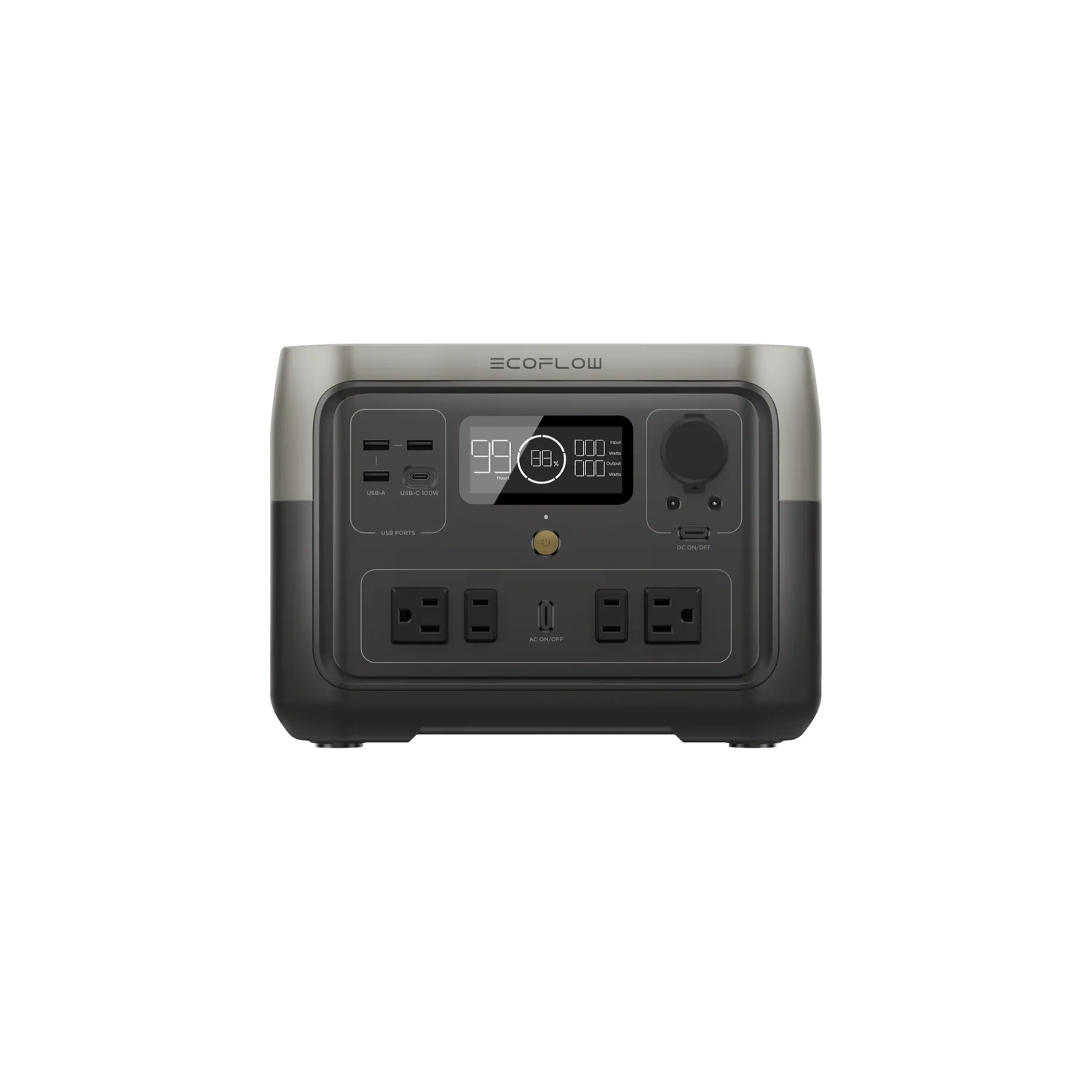
EcoFlow RIVER 2 Max
Sold out at EcoFlow

BLUETTI EP900 + 2×B500
$10,298.00
$10,298.00 · direct from BLUETTI
Last checked 16 days ago. Prices move — check before you buy.
Prices may vary by retailer and are subject to change.