Head-to-head test
EcoFlow RIVER 2 Max vs BLUETTI EB3A
One of these keeps a CPAP running to morning; the other has a documented habit of quitting on a light load two hours in.
Full profiles: EcoFlow RIVER 2 Max → · BLUETTI EB3A →

Written by Wenny ZhengUpdated
Portable Power Tester, Station Arena Test Desk
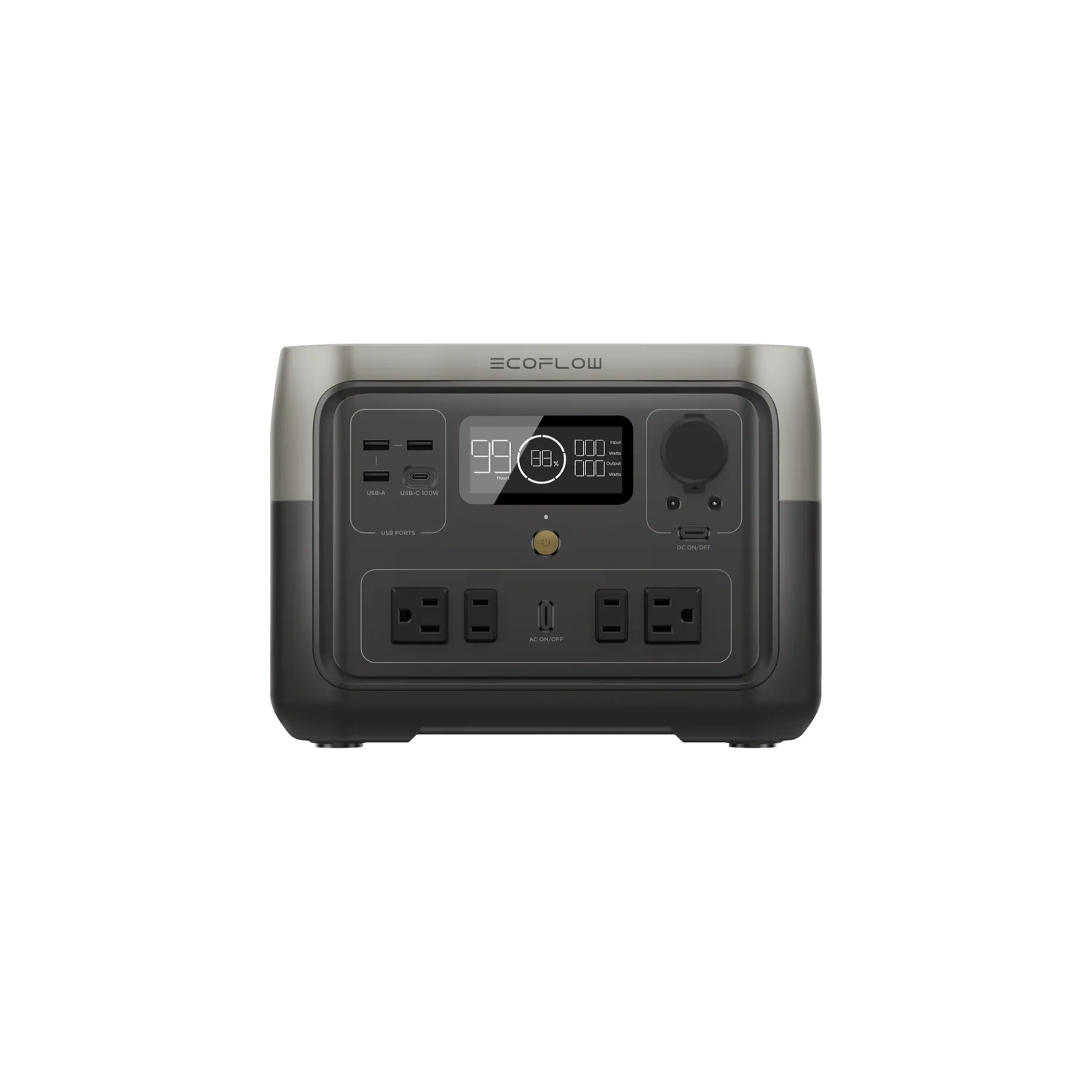
$289.00 · direct from EcoFlow
Last checked 1 day ago. Prices move — check before you buy.

$219.00 · direct from BLUETTI
Last checked 1 day ago. Prices move — check before you buy.
Spec deltas
The RIVER 2 Max holds 512Wh to the EB3A's 268Wh, and that gap decides most of this matchup before you get to anything clever. A CPAP overnight, a longer blackout, a workday's worth of laptop — the bigger tank simply reaches the finish line and the smaller one doesn't.
But the sharper reason to skip the EB3A isn't capacity, it's reliability under the exact job it's marketed for. Across BLUETTI's own forums and DIY solar boards from 2022 through 2024, owners report the EB3A throwing a false 'overload' and shutting off under light UPS loads — a CPAP, a router, a PC — with firmware updates that didn't fix itB5B6B7. That's not a spec you can out-argue.
The EB3A earns its keep in two honest ways: it's $70 cheaper and three pounds lighter, and it lists more raw output. If you want the smallest, cheapest box for topping up phones and a fan on a picnic table, it's fine. For anything you're depending on overnight, the RIVER 2 Max is the safer buy.
What the Numbers Reveal
Each conclusion stated first — the numbers behind it on one line, the full analysis below.
Capacity
It's worse than short on paper. EB3A owners report it quitting two to three hours into the night with a false 'overload' under a light CPAP draw, a pattern that survived the firmware updates BLUETTI told people to installB7B8B9.
RIVER 2 Max 512Wh, usable ~85%a CPAP overnight needs roughly 320WhEB3A holds 268Wh
Why it mattersIf you're buying a small unit specifically to keep a CPAP alive through an outage, the EB3A is the one to rule out.
Typical price
And the $60 year buys 512Wh while the $70 year buys 268Wh — the EB3A costs more per warranted year and hands you half the battery for it.
EB3A $219 with a 2-year warranty, $70 per covered yearRIVER 2 Max $289 with a 5-year warranty, $60 per covered year
Why it mattersThe shopper reaching for the $219 price is paying more over the warranty to own less energy.
The Max's 62dB is a fast-charge-under-load number, and because it refills the whole battery in about an hourA2, the loud stretch is short and you choose when it happens; the EB3A's noise is unscheduled and shows up beside the bed at 2 a.m.
EB3A rated 50dB vs RIVER 2 Max rated 62dBEB3A owners report the fan cycling and buzzing at idle, even in silent modeB1B3RIVER 2 Max refills in about an hourA2
Why it mattersThe bedroom or CPAP buyer should weigh the EB3A's real-world fan behavior, not just its lower printed dB.
The specific dimensions that decide these two units — everything else is a tie.
Your Life, Your Pick
Selected because: CPAP overnight is the one scenario that flips, and it's the strongest case for the Max.
Five of the six scenarios end in 'neither' — both units are too small for a weekend of camping or a full 8-hour fridge-and-lights blackout, and pretending otherwise would be lying to you. The one that splits is CPAP overnight, and it splits cleanly: the RIVER 2 Max carries a roughly 320Wh night on about three-quarters of its usable charge, while the EB3A asks for more than it holds.
Weight the CPAP result heavily and the camping and van-life results lightly, because that's how these two actually get used. Nobody runs a house off either of these. People buy a 300-to-500Wh unit to keep a phone, a router, a fan, or a CPAP going — and among those, the overnight medical load is the one where being short isn't an inconvenience, it's the reason you bought the thing failing at 2 a.m.
Runtime: Will It Power Your Gear?
Selected because: The 512 vs 268Wh gap drives most jobs; show what the capacity buys.
continuous output
512Wh against 268Wh is the whole runtime story, and it compounds: the Max isn't just longer-lasting per charge, it also refills that larger tank in about an hour on wall powerA2, so the turnaround between uses is short. The EB3A holds less and takes longer to feel 'topped up' before your next trip.
Raw output tilts the other way — the EB3A lists 600W continuous to the Max's 500W, and a higher surge — so for a brief high-wattage tool the EB3A can technically pull ahead. But watts you can't sustain for lack of stored energy aren't much use; a 600W draw drains 268Wh in well under half an hour. The Max's combination of more capacity and faster refill is the pairing that matters for the jobs these sizes actually do.
Lifetime Value
Selected because: Cheaper sticker (EB3A) is the pricier owner — warranty-year framing lands it.
cost / lifetime kWh
Spread each price across the years its maker will actually stand behind it and the ranking flips from the sticker. The RIVER 2 Max costs $60 for each of its five warranty years; the EB3A costs $70 for each of its two. The unit that looks $70 cheaper on the shelf is the more expensive promise once you count the coverage you're buying.
This matters more than the usual lifetime-kWh math because a 2,500-to-3,000-cycle rating is a horizon nobody reaches on a unit this size — you'll replace it for a bigger one long before the cells wear out. The warranty window is the ownership period you can actually plan around, and across that window the Max is both cheaper per year and twice the battery.
What the Specs Don't Tell You
Selected because: Noise and warranty both fire; the noise story is more nuanced than the dB numbers.
rated cycles
The noise card flags the RIVER 2 Max at 62dB, and that's true and worth knowing: under a hard charge it's audibly working. What the number misses is that it's a short, scheduled roar — the unit refills in about an hour and then goes quiet. The EB3A's 50dB rating looks better and behaves worse, with a fan that cycles unpredictably at idle.
The warranty card is the quieter tell. Five years to two isn't a rounding difference on a $219-$289 purchase; it's the gap between a unit the maker expects to support through a full ownership cycle and one it doesn't. Paired with the EB3A's documented light-load shutdowns, the shorter coverage is exactly the wrong direction for a unit you'd lean on in an outage.
Strengths & trade-offs
EcoFlow RIVER 2 Max
Strengths
- +Larger battery capacity
- +Longer warranty
- +Faster solar charging
Trade-offs
- –Substantially more expensive (+$70) than the EB3A.
- –Can receive complaints about fan noise under heavy load.
BLUETTI EB3A
Strengths
- +Costs $70 less
- +Lighter by 3.3 lb
- +Higher AC output
Trade-offs
- –No major technical downsides compared to rival.
Will It Power Your Gear?
Scenario math and per-appliance runtimes, modeled from the spec record.
Scenario verdicts
We ran the math on seven real-world scenarios. Here's which unit survives your actual life.
SCN-01 · 2 nights · needs 2,100Wh
Weekend Camping
Two nights off-grid with essential comfort
Neither unit
Neither unit covers this scenario's 2,100Wh: the RIVER 2 Max comes up 1,665Wh short (about 21% covered), the EB3A 1,872Wh (11%). This is well outside what either unit is for; the right answer here is a larger station, not a choice between these two.
Battery budget usedlower = more headroom
LOAD Phone Charger 15W×6h · LED Lights 40W×8h · Box Fan 75W×14h · CPAP Machine 40W×16h
SCN-02 · 8 hours · needs 1,645Wh
8-Hour Blackout
Keep the essentials running through a night without power
Neither unit
Neither clears a real fridge-and-lights blackout — 1,645Wh of demand is roughly six EB3As or a bit over three RIVER 2 Maxes of storage. If a full outage is your worry, both are undersized and you should look a class up. Between the two, the Max's larger tank just lasts longer before you start rationing.
Battery budget usedlower = more headroom
LOAD Fridge 150W×8h · Router + Modem 20W×8h · LED Lights (4 bulbs) 40W×6h · Phone Charger 15W×3h
SCN-03 · 8 hours · needs 320Wh
CPAP Overnight
Sleep therapy without interruption — the #1 medical use case
RIVER 2 Max
This is the one job that separates them. A CPAP's roughly 320Wh overnight draw runs the RIVER 2 Max to about three-quarters of its usable charge, so it wakes up with margin. The EB3A needs more than its 268Wh holds, and in pass-through mode it can misread a light load as an overload and cut out early. If overnight medical power is why you're shopping, that's the whole decision.
Battery budget usedlower = more headroom
LOAD CPAP Machine 40W×8h
SCN-04 · 8 hours · needs 910Wh
Remote Workday
Full work day off-grid without power anxiety
Neither unit
Neither unit covers this scenario's 910Wh: the RIVER 2 Max comes up 475Wh short (about 48% covered), the EB3A 682Wh (25%). Treat this as partial cover — enough for the essentials in it, not the whole list.
Battery budget usedlower = more headroom
LOAD Laptop 60W×8h · External Monitor 30W×8h · Router + Modem 20W×8h · Phone Charger 15W×2h
SCN-05 · 4 hours · needs 670Wh
Tailgate Party
Game day power for the crew
Neither unit
Neither unit covers this scenario's 670Wh: the RIVER 2 Max comes up 235Wh short (about 65% covered), the EB3A 442Wh (34%). Treat this as partial cover — enough for the essentials in it, not the whole list.
Battery budget usedlower = more headroom
LOAD Blender 400W×0.5h · LED TV (55") 80W×4h · Bluetooth Speaker 15W×4h · Phone Charger (×3) 45W×2h
SCN-06 · 24 hours · needs 4,685Wh
Van Life Daily
A full day of mobile living — the ultimate endurance test
Neither unit
Neither unit covers this scenario's 4,685Wh: the RIVER 2 Max comes up 4,250Wh short (about 9% covered), the EB3A 4,457Wh (5%). This is well outside what either unit is for; the right answer here is a larger station, not a choice between these two.
Battery budget usedlower = more headroom
LOAD Mini-Fridge 150W×24h · Laptop 60W×4h · Phone Charger 15W×3h · LED Lights 40W×5h · Fan 75W×8h
SCN-07 · an afternoon · needs 100Wh
Afternoon Off-Grid
Phones and a speaker at the park, beach, or campsite — the small-unit job description
Either unit
This is the job small stations are actually for, and both do it: the RIVER 2 Max finishes at 23% used, the EB3A at 44%. At this size the decider is what rides in the bag — 10.1 lbs for the EB3A against 13.4 for the RIVER 2 Max — and price, not the leftover watt-hours.
Battery budget usedlower = more headroom
LOAD Phone Charger (×2) 30W×2h · Bluetooth Speaker 10W×4h
The Load Test
RUNTIME = (Wh × 0.85) ÷ LOAD
None of the scenarios above exactly yours? Build it. Toggle what you'd plug in; both units are tested against the combined draw.
Essentials
Comfort & Convenience
High-Draw Appliances
Test duration
8h
Continuous draw
205W
Projected runtime
For this load: RIVER 2 Max runs 2.1h vs 1.1h.
$289 list · direct from EcoFlow
Modeled from the spec record — same math as the tables below. Methodology
Runtime by appliance
Real-world runtime estimates for common appliances, modeled at 85% inverter efficiency.¹
Essentials
The basics you need runningscale 0–29hComfort & Convenience
Makes off-grid life actually enjoyablescale 0–5.8hHigh-Draw Appliances
These reveal the real limits¹ Runtime = (capacity × 0.85) ÷ appliance watts. Within each group, all bars share one time scale (the group's longest runtime), so lengths are comparable across appliances; identical runtimes collapse into a single blue/orange bar. Actual runtime varies with battery age, temperature, and simultaneous loads — see methodology.
Conclusion
July 16, 2026
Verdict: the EcoFlow RIVER 2 Max
Pay the extra $70 for the RIVER 2 Max. It holds nearly double the energy (512Wh vs 268Wh), costs less to own across its warranty ($60 a covered year vs $70), and — the part that settles it — it finishes an overnight CPAP job the EB3A physically can't. The EB3A is lighter and has more raw output, but its best-known field problem is shutting down under exactly the light backup loads people buy a small unit for. If price is the only axis you care about, the EB3A wins by $70; on every axis that decides whether the unit does its job, the Max wins.
Editor-assigned confidence, based on cited owner research and spec analysis.
List prices as of July 16, 2026. The links below open EcoFlow's and BLUETTI's current prices.
$289.00 · direct from EcoFlow
Last checked 1 day ago. Prices move — check before you buy.
or check the EB3A price$219.00 list
Written by Wenny Zheng, Portable Power Tester · Station Arena Test Desk · Updated July 16, 2026
Measured Data
Benchmark scores and the full spec record, side by side.
Benchmark scores
Full specifications
ᵈ Derived: price ÷ rated capacity. See the data behind our comparisons →
Comparison ToolAdd more power stations, side by sideOpen Tool →How these numbers are produced
Numeric verification
Every figure on this page traces to our spec database or arithmetic on it — no estimated numbers.
Owner claims
Statements about owner experience are cited to published reviews — see Sources & Research Notes below.
Runtime model
Runtime = (rated capacity × 0.85 inverter efficiency) ÷ device wattage. Solar recharge estimates assume panels deliver 70% of rated output. Cold weather, battery age, and stacked loads reduce real-world results.
Power Score
Computed from 14 published spec dimensions, weighted per use-case bench. Higher is better; a unit must meet a bench's minimum threshold to be rated.
See the full weight table and data sourcing on our methodology page →Class ranking (the star rating)
Each unit's star score is a category ranking, not customer reviews — no buyer opinions feed it. We score every station on size-independent quality (value, output, portability, endurance, ports, warranty, and more), then percentile-rank it against the other units in its capacity class, so a class-leading compact unit and a class-leading whole-home unit can both earn 5★. Here, RIVER 2 Max rates 3.7/5 (26th percentile of 20 Compact-class units), and EB3A rates 3.8/5 (29th percentile of 22 Personal-class units).
How the class ranking is computed →Test Notes & Caveats
Hidden gotchas and advantages we spotted that you won't find on the product page.
The louder box is louder on a schedule
The RIVER 2 Max hits 62dB, but that's the sound of X-Stream refilling all 512Wh in about an hour; at a light overnight load the fan barely stirs, and you pick when the noisy hour happens. The EB3A rates a quieter 50dB yet its fan cycles unpredictably at idle. Rated numbers favor the EB3A; real-world quiet favors the Max.
Five covered years vs two
EcoFlow backs the RIVER 2 Max for 5 years; BLUETTI backs the EB3A for 2. Spread each price across its coverage and the Max costs $60 a warranted year to the EB3A's $70. The cheaper unit on the shelf is the more expensive promise off it.
Full record above — the Test Desk pick is the RIVER 2 Max.
Check RIVER 2 Max price →or check the EB3A priceOwnership Analysis
What happens after you buy — true cost of ownership, brand trust, and growth potential.
Lifetime value
Service lifeyears at one full cycle per day
Lifetime energy delivered
Cost per delivered kWh
│ warranty ends · Reaching the cycle rating means ~80% capacity remains — degraded, not dead.
Analyst note
The EB3A is cheaper to buy, but the RIVER 2 Max is cheaper to own. At $0.19/kWh over its lifetime vs $0.33/kWh, the RIVER 2 Max's higher cycle life and capacity make each dollar go further over the years.
Delivers each lifetime kWh for $0.14 less — check the RIVER 2 Max price →
Brand trust
EcoFlow
Ecosystem
Largest in portable power — 12-15 models across DELTA Pro, DELTA 3, and RIVER 3 series, plus solar panels and smart home panels
Support
US-based phone, email, and chat. Experiences are mixed — many get hassle-free prepaid-label swaps, some report long waits or refurbished replacements — so buying through Costco or Amazon adds a stronger return backstop.
Community
Largest community in the space — Reddit r/Ecoflow_community (~31K members), multiple Facebook groups, and an official community forum
App experience
Rated 4.6/5 iOS (~8,400 ratings) · 4.2/5 Android (~17,000 ratings)
Unique strength
EcoFlow builds the deepest lineup in portable power and iterates fastest, and X-Stream charging — the roughly one-hour refill here — is its signature. If you might grow into a larger DELTA later, the ecosystem is already there.
Worth knowing
EcoFlow floated app-feature paywalls in early 2025 before backlash paused them, and there was an unrelated 2025 DELTA Max recall. Neither touches this unit, but they're the tradeoff for a fast-moving brand.
BLUETTI
Ecosystem
One of the broadest lineups — 15-20+ models from budget (AC2A) to flagship portable (Apex 300, 2764.8Wh). Includes specialized products: vehicle solar hubs, sodium-ion cold-weather units, and balcony storage systems.
Support
The most inconsistent support in the space, heavily email-based with timezone delays; buying direct from BLUETTI tends to produce better outcomes than third-party channels.
Community
Active and growing — Reddit r/bluetti has a dedicated community. Second-largest after EcoFlow in engagement.
App experience
Rated 4.5/5 iOS and Android — tied for best app experience in the category. V3.0 UI redesign was well-received.
Unique strength
BLUETTI's strength is value and breadth — some of the best capacity-per-dollar in the market and an unusually wide catalog, from sodium-ion cold-weather units to home storage.
Worth knowing
Support inconsistency is the brand's #1 risk factor, and it's exactly what EB3A owners ran into when chasing the light-load shutdowns — the fix never came.
Analyst note
Both brands are established and neither is a fly-by-night. The split here is temperament: EcoFlow sells speed and a five-year warranty on this unit; BLUETTI sells value and breadth but pairs it with thinner, slower support — a worse place to be when the specific unit you bought has a known, unfixed quirk.
Growth path
RIVER 2 Max
FIXED CAPACITYFixed at 512Wh, with no expansion — so size it for your needs up front rather than planning to add capacity later.
Accepts up to 220W of solar. Limited to a single portable panel.
Adequate ports for most setups, but heavy users may want a power strip.
EB3A
FIXED CAPACITYFixed at 268Wh, with no expansion — so size it for your needs up front rather than planning to add capacity later.
Accepts up to 200W of solar. Limited to a single portable panel.
Limited ports. You'll likely need a power strip or splitter.
Realistic full solar rechargeat 70% of rated panel output — see methodology
Analyst note
Neither expands, and that's no knock on either — each is a complete unit at a fixed size. Buy the capacity that covers your needs now (the RIVER 2 Max gives you the larger ceiling); you can't add to either later.
What Owners Report
Patterns from published owner reports and long-term reviews — every claim cited to its source below.
EcoFlow RIVER 2 Max
The RIVER 2 Max's signature is speed: it refills from empty in about an hour on wall power via X-Stream chargingA2, which is the spec that makes a small unit genuinely useful in a rolling outage — you can top it back up in the gaps. Owners also single out the EcoFlow app for straightforward remote monitoring and charge-speed control over Wi-Fi and BluetoothA3.
It's light for what it holds — about 13 pounds for 512Wh, lighter than some Li-ion rivals of similar capacityA1 — and its upgraded LFP chemistry is rated for roughly 3,000 cycles, on the order of a decade of everyday use; one field test ran a telescope, a 65-inch TV, two laptops, and phones through a four-hour event with power left overA4. The field data here is about what works, not what breaks.
“512Wh in a light package of about 13 lbs, lighter than some of its closest competitors that use Li-Ion chemistry.”
Sources
storagereview.com · backuppowerhub.com · gagadget.com · ecoflow.com · thecampingnerd.com · thetechnologyman.com · bestbuy.com
BLUETTI EB3A
The EB3A's field record is dominated by one problem: in UPS or pass-through mode under a light load — a CPAP, a PC, a router pulling well under 100W — owners report it misreading the draw as an 'overload' and shutting off, sometimes hours into the nightB5B7B8. It's not a one-off; the reports span 2022 to 2024, BLUETTI's suggested firmware updates didn't resolve it, and support went quiet for several people who chased itB6B9B10. Fan noise is the second recurring theme — ramping, buzzing, and cycling even in silent mode and at idleB1B2B3B12.
In fairness, the EB3A has real fans too. Reviewers call it a well-polished, port-dense little unitB13, one 60-day tester would buy it again after camping trips and an 18-hour outageB16, and as a plain battery — not in UPS mode — it ran a CPAP for about six hours on a chargeB17. The pattern to take away: it's a capable compact battery that becomes unreliable in exactly the always-on backup role, which is a hard thing to forgive in a backup unit.
“Bluetti advertises the EB3A as "tiny but mighty," and I have to agree. They crammed a lot of ports and functionality into a very portable package... it seems to be a very well-polished product.”
Sources
toolguyd.com · diysolarforum.com · backuppowerhub.com · wanderwoman.ca
Sources & Research Notes
Every owner claim in this report is traceable to a published source. The bracketed references above resolve here.
Recurring owner themes
- Light weight, fast roughly-one-hour charging, and a simple capable app are the standout praise for this 512Wh unit. [RIVER 2 Max · 3 entries]
- Multiple owners across forums (2022-2024) report the EB3A randomly shutting off or throwing false 'overload' errors under light loads (40-60W) when used in UPS mode for CPAPs, computers, or routers — a persistent, unresolved issue even after firmware updates. [EB3A · 6 entries]
- Recurring complaints about fan noise and odd fan behavior (ramping, buzzing, wobble) span from 2022 through 2024, spanning silent mode, idle, and charging states, suggesting an ongoing hardware/firmware characteristic rather than a one-time defect. [EB3A · 5 entries]
- Owners report poor or unresponsive Bluetti customer support when troubleshooting UPS failures, including unhelpful firmware fixes and unanswered app support tickets. [EB3A · 2 entries]
- Despite reliability complaints in UPS use, several long-term/extended testers (60+ days, CPAP overnight use) report satisfaction with portability, build quality, and real-world runtime for camping/outage scenarios. [EB3A · 3 entries]
- A1
“512Wh in a light package of about 13 lbs, lighter than some of its closest competitors that use Li-Ion chemistry.”
storagereview.com / backuppowerhub.com — RIVER 2 Max review · 2026 · [positive]
- A2
“Fully charges in about 60 minutes via X-Stream charging — far faster than most portable power stations — with multiple charging options.”
gagadget.com / ecoflow.com — RIVER 2 Max review · 2026 · [positive]
- A3
“The EcoFlow app offers simple remote control and monitoring over WiFi and Bluetooth — view charge levels, customize settings, and adjust charging speed from a phone.”
thecampingnerd.com / ecoflow.com — RIVER 2 Max review · 2026 · [positive]
- A4
“Upgraded LFP chemistry rated for about 3,000 cycles, roughly a decade of everyday use; in field testing it powered a telescope, a 65-inch LED TV, two laptops, and phones through a 4-hour event with power to spare.”
thetechnologyman.com / bestbuy.com owner reviews — RIVER 2 Max · 2026 · [positive]
- B1
“I got tired of hearing the fan on the EB3a coming and going off and on, even in the silent mode. The wobbly noise is because of being unbalanced.”
BLUETTI Community forum — 'EB3A fans noise - how is fix it!' · 2022-08 · [negative]
- B2
“Whenever the fan kicks on my EB3A makes a really strange 25 second sequence of electrical noises coming from near the intake fan on the left side of the unit.”
BLUETTI Community forum — 'EB3A Weird fan ramp up noise' · 2022-06 · [negative]
- B3
“Even in slow charging mode and even when fully charged already, the eb3a fan noise is too high to be in a bedroom (if AC input plugged in) The fan runs every 20 min or so”
BLUETTI Community forum — 'EB3A idle noise suggestion' · 2023-09 · [negative]
- B5
“There is a known issue when running it in UPS mode with a light load (40~60 watts). The unit does not keep itself cool and overheats. (The display shows overload.)”
toolguyd.com — 'Bluetti EB3A Portable Power Station Review' comments · 2023-04 (purchased Aug 2023) · [negative]
- B6
“Firmware was updated and did not help. There are various setting some people said helped, but none did for me. The issue has been around for as long as the product”
toolguyd.com — 'Bluetti EB3A Portable Power Station Review' comments · 2023-08 · [negative]
- B7
“About 2-3 hours into my night's sleep it shut down, showing an "overload" indication despite the fact that my CPAP only draws at most 40 watts.”
diysolarforum.com — 'EB3A "Overload" When Used as Uninterruptible Power Supply' · 2022-09 · [negative]
- B8
“He said that both had failed recently in exactly the same way under light loads... Of the units I personally know of that're being used in this way that's a 100% failure rate”
diysolarforum.com — 'EB3A "Overload" When Used as Uninterruptible Power Supply' · 2022-09 · [negative]
- B9
“I contacted bluetti support and they told me to upgrade the firmware. I did so, and that actually increased the frequency of the "blinks". Support eventually just shrugged and had no further help”
diysolarforum.com — 'Is Bluetti EB3A any good as a UPS?' · 2022-12 · [negative]
- B10
“I tried submitting a ticket via the Bluetti app but never got any response. They don't really have support.”
diysolarforum.com — 'Is Bluetti EB3A any good as a UPS?' · 2022-12 · [negative]
- B12
“I was surprised by the noise level of the internal fan during charging, which rivals that of internal fan-cooled cordless power tool battery chargers.”
toolguyd.com — 'Bluetti EB3A Portable Power Station Review' · 2023-04 · [negative]
- B13
“Bluetti advertises the EB3A as "tiny but mighty," and I have to agree. They crammed a lot of ports and functionality into a very portable package... it seems to be a very well-polished product.”
toolguyd.com — 'Bluetti EB3A Portable Power Station Review' · 2023-04 · [positive]
- B16
“After 60 days of testing—two camping trips, an 18-hour power outage, and five days of van life—would I buy the Bluetti EB3A again? Yes, without hesitation.”
backuppowerhub.com — 'Bluetti EB3A Review: Ultra-Compact Emergency Power Station' · 2026-05 · [positive]
- B17
“On a full charge, the BLUETTI EB3A powered my CPAP machine for approximately six hours... Charging the BLUETTI EB3A from a household outlet took just over four hours.”
wanderwoman.ca — 'CPAP Battery Backup for Camping and Power Outages' · 2026-06 · [positive]
Research compiled July 16, 2026.
What Owners Actually Report
Drawn from 75 comments on independent review channels — not from retailer reviews, which skew to the first week of ownership. Each line is our summary of one commenter's claim, linked to the original. We record what they said, including where it contradicts the spec sheet.
EcoFlow RIVER 2 Max
23 claims from 14 comments · 17 from owners · 7 with figures
- Solar input
- 3 · 36% negative
- Charging
- 3 · 0% negative
- Noise
- 3 · 0% negative
- Durability
- 3 · 70% negative
- App & firmware
- 2 · 60% negative
What owners complain about
220W max solar input kind of sucks; wishes it were at least 500W.
Solar inputmeasuredownersource →
Battery log showed a full discharge the screen never reported below 61%.
App & firmwaremeasuredownersource →
Overloaded on a fridge whose surge he metered at 1300W against a 1000W rating.
Inverter & surgemeasuredownersource →
What owners praise
Instantly hit 174W from the same panel in the sun.
Solar inputmeasuredowner8 agreedsource →
Fan noise is 2-3x lower and only kicks in at high wattage or high temps.
Noiseowner8 agreedsource →
Charged the River 2 Max at 600W from a 1000W vehicle inverter with no problems.
Chargingmeasuredowner1 agreedsource →
BLUETTI EB3A
90 claims from 61 comments · 76 from owners · 22 with figures
- Durability
- 12 · 100% negative
- Runtime
- 10 · 33% negative
- Warranty & support
- 7 · 55% negative
- Price & value
- 10 · 11% negative
- Solar input
- 6 · 40% negative
What owners complain about
EB3A's 8.5A input limit caps solar around 175-180W even with a bigger panel.
Solar inputmeasuredowner6 agreedsource →
Two EB3A units both threw an overload error on a 38W load in UPS mode after 9-24 hours.
UPS switchovermeasuredowner4 agreedsource →
His EB3A died and needed a warranty replacement.
Durabilityowner48 agreedsource →
What owners praise
Ten-pound EB3As are far easier on his bad back than one 32-pound unit.
Size & weightmeasuredowner6 agreedsource →
Lasted 17 hours 30 minutes on the identical 12V fridge test.
Runtimemeasuredowner1 agreedsource →
General support replied within an hour and a new unit arrived in about 2.5 weeks total.
Warranty & supportowner48 agreedsource →
Claims are weighted by how specific they are, whether the commenter owns the unit, and how many readers agreed. Comments that mention a product under a rival's review count for more, because the commenter had no reason to be there. This is what buyers report, not our test results — for measurements we ran ourselves, see the methodology.
Who Should Buy Which
Buy the RIVER 2 Max if you…
- →Anyone whose real reason for shopping is overnight backup for a CPAP or medical device — the Max finishes the night with margin and doesn't misread a light load.
- →The person who wants the fastest turnaround in a rolling outage: empty to full in about an hour means you refill it every time the grid blinks back.
- →Buyers who plan to keep the unit for years and want the longer 5-year warranty behind it.
Buy the EB3A if you…
- →The strict budget buyer who needs the cheapest possible LFP box and will use it as a plain battery — topping up phones, a fan, lights on a picnic table — never as an always-on UPS.
- →Someone who prizes the lightest, smallest unit and genuinely never needs more than ~268Wh at a time.
If neither fits
If your actual need is a weekend of camping, a full 8-hour blackout with a fridge, or van-life daily loads, both of these are too small — you'll be rationing by dinner. Step up to a 1,000Wh-plus unit instead of buying either of these twice.
The Bottom Line
Buy the RIVER 2 Max. It holds nearly twice the energy, refills in about an hour, and costs less per warranted year than the unit with the lower price tag. The EB3A is lighter and cheaper and lists more watts, and none of that helps at 2 a.m. when a documented light-load overload shuts it down mid-CPAP.
The EB3A is a fine plain battery for phones and a fan on a cheap day out. But you're not shopping two power stations to find the better picnic accessory — you're shopping for the one you can trust when the grid drops. That's the Max, and it isn't close.
Frequently Asked Questions
Answers drawn from the spec record and cited owner research.
Can the Bluetti EB3A run a CPAP all night?
As a standalone battery it powered a CPAP for about six hours in one owner's test, short of a full night, and its 268Wh is below the roughly 320Wh an overnight CPAP needs. More importantly, in UPS or pass-through mode owners repeatedly report it shutting off under light loads with a false overload error. For dependable overnight CPAP power, the RIVER 2 Max is the safer pick.
Is the RIVER 2 Max worth $70 more than the EB3A?
For most buyers, yes. The extra $70 buys nearly double the capacity (512Wh vs 268Wh), a 5-year warranty instead of 2, and about-one-hour recharging. Spread across the warranty the Max actually costs less per year to own ($60 vs $70). The EB3A only wins outright if the sticker price is your single deciding factor.
Which is quieter, the EB3A or the RIVER 2 Max?
On the spec sheet the EB3A is quieter, rated 50dB against the Max's 62dB. In practice it's less clear-cut: the Max's noise comes during its roughly one-hour fast charge and then stops, while EB3A owners widely report a fan that cycles and buzzes even at idle and in silent mode. For bedside use, weigh the real-world behavior, not just the rating.
The EB3A lists 600W output vs the Max's 500W — isn't it more powerful?
It has a higher continuous and surge rating, so for a brief high-wattage tool it can pull ahead. But with only 268Wh of storage, a 600W draw empties it in under half an hour. For the small loads these units actually run, stored energy and recharge speed matter more than peak watts, and there the Max leads.
Brand matchup
EcoFlow vs BLUETTI: measured across every matchup →Where to buy
EcoFlow RIVER 2 MaxPick
$289.00
$289.00 · direct from EcoFlow
Last checked 1 day ago. Prices move — check before you buy.
BLUETTI EB3A
$219.00
$219.00 · direct from BLUETTI
Last checked 1 day ago. Prices move — check before you buy.
Prices may vary by retailer and are subject to change.