Head-to-head test
EcoFlow DELTA Pro vs Jackery Explorer 5000 Plus
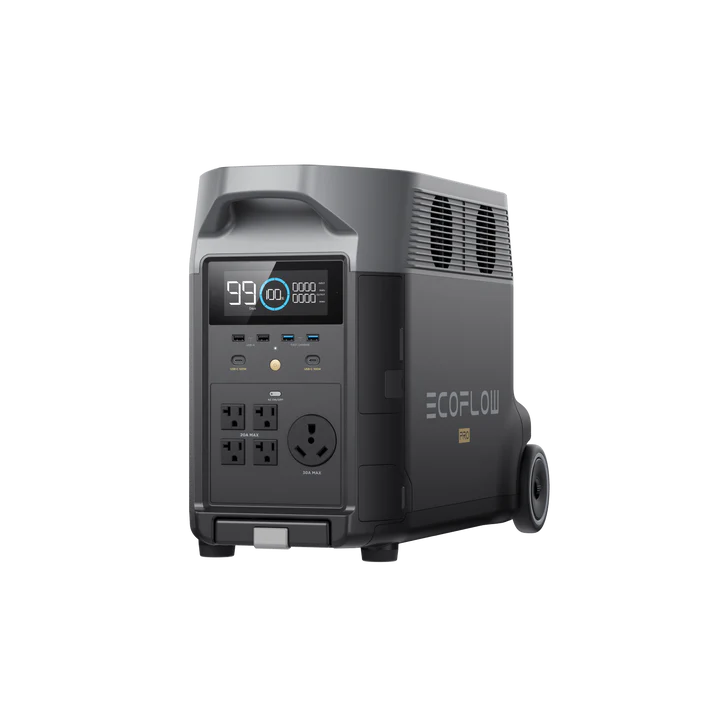
Neither of these is a bigger version of the other: the DELTA Pro has the 30A RV socket and no 240V, the Explorer 5000 Plus has 240V and no RV socket, and no amount of money converts one into the other.
Full profiles: EcoFlow DELTA Pro → · Jackery Explorer 5000 Plus →

Written by Gunner GustafsonUpdated
Whole-Home Backup Tester, Station Arena Test Desk
$1,899.00 · direct from EcoFlow
Last checked 1 day ago. Prices move — check before you buy.

$3,499.00 · direct from Jackery
Last checked 1 day ago. Prices move — check before you buy.
Spec deltas
The Explorer 5000 Plus is the bigger machine by every number that scales: 5,040Wh against 3,600Wh, 7,200W continuous against 3,600W, a 4,000W solar ceiling against 1,600W, and $3,149 against $1,899. What it doesn't have is a 30A RV socket. What the DELTA Pro doesn't have is a 240V outlet. Our catalogue records both of those as an affirmative zero, which makes this less a size comparison than a fork in the road.
Take the DELTA Pro. Cost per lifetime kilowatt-hour lands a penny apart, so there is no bargain hiding on either side of that price gap. You are buying the same energy at the same rate, in two quantities. On five of the six loads we model, the DELTA Pro finishes with reserve in hand, and it does that with more AC sockets than the $3,149 unit.
The case against our own pick is short and real. The DELTA Pro line's consistent knock is fan noise under heavy drawA4, it ends a long outage with less in the tank, and it accepts less than half the solar the Explorer does. If your outages run for days, or anything in your backup plan is wired for 240V, skip to the Explorer and buy it with confidence.
What the Numbers Reveal
Each conclusion stated first — the numbers behind it on one line, the full analysis below.
Typical price
So moving from $1,899 to $3,149 buys 240V and gives up the RV socket, and capacity has no vote in that trade. 5,040Wh doesn't put a 30A RV socket on the Explorer, and 3,600W of output doesn't put 240V on the DELTA Pro. Whichever plug your load ends in settles this purchase before any other number on the page is consulted.
EcoFlow DELTA Pro ports: one 30A RV outlet, zero 240V outletsJackery Explorer 5000 Plus ports: two 240V outlets, zero 30A RV outletsDELTA Pro $1,899 against Explorer 5000 Plus $3,149
Why it mattersTrailer and RV buyers take the DELTA Pro. Anyone backing up a 240V circuit buys the Explorer. Everybody else keeps reading.
rated cycles
That quietly kills the argument these pages usually turn on. Neither one is the value pick, because there's no discount hiding in either: the step up buys the move from 3,600Wh to 5,040Wh and twice the continuous output at the going rate, no more and no less. Which leaves one honest question, whether you will ever drain the extra, and on five of the six loads here the DELTA Pro finishes with reserve to spare.
DELTA Pro: 3,600Wh rated for at least 3,500 cycles, so 12,600kWh over the pack's rated life, at $1,899Explorer 5000 Plus: 5,040Wh rated for at least 4,000 cycles, so 20,160kWh, at $3,149Both carry five-year warranties, the Explorer's full term conditional on registering the unit with Jackery
Why it mattersIf you can't name the load that needs more than 3,600Wh, stop reading the Explorer as an upgrade and read it as a larger order of the same thing.
solar input
That inversion stops being a curiosity the moment the Explorer goes onto a transfer switch, because in that configuration one owner found solar was the only way to put energy back until the grid returnedB4. Its 4,000W ceiling isn't headroom for a future array. On a multi-day outage it is the recharge path, and a box that can absorb 4,000W converts one good afternoon into a full pack.
Explorer 5000 Plus solar input ceiling 4,000W against the DELTA Pro's 1,600WExplorer 5000 Plus 5,040Wh capacity against the DELTA Pro's 3,600WhOne owner reported that with the Explorer on an automatic transfer switch and discharging, only solar could recharge it until grid power returnedB4
Why it mattersAnyone wiring either unit into a transfer switch for outages that run past a night should price panels into the decision, and on the Explorer the panels are not an accessory.
The specific dimensions that decide these two units — everything else is a tie.
Your Life, Your Pick
Selected because: Six real loads, and the split is clean: the DELTA Pro takes the two you carry somewhere, the Explorer takes the two you sit out at home.
The split here isn't about capability. Both units cover five of these six loads and the sixth defeats both, so what separates them is reserve and standing position. The DELTA Pro takes camping and the tailgate because it's the one that arrives. The Explorer takes the blackout and the CPAP night on what's left in it at breakfast, not on whether it copes.
A 910Wh workday is where you see how oversized both are. Their USB-C tops out at the same 100W, and if anything the cheaper unit is the better-equipped desk: five AC sockets against four, four USB-A against two. Both publish a transfer ceiling of no worse than 20ms, so even the switchover declines to break the tie.
Portability & Form Factor
Selected because: One of these two is a solo lift and the other is flagged stationary, which is the only reason two of those six rows aren't close.
weight
Wheels solve pavement. They don't solve a tailgate, a basement step, or the six feet of gravel between the driveway and where you actually want the power. Reviewers who have handled the Explorer describe real wheels, one of the sturdiest sliding suitcase handles they've seen, and multiple side handles for team liftingB3. Read that last detail twice, because side handles exist for the lift wheels can't do.
On the DELTA Pro side our field evidence is thinner than it looks: the available coverage slides constantly between this unit and the newer, heavier DELTA Pro 3, so the measured weights and noise figures in it describe that machine rather than this oneA0. What carries across is line character, wheels and a telescoping handle that want flat, smooth ground with a cart for anything rougherA2. One motivated person still gets the DELTA Pro into a trunk. Nobody does that with the Explorer alone, and that single sentence decides two rows of the scenario table.
Lifetime Value
Selected because: Cost per lifetime kilowatt-hour lands a penny apart, so the cheaper unit isn't the better deal. It's just the smaller one.
cost / lifetime kWh
Spread across the five years you're actually covered, the DELTA Pro works out at $380 a year and the Explorer at $630, and that spread is the price difference talking rather than the terms, since both carry the same length of cover. The useful way to read this section is subtractive. It removes cost per kilowatt-hour, cycle life and warranty from the argument, all three of them tied, which is exactly why this page comes down to sockets and lifting.
Growth Path
Selected because: Both take expansion batteries, so growth comes down to panel headroom: 4,000W against 1,600W.
solar input
Both units take expansion batteries, so 'expandable' isn't the discriminator that word usually is. The discriminator is what refills the bigger bank you're imagining. The Explorer accepts two and a half times the panel input (4,000W against 1,600W), and its documented expansion path runs to 60kWh with extra packs and dual unitsB1. Our record doesn't put a ceiling on the DELTA Pro's battery expansion, so don't read that as a cap on it. Read it as the reason the solar number is the one doing real work here. If your five-year plan involves a roof, this section is where the Explorer earns its price.
Brand Trust
Selected because: You'll open one company's app every week and call one company's support maybe once, and these two brands are not equal on either.
You'll touch the app weekly and support maybe once, and the two brands are mirror images on precisely that. EcoFlow's app rates 4.6 on iOS and 4.2 on Android. Jackery's sits between 2.3 and 3.3, split across two separate apps that want a login even when you're standing next to the unit with no internet. EcoFlow also has roughly 31K members on its subreddit against Jackery's 2,000, which matters the first time you have a question at 11 p.m.
The counterweight against our own pick is real: EcoFlow tested paywalling advanced app features in early 2025 before backing off, and offers no parts or service out of warranty. Jackery's answer to all of it is a checkout counter you can drive to, Costco and Home Depot and Best Buy. Since neither company's support is a selling point, a retailer's return policy is worth more here than either warranty document. Buy whichever one you buy from somewhere that will take it back.
Strengths & trade-offs
EcoFlow DELTA Pro
Strengths
- +Costs $1,250 less
- +Lighter by 35.5 lb
Trade-offs
- –Weaker inverter (-3,600W) limits appliance compatibility.
- –Very heavy unit that may be difficult for one person to lift.
- –Can receive complaints about fan noise under heavy load.
Jackery Explorer 5000 Plus
Strengths
- +Larger battery capacity
- +Higher AC output
- +Faster solar charging
Trade-offs
- –Substantially more expensive (+$1,250) than the DELTA Pro.
- –Significantly heavier (+35.5 lbs), making it harder to move.
- –Very heavy unit that may be difficult for one person to lift.
Will It Power Your Gear?
Scenario math and per-appliance runtimes, modeled from the spec record.
Scenario verdicts
We ran the math on six real-world scenarios. Here's which unit survives your actual life.
SCN-01 · 2 nights · needs 2,100Wh
Weekend Camping
Two nights off-grid with essential comfort
DELTA Pro
The DELTA Pro takes this on the only axis that was ever in doubt, which of them reaches the campsite. It covers the 2,100Wh weekend with 960Wh still spare, so the margin isn't thin. The Explorer clears the same load with more room left and then asks two people to lift it over a tailgate.
Battery budget usedlower = more headroom
LOAD Phone Charger 15W×6h · LED Lights 40W×8h · Box Fan 75W×14h · CPAP Machine 40W×16h
SCN-02 · 8 hours · needs 1,645Wh
8-Hour Blackout
Keep the essentials running through a night without power
Explorer 5000 Plus
Both walk through a 1,645Wh night without complaint. The difference shows up at breakfast: the Explorer is sitting on 2,639Wh, another 1.6 nights of the same, while the DELTA Pro has 1,415Wh, most of one. If your utility's outages have a habit of turning plural, that gap is the entire argument between these two.
Battery budget usedlower = more headroom
LOAD Fridge 150W×8h · Router + Modem 20W×8h · LED Lights (4 bulbs) 40W×6h · Phone Charger 15W×3h
SCN-03 · 8 hours · needs 320Wh
CPAP Overnight
Sleep therapy without interruption — the #1 medical use case
Explorer 5000 Plus
A CPAP asks about 40W for eight hours, roughly 320Wh, which is a rounding error on both of these. The Explorer takes the row on stamina alone: 4,284Wh usable is about thirteen nights between recharges against the DELTA Pro's nine and a half. What neither spec sheet tells you is the thing that actually matters at 3 a.m., how the fan behaves at a 40W draw, so if this lives beside a pillow, go find someone who has slept next to one.
Battery budget usedlower = more headroom
LOAD CPAP Machine 40W×8h
SCN-04 · 8 hours · needs 910Wh
Remote Workday
Full work day off-grid without power anxiety
Either unit
Both power your workstation all day without strain, and their USB-C output is a wash — pick on weight, ports, or price.
Battery budget usedlower = more headroom
LOAD Laptop 60W×8h · External Monitor 30W×8h · Router + Modem 20W×8h · Phone Charger 15W×2h
SCN-05 · 4 hours · needs 670Wh
Tailgate Party
Game day power for the crew
DELTA Pro
670Wh is a small ask of either box, so this row gets decided in the parking lot. The DELTA Pro goes in the trunk and comes back out with 2,390Wh untouched. The Explorer brings side handles and a two-person carry to a load that needed neither.
Battery budget usedlower = more headroom
LOAD Blender 400W×0.5h · LED TV (55") 80W×4h · Bluetooth Speaker 15W×4h · Phone Charger (×3) 45W×2h
SCN-06 · 24 hours · needs 4,685Wh
Van Life Daily
A full day of mobile living — the ultimate endurance test
Neither unit
Neither unit finishes a 4,685Wh day. The DELTA Pro comes up 1,625Wh short and the Explorer 401Wh, close enough that its nameplate 5,040Wh actually clears the load and it's the flat 15% conversion allowance every unit here is charged that tips it under. Full-timers at this draw should be shopping wired house banks rather than portables. Weekenders can plan around a shortfall this size.
Battery budget usedlower = more headroom
LOAD Mini-Fridge 150W×24h · Laptop 60W×4h · Phone Charger 15W×3h · LED Lights 40W×5h · Fan 75W×8h
The Load Test
RUNTIME = (Wh × 0.85) ÷ LOAD
None of the scenarios above exactly yours? Build it. Toggle what you'd plug in; both units are tested against the combined draw.
Essentials
Comfort & Convenience
High-Draw Appliances
Test duration
8h
Continuous draw
205W
Projected runtime
For this load: Explorer 5000 Plus runs 20.9h vs 14.9h.
$3,149 list · direct from Jackery
Modeled from the spec record — same math as the tables below. Methodology
Runtime by appliance
Real-world runtime estimates for common appliances, modeled at 85% inverter efficiency.¹
Essentials
The basics you need runningscale 0–285.6hComfort & Convenience
Makes off-grid life actually enjoyablescale 0–57.1hHigh-Draw Appliances
These reveal the real limitsscale 0–4.3h¹ Runtime = (capacity × 0.85) ÷ appliance watts. Within each group, all bars share one time scale (the group's longest runtime), so lengths are comparable across appliances; identical runtimes collapse into a single blue/orange bar. Actual runtime varies with battery age, temperature, and simultaneous loads — see methodology.
Conclusion
September 13, 2026
Verdict: the EcoFlow DELTA Pro
Take the DELTA Pro at $1,899. It clears every load on this page that the Explorer clears, except the one neither of them finishes, it has the 30A RV socket the Explorer doesn't record, and it's the one a single person still gets into a truck. Our instrument scores the Explorer higher and it should: bigger pack, twice the continuous output, two and a half times the panel input. But every one of those advantages is quantity rather than a better deal, because per lifetime kilowatt-hour the two land a penny apart. So the step from $1,899 to $3,149 only makes sense when you can name what it buys: a 240V circuit, an array the DELTA Pro can't accept, or outages that routinely run past one night. If none of those three is you, the extra capacity is money parked in a battery you never drain.
Editor-assigned confidence, based on cited owner research and spec analysis.
List prices as of September 13, 2026. The links below open EcoFlow's and Jackery's current prices.
$1,899.00 · direct from EcoFlow
Last checked 1 day ago. Prices move — check before you buy.
or check the Explorer 5000 Plus price$3,499.00 list
Written by Gunner Gustafson, Whole-Home Backup Tester · Station Arena Test Desk · Updated September 13, 2026
Measured Data
Benchmark scores and the full spec record, side by side.
Benchmark scores
Not rated for both units (minimum threshold unmet): UPS, RV Living.
Full specifications
ᵈ Derived: price ÷ rated capacity. See the data behind our comparisons →
Comparison ToolAdd more power stations, side by sideOpen Tool →How these numbers are produced
Numeric verification
Every figure on this page traces to our spec database or arithmetic on it — no estimated numbers.
Owner claims
Statements about owner experience are cited to published reviews — see Sources & Research Notes below.
Runtime model
Runtime = (rated capacity × 0.85 inverter efficiency) ÷ device wattage. Solar recharge estimates assume panels deliver 70% of rated output. Cold weather, battery age, and stacked loads reduce real-world results.
Power Score
Computed from 14 published spec dimensions, weighted per use-case bench. Higher is better; a unit must meet a bench's minimum threshold to be rated.
See the full weight table and data sourcing on our methodology page →Class ranking (the star rating)
Each unit's star score is a category ranking, not customer reviews — no buyer opinions feed it. We score every station on size-independent quality (value, output, portability, endurance, ports, warranty, and more), then percentile-rank it against the other units in its capacity class, so a class-leading compact unit and a class-leading whole-home unit can both earn 5★. Here, DELTA Pro rates 3.9/5 (33rd percentile of 16 Home Backup-class units), and Explorer 5000 Plus rates 4.8/5 (87th percentile of 16 Home Backup-class units).
How the class ranking is computed →Test Notes & Caveats
Hidden gotchas and advantages we spotted that you won't find on the product page.
Neither One Is Grab-and-Go
99 lbs is one person, bent knees, nothing in the way and no stairs. 134.5 lbs is a two-person lift or a ramp, every single time, and our record flags the Explorer as stationary for exactly that reason. Both roll on flat ground. Neither rolls over a tailgate, a threshold or gravel. Buy for the lift on your worst day rather than your best one.
The 60dB Number, and What It Isn't
60dB is conversation volume, and it is the DELTA Pro's own published figure. The Explorer's sheet says 30dB. Those are two makers measuring their own way, one convention quoting a best case and another a maximum under heavy load, so the distance between them is not a measured gap and neither number describes a light overnight draw. Sleep tends to suffer somewhere above 45dB, which is why this one deserves a hands-on report instead of a spec line.
Five Years Each, One Asterisk
Both carry five years, so coverage decides nothing here. The asterisk is Jackery's: the full term is a maximum, and reaching it means registering the unit. And don't read the per-dollar version of this as a quality signal. If cover per dollar spent favors the DELTA Pro, that's the price difference talking, not the terms.
Full record above — the Test Desk pick is the DELTA Pro.
Check DELTA Pro price →or check the Explorer 5000 Plus priceOwnership Analysis
What happens after you buy — true cost of ownership, brand trust, and growth potential.
Lifetime value
Service lifeyears at one full cycle per day
Lifetime energy delivered
Cost per delivered kWh
│ warranty ends · Reaching the cycle rating means ~80% capacity remains — degraded, not dead.
Analyst note
Both units have similar long-term ownership costs ($0.15/kWh vs $0.16/kWh). The price difference is what you see on the sticker — neither is a hidden bargain or rip-off.
Brand trust
EcoFlow
Ecosystem
The deepest catalogue in the category, 12 to 15 models across the DELTA Pro, DELTA 3 and RIVER 3 lines plus panels and smart home panels. The practical value of that is boring and real: expansion batteries and accessories stay purchasable years after you buy.
Support
US phone, email and chat, with experiences that split hard. Plenty of prepaid-label replacements handled without a fight, plenty of long waits and refurbished units sent against new claims. Buying through Costco or Amazon gives you a return window that doesn't depend on which of those two you get.
Community
Largest community in the space — Reddit r/Ecoflow_community (~31K members), multiple Facebook groups, and an official community forum
App experience
Rated 4.6/5 iOS (~8,400 ratings) · 4.2/5 Android (~17,000 ratings)
Unique strength
X-Stream fast charging, the most active release cadence in the space, and the better app of the two by a wide margin at 4.6 on iOS and 4.2 on Android.
Worth knowing
EcoFlow tested paywalling advanced app features in early 2025 and paused the plan after the community pushback. Nothing about that is settled. There's also no parts or service path once the warranty lapses, so plan on the unit being self-sufficient.
Jackery
Ecosystem
12-15+ models across Explorer (portable) and HomePower (home backup) series, plus SolarSaga panel ecosystem and innovative form factors
Support
US-based and the weak point: slow or scripted replies, strict receipt requirements on warranty claims, and refurbished replacements for units that failed outright. Keep the receipt, and buy where returns are easy.
Community
The smallest community of the major brands, about 2,000 on its subreddit against EcoFlow's 31K. If you're the kind of buyer who solves problems by finding someone else's thread, that's a real difference.
App experience
Rated 2.3-3.3/5 iOS and Android — the weakest app experience of the major brands. Multiple confusing apps (Jackery app vs Jackery Home) and mandatory login even offline.
Unique strength
The widest retail distribution in the category, Costco and Home Depot and Best Buy and Amazon, which is quietly the best thing about buying Jackery. A physical returns counter beats any warranty policy ever written.
Worth knowing
The app is the weakest of the major brands at 2.3 to 3.3 stars, split across two confusing apps and demanding a login even offline. Separately, if you're cross-shopping older Jackery models, check the cycle rating on the specific unit, because a couple still ship the shorter-lived chemistry. This one is LFP.
Analyst note
EcoFlow wins the software and the community. Jackery wins the counter you can drive to. Neither support organization is a reason to choose, which is the actual takeaway: buy whichever unit fits your sockets, buy it from a retailer with a real return policy, and your warranty experience stops being the thing that decides this.
Growth path
DELTA Pro
EXPANDABLESupports EcoFlow expansion batteries, so you can add capacity later without replacing the base unit — useful if your needs may climb past 3,600Wh.
Accepts up to 1,600W of solar. Enough for a serious multi-panel array.
Generous port selection supports complex multi-device setups.
Expansion batteries are EcoFlow-specific. You're investing in the EcoFlow ecosystem.
Explorer 5000 Plus
EXPANDABLESupports Jackery expansion batteries, so you can add capacity later without replacing the base unit — useful if your needs may climb past 5,040Wh.
Accepts up to 4,000W of solar. Enough for a serious multi-panel array.
Adequate ports for most setups, but heavy users may want a power strip.
Expansion batteries are Jackery-specific. You're investing in the Jackery ecosystem.
Realistic full solar rechargeat 70% of rated panel output — see methodology
Analyst note
Both expand, but the Explorer 5000 Plus's higher solar ceiling (4,000W vs 1,600W) gives it the stronger off-grid growth path — more panels can feed a bigger bank as it grows.
What Owners Report
Patterns from published owner reports and long-term reviews — every claim cited to its source below.
EcoFlow DELTA Pro
Start with a caveat about our own evidence. The available coverage for the DELTA Pro slides repeatedly into the newer, heavier DELTA Pro 3, so the measured figures in it, weights and noise numbers alike, belong to that machine and not to the 3,600Wh unit on this pageA0. What carries across is line character, and it's consistent. The DELTA Pro line has been treated as the reference point for home backup for years, sized for high-draw appliances and full-scale battery expansion, running a fridge, lighting and a space heater through outagesA1. One longer-term account has it as the primary backup across months of overnight outages, powering essentials simultaneously, with the LFP pack rated for thousands of cyclesA3.
The knock is noise, and it's specific rather than general: light loads are quiet, but above roughly 2,000W the fans take on a high-pitched whine that's distracting in a quiet roomA4. Handling reports say the wheels and telescoping handle do real work on flat, smooth ground and want a cart for anything rougherA2. Both of those entries sit in the model-uncertain pile, so take them as line character rather than as measurements of this exact unitA0.
“Long regarded as a gold standard for home backup — designed for high-draw appliances and full-scale battery expansion, running home essentials like a fridge, lighting, and a space heater through outages.”
Sources
backuppowerhub.com · us.ecoflow.co · outdoorgearlab.com · bobvila.com · powerstationadvisor.com · robbsutton.com
Jackery Explorer 5000 Plus
Field material on the Explorer 5000 Plus is positive and mostly recent. Reviewers score it 9.3 out of 10 and describe a compact, well-built box: real wheels, one of the sturdiest sliding suitcase handles they've come across, and multiple side handles for team lifting at around 134 lbsB2B3. The platform's documented expansion path runs to 60kWh using additional packs and paired unitsB1.
The single owner-flagged limitationB4 is worth more to you than the praise. Hooked to an automatic transfer switch and discharging, it could only be recharged by solar until grid power came backB4. That's one report rather than a pattern, but it lands squarely on how a unit this size actually gets installed, so ask about it before you wire one in.
“A 5,040Wh LiFePO4 battery with 7,200W output and 240V, expandable up to 60kWh (E5000 Plus battery packs and dual units).”
Sources
jackery.com · offgridbenchmark.com · thesolarlab.com · batteryskills.com
Sources & Research Notes
Every owner claim in this report is traceable to a published source. The bracketed references above resolve here.
Recurring owner themes
- Established home-backup platform with wheeled portability and massive expandability; the consistent knock is fan noise under heavy load. [DELTA Pro · 3 entries]
- Large 5,040Wh LFP capacity, 7,200W/240V output, big expandability (to 60kWh), and a well-built wheeled design earn strong scores; heavy at ~134 lbs. [Explorer 5000 Plus · 3 entries]
- A1
“Long regarded as a gold standard for home backup — designed for high-draw appliances and full-scale battery expansion, running home essentials like a fridge, lighting, and a space heater through outages.”
backuppowerhub.com / us.ecoflow.com — EcoFlow DELTA Pro review · 2025-2026 · [positive]
- A2
“Heavy but wheeled — integrated wheels and a telescoping handle help move its considerable weight, though they work best on flat, smooth surfaces; a cart is needed for uneven ground.”
outdoorgearlab.com / bobvila.com — DELTA Pro-line review · 2025-2026 · [mixed]
- A3
“Reliable through extended outage use — served as primary backup across multiple overnight outages over months, powering essentials simultaneously; LFP battery rated for thousands of cycles and 10+ years of daily use.”
powerstationadvisor.com / robbsutton.com — DELTA Pro-line review · 2025-2026 · [positive]
- A4
“Not silent under heavy load — under 2000W-plus draws the fans emit a noticeable high-pitched whine that's distracting in a quiet room, though it runs quietly enough at lighter loads.”
outdoorgearlab.com — DELTA Pro-line noise testing · 2025-2026 · [negative]
- B1
“A 5,040Wh LiFePO4 battery with 7,200W output and 240V, expandable up to 60kWh (E5000 Plus battery packs and dual units).”
jackery.com / offgridbenchmark.com — Explorer 5000 Plus review · 2026 · [positive]
- B2
“Scores 9.3/10 in testing; at ~$2,879 (MSRP $4,299) it delivers 5,040Wh and 7,200W.”
offgridbenchmark.com / thesolarlab.com — Explorer 5000 Plus review · 2026 · [positive]
- B3
“Weighs about 134 lbs but has real wheels, one of the sturdiest sliding suitcase handles reviewers have seen, and multiple side handles for team lifting; a compact, well-built design.”
batteryskills.com — Explorer 5000 Plus review · 2026 · [positive]
- B4
“One owner flagged a limitation: when hooked to an automatic transfer switch and discharging, it can only be recharged by solar input until grid power returns.”
offgridbenchmark.com owner review — Explorer 5000 Plus · 2026 · [mixed]
Research compiled September 13, 2026.
What Owners Actually Report
Drawn from 158 comments on independent review channels — not from retailer reviews, which skew to the first week of ownership. Each line is our summary of one commenter's claim, linked to the original. We record what they said, including where it contradicts the spec sheet.
EcoFlow DELTA Pro
211 claims from 147 comments · 155 from owners · 39 with figures
- Price & value
- 37 · 26% negative
- Durability
- 22 · 73% negative
- Solar input
- 23 · 35% negative
- Runtime
- 18 · 23% negative
- Other
- 18 · 48% negative
What owners complain about
Bought October 2023, died June 2024.
Durabilitymeasuredownerafter 8 months25 agreedsource →
The 100 lb weight of the DELTA Pro is no joke.
Size & weightmeasuredowner14 agreedsource →
Even the 767's loudest fan state is far quieter than the DELTA Pro.
Noiseowner41 agreedsource →
What owners praise
Charges two DELTA Pros from two ~2,500W strings running at about 125V.
Solar inputmeasuredowner13 agreedsource →
Electric bill fell from $250 a month to between $26 and $44.
Price & valuemeasuredowner14 agreedsource →
Delta Pro with battery and 800W of solar keeps him fully off grid and happy.
Runtimeownerafter 8 months62 agreedsource →
Jackery Explorer 5000 Plus
28 claims from 11 comments · 27 from owners · 5 with figures
- Runtime
- 4 · 61% negative
- Warranty & support
- 5 · 72% negative
- Durability
- 4 · 100% negative
- Price & value
- 3 · 71% negative
- App & firmware
- 4 · 83% negative
What owners complain about
Proprietary expansion batteries cost $2500+ for 5-6kWh versus $800-1000 server rack packs.
Expandabilitymeasuredowner8 agreedsource →
Paid $2,700 and warns buyers away from the unit entirely.
Price & valuemeasuredowner5 agreedsource →
Unit had several out-of-box issues that a firmware update only partly fixed.
Durabilityowner8 agreedsource →
What owners praise
Uses it to charge EVs and a PHEV and for peak shaving through a transfer switch.
Runtimeowner24 agreedsource →
Jackery replied daily, replaced the unit and paid shipping both ways at no cost.
Warranty & supportowner8 agreedsource →
Really quiet and with soft start runs his 2-ton home AC with no problem.
Noiseowner8 agreedsource →
Claims are weighted by how specific they are, whether the commenter owns the unit, and how many readers agreed. Comments that mention a product under a rival's review count for more, because the commenter had no reason to be there. This is what buyers report, not our test results — for measurements we ran ourselves, see the methodology.
Who Should Buy Which
Buy the DELTA Pro if you…
- →Your trailer's cord ends in a 30A plug. The DELTA Pro has that outlet, the Explorer records none, and the comparison is over before capacity comes up.
- →The unit moves: campsite one weekend, tailgate the next, garage in between. One person loads the DELTA Pro. Nobody loads the Explorer alone.
- →Your outages are an evening. A 1,645Wh night leaves the DELTA Pro 1,415Wh in reserve, which is margin you'll never reach the end of.
Buy the Explorer 5000 Plus if you…
- →Something in the backup plan runs on 240V, a well pump or a dryer or a subpanel circuit. Two 240V outlets and 7,200W continuous make the Explorer the only candidate on this page.
- →You're planning a roof or a ground array, not a couple of folding panels. A 4,000W input ceiling is the difference between refilling in an afternoon and rationing.
- →Your outages get measured in days and the box lives in one spot forever. Weight stops being a cost the moment nothing ever has to lift it.
If neither fits
If your day genuinely draws 4,685Wh, a full-time van build or a cabin running a fridge, pump and tools continuously, neither unit finishes it, and the Explorer misses by only 401Wh precisely because it's borderline. Buying a portable in order to lose by a little is the worst version of this purchase. Look instead at a hardwired house bank with its own inverter and a real array, where you size the battery and the panels separately and neither one has to be a compromise.
The Bottom Line
The DELTA Pro is the buy at $1,899, and the reason isn't that it's cheaper. It's that the money is a tie and the sockets aren't. Fifteen cents or sixteen cents a lifetime kilowatt-hour is the same deal in two sizes, so the step up has to be justified by something you will actually plug in. For most people cross-shopping these two, that something doesn't exist: the pair clears the same loads, the DELTA Pro does it with more outlets, and it's the only one a single person gets to a campsite.
Two sentences flip it. If your backup plan includes a 240V circuit, the Explorer is the only unit here with the outlets for the job. And if you're wiring a transfer switch for outages that run days, its bigger reserve and 4,000W panel ceiling stop being luxuries, because solar may be the only way back up mid-outageB4. Outside those two cases, buy the DELTA Pro and spend the difference on panels.
Frequently Asked Questions
Answers drawn from the spec record and cited owner research.
Is the Jackery Explorer 5000 Plus worth the jump from $1,899 to $3,149?
Only if you can name what the money buys. Per lifetime kilowatt-hour the two land a penny apart, so you're paying the same rate for energy either way and the Explorer simply sells you more of it, plus two 240V outlets and a 4,000W solar ceiling. If nothing in your plan needs 240V, you're not planning a big array, and your outages end the same evening, the DELTA Pro does the identical job for $1,899.
Can the EcoFlow DELTA Pro run a 240V appliance like a well pump or a dryer?
No. Our record lists zero 240V outlets on the DELTA Pro, and its 3,600W of continuous output doesn't change the shape of the socket. The Explorer 5000 Plus records two 240V outlets and 7,200W continuous, so between these two it is the only one in that conversation. The reverse holds as well: the Explorer records no 30A RV outlet and the DELTA Pro has one.
Which one of these can I actually take camping?
The DELTA Pro, and it isn't close. It's the lighter of the two by a wide margin and one person can load it, while the Explorer is a two-person lift that our record flags as stationary. Both cover a 2,100Wh weekend with room to spare, so this decision gets made in the driveway rather than on the spec sheet.
Will either one get me through a multi-day outage?
The Explorer gets further. After a 1,645Wh night it still holds 2,639Wh, about 1.6 more nights at that draw, where the DELTA Pro finishes on 1,415Wh, most of one more. The real multi-day variable is recharging rather than capacity, though: one owner reported that with the Explorer wired to an automatic transfer switch and discharging, solar was the only way to put energy back until the grid returned, so panels belong in that budget from the start.
Is the Explorer 5000 Plus really quieter, at 30dB against the DELTA Pro's 60dB?
Those two numbers aren't measuring the same thing. Each is its own maker's published rating, and makers differ on convention, some quoting a best-case floor from a quiet mode and some a maximum reached under heavy charge, so the distance between them is not a measured gap and neither figure describes a light overnight load. What the field material supports is narrower: the DELTA Pro line's recurring complaint is fan whine under heavy draw, and even that coverage slides between this unit and the newer DELTA Pro 3. If the box is sleeping beside you, treat both ratings as unverified and go looking for hands-on measurements.
Brand matchup
EcoFlow vs Jackery: measured across every matchup →Where to buy
EcoFlow DELTA ProPick
$1,899.00
$1,899.00 · direct from EcoFlow
Last checked 1 day ago. Prices move — check before you buy.
Jackery Explorer 5000 Plus
$3,499.00
$3,499.00 · direct from Jackery
Last checked 1 day ago. Prices move — check before you buy.
Prices may vary by retailer and are subject to change.