Head-to-head test
EcoFlow DELTA Pro vs EcoFlow RIVER 3 MAX PLUS
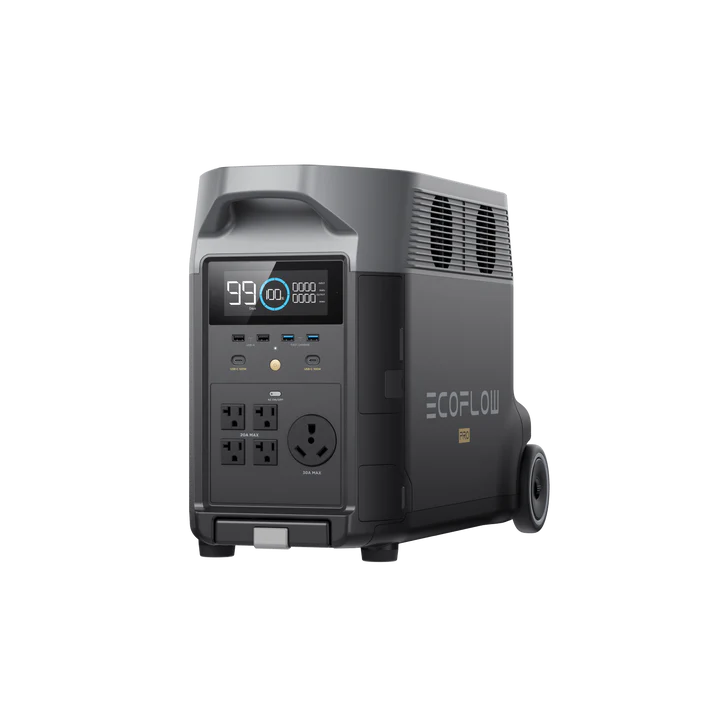
At 99 lbs, the DELTA Pro is furniture you install once; at 20.8 lbs, the RIVER 3 MAX PLUS is luggage you actually carry. That's the real axis this comparison turns on, not which one wins.
Full profiles: EcoFlow DELTA Pro → · EcoFlow RIVER 3 MAX PLUS →

Written by Gunner GustafsonUpdated
Whole-Home Backup Tester, Station Arena Test Desk
$1,899.00 · direct from EcoFlow
Last checked 1 day ago. Prices move — check before you buy.

No longer sold
EcoFlow no longer sells the RIVER 3 Max Plus. At this size the closest unit EcoFlow still sells is the RIVER 2 Pro — 768Wh with a stronger 800W inverter, typically for less money. If you'd rather step up in capacity, the DELTA 3 Classic (1,024Wh, 1,800W) is the move.
RIVER 2 Pro · $389.00Spec deltas
EcoFlow builds both of these, and the family resemblance stops at the badge. The DELTA Pro packs 3,600Wh into a 99-lb case meant to sit next to a breaker panel and run a house through an outage. The RIVER 3 MAX PLUS packs 858Wh into 20.8 lbs meant to ride along in a trunk. That's a 2,742Wh gap in capacity and a 78.2-lb gap in what you're expected to lift.
The DELTA Pro wins nearly every scenario on this page: a weekend of camping, an 8-hour blackout, a remote workday, a tailgate, even a CPAP overnight. It simply holds more. None of it is close. The RIVER 3 MAX PLUS would need 226% to 288% of its own capacity to cover a blackout or a camping trip, which is to say it can't. The one load neither unit should be trusted with is a full day of van life at 4,685Wh. That's a job for a different category of system entirely.
But winning scenarios isn't the same as winning your specific decision. At $1,899, the DELTA Pro only pays off if you'll use its scale. At $359, the RIVER 3 MAX PLUS is quieter, switches power over faster, and costs under a quarter as much per year of warranty coverage. If your outages, trips, or CPAP nights fit inside 858Wh, the bigger box buys you weight and dollars you'll never spend down.
What the Numbers Reveal
Each conclusion stated first — the numbers behind it on one line, the full analysis below.
Capacity
Because the per-Wh economics are nearly flat between them, this was never a 'which is the better deal' comparison. It's a 'how much capacity do you actually need' one. The DELTA Pro's higher price buys real watt-hours at essentially the smaller unit's own rate, not a luxury markup.
DELTA Pro: $1,899 at 3,600Wh works out to $0.44/WhRIVER 3 MAX PLUS: $359 at 858Wh works out to $0.42/Whcost per lifetime kWh: $0.13 (DELTA Pro) vs $0.14 (RIVER 3 MAX PLUS)
Why it mattersDon't read $1,899 as overpriced on its own. If you need the capacity, you're paying close to the same rate per Wh either way. If you don't, the extra dollars, and the extra 78.2 lbs, are capacity you'll never touch.
92% used is a full tank, not a comfortable margin. One longer party or one more round of phone charging and the RIVER 3 MAX PLUS joins the three scenarios it already fails outright. CPAP Overnight is the safer bet by a wide margin, with real headroom to spare.
Tailgate Party: RIVER 3 MAX PLUS uses 92% of capacity, can handle itCPAP Overnight: RIVER 3 MAX PLUS uses 44% of capacity, can handle itWeekend Camping / 8-Hour Blackout / Remote Workday: RIVER 3 MAX PLUS needs 288% / 226% / 125%, cannot handle any
Why it mattersA reader picking the RIVER 3 MAX PLUS for tailgating specifically should treat that 92% as packed to the brim and have a backup plan for anything longer than the test case. A reader picking it for CPAP nights has room to spare.
On the two specs that actually decide a good night's sleep, noise and how cleanly a power blip gets bridged, the smaller unit is the more polished choice: half the decibels, half the switchover time, and none of the fan whine reviewers flag on the DELTA Pro under heavy drawA4. The DELTA Pro's edge here is headroom a CPAP user doesn't need. The RIVER 3 MAX PLUS's edge is quiet you'll notice every night.
CPAP Overnight: DELTA Pro uses 10%, RIVER 3 MAX PLUS uses 44%, both can handle itnoise under load: 60dB (DELTA Pro) vs 30dB (RIVER 3 MAX PLUS)UPS switchover: 20ms (DELTA Pro, standby) vs 10ms (RIVER 3 MAX PLUS, line-interactive)DELTA Pro-line fans reported as audibly whiny under heavy loadA4sub-10ms switchover repeatedly singled out as a standout on the RIVER 3 Plus/Max familyB3B5
Why it mattersA reader whose only real load is a CPAP should weight noise and switchover speed over raw capacity. On that basis, the RIVER 3 MAX PLUS is a defensible pick even though the scenario math favors the DELTA Pro.
Some of that gap is just scale. The DELTA Pro's warranty is backing roughly five times the total lifetime energy, so it costs more to insure. But a buyer whose real need fits inside 858Wh is still paying DELTA Pro-sized warranty costs for a promise sized for a house, not an apartment.
cost per warranty year: $320 (DELTA Pro) vs $72 (RIVER 3 MAX PLUS)both warrantied for 5 yearstotal lifetime kWh: 12,600 (DELTA Pro) vs 2,574 (RIVER 3 MAX PLUS)
Why it mattersIf your capacity need is RIVER 3 MAX PLUS-sized, let the warranty-per-dollar number carry real weight in the decision. It's one of the few places on this page where bigger is a straightforwardly worse deal for you specifically.
The specific dimensions that decide these two units — everything else is a tie.
Your Life, Your Pick
Selected because: p1 sweeps 5 of 6 named scenarios, but the margins range from blowout to razor-thin, and that nuance matters more than the sweep itself.
Five of six scenarios go to the DELTA Pro, but 'wins' hides two very different margins. Weekend Camping and an 8-hour blackout aren't close: the RIVER 3 MAX PLUS would need 288% and 226% of its own capacity, meaning it simply can't. Remote Workday is the same story at 125%. Tailgate Party is the one to watch. The RIVER 3 MAX PLUS clears it, but at 92% used, which is a full tank, not a comfortable margin.
CPAP Overnight is the scenario that matters most for a specific reader, and it's the one where the DELTA Pro's win is the least meaningful. Both units clear it easily on paper, 10% and 44% used, so the deciding factor isn't which one has power to spare. It's which one you want humming near your pillow at 2 a.m. (more on that under Gotchas). Van Life Daily is the honest miss for both: 4,685Wh a day is 153% of the DELTA Pro's own capacity and 642% of the RIVER 3 MAX PLUS's. That's a generator-and-solar-bank problem, not a pick-one-of-these-two problem.
Portability & Form Factor
Selected because: 99 lbs vs 20.8 lbs is the most viscerally decisive gap on the page and anchors the carry-it-vs-install-it framing.
weight
99 lbs isn't a spec. It's a two-person carry the moment stairs get involved. Even with the DELTA Pro's integrated wheels doing the work on flat concrete, reviewers note a curb or a gravel site puts the weight straight back on your armsA2. The RIVER 3 MAX PLUS, at 20.8 lbs, is the one you pick up one-handed and set in the truck without a second thought.
That's a 78.2-lb gap, and you only need to move each unit once to feel every pound of it. One of these is meant to be installed and left. The other is meant to travel. Neither is wrong; they're just not solving the same problem.
What the Specs Don't Tell You
Selected because: All four firing cards split evenly: two are DELTA Pro weaknesses, two are RIVER 3 MAX PLUS wins, and together they tell the real tradeoff better than the scenario sweep alone.
rated cycles
Two of these four cards are the DELTA Pro's problems, and two belong to the RIVER 3 MAX PLUS outright. The DELTA Pro shows up as both a 99-lb commitment and 60dB under load: heavy to move, and audibly whiny once you're pulling more than a couple thousand watts through it, per reviewersA4. Neither is a dealbreaker for a unit meant to sit in a basement and run a fridge, but they're real costs of the scale.
The other two cards belong to the smaller unit. The RIVER 3 MAX PLUS switches over in under 10ms against the DELTA Pro's 20ms: line-interactive versus standby, a distinction reviewers single out as a standout on this side of EcoFlow's lineupB3B5. Its warranty also costs $72 a year against $320 for the same five years of coverage. Scale bought the DELTA Pro five of six scenarios. It didn't buy the podium on noise, switching speed, or warranty economics.
Lifetime Value
Selected because: cheaperToOwn favors the DELTA Pro by a cent, but cost-per-warranty-year cuts the other way hard; both numbers need to be on the page.
cost / lifetime kWh
Cost per lifetime kWh is close enough to be a rounding error: $0.13 for the DELTA Pro, $0.14 for the RIVER 3 MAX PLUS. The DELTA Pro wins that by a penny, which means the sticker gap isn't a 'you're overpaying for the big one' story. The raw per-Wh price, $0.44 against $0.42, is nearly identical too. You're not paying a premium for the DELTA Pro's scale. You're just paying for the scale.
The number that does move is cost per warranty year: $320 for the DELTA Pro against $72 for the RIVER 3 MAX PLUS. Some of that gap is the DELTA Pro's warranty backing roughly five times the total lifetime energy (12,600 kWh against 2,574). A bigger promise costs more to insure. But if your actual need tops out well under 858Wh, you're still bankrolling coverage on capacity you'll never draw down.
Growth Path
Selected because: Both expand, but the DELTA Pro's solar ceiling makes its growth path the more serious one for a buyer scaling toward real off-grid capacity.
solar input
Both expand, so 'expandable' isn't the decision. How far, and into what, is. The DELTA Pro's expansion batteries are chasing a unit that's already at 3,600Wh. The RIVER 3 MAX PLUS has effectively already used its own expansion path once, built from a base RIVER 3 Plus plus an EB600 battery to reach this 858Wh configurationB2B9. Whatever you bolt onto it next tops out at a much smaller ceiling no matter how you slice it.
The gap that matters long-term is solar: 1,600W of input on the DELTA Pro against 200W on the RIVER 3 MAX PLUS, 8 times the ceiling. A buyer planning to grow into a real off-grid setup, more panels, more batteries, less reliance on the grid, is buying into the DELTA Pro's growth path, not the RIVER 3 MAX PLUS's. The smaller unit's ceiling is a good one for a single trip. The bigger unit's ceiling is a plan.
Strengths & trade-offs
EcoFlow DELTA Pro
Strengths
- +Larger battery capacity
- +Higher AC output
- +Faster solar charging
Trade-offs
- –Substantially more expensive (+$1,540) than the RIVER 3 MAX PLUS.
- –Significantly heavier (+78.2 lbs), making it harder to move.
- –Very heavy unit that may be difficult for one person to lift.
- –Can receive complaints about fan noise under heavy load.
EcoFlow RIVER 3 MAX PLUS
Strengths
- +Costs $1,540 less
- +Lighter by 78.2 lb
Trade-offs
- –Weaker inverter (-3,000W) limits appliance compatibility.
Will It Power Your Gear?
Scenario math and per-appliance runtimes, modeled from the spec record.
Scenario verdicts
We ran the math on six real-world scenarios. Here's which unit survives your actual life.
SCN-01 · 2 nights · needs 2,100Wh
Weekend Camping
Two nights off-grid with essential comfort
DELTA Pro
A weekend camping trip pencils out to about 2,100Wh. The DELTA Pro covers it using 69% of its capacity with plenty to spare. The RIVER 3 MAX PLUS would need 288% of its 858Wh, nearly three full charges it doesn't have. This one isn't close.
Battery budget usedlower = more headroom
LOAD Phone Charger 15W×6h · LED Lights 40W×8h · Box Fan 75W×14h · CPAP Machine 40W×16h
SCN-02 · 8 hours · needs 1,645Wh
8-Hour Blackout
Keep the essentials running through a night without power
DELTA Pro
An 8-hour blackout runs roughly 1,645Wh. The DELTA Pro covers it at 54% of capacity. The RIVER 3 MAX PLUS would need 226% of what it holds. For an outage this long, capacity decides it outright.
Battery budget usedlower = more headroom
LOAD Fridge 150W×8h · Router + Modem 20W×8h · LED Lights (4 bulbs) 40W×6h · Phone Charger 15W×3h
SCN-03 · 8 hours · needs 320Wh
CPAP Overnight
Sleep therapy without interruption — the #1 medical use case
RIVER 3 MAX PLUS
A CPAP overnight draws about 320Wh, and both units clear it: 10% of the DELTA Pro's capacity, 44% of the RIVER 3 MAX PLUS's. Neither runs short, so the deciding factor here isn't runway. It's the other specs that matter at 2 a.m., like noise and switchover speed.
Battery budget usedlower = more headroom
LOAD CPAP Machine 40W×8h
SCN-04 · 8 hours · needs 910Wh
Remote Workday
Full work day off-grid without power anxiety
DELTA Pro
A remote workday's roughly 910Wh fits inside the DELTA Pro at 30% of capacity with room to spare. The RIVER 3 MAX PLUS would need 125% of its 858Wh, just past what it has, which is enough that a full workday isn't a safe bet on this unit alone.
Battery budget usedlower = more headroom
LOAD Laptop 60W×8h · External Monitor 30W×8h · Router + Modem 20W×8h · Phone Charger 15W×2h
SCN-05 · 4 hours · needs 670Wh
Tailgate Party
Game day power for the crew
DELTA Pro
A tailgate's approximately 670Wh needs only 22% of the DELTA Pro's capacity. The RIVER 3 MAX PLUS clears it too, but at 92% used. That's a full tank, not a comfortable margin, and the scenario where the smaller unit works hardest to keep up.
Battery budget usedlower = more headroom
LOAD Blender 400W×0.5h · LED TV (55") 80W×4h · Bluetooth Speaker 15W×4h · Phone Charger (×3) 45W×2h
SCN-06 · 24 hours · needs 4,685Wh
Van Life Daily
A full day of mobile living — the ultimate endurance test
Neither unit
A full van-life day at roughly 4,685Wh outruns both units: 153% of the DELTA Pro's capacity and 642% of the RIVER 3 MAX PLUS's. Neither is sized for a daily load this large on its own.
Battery budget usedlower = more headroom
LOAD Mini-Fridge 150W×24h · Laptop 60W×4h · Phone Charger 15W×3h · LED Lights 40W×5h · Fan 75W×8h
The Load Test
RUNTIME = (Wh × 0.85) ÷ LOAD
None of the scenarios above exactly yours? Build it. Toggle what you'd plug in; both units are tested against the combined draw.
Essentials
Comfort & Convenience
High-Draw Appliances
Test duration
8h
Continuous draw
205W
Projected runtime
For this load: DELTA Pro runs 14.9h vs 3.6h.
$1,899 list · direct from EcoFlow
Modeled from the spec record — same math as the tables below. Methodology
Runtime by appliance
Real-world runtime estimates for common appliances, modeled at 85% inverter efficiency.¹
Essentials
The basics you need runningscale 0–204hComfort & Convenience
Makes off-grid life actually enjoyablescale 0–40.8hHigh-Draw Appliances
These reveal the real limitsscale 0–3.1h¹ Runtime = (capacity × 0.85) ÷ appliance watts. Within each group, all bars share one time scale (the group's longest runtime), so lengths are comparable across appliances; identical runtimes collapse into a single blue/orange bar. Actual runtime varies with battery age, temperature, and simultaneous loads — see methodology.
Conclusion
July 28, 2026
Verdict: the DELTA Pro, on Power Score margin
Take the DELTA Pro if your real need is multi-day or whole-home backup. It clears every scenario on this page except a full van-life day, costs almost exactly the same per watt-hour as the RIVER 3 MAX PLUS despite a sticker price of $1,899 against $359, and leaves real room to grow with 1,600W of solar input. Take the RIVER 3 MAX PLUS instead if your loads genuinely fit inside 858Wh: a CPAP, a weekend, a tailgate. It's 78.2 lbs lighter, switches over twice as fast, runs at half the noise, and its warranty costs under a quarter as much per year for the same five years of coverage. This isn't close on scenario coverage, but it's not a clean sweep on merit either. Buy the scale only if you'll actually use it.
Editor-assigned confidence, based on cited owner research and spec analysis.
List prices as of July 28, 2026. The links below open EcoFlow's current price.
$1,899.00 · direct from EcoFlow
Last checked 1 day ago. Prices move — check before you buy.
or check the RIVER 3 MAX PLUS price$359.00 list
Written by Gunner Gustafson, Whole-Home Backup Tester · Station Arena Test Desk · Updated July 28, 2026
Measured Data
Benchmark scores and the full spec record, side by side.
Benchmark scores
Not rated for both units (minimum threshold unmet): RV Living, Home Backup, CPAP, Tailgating, Food Truck, Apartment Balcony, Camping.
Full specifications
ᵈ Derived: price ÷ rated capacity. See the data behind our comparisons →
Comparison ToolAdd more power stations, side by sideOpen Tool →How these numbers are produced
Numeric verification
Every figure on this page traces to our spec database or arithmetic on it — no estimated numbers.
Owner claims
Statements about owner experience are cited to published reviews — see Sources & Research Notes below.
Runtime model
Runtime = (rated capacity × 0.85 inverter efficiency) ÷ device wattage. Solar recharge estimates assume panels deliver 70% of rated output. Cold weather, battery age, and stacked loads reduce real-world results.
Power Score
Computed from 14 published spec dimensions, weighted per use-case bench. Higher is better; a unit must meet a bench's minimum threshold to be rated.
See the full weight table and data sourcing on our methodology page →Class ranking (the star rating)
Each unit's star score is a category ranking, not customer reviews — no buyer opinions feed it. We score every station on size-independent quality (value, output, portability, endurance, ports, warranty, and more), then percentile-rank it against the other units in its capacity class, so a class-leading compact unit and a class-leading whole-home unit can both earn 5★. Here, DELTA Pro rates 3.9/5 (33rd percentile of 16 Home Backup-class units), and RIVER 3 MAX PLUS rates 4.9/5 (95th percentile of 20 Compact-class units).
How the class ranking is computed →Test Notes & Caveats
Hidden gotchas and advantages we spotted that you won't find on the product page.
99 Pounds Is a Two-Person Job
The DELTA Pro outweighs the RIVER 3 MAX PLUS by 78.2 lbs: 99 against 20.8. That gap isn't a number you feel until you're the one lifting it out of a trunk or down a flight of stairs. Wheels do the work on flat ground; anywhere they can't roll, it's back to arms and knees.
60dB Under Load, Against 30dB
Both units carry a noise rating for load conditions, and the gap is exactly double: 60dB for the DELTA Pro against 30dB for the RIVER 3 MAX PLUS. If either unit is going to run in the room you're sleeping or working in, that's the number to weigh against the extra capacity.
Line-Interactive Beats Standby by Half
The RIVER 3 MAX PLUS switches over in under 10ms, a line-interactive design. The DELTA Pro takes up to 20ms, standby-style, twice as long. Most electronics won't notice either way, but it's the sharper number for anything that hates even a brief interruption.
Same 5 Years, Very Different Price
Both units carry a 5-year warranty, but the cost of that coverage isn't equal: $320 a year for the DELTA Pro against $72 a year for the RIVER 3 MAX PLUS, a bit over 4 times as much. Some of that is scale. The DELTA Pro's warranty backs roughly 5 times the total lifetime energy, but it's real money either way.
Full record above — the Test Desk pick is the DELTA Pro.
Check DELTA Pro price →or check the RIVER 3 MAX PLUS priceOwnership Analysis
What happens after you buy — true cost of ownership, brand trust, and growth potential.
Lifetime value
Service lifeyears at one full cycle per day
Lifetime energy delivered
Cost per delivered kWh
│ warranty ends · Reaching the cycle rating means ~80% capacity remains — degraded, not dead.
Analyst note
Both units have similar long-term ownership costs ($0.15/kWh vs $0.14/kWh). The price difference is what you see on the sticker — neither is a hidden bargain or rip-off.
Growth path
DELTA Pro
EXPANDABLESupports EcoFlow expansion batteries, so you can add capacity later without replacing the base unit — useful if your needs may climb past 3,600Wh.
Accepts up to 1,600W of solar. Enough for a serious multi-panel array.
Generous port selection supports complex multi-device setups.
Expansion batteries are EcoFlow-specific. You're investing in the EcoFlow ecosystem.
RIVER 3 MAX PLUS
EXPANDABLESupports EcoFlow expansion batteries, so you can add capacity later without replacing the base unit — useful if your needs may climb past 858Wh.
Accepts up to 200W of solar. Limited to a single portable panel.
Adequate ports for most setups, but heavy users may want a power strip.
Expansion batteries are EcoFlow-specific. You're investing in the EcoFlow ecosystem.
Realistic full solar rechargeat 70% of rated panel output — see methodology
Analyst note
Both expand, but the DELTA Pro's higher solar ceiling (1,600W vs 200W) gives it the stronger off-grid growth path — more panels can feed a bigger bank as it grows.
What Owners Report
Patterns from published owner reports and long-term reviews — every claim cited to its source below.
EcoFlow DELTA Pro
Owners and reviewers treat the DELTA Pro as a genuine home-backup standard: the kind of unit people run a fridge, lighting, and a space heater through multi-day outages, not just a camping battery with delusions of grandeurA1. One long-term account describes it as primary backup across several overnight outages spread over months, with the LFP chemistry good for its full 3,500 rated cycles and, per that account, a decade-plus of daily use before it's expected to fadeA3.
The complaints cluster around exactly what the spec sheet would predict: it's heavy, and it isn't quiet under load. The integrated wheels and telescoping handle help on flat concrete, but reviewers note you'll want a cart for anything unevenA2, and past roughly a couple thousand watts of draw the fans pick up a high-pitched whine that's noticeable in an otherwise quiet roomA4. Worth flagging: some DELTA Pro figures circulating online actually describe the newer, heavier DELTA Pro 3. The unit on this page is the original 3,600Wh, 99-lb DELTA Pro, and its 60dB rating is the one to trust.
“Long regarded as a gold standard for home backup — designed for high-draw appliances and full-scale battery expansion, running home essentials like a fridge, lighting, and a space heater through outages.”
Sources
backuppowerhub.com · us.ecoflow.co · outdoorgearlab.com · bobvila.com · powerstationadvisor.com · robbsutton.com
EcoFlow RIVER 3 MAX PLUS
Field data on this exact configuration is thin. Most of what's available is short-term hands-on review coverage rather than long-term owner-forum threads, and some of it covers the smaller RIVER 3 or RIVER 3 Plus rather than this specific Max Plus bundle. What is consistent: it charges unusually fast from empty to full off mains for its sizeB1, and reviewers repeatedly flag the sub-10ms UPS switchover as a standout on the RIVER 3 Plus/Max familyB3B5.
The other consistent note is a limit, not a flaw: the extended 1,200W output mode is meant for resistive loads like heaters or hair dryers, not sensitive electronics such as a desktop PCB4B7. One reviewer called the Max Plus configuration a brilliant middle ground for wild parking or a weekend off-gridB5, which tracks with the scenario math on this page. It's built for a weekend, not a week.
“The RIVER 3 Max Plus (Wireless) can go from empty to full from mains in around 2.3 hours, which is very quick given its capacity.”
Sources
wandering-bird.com · root-nation.com · phonearena.com
Sources & Research Notes
Every owner claim in this report is traceable to a published source. The bracketed references above resolve here.
Recurring owner themes
- Established home-backup platform with wheeled portability and massive expandability; the consistent knock is fan noise under heavy load. [DELTA Pro · 3 entries]
- Owners/reviewers consistently note the Max Plus is a modular upgrade (base unit + EB600 battery) rather than a distinct unit, and reference its 858Wh combined capacity — this conflicts with the 1196Wh figure given in the task brief, suggesting a possible spec discrepancy or regional/bundle variant not covered by available sources. [RIVER 3 MAX PLUS · 3 entries]
- Reviewers agree the extended 1200W X-Boost output is best suited to resistive/heating loads, not sensitive electronics like PCs. [RIVER 3 MAX PLUS · 2 entries]
- Sub-10ms UPS switchover is repeatedly highlighted as a standout, real-world-tested feature across the River 3 Plus/Max/Max Plus family. [RIVER 3 MAX PLUS · 2 entries]
- A1
“Long regarded as a gold standard for home backup — designed for high-draw appliances and full-scale battery expansion, running home essentials like a fridge, lighting, and a space heater through outages.”
backuppowerhub.com / us.ecoflow.com — EcoFlow DELTA Pro review · 2025-2026 · [positive]
- A2
“Heavy but wheeled — integrated wheels and a telescoping handle help move its considerable weight, though they work best on flat, smooth surfaces; a cart is needed for uneven ground.”
outdoorgearlab.com / bobvila.com — DELTA Pro-line review · 2025-2026 · [mixed]
- A3
“Reliable through extended outage use — served as primary backup across multiple overnight outages over months, powering essentials simultaneously; LFP battery rated for thousands of cycles and 10+ years of daily use.”
powerstationadvisor.com / robbsutton.com — DELTA Pro-line review · 2025-2026 · [positive]
- A4
“Not silent under heavy load — under 2000W-plus draws the fans emit a noticeable high-pitched whine that's distracting in a quiet room, though it runs quietly enough at lighter loads.”
outdoorgearlab.com — DELTA Pro-line noise testing · 2025-2026 · [negative]
- B1
“The RIVER 3 Max Plus (Wireless) can go from empty to full from mains in around 2.3 hours, which is very quick given its capacity.”
wandering-bird.com — REVIEW: Ecoflow River 3 Max Plus- vanlife essential or not? · 2025-11 · [positive]
- B2
“The RIVER 3 Max Plus (Wireless) is created by taking the RIVER 3 Plus (Wireless) and attaching the larger EB600 extra battery, giving a total capacity of 858Wh.”
wandering-bird.com — REVIEW: Ecoflow River 3 Max Plus- vanlife essential or not? · 2025-11 · [positive]
- B3
“UPS (Uninterruptible Power Supply) switching on the RIVER 3 Plus/Max models is under 10 milliseconds”
wandering-bird.com — REVIEW: Ecoflow River 3 Max Plus- vanlife essential or not? · 2025-11 · [positive]
- B4
“It won't run a high-power hairdryer or microwave, but that's true for most portable power stations unless you go for one of the big Delta units.”
wandering-bird.com — REVIEW: Ecoflow River 3 Max Plus- vanlife essential or not? · 2025-11 · [mixed]
- B5
“For typical wild parking or a weekend off-grid, the Max Plus version is a brilliant middle ground.”
wandering-bird.com — REVIEW: Ecoflow River 3 Max Plus- vanlife essential or not? · 2025-11 · [positive]
- B7
“the extended output is designed for resistive loads – things like hair dryers, heaters, or compact air conditioners. It's not meant for sensitive electronics like desktop PCs.”
root-nation.com — EcoFlow River 3 Max Review (discusses River 3 Max Plus family) · 2025-05 · [mixed]
- B9
“With the EB300, you transform the station into the River 3 Max model, while the larger expansion battery gives you the EcoFlow River 3 Max Plus.”
phonearena.com — EcoFlow River 3 Plus Review · 2025-03 · [positive]
Research compiled July 28, 2026.
Who Should Buy Which
Buy the DELTA Pro if you…
- →You're covering a real multi-day outage: a fridge, lighting, maybe a CPAP and a space heater, all running at once, and you want a box you set up once next to the breaker panel and don't think about again for yearsA1A3.
- →You're already planning to expand: more batteries, more solar, a real off-grid buildout. The DELTA Pro's 1,600W solar ceiling and expansion bays are the growth path that actually scales. The RIVER 3 MAX PLUS's doesn't reach nearly as far.
Buy the RIVER 3 MAX PLUS if you…
- →You need something you'll actually carry: into a tent, onto a tailgate, up an apartment stairwell, and 78.2 fewer pounds than the DELTA Pro matters more to you than the extra capacity.
- →You're protecting one sensitive load (a CPAP, a laptop, a modem) through short outages or brief power blips, where a sub-10ms switchoverB3B5 and a 30dB noise floor matter more than headroom you'll never use.
This is you — check the RIVER 3 MAX PLUS price
If neither fits
Running a van's full daily load, fridge, induction cooktop, laptop charging, the works, at 4,685Wh a day asks for 153% of the DELTA Pro's own capacity and 642% of the RIVER 3 MAX PLUS's. Both fall short of a full day; that's a job for a larger expandable bank or a generator-backed system, not a choice between these two.
The Bottom Line
Scale versus polish is the whole page. The DELTA Pro wins five of six scenarios, costs a penny less per lifetime kWh, and beats the RIVER 3 MAX PLUS eight times over on solar ceiling. But the RIVER 3 MAX PLUS switches over twice as fast, runs at half the noise, and costs under a quarter as much per warranty-year, all while weighing 78.2 lbs less.
Buy the DELTA Pro if you need to cover more than 858Wh of real draw, especially across multiple daysA1A3. Buy the RIVER 3 MAX PLUS if you don't, and let it ride along instead of anchoring a corner of the garage.
Frequently Asked Questions
Answers drawn from the spec record and cited owner research.
Is the EcoFlow DELTA Pro overkill for a weekend of camping?
For a single weekend, usually. Weekend Camping on this page needs about 2,100Wh, and the DELTA Pro only uses 69% of its 3,600Wh capacity to cover it. It's built more for multi-day, whole-home backup than a one-tent trip. If camping is your only use case, that headroom is weight you're carrying for no reason.
Can the RIVER 3 MAX PLUS run a CPAP all night?
Yes. CPAP Overnight needs about 320Wh, which uses 44% of the RIVER 3 MAX PLUS's 858Wh capacity, leaving real headroom for a multi-night trip without an outlet. Its 30dB noise floor and sub-10ms UPS switchover also make it the quieter, faster-switching choice if a CPAP is the only load you're protecting.
Why is the DELTA Pro so much heavier than the RIVER 3 MAX PLUS?
Mostly the battery: 3,600Wh of cells weighs more than 858Wh's worth, and there's no way around that. At 99 lbs against 20.8, the DELTA Pro ships with integrated wheels and a telescoping handle to compensate, but that only helps on flat, smooth ground. Stairs or gravel put the weight back on your arms.
Is the DELTA Pro's warranty actually better than the RIVER 3 MAX PLUS's?
They're the same length, 5 years on both, but not the same value. The DELTA Pro costs $320 a year of that coverage against $72 a year for the RIVER 3 MAX PLUS, largely because it's backing roughly five times the total lifetime energy. If your needs fit inside 858Wh, you're paying DELTA Pro warranty prices for capacity you won't use.
Which one is actually cheaper to own long-term?
By a penny, the DELTA Pro: $0.13 per lifetime kWh against $0.14 for the RIVER 3 MAX PLUS, and the raw per-Wh price, $0.44 against $0.42, is nearly identical too. The sticker gap, $1,899 against $359, is almost entirely explained by capacity, not a scale premium. So 'cheaper to own' only matters if you actually need the DELTA Pro's 3,600Wh in the first place.
Where to buy
EcoFlow DELTA ProPick
$1,899.00
$1,899.00 · direct from EcoFlow
Last checked 1 day ago. Prices move — check before you buy.
EcoFlow RIVER 3 MAX PLUS
$359.00
$359.00 · direct from EcoFlow
Last checked 41 days ago. Prices move — check before you buy.
Prices may vary by retailer and are subject to change.