Head-to-head test
EcoFlow DELTA Pro vs BLUETTI AC200MAX
Neither of these is leaving the spot you set it down in, so the real question is whether the DELTA Pro's 1,552Wh bigger tank, faster solar ceiling, and only UPS spec on this page are worth $700 and 37 more pounds than the AC200MAX.
Full profiles: EcoFlow DELTA Pro → · BLUETTI AC200MAX →

Written by Gunner GustafsonUpdated
Whole-Home Backup Tester, Station Arena Test Desk
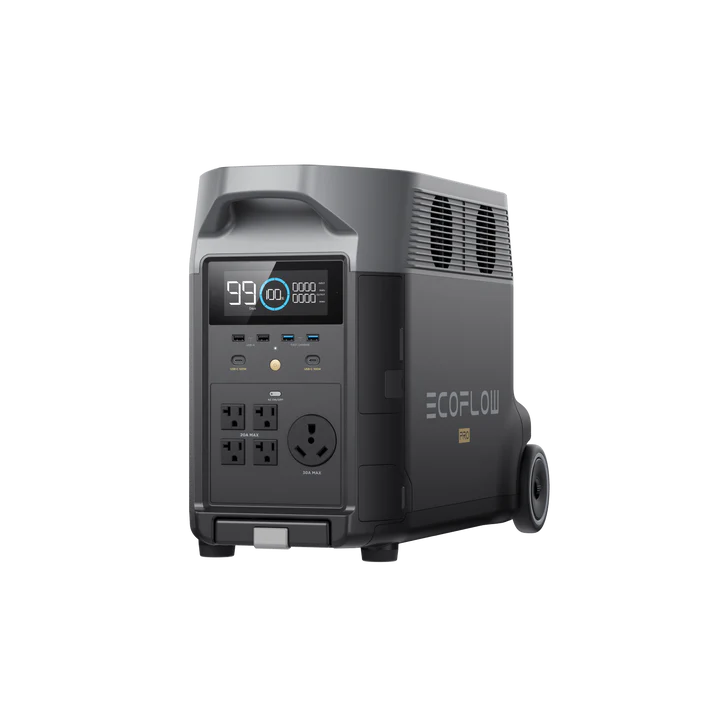
$1,899.00 · direct from EcoFlow
Last checked 1 day ago. Prices move — check before you buy.

$1,199.00 · direct from BLUETTI
Last checked 1 day ago. Prices move — check before you buy.
Spec deltas
Set either of these down and it's staying there. The DELTA Pro weighs 99 lbs, the AC200MAX 61.9, and neither is a grab-and-go battery you toss in a trunk for the weekend. The DELTA Pro is the one to buy: it wins four of six real-world scenarios outright, ties the fifth, and backs that up with a power score of 5,338 against the AC200MAX's 3,590.
The catch is $700. The DELTA Pro lists at $1,899 against $1,199 for the AC200MAX, and it's the heavier, louder-rated box on paper too — 60dB against 50dB. What that $700 buys is 1,552Wh more capacity, a solar ceiling roughly 1.8 times the AC200MAX's (1,600W vs 900W), and the one feature the AC200MAX doesn't have at all: a 20-millisecond UPS switchover that can catch a power cut before a router even notices.
That combination is why the DELTA Pro also ends up cheaper to own despite costing more to buy — $0.13 per lifetime kWh against $0.17 for the AC200MAX. The AC200MAX still has a real case: it's $700 cheaper today, 37 lbs lighter, and rated 10dB quieter on the spec sheet. But for anyone actually riding out a blackout or feeding a solar bank, the DELTA Pro is carrying the load, literally and otherwise.
What the Numbers Reveal
Each conclusion stated first — the numbers behind it on one line, the full analysis below.
solar input
The DELTA Pro isn't trading refill speed for its extra size. EcoFlow scaled the solar input right along with the tank, so 1,552Wh more capacity doesn't cost you a slower recharge.
DELTA Pro: 3,600Wh capacity, 1,600W max solar inputAC200MAX: 2,048Wh capacity, 900W max solar input
Why it mattersAnyone weighing these for solar or off-grid use can drop recharge time as a tiebreaker — it's a wash — and just decide how much stored energy they actually want in reserve.
That's before the outage itself even starts. The DELTA Pro's 20-millisecond switchover can catch a router or a medical device before it loses power; the AC200MAX has no switchover spec at all, so it can only protect what's already running or gets plugged in fast enough by hand.
DELTA Pro: 20ms UPS switchover spec; AC200MAX: no switchover spec listed8-Hour Blackout scenario: DELTA Pro at 54% capacity used, AC200MAX at 94%
Why it mattersAnyone buying to protect always-on gear — a modem, a CPAP, a sump pump — should treat the UPS spec as close to a deciding factor on its own, independent of price.
weight
The AC200MAX, at 61.9 lbs, is the one that's actually a two-handed carry into a tent or a truck bed. The DELTA Pro, at 99 lbs, is built to be wheeled to one spot and stay thereA2. The weight gap isn't really about who's heavier — it's about which one was ever meant to travel.
DELTA Pro: 99 lbs; AC200MAX: 61.9 lbsDELTA Pro ships with integrated wheels and a telescoping handleA2
Why it mattersIf the unit needs to move under its own power to a campsite or a tailgate, the lighter AC200MAX is the one you'll still be willing to load in a year. If it's living next to a breaker panel, the DELTA Pro's extra 37 lbs costs you nothing.
Both numbers are honest — they're just answering different questions. The DELTA Pro earns its lower cost-per-kWh by holding far more total lifetime energy, 12,600kWh against 7,168kWh, while its cost-per-warranty-year is only higher because the extra $700 is spread across just one additional year of coverage, 5 against 4.
DELTA Pro: $0.13 cost per lifetime kWh, $320 cost per warranty year, 5-year warrantyAC200MAX: $0.17 cost per lifetime kWh, $300 cost per warranty year, 4-year warranty
Why it mattersDon't let the $20-a-year figure flip the decision — it's pricing the warranty, not the battery. Cost per kWh tracks what you actually get for your money, and it still favors the DELTA Pro.
The specific dimensions that decide these two units — everything else is a tie.
Your Life, Your Pick
Selected because: Six concrete use cases are the most honest decision tool here — DELTA Pro wins 4 outright, ties 1 (CPAP), both fail 1 (Van Life Daily).
Run six real nights through both units and the DELTA Pro wins four outright — Weekend Camping, the 8-Hour Blackout, Remote Workday, and Tailgate Party — while CPAP Overnight is a tie neither unit will notice, since both use well under a fifth of their tank for a CPAP alone. The only place both fail is Van Life Daily, where a full day of cooking, climate control, and electronics needs 4,685Wh — more than either unit holds even before the usable-capacity haircut.
The gap is starkest at Weekend Camping: the AC200MAX runs out at 121% of its usable capacity, while the DELTA Pro still has roughly a third of its tank left at 69% used. That's the scenario where the extra 1,552Wh actually gets spent, not banked.
Lifetime Value
Selected because: cheaperToOwn=p1 despite the higher sticker price; also surfaces the cost-per-warranty-year honest counter-metric.
cost / lifetime kWh
The DELTA Pro costs $700 more to buy and still comes out cheaper to own: $0.13 per lifetime kWh against the AC200MAX's $0.17. That's because 3,500 charge cycles on a 3,600Wh tank works out to 12,600kWh of total lifetime energy, against the AC200MAX's 7,168kWh on the same cycle count — same chemistry, same cycle life, very different amount of energy that life actually delivers.
It isn't a clean sweep, though. Spread each price over its warranty instead of its lifetime energy, and the DELTA Pro runs $320 a year of coverage against the AC200MAX's $300, since the extra $700 buys only one more warranty year (5 vs 4). That's the honest asterisk on an otherwise one-sided page: the DELTA Pro is the better long-term buy, just not the better deal on every single cut of the math.
What the Specs Don't Tell You
Selected because: All three firing gotchas (weight, noise, ups) speak directly to what living with either unit day to day is actually like.
The DELTA Pro is the heavier box here and the louder one on the spec sheet — 99 lbs against 61.9, rated at 60dB against 50dB. Both are real costs of packing in the bigger battery.
The third catch runs the other way, and it's the one that can matter most: the DELTA Pro is the only unit of the two with a UPS switchover spec, at 20 milliseconds. For a buyer whose actual goal is protecting something that can't tolerate a power gap, that's not a tiebreaker among nice-to-haves. It's the one spec the AC200MAX simply has no answer for.
Brand Trust
Selected because: Cross-brand pair with a real support/recall divergence worth surfacing before a multi-year purchase.
EcoFlow is the bigger platform by almost every measure: the largest product ecosystem in the category, the biggest community (Reddit's r/Ecoflow_community alone runs around 31K members), and support reachable by US phone, email, or chat. That scale comes with a caveat worth knowing before committing years to the brand — EcoFlow recalled the DELTA Max 2000 in October 2025 over an overheating and fire risk tied to six incidents, and briefly tested a subscription paywall for app features in early 2025 before backing off under community pushback.
BLUETTI's pitch is value, not scale. The AC200MAX undercuts the DELTA Pro by $700 up front, and BLUETTI's own app is rated on par with EcoFlow's (4.5/5 on both iOS and Android). The tradeoff is support: BLUETTI's is the most inconsistent in the category, largely email-based with China-timezone delays, and some discontinued models carry no spare-parts policy at all once the warranty runs out.
Growth Path
Selected because: Both expand, but the solar-ceiling gap is the real growth differentiator per the engine's own recommendation.
solar input
Both units support add-on batteries rather than forcing a full replacement once you outgrow the base capacity — DELTA Pro past 3,600Wh, AC200MAX past 2,048Wh. On paper that's a wash: expandable is expandable.
The real difference is how fast either one refills once it's expanded, and that comes down to solar ceiling: 1,600W for the DELTA Pro against 900W for the AC200MAX. A bigger bank is only as useful as your ability to keep it full, and the DELTA Pro can absorb roughly 1.8 times the sunlight per hour to do it.
Strengths & trade-offs
EcoFlow DELTA Pro
Strengths
- +Larger battery capacity
- +Higher AC output
- +Longer warranty
- +Faster solar charging
Trade-offs
- –Substantially more expensive (+$700) than the AC200MAX.
- –Significantly heavier (+37.1 lbs), making it harder to move.
- –Very heavy unit that may be difficult for one person to lift.
- –Can receive complaints about fan noise under heavy load.
BLUETTI AC200MAX
Strengths
- +Costs $700 less
- +Lighter by 37.1 lb
Trade-offs
- –Weaker inverter (-1,400W) limits appliance compatibility.
Will It Power Your Gear?
Scenario math and per-appliance runtimes, modeled from the spec record.
Scenario verdicts
We ran the math on six real-world scenarios. Here's which unit survives your actual life.
SCN-01 · 2 nights · needs 2,100Wh
Weekend Camping
Two nights off-grid with essential comfort
DELTA Pro
A weekend's worth of camping load needs about 2,100Wh. The DELTA Pro covers it with room left at 69% used; the AC200MAX runs out first, needing 121% of what it actually has to give.
Battery budget usedlower = more headroom
LOAD Phone Charger 15W×6h · LED Lights 40W×8h · Box Fan 75W×14h · CPAP Machine 40W×16h
SCN-02 · 8 hours · needs 1,645Wh
8-Hour Blackout
Keep the essentials running through a night without power
DELTA Pro
An 8-hour blackout at 1,645Wh is inside both units' range, but not by the same margin. The DELTA Pro uses 54% of its capacity and has plenty left for a second night, while the AC200MAX is already at 94% with almost nothing more to give.
Battery budget usedlower = more headroom
LOAD Fridge 150W×8h · Router + Modem 20W×8h · LED Lights (4 bulbs) 40W×6h · Phone Charger 15W×3h
SCN-03 · 8 hours · needs 320Wh
CPAP Overnight
Sleep therapy without interruption — the #1 medical use case
AC200MAX
A CPAP alone needs only about 320Wh a night, and both units treat that as a rounding error — 10% of the DELTA Pro's tank, 18% of the AC200MAX's. For this use case alone, the cheaper AC200MAX is plenty of battery; the deciding factor is everything else you might also want to run.
Battery budget usedlower = more headroom
LOAD CPAP Machine 40W×8h
SCN-04 · 8 hours · needs 910Wh
Remote Workday
Full work day off-grid without power anxiety
DELTA Pro
A full remote workday draws about 910Wh. The DELTA Pro spends 30% of its tank on it and barely notices; the AC200MAX spends 52% — still fine for one day, tighter if the power stays out for more than one.
Battery budget usedlower = more headroom
LOAD Laptop 60W×8h · External Monitor 30W×8h · Router + Modem 20W×8h · Phone Charger 15W×2h
SCN-05 · 4 hours · needs 670Wh
Tailgate Party
Game day power for the crew
DELTA Pro
Tailgate-party loads run about 670Wh. Both units handle it easily — 22% of the DELTA Pro's capacity against 38% of the AC200MAX's — so price and portability matter more here than capacity headroom.
Battery budget usedlower = more headroom
LOAD Blender 400W×0.5h · LED TV (55") 80W×4h · Bluetooth Speaker 15W×4h · Phone Charger (×3) 45W×2h
SCN-06 · 24 hours · needs 4,685Wh
Van Life Daily
A full day of mobile living — the ultimate endurance test
Neither unit
A full day of van-life power — cooking, climate control, electronics — needs about 4,685Wh, more than either unit holds. The DELTA Pro falls short at 153% of its usable capacity and the AC200MAX at 269%. This is a job for a bigger unit or a second battery, not either of these alone.
Battery budget usedlower = more headroom
LOAD Mini-Fridge 150W×24h · Laptop 60W×4h · Phone Charger 15W×3h · LED Lights 40W×5h · Fan 75W×8h
The Load Test
RUNTIME = (Wh × 0.85) ÷ LOAD
None of the scenarios above exactly yours? Build it. Toggle what you'd plug in; both units are tested against the combined draw.
Essentials
Comfort & Convenience
High-Draw Appliances
Test duration
8h
Continuous draw
205W
Projected runtime
For this load: DELTA Pro runs 14.9h vs 8.5h.
$1,899 list · direct from EcoFlow
Modeled from the spec record — same math as the tables below. Methodology
Runtime by appliance
Real-world runtime estimates for common appliances, modeled at 85% inverter efficiency.¹
Essentials
The basics you need runningscale 0–204hComfort & Convenience
Makes off-grid life actually enjoyablescale 0–40.8hHigh-Draw Appliances
These reveal the real limitsscale 0–3.1h¹ Runtime = (capacity × 0.85) ÷ appliance watts. Within each group, all bars share one time scale (the group's longest runtime), so lengths are comparable across appliances; identical runtimes collapse into a single blue/orange bar. Actual runtime varies with battery age, temperature, and simultaneous loads — see methodology.
Conclusion
July 28, 2026
Verdict: the DELTA Pro, on Power Score margin
The DELTA Pro wins on the numbers that matter once you actually own one: four of six real-world scenarios outright, a power score of 5,338 against the AC200MAX's 3,590, a lower cost per lifetime kWh ($0.13 vs $0.17) despite costing $700 more upfront, and the only UPS switchover spec between the two (20ms). The AC200MAX is the honest budget pick — cheaper, lighter, and still comfortable in four of the six scenarios — but it's outmatched everywhere that matters for sustained or protected backup power, not just outmatched on paper.
Editor-assigned confidence, based on cited owner research and spec analysis.
List prices as of July 28, 2026. The links below open EcoFlow's and BLUETTI's current prices.
$1,899.00 · direct from EcoFlow
Last checked 1 day ago. Prices move — check before you buy.
or check the AC200MAX price$1,199.00 list
Written by Gunner Gustafson, Whole-Home Backup Tester · Station Arena Test Desk · Updated July 28, 2026
Measured Data
Benchmark scores and the full spec record, side by side.
Benchmark scores
Not rated for both units (minimum threshold unmet): UPS, Tailgating, Apartment Balcony.
Full specifications
ᵈ Derived: price ÷ rated capacity. See the data behind our comparisons →
Comparison ToolAdd more power stations, side by sideOpen Tool →How these numbers are produced
Numeric verification
Every figure on this page traces to our spec database or arithmetic on it — no estimated numbers.
Owner claims
Statements about owner experience are cited to published reviews — see Sources & Research Notes below.
Runtime model
Runtime = (rated capacity × 0.85 inverter efficiency) ÷ device wattage. Solar recharge estimates assume panels deliver 70% of rated output. Cold weather, battery age, and stacked loads reduce real-world results.
Power Score
Computed from 14 published spec dimensions, weighted per use-case bench. Higher is better; a unit must meet a bench's minimum threshold to be rated.
See the full weight table and data sourcing on our methodology page →Class ranking (the star rating)
Each unit's star score is a category ranking, not customer reviews — no buyer opinions feed it. We score every station on size-independent quality (value, output, portability, endurance, ports, warranty, and more), then percentile-rank it against the other units in its capacity class, so a class-leading compact unit and a class-leading whole-home unit can both earn 5★. Here, DELTA Pro rates 3.9/5 (33rd percentile of 16 Home Backup-class units), and AC200MAX rates 3.4/5 (4th percentile of 26 Large-class units).
How the class ranking is computed →Test Notes & Caveats
Hidden gotchas and advantages we spotted that you won't find on the product page.
Weight Reality Check
99 lbs against 61.9 lbs — a 37-lb gap, or close to 1.6 times the mass. That's the physical cost of the DELTA Pro's larger 3,600Wh tank versus the AC200MAX's 2,048Wh.
Fan Noise Under Load
60dB rated for the DELTA Pro against 50dB for the AC200MAX — a 10dB gap on paper. Both figures are idle/rated numbers; expect more from either once the fans are actually working under a real load.
Only the DELTA Pro Has UPS Protection
The DELTA Pro lists a 20-millisecond switchover spec for automatic UPS behavior; the AC200MAX has no switchover spec listed at all. That's the difference between a unit that can sit inline protecting always-on gear and one that has to already be running when the power cuts.
Warranty: 5 Years vs 4
The DELTA Pro is covered for 5 years against the AC200MAX's 4 years. The cheaper AC200MAX does buy more warranty per dollar (3.3 years per $1,000 against 2.6), but that is a statement about price, not about coverage — if a fault appears in year 5, only one of these is still covered. An underrated factor if you're keeping this unit for years.
Full record above — the Test Desk pick is the DELTA Pro.
Check DELTA Pro price →or check the AC200MAX priceOwnership Analysis
What happens after you buy — true cost of ownership, brand trust, and growth potential.
Lifetime value
Service lifeyears at one full cycle per day
Lifetime energy delivered
Cost per delivered kWh
│ warranty ends · Reaching the cycle rating means ~80% capacity remains — degraded, not dead.
Analyst note
The AC200MAX is cheaper to buy, but the DELTA Pro is cheaper to own. At $0.15/kWh over its lifetime vs $0.17/kWh, the DELTA Pro's higher cycle life and capacity make each dollar go further over the years. One thing to know reading the table: both carry the same 3,500-cycle rating, so the lifetime rows are sticker price and capacity in disguise — the wear horizon is identical and decides nothing here.
Brand trust
EcoFlow
Ecosystem
The largest platform in the category — a dozen-plus models spanning DELTA Pro, DELTA 3, and RIVER 3, plus solar panels and smart home panels, if you ever want the DELTA Pro to be one piece of a bigger system rather than a standalone box.
Support
US-based phone, email, and chat support, though the experience is polarized. Some buyers get a hassle-free prepaid-label replacement; others describe long waits or a refurbished unit sent back for a new claim. Buying through Costco or Amazon tends to add a stronger safety net on top of EcoFlow's own policy.
Community
The biggest community in the space by a wide margin — Reddit's r/Ecoflow_community alone runs around 31K members, plus multiple Facebook groups and an official forum, so field troubleshooting is easy to find.
App experience
Rated 4.6/5 iOS (~8,400 ratings) · 4.2/5 Android (~17,000 ratings)
Unique strength
Fastest-charging tech in the category (X-Stream) and the deepest ecosystem, with expansion scaling up to 180kWh on the newer Pro Ultra X stack — well beyond what this particular 3,600Wh unit needs, but a sign of how far the platform goes.
Worth knowing
EcoFlow recalled the DELTA Max 2000 in October 2025 over an overheating and fire risk tied to six incidents, and briefly tested a subscription paywall for app features in early 2025 before community backlash paused it. Also worth knowing: no parts or service once a unit is out of warranty.
BLUETTI
Ecosystem
One of the broadest lineups in the category, from budget models up to the 3,072Wh Apex 300, plus specialty gear like sodium-ion cold-weather units and vehicle solar hubs — the AC200MAX sits in the middle of a genuinely wide range.
Support
The most inconsistent support experience in the category — mostly email-based, with China-timezone delays. Some buyers get smooth service; others describe weeks of back-and-forth, a discount on a new unit offered instead of a repair, and confusing claims processes through third-party sellers. Buying direct from BLUETTI's own site tends to produce better outcomes.
Community
Active and growing — Reddit's r/bluetti is the second-largest community in the category, behind EcoFlow's.
App experience
Rated 4.5/5 iOS and Android — tied for best app experience in the category. V3.0 UI redesign was well-received.
Unique strength
The strongest capacity-to-price ratio in the market, full LFP standardization across the lineup, and dual-voltage 120V/240V support on its flagship units.
Worth knowing
Support inconsistency is the real risk here, not hardware — and some older or discontinued models carry no spare-parts policy at all, which matters if the AC200MAX is eventually one of them.
Analyst note
EcoFlow is the safer long-term bet on scale and support access; BLUETTI is the safer bet on price. Neither brand's caveat points at this specific unit — both are about what happens if something goes wrong years from now, which is worth weighing on a purchase this size.
Growth path
DELTA Pro
EXPANDABLESupports EcoFlow expansion batteries, so you can add capacity later without replacing the base unit — useful if your needs may climb past 3,600Wh.
Accepts up to 1,600W of solar. Enough for a serious multi-panel array.
Generous port selection supports complex multi-device setups.
Expansion batteries are EcoFlow-specific. You're investing in the EcoFlow ecosystem.
AC200MAX
EXPANDABLESupports BLUETTI expansion batteries, so you can add capacity later without replacing the base unit — useful if your needs may climb past 2,048Wh.
Accepts up to 900W of solar. Suitable for a 1-2 panel setup.
Generous port selection supports complex multi-device setups.
Expansion batteries are BLUETTI-specific. You're investing in the BLUETTI ecosystem.
Realistic full solar rechargeat 70% of rated panel output — see methodology
Analyst note
Both expand, but the DELTA Pro's higher solar ceiling (1,600W vs 900W) gives it the stronger off-grid growth path — more panels can feed a bigger bank as it grows.
What Owners Report
Patterns from published owner reports and long-term reviews — every claim cited to its source below.
EcoFlow DELTA Pro
The DELTA Pro is long regarded as a gold-standard home-backup unit, built for high-draw appliances and full-scale expansion — running a fridge, lighting, and even a space heater through outagesA1. Owners report it holding up as primary backup across multiple overnight outages spanning months, powering essentials simultaneouslyA3.
That capability doesn't come free. At 99 lbs, it's built to be wheeled into place with its integrated handle and cart rather than carried, and owners note the wheels work best on pavement or flat ground — uneven terrain calls for a hand truckA2. Push it past 2,000W and the fans are the other tradeoff: owners describe a noticeable high-pitched whine under heavy draw that's distracting in a quiet room, even though it runs quietly enough at lighter loadsA4.
“Long regarded as a gold standard for home backup — designed for high-draw appliances and full-scale battery expansion, running home essentials like a fridge, lighting, and a space heater through outages.”
Sources
backuppowerhub.com · us.ecoflow.co · outdoorgearlab.com · bobvila.com · powerstationadvisor.com · robbsutton.com
BLUETTI AC200MAX
The AC200MAX earned a reputation as a solid, well-liked mid-range unit with a genuinely expandable battery — owners generally rate the hardware as dependable LFP gear, good for roughly nine years of the use its cycle rating impliesB4. Most of the criticism is relative, not absolute: it's the unit reviewers compare unfavorably to BLUETTI's newer AC200L, faulting its slower charging, older LFP tuning, and an app that felt like an afterthoughtB3.
Two complaints show up consistently. Owners report the fans get noticeably loud once the unit is actually working — recharging or under real load — a step behind the newer AC200L's quieter behavior at the same loadB1. AC charging is the other one: owners describe it taking roughly two hours to reach most of a charge, versus well under an hour on the AC200LB2.
“The AC200MAX was a popular mid-range unit with solid capacity and an expandable battery, but its frustrations included slow charging, aging LFP chemistry, and an app that felt like an afterthought — the AC200L addresses nearly every one of these.”
Sources
diysolarforum.com · offgridbenchmark.com · firstquadcopter.com · bluettipower.eu · techradar.com
Sources & Research Notes
Every owner claim in this report is traceable to a published source. The bracketed references above resolve here.
Recurring owner themes
- Established home-backup platform with wheeled portability and massive expandability; the consistent knock is fan noise under heavy load. [DELTA Pro · 3 entries]
- The AC200MAX is the older generation — louder, slower to charge, weaker app — that the AC200L was built to improve on. [AC200MAX · 3 entries]
- A1
“Long regarded as a gold standard for home backup — designed for high-draw appliances and full-scale battery expansion, running home essentials like a fridge, lighting, and a space heater through outages.”
backuppowerhub.com / us.ecoflow.com — EcoFlow DELTA Pro review · 2025-2026 · [positive]
- A2
“Heavy but wheeled — integrated wheels and a telescoping handle help move its considerable weight, though they work best on flat, smooth surfaces; a cart is needed for uneven ground.”
outdoorgearlab.com / bobvila.com — DELTA Pro-line review · 2025-2026 · [mixed]
- A3
“Reliable through extended outage use — served as primary backup across multiple overnight outages over months, powering essentials simultaneously; LFP battery rated for thousands of cycles and 10+ years of daily use.”
powerstationadvisor.com / robbsutton.com — DELTA Pro-line review · 2025-2026 · [positive]
- A4
“Not silent under heavy load — under 2000W-plus draws the fans emit a noticeable high-pitched whine that's distracting in a quiet room, though it runs quietly enough at lighter loads.”
outdoorgearlab.com — DELTA Pro-line noise testing · 2025-2026 · [negative]
- B1
“The AC200MAX's fans are noticeably louder than the newer AC200L — measured well into the 50s dBA under load at 1 meter, versus the AC200L staying barely audible under moderate load.”
diysolarforum.com / offgridbenchmark.com — AC200MAX vs AC200L noise · 2026 · [negative]
- B2
“Slow AC charging is a common frustration — the AC200MAX takes roughly two hours to reach most of a charge, versus well under an hour for the AC200L.”
offgridbenchmark.com / firstquadcopter.com — AC200L vs AC200MAX · 2026 · [negative]
- B3
“The AC200MAX was a popular mid-range unit with solid capacity and an expandable battery, but its frustrations included slow charging, aging LFP chemistry, and an app that felt like an afterthought — the AC200L addresses nearly every one of these.”
offgridbenchmark.com — AC200L review / comparison · 2026 · [mixed]
- B4
“Still a solid, well-liked expandable power station with LFP chemistry rated around 3,500 cycles (roughly nine years of useful life) and a 4-year warranty, versus the AC200L's 5-year.”
bluettipower.eu / techradar.com — AC200MAX · 2026 · [mixed]
Research compiled July 28, 2026.
What Owners Actually Report
Drawn from 203 comments on independent review channels — not from retailer reviews, which skew to the first week of ownership. Each line is our summary of one commenter's claim, linked to the original. We record what they said, including where it contradicts the spec sheet.
EcoFlow DELTA Pro
211 claims from 147 comments · 155 from owners · 39 with figures
- Price & value
- 37 · 26% negative
- Durability
- 22 · 73% negative
- Solar input
- 23 · 35% negative
- Runtime
- 18 · 23% negative
- Other
- 18 · 48% negative
What owners complain about
Bought October 2023, died June 2024.
Durabilitymeasuredownerafter 8 months25 agreedsource →
The 100 lb weight of the DELTA Pro is no joke.
Size & weightmeasuredowner14 agreedsource →
Even the 767's loudest fan state is far quieter than the DELTA Pro.
Noiseowner41 agreedsource →
What owners praise
Charges two DELTA Pros from two ~2,500W strings running at about 125V.
Solar inputmeasuredowner13 agreedsource →
Electric bill fell from $250 a month to between $26 and $44.
Price & valuemeasuredowner14 agreedsource →
Delta Pro with battery and 800W of solar keeps him fully off grid and happy.
Runtimeownerafter 8 months62 agreedsource →
BLUETTI AC200MAX
76 claims from 56 comments · 54 from owners · 8 with figures
- Other
- 11 · 36% negative
- Runtime
- 7 · 11% negative
- Durability
- 7 · 75% negative
- Expandability
- 7 · 24% negative
- Solar input
- 7 · 52% negative
What owners complain about
Even the 767's loudest fan state is far quieter than the AC200MAX.
Noiseowner41 agreedsource →
Has barely used the DC outputs or the dated 12V cigarette-lighter port.
Otherowner51 agreedsource →
AC200MAX shows 0% and beeps nonstop when an external battery is on the expansion port.
Expandabilityowner3 agreedsource →
What owners praise
Runs a boat's fridge, microwave, stereo, fans and pumps for 12-16 hours on the AC200MAX.
Runtimemeasuredowner10 agreedsource →
Three years with the AC200MAX and two B230s with no complaints.
Durabilityownerafter 36 months51 agreedsource →
Has run heavy shop vacs, chop saws and water pumps on 120V and 220V.
Inverter & surgeowner51 agreedsource →
Claims are weighted by how specific they are, whether the commenter owns the unit, and how many readers agreed. Comments that mention a product under a rival's review count for more, because the commenter had no reason to be there. This is what buyers report, not our test results — for measurements we ran ourselves, see the methodology.
Who Should Buy Which
Buy the DELTA Pro if you…
- →You're building real home-backup capacity and want a box that can run a fridge, lighting, and a space heater through a multi-day outage without doing the math yourself. The DELTA Pro clears the 8-Hour Blackout scenario with roughly half its tank still in reserve.
- →You're protecting something that can't tolerate even a brief gap: a modem, a sump pump, a CPAP on a bad night. The DELTA Pro is the only unit here with an actual UPS switchover spec, at 20ms, sitting inline.
- →You're building a solar bank that needs room to grow. The DELTA Pro's 1,600W solar ceiling and expansion-battery support give it real headroom as the setup gets bigger.
Buy the AC200MAX if you…
- →You want most of the same capability for $700 less and can live with a smaller tank. The AC200MAX still comfortably covers the CPAP Overnight, Remote Workday, and Tailgate Party scenarios.
- →You need to actually carry the thing sometimes. At 61.9 lbs it's the one you can still lift into a truck bed without wheeling it, unlike the 99-lb DELTA Pro.
- →You're price-sensitive and your outages tend to be short. The AC200MAX's 900W solar input and 2,048Wh tank are plenty if you're not trying to outlast a multi-day blackout.
If neither fits
Skip both if a full Van Life Daily load is the actual job. Cooking, climate control, and electronics for one full day needs about 4,685Wh, more than either tank holds even before the usable-capacity buffer. That calls for a bigger flagship or a proper permanent house battery, not either of these.
The Bottom Line
The DELTA Pro is the pick. It wins four of six real scenarios outright, ties the CPAP-only case, costs less per lifetime kWh ($0.13 against $0.17) despite a $700 higher price, and is the only one of the two that can actually function as a UPS. The AC200MAX's case is real — $700 cheaper, 37 lbs lighter, quieter on the spec sheet — but none of that closes a gap this wide once you're actually living with an outage.
Buy the DELTA Pro if you want the bigger, better-protected box and can live with its weight and its fans under loadA4. Buy the AC200MAX if the $700 and the 37 lbs matter more to you than the extra headroom, but don't expect it to catch a power blip the way its rival can.
Frequently Asked Questions
Answers drawn from the spec record and cited owner research.
Which one is actually cheaper to own, not just cheaper to buy?
The AC200MAX is $700 cheaper upfront, but the DELTA Pro works out cheaper over its life: $0.13 per lifetime kWh against $0.17 for the AC200MAX. Its bigger 3,600Wh tank delivers 12,600kWh of total lifetime energy across the same 3,500-cycle rating, against the AC200MAX's 7,168kWh. If you're keeping it more than a couple of years, the DELTA Pro is the better deal despite the higher sticker price.
Can either of these actually run a house during a blackout?
Both can, within limits. An 8-hour blackout needing 1,645Wh uses 54% of the DELTA Pro's capacity and 94% of the AC200MAX's — still enough for either, but with far less margin left on the AC200MAX. Neither is sized for a full day of heavy use: Van Life Daily-style draw runs about 4,685Wh, more than either can deliver. Plan around the specific loads you'll actually run, not the whole house.
Is the DELTA Pro's fan noise actually a problem?
On the spec sheet the DELTA Pro is rated at 60dB against the AC200MAX's 50, and that gap tends to widen once either unit is working hard rather than sitting idle. Owners describe the DELTA Pro developing a noticeable high-pitched whine under heavy draw, and AC200MAX owners report similarly loud fans once it's charging or under real load. Both are loudest exactly when you're using them for the job they're built for.
What's the actual difference in solar charging?
The DELTA Pro accepts up to 1,600W of solar input against the AC200MAX's 900W, but because its tank is also bigger, both take roughly the same 2.25 to 2.3 hours of strong sun to refill from empty. The DELTA Pro's advantage isn't a faster recharge — it's a bigger tank that refills in the same window.
Does either one work as a UPS for backup power?
Only the DELTA Pro does. It lists a 20-millisecond switchover spec, fast enough to keep something like a router or a medical device from noticing a grid outage. The AC200MAX has no switchover spec at all, so it can't be relied on as an automatic UPS — it has to already be running, or get plugged in fast by hand, when the power actually cuts.
Brand matchup
EcoFlow vs BLUETTI: measured across every matchup →Where to buy
EcoFlow DELTA ProPick
$1,899.00
$1,899.00 · direct from EcoFlow
Last checked 1 day ago. Prices move — check before you buy.
BLUETTI AC200MAX
$1,199.00
$1,199.00 · direct from BLUETTI
Last checked 1 day ago. Prices move — check before you buy.
Prices may vary by retailer and are subject to change.