Head-to-head test
EcoFlow DELTA Pro vs BLUETTI Elite 30 V2
It comes down to one line: does your load list clear 245Wh in a sitting? Above it only the DELTA Pro finishes anything; below it you are paying $1,899 instead of $239 to haul 99 lbs of battery you will never touch.
Full profiles: EcoFlow DELTA Pro → · BLUETTI Elite 30 V2 →

Written by Ian SchneiderUpdated
Solar & Off-Grid Tester, Station Arena Test Desk
Spec deltas
$1,899 against $239, 3,600Wh against 288Wh, 99 lbs against 10.3. These two are not rivals, and treating them as rivals produces a bad purchase in both directions: buy the small one for a blackout and it quits with most of the evening still ahead of you, buy the big one for a beach afternoon and you have rolled 99 lbs of battery out to charge a phone.
The line that separates them is 245Wh, which is what the Elite 30 V2's 288Wh pack actually delivers after the flat 85% derate this site applies to every unit. Six of the seven loads we model sit above that line and the Elite 30 V2 finishes none of them. It misses the smallest one, a 320Wh CPAP night, by 75Wh. Seventy-five watt-hours is roughly the last quarter of your sleep, which is the worst place on the clock to run out.
The cheap unit is also the expensive energy, and that is the part people do not expect. Priced against its rated life the DELTA Pro delivers a kilowatt-hour for $0.15 and the Elite 30 V2 for $0.28, because close to eight times the money buys twelve and a half times the battery. That is not by itself a reason to buy it. Energy you never draw is the most expensive kind there is. Clear the 245Wh line and the DELTA Pro is the buy; stay under it and keep the $1,660 difference.
What the Numbers Reveal
Each conclusion stated first — the numbers behind it on one line, the full analysis below.
cost / lifetime kWh
A better rate only pays out if you spend at it. The Elite 30 V2 covers a 100Wh afternoon with 145Wh still in hand, and on that job the DELTA Pro's cheaper kilowatt-hours are 3,600Wh you paid for and never drew. Cost per lifetime kilowatt-hour is the right lens for someone running a fridge through outages and a meaningless one for someone charging phones.
EcoFlow DELTA Pro: $1,899 for 3,600Wh, rated 3,500 cyclesBLUETTI Elite 30 V2: $239 for 288Wh, rated 3,000 cyclesComputed lifetime cost: $0.15 per kWh for the DELTA Pro against $0.28 for the Elite 30 V2
Why it mattersIf you are talking yourself into the DELTA Pro on cost per watt-hour, check that your load list clears the Elite 30 V2's usable capacity first. Otherwise the cheaper rate is an argument for a purchase you do not need.
You cannot buy your way out of a 75Wh miss on this unit, because the pack is sealed and nothing bolts on. A CPAP shopper who reads the switchover rating, likes it, and buys on it still ends up buying a second and larger station later. The DELTA Pro finishes the same night having used a tenth of itself.
CPAP Overnight in our model needs 320WhElite 30 V2 usable energy is 245Wh, leaving it 75Wh short of that nightElite 30 V2 UPS is rated no worse than 10ms, against the DELTA Pro's no worse than 20msElite 30 V2 is sealed at 288Wh with no expansion option
Why it mattersIf a CPAP is the reason you are shopping, treat the Elite 30 V2's faster rated switchover as beside the point and move up a size.
245Wh divided by that 476W kettle is about half an hour of continuous boil, and that is the unit's real shape: a 600W inverter writing checks a 288Wh pack can only cover for minutes. It handles big draws in short bursts or small draws for hours. Never both at once.
Elite 30 V2: 600W continuous, 1,500W surgePeak demand across the seven modelled loads tops out at 400W, and the Elite 30 V2 starts and sustains every one of themA reviewer boiled a kettle drawing 476W on itB13Elite 30 V2 usable energy is 245Wh
Why it mattersSize this one by duty cycle rather than by wattage. If the appliance runs for hours instead of minutes, the 600W rating is telling you nothing you can use.
weight
On the single row both units win, the DELTA Pro turns up with 99 lbs and leaves 2,960Wh untouched. Weight is not a tiebreaker on this page, it is the entry condition. If the power has to end up somewhere a wheeled 99 lb box cannot follow, a canoe, a backpack, a third-floor walk-up, then the spec sheet never opens.
DELTA Pro: 99 lbs. Elite 30 V2: 10.3 lbsDELTA Pro-line coverage describes it as heavy but wheeled, happiest on flat smooth ground and needing a cart on rough terrainA2, from sources our research could not separate from the heavier DELTA Pro 3A0Afternoon Off-Grid needs 100Wh, both units cover it, and the DELTA Pro finishes with 2,960Wh unused
Why it mattersWork out where the box has to live before comparing anything else. For a lot of readers that one question ends the comparison.
The specific dimensions that decide these two units — everything else is a tie.
Your Life, Your Pick
Selected because: Six of the seven loads modelled below sit above the Elite 30 V2's 245Wh of usable energy, so this is the section that decides the page.
The Elite 30 V2 starts every load on this page. Peak demand tops out at 400W across the seven rows and its inverter sustains all of them, so watts are never the problem. The tank is. 245Wh of usable energy against a 2,100Wh camping weekend leaves a gap that no amount of clever load management closes, and the same shape repeats down the column.
What matters on the DELTA Pro's side is not that it passes but by how much, because margin is what survives the second day. Its 1,600W solar ceiling refills the full 3,600Wh in a bit over two hours of strong sun, 3,600 divided by 1,600, which means a three-day outage is not three times harder than a one-day outage. It is the same day repeated with a morning of sun in between. The Elite 30 V2's 200W input refills 288Wh in about an hour and a half, which sounds competitive until you remember how little it is refilling.
Portability & Form Factor
Selected because: 99 lbs that rolls against 10.3 lbs that you carry: for many readers this eliminates one of the two before a single runtime is calculated.
weight
Stairs, soft sand, a boat, a trailhead: all of those are settled in this section rather than in the capacity column. The Elite 30 V2 goes wherever your arm goes at 10.3 lbs, with the handle formed into the casing rather than hinged, which is one less part to wear outB15. The DELTA Pro goes where a wheeled 99 lb box can be pushed, and that is a genuinely shorter list than the spec sheet suggests.
This is why the Afternoon Off-Grid row is worth reading twice. 100Wh of phones and a speaker is the one job both units do, and it is the only row where the big unit's capacity is luggage rather than headroom. If that row describes most of your year, this comparison already has a winner and it is not the one with wheels.
Lifetime Value
Selected because: The $239 unit is the expensive energy here, at $0.28 per lifetime kilowatt-hour against the DELTA Pro's $0.15.
cost / lifetime kWh
Fifteen cents a kilowatt-hour against twenty-eight, and the counterintuitive part is done in one reading: the $239 unit is the expensive one to feed. Rated cycles are what do it. 3,000 cycles of a 288Wh pack is 864 kWh of lifetime energy, while 3,500 cycles of 3,600Wh is 12,600 kWh, so the DELTA Pro is buying its watt-hours wholesale.
There is one trap in the per-dollar framing and it is worth naming, because the figures beside this paragraph invite it. Both units carry the same 5-year warranty, so the Elite 30 V2 looks dramatically cheaper per year of cover, but that spread is the price gap talking rather than better terms. The same goes for the energy rate: a cheap rate on a tank you never empty is a worse deal than an expensive rate on one you drain every week.
What the Specs Don't Tell You
Selected because: Six cautions fire on this pair, and two of them, surge ceiling versus surge ratio and a UPS rating the smaller unit wins, cut against the obvious reading.
rated cycles
Two of the six cautions here cut against the obvious reading, and both of them favor the small unit on paper. The Elite 30 V2 keeps the wider headroom above its own rating, 2.5 times against 2 times, and the quicker rated switchover, no worse than 10ms against no worse than 20ms. Neither survives the capacity question. A motor draws a specific number of watts at switch-on rather than a multiple of somebody's inverter rating, so on raw starting ability 7,200W of surge beats 1,500W, and a sub-10ms rating protects a router or a desktop for exactly as long as a 288Wh pack lasts.
If you are leaning toward the DELTA Pro, the cards to read hardest are the weight one and the noise one. A 3,600W inverter comes with fans sized for 3,600W of heat, and the published noise figures on this page come from two makers measuring their own way, so the difference between them is not a gap you can bank. What we can say from field coverage is narrower: the Elite 30 V2 is consistently described as quiet under load by reviewers testing separatelyB4B5B6, while DELTA Pro-line coverage flags a high-pitched whine at heavy draws, and that specific claim comes from sources our research could not pin to this model rather than to its heavier siblingA0A4.
Strengths & trade-offs
EcoFlow DELTA Pro
Strengths
- +Larger battery capacity
- +Higher AC output
- +Faster solar charging
Trade-offs
- –Substantially more expensive (+$1,660) than the Elite 30 V2.
- –Significantly heavier (+88.7 lbs), making it harder to move.
- –Very heavy unit that may be difficult for one person to lift.
- –Can receive complaints about fan noise under heavy load.
BLUETTI Elite 30 V2
Strengths
- +Costs $1,660 less
- +Lighter by 88.7 lb
Trade-offs
- –Weaker inverter (-3,000W) limits appliance compatibility.
- –Sealed capacity — the DELTA Pro can add batteries to grow past 288Wh; this one can't.
Will It Power Your Gear?
Scenario math and per-appliance runtimes, modeled from the spec record.
Scenario verdicts
We ran the math on seven real-world scenarios. Here's which unit survives your actual life.
SCN-01 · 2 nights · needs 2,100Wh
Weekend Camping
Two nights off-grid with essential comfort
DELTA Pro
A camping weekend is where these two stop being comparable at all. The DELTA Pro covers it and still has 960Wh in hand for Sunday morning. The Elite 30 V2 is not rationing its way to the finish, it is 1,855Wh from it, and that is a wrong-unit problem rather than a load-management one.
Battery budget usedlower = more headroom
LOAD Phone Charger 15W×6h · LED Lights 40W×8h · Box Fan 75W×14h · CPAP Machine 40W×16h
SCN-02 · 8 hours · needs 1,645Wh
8-Hour Blackout
Keep the essentials running through a night without power
DELTA Pro
The Elite 30 V2 doesn't finish — 245Wh usable against the 1,645Wh this needs leaves it 1,400Wh short, about 15% of the scenario covered. The DELTA Pro covers it with 1,415Wh to spare.
Battery budget usedlower = more headroom
LOAD Fridge 150W×8h · Router + Modem 20W×8h · LED Lights (4 bulbs) 40W×6h · Phone Charger 15W×3h
SCN-03 · 8 hours · needs 320Wh
CPAP Overnight
Sleep therapy without interruption — the #1 medical use case
DELTA Pro
The Elite 30 V2 holds the better UPS rating of the pair and the lower published noise number, and it still does not reach morning on a 320Wh night. The DELTA Pro finishes the same night having used a tenth of itself. If a CPAP is the reason you are here, the small unit is out on arithmetic rather than on character.
Battery budget usedlower = more headroom
LOAD CPAP Machine 40W×8h
SCN-04 · 8 hours · needs 910Wh
Remote Workday
Full work day off-grid without power anxiety
DELTA Pro
The Elite 30 V2 doesn't finish — 245Wh usable against the 910Wh this needs leaves it 665Wh short, about 27% of the scenario covered. The DELTA Pro covers it with 2,150Wh to spare.
Battery budget usedlower = more headroom
LOAD Laptop 60W×8h · External Monitor 30W×8h · Router + Modem 20W×8h · Phone Charger 15W×2h
SCN-05 · 4 hours · needs 670Wh
Tailgate Party
Game day power for the crew
DELTA Pro
The Elite 30 V2 doesn't finish — 245Wh usable against the 670Wh this needs leaves it 425Wh short, about 36% of the scenario covered. The DELTA Pro covers it with 2,390Wh to spare.
Battery budget usedlower = more headroom
LOAD Blender 400W×0.5h · LED TV (55") 80W×4h · Bluetooth Speaker 15W×4h · Phone Charger (×3) 45W×2h
SCN-06 · 24 hours · needs 4,685Wh
Van Life Daily
A full day of mobile living — the ultimate endurance test
Neither unit
Neither unit does this, and it is not close enough to argue about. A full van-life day is 4,685Wh: the DELTA Pro comes up 1,625Wh short and the Elite 30 V2 is short 4,440Wh. The answer to this row is a larger station or a house bank with alternator charging, not a choice between these two.
Battery budget usedlower = more headroom
LOAD Mini-Fridge 150W×24h · Laptop 60W×4h · Phone Charger 15W×3h · LED Lights 40W×5h · Fan 75W×8h
SCN-07 · an afternoon · needs 100Wh
Afternoon Off-Grid
Phones and a speaker at the park, beach, or campsite — the small-unit job description
Either unit
Here is the row the little one owns. 100Wh of phones and a speaker across an afternoon, and both units cover it, the Elite 30 V2 finishing at 41% used with 145Wh still in hand. The DELTA Pro covers it too, and brings 99 lbs along to do it. When the job is this size the only spec left that matters is which one you feel like picking up.
Battery budget usedlower = more headroom
LOAD Phone Charger (×2) 30W×2h · Bluetooth Speaker 10W×4h
The Load Test
RUNTIME = (Wh × 0.85) ÷ LOAD
None of the scenarios above exactly yours? Build it. Toggle what you'd plug in; both units are tested against the combined draw.
Essentials
Comfort & Convenience
High-Draw Appliances
Test duration
8h
Continuous draw
205W
Projected runtime
For this load: DELTA Pro runs 14.9h vs 1.2h.
$1,899 list · direct from EcoFlow
Planning for more than this? Describe your whole setup and get it sized →
Modeled from the spec record — same math as the tables below. Methodology
Runtime by appliance
Real-world runtime estimates for common appliances, modeled at 85% inverter efficiency.¹
Essentials
The basics you need runningscale 0–204hComfort & Convenience
Makes off-grid life actually enjoyablescale 0–40.8hHigh-Draw Appliances
These reveal the real limitsscale 0–3.1h¹ Runtime = (capacity × 0.85) ÷ appliance watts. Within each group, all bars share one time scale (the group's longest runtime), so lengths are comparable across appliances; identical runtimes collapse into a single blue/orange bar. Actual runtime varies with battery age, temperature, and simultaneous loads — see methodology.
Conclusion
September 13, 2026
Verdict: the DELTA Pro, on Power Score margin
The DELTA Pro wins on capability and, less obviously, on cost. It covers five of the loads modelled here that the Elite 30 V2 cannot finish, and it delivers energy at $0.15 per kilowatt-hour across its rated life against the Elite 30 V2's $0.28. Confidence sits at seven rather than ten because the DELTA Pro's superiority is not in doubt and its relevance is: a large share of people who land on this pair need 288Wh, one hand and $239, and for them 3,600Wh on wheels is the wrong purchase at any price per watt-hour. So run the test rather than the comparison. Add up what you actually draw between charges; clear the Elite 30 V2's usable capacity and the DELTA Pro is the only unit here that reaches morning, stay under it and the small one is not a compromise, it is the right answer.
Today the DELTA Pro is $1,799, $100 under its typical $1,899. The verdict weighs typical prices, not today's. Prices checked 16 days ago.
Editor-assigned confidence, based on cited owner research and spec analysis.
List prices as of September 13, 2026. The links below open EcoFlow's and BLUETTI's current prices.
$1,799.00 · direct from EcoFlow
down from $1,899 · 5% below usual
Last checked 16 days ago. Prices move — check before you buy.
or check the Elite 30 V2 price$289.99 list
Written by Ian Schneider, Solar & Off-Grid Tester · Station Arena Test Desk · Updated September 13, 2026
Black Friday · 38 days out
Prices to beat:DELTA Pro $1,599Elite 30 V2 $219
The lowest we have recorded for each. A Black Friday price above it is a sale that unit has already had.
Measured Data
Benchmark scores and the full spec record, side by side.
Benchmark scores
Not rated for both units (minimum threshold unmet): RV Living, Home Backup, CPAP, Tailgating, Food Truck, Apartment Balcony, Camping.
Full specifications
ᵈ Derived: price ÷ rated capacity. See the data behind our comparisons →
Comparison ToolAdd more power stations, side by sideOpen Tool →How these numbers are produced
Numeric verification
Every figure on this page traces to our spec database or arithmetic on it — no estimated numbers.
Owner claims
Statements about owner experience are cited to published reviews — see Sources & Research Notes below.
Runtime model
Runtime = (rated capacity × 0.85 inverter efficiency) ÷ device wattage. Solar recharge estimates assume panels deliver 70% of rated output. Cold weather, battery age, and stacked loads reduce real-world results.
Power Score
Computed from 14 published spec dimensions, weighted per use-case bench. Higher is better; a unit must meet a bench's minimum threshold to be rated.
See the full weight table and data sourcing on our methodology page →Class ranking (the star rating)
Each unit's star score is a category ranking, not customer reviews — no buyer opinions feed it. We score every station on size-independent quality (value, output, portability, endurance, ports, warranty, and more), then percentile-rank it against the other units in its capacity class, so a class-leading compact unit and a class-leading whole-home unit can both earn 5★. Here, DELTA Pro rates 3.7/5 (26th percentile of 20 Home Backup-class units), and Elite 30 V2 rates 4.9/5 (91st percentile of 24 Personal-class units).
How the class ranking is computed →Test Notes & Caveats
Hidden gotchas and advantages we spotted that you won't find on the product page.
99 lbs, and Everywhere It Cannot Go
Ninety-nine pounds is a two-person lift or a one-person roll across flat ground, and it is the spec most likely to make this the wrong unit for you even when the runtime math says otherwise. Stairs, soft sand, a boat, a trailhead: those are all decided right here rather than in the capacity column. The 10.3 lb unit next to it goes wherever your arm goes.
Two Ratings, Two Rulers
Each maker publishes its own noise figure measured its own way, so the difference between these two numbers is not a measured gap and should not decide anything. The physics underneath is firmer ground. Fans exist to move heat, heat scales with the watts you pull, and a 3,600W inverter working hard makes far more of it than a 600W one running a laptop. At CPAP-level draw neither unit is working hard. At a heavy draw, only one of these is even capable of a heavy draw, and that is when you will hear it.
Elite 30 V2: Fixed Capacity
The Elite 30 V2 is sealed at 288Wh — fine if that covers you, but it's the ceiling. By contrast the DELTA Pro can add expansion batteries, though the first thing it has over the Elite 30 V2 is its own 3,600Wh base — expansion is the step after that, for the buyer who would outgrow 3,600Wh as well.
Ratio Against Ceiling
The Elite 30 V2 holds the better ratio and the DELTA Pro holds the better ceiling, and only one of those starts a motor. A compressor pulls a specific number of watts at switch-on and has no idea what your inverter is rated for, so 7,200W of surge headroom against 1,500W is the figure that decides whether something starts at all. The 2.5 times ratio tells you something different and still useful: at steady state the Elite 30 V2 runs further below its own limit, which is an easier life for an inverter.
UPS Switchover: ≤10ms vs ≤20ms
Both list a UPS mode, at different rated speeds. The Elite 30 V2 is rated ≤10ms — quick enough on paper that desktop PCs and routers should ride through, treating that as the rating it is. The DELTA Pro is rated ≤20ms — fine on paper for routers and most electronics; the fussiest PC power supplies sit right at this line. If a computer with unsaved work is the thing being protected, the stated class is worth the attention; nothing here is a lab result.
Warranty: No Difference
Both units carry the same 5-year warranty, so coverage isn't a tiebreaker here. The Elite 30 V2's figure is a maximum rather than a guarantee — it depends on buying direct from BLUETTI or registering the unit, since reseller purchases carry a shorter term. Worth saying because the per-dollar framing can suggest otherwise: the Elite 30 V2 works out at 20.9 years of cover per $1,000 spent against the DELTA Pro's 2.6, but that spread is the price gap, not the terms.
Full record above — the Test Desk pick is the DELTA Pro.
Check DELTA Pro price →or check the Elite 30 V2 priceOwnership Analysis
What happens after you buy — true cost of ownership, brand trust, and growth potential.
Lifetime value
Service lifeyears at one full cycle per day
Lifetime energy delivered
Cost per delivered kWh
│ warranty ends · Reaching the cycle rating means ~80% capacity remains — degraded, not dead.
Analyst note
The Elite 30 V2 is cheaper to buy, but the DELTA Pro is cheaper to own. At $0.15/kWh over its lifetime vs $0.28/kWh, the DELTA Pro's higher cycle life and capacity make each dollar go further over the years.
Delivers each lifetime kWh for $0.13 less — check the DELTA Pro price →
Brand trust
EcoFlow
Ecosystem
Largest in portable power — 12-15 models across DELTA Pro, DELTA 3, and RIVER 3 series, plus solar panels and smart home panels
Support
US-based phone, email and chat, with experiences that split hard: hassle-free prepaid-label replacements on one side, long waits and refurbished units against new-unit claims on the other. Buying through Costco or Amazon layers a returns policy on top of the warranty, which on a purchase this size is worth more than it sounds.
Community
Largest community in the space — Reddit r/Ecoflow_community (~31K members), multiple Facebook groups, and an official community forum
App experience
Rated 4.6/5 iOS (~8,400 ratings) · 4.2/5 Android (~17,000 ratings)
Unique strength
Fastest-charging technology (X-Stream), deepest product ecosystem, and most active innovation cadence. At the top of the range sit two whole-home paths: the TITAN line, one 5 kWh unit that grows to 30 kWh, and the DELTA Pro Ultra platform, which stacks batteries and inverters further — flagship paths, not line-wide features.
Worth knowing
EcoFlow tested subscription paywalls for advanced app features in early 2025 and paused the plan after community pushback. There is also no parts or service once the warranty term is done, which makes year six a different proposition from year four.
BLUETTI
Ecosystem
One of the broadest lineups — 15-20+ models from budget (AC2A) to flagship portable (Apex 300, 2764.8Wh). Includes specialized products: vehicle solar hubs, sodium-ion cold-weather units, and balcony storage systems.
Support
The most inconsistent support in the category, heavily email-based and running on a China timezone. Some claims move smoothly; others turn into weeks of troubleshooting, or an offer of a discount on a new unit instead of a repair. Buying direct from BLUETTI tends to produce the better outcome, and third-party purchase claims the messier one.
Community
Active and growing — Reddit r/bluetti has a dedicated community. Second-largest after EcoFlow in engagement.
App experience
Rated 4.5/5 iOS and Android — tied for best app experience in the category. V3.0 UI redesign was well-received.
Unique strength
BLUETTI's habit is the best capacity per dollar in the category, and the Elite line is where that shows most plainly. The catalogue is also the widest in the space, with sodium-ion cold-weather units, vehicle solar hubs and balcony storage, and LFP cells standard across it, though rated cycle life varies enough between models that it pays to check the specific one.
Worth knowing
Customer support inconsistency is the #1 risk factor. Older/discontinued units may become unrepairable — no spare parts policy for some models. Some reports of erratic communication from support agents.
Analyst note
Both brands' support records are things to plan around rather than to be surprised by, and the price gap changes what that planning is worth. A runaround over a $239 unit costs you a weekend and a replacement; the same runaround over a $1,899 unit is the reason to buy through a channel with its own returns desk. EcoFlow brings the deeper ecosystem and a phone number; BLUETTI brings the better rate per watt-hour and, by store ratings, an app tied for the best in the category. Neither record should decide this page, because capacity already has.
Growth path
DELTA Pro
EXPANDABLESupports EcoFlow expansion batteries, so you can add capacity later without replacing the base unit — useful if your needs may climb past 3,600Wh.
Accepts up to 1,600W of solar. Enough for a serious multi-panel array.
Generous port selection supports complex multi-device setups.
Expansion batteries are EcoFlow-specific. You're investing in the EcoFlow ecosystem.
Elite 30 V2
FIXED CAPACITYFixed at 288Wh, with no expansion — so size it for your needs up front rather than planning to add capacity later.
Accepts up to 200W of solar. Limited to a single portable panel.
Limited ports. You'll likely need a power strip or splitter.
Realistic full solar rechargeat 70% of rated panel output — see methodology
Analyst note
The Elite 30 V2 is sealed at 288Wh, which is fine if that covers you. The DELTA Pro starts at 3,600Wh and can grow beyond it with EcoFlow expansion batteries — real headroom the Elite 30 V2 doesn't have if your needs climb toward partial-home backup.
What Owners Report
Patterns from published owner reports and long-term reviews — every claim cited to its source below.
EcoFlow DELTA Pro
The field record for this exact unit is tangled, and saying so is more useful than pretending otherwise: available coverage repeatedly conflated the original DELTA Pro with the newer and heavier DELTA Pro 3, so measured weights and noise figures in circulation belong to that model rather than this oneA0. What carries at the line level is character, and it is consistent. The DELTA Pro has been treated as the reference home-backup unit for years, run on fridges, lighting and space heaters through outagesA1, and one extended account had it serving as primary backup across months of overnight outages without dramaA3.
Two claims we would normally lean on, we will not. Reviewers describe the line as heavy but wheeled and happiest on flat smooth ground, needing a cart on rough terrainA2, and as emitting a noticeable high-pitched whine at heavy draws while staying quiet at light onesA4. Both ring true for a 99 lb box with a 3,600W inverter, and both come from sources our research could not separate from the sibling model, so treat them as character rather than measurementA0.
“Long regarded as a gold standard for home backup — designed for high-draw appliances and full-scale battery expansion, running home essentials like a fridge, lighting, and a space heater through outages.”
Sources
backuppowerhub.com · us.ecoflow.co · outdoorgearlab.com · bobvila.com · powerstationadvisor.com · robbsutton.com
BLUETTI Elite 30 V2
The Elite 30 V2's field record is young and thin in a specific way worth knowing about: it launched in 2025, no independent owner threads on it surfaced anywhere, and nearly every hands-on account comes from a reviewer BLUETTI supplied with a unitB0. Read it with that discount applied. Within those limits one finding is consistent enough to trust, because three reviewers testing separately all describe it as quiet under load with the fan only announcing itself at higher wattages, one of them saying outright it is a noise he could sleep throughB4B5B6. The charging claims also survived contact: turbo to 80% in about 45 minutes and a full refill in roughly 70 minutes to two hours, checked in use rather than repeated off the boxB11B12. Only one account covers months rather than a first weekend, and it is a positive one, with no durability failures despite the unit carrying no IP ratingB14B16.
The complaints are small and they repeat. Separate AC and DC buttons add a step every time you plug something in, which one long-term reviewer found pointless and another simply described as how the unit worksB7B8. The app splits opinion, called functional but rough by one reviewer and great for monitoring by anotherB1B2. And the honest one: battery life came up shorter than expected under demanding editing work, which is what 288Wh does when you ask real questions of itB9.
“The smartphone app works great allowing for customizing the settings and keeping track of the unit's status.”
Sources & Research Notes
Every owner claim in this report is traceable to a published source. The bracketed references above resolve here.
Recurring owner themes
- Established home-backup platform with wheeled portability and massive expandability; the consistent knock is fan noise under heavy load. [DELTA Pro · 3 entries]
- Multiple independent reviewers, testing separately over several months, consistently describe the unit as very quiet even under load, with the fan only noticeably kicking in at higher wattages. [Elite 30 V2 · 3 entries]
- Impressions of the companion app are inconsistent between reviewers — one calls the UI rough/basic while another says it works great for monitoring and customization. [Elite 30 V2 · 2 entries]
- BLUETTI's advertised fast-charging claims (turbo to 80% in ~45 min, full charge in roughly 70 minutes to 2 hours) were verified as accurate in hands-on testing rather than just marketing numbers. [Elite 30 V2 · 2 entries]
- The three separate physical power buttons (main/DC/AC) create an extra step in normal use that at least one long-term user found unnecessary, though another reviewer described it neutrally as just how BLUETTI designs its units. [Elite 30 V2 · 2 entries]
- Reviewers who kept the unit for extended field use (months, not just an initial test) report continued satisfaction and no durability failures, despite the unit lacking a formal IP rating. [Elite 30 V2 · 2 entries]
- A1
“Long regarded as a gold standard for home backup — designed for high-draw appliances and full-scale battery expansion, running home essentials like a fridge, lighting, and a space heater through outages.”
backuppowerhub.com / us.ecoflow.com — EcoFlow DELTA Pro review · 2025-2026 · [positive]
- A2
“Heavy but wheeled — integrated wheels and a telescoping handle help move its considerable weight, though they work best on flat, smooth surfaces; a cart is needed for uneven ground.”
outdoorgearlab.com / bobvila.com — DELTA Pro-line review · 2025-2026 · [mixed]
- A3
“Reliable through extended outage use — served as primary backup across multiple overnight outages over months, powering essentials simultaneously; LFP battery rated for thousands of cycles and 10+ years of daily use.”
powerstationadvisor.com / robbsutton.com — DELTA Pro-line review · 2025-2026 · [positive]
- A4
“Not silent under heavy load — under 2000W-plus draws the fans emit a noticeable high-pitched whine that's distracting in a quiet room, though it runs quietly enough at lighter loads.”
outdoorgearlab.com — DELTA Pro-line noise testing · 2025-2026 · [negative]
- B1
“My only criticism of the app is that it doesn't look overly slick and maybe a bit agricultural; it's functional but a bit rough compared to many apps.”
Digital Reviews Network — 'BLUETTI Elite 30 V2 Review: Portable Power Station with 140W USB-C & UPS for Glamping' · 2025-12 · [negative]
- B2
“The smartphone app works great allowing for customizing the settings and keeping track of the unit's status.”
The Digital Story — 'The Bluetti Elite 30 V2 Portable Power Station Review' · 2025-09 · [positive]
- B4
“It is nearly silent when charging and when powering things like iPhones and Macs. The fan inside will kick on under higher loads, but it's still not unreasonably loud. I can hear it, but it's a noise I could sleep through.”
MacRumors — 'Bluetti Elite 30 V2 Review: A Lightweight Portable Power Station for Camping and Backup Power' · 2025-12 · [positive]
- B5
“It doesn't make much noise, which is a good thing when you're relaxing or trying to sleep.”
AllOutdoor — 'AllOutdoor Review – BLUETTI Elite 30 V2 Power Station' · 2026-07 · [positive]
- B6
“The device ran quietly, under 30 dB, so it didn't interrupt the peaceful outdoors.”
TheGadgetFlow — 'Bluetti Elite 30 V2 review: more than a mini power station, coming up at CES 2026' · 2026-01 · [positive]
- B7
“The separate AC/DC button felt a bit pointless and added an extra step when quickly turning the outputs on or off.”
AllOutdoor — 'AllOutdoor Review – BLUETTI Elite 30 V2 Power Station' · 2026-07 · [negative]
- B8
“When you plug something in, you have to turn on power to the appropriate port before charging will begin. It's also a good idea to turn it off when you're done to ensure there's no power drain.”
MacRumors — 'Bluetti Elite 30 V2 Review: A Lightweight Portable Power Station for Camping and Backup Power' · 2025-12 · [mixed]
- B9
“The battery life in real-world use was a little less than I expected when doing demanding editing, but that's to be expected with its small 288Wh capacity.”
AllOutdoor — 'AllOutdoor Review – BLUETTI Elite 30 V2 Power Station' · 2026-07 · [negative]
- B11
“Turbo mode can get you up to 80% in about 45 minutes, while a full charge on standard takes 2 hours and silent takes 3. I have to say those times are pretty accurate based on my usage.”
The Gadgeteer — 'Bluetti Elite 30 V2 portable power station review - Petite portable power to keep the party going' · 2025-10 · [positive]
- B12
“Plugged into a standard outlet, the Elite 30 V2 fully recharged surprisingly quickly in about 70 minutes. That's perfect for last-minute prep before a camping trip.”
TheGadgetFlow — 'Bluetti Elite 30 V2 review: more than a mini power station, coming up at CES 2026' · 2026-01 · [positive]
- B13
“I filled the kettle and fired it up. Within a few seconds the kettle was drawing 476 watts... I've never been able to use the Joulle kettle with a 288Wh power station before.”
The Digital Story — 'The Bluetti Elite 30 V2 Portable Power Station Review' · 2025-09 · [positive]
- B14
“This station lacks an official IP rating for water or dust resistance, so it's best stored inside a tent or vehicle rather than left exposed during rainstorms.”
BackupPowerHub — 'BLUETTI Elite 30 V2 Review: Best Ultra-Portable Under $250 in 2026?' · 2026 · [mixed]
- B15
“I also love BLUETTI's newest design trend of forming the handle into the main casing, creating a much more robust and sturdy gripping solution without concern of a hinge wearing out over time.”
CGMagazine — 'BLUETTI Elite 30 V2 Portable Power Station Review' · 2026-04 · [positive]
- B16
“After using the BLUETTI Elite 30 V2 Portable Power Station for months on work and camping, I've found it to be a very good and handy piece of equipment that is pretty affordable.”
AllOutdoor — 'AllOutdoor Review – BLUETTI Elite 30 V2 Power Station' · 2026-07 · [positive]
Research compiled September 13, 2026.
What Owners Actually Report
Drawn from 160 comments on independent review channels — not from retailer reviews, which skew to the first week of ownership. Each line is our summary of one commenter's claim, linked to the original. We record what they said, including where it contradicts the spec sheet.
EcoFlow DELTA Pro
211 claims from 147 comments · 155 from owners · 39 with figures
- Price & value
- 37 · 26% negative
- Durability
- 22 · 73% negative
- Solar input
- 23 · 35% negative
- Runtime
- 18 · 23% negative
- Other
- 18 · 48% negative
What owners complain about
Bought October 2023, died June 2024.
Durabilitymeasuredownerafter 8 months25 agreedsource →
The 100 lb weight of the DELTA Pro is no joke.
Size & weightmeasuredowner14 agreedsource →
Even the 767's loudest fan state is far quieter than the DELTA Pro.
Noiseowner41 agreedsource →
What owners praise
Charges two DELTA Pros from two ~2,500W strings running at about 125V.
Solar inputmeasuredowner13 agreedsource →
Electric bill fell from $250 a month to between $26 and $44.
Price & valuemeasuredowner14 agreedsource →
Delta Pro with battery and 800W of solar keeps him fully off grid and happy.
Runtimeownerafter 8 months62 agreedsource →
BLUETTI Elite 30 V2
22 claims from 13 comments · 12 from owners · 2 with figures
- Solar input
- 1 · 0% negative
- Inverter & surge
- 3 · 0% negative
- Other
- 4 · 25% negative
- Price & value
- 2 · 0% negative
- Build quality
- 2 · 0% negative
What owners complain about
Burned itself out within roughly six months.
Durabilityownerafter 6 monthssource →
Charge limiter did not work.
App & firmwareownersource →
Mocks the 288Wh rating as marketing to one-up the River 3 Max Plus at 286Wh.
Other7 agreedsource →
What owners praise
Overpanelling with a 200W panel is fine; the MPPT simply caps at its 10A limit.
Solar inputmeasuredowner21 agreedsource →
Got a Bluetti Elite 30 V2 in the same condition for the same $200 CAD.
Price & valuemeasuredownersource →
In lifting mode it runs an electric kettle, a 1000W burner and an 800W shop vac while camping.
Inverter & surgeowner1 agreedsource →
Claims are weighted by how specific they are, whether the commenter owns the unit, and how many readers agreed. Comments that mention a product under a rival's review count for more, because the commenter had no reason to be there. This is what buyers report, not our test results — for measurements we ran ourselves, see the methodology.
Who Should Buy Which
Buy the DELTA Pro if you…
- →You have sat through an outage with the fridge warming and every phone in the house dying, and you want the next one to be boring. This is the unit that covers an eight-hour evening and still has enough left that the second night is not a fresh decision.
- →Your station lives in a garage and rolls to a driveway, an RV bay or a job site. 99 lbs on wheels is fine when the route is flat and awful when it is not, so the route is the thing to check before the specs.
- →You expect the load list to grow. This is the only one of the two with somewhere to go, since expansion batteries stack on top of 3,600Wh, and that is the difference between a large power station and the beginning of partial-home backup.
Buy the Elite 30 V2 if you…
- →Everything you plug in is small, and you carry it further than you roll it. 288Wh at 10.3 lbs covers an afternoon of phones, a camera battery, a laptop and a speaker without you thinking about it once.
- →You want a UPS for a desk rather than for a house. Its rated handoff is no worse than 10ms, the better of the two here, and a small pack is enough to ride out the flickers that trip a router or a desktop.
- →You already own something big and you need a second unit to go where it cannot. At $239 against $1,899 these are not alternatives, and plenty of people who own a DELTA Pro-class station should own an Elite 30 V2-class one as well.
If neither fits
The full-time van or RV dweller with a real daily draw should skip both. A modelled van-life day is 4,685Wh, which leaves the DELTA Pro 1,625Wh short and the Elite 30 V2 nowhere in the conversation, and that is a system problem rather than a shopping problem: a larger station, or a house bank sized to the day with alternator and roof-solar charging. The same goes for anyone whose honest position is that they want the small one but need the big one's runtime. Look at the mid-size class that sits between these two rather than buying at either end and regretting it in a month.
The Bottom Line
Buy the DELTA Pro if your load list clears that 245Wh line, because above it this is the only unit on the page that finishes, and it delivers its energy at roughly half the lifetime cost per kilowatt-hour while doing it. Six of our seven scenarios sit above the line and the Elite 30 V2 completes none of them. That is the whole case and it is a strong one, right up to the edge of where it applies.
Below the line the case inverts completely, and cheerfully. If your year is phones, a laptop and a speaker across an afternoon, the Elite 30 V2 does that job at 10.3 lbs for $239, and every watt-hour the DELTA Pro adds is something you carry and never spend. Work out which of those two paragraphs is about you, then stop comparing. This was never one decision.
Frequently Asked Questions
Answers drawn from the spec record and cited owner research.
Can the BLUETTI Elite 30 V2 run a CPAP all night?
Not a full night. A CPAP overnight in our model needs 320Wh and the Elite 30 V2 delivers 245Wh usable, so it stops about 75Wh from morning, which is roughly the last quarter of the night. If a CPAP is the load you are buying for, this is not the unit, and no accessory fixes it because the pack is sealed at 288Wh.
Is the EcoFlow DELTA Pro overkill for camping?
For a weekend with a fridge, lights and devices, no. That load is 2,100Wh in our model, and the DELTA Pro covers it with 960Wh spare while the Elite 30 V2 does not finish at all. For a weekend of phones, a camera battery and a speaker, yes, completely: you would be rolling 99 lbs out to a site for capacity you will never touch.
Which one is cheaper in the long run?
The DELTA Pro, by a wide margin per unit of energy: $0.15 per kilowatt-hour across its rated life against $0.28 for the Elite 30 V2. That comes from 3,500 cycles of 3,600Wh being 12,600 kWh of lifetime energy against 3,000 cycles of 288Wh being 864 kWh. It only matters if you use the energy, though. Across an afternoon of charging phones the rate is irrelevant and the $239 sticker is not.
Can I start with the Elite 30 V2 and add capacity later?
No. It is sealed at 288Wh with no expansion option, so you have to size it up front. The DELTA Pro does take expansion batteries on top of its 3,600Wh, and at that starting point the path leads toward partial-home backup rather than toward a slightly longer camping trip.
Does the Elite 30 V2's faster UPS switchover make it the better backup unit?
It is the better switchover rating, no worse than 10ms against the DELTA Pro's no worse than 20ms, and both figures are manufacturer ratings rather than lab measurements. Backup is a duration question as much as a handoff question, though, and 245Wh usable is an evening of small loads rather than a night of household ones. The DELTA Pro finishes our eight-hour blackout with 1,415Wh in reserve; the Elite 30 V2 ends it 1,400Wh short.
Brand matchup
EcoFlow vs BLUETTI: measured across every matchup →Where to buy
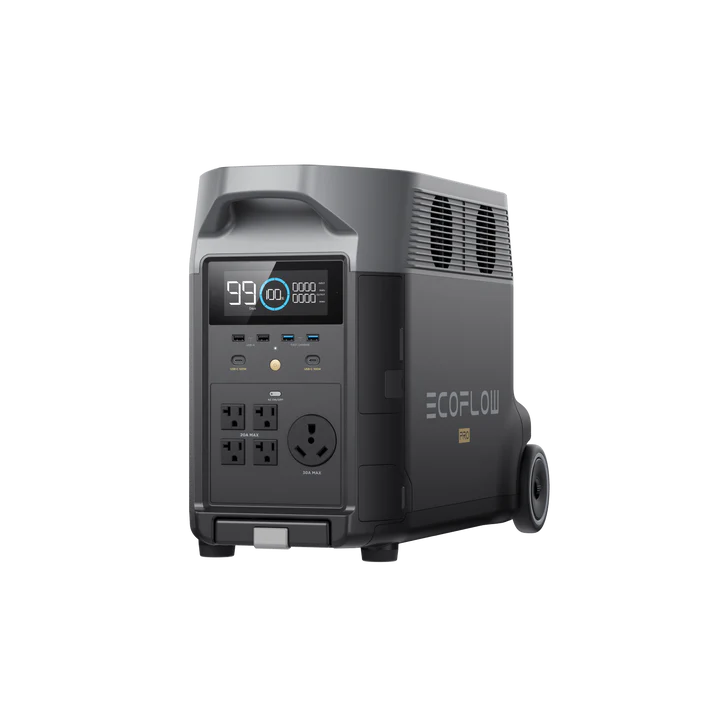
EcoFlow DELTA ProPick
$1,799.00
$1,799.00 · direct from EcoFlow
down from $1,899 · 5% below usual
Last checked 16 days ago. Prices move — check before you buy.

BLUETTI Elite 30 V2
$289.99
$289.99 · direct from BLUETTI
Last checked 16 days ago. Prices move — check before you buy.
Prices may vary by retailer and are subject to change.