Head-to-head test
EcoFlow DELTA Pro vs BLUETTI Apex 300 + 2×B500K
The line is 3,060 usable watt-hours: under it the DELTA Pro does everything the Apex bundle does for $3,500 less, and over it the DELTA Pro simply stops.
Full profiles: EcoFlow DELTA Pro → · BLUETTI Apex 300 + 2×B500K →

Written by Gunner GustafsonUpdated
Whole-Home Backup Tester, Station Arena Test Desk
Spec deltas
$1,899 against $5,399, and the cheaper unit clears five of the six loads on this page. The DELTA Pro holds 3,600Wh, which is 3,060Wh once you take the 15% the inverter keeps, and a blackout night, a camping weekend, a workday and a CPAP all fit inside that with margin left over.
The Apex 300 with two B500K batteries holds 13,004.8Wh and sweeps the scoreboard, which is what a battery 3.6 times the size is supposed to do. The interesting part is everything it doesn't win. Same 3,500 cycles. Same five-year warranty. Continuous output of 3,840W against 3,600W, a 240W gap you will never plug into.
So the question isn't which is better. It's whether your worst day is bigger than 3,060Wh, and then whether the box ever has to move. The Apex bundle's 282.2 lbs arrives as three separate pieces and stays where you commission it. The DELTA Pro's 99 lbs is one box that goes where the problem is.
What the Numbers Reveal
Each conclusion stated first — the numbers behind it on one line, the full analysis below.
solar input
The Apex's extra 7,994Wh of usable reserve is only renewable if you actually own and can site 2,400W of panels. Without that array it's a one-shot tank that takes more than twice as long to bring back, and in a multi-day outage the unit that recharges by lunchtime beats the unit that holds more and refills all day.
DELTA Pro: 3,600Wh capacity, 1,600W maximum solar inputApex 300 + 2×B500K: 13,004.8Wh capacity, 2,400W maximum solar inputUsable reserve after the 85% derate: 3,060Wh vs 11,054Wh
Why it mattersIf you're buying for off-grid or extended-outage use, size the array before you size the battery; the bigger bank without the panels to feed it is a worse position than the smaller bank with them.
Typical price
The heaviest day this page models is 4,685Wh, which still leaves 6,369Wh of the Apex untouched. You would collect the 11 cents only by finding 13,004.8Wh of demand every day for 9.6 years. Short of that, the number you actually pay is $5,399 against $1,899, and across the five years both warranties run, $1,000 a year against $320.
$1,899 divided by 12,600 lifetime kWh is 13 cents per kWh$5,399 divided by 45,517 lifetime kWh is 11 cents per kWhBoth units are rated for the same 3,500 cycles
Why it mattersBuy the 11-cent rate only if you have a load that genuinely empties 13kWh a day; a household that uses a third of it is paying the sticker, not the rate.
weight
That reframes the whole portability question. The Apex isn't a heavy thing to carry, it's an installation: three pieces you place, cable and leave, which is why one reviewer testing it couldn't get it onto a table and stopped tryingB4. The DELTA Pro is 99 lbs in one trip, a real two-hands lift but a lift, and it can follow you from the garage to the campsite to somebody else's ice storm.
Apex bundle: 282.2 lbs and 13,004.8Wh, both totals across three boxes (one Apex 300 plus two B500K batteries)The Apex 300 alone is 2,764.8Wh, so the two batteries carry the other 10,240Wh, 5,120Wh eachDELTA Pro: 99 lbs, one box, with wheels and a telescoping handle that work best on flat, smooth groundA2; the Apex has no wheels at allB11
Why it mattersIf the unit has to move between the house, the truck and a campsite, the Apex's entire win column is irrelevant, because it isn't the kind of object that goes with you.
continuous output
Nothing you can plug into one of these fails on the other. Same appliances, same startup behavior, same refusal list. The $3,500 doesn't buy a bigger kettle, an air conditioner the other can't start, or a welder; it buys the same appliances running for longer.
DELTA Pro: 3,600W continuous, 7,200W surge ceilingApex 300 + 2×B500K: 3,840W continuous, 7,680W surge ceilingThe engine's peak check for all six scenarios is run against those continuous ratings, and both units clear all six
Why it mattersIf you're upgrading because you think you need more inverter, you don't. Check your daily watt-hours instead, because that's the only spec that actually splits these two.
The specific dimensions that decide these two units — everything else is a tie.
Runtime: Will It Power Your Gear?
Selected because: 3,060Wh usable against 11,054Wh usable is the only gap that changes what either unit can finish.
continuous output
Everything the DELTA Pro can do, it does below 3,060Wh. That's 3,600Wh minus the 15% the inverter takes, and it's the real ceiling, because the nameplate never reaches your appliances. The Apex bundle's equivalent is 11,054Wh. The honest way to read that gap is that it buys nights, not capability.
Put the 1,645Wh household blackout load against both. The DELTA Pro finishes with 1,415Wh unused, most of a second night on the same appliances. The Apex finishes with 9,409Wh, close to six more nights at that load (9,409 divided by 1,645). If your power comes back by morning, you are paying for nights four and five.
Lifetime Value
Selected because: $1,899 against $5,399, and an 11-cent lifetime kWh that only pays out if you empty 13,004.8Wh a day.
cost / lifetime kWh
Eleven cents a lifetime kilowatt-hour against thirteen. The Apex is the cheaper energy and the arithmetic is sound, but the denominator is doing quiet work: 45,517 kWh assumes the Apex gets emptied and refilled 3,500 times. Both units carry the same 3,500-cycle rating, so nothing about longevity separates them. Only the size of each cycle does.
That two-cent edge is a coupon you redeem by using 13,004.8Wh a day, every day, for 9.6 years. The blackout scenario spends 15% of it. Van life, the heaviest load here, spends 42%. Meanwhile the exposure is concrete: over the five years both warranties cover, the DELTA Pro costs $320 a year and the Apex $1,000. Cheap energy you never draw is just expensive shelf space.
Portability & Form Factor
Selected because: 99 lbs in one box against 282.2 lbs spread over three, which decides where each of these lives.
weight
282.2 lbs is a system total, not a lift. The bundle is three boxes, an Apex 300 and two B500K batteries, and its 13,004.8Wh is a sum in exactly the same way: 2,764.8Wh in the Apex 300 itself, the remaining 10,240Wh split between the two batteries at 5,120Wh each. Calling that a two-person lift misses what actually happens, which is that you place the pieces, cable them together, and never touch them again.
The DELTA Pro's 99 lbs is one box in one trip. It's a genuine two-hands, bent-knees job, and the wheels and telescoping handle only really help on flat, smooth ground; anything rougher wants a cartA2. The Apex has no wheels of any kindB11. So the difference between these two isn't pounds. One of them follows you around and the other one has an address.
Growth Path
Selected because: Both take expansion batteries, so the cheaper unit's 3,600Wh is a starting point rather than a ceiling.
solar input
The DELTA Pro's expansion path is what makes $1,899 a safe bet rather than a gamble. Both units accept expansion batteries, which means the van-life shortfall isn't a wrong-unit problem for the DELTA Pro buyer. It's a battery you add when the demand actually shows up, bolted to a base unit you already own, instead of $3,500 spent today against a maybe.
The Apex does have the higher ceiling to grow into, and the stronger solar input to match at 2,400W against 1,600W. Relative to its own tank, though, the DELTA Pro is the better-fed unit: 1,600W into 3,600Wh is a refill in roughly 2.25 hours at full rated input, while 2,400W into 13,004.8Wh takes about 5.4. Growing the Apex means growing the array with it. Expansion is only headroom if you can put the energy back.
What the Specs Don't Tell You
Selected because: Four cards fire on this pair, and the warranty and noise ones read louder than the specs behind them.
rated cycles
Warranty is a wash: five years on each, identical terms. What differs is what's riding on it, which is $320 a year against $1,000. Same promise, three times the money wrapped inside it.
The noise gap is real and rated, 45dB against 60dB, but both figures are taken under load and that's the part the numbers hide. Push the DELTA Pro past about 2,000W and its fans produce an audible high-pitched whineA4; the Apex's are described as comparatively tameB1. At a 40W trickle neither unit is running its fans anywhere near the rating, so don't buy the Apex for a quiet bedroom on the strength of a spec measured at full tilt. The 10ms against 20ms switchover is the one card you can skip entirely. Both are inside what a desktop, a router or a NAS rides through without noticing.
Strengths & trade-offs
EcoFlow DELTA Pro
Strengths
- +Costs $3,500 less
- +Lighter by 183.2 lb
Trade-offs
- –Very heavy unit that may be difficult for one person to lift.
- –Can receive complaints about fan noise under heavy load.
- –Shorter-lived battery — rated for 3,500 charge cycles vs the Apex 300 + 2×B500K's 6,000, so it wears out sooner.
BLUETTI Apex 300 + 2×B500K
Strengths
- +Larger battery capacity
- +Higher AC output
- +Faster solar charging
- +Rated for 6,000 charge cycles — much longer battery lifespan
Trade-offs
- –Substantially more expensive (+$3,500) than the DELTA Pro.
- –Significantly heavier (+183.2 lbs), making it harder to move.
- –Very heavy unit that may be difficult for one person to lift.
Will It Power Your Gear?
Scenario math and per-appliance runtimes, modeled from the spec record.
Scenario verdicts
We ran the math on six real-world scenarios. Here's which unit survives your actual life.
SCN-01 · 2 nights · needs 2,100Wh
Weekend Camping
Two nights off-grid with essential comfort
DELTA Pro
The Apex takes this on watt-hours and it isn't close, finishing a 2,100Wh weekend with 8,954Wh spare against the DELTA Pro's 960Wh. Read that as a scoreboard result rather than a recommendation. This scenario scores energy and nothing else, so it has no way to price the fact that the Apex bundle is 282.2 lbs of hardware in three boxes while the DELTA Pro is 99 lbs in one, and that a campsite is somewhere you drive to. On the metric, the Apex. In the truck, the DELTA Pro clears the same weekend with 960Wh still in reserve.
Battery budget usedlower = more headroom
LOAD Phone Charger 15W×6h · LED Lights 40W×8h · Box Fan 75W×14h · CPAP Machine 40W×16h
SCN-02 · 8 hours · needs 1,645Wh
8-Hour Blackout
Keep the essentials running through a night without power
Apex 300 + 2×B500K
1,645Wh over eight hours, and both finish it comfortably: 1,415Wh left in the DELTA Pro, 9,409Wh in the Apex, which takes the round. The percentages are really answering how many nights, not whether. At the same load the Apex has close to six more in it; the DELTA Pro has most of a second. Whether that's worth $3,500 depends entirely on whether your outages end by breakfast or by Thursday.
Battery budget usedlower = more headroom
LOAD Fridge 150W×8h · Router + Modem 20W×8h · LED Lights (4 bulbs) 40W×6h · Phone Charger 15W×3h
SCN-03 · 8 hours · needs 320Wh
CPAP Overnight
Sleep therapy without interruption — the #1 medical use case
Either unit
A CPAP pulls about 40W, so 320Wh gets you through the night and both units hold that many times over. The Apex wins at 3% used against 10%, and at this load the percentage is a formality. The dB ratings are the usual tiebreak and they're worth less than they look here: 45dB and 60dB are figures measured under load, and 40W is not load. Decide this one on where the box lives, not on a fan spec taken at full tilt.
Battery budget usedlower = more headroom
LOAD CPAP Machine 40W×8h
SCN-04 · 8 hours · needs 910Wh
Remote Workday
Full work day off-grid without power anxiety
Apex 300 + 2×B500K
910Wh for a full day of work, and the Apex wins it with 10,144Wh spare. Neither unit is being tested. The DELTA Pro ends the day with 2,150Wh unused, which is more than two additional workdays before you go looking for a wall socket (2,150 divided by 910). Buy on something else, because this scenario doesn't separate them in any way you'd feel.
Battery budget usedlower = more headroom
LOAD Laptop 60W×8h · External Monitor 30W×8h · Router + Modem 20W×8h · Phone Charger 15W×2h
SCN-05 · 4 hours · needs 670Wh
Tailgate Party
Game day power for the crew
DELTA Pro
670Wh across a game day, so the Apex wins at 6% used against 22% and neither unit notices the load. What actually decides a tailgate is the parking lot. The Apex bundle is 282.2 lbs of hardware in three pieces; the DELTA Pro is 99 lbs in one. The scenario rewards the bigger battery, but the game rewards whatever you can get out of the truck and back in again.
Battery budget usedlower = more headroom
LOAD Blender 400W×0.5h · LED TV (55") 80W×4h · Bluetooth Speaker 15W×4h · Phone Charger (×3) 45W×2h
SCN-06 · 24 hours · needs 4,685Wh
Van Life Daily
A full day of mobile living — the ultimate endurance test
Apex 300 + 2×B500K
The DELTA Pro fails this one outright. A 4,685Wh daily draw against 3,060Wh usable leaves it 1,625Wh short, and no amount of careful budgeting closes a gap that size. The Apex covers the day and finishes with 6,369Wh still in hand, more than another full day at the same draw. This is the scenario that justifies the bundle, and it's the only one that does. If it's your day, the price difference stops being a question.
Battery budget usedlower = more headroom
LOAD Mini-Fridge 150W×24h · Laptop 60W×4h · Phone Charger 15W×3h · LED Lights 40W×5h · Fan 75W×8h
The Load Test
RUNTIME = (Wh × 0.85) ÷ LOAD
None of the scenarios above exactly yours? Build it. Toggle what you'd plug in; both units are tested against the combined draw.
Essentials
Comfort & Convenience
High-Draw Appliances
Test duration
8h
Continuous draw
205W
Projected runtime
For this load: Apex 300 + 2×B500K runs 53.9h vs 14.9h.
$5,399 list · direct from BLUETTI
Planning for more than this? Describe your whole setup and get it sized →
Modeled from the spec record — same math as the tables below. Methodology
Runtime by appliance
Real-world runtime estimates for common appliances, modeled at 85% inverter efficiency.¹
Essentials
The basics you need runningscale 0–736.9hComfort & Convenience
Makes off-grid life actually enjoyablescale 0–147.4hHigh-Draw Appliances
These reveal the real limitsscale 0–11.1h¹ Runtime = (capacity × 0.85) ÷ appliance watts. Within each group, all bars share one time scale (the group's longest runtime), so lengths are comparable across appliances; identical runtimes collapse into a single blue/orange bar. Actual runtime varies with battery age, temperature, and simultaneous loads — see methodology.
Conclusion
August 9, 2026
Verdict: the EcoFlow DELTA Pro
Take the DELTA Pro at $1,899 unless you can name a day that draws more than 3,060Wh. That figure is 3,600Wh after the standard 15% inverter derate, and five of the six loads modeled on this page land under it, the tightest with 960Wh still to spare. The Apex 300 with two B500K batteries wins all six on percentage, because 13,004.8Wh wins everything on percentage, and it costs $3,500 more to do it. One scenario actually separates them: the van-life day at 4,685Wh, where the DELTA Pro comes up 1,625Wh short and no amount of careful budgeting closes the gap. If that's your day, or if the unit is going into an RV bay or beside a load center and never moving again, the Apex is the only one of the two that finishes. Otherwise you're paying for 7,994Wh of reserve (11,054 usable minus 3,060) that you never reach into.
Today the DELTA Pro is $1,799, $100 under its typical $1,899. The verdict weighs typical prices, not today's. Prices checked 16 days ago.
Editor-assigned confidence, based on cited owner research and spec analysis.
List prices as of August 9, 2026. The links below open EcoFlow's and BLUETTI's current prices.
$1,799.00 · direct from EcoFlow
down from $1,899 · 5% below usual
Last checked 16 days ago. Prices move — check before you buy.
or check the Apex 300 + 2×B500K price$5,399.00 list
Written by Gunner Gustafson, Whole-Home Backup Tester · Station Arena Test Desk · Updated August 9, 2026
Black Friday · 38 days out
Prices to beat:DELTA Pro $1,599Apex 300 + 2×B500K $4,999
The lowest we have recorded for each. A Black Friday price above it is a sale that unit has already had.
Measured Data
Benchmark scores and the full spec record, side by side.
Benchmark scores
Not rated for both units (minimum threshold unmet): UPS, RV Living, Solar Generator.
Full specifications
ᵈ Derived: price ÷ rated capacity. See the data behind our comparisons →
Comparison ToolAdd more power stations, side by sideOpen Tool →How these numbers are produced
Numeric verification
Every figure on this page traces to our spec database or arithmetic on it — no estimated numbers.
Owner claims
Statements about owner experience are cited to published reviews — see Sources & Research Notes below.
Runtime model
Runtime = (rated capacity × 0.85 inverter efficiency) ÷ device wattage. Solar recharge estimates assume panels deliver 70% of rated output. Cold weather, battery age, and stacked loads reduce real-world results.
Power Score
Computed from 14 published spec dimensions, weighted per use-case bench. Higher is better; a unit must meet a bench's minimum threshold to be rated.
See the full weight table and data sourcing on our methodology page →Class ranking (the star rating)
Each unit's star score is a category ranking, not customer reviews — no buyer opinions feed it. We score every station on size-independent quality (value, output, portability, endurance, ports, warranty, and more), then percentile-rank it against the other units in its capacity class, so a class-leading compact unit and a class-leading whole-home unit can both earn 5★. Here, DELTA Pro rates 3.7/5 (26th percentile of 20 Home Backup-class units), and Apex 300 + 2×B500K rates 3.5/5 (14th percentile of 29 Whole-Home / Off-Grid-class units).
How the class ranking is computed →Test Notes & Caveats
Hidden gotchas and advantages we spotted that you won't find on the product page.
What 282.2 lbs Actually Means Here
The Apex figure is a system total across three boxes: the Apex 300 and two B500K batteries. No single piece weighs anything close to 282.2 lbs, and nobody lifts it as one object, so a two-person-lift framing points at the wrong problem. This is a commissioning job. You place the pieces, cable them together, and they stay. The DELTA Pro's 99 lbs is one box in one trip, which is the honest difference between these two: a system with an address versus a unit you can relocate.
45dB vs 60dB, and When It Applies
The Apex is rated 45dB against the DELTA Pro's 60dB, and that 15dB gap is real when either unit is working hard. Both figures are taken under load, though, which is what the numbers hide: at a 40W trickle neither one is running its fans anywhere near its rating. If the box shares a room and does real work overnight, the gap matters and the Apex is the quieter neighbor. If it's idling beside a CPAP, the rating is describing a situation you're not in.
Apex 300 + 2×B500K: Power Lifting to 7,680W
The Apex 300 + 2×B500K has BLUETTI's Power Lifting mode, which runs a resistive appliance rated up to 7,680W from its 3,840W inverter. It does that by delivering less power than the appliance asks for, not more than the inverter has: the heater still works, it just heats more slowly. Two things follow. BLUETTI scopes the mode to purely resistive loads — a heater, a kettle, an incandescent lamp — so it does nothing for a fridge compressor, a pump or a power tool, and this record publishes no surge figure at all, so read the mode as a resistive-load feature rather than as starting ability. And it is not a reason to size down, because running a load that big from 13,005Wh is a short session either way. Genuinely useful if a heater or a kettle is why you're buying; beside the point otherwise. The DELTA Pro publishes no equivalent.
10ms vs 20ms: Not a Deciding Spec
The Apex switches to battery in 10ms, the DELTA Pro in 20ms. Both are fast enough that a desktop, a router or a NAS rides through the handoff without dropping, and the 10ms between them isn't something any of that equipment can tell apart. Worth knowing if you're wiring either in as a home UPS. Not worth a dollar of the price gap.
Warranty: Five Years Each
Both units carry five years, identical terms, so coverage doesn't break the tie in either direction. What differs is what you have riding on it. $1,899 over five years works out to $320 a year; $5,399 works out to $1,000. Same promise, roughly three times as much money wrapped inside it, and the same 3,500-cycle rating on both sets of cells underneath.
Battery Lifespan in Real Years
The Apex 300 + 2×B500K is rated for 6,000 cycles vs 3,500. In real life: at daily use, that's 16.4 vs 9.6 years. At weekend use (twice a week), it's 58 vs 34 years. One caution reading years across different sizes: a cycle is 13,005Wh on the Apex 300 + 2×B500K and 3,600Wh on the DELTA Pro, so count lifetime energy — roughly 78,029 kWh against 12,600 kWh over the rated life. After hitting the cycle limit, the battery doesn't die — it drops to ~80% of original capacity, which is still very usable.
Full record above — the Test Desk pick is the DELTA Pro.
Check DELTA Pro price →or check the Apex 300 + 2×B500K priceOwnership Analysis
What happens after you buy — true cost of ownership, brand trust, and growth potential.
Lifetime value
Service lifeyears at one full cycle per day
Lifetime energy delivered
Cost per delivered kWh
│ warranty ends · Reaching the cycle rating means ~80% capacity remains — degraded, not dead.
Analyst note
The DELTA Pro is cheaper to buy, but the Apex 300 + 2×B500K is cheaper to own. At $0.07/kWh over its lifetime vs $0.15/kWh, the Apex 300 + 2×B500K's higher cycle life and capacity make each dollar go further over the years.
Brand trust
EcoFlow
Ecosystem
Largest in portable power — 12-15 models across DELTA Pro, DELTA 3, and RIVER 3 series, plus solar panels and smart home panels
Support
US-based phone, email and chat, and experiences split hard in both directions: prepaid return labels and painless swaps in some cases, long waits and refurbished units sent against new claims in others. Buying through Costco or Amazon puts a second return policy behind the first, which is a cheap hedge on a $1,899 purchase.
Community
Largest community in the space — Reddit r/Ecoflow_community (~31K members), multiple Facebook groups, and an official community forum
App experience
Rated 4.6/5 iOS (~8,400 ratings) · 4.2/5 Android (~17,000 ratings)
Unique strength
Fastest-charging technology (X-Stream), deepest product ecosystem, and most active innovation cadence. At the top of the range sit two whole-home paths: the TITAN line, one 5 kWh unit that grows to 30 kWh, and the DELTA Pro Ultra platform, which stacks batteries and inverters further — flagship paths, not line-wide features.
Worth knowing
EcoFlow offers no parts or service once the warranty is up. On a unit rated for 3,500 cycles, that's roughly 9.6 years of daily use with five years of support behind it, so the cells are built to outlast the help.
BLUETTI
Ecosystem
One of the broadest lineups — 15-20+ models from budget (AC2A) to flagship portable (Apex 300, 2764.8Wh). Includes specialized products: vehicle solar hubs, sodium-ion cold-weather units, and balcony storage systems.
Support
The least predictable support desk in the category. It's email-first with China-timezone delays, and outcomes range from efficient to weeks of runaround, including discount offers on a new unit in place of an actual repair. Buying direct from BLUETTI rather than through a third-party seller consistently produces the cleaner claim.
Community
Active and growing — Reddit r/bluetti has a dedicated community. Second-largest after EcoFlow in engagement.
App experience
Rated 4.5/5 iOS and Android — tied for best app experience in the category. V3.0 UI redesign was well-received.
Unique strength
Among the best capacity-to-price ratios available — several Elite and Apex units are the lowest $/Wh in the catalog. Widest product diversity including industry-firsts like sodium-ion cold-weather units and dual solar+alternator vehicle hubs. LFP across the rest of the range, though rated cycle life spans 2,500 (EB3A) to 6,000, and it varies WITHIN the Elite range rather than tracking it — the Elite 300 and Elite 200 V2 are rated 6,000 while the Elite 30 V2, Elite 10 Mini, Elite 320 and Elite 400 are rated 3,000+ and the Elite 100 V2 4,000+, so check the specific model. Dual-voltage (120V/240V) in flagships.
Worth knowing
Some older BLUETTI models have gone unrepairable for want of spare parts. On a $5,399 modular system where the controller and the batteries are separate pieces bought separately, that's a longer tail of risk than it would be on a single sealed box.
Analyst note
Both apps are strong, so that isn't the differentiator: EcoFlow rates 4.6 on iOS and 4.2 on Android, BLUETTI 4.5 on both and tied for best in the category. Support is the differentiator, and it runs the wrong way relative to the money. The $5,399 system is the one sitting behind the less predictable service desk, and it's also the one with the most separate pieces to make a claim about.
Growth path
DELTA Pro
EXPANDABLESupports EcoFlow expansion batteries, so you can add capacity later without replacing the base unit — useful if your needs may climb past 3,600Wh.
Accepts up to 1,600W of solar. Enough for a serious multi-panel array.
Generous port selection supports complex multi-device setups.
Expansion batteries are EcoFlow-specific. You're investing in the EcoFlow ecosystem.
Apex 300 + 2×B500K
EXPANDABLESupports BLUETTI expansion batteries, so you can add capacity later without replacing the base unit — useful if your needs may climb past 13,005Wh.
Accepts up to 2,400W of solar. Enough for a serious multi-panel array.
Limited ports. You'll likely need a power strip or splitter.
Expansion batteries are BLUETTI-specific. You're investing in the BLUETTI ecosystem.
Realistic full solar rechargeat 70% of rated panel output — see methodology
Analyst note
Both expand, but the Apex 300 + 2×B500K's higher solar ceiling (2,400W vs 1,600W) gives it the stronger off-grid growth path — more panels can feed a bigger bank as it grows.
What Owners Report
Patterns from published owner reports and long-term reviews — every claim cited to its source below.
EcoFlow DELTA Pro
Read the DELTA Pro field reports with one caveat attached: a lot of published commentary conflates the original DELTA Pro with the heavier DELTA Pro 3, so line-level behavior carries over but specific measured figures don't. What holds up is the reputation. It's treated as a default for home backup, built around high-draw appliances and full-scale battery expansionA1, and one long-run account has it serving as primary backup across multiple overnight outages over months, running essentials simultaneouslyA3.
The consistent knock is noise, and it's load-dependent rather than constant: quiet enough at light draws, but above roughly 2,000W the fans take on a high-pitched whine that's distracting in a quiet roomA4. The other recurring note is that the wheels oversell themselves. They and the telescoping handle genuinely help on flat, smooth surfaces, and want a cart on grass or gravelA2.
“Long regarded as a gold standard for home backup — designed for high-draw appliances and full-scale battery expansion, running home essentials like a fridge, lighting, and a space heater through outages.”
Sources
backuppowerhub.com · us.ecoflow.co · outdoorgearlab.com · bobvila.com · powerstationadvisor.com · robbsutton.com
BLUETTI Apex 300 + 2×B500K
Field data on this exact configuration is thin, and worth saying plainly. Almost everything published tests the Apex 300 with the older B300K battery rather than the B500K, and only one entry is a genuine owner naming this pairing: someone running a 50A fifth wheel off an Apex 300 with a B500KB10. Nothing found addresses multi-month longevity, cold-weather behavior or firmware history for this bundle. What exists is reviewer testing rather than ownershipB1B8B9.
Within that limit the reports are consistent. The fans are tame under loadB1, and one tester found the system covered household essentials for more than a full day without any rationingB8. Weight dominates the complaints: heavy enough that one reviewer could barely move it a few feet and gave up trying to lift it onto a tableB4, no wheels so plan on a cartB11, though the handles and modular design make it manageable for a home installation as long as you're not dragging it to a picnicB9. The recessed ports sit under rubber bungs that fight oversized plugs and adaptorsB5.
One conflict we haven't resolved, and you should know about it before you weigh ports either way. Three reviewer entries describe the Apex face as having no DC or USB ports at all, with a $300 Hub D1 accessory required to add themB2B6B12, while our own spec sheet lists 100W USB-C on this bundle. One of those is wrong. Until it's settled, don't decide this matchup on port count from this page. The same reviewers flag the wider add-on economics as the real cost story: paralleling two Apex units needs a $699 Hub A1 box on top of everything elseB7.
“Some units sound like small jet engines under load, but the Apex 300's fans are relatively tame.”
Sources
techspective.net · thesolarlab.com · t3.com · trustedreviews.com · notebookcheck.net · bluettipower.com
Sources & Research Notes
Every owner claim in this report is traceable to a published source. The bracketed references above resolve here.
Recurring owner themes
- Established home-backup platform with wheeled portability and massive expandability; the consistent knock is fan noise under heavy load. [DELTA Pro · 3 entries]
- Reviewers consistently note the lack of built-in USB/DC ports, requiring a separate $300 Hub D1 accessory, as a notable and costly design compromise. [Apex 300 + 2×B500K · 3 entries]
- The unit's extreme weight (~85 lbs base, more with expansion batteries) makes it effectively immobile once placed, despite being marketed as 'portable.' [Apex 300 + 2×B500K · 3 entries]
- The modular ecosystem (Hub A1, Hub D1, expansion batteries) is praised for flexibility but criticized for high add-on costs relative to competitors. [Apex 300 + 2×B500K · 3 entries]
- A1
“Long regarded as a gold standard for home backup — designed for high-draw appliances and full-scale battery expansion, running home essentials like a fridge, lighting, and a space heater through outages.”
backuppowerhub.com / us.ecoflow.com — EcoFlow DELTA Pro review · 2025-2026 · [positive]
- A2
“Heavy but wheeled — integrated wheels and a telescoping handle help move its considerable weight, though they work best on flat, smooth surfaces; a cart is needed for uneven ground.”
outdoorgearlab.com / bobvila.com — DELTA Pro-line review · 2025-2026 · [mixed]
- A3
“Reliable through extended outage use — served as primary backup across multiple overnight outages over months, powering essentials simultaneously; LFP battery rated for thousands of cycles and 10+ years of daily use.”
powerstationadvisor.com / robbsutton.com — DELTA Pro-line review · 2025-2026 · [positive]
- A4
“Not silent under heavy load — under 2000W-plus draws the fans emit a noticeable high-pitched whine that's distracting in a quiet room, though it runs quietly enough at lighter loads.”
outdoorgearlab.com — DELTA Pro-line noise testing · 2025-2026 · [negative]
- B1
“Some units sound like small jet engines under load, but the Apex 300's fans are relatively tame.”
techspective.net — Bluetti Apex 300 with B300K Review · 2025-09 · [positive]
- B2
“Not having DC or USB ports on the face is a tradeoff. The Hub D1 solves the problem—but it's an additional $300 accessory that you then have to bolt on after the fact.”
techspective.net — Bluetti Apex 300 with B300K Review · 2025-09 · [negative]
- B4
“In fact, it's so heavy I can hardly carry it more than a few feet at a time and have been unable to lift it onto a table”
t3.com — Bluetti Apex 300 review · 2025-11 · [negative]
- B5
“Each is protected by a rubber bung... It can be annoying when it comes to inserting oversized plugs or adaptors, though.”
trustedreviews.com — Bluetti Apex 300 Review · 2025-10 · [negative]
- B6
“That Bluetti D1 Power Hub that gives you your DC and USB ports costs about $300, which is a steep price for what you're getting.”
thesolarlab.com — Bluetti Apex 300 Review · unknown · [negative]
- B7
“Say you want to connect multiple Apex 300 power stations together, you'll need to buy the Bluetti Hub A1 Parallel Box, which retails for around $699!”
thesolarlab.com — Bluetti Apex 300 Review · unknown · [negative]
- B8
“With some portable power stations, I'd have to ration power more carefully, but with this system, I could run essentials for more than a full day if I needed to.”
techspective.net — Bluetti Apex 300 with B300K Review · 2025-09 · [positive]
- B9
“It's heavy, no question, but the handles and modular battery design make it manageable. I wouldn't drag it to a picnic, but it's a solid choice for home backup”
techspective.net — Bluetti Apex 300 with B300K Review · 2025-09 · [mixed]
- B10
“I recently purchased a Bluetti Apex 300 with a B500K expansion battery to help power our 50A Brinkley 5th wheel.”
BLUETTI Community forum — 'Apex 300 operating mode and settings?' · 2026-02 · [positive]
- B11
“No wheels though, so if you plan on moving it regularly, invest in a cart.”
thesolarlab.com — Bluetti Apex 300 Review · unknown · [negative]
- B12
“This can [be] overwhelming both for buyers and their wallets... these optional accessories also provide a high degree of flexibility.”
notebookcheck.net — Bluetti APEX 300 power storage system review · 2025-08 · [mixed]
Research compiled August 9, 2026.
Who Should Buy Which
Buy the DELTA Pro if you…
- →Your worst night is the blackout: fridge, a few lights, the router, everybody's phones. That's 1,645Wh, and the DELTA Pro ends it with 1,415Wh still in reserve, for $1,899.
- →You want one box that goes where the problem is. The garage this month, a campsite in July, your parents' house when the ice storm hits. 99 lbs is a real lift, but it is a lift, and the wheels handle flat groundA2.
- →You don't yet know how big your needs will get. Both units expand, and the DELTA Pro is by far the cheaper place to be wrong: you add capacity when the demand appears rather than buying 13,004.8Wh against a hunch.
Buy the Apex 300 + 2×B500K if you…
- →You're feeding a rig, not a room. The one genuine owner report on this pairing is someone running a 50A fifth wheelB10, and that's the shape of the buyer: a daily draw the DELTA Pro physically cannot finish.
- →Your day actually exceeds 3,060Wh. At the 4,685Wh van-life load the DELTA Pro is 1,625Wh short with nowhere to go, while the Apex covers it and still has 6,369Wh in hand, more than another full day at the same draw.
- →The unit is getting an address. It goes in an RV bay or beside the panel and stays there, and you either have or are planning the array to feed its 2,400W of solar input, which is the only way its capacity refills at a useful rate.
If neither fits
If your real load is a CPAP and a couple of phones, both of these are the wrong shelf. That's 320Wh a night, 10% of the DELTA Pro's usable reserve and 3% of the Apex's; buy the smallest class on the site and keep the difference in your pocket. Same answer if the unit has to go up stairs, onto a boat or into a truck bed on a regular basis, because 99 lbs is already a two-hands job and 282.2 lbs of three-box system is furniture.
The Bottom Line
Take the DELTA Pro at $1,899 unless you can point at a day that draws more than 3,060Wh. Five of the six loads on this page fit under that line with room left over, and the Apex bundle wins them by holding energy you never spend. The scoreboard says it sweeps. The scoreboard is measuring headroom, and headroom is the one thing $3,500 buys reliably.
The exception is sharp and easy to check against your own week. If your day looks like the 4,685Wh van-life load, the DELTA Pro comes up 1,625Wh short and nothing fixes that, and if the system is going into an RV bay or next to a load center to stay, its 282.2 lbs across three boxes stops being a drawback and becomes a description. Everyone else: buy the smaller box, keep the $3,500, and add a battery later if you turn out to be wrong.
Frequently Asked Questions
Answers drawn from the spec record and cited owner research.
Is the BLUETTI Apex 300 bundle worth $3,500 more than the EcoFlow DELTA Pro?
Only if your daily draw is above 3,060Wh, which is what the DELTA Pro's 3,600Wh comes to after the 15% inverter derate. Below that line the DELTA Pro finishes every load modeled here, the tightest of them with 960Wh to spare, and the Apex wins those only by holding energy you never spend. Above that line the DELTA Pro doesn't finish at all, and the $3,500 buys the only unit here that does.
How long will the DELTA Pro actually run my house in a blackout?
Against the 1,645Wh eight-hour household load used here it finishes with 1,415Wh unused, so most of a second night on the same appliances. The Apex bundle still has 9,409Wh at that point, close to six more nights at the same draw. If your outages are measured in hours, the DELTA Pro is enough; if they run for days and you can't recharge, that's the real case for the bigger bank.
Which one is quieter to sleep next to?
The Apex is rated 45dB and the DELTA Pro 60dB, but both are load ratings and a CPAP pulls about 40W, which won't spin either unit's fans up. Under a genuine 2,000W-plus draw the DELTA Pro does produce an audible whine, while the Apex's fans are described as comparatively tame. For a bedside CPAP either is fine; for a unit running your house from the next room, the Apex is the quieter one.
Can one person move the Apex 300 with two B500K batteries?
Not as a single object, because 282.2 lbs is the total across three separate boxes: the Apex 300 plus two B500K batteries. Even piece by piece it's awkward. It has no wheels, and one reviewer testing the Apex 300 couldn't lift it onto a table. Plan on siting it once and leaving it. The DELTA Pro's 99 lbs is one box and one trip.
Do I give up any power by taking the cheaper DELTA Pro?
Almost none. The DELTA Pro runs 3,600W continuous with a 7,200W surge ceiling; the Apex bundle runs 3,840W continuous with a 7,680W ceiling. That's 240W and 480W apart, under 7% either way, and the peak check on all six scenarios here is run against those continuous ratings, which both units clear. Anything you can plug into one, you can plug into the other. What you give up is runtime, not capability.
Brand matchup
EcoFlow vs BLUETTI: measured across every matchup →Where to buy
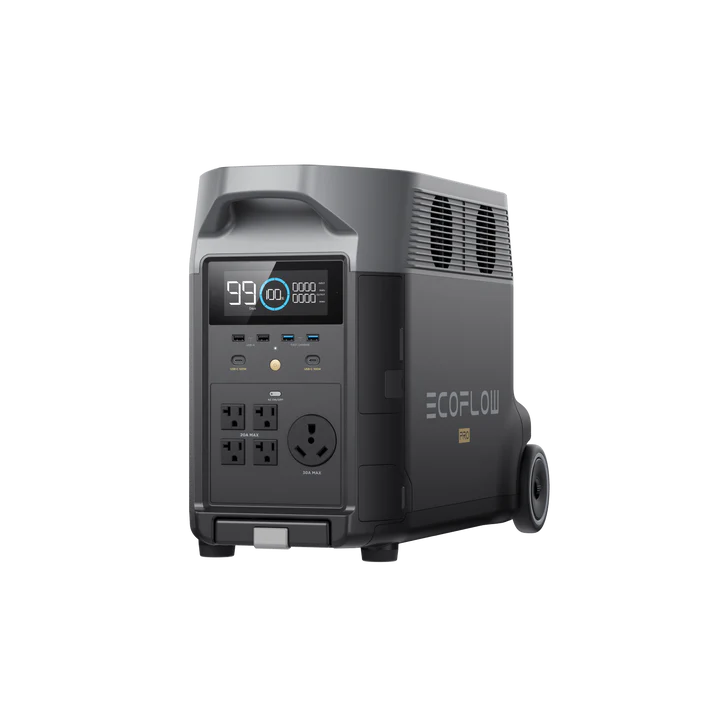
EcoFlow DELTA ProPick
$1,799.00
$1,799.00 · direct from EcoFlow
down from $1,899 · 5% below usual
Last checked 16 days ago. Prices move — check before you buy.

BLUETTI Apex 300 + 2×B500K
$5,399.00
$5,399.00 · direct from BLUETTI
Last checked 16 days ago. Prices move — check before you buy.
Prices may vary by retailer and are subject to change.