Head-to-head test
EcoFlow DELTA Pro Ultra vs EcoFlow DELTA Pro Ultra + 1 Battery
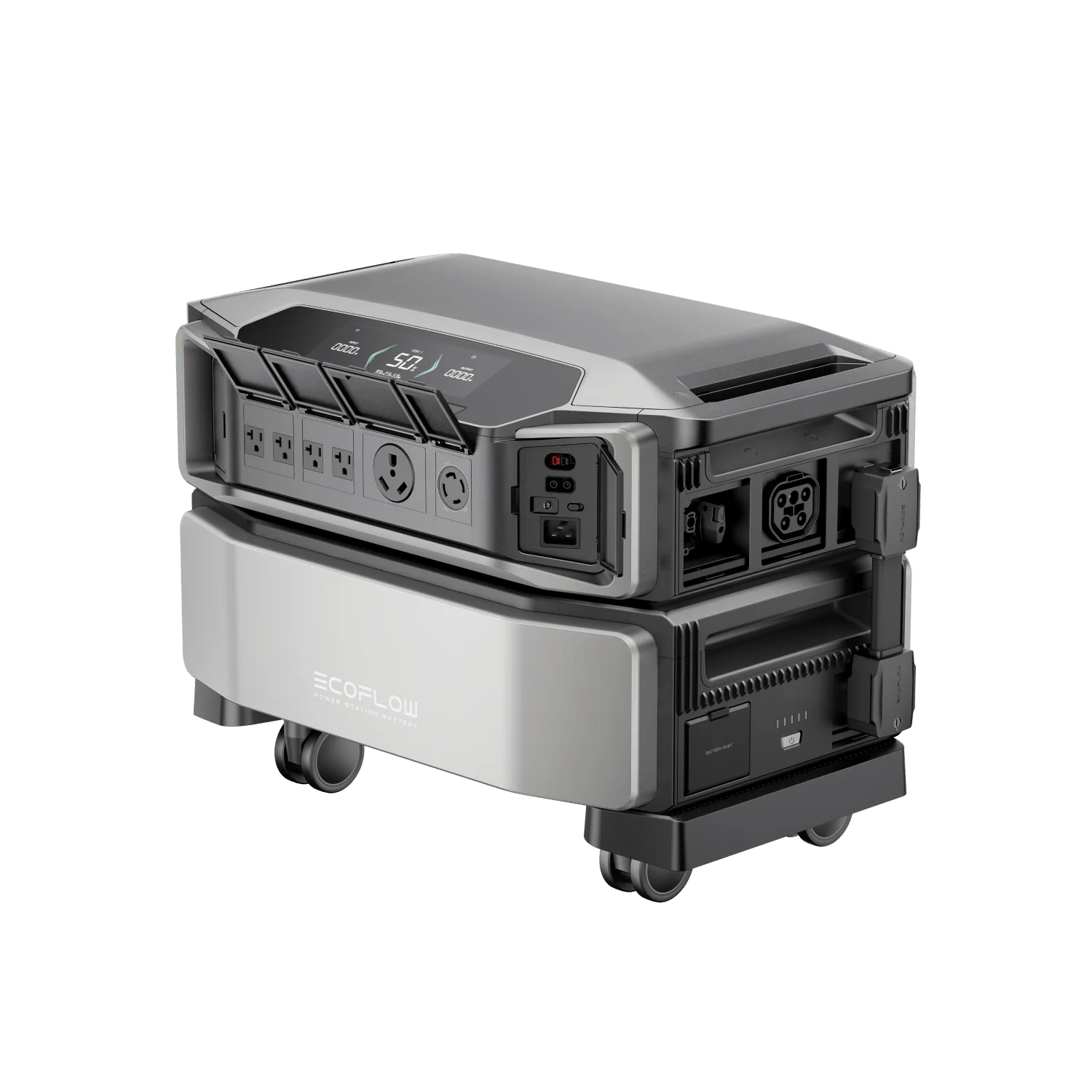
EcoFlow DELTA Pro Ultra vs EcoFlow DELTA Pro Ultra + 1 Battery: identical 7,200W output, identical ports, identical 10-year warranty; the second pack only doubles capacity to 12,288Wh and adds 112 lbs as a separate box. Buy the single-battery system unless a day's draw or an outage actually runs past one pack.
Full profiles: EcoFlow DELTA Pro Ultra → · EcoFlow DELTA Pro Ultra + 1 Battery →

Written by Gunner GustafsonUpdated
Whole-Home Backup Tester, Station Arena Test Desk
$4,199.00 · direct from EcoFlow
Last checked 1 day ago. Prices move — check before you buy.

$6,199.00 · direct from EcoFlow
Last checked 1 day ago. Prices move — check before you buy.
Spec deltas
There is exactly one difference between these two, and it is 6,144Wh. Same 7,200W inverter, same 10,800W surge, same three AC outlets, same pair of 240V outlets and single 30A RV port, same 5,600W solar ceiling, same 10-year warranty. The DELTA Pro Ultra + 1 Battery is the identical machine with twice the tank: 12,288Wh where the base system has 6,144Wh.
That makes the added energy the cheapest in the system. The step between $4,199 and $5,999 is $1,800, and dividing it by the 6,144Wh it adds works out to about 29 cents a watt-hour, against about 68 cents for the base unit's own capacity ($4,199 over 6,144Wh). Nothing sinister is happening there. The first pack's price includes an inverter, a cabinet and the control electronics, and the second pack doesn't buy any of that twice. It is a real bulk discount on watt-hours.
It is also a bulk discount you have to use. The base unit spends 31% of itself on the modeled 1,645Wh blackout and 17% on a 910Wh workday, so for standby duty the second pack adds depth you will never reach down into. One profile does reach it: at 4,685Wh a day, full-time living leaves the base unit 537Wh of margin. If that is your number, buy the battery. If it isn't, the base system is the whole capability at the lower price.
What the Numbers Reveal
Each conclusion stated first — the numbers behind it on one line, the full analysis below.
Capacity
Which is also the trap: identical output, identical surge, identical sockets means that $1,800 adds no capability whatsoever. Not one more watt of continuous draw, not one more outlet, not one more year of coverage. It buys duration, and duration is the one spec you can only justify by naming the hours you need.
DELTA Pro Ultra: $4,199 for 6,144WhDELTA Pro Ultra + 1 Battery: $5,999 for 12,288WhBoth list 7,200W continuous output and 10,800W surge, three AC outlets, two 240V outlets, one 30A RV port and 100W USB-C
Why it mattersIf what worries you is a load that might trip the inverter, a well pump or a central AC compressor coming on, the second battery does nothing for you and you are shopping the wrong axis.
So the second pack is not a throughput upgrade, it is a weather buffer. At 4,685Wh a day the base unit has to win back almost everything it spent, every single day, and the 537Wh it finishes on is the entire allowance for a day that doesn't cooperate. The two-pack ends that same day at 45% used, which is the difference between needing a good solar day and merely preferring one.
Both configurations accept up to 5,600W of solar inputCapacity doubles from 6,144Wh to 12,288WhVan Life Daily draws 4,685Wh, leaving the base unit 537Wh of its 5,222Wh usable and the two-pack 5,760Wh of its 10,445Wh
Why it mattersFull-time off-grid buyers, where a cloudy Tuesday is the actual failure mode, should pay for the second pack. Backup buyers who refill from the wall in an hour of grid time should not.
The two configurations also age on the same clock. Ten years either way, so the extra money doesn't extend the service life, it deepens each year of it, and on standby duty most of that depth is never touched. That is why the per-watt-hour figure and the per-year figure point in opposite directions here, and why the honest question is which of the two describes your duty cycle.
Cost per warranty year: $420 for the base unit, $600 for the two-packBoth carry the same 10-year warrantyThe base unit finishes the modeled 1,645Wh outage at 31% used
Why it mattersIf the unit's job is to sit charged and wait for the grid to fail, take the base system and put the difference toward panels or the transfer hardware, both of which shorten an outage in a way that more cells do not.
The watt-hours are physically there, so this doesn't cancel the capacity. It changes how you would run a long outage: budget against the clock and a known household draw rather than the percentage on the screen. It also means the big configuration's advantage stays invisible until the third night, while its price is visible on day one.
The two-pack ends the 1,645Wh outage at 16% used with 8,800Wh left, 5.3 more nights of the same loadThe app has no state-of-charge graphB8One owner watched a reading of 90% fall to 8% across a few overnight cyclesB9
Why it mattersIf you buy the two-pack, write your overnight consumption on the side of the case so you can do the arithmetic yourself the evening the app's number looks wrong.
The specific dimensions that decide these two units — everything else is a tie.
Lifetime Value
Selected because: The only difference between these two is a $1,800 step from $4,199 to $5,999 that buys 6,144Wh and nothing else, so cost per unit of energy is what settles it.
cost / lifetime kWh
The bigger configuration reads cheaper per lifetime kilowatt-hour, and the reason is structural rather than clever: one inverter, one cabinet and one set of control electronics get spread across twice as many cells. Buy watt-hours in this family and the second half really is on sale.
The calendar tells the opposite story. Coverage works out to $600 a year on the two-pack against $420 on the base unit for the identical 10-year term, and a unit doing standby backup duty, 31% used on the modeled outage, never cycles often enough to redeem the per-watt-hour discount. Per watt-hour the big one wins. Per year on standby the small one does. Which of those two numbers describes your usage is the only question on this page.
Your Life, Your Pick
Selected because: Four of the six modeled loads can't tell these two apart; the 8-hour blackout and the 4,685Wh van-life day are where the second battery earns its price or doesn't.
Two of these rows are a formality and two are asking a question these boxes were never built to answer. The CPAP night and the remote workday are decided before they start, because 320Wh and 910Wh are rounding errors against either pack. Camping and the tailgate fail for both units on identical grounds, and it has nothing to do with the 2,100Wh on offer: neither of these is a thing you carry.
That leaves the blackout and the van-life day, and they turn out to be one finding stated twice. The second pack matters exactly when the job outlasts a pack: another 5.3 nights of the modeled outage instead of another 2.2, and a full-time daily draw that lands at 45% used instead of 90%. If neither of those describes your week, the scenario table just told you to save $1,800.
Growth Path
Selected because: Both configurations take EcoFlow expansion batteries, so the question was never whether you can grow later, only whether to pay for the second pack now.
Nobody loses this column. Both configurations accept EcoFlow expansion batteries, so the base unit isn't a dead end and the two-pack isn't a ceiling, and the expandable checkbox can't break the tie in either direction.
What that buys you is permission to underbuy. The $1,800 step is the one growth increment our pricing covers, and choosing the base system today doesn't forfeit it. If your needs climb past 6,144Wh in a year, you will find out from your own usage history rather than from a guess you paid for up front.
What the Specs Don't Tell You
Selected because: Two cards fire on this pair: weight, which is a real cost paid once, and a warranty that runs 10 years on both and therefore decides nothing.
rated cycles
Weight here is an install cost rather than a handling cost. Both builds are meant to be placed once, and the port list says so: no 12V car socket, two 240V outlets, a 30A RV port. This is hardware that sits beside a panel and stays there. So the heavier configuration doesn't ask more of your back than the lighter one, it asks for a second corner with clearance around it.
The warranty card is worth reading precisely because it says nothing happened: 10 years on both, so the second battery buys hours and not coverage. If you haven't got a spot that takes another box with room around it, the decision has already been made for you.
Strengths & trade-offs
EcoFlow DELTA Pro Ultra
Strengths
- +Costs $1,800 less
- +Lighter by 111.8 lb
Trade-offs
- –Very heavy unit that may be difficult for one person to lift.
EcoFlow DELTA Pro Ultra + 1 Battery
Strengths
- +Larger battery capacity
Trade-offs
- –Substantially more expensive (+$1,800) than the DELTA Pro Ultra.
- –Significantly heavier (+111.8 lbs), making it harder to move.
- –Very heavy unit that may be difficult for one person to lift.
Will It Power Your Gear?
Scenario math and per-appliance runtimes, modeled from the spec record.
Scenario verdicts
We ran the math on six real-world scenarios. Here's which unit survives your actual life.
SCN-01 · 2 nights · needs 2,100Wh
Weekend Camping
Two nights off-grid with essential comfort
Neither unit
Scoring these two at a campsite is a category error: neither travels — the DELTA Pro Ultra is 181.8 lbs and the DELTA Pro Ultra + 1 Battery 293.6 lbs, and at those weights they roll off a truck bed if they go anywhere at all. The 2,100Wh here is trivial for either — it's the going that doesn't happen. If you need power away from the building, you're shopping the wrong class.
Battery budget usedlower = more headroom
LOAD Phone Charger 15W×6h · LED Lights 40W×8h · Box Fan 75W×14h · CPAP Machine 40W×16h
SCN-02 · 8 hours · needs 1,645Wh
8-Hour Blackout
Keep the essentials running through a night without power
DELTA Pro Ultra + 1 Battery
Both survive the night. The DELTA Pro Ultra + 1 Battery finishes at 16% used with 8,800Wh left — 5.3 more nights like it. The DELTA Pro Ultra finishes at 31% with 3,577Wh, 2.2 more nights like it. If your outages tend to run past one evening, that difference is the whole argument between them.
Battery budget usedlower = more headroom
LOAD Fridge 150W×8h · Router + Modem 20W×8h · LED Lights (4 bulbs) 40W×6h · Phone Charger 15W×3h
SCN-03 · 8 hours · needs 320Wh
CPAP Overnight
Sleep therapy without interruption — the #1 medical use case
Either unit
A 40W machine for eight hours is 320Wh, which is 6% of the smaller pack's 5,222Wh of usable capacity and 3% of the larger one's 10,445Wh. Both start it, both hold it until morning, and both finish the night with thousands of watt-hours untouched. Whatever decides this matchup, it isn't the CPAP.
Battery budget usedlower = more headroom
LOAD CPAP Machine 40W×8h
SCN-04 · 8 hours · needs 910Wh
Remote Workday
Full work day off-grid without power anxiety
Either unit
910Wh is a full day of laptop, monitor and the rest of the desk, and against the smaller pack's 5,222Wh of usable capacity that is five working days between charges. The bigger configuration simply doubles that, with the same 100W USB-C and the same three AC outlets doing the work. At this draw the two are interchangeable, so decide it on what fits in the room and what you pay.
Battery budget usedlower = more headroom
LOAD Laptop 60W×8h · External Monitor 30W×8h · Router + Modem 20W×8h · Phone Charger 15W×2h
SCN-05 · 4 hours · needs 670Wh
Tailgate Party
Game day power for the crew
Neither unit
Scoring these two at a tailgate is a category error: neither travels — the DELTA Pro Ultra is 181.8 lbs and the DELTA Pro Ultra + 1 Battery 293.6 lbs, and at those weights they roll off a truck bed if they go anywhere at all. The 670Wh here is trivial for either — it's the going that doesn't happen. If you need power away from the building, you're shopping the wrong class.
Battery budget usedlower = more headroom
LOAD Blender 400W×0.5h · LED TV (55") 80W×4h · Bluetooth Speaker 15W×4h · Phone Charger (×3) 45W×2h
SCN-06 · 24 hours · needs 4,685Wh
Van Life Daily
A full day of mobile living — the ultimate endurance test
DELTA Pro Ultra + 1 Battery
The DELTA Pro Ultra uses 90% of its battery on a full day, leaving 537Wh — miss a solar day and that is the entire cushion. The DELTA Pro Ultra + 1 Battery at 45% keeps 5,760Wh in hand, a far more forgiving rhythm for full-time living.
Battery budget usedlower = more headroom
LOAD Mini-Fridge 150W×24h · Laptop 60W×4h · Phone Charger 15W×3h · LED Lights 40W×5h · Fan 75W×8h
The Load Test
RUNTIME = (Wh × 0.85) ÷ LOAD
None of the scenarios above exactly yours? Build it. Toggle what you'd plug in; both units are tested against the combined draw.
Essentials
Comfort & Convenience
High-Draw Appliances
Test duration
8h
Continuous draw
205W
Projected runtime
For this load: DELTA Pro Ultra + 1 Battery runs 51h vs 25.5h.
$5,999 list · direct from EcoFlow
Modeled from the spec record — same math as the tables below. Methodology
Runtime by appliance
Real-world runtime estimates for common appliances, modeled at 85% inverter efficiency.¹
Essentials
The basics you need runningscale 0–696.3hComfort & Convenience
Makes off-grid life actually enjoyablescale 0–139.3hHigh-Draw Appliances
These reveal the real limitsscale 0–10.4h¹ Runtime = (capacity × 0.85) ÷ appliance watts. Within each group, all bars share one time scale (the group's longest runtime), so lengths are comparable across appliances; identical runtimes collapse into a single blue/orange bar. Actual runtime varies with battery age, temperature, and simultaneous loads — see methodology.
Conclusion
September 13, 2026
Verdict: the DELTA Pro Ultra
Take the base DELTA Pro Ultra at $4,199. The extra 6,144Wh in the two-pack is genuinely cheap energy, about 29 cents a watt-hour for the $1,800 step ($5,999 minus $4,199) against roughly 68 cents for the base system's own capacity ($4,199 over 6,144Wh), but energy is the only thing the money buys: output stays at 7,200W, surge at 10,800W, solar input at 5,600W, warranty at 10 years, and the port list doesn't change by a single socket. On the loads people at this price are actually buying for, one pack has room to spare. The modeled 1,645Wh outage leaves the base unit 3,577Wh in hand, another 2.2 nights of the same night. The call flips when a single day's draw approaches a whole pack: full-time off-grid at 4,685Wh a day puts the base unit at 90% used with 537Wh left, and there the second battery stops being depth you never touch and becomes the cushion for a cloudy Tuesday.
Editor-assigned confidence, based on cited owner research and spec analysis.
List prices as of September 13, 2026. The links below open EcoFlow's current price.
$4,199.00 · direct from EcoFlow
Last checked 1 day ago. Prices move — check before you buy.
or check the DELTA Pro Ultra + 1 Battery price$6,199.00 list
Written by Gunner Gustafson, Whole-Home Backup Tester · Station Arena Test Desk · Updated September 13, 2026
Measured Data
Benchmark scores and the full spec record, side by side.
Benchmark scores
Full specifications
ᵈ Derived: price ÷ rated capacity. See the data behind our comparisons →
Comparison ToolAdd more power stations, side by sideOpen Tool →How these numbers are produced
Numeric verification
Every figure on this page traces to our spec database or arithmetic on it — no estimated numbers.
Owner claims
Statements about owner experience are cited to published reviews — see Sources & Research Notes below.
Runtime model
Runtime = (rated capacity × 0.85 inverter efficiency) ÷ device wattage. Solar recharge estimates assume panels deliver 70% of rated output. Cold weather, battery age, and stacked loads reduce real-world results.
Power Score
Computed from 14 published spec dimensions, weighted per use-case bench. Higher is better; a unit must meet a bench's minimum threshold to be rated.
See the full weight table and data sourcing on our methodology page →Class ranking (the star rating)
Each unit's star score is a category ranking, not customer reviews — no buyer opinions feed it. We score every station on size-independent quality (value, output, portability, endurance, ports, warranty, and more), then percentile-rank it against the other units in its capacity class, so a class-leading compact unit and a class-leading whole-home unit can both earn 5★. Here, DELTA Pro Ultra rates 4.9/5 (93rd percentile of 16 Home Backup-class units), and DELTA Pro Ultra + 1 Battery rates 3.7/5 (25th percentile of 29 Whole-Home / Off-Grid-class units).
How the class ranking is computed →Test Notes & Caveats
Hidden gotchas and advantages we spotted that you won't find on the product page.
The 112 lbs is paid once
Neither configuration is grab-and-go, but the gap between them is gentler than it looks. The two-pack's 293.6 lbs is a sum across boxes rather than a heavier object, so the added pack is a delivery-day problem and not a daily one, while the base unit's 181.8 lbs is the only genuine two-person lift in either build. Decide where it lives before it arrives. That is the part you end up living with.
Ten years either way
Same 10-year term on both configurations, so the second battery buys hours and not coverage. Worth flagging because the per-dollar version of that math looks like a penalty on the bigger unit when it is only the price gap showing through: the terms are identical, the invoice isn't.
Full record above — the Test Desk pick is the DELTA Pro Ultra.
Check DELTA Pro Ultra price →or check the DELTA Pro Ultra + 1 Battery priceOwnership Analysis
What happens after you buy — true cost of ownership, brand trust, and growth potential.
Lifetime value
Service lifeyears at one full cycle per day
Lifetime energy delivered
Cost per delivered kWh
│ warranty ends · Reaching the cycle rating means ~80% capacity remains — degraded, not dead.
Analyst note
The DELTA Pro Ultra is cheaper to buy, but the DELTA Pro Ultra + 1 Battery is cheaper to own. At $0.12/kWh over its lifetime vs $0.2/kWh, the DELTA Pro Ultra + 1 Battery's higher cycle life and capacity make each dollar go further over the years.
Growth path
DELTA Pro Ultra
EXPANDABLESupports EcoFlow expansion batteries, so you can add capacity later without replacing the base unit — useful if your needs may climb past 6,144Wh.
Accepts up to 5,600W of solar. Enough for a serious multi-panel array.
Adequate ports for most setups, but heavy users may want a power strip.
Expansion batteries are EcoFlow-specific. You're investing in the EcoFlow ecosystem.
DELTA Pro Ultra + 1 Battery
EXPANDABLESupports EcoFlow expansion batteries, so you can add capacity later without replacing the base unit — useful if your needs may climb past 12,288Wh.
Accepts up to 5,600W of solar. Enough for a serious multi-panel array.
Adequate ports for most setups, but heavy users may want a power strip.
Expansion batteries are EcoFlow-specific. You're investing in the EcoFlow ecosystem.
Realistic full solar rechargeat 70% of rated panel output — see methodology
Analyst note
Both expand, so neither locks you out of growth — decide on capacity, price, and the rest, not the expansion checkbox.
What Owners Report
Patterns from published owner reports and long-term reviews — every claim cited to its source below.
EcoFlow DELTA Pro Ultra
Field material on the base unit is thin, and most of it isn't from owners: our ledger for this configuration leans on EcoFlow's own pages and retailer listings rather than on people a year inA0. The owner commentary that does exist, from a Home Depot listing, describes quick setup, strong solar input and useful app monitoring, with the 7,200W inverter running a 3-ton central ACA4, and the cells are rated past 3,500 cycles to 80%A2.
One claim to discount before you meet it elsewhere: the widely repeated line that the unit runs at 0 dB below 2,000W traces to the manufacturer's own material, not to anything measured and publishedA3. The 30 dBA in the spec table is a maker's figure too. Nothing in our field data puts a meter next to this platformA0A3, so treat the quiet-operation claims as copy until someone does.
“6,144Wh per battery with 7,200W continuous output (10.8kW surge), expandable to 90kWh across a system for a household — over 30 days of essential backup.”
Sources
ecoflow.com · homedepot.com · autoboosting.com · ecogadgethub.com
EcoFlow DELTA Pro Ultra + 1 Battery
There is no field data on this exact buildB0. Our research turned up nothing discussing the two-battery configuration specifically, no long-term durability reports, no cold-weather behavior and no UPS switchover experience for itB0. What follows is about the platform underneath, which is the same hardware either way.
The most detailed owner account is a single DIY Solar Forum thread from February 2024B0, and it isn't flattering. That owner found RF interference around 146.520MHz that persisted with the inverter idle and disappeared when the unit was switched off, and was advised by support to try a faraday cageB6B7. The same thread notes no state-of-charge graph in the appB8, a charge reading falling from 90% to 8% across a few overnight cyclesB9, and a web user guide standing in for a manualB5. That owner's own summary was being "kind of meh" on it and unlikely to expandB4, which is worth hearing on a page about buying the expansion. A reply from another EcoFlow owner calls the line great for certain use cases but troubled by hardware and firmware issues, though that one is brand-wide rather than about this modelB10.
Two caveats on how much weight to give that. It is a 2024 thread, and the app gaps are the kind of thing firmware closes while RF behavior is a hardware trait that doesn't get patched away. And fan noise, the question owners keep circling, rests on entries that partly describe a sibling EG4 unit rather than this one, so we won't hang anything on themB1B2B3.
“When the fans are not on, the inverter emits zero noise...even when I put my ear against the case.”
Sources
windinmyface.com · diysolarforum.com
Sources & Research Notes
Every owner claim in this report is traceable to a published source. The bracketed references above resolve here.
Recurring owner themes
- Whole-home scale (to 90kWh), 7,200W output, online UPS, silent operation under load, and industry-fast charging are the standout features. [DELTA Pro Ultra · 2 entries]
- SoC/battery metering appears unreliable, with reported percentage dropping much faster than expected after resuming charge cycles [DELTA Pro Ultra + 1 Battery · 2 entries]
- Support interactions were unhelpful or dismissive when owners raised specific technical issues (manual gaps, RFI, missing SoC graph) [DELTA Pro Ultra + 1 Battery · 3 entries]
- Fan behavior/noise is a recurring point of owner scrutiny, though direct DPU-specific noise data is thin and partly inferred from sibling EG4 units [DELTA Pro Ultra + 1 Battery · 3 entries]
- A2
“LFP chemistry rated for over 3,500 cycles to 80% (10+ years of use).”
ecoflow.com / autoboosting.com — DELTA Pro Ultra review · 2026 · [positive]
- A3
“Industry-fast 8,800W charging tops up two batteries in about 2 hours; an online UPS protects sensitive electronics round the clock, and it runs at 0 dB (silent) for draws under 2,000W.”
ecoflow.com / ecogadgethub.com — DELTA Pro Ultra review · 2026 · [positive]
- A4
“Owners call it a powerful, easy-to-use whole-home backup with quick setup, strong solar input, and good app monitoring; its 7,200W inverter can power a 3-ton central AC.”
homedepot.com owner reviews — DELTA Pro Ultra · 2026 · [positive]
- B1
“Yuck—fans always run even on the expensive high end Delta Pro Ultra?”
windinmyface.com blog — 'Fan Noise with Solar Power / Solar Generators (Anker, Ecoflow, EG4)' (comment thread) · 2024-12 · [negative]
- B2
“When the fans are not on, the inverter emits zero noise...even when I put my ear against the case.”
windinmyface.com blog — 'Fan Noise with Solar Power / Solar Generators (Anker, Ecoflow, EG4)' (owner test notes, related EG4 12kPV/18kPV comparison to DPU) · 2024-12 · [positive]
- B3
“At 6.3kW of load, the fan turned on... The fans turned off when I reached about 4.5kW. This is probably the expected hysteresis behavior.”
windinmyface.com blog — 'Fan Noise with Solar Power / Solar Generators (Anker, Ecoflow, EG4)' (thermal/fan behavior test, note: performed on EG4 18kPV, referenced as comparison point to DPU) · 2024-12 · [mixed]
- B4
“Pulled the trigger on an EcoFlow Delta Pro Ultra (DPU) and I'm kind of meh on it and unlikely to expand or integrate it into the house.”
diysolarforum.com — 'EcoFlow Delta Pro Ultra issues' · 2024-02 · [negative]
- B5
“No real manual. All they have is the web user guide which is superficial if I'm being generous.”
diysolarforum.com — 'EcoFlow Delta Pro Ultra issues' · 2024-02 · [negative]
- B6
“Even when the inverter is not running, it interferes with common frequencies like 146.520MHz... Turn off the DPU, emission goes away.”
diysolarforum.com — 'EcoFlow Delta Pro Ultra issues' · 2024-02 · [negative]
- B7
“I contacted EcoFlow support and they told me I could put it in a "faraday cage".”
diysolarforum.com — 'EcoFlow Delta Pro Ultra issues' · 2024-02 · [negative]
- B8
“No State of Charge graph in the app. Figured if they were showing charts of Input and Output over time, they must have a SoC chart. Nope.”
diysolarforum.com — 'EcoFlow Delta Pro Ultra issues' · 2024-02 · [negative]
- B9
“After a few days of using it overnight and letting it charge back up to "90%", it'd go from "90%" down to "8%".”
diysolarforum.com — 'EcoFlow Delta Pro Ultra issues' · 2024-02 · [negative]
- B10
“They're great for certain use cases but some hardware issues and lots of firmware issues.”
diysolarforum.com — 'EcoFlow Delta Pro Ultra issues' (reply from another EcoFlow product owner, D2M, discussing brand-wide pattern) · 2024-02 · [negative]
Research compiled September 13, 2026.
Who Should Buy Which
Buy the DELTA Pro Ultra if you…
- →The home-backup buyer whose worst night looks like the modeled 1,645Wh outage: 31% used, another 2.2 nights in reserve, and $1,800 still in the account.
- →Anyone installing into a utility closet or an apartment corner, where the base unit's single box is already the largest thing that fits.
- →Buyers shopping for output rather than duration. The 7,200W inverter, 10,800W surge and 30A RV port are identical on both, so the cheaper configuration is the entire capability.
Buy the DELTA Pro Ultra + 1 Battery if you…
- →Full-time off-grid living around 4,685Wh a day, where the base unit ends at 90% used with 537Wh left and this one ends at 45% with 5,760Wh still in hand.
- →Households whose outages run past one evening. On the modeled blackout this configuration finishes with 8,800Wh, 5.3 more nights of the same load.
- →Anyone who already knows 6,144Wh is short. The second pack's energy costs under half what the first pack's did per watt-hour, and it is the one expansion step with a price on it.
If neither fits
If the plan is to carry power to a campsite or a tailgate, close this tab and look at something you can lift with one hand: the 2,100Wh weekend is trivial for both of these, but neither one travels, so the modeled weekend fails on the going rather than the watt-hours. Same answer if the whole job is a CPAP. That is 320Wh a night, 6% of even the smaller pack, and a unit that fits on a nightstand will do it for a fraction of $4,199.
The Bottom Line
Take the base DELTA Pro Ultra. The second pack's watt-hours are cheap, under half the price per watt-hour of the ones in the base unit, and they are all you get: same 7,200W output, same surge, same ports, same 10-year warranty, same 5,600W solar ceiling. A discount on capability would be worth chasing. A discount on depth is only worth it if you go that deep.
So the test is simple, and it is arithmetic rather than taste: name the night. If your worst evening looks like the 1,645Wh outage that leaves the base unit 3,577Wh in reserve, you already have more unit than night. If your days look like 4,685Wh of full-time living with 537Wh to spare, buy the battery and sleep through the cloudy Tuesday.
Frequently Asked Questions
Answers drawn from the spec record and cited owner research.
Is the extra battery worth $1,800?
Per watt-hour it is the best-priced energy in the system: $1,800 for 6,144Wh works out to about 29 cents a watt-hour, against roughly 68 cents for the base unit's own capacity. In absolute terms it only pays off if you use the depth. The modeled 8-hour outage takes 31% out of the base unit, so a standby backup buyer is paying $1,800 for reserve they never reach; a full-time off-grid draw of 4,685Wh a day, which leaves the base unit 537Wh, is the case where it earns the money.
Can I add the second battery later instead?
Yes. Both configurations support EcoFlow expansion batteries, so buying the single-battery system doesn't lock you out of growing past 6,144Wh. The one caution is pricing: the $1,800 figure on this page is the gap between the two bundled configurations ($4,199 and $5,999), not a quote for a pack bought on its own, so check the standalone price before you assume the later route costs the same.
Does the second battery make it charge faster or run bigger appliances?
Neither. Continuous output is 7,200W on both, surge is 10,800W on both, and solar input tops out at 5,600W on both, so no load that stalls one will run on the other. Because the input ceiling is unchanged while capacity doubles to 12,288Wh, the larger configuration actually takes twice as long to refill from empty. All the extra pack changes is how long you can run, not how hard.
How much longer does the DELTA Pro Ultra + 1 Battery last in a blackout?
Exactly twice as long on any given load, since capacity goes from 6,144Wh to 12,288Wh and nothing else changes. On the modeled 1,645Wh evening the base unit finishes at 31% used with 3,577Wh left, about 2.2 more nights of the same outage, and the two-pack finishes at 16% with 8,800Wh, about 5.3 more. If your outages are single evenings, both are heavy overkill; if they run for days, that gap is the reason to buy up.
How heavy is the DELTA Pro Ultra + 1 Battery, and can one person move it?
It totals 293.6 lbs against 181.8 lbs for the single-battery system, but that is a sum across boxes rather than one object, so the extra 112 lbs is a second pack to site rather than a heavier lift. The base unit alone is still a two-person job. Both are stationary-class hardware with 240V outlets and a 30A RV port, meant to be placed once and left there, so plan the location before the delivery rather than after.
Related comparisons
Where to buy
EcoFlow DELTA Pro UltraPick
$4,199.00
$4,199.00 · direct from EcoFlow
Last checked 1 day ago. Prices move — check before you buy.
EcoFlow DELTA Pro Ultra + 1 Battery
$6,199.00
$6,199.00 · direct from EcoFlow
Last checked 1 day ago. Prices move — check before you buy.
Prices may vary by retailer and are subject to change.