Head-to-head test
Jackery Explorer 2000 Plus vs Jackery HomePower 3000
At an identical $1,199, the HomePower 3000 starts 1,029Wh ahead, and the Explorer 2000 Plus's one real advantage, expandability, spends its first upgrade climbing back to even.
Full profiles: Jackery Explorer 2000 Plus → · Jackery HomePower 3000 →

Written by Gunner GustafsonUpdated
Whole-Home Backup Tester, Station Arena Test Desk
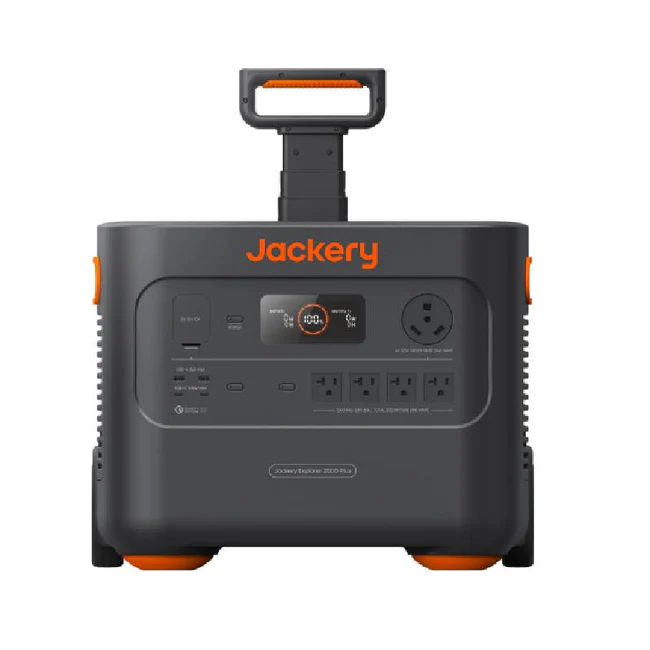
No longer sold
Jackery no longer sells the Explorer 2000 Plus as a standalone unit — the listing now carries only kits, the add-on battery and a refurbished unit. Its successor in the line is the HomePower 2000 Plus v2: the same 2 kWh class with a 2,400W inverter in the newer design.
HomePower 2000 Plus v2 · $1,199.00
$1,499.00 · direct from Jackery
Last checked 1 day ago. Prices move — check before you buy.
Spec deltas
Two Jackery power stations at the same $1,199, and the HomePower 3000 hands you 1,029Wh more capacity before you plug anything in. At identical money it also holds a bigger battery (3,072Wh to 2,043Wh), pushes more power (3,600W of continuous output to 3,000), and weighs a couple pounds less. On the spec sheet, this isn't close.
So why would anyone take the Explorer 2000 Plus? One reason, and it's a good one for the right buyer: the Explorer expands and the HomePower doesn't. Bolt on batteries and it climbs toward whole-home and RV scale; the HomePower is sealed at its rated capacity for life.
The catch is where the Explorer starts. Its expansion path begins below the HomePower's fixed capacity, so the first battery you add mostly buys back the gap the HomePower already covers at the same price. Short of needing more than the HomePower holds, that's an upgrade slot you financed and left empty. Past that ceiling, the Explorer is the only one of these two that can follow you.
What the Numbers Reveal
Each conclusion stated first — the numbers behind it on one line, the full analysis below.
So the first expansion battery the Explorer owner buys is spent mostly buying back capacity the HomePower ships with; the port only turns into a real advantage once actual demand climbs past 3,072Wh, and every watt-hour before that is a slot you financed and left empty.
Explorer 2000 Plus: 2,043Wh, expandableHomePower 3000: 3,072Wh, sealedboth priced $1,199
Why it mattersIf you can't name a load that will push you past what the HomePower already holds, the Explorer's headline feature is one you pay for and never cash.
One of these finishes the weekend with a fifth of the tank in reserve and the other runs dry before Sunday; at the same $1,199, the Explorer would need its first expansion battery just to match a trip the HomePower makes stock.
Weekend Camping load is about 2,100WhExplorer 2000 Plus rated 2,043WhHomePower 3000 rated 3,072Wh
Why it mattersWeekend campers who'd rather not ration power on Saturday night should take the HomePower; the Explorer needs an accessory to do the same job.
Across 4,000 cycles that compounds to 12,288 kWh of lifetime energy against 8,171, which is why the same box price works out to 10 cents per lifetime kilowatt-hour on the HomePower and 15 on the Explorer.
both priced $1,199both rated 4,000 cyclesHomePower 3,072Wh vs Explorer 2,043Wh per cycle
Why it mattersAnyone weighing these on cost should know the sticker is a tie and the value isn't: the HomePower is the cheaper energy over the decade you'll own it.
The specific dimensions that decide these two units — everything else is a tie.
Growth Path
Selected because: The Explorer's only real edge; must show it starts below the HomePower's fixed capacity, so it only pays past 3,072Wh.
solar input
Expandability is the Explorer 2000 Plus's entire case here, and it's built on a floor that sits below its rival. The HomePower gives you a sealed 3,072Wh; the Explorer gives you 2,043Wh and a port. Add the first expansion battery and you've largely paid to reach a number the HomePower shipped with, which is a strange way to spend an upgrade. The slot only earns its keep once real demand climbs past what the HomePower already holds, the growing off-grid cabin or the RV that keeps gaining appliances. Owners who bought the Explorer for exactly that reason praise how far it scales, up to 12kWh on a single unit and 24kWh pairedA2. That ceiling is real, and it's high.
So the read on the port is simple. If your capacity need is a moving target headed up, the Explorer's lower starting line is worth it for the room to grow. If your need is parked at running the house through an outage, you're buying a feature to leave it unused, and paying for it in the capacity you didn't get on day one.
Lifetime Value
Selected because: Same $1,199, same cycles; value collapses to capacity-per-dollar, which the HomePower wins at $0.39 vs $0.59 per Wh.
Price, warranty, and cycle rating land in a three-way tie: $1,199, five years, the same cells on both. That collapses the whole value question down to one number, how much battery each dollar buys, and the HomePower takes it at 39 cents per watt-hour to the Explorer's 59. You aren't paying more for the bigger unit. You're paying the same for it.
Your Life, Your Pick
Selected because: Concrete loads: HomePower holds more blackout margin, and the van-life case is the Explorer's lone opening.
Step down to a single 8-hour outage and both units keep the lights on, but the margins split hard. The Explorer finishes that blackout at 95% of what it can deliver, essentially coasting in on fumes, while the HomePower stops at 63% and keeps better than a third of its charge in reserve. An outage never announces its length in advance, and if this one runs into a second evening, only the HomePower still has a night left to give.
At the small end the two are a genuine tie: a CPAP draws about 320Wh overnight, 18% of the Explorer and 12% of the HomePower, and both idle at the same quiet 30 dBA while they do it. At the large end, neither is enough alone, since a van-life daily draw of 4,685Wh overruns both batteries. That last case is the Explorer's single opening on this page: it's the only one of the two whose expansion port can chase a number that big.
PowerScore Breakdown
Selected because: Aggregate 5,250 vs 4,151 traces to more output, surge, and solar at equal price.
overall power score
The aggregate score reads 5,250 for the HomePower and 4,151 for the Explorer, and the pieces behind it are a list of things you'd want more of at the same price: 3,600W of continuous output to 3,000, a 7,200W surge ceiling to 6,000, and 1,400W of solar input to 1,200. None of these is a landslide on its own. Stacked at an identical sticker, they're why the HomePower is the stronger box before expandability enters the conversation at all.
Portability & Form Factor
Selected because: Near-tie on weight; the higher-capacity HomePower is actually the lighter unit.
weight
Weight is the one place you'd expect the bigger battery to charge a penalty, and it doesn't. The HomePower carries more capacity and still lands about two pounds lighter, 59.5 to the Explorer's 61.5, on a dense cell-to-body design owners rate as the lightest 3kWh unit they've picked upB1. In the hallway this is a wash: both are a two-hands, bent-knees lift you shouldn't try on stairs aloneA3. The Explorer answers with wheels and an IP65 shellA5, which earn their keep on a gravel job site more than in a living room. Call the weight even and decide on something that isn't.
Strengths & trade-offs
Jackery Explorer 2000 Plus
Strengths
- +Costs $500 less
Trade-offs
- –Weaker inverter (-600W) limits appliance compatibility.
Jackery HomePower 3000
Strengths
- +Lighter by 2 lb
- +Larger battery capacity
- +Higher AC output
- +Faster solar charging
Trade-offs
- –Substantially more expensive (+$500) than the Explorer 2000 Plus.
Will It Power Your Gear?
Scenario math and per-appliance runtimes, modeled from the spec record.
Scenario verdicts
We ran the math on six real-world scenarios. Here's which unit survives your actual life.
SCN-01 · 2 nights · needs 2,100Wh
Weekend Camping
Two nights off-grid with essential comfort
HomePower 3000
The Explorer can't finish this one. The weekend load overruns its usable capacity and it taps out before Sunday, while the HomePower covers the same trip with a fifth of the tank left. Same price, and only one of them makes it to the end.
Battery budget usedlower = more headroom
LOAD Phone Charger 15W×6h · LED Lights 40W×8h · Box Fan 75W×14h · CPAP Machine 40W×16h
SCN-02 · 8 hours · needs 1,645Wh
8-Hour Blackout
Keep the essentials running through a night without power
HomePower 3000
Both keep the lights on, but only one keeps them on with margin. The Explorer crosses the finish line near empty; the HomePower stops with roughly a third of its charge untouched. Since no outage tells you how long it plans to last, that reserve is the entire point.
Battery budget usedlower = more headroom
LOAD Fridge 150W×8h · Router + Modem 20W×8h · LED Lights (4 bulbs) 40W×6h · Phone Charger 15W×3h
SCN-03 · 8 hours · needs 320Wh
CPAP Overnight
Sleep therapy without interruption — the #1 medical use case
Either unit
A dead heat, and a lopsided kind: a CPAP uses a sliver of either battery, and both idle at the same near-silent hum. This is the night where the extra capacity does nothing for you. Decide on price and weight, not on this.
Battery budget usedlower = more headroom
LOAD CPAP Machine 40W×8h
SCN-04 · 8 hours · needs 910Wh
Remote Workday
Full work day off-grid without power anxiety
HomePower 3000
The HomePower 3000 clears the workday at 35% used, banking 1,701Wh — late work, extra calls, or a second laptop charge without arithmetic. The Explorer 2000 Plus at 52% also finishes, with 826Wh of slack for the unplanned.
Battery budget usedlower = more headroom
LOAD Laptop 60W×8h · External Monitor 30W×8h · Router + Modem 20W×8h · Phone Charger 15W×2h
SCN-05 · 4 hours · needs 670Wh
Tailgate Party
Game day power for the crew
HomePower 3000
Both handle game day; the HomePower 3000 keeps more in reserve (26% used vs 39%). Tailgating is a light load, though, so the number you'll feel is weight: 59.5 lbs for the HomePower 3000 against 61.5 lbs for the Explorer 2000 Plus, from the trunk to the setup spot.
Battery budget usedlower = more headroom
LOAD Blender 400W×0.5h · LED TV (55") 80W×4h · Bluetooth Speaker 15W×4h · Phone Charger (×3) 45W×2h
SCN-06 · 24 hours · needs 4,685Wh
Van Life Daily
A full day of mobile living — the ultimate endurance test
Neither unit
Neither finishes a true van-life day stock, because the draw overruns both batteries. This is the Explorer's one moment on the page: it's the only unit here that can expand to chase a load this size. If you're pulling this daily and won't add batteries, both are simply the wrong size.
Battery budget usedlower = more headroom
LOAD Mini-Fridge 150W×24h · Laptop 60W×4h · Phone Charger 15W×3h · LED Lights 40W×5h · Fan 75W×8h
The Load Test
RUNTIME = (Wh × 0.85) ÷ LOAD
None of the scenarios above exactly yours? Build it. Toggle what you'd plug in; both units are tested against the combined draw.
Essentials
Comfort & Convenience
High-Draw Appliances
Test duration
8h
Continuous draw
205W
Projected runtime
For this load: HomePower 3000 runs 12.7h vs 8.5h.
$1,399 list · direct from Jackery
Modeled from the spec record — same math as the tables below. Methodology
Runtime by appliance
Real-world runtime estimates for common appliances, modeled at 85% inverter efficiency.¹
Essentials
The basics you need runningscale 0–174.1hComfort & Convenience
Makes off-grid life actually enjoyablescale 0–34.8hHigh-Draw Appliances
These reveal the real limitsscale 0–2.6h¹ Runtime = (capacity × 0.85) ÷ appliance watts. Within each group, all bars share one time scale (the group's longest runtime), so lengths are comparable across appliances; identical runtimes collapse into a single blue/orange bar. Actual runtime varies with battery age, temperature, and simultaneous loads — see methodology.
Conclusion
July 18, 2026
Verdict: the HomePower 3000
Same brand, same $1,199, and the HomePower 3000 is the stronger unit on nearly every axis that isn't expandability: more capacity, more output and surge, a couple pounds lighter, more solar input, and a lower cost per watt-hour. The Explorer 2000 Plus pulls ahead in exactly one situation, when you already know you'll grow past 3,072Wh, because its expansion path starts below where the HomePower already sits. If that growth is real, buy the Explorer for the port. If it isn't, the HomePower hands you more of everything for the same money.
Editor-assigned confidence, based on cited owner research and spec analysis.
List prices as of July 18, 2026. The links below open Jackery's current price.
$1,499.00 · direct from Jackery
Last checked 1 day ago. Prices move — check before you buy.
or check the Explorer 2000 Plus price$899.00 list
Written by Gunner Gustafson, Whole-Home Backup Tester · Station Arena Test Desk · Updated July 18, 2026
Measured Data
Benchmark scores and the full spec record, side by side.
Benchmark scores
Full specifications
ᵈ Derived: price ÷ rated capacity. See the data behind our comparisons →
Comparison ToolAdd more power stations, side by sideOpen Tool →How these numbers are produced
Numeric verification
Every figure on this page traces to our spec database or arithmetic on it — no estimated numbers.
Owner claims
Statements about owner experience are cited to published reviews — see Sources & Research Notes below.
Runtime model
Runtime = (rated capacity × 0.85 inverter efficiency) ÷ device wattage. Solar recharge estimates assume panels deliver 70% of rated output. Cold weather, battery age, and stacked loads reduce real-world results.
Power Score
Computed from 14 published spec dimensions, weighted per use-case bench. Higher is better; a unit must meet a bench's minimum threshold to be rated.
See the full weight table and data sourcing on our methodology page →Class ranking (the star rating)
Each unit's star score is a category ranking, not customer reviews — no buyer opinions feed it. We score every station on size-independent quality (value, output, portability, endurance, ports, warranty, and more), then percentile-rank it against the other units in its capacity class, so a class-leading compact unit and a class-leading whole-home unit can both earn 5★. Here, Explorer 2000 Plus rates 4.5/5 (68th percentile of 26 Large-class units), and HomePower 3000 rates 4.7/5 (84th percentile of 26 Large-class units).
How the class ranking is computed →Test Notes & Caveats
Hidden gotchas and advantages we spotted that you won't find on the product page.
61.5 lbs, and It's the Heavier One
The weight flag lands on the Explorer, and it's fair: 61.5 pounds is a two-hands, bent-knees lift whether or not it has wheels. The quiet twist is that the higher-capacity HomePower weighs less, not more, so this isn't a penalty you're paying for the bigger battery. Neither belongs on basement stairs without a second set of hands.
The Catch on Our Pick: It's Sealed
Here's the real knock on the HomePower: it's fixed at its rated capacity, full stop. Outgrow it and your only move is buying a second unit, where the Explorer would simply take another battery. The reason it doesn't sink our pick is that the HomePower's sealed ceiling already sits above where the Explorer starts, so for anyone not planning to grow, fixed reads as complete rather than limited.
Warranty: No Difference
Both units carry the same 5-year warranty, so coverage isn't a tiebreaker here. Both figures are maximums rather than guarantees — they depend on registering the unit with Jackery, which is what extends the base term to the full period. Worth saying because the per-dollar framing can suggest otherwise: the Explorer 2000 Plus works out at 5.6 years of cover per $1,000 spent against the HomePower 3000's 3.6, but that spread is the price gap, not the terms.
Full record above — the Test Desk pick is the HomePower 3000.
Check HomePower 3000 price →or check the Explorer 2000 Plus priceOwnership Analysis
What happens after you buy — true cost of ownership, brand trust, and growth potential.
Lifetime value
Service lifeyears at one full cycle per day
Lifetime energy delivered
Cost per delivered kWh
│ warranty ends · Reaching the cycle rating means ~80% capacity remains — degraded, not dead.
Analyst note
Both units cost the same to own over their rated lives — $0.11/kWh each. Lifetime cost can't separate them, so decide on the sticker price and everything else. One thing to know reading the table: both carry the same 4,000-cycle rating, so the lifetime rows are sticker price and capacity in disguise — the wear horizon is identical and decides nothing here.
Growth path
Explorer 2000 Plus
EXPANDABLESupports Jackery expansion batteries, so you can add capacity later without replacing the base unit — useful if your needs may climb past 2,043Wh.
Accepts up to 1,200W of solar. Enough for a serious multi-panel array.
Adequate ports for most setups, but heavy users may want a power strip.
Expansion batteries are Jackery-specific. You're investing in the Jackery ecosystem.
HomePower 3000
FIXED CAPACITYFixed at 3,072Wh — a sealed, complete system rather than a starting point. There's no expansion port, so that figure is the ceiling: check it against your longest unplugged stretch before you buy.
Accepts up to 1,400W of solar. Enough for a serious multi-panel array.
Adequate ports for most setups, but heavy users may want a power strip.
Realistic full solar rechargeat 70% of rated panel output — see methodology
Analyst note
Don't read the Explorer 2000 Plus's expandability as a straight win here: it starts at 2,043Wh, below the HomePower 3000's 3,072Wh, so a first expansion battery largely buys back capacity the HomePower 3000 already includes. It only pulls ahead if you'd grow past 3,072Wh — short of that, the HomePower 3000's larger fixed capacity is the simpler value.
What Owners Report
Patterns from published owner reports and long-term reviews — every claim cited to its source below.
Jackery Explorer 2000 Plus
Reviewers land on the Explorer 2000 Plus as dependable and genuinely quiet, holding steady and low-noise even under a full 3,000W pull, and compatible with basically anything from a CPAP machine to an electric grillA1. Its identity, though, is scale: each unit's battery expands up to 12kWh, and a paired setup reaches 6,000W of output and as much as 24kWh, which is why it lands on RV, off-grid, and whole-home shortlistsA2. The hardware backs the ambition, a tank-like IP65 build feeding on dual-MPPT solar of roughly 1,200 to 1,400WA5.
The honest caveats are weight and software. At about 61 pounds it's a two-person lift for stairs, though the wheels and handle earn their keep on flat groundA3. The app covers the essentials well, with cycle counts and efficiency graphs a data nerd will enjoy, but reviewers agree it still needs polish next to the slickest rivalsA4.
“Reviewers describe it as dependable, easy to use, and relatively quiet even under a 3000W load, with universal compatibility for powering everything from CPAP machines to electric grills.”
Sources
outdoorgearlab.com · thesolarpit.com · jackery.com · voltagebasics.com · storagereview.com · thesolarlab.com · tipselite3s.com
Jackery HomePower 3000
The HomePower 3000 reads in reviews as the compact one that outperforms its footprint, billed as the lightest and smallest 3kWh station going, thanks to a cell-to-body construction one person can carry at roughly 60 pounds and narrow enough at 16.4 inches to slide into shelves that reject the competitionB1. On backup duty it delivers: testers kept a standard refrigerator running for nearly two days and a 55-inch TV for about 30 hours, with a grid-to-battery switchover measured under 20 millisecondsB4.
Reliability is the quieter selling point. Jackery posts the lowest reported failure and warranty-claim rate among the major brands in owner communitiesB2, and the LiFePO4 cells here carry strong thermal stability and long rated life, which is exactly what you want from a box that sits in a closet waiting for the grid to failB3.
“Described as the world's lightest and smallest 3kWh power station thanks to an advanced cell-to-body (CTB) design — one person can carry it at around 60 lbs, and its compact 16.4-inch width fits spaces that reject rivals.”
Sources
backuppowerhub.com · jackery.com · poweredthrough.com · thesolarlab.com · poweraic.com · tipselite3s.com
Sources & Research Notes
Every owner claim in this report is traceable to a published source. The bracketed references above resolve here.
Recurring owner themes
- Standout expandability (up to 24kWh dual), a rugged IP65 build with wheels, and dependable quiet operation are the praise; the heavy weight and an app that needs polish are the caveats. [Explorer 2000 Plus · 3 entries]
- Standout compactness and light weight for a 3kWh unit, Jackery's low failure/warranty-claim record, and dependable LFP home-backup performance are the praise. [HomePower 3000 · 3 entries]
- A1
“Reviewers describe it as dependable, easy to use, and relatively quiet even under a 3000W load, with universal compatibility for powering everything from CPAP machines to electric grills.”
outdoorgearlab.com / thesolarpit.com — Jackery Explorer 2000 Plus review · 2026 · [positive]
- A2
“Massive expandability — each unit's battery expands up to 12kWh, and pairing two units gives 6000W output and up to 24kWh total, ideal for RVs, home backup, or serious off-grid setups.”
jackery.com / thesolarpit.com — Explorer 2000 Plus review · 2026 · [positive]
- A3
“Not light at around 61-62 lbs — included wheels and a handle help on smooth surfaces, but it still demands a two-person lift for stairs.”
outdoorgearlab.com / voltagebasics.com — Explorer 2000 Plus review · 2026 · [mixed]
- A4
“The app nails the essentials with pro-level insights like cycle counts and efficiency graphs, but it lacks some of the bells and whistles of rivals and still needs polishing.”
storagereview.com / thesolarlab.com — Explorer 2000 Plus review · 2026 · [mixed]
- A5
“Strong solar with two MPPT inputs (up to ~1,200-1,400W), plus a tank-like build with IP65 dust and water resistance on key ports.”
storagereview.com / tipselite3s.com — Explorer 2000 Plus review · 2026 · [positive]
- B1
“Described as the world's lightest and smallest 3kWh power station thanks to an advanced cell-to-body (CTB) design — one person can carry it at around 60 lbs, and its compact 16.4-inch width fits spaces that reject rivals.”
backuppowerhub.com / jackery.com — HomePower 3000 review · 2026 · [positive]
- B2
“Jackery maintains the lowest rate of reported failures and warranty claims among the major brands in owner communities.”
poweredthrough.com / backuppowerhub.com — Jackery reliability · 2026 · [positive]
- B3
“Uses LiFePO4 chemistry with strong thermal stability; Jackery and reviewers rate the cells at roughly 4,000 cycles — notably higher than the figure in some spec listings, so treat lower cycle numbers with caution.”
thesolarlab.com / poweraic.com — HomePower 3000 review · 2026 · [positive]
- B4
“Solid home backup — kept a standard refrigerator running for nearly two days and a 55-inch TV for around 30 hours, with a grid-to-battery UPS switchover measured under 20 milliseconds.”
backuppowerhub.com / tipselite3s.com — HomePower 3000 review · 2026 · [positive]
Research compiled July 18, 2026.
Who Should Buy Which
Buy the Explorer 2000 Plus if you…
- →The buyer who can already name the load that will outgrow 3,072Wh: a cabin adding circuits, an RV that keeps collecting appliances, a backup plan headed for a second battery. The expansion path is real and reaches up to 12kWh on a single unitA2, and it's the only reason on this page to accept the lower starting point.
- →Anyone working outdoors or on a job site who wants the IP65 ruggedness and the wheels to move 60-odd pounds across gravel without a second person on the flatA3A5.
This is you — check the Explorer 2000 Plus price
Buy the HomePower 3000 if you…
- →The same-price shopper who wants the most capacity, output, and surge today and has no concrete plan to expand, which describes most people comparing these two.
- →The weekend camper who's done rationing: the HomePower clears the full weekend load the Explorer taps out on, with reserve to spare.
- →The home-backup buyer who wants a refrigerator to survive a two-day outage and a UPS switchover fast enough for a desktop PC to never noticeB4, in the lightest, most shelf-friendly 3kWh box on offerB1.
If neither fits
If your daily draw is genuinely van-life scale, think 4,685Wh a day, neither one finishes it stock, and only the Explorer can even chase it by expanding; if you won't add batteries, step up to a larger single unit or run two in parallel instead. And if all you're really backing up is a CPAP and a phone, both of these are far more battery than a single night will ever touch, and something a third the size and price will do the job and leave money in your pocket.
The Bottom Line
Same brand, same $1,199, and the HomePower 3000 is the stronger unit in every direction that isn't the expansion port: more capacity, more output, more surge, more solar, a lower cost per watt-hour, and a couple pounds less to haul up the stairs. The Explorer 2000 Plus's one card is that it grows. But it grows from a starting line below where the HomePower already stands, so the first battery you add just brings you level.
So the decision comes out clean. If you can name the load that will push you past what the HomePower holds, buy the Explorer for the port and start climbing. If you can't, buy the HomePower and enjoy being done: it's the bigger, stronger, cheaper-per-watt-hour box, and it costs exactly the same.
Frequently Asked Questions
Answers drawn from the spec record and cited owner research.
Same price, so why does the HomePower 3000 usually win?
Because at an identical $1,199 it gives you more of almost everything: a bigger 3,072Wh battery to the Explorer's 2,043Wh, more continuous output and surge, more solar input, a lower cost per watt-hour, and even a slightly lighter body. The Explorer 2000 Plus's one counter is that it expands and the HomePower doesn't. Unless you'll grow past what the HomePower holds, that's the whole scoreboard.
Is the Explorer 2000 Plus's expandability actually worth paying for?
Only if your needs will climb past what the HomePower already holds. The Explorer starts below the HomePower, so your first expansion battery mostly buys back capacity the sealed HomePower includes at the same price. Past that point the Explorer keeps climbing, up to 12kWh on a single unit, and becomes the only real choice. Below it, you've bought an upgrade slot you won't use.
Can either one run a refrigerator through a multi-day outage?
Yes, and the HomePower has more room for it; testers kept a standard fridge going for nearly two days on one. Both offer a UPS switchover under 20 milliseconds, quick enough that a fridge or a desktop PC won't register the grid dropping. The Explorer will do the job too, it just starts with less capacity in reserve for everything else you need to power.
Is either one quiet enough to run a CPAP by the bed?
Both are, and they're evenly matched at it: each idles around 30 dBA, and a CPAP only pulls about 320Wh overnight, a small slice of either battery. Reviewers single out the Explorer for staying quiet even under a heavy load, and the HomePower runs just as low at idle. For a bedside machine this is a tie, so decide on capacity and price instead.
Where to buy
Jackery Explorer 2000 Plus
$899.00
$899.00 · direct from Jackery
Last checked 21 days ago. Prices move — check before you buy.
Jackery HomePower 3000Pick
$1,499.00
$1,499.00 · direct from Jackery
Last checked 1 day ago. Prices move — check before you buy.
Prices may vary by retailer and are subject to change.