Head-to-head test
EcoFlow DELTA Pro 3 vs BLUETTI Apex 300 + 2×B500K
One of the six loads on this page needs more than the DELTA Pro 3 has to give, so the axis isn't which unit is better, it's whether your day spends more than 3,482Wh.
Full profiles: EcoFlow DELTA Pro 3 → · BLUETTI Apex 300 + 2×B500K →

Written by Gunner GustafsonUpdated
Whole-Home Backup Tester, Station Arena Test Desk
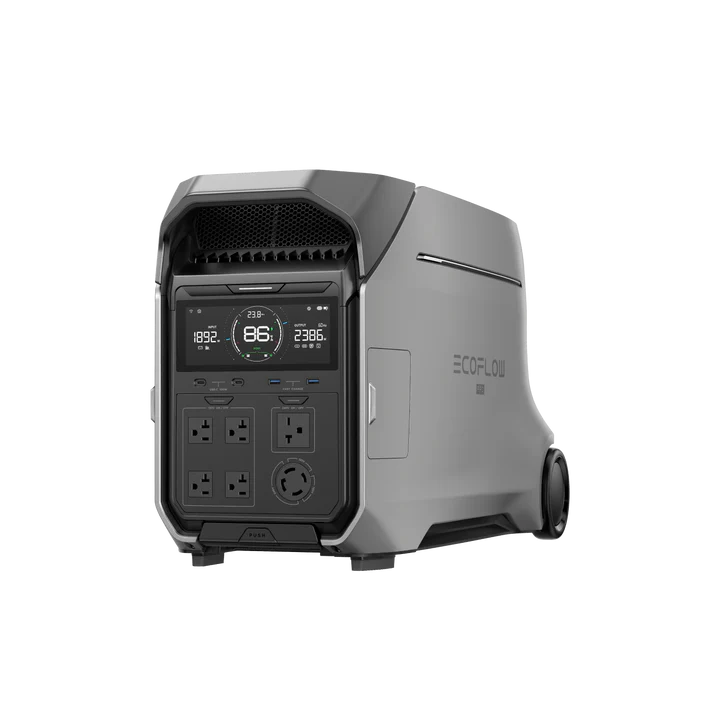
$2,399.00 · direct from EcoFlow
down from $2,799 · 14% below usual
Last checked 8 hours ago. Prices move — check before you buy.

$4,999.00 · direct from BLUETTI
down from $5,399 · 7% below usual
Last checked 8 hours ago. Prices move — check before you buy.
Spec deltas
The extra energy in this matchup is the cheapest energy on the page. $5,399 for the Apex 300 with two B500K batteries buys 8,909Wh more than the DELTA Pro 3's 4,096Wh at $2,799, and $2,600 for that much energy works out to 29 cents a watt-hour. Both units sell their own capacity for more than that: 68 cents a watt-hour for the DELTA Pro 3, 42 for the BLUETTI stack. If what you want is watt-hours, buying them by the crate is the right move.
One number decides whether you want them, and it's 4,685Wh. That's the Van Life Daily load, the only one of six profiles here the DELTA Pro 3 doesn't finish, and it misses by 1,203Wh. Every other load on this page fits inside the cheaper box with slack, the blackout night included. The Apex stack wins three of the six rows, and two of those it wins on surplus rather than survival.
So take the DELTA Pro 3 and keep the difference, unless your daily draw genuinely runs past what it has to give or your outages routinely run past one evening. The honest catch on that advice: 4,096Wh is one evening of house loads plus a cushion, not a weekend of them, and if you guess low you'll be shopping again. EcoFlow's answer is that the pack grows, rated expandable to 48kWhA1, which is the same insurance the price gap was going to buy you.
What the Numbers Reveal
Each conclusion stated first — the numbers behind it on one line, the full analysis below.
Capacity
Cheap marginal energy still needs somewhere to go, and the load table says there mostly isn't anywhere. Five of six profiles finish inside the smaller pack, and the blackout night ends with 1,837Wh spare. The 29-cent watt-hours are a bargain the way a bulk pallet of flour is a bargain: only if you were going to bake.
DELTA Pro 3: 4,096Wh at $2,799, which is 68 cents per WhApex 300 + 2×B500K: 13,004.8Wh at $5,399, which is 42 cents per WhOf the six scenario loads, only Van Life Daily (4,685Wh) exceeds the DELTA Pro 3's 3,482Wh usable
Why it mattersIf your daily draw clears roughly 3,500Wh, pay the $2,600 without hesitating. If it doesn't, you're buying a discount on energy you never take delivery of.
Price the way an outage buyer actually uses it and the rate evaporates. The 8-hour blackout profile draws 1,645Wh, about four tenths of a DELTA Pro 3 cycle and roughly an eighth of an Apex stack cycle. A unit that spends its life charged and waiting hits the five-year warranty and the calendar long before it hits either cycle ceiling, so the cheaper lifetime energy never gets collected while the price gap is spent on day one.
Cost per lifetime kilowatt-hour: 7 cents for the Apex stack, 17 cents for the DELTA Pro 3At daily cycling the rated life runs 16.4 years for the Apex stack and 11 for the DELTA Pro 3Both carry 5-year warranties, and BLUETTI's 5 years is a maximum that depends on buying direct or registering
Why it mattersDaily cyclers, van dwellers and off-grid cabins convert that rate into real money. Anyone buying storm insurance should take the cash instead.
The small-load buyer is the one the port list punishes. A DC-powered machine runs straight off the DELTA Pro 3's car socket; on the Apex stack it runs through the inverter all night instead. Reviewers testing the Apex 300 with the older B300K battery put the fix at a roughly $300 Hub D1 accessory, which we cite for character rather than spec since the source model can't be confirmed against this bundleB2B6B0. USB-C is a wash at 100W either way.
Our record for the Apex stack lists 6 AC outlets, 2 USB-A, 2 USB-C at 100W, and zero 12V car outletsDELTA Pro 3: 1 12V car outlet, 4 USB-A, 2 USB-C at 100W, and two 240V outlets to the Apex stack's oneA CPAP night draws about 320Wh, which is 9% of the DELTA Pro 3's usable energy and 3% of the Apex stack's
Why it mattersIf the real job is a CPAP, a router, a 12V fridge or a radio, buy the DELTA Pro 3, or budget the hub before you compare prices.
solar input
So the Apex stack's cushion is front-loaded. It hands you nearly six blackout nights before it needs the sun, then asks for most of a good solar day to get back. The smaller pack can plausibly refill inside a morning and do it again tomorrow, assuming your array can actually deliver its rated input. In a grid-down week, the unit that recovers daily and the unit that holds more are not the same purchase.
Rated solar input: 2,000W on the DELTA Pro 3, 2,400W on the Apex stack, whose figure is disputed in the field because of an input-voltage limitCapacity to refill: 4,096Wh against 13,004.8WhAfter the 8-hour blackout profile the Apex stack still holds 9,409Wh, about 5.7 more nights like it, against the DELTA Pro 3's 1.1
Why it mattersIf you're buying for multi-day outages, size the panels before you size the pack. The Apex stack's advantage is a reservoir, not a supply.
The specific dimensions that decide these two units — everything else is a tie.
Runtime: Will It Power Your Gear?
Selected because: The capacity gap is 3.2 times, and exactly one of the six loads here needs more than the DELTA Pro 3's 3,482Wh of usable energy.
continuous output
Usable energy is the figure worth arguing with, not nameplate. A flat 85% derate is applied to every unit here, which leaves 3,482Wh in the DELTA Pro 3 and 11,054Wh in the Apex stack. One of those is an evening of real house loads with room to be wrong. The other is a long weekend of them.
That difference only becomes a reason to spend when one day's draw exceeds the smaller number, which happens exactly once across six profiles. Below that line, extra capacity doesn't make the lights brighter or the fridge colder. It sits at full retail, holding energy you already had enough of.
Your Life, Your Pick
Selected because: The Apex stack takes three of six rows, but two of those it wins on leftovers. The row it wins on finishing at all is the whole decision.
Read the six rows for shape rather than score. The Apex stack takes the blackout and the workday by finishing with more in reserve, which counts only if something is coming for that reserve. It takes Van Life Daily by finishing at all, and that is a different kind of win.
Two rows go to neither unit, for the same reason: at these weights both are appliances rather than gear, so a campsite and a tailgate are category errors instead of close calls. The CPAP row goes to the DELTA Pro 3, and not on capacity, which both cover several times over. It goes on the socket you plug the machine into.
Lifetime Value
Selected because: The Apex stack is the cheaper energy across its rated life and the more expensive year of ownership: $1,080 per warranty year against $560.
cost / lifetime kWh
Cost per lifetime kilowatt-hour is collected by running energy through the box, one discharge at a time, and the Apex stack's rate assumes 6,000 complete discharges of a pack that size. The blackout profile on this page draws 1,645Wh. Getting to 6,000 of those discharges is not a plan, it's a career.
Spread across the five years both warranties cover, the same purchase reads the other way: $1,080 a year against $560. Cycle daily and the rate is real money, the Apex stack wins this section outright, and the arithmetic is on its side for 16.4 years. Leave it charged and waiting between storms and you've bought the cheapest energy you'll never use.
What the Specs Don't Tell You
Selected because: Five cards fire here and only the surge ceiling, 7,680W against 6,000W, can change a purchase.
rated cycles
The surge card is the Apex stack's strongest honest argument. Motors draw two to three times their rated wattage on startup, so the Apex stack's higher ceiling is a real difference, and nothing in the six profiles above asks for more than 400W of startup. It's a card for the buyer with a well pump or an AC compressor, not for the reader with a fridge and a modem.
The rest is housekeeping. Warranty is a wash at five years each, with the asterisk that BLUETTI's five needs a direct purchase or a registration to exist at all. The weight card is a cost paid once, at delivery. The two noise ratings were published under different conventions by different makers, so they shouldn't settle anything, least of all a bedroom.
Brand Trust
Selected because: On a 282 lb, three-box, $5,399 system, support quality stops being a footnote.
Support is the asymmetry here, and it runs against the more expensive unit. EcoFlow's service is polarized: prepaid replacement labels and quick turnarounds on one side, long waits and refurbished units against new-product claims on the other, with a Costco or Amazon purchase giving you a return path that doesn't depend on either. BLUETTI's is the least consistent in the category, email-first and on China time, with outcomes running from efficient to weeks of troubleshooting and an offer of a discount on a new unit in place of a repair.
If you do buy the BLUETTI, buy it direct. That's the difference between the five-year term and a shorter one, and on a three-box stack at this price it's also the difference between a warranty claim and a negotiation.
Strengths & trade-offs
EcoFlow DELTA Pro 3
Strengths
- +Costs $2,600 less
- +Lighter by 169.8 lb
- +Higher AC output
Trade-offs
- –Very heavy unit that may be difficult for one person to lift.
- –Shorter-lived battery — rated for 4,000 charge cycles vs the Apex 300 + 2×B500K's 6,000, so it wears out sooner.
BLUETTI Apex 300 + 2×B500K
Strengths
- +Larger battery capacity
- +Faster solar charging
- +Rated for 6,000 charge cycles — much longer battery lifespan
Trade-offs
- –Substantially more expensive (+$2,600) than the DELTA Pro 3.
- –Significantly heavier (+169.8 lbs), making it harder to move.
- –Very heavy unit that may be difficult for one person to lift.
Will It Power Your Gear?
Scenario math and per-appliance runtimes, modeled from the spec record.
Scenario verdicts
We ran the math on six real-world scenarios. Here's which unit survives your actual life.
SCN-01 · 2 nights · needs 2,100Wh
Weekend Camping
Two nights off-grid with essential comfort
Neither unit
Neither, and not because the load is hard. 2,100Wh is 60% of the DELTA Pro 3's usable energy and 19% of the Apex stack's, which is to say trivial for both. The problem is the loading, not the load: 112.4 lbs is a two-person lift into a truck bed, and 282.2 lbs across three boxes doesn't get lifted at all. If the power has to leave the driveway, you're in the wrong class of product.
Battery budget usedlower = more headroom
LOAD Phone Charger 15W×6h · LED Lights 40W×8h · Box Fan 75W×14h · CPAP Machine 40W×16h
SCN-02 · 8 hours · needs 1,645Wh
8-Hour Blackout
Keep the essentials running through a night without power
Apex 300 + 2×B500K
The Apex stack takes this on what's left over, not on whether it finishes, because both do. After the 1,645Wh night it still holds 9,409Wh, about 5.7 more nights like it. The DELTA Pro 3 holds 1,837Wh, or 1.1. One of these is a night of insurance and the other is most of a week of it, so the only question that matters is how long your outages actually last.
Battery budget usedlower = more headroom
LOAD Fridge 150W×8h · Router + Modem 20W×8h · LED Lights (4 bulbs) 40W×6h · Phone Charger 15W×3h
SCN-03 · 8 hours · needs 320Wh
CPAP Overnight
Sleep therapy without interruption — the #1 medical use case
DELTA Pro 3
320Wh over eight hours is 9% of the DELTA Pro 3's usable energy and 3% of the Apex stack's, so capacity is a formality and the ports decide the row. The DELTA Pro 3 has a 12V car socket and four USB-A on the box; our record for the Apex stack shows six AC outlets and no 12V socket at all, so the same machine has to run through the inverter all night instead. Both cap USB-C at 100W, so that part is a wash.
Battery budget usedlower = more headroom
LOAD CPAP Machine 40W×8h
SCN-04 · 8 hours · needs 910Wh
Remote Workday
Full work day off-grid without power anxiety
Apex 300 + 2×B500K
The Apex stack wins with 10,144Wh still banked after the 910Wh day, against 2,572Wh for the DELTA Pro 3. Both finish without thinking about it, so the question is what the surplus buys: a late call, a second monitor and a laptop top-up all fit inside either unit's slack. If your office is a desk in a house, this isn't the row where the price gap gets decided.
Battery budget usedlower = more headroom
LOAD Laptop 60W×8h · External Monitor 30W×8h · Router + Modem 20W×8h · Phone Charger 15W×2h
SCN-05 · 4 hours · needs 670Wh
Tailgate Party
Game day power for the crew
Neither unit
Neither, for the same reason as camping, with a different lift. 670Wh is a rounding error for either pack and the 400W startup here is comfortably inside both inverters, so on paper this row is a formality. Then someone has to get the thing over the tailgate. The cooler goes over; these two don't.
Battery budget usedlower = more headroom
LOAD Blender 400W×0.5h · LED TV (55") 80W×4h · Bluetooth Speaker 15W×4h · Phone Charger (×3) 45W×2h
SCN-06 · 24 hours · needs 4,685Wh
Van Life Daily
A full day of mobile living — the ultimate endurance test
Apex 300 + 2×B500K
This is the row that separates them. 4,685Wh a day is more than the DELTA Pro 3 has to give: 3,482Wh usable, 1,203Wh short, about three quarters of the day covered, and careful rationing can't fix a pack smaller than the load. The Apex stack finishes with 6,369Wh spare. If this row describes your life, stop reading and buy the BLUETTI.
Battery budget usedlower = more headroom
LOAD Mini-Fridge 150W×24h · Laptop 60W×4h · Phone Charger 15W×3h · LED Lights 40W×5h · Fan 75W×8h
The Load Test
RUNTIME = (Wh × 0.85) ÷ LOAD
None of the scenarios above exactly yours? Build it. Toggle what you'd plug in; both units are tested against the combined draw.
Essentials
Comfort & Convenience
High-Draw Appliances
Test duration
8h
Continuous draw
205W
Projected runtime
For this load: Apex 300 + 2×B500K runs 53.9h vs 17h.
$5,399 list · direct from BLUETTI
Modeled from the spec record — same math as the tables below. Methodology
Runtime by appliance
Real-world runtime estimates for common appliances, modeled at 85% inverter efficiency.¹
Essentials
The basics you need runningscale 0–736.9hComfort & Convenience
Makes off-grid life actually enjoyablescale 0–147.4hHigh-Draw Appliances
These reveal the real limitsscale 0–11.1h¹ Runtime = (capacity × 0.85) ÷ appliance watts. Within each group, all bars share one time scale (the group's longest runtime), so lengths are comparable across appliances; identical runtimes collapse into a single blue/orange bar. Actual runtime varies with battery age, temperature, and simultaneous loads — see methodology.
Conclusion
September 13, 2026
Verdict: the DELTA Pro 3
Buy the DELTA Pro 3. It finishes five of the six loads on this page with margin left, it's the cheaper box by $2,600, it's 170 lbs lighter, it arrives as one box instead of three, and it has the 12V socket the Apex stack's record doesn't. The Apex stack is the better machine by most of the ways machines get measured, and it genuinely sells cheaper energy over its rated life. It's the right buy only if you're the buyer who drains it: a daily draw above what the DELTA Pro 3 can deliver, outages counted in days rather than evenings, or a motor load that needs the 7,680W ceiling. Short of that, you're paying up for headroom you'll never see the top of, from the brand with the least predictable support in the category.
Today the DELTA Pro 3 is $2,399, $400 under its typical $2,799 and the Apex 300 + 2×B500K is $4,999, $400 under its typical $5,399. The verdict weighs typical prices, not today's. Prices checked 8 hours ago.
Editor-assigned confidence, based on cited owner research and spec analysis.
List prices as of September 13, 2026. The links below open EcoFlow's and BLUETTI's current prices.
$2,399.00 · direct from EcoFlow
down from $2,799 · 14% below usual
Last checked 8 hours ago. Prices move — check before you buy.
or check the Apex 300 + 2×B500K price$4,999.00 list
Written by Gunner Gustafson, Whole-Home Backup Tester · Station Arena Test Desk · Updated September 13, 2026
Measured Data
Benchmark scores and the full spec record, side by side.
Benchmark scores
Not rated for both units (minimum threshold unmet): RV Living, Solar Generator.
Full specifications
ᵈ Derived: price ÷ rated capacity. See the data behind our comparisons →
Comparison ToolAdd more power stations, side by sideOpen Tool →How these numbers are produced
Numeric verification
Every figure on this page traces to our spec database or arithmetic on it — no estimated numbers.
Owner claims
Statements about owner experience are cited to published reviews — see Sources & Research Notes below.
Runtime model
Runtime = (rated capacity × 0.85 inverter efficiency) ÷ device wattage. Solar recharge estimates assume panels deliver 70% of rated output. Cold weather, battery age, and stacked loads reduce real-world results.
Power Score
Computed from 14 published spec dimensions, weighted per use-case bench. Higher is better; a unit must meet a bench's minimum threshold to be rated.
See the full weight table and data sourcing on our methodology page →Class ranking (the star rating)
Each unit's star score is a category ranking, not customer reviews — no buyer opinions feed it. We score every station on size-independent quality (value, output, portability, endurance, ports, warranty, and more), then percentile-rank it against the other units in its capacity class, so a class-leading compact unit and a class-leading whole-home unit can both earn 5★. Here, DELTA Pro 3 rates 4.0/5 (40th percentile of 16 Home Backup-class units), and Apex 300 + 2×B500K rates 3.5/5 (14th percentile of 29 Whole-Home / Off-Grid-class units).
How the class ranking is computed →Test Notes & Caveats
Hidden gotchas and advantages we spotted that you won't find on the product page.
170 lbs, Paid Once
112.4 lbs is a two-person lift with bent knees. 282.2 lbs is a delivery, and then it's furniture. The 170 lb difference is a cost you pay once, getting the Apex stack into position rather than every time you use it. What you keep paying is siting: it arrives as an inverter plus two batteries, so it needs a spot that fits three boxes and the cabling between them, and that spot is permanent.
Apex 300 + 2×B500K: 45dB Published
45dB is about as loud as a running refrigerator. The DELTA Pro 3 is rated 30dB — lower, but published by a different maker measuring its own way, so the two figures are not a like-for-like gap. For most people, fan noise around 45dB and up is where sleep starts to suffer.
The Ceiling Is the Spec, Not the Ratio
The Apex stack surges to 7,680W against the DELTA Pro 3's 6,000W, and its 2x surge-to-continuous ratio beats 1.5x. Motors draw two to three times their rated wattage for the moment they start, which is what makes the ratio worth printing. What decides whether your compressor starts is the ceiling: look up the startup draw of the heaviest motor you own and check it against 6,000W before you rule the DELTA Pro 3 out. Nothing in the six scenarios above asks for more than 400W of startup.
Five Years Each, One With an Asterisk
Same five years on both, so coverage isn't the tiebreak. BLUETTI's five is a maximum rather than a default: it depends on buying direct or registering the unit, and reseller purchases carry a shorter term, so register it the day it lands. The per-dollar framing flatters the cheaper unit here, but that spread is the price gap talking, not the terms.
Count Energy, Not Years
6,000 cycles against 4,000 sounds like half again the life, and it isn't, because a cycle isn't the same size on both: 13,005Wh on the Apex stack, 4,096Wh on the DELTA Pro 3. Over the rated life that's roughly 78,029 kWh against 16,384, which is the honest way to compare them. Then the part nobody mentions: hitting the cycle limit doesn't kill the pack. It settles at about 80% of the capacity you started with and keeps working.
Full record above — the Test Desk pick is the DELTA Pro 3.
Check DELTA Pro 3 price →or check the Apex 300 + 2×B500K priceOwnership Analysis
What happens after you buy — true cost of ownership, brand trust, and growth potential.
Lifetime value
Service lifeyears at one full cycle per day
Lifetime energy delivered
Cost per delivered kWh
│ warranty ends · Reaching the cycle rating means ~80% capacity remains — degraded, not dead.
Analyst note
The DELTA Pro 3 is cheaper to buy, but the Apex 300 + 2×B500K is cheaper to own. At $0.07/kWh over its lifetime vs $0.17/kWh, the Apex 300 + 2×B500K's higher cycle life and capacity make each dollar go further over the years.
Brand trust
EcoFlow
Ecosystem
Largest in portable power — 12-15 models across DELTA Pro, DELTA 3, and RIVER 3 series, plus solar panels and smart home panels
Support
US-based phone, email and chat, and the experiences split hard. One group gets a prepaid label and a fast replacement; another waits, then gets a refurbished unit against a new-product claim. Buying through Costco or Amazon gives you a return path that doesn't depend on which group you land in.
Community
Largest community in the space — Reddit r/Ecoflow_community (~31K members), multiple Facebook groups, and an official community forum
App experience
Rated 4.6/5 iOS (~8,400 ratings) · 4.2/5 Android (~17,000 ratings)
Unique strength
The deepest catalogue in portable power and the fastest charging in it, with solar and smart home panels attached to the same ecosystem. At the very top of the range the DELTA Pro Ultra platform stacks batteries and inverters into whole-home backup, though that's a flagship path rather than something the whole line does.
Worth knowing
EcoFlow tested subscription paywalls for advanced app features in early 2025 and paused the plan after community backlash, so treat app features as a thing that could be repriced. There's also no parts or service offered once the warranty is up.
BLUETTI
Ecosystem
One of the broadest lineups — 15-20+ models from budget (AC2A) to flagship portable (Apex 300, 2764.8Wh). Includes specialized products: vehicle solar hubs, sodium-ion cold-weather units, and balcony storage systems.
Support
The least consistent support in the category, and on a three-box system at this price that's the risk to weigh before the specs. It's email-first with China-timezone delays, and outcomes run from smooth and efficient to weeks of troubleshooting, confusing third-party claim processes, and an offer of a discount on a new unit instead of a repair. Buying direct from BLUETTI improves both your odds and your warranty term.
Community
Active and growing — Reddit r/bluetti has a dedicated community. Second-largest after EcoFlow in engagement.
App experience
Rated 4.5/5 iOS and Android — tied for best app experience in the category. V3.0 UI redesign was well-received.
Unique strength
Some of the best capacity-to-price ratios anyone sells, which is precisely what this bundle is at 42 cents a watt-hour. The catalogue is also the widest in the category, down to industry-firsts like sodium-ion cold-weather units and dual solar-plus-alternator vehicle hubs.
Worth knowing
Rated cycle life varies inside a single BLUETTI range rather than tracking it, so check the specific model instead of the family name. This bundle's 6,000 cycles is the top of the line, not a house standard. Older discontinued units can also become unrepairable for want of spare parts.
Analyst note
EcoFlow is the bigger company with the deeper ecosystem and the less erratic service desk. BLUETTI sells more watt-hours per dollar than anyone and asks more of you when something breaks. On a single box you can live with either answer. On a 282 lb stack that arrives in three pieces and gets sited once, support is part of the product, and that's worth more than a spec line.
Growth path
DELTA Pro 3
EXPANDABLESupports EcoFlow expansion batteries, so you can add capacity later without replacing the base unit — useful if your needs may climb past 4,096Wh.
Accepts up to 2,000W of solar. Enough for a serious multi-panel array.
Generous port selection supports complex multi-device setups.
Expansion batteries are EcoFlow-specific. You're investing in the EcoFlow ecosystem.
Apex 300 + 2×B500K
EXPANDABLESupports BLUETTI expansion batteries, so you can add capacity later without replacing the base unit — useful if your needs may climb past 13,005Wh.
Accepts up to 2,400W of solar. Enough for a serious multi-panel array.
Generous port selection supports complex multi-device setups.
Expansion batteries are BLUETTI-specific. You're investing in the BLUETTI ecosystem.
Realistic full solar rechargeat 70% of rated panel output — see methodology
Analyst note
Both expand, so neither locks you out of growth — decide on capacity, price, and the rest, not the expansion checkbox.
What Owners Report
Patterns from published owner reports and long-term reviews — every claim cited to its source below.
EcoFlow DELTA Pro 3
Field evidence for the DELTA Pro 3 is reviewer-grade rather than long-term. Our ledger is assembled from established review sites and retailer reviews, not from owners who have lived with one through a couple of wintersA0A4. What's there is consistent: LiFePO4 rated 4,000+ cycles to 80% with an IP65 battery ratingA2, and charging as the headline act, 0 to 80% in about 50 minutes on multi-charge with a full pack in roughly 90A3. Reviewers are happy to call it a reference-grade whole-home unit, and they also agree it's a two-person liftA4.
Nobody in this ledger complains about long-term reliability. Nobody has had it long enough to.
“4,096Wh LFP battery with 4,000W continuous AC output (6,000W with X-Boost) and dual-voltage 120V/240V, expandable to 48kWh.”
Sources
ecoflow.com · amazon.com · homedepot.com · thepowerpick.com · outboundpower.com · techradar.com · thesolarlab.com
BLUETTI Apex 300 + 2×B500K
Almost nothing in the BLUETTI ledger is about this exact bundle. Most of it tests the Apex 300 with the older B300K battery rather than the B500K, and a single entry, an owner powering a 50A fifth wheel, is the only one that names the B500K pairing at allB0B10. Read the rest for character, not for spec.
Two patterns survive that caveat. Weight is the first: one reviewer could hardly carry it a few feet and couldn't get it onto a tableB4, another calls it manageable thanks to the handles and the modular batteries but wouldn't drag it to a picnicB9, and a third notes there are no wheels, so budget for a cartB11. Accessory cost is the second: DC and USB ports arrive by way of a roughly $300 Hub D1, tying multiple units together wants a parallel box around $699, and the modular catalogue gets described as flexible and overwhelming in the same breathB2B6B7B12.
On noise the ledger leans mildly in the Apex's favour, with one review calling its fans relatively tameB1, which cuts against the published rating gap and is exactly why that gap shouldn't be trusted. One smaller annoyance, from a reviewer rather than an owner: every port sits under a rubber bung that fights oversized plugs and adaptorsB5.
“Some units sound like small jet engines under load, but the Apex 300's fans are relatively tame.”
Sources
techspective.net · thesolarlab.com · t3.com · trustedreviews.com · notebookcheck.net
Sources & Research Notes
Every owner claim in this report is traceable to a published source. The bracketed references above resolve here.
Recurring owner themes
- Huge 4,096Wh LFP capacity, 4,000W dual-voltage output, very fast charging, and big expandability are the standout praise; it's heavy at ~113 lbs. [DELTA Pro 3 · 2 entries]
- Reviewers consistently note the lack of built-in USB/DC ports, requiring a separate $300 Hub D1 accessory, as a notable and costly design compromise. [Apex 300 + 2×B500K · 3 entries]
- The unit's extreme weight (~85 lbs base, more with expansion batteries) makes it effectively immobile once placed, despite being marketed as 'portable.' [Apex 300 + 2×B500K · 3 entries]
- The modular ecosystem (Hub A1, Hub D1, expansion batteries) is praised for flexibility but criticized for high add-on costs relative to competitors. [Apex 300 + 2×B500K · 3 entries]
- A1
“4,096Wh LFP battery with 4,000W continuous AC output (6,000W with X-Boost) and dual-voltage 120V/240V, expandable to 48kWh.”
ecoflow.com / amazon.com — DELTA Pro 3 · 2026 · [positive]
- A2
“LiFePO4 rated for 4,000+ cycles to 80% (10+ years), with an IP65 battery rating.”
homedepot.com / thepowerpick.com — DELTA Pro 3 review · 2026 · [positive]
- A3
“Multi-charge technology reaches 0-80% in about 50 minutes using up to 7,000W input, with a full charge in roughly 90 minutes; up to 2,600W solar.”
outboundpower.com / techradar.com — DELTA Pro 3 review · 2026 · [positive]
- A4
“Weighs about 113.5 lbs; reviewers call it a gold-standard whole-home backup unit for 2026.”
techradar.com / thesolarlab.com — DELTA Pro 3 review · 2026 · [positive]
- B1
“Some units sound like small jet engines under load, but the Apex 300's fans are relatively tame.”
techspective.net — Bluetti Apex 300 with B300K Review · 2025-09 · [positive]
- B2
“Not having DC or USB ports on the face is a tradeoff. The Hub D1 solves the problem—but it's an additional $300 accessory that you then have to bolt on after the fact.”
techspective.net — Bluetti Apex 300 with B300K Review · 2025-09 · [negative]
- B4
“In fact, it's so heavy I can hardly carry it more than a few feet at a time and have been unable to lift it onto a table”
t3.com — Bluetti Apex 300 review · 2025-11 · [negative]
- B5
“Each is protected by a rubber bung... It can be annoying when it comes to inserting oversized plugs or adaptors, though.”
trustedreviews.com — Bluetti Apex 300 Review · 2025-10 · [negative]
- B6
“That Bluetti D1 Power Hub that gives you your DC and USB ports costs about $300, which is a steep price for what you're getting.”
thesolarlab.com — Bluetti Apex 300 Review · unknown · [negative]
- B7
“Say you want to connect multiple Apex 300 power stations together, you'll need to buy the Bluetti Hub A1 Parallel Box, which retails for around $699!”
thesolarlab.com — Bluetti Apex 300 Review · unknown · [negative]
- B9
“It's heavy, no question, but the handles and modular battery design make it manageable. I wouldn't drag it to a picnic, but it's a solid choice for home backup”
techspective.net — Bluetti Apex 300 with B300K Review · 2025-09 · [mixed]
- B10
“I recently purchased a Bluetti Apex 300 with a B500K expansion battery to help power our 50A Brinkley 5th wheel.”
BLUETTI Community forum — 'Apex 300 operating mode and settings?' · 2026-02 · [positive]
- B11
“No wheels though, so if you plan on moving it regularly, invest in a cart.”
thesolarlab.com — Bluetti Apex 300 Review · unknown · [negative]
- B12
“This can [be] overwhelming both for buyers and their wallets... these optional accessories also provide a high degree of flexibility.”
notebookcheck.net — Bluetti APEX 300 power storage system review · 2025-08 · [mixed]
Research compiled September 13, 2026.
Who Should Buy Which
Buy the DELTA Pro 3 if you…
- →Your worst realistic night is one evening without the grid. The DELTA Pro 3 ends the blackout profile with reserve in hand, and the price gap went into something you can see.
- →The unit is going to live next to a pillow. A CPAP night is 9% of this pack, so capacity is a formality, and the 12V socket plus four USB-A ports mean a DC machine never has to wake the inverter.
- →You don't yet know how big your needs will get. It's rated expandable to 48kWhA1, so the ceiling you buy today isn't the ceiling you're stuck with.
- →You need two 240V outlets rather than one, or you want a box two people can reposition after the first install.
Buy the Apex 300 + 2×B500K if you…
- →Your day genuinely spends more than the DELTA Pro 3 can deliver, van-life style. This is the only unit here that finishes that day, with 6,369Wh still in hand.
- →Your outages are measured in days rather than evenings. It comes out of the blackout night with most of a week of them left.
- →You're starting motors: well pump, AC compressor, serious power tools. Its surge ceiling is the reason to be on this page at all.
- →You already run BLUETTI gear, or you're wiring a 50A rig where the modular stack is the entire pointB10.
If neither fits
If the power has to leave the building, close both tabs. The camping and tailgate profiles here need 2,100Wh and 670Wh, which is a carry-class unit's job, and these two weigh what a pair of appliances weigh. And if what you actually want is whole-home backup on a transfer switch with nothing sitting in the hallway, you're shopping installed home batteries, not portable stations.
The Bottom Line
The DELTA Pro 3 is the buy, and the load table is the reason rather than the price tag. Five of six profiles here finish inside it. The sixth is the van, and it's the only row where more money buys something you would actually miss.
Everyone else is paying $2,600 for a reservoir. The cheaper watt-hours are real, but they arrive as 170 extra pounds in three boxes that get sited once and never moved, from the brand whose support is the least predictable in the category, and collecting the cheaper rate takes daily cycling for years. Take the box two people can carry up the stairs, and put the difference toward panels.
Frequently Asked Questions
Answers drawn from the spec record and cited owner research.
Is the BLUETTI Apex 300 with two B500K batteries worth $2,600 more than the DELTA Pro 3?
Only if you'll drain it. The extra capacity prices out cheaper per watt-hour than either unit's own sticker, so the bundle is fairly priced, not a gouge. But five of the six load profiles on this page finish inside the DELTA Pro 3's 3,482Wh usable, and capacity that never gets used pays no dividend. Under that line, the cheaper box is the better buy.
Can the DELTA Pro 3 run a house through a blackout?
Through an evening, comfortably. The 8-hour blackout profile here draws 1,645Wh and leaves it 1,837Wh, so it finishes the night with reserve rather than on fumes. If your outages run for days instead, that's the wrong unit: the Apex stack ends the same night with 9,409Wh, and that gap is the clearest reason on this page to spend more.
Does the BLUETTI Apex 300 have USB and 12V outlets?
Our record for this bundle lists six AC outlets, two USB-A and two USB-C at 100W, and no 12V car socket. That last one is the real gap: 12V gear such as a CPAP brick, a DC fridge or a radio has to run through the inverter instead of straight off DC. Reviewers testing the Apex 300 with the older B300K battery point to a roughly $300 Hub D1 accessory as the fix, which we can't confirm against this exact bundle and so cite for character only. The DELTA Pro 3 has one 12V socket and four USB-A on the box.
Which one is quieter to sleep next to?
The published numbers can't answer that. The DELTA Pro 3 is rated 30dB and the Apex stack 45dB, but each maker publishes its own way, some quoting a best-case floor and some a figure under load, so the two aren't a like-for-like gap and neither describes a 40W CPAP draw in the middle of the night. One review of the Apex 300 with the older B300K calls its fans relatively tame, which is character rather than measurement. If the unit sleeps in the bedroom, go looking for hands-on reports before you commit to either.
How long does each take to recharge from solar?
Arithmetic first: 4,096Wh at the DELTA Pro 3's rated 2,000W input is about two hours of strong sun, and 13,004.8Wh at the Apex stack's rated 2,400W is about five and a half. Then the caveat: that 2,400W figure is disputed in the field, where an input-voltage limit has held demonstrated input well below the rating, so plan on longer. The asymmetry is the thing to notice. The Apex stack is 3.2 times the pack on 20% more input.
Brand matchup
EcoFlow vs BLUETTI: measured across every matchup →Where to buy
EcoFlow DELTA Pro 3Pick
$2,399.00
$2,399.00 · direct from EcoFlow
down from $2,799 · 14% below usual
Last checked 8 hours ago. Prices move — check before you buy.
BLUETTI Apex 300 + 2×B500K
$4,999.00
$4,999.00 · direct from BLUETTI
down from $5,399 · 7% below usual
Last checked 8 hours ago. Prices move — check before you buy.
Prices may vary by retailer and are subject to change.