Head-to-head test
EcoFlow DELTA 3 vs EcoFlow DELTA Pro
EcoFlow DELTA 3 vs EcoFlow DELTA Pro: the two are priced at effectively the same rate per watt-hour, so the gap buys capacity rather than quality, 1,024Wh at 27 lbs against 3,600Wh at 99 lbs, and the cheaper unit carries the higher cycle rating. Take the DELTA Pro only if your loads clear the DELTA 3's 870Wh of usable energy.
Full profiles: EcoFlow DELTA 3 → · EcoFlow DELTA Pro →

Written by Gunner GustafsonUpdated
Whole-Home Backup Tester, Station Arena Test Desk

$629.00 · direct from EcoFlow
Last checked 1 day ago. Prices move — check before you buy.
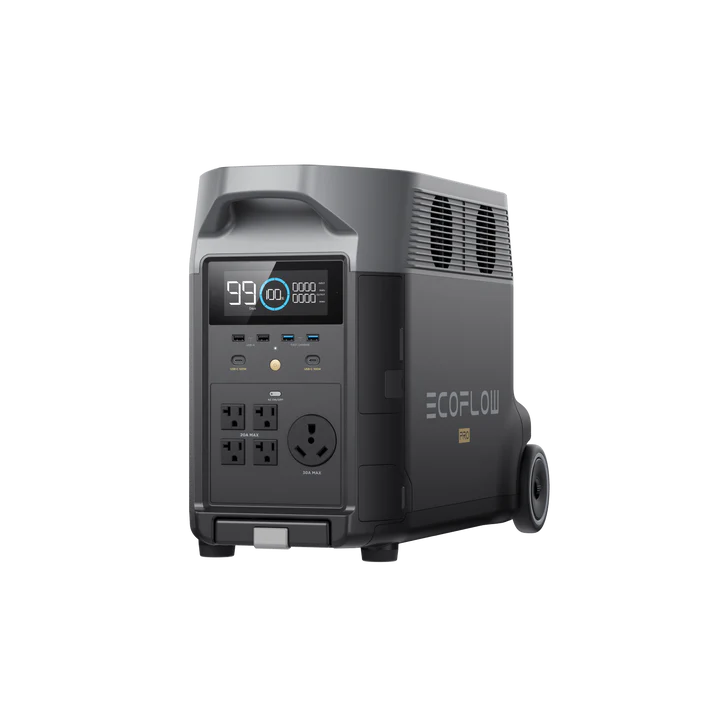
$1,899.00 · direct from EcoFlow
Last checked 1 day ago. Prices move — check before you buy.
Spec deltas
$629 buys 1,024Wh. $1,899 buys 3,600Wh. Work that out and the two land within a cent of each other per watt-hour ($.54 against $.53), which is the most useful thing on this page: EcoFlow is not charging a premium for the bigger box, it is charging for the watt-hours inside it.
So the DELTA Pro does not win here by being the better unit. It wins because the loads people bring to a 3,600Wh station are bigger than 870Wh, and 870Wh is what the DELTA 3 has to spend after the flat 15% allowance applied to every unit on this site. A blackout night draws 1,645Wh. A camping weekend, 2,100Wh. It misses both by margins no amount of careful load management closes.
The other direction is more interesting than the generation gap suggests. The newer unit wins on the figures, not on being newer: at least 4,000 cycles against the Pro's 3,500, a rated transfer class of no worse than 10ms against 20ms, and 27 lbs against 99. If your loads fit, you are not settling for the cheap one. You are buying the longer-lived pack and keeping the change.
What the Numbers Reveal
Each conclusion stated first — the numbers behind it on one line, the full analysis below.
rated cycles
And the cycle rating runs the other way. The cheaper, newer pack is rated for 500 more cycles than the expensive one, which removes the last comfortable story for over-buying: you cannot tell yourself the Pro is built better to justify capacity you will not discharge. The only honest reason to spend up is a load list that needs the watt-hours.
DELTA 3: $629 for 1,024Wh, or $.54 per WhDELTA Pro: $1,899 for 3,600Wh, or $.53 per WhDELTA 3 rated for a minimum of 4,000 cycles; DELTA Pro a minimum of 3,500
Why it mattersAnyone choosing the Pro for headroom rather than for a load they have added up in watt-hours is paying for a battery that never gets used, and carrying it.
solar input
In a multi-day outage that parity is the whole argument. The DELTA 3 cannot cover a single 1,645Wh night, so it needs sun every day and still comes up short before dark; the Pro covers the night and refills inside the same solar window. The extra capacity costs no extra daylight.
DELTA Pro accepts up to 1,600W of solar into 3,600WhDELTA 3 accepts up to 500W of solar into 1,024WhThe 8-hour blackout profile draws 1,645Wh, against the DELTA 3's 870Wh usable
Why it mattersIf you are buying for multi-day outages or off-grid weeks, stop comparing capacity and compare capacity per solar hour. That is the one place the Pro's price stops reading as a scale-up.
weight
That line is easy to feel in practice: a day of screens and phones finishes, and a day with a kettle or a space heater in it does not. The Pro deletes the arithmetic, and you pay for that certainty in 72 lbs you cannot lift one-handed, in a unit you site once rather than throw in the back seat.
Remote Workday needs 910Wh; the DELTA 3 has 870Wh after the flat 15% derateThe DELTA 3's nameplate 1,024Wh clears 910Wh outrightDELTA 3 weighs 27 lbs, DELTA Pro 99 lbs
Why it mattersIf your day is screens, take the DELTA 3 and stop doing sums. If anything on your list heats or cools, the arithmetic is not close enough to risk.
continuous output
The Pro's output advantage only appears on loads none of these profiles contain: a single 2,000W-plus appliance, or several heating elements at once. If your list is a fridge, screens, lights and a CPAP, the DELTA 3 starts and runs every item on it, and the decision collapses back to watt-hours.
DELTA 3: 1,800W rated output, 3,600W surgeDELTA Pro: 3,600W rated output, 7,200W surgeThe heaviest peak in any profile modeled here is 400W, at the tailgate
Why it mattersDo not let the 3,600W figure sell the Pro. Buy it for the battery or do not buy it.
The specific dimensions that decide these two units — everything else is a tie.
Runtime: Will It Power Your Gear?
Selected because: Three of the five completable loads on this page land between the DELTA 3's 870Wh of usable energy and the DELTA Pro's 3,060Wh, so usable capacity settles this before any other spec gets a vote.
continuous output
Usable energy is where this stops being a spec comparison and becomes a bedtime. The DELTA 3 has 870Wh to spend, the Pro 3,060Wh, and three of the loads modeled here sit in the gap between them. The DELTA 3 does not lose the camping weekend and the blackout night narrowly. It is not in the room for either.
The workday is the row worth staring at. It needs 910Wh, and the DELTA 3's nameplate 1,024Wh clears that outright; the flat derate is what pushes it under by 40Wh. Read it as a warning light rather than a failure, because a 40Wh margin is one small appliance either way.
Your Life, Your Pick
Selected because: The DELTA Pro takes four of six profiles, the DELTA 3 takes the CPAP night, and one belongs to neither, which maps exactly where the cheaper unit stops being enough.
Four rows to the Pro, one to the DELTA 3, one to neither. The DELTA 3's single win is the CPAP night, and it takes it with 550Wh of its usable energy still untouched, which is a better argument for the small unit than any row it lost is against it.
The Van Life row is the honest one. 4,685Wh a day beats both units, and the instructive number is the Pro's: still 1,625Wh short. When a scenario asks for more than the larger unit holds, the answer is not the larger unit.
Lifetime Value
Selected because: At 13 cents and 15 cents per lifetime kilowatt-hour, the two charge the same for stored energy, so this section exists to rule cost-per-kWh out as a tiebreaker.
Thirteen cents a lifetime kilowatt-hour for the DELTA 3, fifteen for the Pro. Two cents apart is not a reason to buy anything, and that is the finding: across each pack's rated life you pay about the same for stored energy, so this column cannot referee the matchup. All it establishes is that neither unit is the expensive mistake.
What it does expose is the shape of the spend. Five years of cover works out at $110 of purchase price per year on the DELTA 3 against $380 on the Pro, and since the term is identical, that spread is the price gap wearing a different hat. Capacity you use is fine at either rate. Capacity you do not is the most expensive way to own an idle battery.
Portability & Form Factor
Selected because: 27 lbs against 99 lbs is the other half of the price difference, and it decides what kind of trips each unit can be part of.
weight
Twenty-seven pounds is one hand and a car seat. Ninety-nine is a decision about where the unit lives. That is the fair way to read the weight gap: less a toll you pay on every trip than a limit on which trips exist at all. The DELTA 3 goes where you go, the Pro goes where you put it and mostly stays there.
The tailgate row makes it concrete. Both units cover a 670Wh afternoon without strain, so the reserve the Pro holds back is real and you never reach for it, while the 72 lb difference is in your forearms from the trunk to the setup spot.
Growth Path
Selected because: Both accept EcoFlow expansion batteries, so the real difference in growing a system is the feed: 500W of solar input against 1,600W.
solar input
Both take EcoFlow expansion batteries, so neither box is a ceiling and no-growth is not a knock on either one. The difference is the feed: 500W of solar into the DELTA 3 against 1,600W into the Pro. Adding capacity is the easy part. Keeping it full is the part that needs panels.
That is also why the bigger unit does not behave like a bigger chore. Three and a half times the battery with more than three times the solar input means the Pro's daily rhythm looks like the DELTA 3's, not like something you spend a weekend nursing back to full.
Strengths & trade-offs
EcoFlow DELTA 3
Strengths
- +Costs $1,270 less
- +Lighter by 72 lb
Trade-offs
- –Weaker inverter (-1,800W) limits appliance compatibility.
EcoFlow DELTA Pro
Strengths
- +Larger battery capacity
- +Higher AC output
- +Faster solar charging
Trade-offs
- –Substantially more expensive (+$1,270) than the DELTA 3.
- –Significantly heavier (+72 lbs), making it harder to move.
- –Very heavy unit that may be difficult for one person to lift.
- –Can receive complaints about fan noise under heavy load.
Will It Power Your Gear?
Scenario math and per-appliance runtimes, modeled from the spec record.
Scenario verdicts
We ran the math on six real-world scenarios. Here's which unit survives your actual life.
SCN-01 · 2 nights · needs 2,100Wh
Weekend Camping
Two nights off-grid with essential comfort
DELTA Pro
2,100Wh over a weekend is not a stretch goal for the DELTA 3, it is a different product. 870Wh of usable energy covers about 41% of the trip, so you would be rationing before the halfway point and hunting sun with a 500W ceiling to do it. The Pro finishes the weekend with 960Wh still in the bank.
Battery budget usedlower = more headroom
LOAD Phone Charger 15W×6h · LED Lights 40W×8h · Box Fan 75W×14h · CPAP Machine 40W×16h
SCN-02 · 8 hours · needs 1,645Wh
8-Hour Blackout
Keep the essentials running through a night without power
DELTA Pro
1,645Wh is the night. The DELTA 3 holds 870Wh of it, just over half, and outages do not stop at half. The Pro ends the same night with 1,415Wh unused, which is the margin that lets you go to sleep instead of doing mental arithmetic at midnight.
Battery budget usedlower = more headroom
LOAD Fridge 150W×8h · Router + Modem 20W×8h · LED Lights (4 bulbs) 40W×6h · Phone Charger 15W×3h
SCN-03 · 8 hours · needs 320Wh
CPAP Overnight
Sleep therapy without interruption — the #1 medical use case
DELTA 3
A CPAP is about 40W, so 320Wh covers the night and both units clear that several times over. The DELTA 3 takes this row on everything except capacity you will not touch: it finishes with 550Wh of its usable energy unused, lists the tighter UPS transfer class if it is riding a wall outlet when the power cuts, and at 27 lbs it can move to wherever your machine already sits. Buying 3,600Wh to move 320Wh is the textbook definition of over-buying.
Battery budget usedlower = more headroom
LOAD CPAP Machine 40W×8h
SCN-04 · 8 hours · needs 910Wh
Remote Workday
Full work day off-grid without power anxiety
DELTA Pro
The closest row on the page, and the DELTA 3 loses it by 40Wh. Its nameplate 1,024Wh clears the 910Wh day outright; the flat 15% allowance is what tips it under, so this row is decided as much by an accounting convention as by the battery. Take the Pro if you cannot afford to watch the percentage, since it ends the day with 2,150Wh spare. Take the DELTA 3 if you can leave one small appliance out of the day.
Battery budget usedlower = more headroom
LOAD Laptop 60W×8h · External Monitor 30W×8h · Router + Modem 20W×8h · Phone Charger 15W×2h
SCN-05 · 4 hours · needs 670Wh
Tailgate Party
Game day power for the crew
DELTA Pro
Both handle game day; the DELTA Pro keeps more in reserve (22% used vs 77%). Tailgating is a light load, though, so the number you'll feel is weight: 27 lbs for the DELTA 3 against 99 lbs for the DELTA Pro, from the trunk to the setup spot.
Battery budget usedlower = more headroom
LOAD Blender 400W×0.5h · LED TV (55") 80W×4h · Bluetooth Speaker 15W×4h · Phone Charger (×3) 45W×2h
SCN-06 · 24 hours · needs 4,685Wh
Van Life Daily
A full day of mobile living — the ultimate endurance test
Neither unit
Neither unit covers 4,685Wh a day. The DELTA 3 manages about a fifth of it, and the Pro reaches 65% and is still 1,625Wh short, which is the more useful figure: the big one is not close either. Full-time van power is a base station with expansion behind it and a real array on the roof, not a choice between these two.
Battery budget usedlower = more headroom
LOAD Mini-Fridge 150W×24h · Laptop 60W×4h · Phone Charger 15W×3h · LED Lights 40W×5h · Fan 75W×8h
The Load Test
RUNTIME = (Wh × 0.85) ÷ LOAD
None of the scenarios above exactly yours? Build it. Toggle what you'd plug in; both units are tested against the combined draw.
Essentials
Comfort & Convenience
High-Draw Appliances
Test duration
8h
Continuous draw
205W
Projected runtime
For this load: DELTA Pro runs 14.9h vs 4.2h.
$1,899 list · direct from EcoFlow
Modeled from the spec record — same math as the tables below. Methodology
Runtime by appliance
Real-world runtime estimates for common appliances, modeled at 85% inverter efficiency.¹
Essentials
The basics you need runningscale 0–204hComfort & Convenience
Makes off-grid life actually enjoyablescale 0–40.8hHigh-Draw Appliances
These reveal the real limitsscale 0–3.1h¹ Runtime = (capacity × 0.85) ÷ appliance watts. Within each group, all bars share one time scale (the group's longest runtime), so lengths are comparable across appliances; identical runtimes collapse into a single blue/orange bar. Actual runtime varies with battery age, temperature, and simultaneous loads — see methodology.
Conclusion
September 13, 2026
Verdict: the DELTA Pro, on Power Score margin
Buy the DELTA Pro if you are shopping this pair for the reasons people usually shop it: an 8-hour outage with a refrigerator in the kitchen draws 1,645Wh and a camping weekend 2,100Wh, and the DELTA 3 finishes neither. The Pro covers both with reserve left, and because it accepts up to 1,600W of solar it refills in roughly the same slice of daylight the smaller unit needs for its much smaller bank. Confidence is moderate rather than high because the DELTA 3 becomes the better instrument the moment your loads drop under about 870Wh usable: a third of the price, 72 lbs lighter, the higher minimum cycle rating and the tighter rated UPS transfer class. Add up your watt-hours before you spend the difference. That arithmetic decides this, not the model year.
Editor-assigned confidence, based on cited owner research and spec analysis.
List prices as of September 13, 2026. The links below open EcoFlow's current price.
$1,899.00 · direct from EcoFlow
Last checked 1 day ago. Prices move — check before you buy.
or check the DELTA 3 price$629.00 list
Written by Gunner Gustafson, Whole-Home Backup Tester · Station Arena Test Desk · Updated September 13, 2026
Measured Data
Benchmark scores and the full spec record, side by side.
Benchmark scores
Not rated for both units (minimum threshold unmet): CPAP, Tailgating, Apartment Balcony, Camping.
Full specifications
ᵈ Derived: price ÷ rated capacity. See the data behind our comparisons →
Comparison ToolAdd more power stations, side by sideOpen Tool →How these numbers are produced
Numeric verification
Every figure on this page traces to our spec database or arithmetic on it — no estimated numbers.
Owner claims
Statements about owner experience are cited to published reviews — see Sources & Research Notes below.
Runtime model
Runtime = (rated capacity × 0.85 inverter efficiency) ÷ device wattage. Solar recharge estimates assume panels deliver 70% of rated output. Cold weather, battery age, and stacked loads reduce real-world results.
Power Score
Computed from 14 published spec dimensions, weighted per use-case bench. Higher is better; a unit must meet a bench's minimum threshold to be rated.
See the full weight table and data sourcing on our methodology page →Class ranking (the star rating)
Each unit's star score is a category ranking, not customer reviews — no buyer opinions feed it. We score every station on size-independent quality (value, output, portability, endurance, ports, warranty, and more), then percentile-rank it against the other units in its capacity class, so a class-leading compact unit and a class-leading whole-home unit can both earn 5★. Here, DELTA 3 rates 4.4/5 (65th percentile of 27 Everyday-class units), and DELTA Pro rates 3.9/5 (33rd percentile of 16 Home Backup-class units).
How the class ranking is computed →Test Notes & Caveats
Hidden gotchas and advantages we spotted that you won't find on the product page.
DELTA Pro: 99 lbs Decides Where It Lives
Ninety-nine pounds against the DELTA 3's 27 is less a carrying problem than a siting decision. You move the Pro into place once, a basement corner, the back of a van, beside the panel, and after that it mostly stays, which is fine when the load comes to it and awkward when you are the one moving. The DELTA 3 is a one-hand lift you stop thinking about. If the unit has to travel with you, the gap is the whole argument. If it has a home, it is one afternoon.
Noise: Two Quiet-Mode Ratings, Not Two Measurements
The DELTA 3's 30dB and the Pro's 60dB are best-case floors published by the maker, typically a capped quiet mode, not readings taken at the load you will actually run, and not comparable across two generations of hardware as if both had sat in front of the same meter. The figure comes closest to meaning something at very low draw: around 40W for a CPAP is near the regime the rating describes, so leaning toward the DELTA 3 for a bedroom is fair. At 2,000W it tells you nothing about either unit. If sleeping beside it is the point, treat the gap as a direction to lean and check how each one behaves at low load before it goes near a bed.
UPS: No Worse Than 10ms vs No Worse Than 20ms
Both units list a UPS mode, and both figures are ceilings the maker promises not to exceed rather than stopwatch results. The DELTA 3's class is the tighter of the two and the one to lean on when what is plugged in is a desktop with unsaved work. The Pro's is comfortable on paper for routers, modems and most consumer electronics, with the fussiest PC power supplies sitting right about at that line. It is a quiet point in the newer unit's column that has nothing to do with size.
Warranty: Identical Terms, Very Different Bills
Both carry the same up-to-five-year term, so coverage is not a tiebreaker and the older design's age changes nothing about what EcoFlow owes you. The per-dollar version looks lopsided, $110 of purchase price per covered year on the DELTA 3 against $380 on the Pro, but that is the price gap restated rather than a difference in the terms. Read it as a reminder that the money here buys watt-hours, not protection.
Full record above — the Test Desk pick is the DELTA Pro.
Check DELTA Pro price →or check the DELTA 3 priceOwnership Analysis
What happens after you buy — true cost of ownership, brand trust, and growth potential.
Lifetime value
Service lifeyears at one full cycle per day
Lifetime energy delivered
Cost per delivered kWh
│ warranty ends · Reaching the cycle rating means ~80% capacity remains — degraded, not dead.
Analyst note
Both units cost the same to own over their rated lives — $0.15/kWh each. Lifetime cost can't separate them, so decide on the sticker price and everything else. One caution on the lifespan row: the DELTA 3 takes longer to reach its cycle rating, but a cycle moves a different amount of energy on each unit — the DELTA Pro still delivers more over its shorter horizon (12,600 vs 4,096 kWh). Years measure wear, not usefulness.
Growth path
DELTA 3
EXPANDABLESupports EcoFlow expansion batteries, so you can add capacity later without replacing the base unit — useful if your needs may climb past 1,024Wh.
Accepts up to 500W of solar. Suitable for a 1-2 panel setup.
Generous port selection supports complex multi-device setups.
Expansion batteries are EcoFlow-specific. You're investing in the EcoFlow ecosystem.
DELTA Pro
EXPANDABLESupports EcoFlow expansion batteries, so you can add capacity later without replacing the base unit — useful if your needs may climb past 3,600Wh.
Accepts up to 1,600W of solar. Enough for a serious multi-panel array.
Generous port selection supports complex multi-device setups.
Expansion batteries are EcoFlow-specific. You're investing in the EcoFlow ecosystem.
Realistic full solar rechargeat 70% of rated panel output — see methodology
Analyst note
Both expand, but the DELTA Pro's higher solar ceiling (1,600W vs 500W) gives it the stronger off-grid growth path — more panels can feed a bigger bank as it grows.
What Owners Report
Patterns from published owner reports and long-term reviews — every claim cited to its source below.
EcoFlow DELTA 3
Field data on the standard DELTA 3 is thin, and worth saying plainly: most published testing covers the Plus, Max and Ultra variants, which differ in capacity and fan behavior, so treat sentiment here as preliminaryA0. What is attributable to this model is encouraging for anyone sleeping near it. Under 200W the fans often stay off entirely, and at 500 to 800W they are barely audible from three feet awayA1.
The UPS story is the one to hold loosely. The observed handoff, quick enough that routers do not reset and CPAP therapy does not interrupt, comes from a sibling unit that shares the same 10ms rating rather than from this boxA2, which our own coverage note flags as unconfirmedA0. Good character reference, not proof.
“At low loads (under 200W) the fans often stay completely off, making the Delta 3 effectively silent; under moderate load (500–800W) the fans are barely audible from three feet away.”
Sources
portablepowernerd.com · thesolarlab.com · outputreport.com
EcoFlow DELTA Pro
The DELTA Pro has years of backup duty behind it, and it shows in how people describe it: a home-backup default built for high-draw appliances and full-scale expansion, running a fridge, lighting and a space heater through outagesB1, with one account covering months of overnight outages with essentials running at onceB3. That is the kind of record a newer unit cannot have yet.
The consistent knock is fan noise. Above roughly 2,000W the fans take on a noticeable high-pitched whine that is distracting in a quiet room, though lighter loads stay calmerB4. Weight is handled by integrated wheels and a telescoping handle that want flat, smooth ground, with a cart needed on anything rougherB2. Both of those come from coverage that mixes the original DELTA Pro with the newer, heavier Pro 3, so read them as line traits rather than measurements of this SKUB0.
“Long regarded as a gold standard for home backup — designed for high-draw appliances and full-scale battery expansion, running home essentials like a fridge, lighting, and a space heater through outages.”
Sources
backuppowerhub.com · us.ecoflow.co · outdoorgearlab.com · bobvila.com · powerstationadvisor.com · robbsutton.com
Sources & Research Notes
Every owner claim in this report is traceable to a published source. The bracketed references above resolve here.
Recurring owner themes
- Established home-backup platform with wheeled portability and massive expandability; the consistent knock is fan noise under heavy load. [DELTA Pro · 3 entries]
- A1
“At low loads (under 200W) the fans often stay completely off, making the Delta 3 effectively silent; under moderate load (500–800W) the fans are barely audible from three feet away.”
portablepowernerd.com — EcoFlow Delta 3 Tested: 2026 Hands-On Review; thesolarlab.com · 2026 · [positive]
- A2
“UPS switchover works as advertised — a power cut results in a ~10ms handoff, fast enough that routers don't reset, fridges don't skip a compressor cycle, and CPAP machines don't interrupt therapy.”
outputreport.com / thesolarlab.com — DELTA 3 line UPS testing (observed on DELTA 3 Plus, which shares the 10ms UPS spec) · 2026 · [positive]
- B1
“Long regarded as a gold standard for home backup — designed for high-draw appliances and full-scale battery expansion, running home essentials like a fridge, lighting, and a space heater through outages.”
backuppowerhub.com / us.ecoflow.com — EcoFlow DELTA Pro review · 2025-2026 · [positive]
- B2
“Heavy but wheeled — integrated wheels and a telescoping handle help move its considerable weight, though they work best on flat, smooth surfaces; a cart is needed for uneven ground.”
outdoorgearlab.com / bobvila.com — DELTA Pro-line review · 2025-2026 · [mixed]
- B3
“Reliable through extended outage use — served as primary backup across multiple overnight outages over months, powering essentials simultaneously; LFP battery rated for thousands of cycles and 10+ years of daily use.”
powerstationadvisor.com / robbsutton.com — DELTA Pro-line review · 2025-2026 · [positive]
- B4
“Not silent under heavy load — under 2000W-plus draws the fans emit a noticeable high-pitched whine that's distracting in a quiet room, though it runs quietly enough at lighter loads.”
outdoorgearlab.com — DELTA Pro-line noise testing · 2025-2026 · [negative]
Research compiled September 13, 2026.
What Owners Actually Report
Drawn from 173 comments on independent review channels — not from retailer reviews, which skew to the first week of ownership. Each line is our summary of one commenter's claim, linked to the original. We record what they said, including where it contradicts the spec sheet.
EcoFlow DELTA 3
34 claims from 26 comments · 17 from owners · 7 with figures
- Solar input
- 5 · 27% negative
- Runtime
- 3 · 66% negative
- Price & value
- 4 · 11% negative
- Build quality
- 2 · 100% negative
- Inverter & surge
- 2 · 0% negative
What owners complain about
At 30% charge it ran a 12V cool box for only 30 minutes against a claimed 12 hours at full charge.
Runtimemeasuredowner1 agreedsource →
AC-port surge protection is rated only 150 joules versus 1,800 on his UPS, so he chained both.
Build qualitymeasuredownersource →
Four 12V 100W panels in series give an overload error despite a 60V input rating.
Solar inputmeasuredownersource →
What owners praise
The same pressure washer ran on their DELTA 3 with no errors.
Inverter & surgemeasuredowner1 agreedsource →
Charges 0-100% in 1 hour on 1,000W of solar; 800W takes only 20 minutes longer.
Solar inputmeasuredowner1 agreedsource →
Bought a DELTA 3 from a Costco sale for $389 to replace a 1500VA UPS.
Price & valuemeasuredownersource →
EcoFlow DELTA Pro
211 claims from 147 comments · 155 from owners · 39 with figures
- Price & value
- 37 · 26% negative
- Durability
- 22 · 73% negative
- Solar input
- 23 · 35% negative
- Runtime
- 18 · 23% negative
- Other
- 18 · 48% negative
What owners complain about
Bought October 2023, died June 2024.
Durabilitymeasuredownerafter 8 months25 agreedsource →
The 100 lb weight of the DELTA Pro is no joke.
Size & weightmeasuredowner14 agreedsource →
Even the 767's loudest fan state is far quieter than the DELTA Pro.
Noiseowner41 agreedsource →
What owners praise
Charges two DELTA Pros from two ~2,500W strings running at about 125V.
Solar inputmeasuredowner13 agreedsource →
Electric bill fell from $250 a month to between $26 and $44.
Price & valuemeasuredowner14 agreedsource →
Delta Pro with battery and 800W of solar keeps him fully off grid and happy.
Runtimeownerafter 8 months62 agreedsource →
Claims are weighted by how specific they are, whether the commenter owns the unit, and how many readers agreed. Comments that mention a product under a rival's review count for more, because the commenter had no reason to be there. This is what buyers report, not our test results — for measurements we ran ourselves, see the methodology.
Who Should Buy Which
Buy the DELTA 3 if you…
- →Your heaviest day is screens: a laptop, a monitor, a pile of phones, maybe a CPAP overnight. That fits inside 870Wh, and the DELTA 3 is $1,270 less for the part of the battery you would actually reach.
- →You are the one carrying it. Tailgates, job sites, a car-camping kit that lives in the trunk. 27 lbs is a one-hand lift, and no amount of reserve capacity helps a unit you left at home because it was heavy.
- →You want a desk UPS. The DELTA 3 lists the tighter transfer class of the two, and desk loads are small enough that 1,800W of output is never the thing that limits you.
Buy the DELTA Pro if you…
- →You are buying for the lights going out with a refrigerator in the kitchen. That night draws 1,645Wh here, and the Pro is the only unit on this page that reaches morning, with 1,415Wh still in reserve.
- →You camp for a weekend rather than a night. 2,100Wh fits inside the Pro's 3,060Wh usable with 960Wh spare, so nobody is rationing on Sunday morning.
- →You plan to grow into panels. 1,600W of solar input is more than three times the DELTA 3's ceiling, and that ceiling is a property of the base unit no expansion battery changes.
If neither fits
If your daily draw looks like full-time van life, 4,685Wh in this model, close the tab on both. The Pro gets to 65% of that day and the DELTA 3 about a fifth, so the real choice is between a Pro with expansion batteries behind it and a larger base station built for the job, not between these two as sold. Buy the biggest unit on this page hoping it stretches and you end up owning two batteries and still watching the percentage at breakfast.
The Bottom Line
Take the DELTA Pro if your night is bigger than 870Wh, and any night with a refrigerator in it is. It covers the blackout and the camping weekend with reserve to spare, and because it accepts 1,600W of solar it refills in roughly the same window of daylight the DELTA 3 needs for a bank a third the size. Extra capacity that costs no extra sun is the strongest thing on its side of the page.
Take the DELTA 3 if you have done the arithmetic and your loads fit, and do not feel talked down to for it. Same brand, same warranty term, the higher cycle rating, the tighter rated transfer class, 72 lbs lighter, and a third of the money. The Pro wins this page. The DELTA 3 wins a lot of houses.
Frequently Asked Questions
Answers drawn from the spec record and cited owner research.
Is the DELTA Pro worth three and a half times the price of the DELTA 3?
Only if you need the watt-hours, because that is all the extra money buys. Per watt-hour the two are priced within a cent of each other, so the gap is capacity rather than quality, and the cheaper unit actually carries the higher minimum cycle rating. Add up what you need to run overnight: if it clears about 870Wh, the Pro earns the money. If it does not, you are paying for storage that never discharges.
Can the EcoFlow DELTA 3 run a refrigerator through a blackout?
Starting one is not the problem. The DELTA 3 is rated 1,800W continuous with 3,600W of surge, exactly double, and the heaviest peak in any profile on this page is 400W. Finishing the night is the problem. The 8-hour outage profile here draws 1,645Wh with the fridge and the rest of the essentials, against 870Wh of usable energy, so it holds the fridge cold for part of the night and then stops.
Which one is quieter if I am sleeping next to it?
The DELTA 3 on the evidence available, but the dB numbers on the box are not that evidence: both are manufacturer best-case floors, typically a capped quiet mode, and they were not measured at the same load or on the same generation of hardware. What is attributable to the DELTA 3 is that its fans often stay off entirely under 200W and are barely audible from three feet at 500 to 800W. For the DELTA Pro line, testing describes a high-pitched whine above roughly 2,000W with calmer behavior at light loads, from coverage that mixes in the newer Pro 3. At a 40W CPAP draw, lean DELTA 3.
The DELTA Pro is the older model, so is it still worth buying?
Judge it on the figures rather than the model year. Its age shows up as 500 fewer rated cycles than the DELTA 3 and a looser rated transfer class, no worse than 20ms against no worse than 10ms, and neither of those outweighs three and a half times the battery, twice the rated output and more than three times the solar input. The warranty term is identical on both. If you need the scale, the older design costs you very little here. If you do not, the newer unit is the better pack.
Can I buy the DELTA 3 now and add expansion batteries later?
Yes, both units take EcoFlow expansion batteries, so neither box is a dead end and starting small is a real option. Two cautions. Expansion adds capacity, not input: the DELTA 3's listed 500W solar ceiling is a property of the base unit, against 1,600W on the Pro, so a bigger bank behind the smaller unit refills more slowly. And if you already know your daily need runs into the thousands of watt-hours, pick the base closest to that number rather than planning around a stack you have not priced.
Where to buy
EcoFlow DELTA 3
$629.00
$629.00 · direct from EcoFlow
Last checked 1 day ago. Prices move — check before you buy.
EcoFlow DELTA ProPick
$1,899.00
$1,899.00 · direct from EcoFlow
Last checked 1 day ago. Prices move — check before you buy.
Prices may vary by retailer and are subject to change.