Head-to-head test
EcoFlow DELTA 3 Ultra Plus vs Jackery Explorer 2000 Plus
1,029 more watt-hours for $700 more is arithmetic even a tired camper can do — the Explorer 2000 Plus runs out mid-weekend, the DELTA 3 Ultra Plus doesn't.
Full profiles: EcoFlow DELTA 3 Ultra Plus → · Jackery Explorer 2000 Plus →

Written by Gunner GustafsonUpdated
Whole-Home Backup Tester, Station Arena Test Desk

$1,599.00 · direct from EcoFlow
Last checked 1 day ago. Prices move — check before you buy.
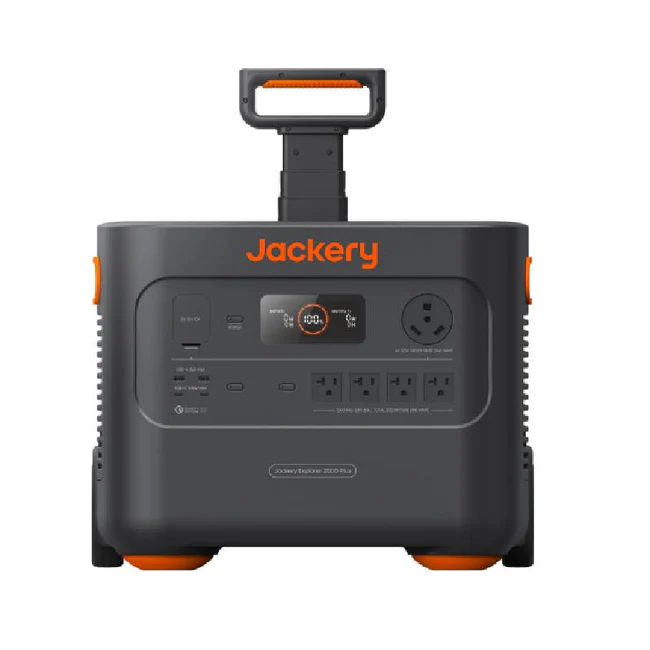
No longer sold
Jackery no longer sells the Explorer 2000 Plus as a standalone unit — the listing now carries only kits, the add-on battery and a refurbished unit. Its successor in the line is the HomePower 2000 Plus v2: the same 2 kWh class with a 2,400W inverter in the newer design.
HomePower 2000 Plus v2 · $1,199.00Spec deltas
The DELTA 3 Ultra Plus wins this one on a number the Explorer 2000 Plus can't argue with: 3,072Wh against 2,042.8Wh, a 1,029Wh gap for $700 more sticker price. Run that through the site's Weekend Camping scenario (2,100Wh of demand) and the abstraction turns concrete — the Jackery needs 121% of its capacity to cover the trip, meaning it comes home dead partway through Sunday, while the Delta uses 80% and still has a reserve for the drive back.
Both units share more than they differ on: identical 4,000-cycle batteries, identical 5-year warranties, identical 100W USB-C, and near-identical fan noise at 30dBA. This isn't a matchup where one company shipped a dated unit — it's two current flagships, and the separation is almost entirely capacity, output, and refill speed. The DELTA 3 Ultra Plus outputs 3,600W continuous against 3,000W, and takes solar at 1,600W against 1,200W, a 400W head start every sunny morning of a multi-day trip.
Where the Jackery pulls back some ground: it's 15.7 lbs lighter at 61.5 lbs, and its expansion story goes further on paper — pair two units and Jackery quotes up to 24kWh and 6,000W combined. If you already know you're building a permanent bank rather than running either unit stock, that ceiling is worth weighing against the Delta's day-one capacity lead.
What the Numbers Reveal
Each conclusion stated first — the numbers behind it on one line, the full analysis below.
Capacity
$700 is less than most people spend on the campground fees for that same weekend, and it buys the difference between a power station that finishes the trip and one that taps out Saturday night.
Weekend Camping scenario needs 2,100WhDELTA 3 Ultra Plus uses 80% of its 3,072Wh capacity (handles it); Explorer 2000 Plus needs 121% of its 2,042.8Wh capacity (can't)Price gap is $700 ($1,599 vs $899)
Why it mattersAnyone planning to run a multi-day trip off a single charge, with no vehicle or wall outlet to top off from, should pay the $700.
Because cycle life is tied at 4,000 on both, the extra weight buys no durability offset — it's a pure tax paid in exchange for the capacity gap, not a tradeoff against longevity.
Explorer 2000 Plus weighs 61.5 lbs and owners describe it as a two-person lift for stairs even at that weightB3DELTA 3 Ultra Plus weighs 77.2 lbs, described by reviewers as "a thunderous 74 pounds"A9Both units carry identical 4,000-cycle batteries
Why it mattersBuyers without a dolly, a truck tailgate, or a fixed spot for the unit to live should weight this heavily; anyone parking it once and rarely moving it loses nothing by ignoring it.
For most electronics 10 or 20 milliseconds is invisible, but for gear that reboots on any interruption — a CPAP, a desktop workstation mid-save, a medical fridge — that gap is the difference between a blackout you slept through and one you didn't.
DELTA 3 Ultra Plus switches over in 10ms; Explorer 2000 Plus in 20msReviewers report zero shut-offs or power dips when unplugging the DELTA 3 Ultra Plus from the wallA6
Why it mattersBuyers running sensitive or life-support-adjacent equipment should treat the faster switchover as decisive, even though both units technically pass the site's CPAP Overnight scenario.
The specific dimensions that decide these two units — everything else is a tie.
Lifetime Value
Selected because: Cost-per-kWh gap ($0.12 vs $0.15) is the cleanest number for a $700 price difference.
cost / lifetime kWh
Twelve cents against fifteen cents per lifetime kilowatt-hour. Once you've read that, the rest of this section is a footnote to it — the Delta earns back its $700 premium through capacity alone, before you even factor in the faster charging or the higher output ceiling.
The Jackery isn't a bad value; $0.15/kWh over a 4,000-cycle life is still a fair price for reliable LFP storage. It's just the more expensive way to buy energy, in a category where the whole point is buying energy.
Your Life, Your Pick
Selected because: Weekend Camping is the scenario where the Jackery mathematically can't finish; worth showing directly.
Weekend Camping is where this pair stops being close. The Jackery needs 121% of its capacity for a 2,100Wh weekend; it cannot do the job without a mid-trip recharge. The Delta uses 80% and comes home with room to spare.
Everywhere else, both units clear the bar — CPAP Overnight, Remote Workday, Tailgate Party all land comfortably inside both batteries, just with a wider cushion on the Delta's side. Van Life Daily beats both of them; a 4,685Wh daily load is a different unit's problem entirely, not a knock on either of these.
Portability & Form Factor
Selected because: Weight gotcha fires; the 15.7 lb gap is the Jackery's strongest counter-argument.
weight
Seventy-seven point two pounds and sixty-one point five pounds are both two-hands, bent-knees numbers — neither of these is a unit you swing off a shelf one-handed. The Jackery is the easier lift of the two, and owners already call it a two-person job for stairsB3, which tells you where the Delta lands on the same staircase.
If the unit lives in one spot — a closet, a garage shelf, the back of a van that's already outfitted — the weight gap barely matters after the first placement. It matters most for anyone who's loading and unloading a trunk every weekend.
Growth Path
Selected because: Jackery's dual-unit 24kWh ceiling is a genuine edge worth surfacing honestly.
solar input
Both units expand, and both take solar seriously, but they lead with different strengths. The Delta's 1,600W solar ceiling — 400W ahead of the Jackery's 1,200W — means every off-grid day refills faster, which compounds the longer a trip runs.
The Jackery's counter is real: pair two Explorer 2000 Plus units and Jackery quotes up to 24kWh and 6,000W combinedB2, a bigger stated maximum than anything in the Delta's specs here. If you're planning a permanent multi-battery bank rather than buying one unit to run stock, that ceiling deserves its own look before you decide on capacity alone.
Strengths & trade-offs
EcoFlow DELTA 3 Ultra Plus
Strengths
- +Larger battery capacity
- +Higher AC output
- +Faster solar charging
Trade-offs
- –Substantially more expensive (+$700) than the Explorer 2000 Plus.
- –Significantly heavier (+12.8 lbs), making it harder to move.
Jackery Explorer 2000 Plus
Strengths
- +Costs $700 less
- +Lighter by 12.8 lb
Trade-offs
- –Weaker inverter (-600W) limits appliance compatibility.
Will It Power Your Gear?
Scenario math and per-appliance runtimes, modeled from the spec record.
Scenario verdicts
We ran the math on six real-world scenarios. Here's which unit survives your actual life.
SCN-01 · 2 nights · needs 2,100Wh
Weekend Camping
Two nights off-grid with essential comfort
DELTA 3 Ultra Plus
The Explorer 2000 Plus doesn't finish — 1,736Wh usable against the 2,100Wh this needs leaves it 364Wh short, about 83% of the scenario covered. The DELTA 3 Ultra Plus covers it with 511Wh to spare.
Battery budget usedlower = more headroom
LOAD Phone Charger 15W×6h · LED Lights 40W×8h · Box Fan 75W×14h · CPAP Machine 40W×16h
SCN-02 · 8 hours · needs 1,645Wh
8-Hour Blackout
Keep the essentials running through a night without power
DELTA 3 Ultra Plus
Both survive the night. The DELTA 3 Ultra Plus finishes at 63% used with 966Wh left — 59% of a second night. The Explorer 2000 Plus finishes at 95% with 91Wh, 6% of a second night. If your outages tend to run past one evening, that difference is the whole argument between them.
Battery budget usedlower = more headroom
LOAD Fridge 150W×8h · Router + Modem 20W×8h · LED Lights (4 bulbs) 40W×6h · Phone Charger 15W×3h
SCN-03 · 8 hours · needs 320Wh
CPAP Overnight
Sleep therapy without interruption — the #1 medical use case
Either unit
A CPAP is about 40W for eight hours, so both cover the night many times over and the capacity margin is a formality. Both happen to list 30dB — two makers' own figures landing on the same number rather than a measured tie — so there is nothing in the noise column to separate them either. Buy whichever is cheaper or easier to carry.
Battery budget usedlower = more headroom
LOAD CPAP Machine 40W×8h
SCN-04 · 8 hours · needs 910Wh
Remote Workday
Full work day off-grid without power anxiety
DELTA 3 Ultra Plus
The DELTA 3 Ultra Plus clears the workday at 35% used, banking 1,701Wh — late work, extra calls, or a second laptop charge without arithmetic. The Explorer 2000 Plus at 52% also finishes, with 826Wh of slack for the unplanned.
Battery budget usedlower = more headroom
LOAD Laptop 60W×8h · External Monitor 30W×8h · Router + Modem 20W×8h · Phone Charger 15W×2h
SCN-05 · 4 hours · needs 670Wh
Tailgate Party
Game day power for the crew
DELTA 3 Ultra Plus
Both handle game day; the DELTA 3 Ultra Plus keeps more in reserve (26% used vs 39%). Tailgating is a light load, though, so the number you'll feel is weight: 61.5 lbs for the Explorer 2000 Plus against 74.3 lbs for the DELTA 3 Ultra Plus, from the trunk to the setup spot.
Battery budget usedlower = more headroom
LOAD Blender 400W×0.5h · LED TV (55") 80W×4h · Bluetooth Speaker 15W×4h · Phone Charger (×3) 45W×2h
SCN-06 · 24 hours · needs 4,685Wh
Van Life Daily
A full day of mobile living — the ultimate endurance test
Neither unit
Neither unit covers this scenario's 4,685Wh: the DELTA 3 Ultra Plus comes up 2,074Wh short (about 56% covered), the Explorer 2000 Plus 2,949Wh (37%). Treat this as partial cover — enough for the essentials in it, not the whole list.
Battery budget usedlower = more headroom
LOAD Mini-Fridge 150W×24h · Laptop 60W×4h · Phone Charger 15W×3h · LED Lights 40W×5h · Fan 75W×8h
The Load Test
RUNTIME = (Wh × 0.85) ÷ LOAD
None of the scenarios above exactly yours? Build it. Toggle what you'd plug in; both units are tested against the combined draw.
Essentials
Comfort & Convenience
High-Draw Appliances
Test duration
8h
Continuous draw
205W
Projected runtime
For this load: DELTA 3 Ultra Plus runs 12.7h vs 8.5h.
$1,599 list · direct from EcoFlow
Modeled from the spec record — same math as the tables below. Methodology
Runtime by appliance
Real-world runtime estimates for common appliances, modeled at 85% inverter efficiency.¹
Essentials
The basics you need runningscale 0–174.1hComfort & Convenience
Makes off-grid life actually enjoyablescale 0–34.8hHigh-Draw Appliances
These reveal the real limitsscale 0–2.6h¹ Runtime = (capacity × 0.85) ÷ appliance watts. Within each group, all bars share one time scale (the group's longest runtime), so lengths are comparable across appliances; identical runtimes collapse into a single blue/orange bar. Actual runtime varies with battery age, temperature, and simultaneous loads — see methodology.
Conclusion
July 14, 2026
Verdict: the DELTA 3 Ultra Plus, on Power Score margin
The DELTA 3 Ultra Plus carries 3,072Wh against the Explorer 2000 Plus's 2,042.8Wh, a gap that shows up directly in the numbers: at $1,599 versus $899, it costs $0.12 per lifetime kWh against $0.15, and it's the only one of the two that clears the site's Weekend Camping load (80% used versus 121% — the Jackery simply can't finish that trip on one charge). The Jackery answers back with 15.7 fewer pounds and a genuinely bigger maximum expansion ceiling (up to 24kWh with a second unit), so a buyer who's building toward a permanent multi-battery setup and never plans to run either unit stock has a real reason to look at it instead.
Editor-assigned confidence, based on cited owner research and spec analysis.
List prices as of July 14, 2026. The links below open EcoFlow's and Jackery's current prices.
$1,599.00 · direct from EcoFlow
Last checked 1 day ago. Prices move — check before you buy.
or check the Explorer 2000 Plus price$899.00 list
Written by Gunner Gustafson, Whole-Home Backup Tester · Station Arena Test Desk · Updated July 14, 2026
Measured Data
Benchmark scores and the full spec record, side by side.
Benchmark scores
Not rated for both units (minimum threshold unmet): Apartment Balcony.
Full specifications
ᵈ Derived: price ÷ rated capacity. See the data behind our comparisons →
Comparison ToolAdd more power stations, side by sideOpen Tool →How these numbers are produced
Numeric verification
Every figure on this page traces to our spec database or arithmetic on it — no estimated numbers.
Owner claims
Statements about owner experience are cited to published reviews — see Sources & Research Notes below.
Runtime model
Runtime = (rated capacity × 0.85 inverter efficiency) ÷ device wattage. Solar recharge estimates assume panels deliver 70% of rated output. Cold weather, battery age, and stacked loads reduce real-world results.
Power Score
Computed from 14 published spec dimensions, weighted per use-case bench. Higher is better; a unit must meet a bench's minimum threshold to be rated.
See the full weight table and data sourcing on our methodology page →Class ranking (the star rating)
Each unit's star score is a category ranking, not customer reviews — no buyer opinions feed it. We score every station on size-independent quality (value, output, portability, endurance, ports, warranty, and more), then percentile-rank it against the other units in its capacity class, so a class-leading compact unit and a class-leading whole-home unit can both earn 5★. Here, DELTA 3 Ultra Plus rates 4.9/5 (92nd percentile of 26 Large-class units), and Explorer 2000 Plus rates 4.5/5 (68th percentile of 26 Large-class units).
How the class ranking is computed →Test Notes & Caveats
Hidden gotchas and advantages we spotted that you won't find on the product page.
Both Are Two-Hands Lifts
77.2 lbs and 61.5 lbs are both bent-knees numbers, not one-hand-off-the-shelf ones. Owners already call the lighter Jackery a two-person job on stairs — plan the Delta's extra 15.7 lbs accordingly, especially if it's living somewhere without a flat, wheeled path in.
10ms vs 20ms: Both Pass, One Has More Margin
Both switchover speeds clear what most home electronics need. The gap only matters for gear that can't tolerate any interruption — treat the Delta's 10ms as the safer number if you're running a CPAP, a NAS, or anything mid-write when the power drops.
Warranty: No Difference
Both units carry the same 5-year warranty, so coverage isn't a tiebreaker here. The Explorer 2000 Plus's figure is a maximum rather than a guarantee — it depends on registering the unit with Jackery, which is what extends the base term to the full period. Worth saying because the per-dollar framing can suggest otherwise: the Explorer 2000 Plus works out at 5.6 years of cover per $1,000 spent against the DELTA 3 Ultra Plus's 3.1, but that spread is the price gap, not the terms.
Full record above — the Test Desk pick is the DELTA 3 Ultra Plus.
Check DELTA 3 Ultra Plus price →or check the Explorer 2000 Plus priceOwnership Analysis
What happens after you buy — true cost of ownership, brand trust, and growth potential.
Lifetime value
Service lifeyears at one full cycle per day
Lifetime energy delivered
Cost per delivered kWh
│ warranty ends · Reaching the cycle rating means ~80% capacity remains — degraded, not dead.
Analyst note
Both units have similar long-term ownership costs ($0.13/kWh vs $0.11/kWh). The price difference is what you see on the sticker — neither is a hidden bargain or rip-off. One thing to know reading the table: both carry the same 4,000-cycle rating, so the lifetime rows are sticker price and capacity in disguise — the wear horizon is identical and decides nothing here.
Brand trust
EcoFlow
Ecosystem
Largest in portable power — 12-15 models across DELTA Pro, DELTA 3, and RIVER 3 series, plus solar panels and smart home panels
Support
US-based phone/email/chat support (1-800-368-8604). Experiences are polarized — many report hassle-free prepaid-label replacements, but others report long waits and refurbished units sent for new claims. Pro tip: buying from Costco or Amazon gives you a stronger return safety net.
Community
Largest community in the space — Reddit r/Ecoflow_community (~31K members), multiple Facebook groups, and an official community forum
App experience
Rated 4.6/5 iOS (~8,400 ratings) · 4.2/5 Android (~17,000 ratings)
Unique strength
Deepest ecosystem in the category and the largest community (Reddit r/Ecoflow_community, ~31K members) — useful if you want troubleshooting help or accessory compatibility answers fast.
Worth knowing
Support experiences are polarized; buying through Costco or Amazon gives a stronger return safety net than going direct.
Jackery
Ecosystem
12-15+ models across Explorer (portable) and HomePower (home backup) series, plus SolarSaga panel ecosystem and innovative form factors
Support
US-based support but widely criticized. Reddit reports describe slow/dismissive responses, scripted AI agents, strict receipt requirements for warranty claims, and refurbished replacements for clearly defective units. Strongly recommended: buy from Costco or Amazon for return protection.
Community
Smallest community of the major brands — Reddit r/Jackery has ~2,000 members. YouTube presence is solid due to brand recognition.
App experience
Rated 2.3-3.3/5 iOS and Android — the weakest app experience of the major brands. Multiple confusing apps (Jackery app vs Jackery Home) and mandatory login even offline.
Unique strength
The widest retail footprint of any brand here — Costco, Home Depot, Best Buy, Amazon all carry it, which matters if you want to see or return the unit in person.
Worth knowing
Jackery's community is the smallest of the major brands (Reddit r/Jackery, ~2,000 members) and its app trails the category — expect fewer crowdsourced answers if something goes wrong.
Analyst note
EcoFlow's advantage here is ecosystem depth and community size; Jackery's is retail reach and brand recognition. Neither support org is uniformly excellent, so buying through a big-box retailer's return window is the more reliable hedge with either brand.
Growth path
DELTA 3 Ultra Plus
EXPANDABLESupports EcoFlow expansion batteries, so you can add capacity later without replacing the base unit — useful if your needs may climb past 3,072Wh.
Accepts up to 1,600W of solar. Enough for a serious multi-panel array.
Generous port selection supports complex multi-device setups.
Expansion batteries are EcoFlow-specific. You're investing in the EcoFlow ecosystem.
Explorer 2000 Plus
EXPANDABLESupports Jackery expansion batteries, so you can add capacity later without replacing the base unit — useful if your needs may climb past 2,043Wh.
Accepts up to 1,200W of solar. Enough for a serious multi-panel array.
Adequate ports for most setups, but heavy users may want a power strip.
Expansion batteries are Jackery-specific. You're investing in the Jackery ecosystem.
Realistic full solar rechargeat 70% of rated panel output — see methodology
Analyst note
Both expand, but the DELTA 3 Ultra Plus's higher solar ceiling (1,600W vs 1,200W) gives it the stronger off-grid growth path — more panels can feed a bigger bank as it grows.
What Owners Report
Patterns from published owner reports and long-term reviews — every claim cited to its source below.
EcoFlow DELTA 3 Ultra Plus
Reviewers keep landing on the same surprise: a 77.2 lb, 3,600W unit that doesn't sound like it. "Even when you're pushing it hard, the DELTA 3 Ultra Plus runs much quieter than older EcoFlow models"A1, with one reviewer comparing the noise to EcoFlow's flagship DELTA Pro UltraA2 — high praise for a unit at this price. Build quality gets the same treatment: "it does not feel cheap or fragile," from the shell to the AC cableA8.
The honest catch is the weight itself — "weighing in at a thunderous 74 pounds, the Ultra is not considered lightweight by any standards"A9 — and reviewers were split on the $2,899 MSRP before noting the street price tells the real story: at $1,599–$1,599, "the value equation shifts dramatically in the Ultra Plus's favor"A11. One remote worker ran a full eight-hour day — laptop, desktop, monitors — and still had 40% leftA5, which is the kind of margin that makes the capacity gap over the Jackery feel earned rather than theoretical. This is a recently released unit, so most of this comes from professional reviewers running short-term tests rather than owners with six months on the clock — worth knowing before you weight it as heavily as a longer track record.
“even when you're pushing it hard, the DELTA 3 Ultra Plus runs much quieter than older EcoFlow models, like the DELTA 2 Max”
Sources
thesolarlab.com · postperspective.com · appleinsider.com · digitaltrends.com · storagereview.com
Jackery Explorer 2000 Plus
The Explorer 2000 Plus reads as the dependable, no-drama choice — reviewers call it easy to use and relatively quiet even under a 3,000W load, with wide enough compatibility to run a CPAP or an electric grill off the same unitB1. Its IP65-rated ports and a tank-like build back that upB5.
Weight comes up unprompted: "not light at around 61-62 lbs... it still demands a two-person lift for stairs"B3. The app draws mixed marks — "pro-level insights like cycle counts and efficiency graphs," but reviewers flag it as still needing polishB4. The standout is expansion: pair two units for up to 24kWh and 6,000W combined, which reviewers frame as genuinely suited to RVs and serious off-grid setupsB2.
“Reviewers describe it as dependable, easy to use, and relatively quiet even under a 3000W load, with universal compatibility for powering everything from CPAP machines to electric grills.”
Sources
outdoorgearlab.com · thesolarpit.com · jackery.com · voltagebasics.com · storagereview.com · thesolarlab.com · tipselite3s.com
Sources & Research Notes
Every owner claim in this report is traceable to a published source. The bracketed references above resolve here.
Recurring owner themes
- Professional reviewers consistently describe the fan noise as very quiet even under heavy load, comparable to EcoFlow's premium DELTA Pro Ultra line. [DELTA 3 Ultra Plus · 3 entries]
- Reviewers report solid UPS/pass-through charging performance with no noticeable switchover issues or output throttling tied to input wattage. [DELTA 3 Ultra Plus · 2 entries]
- The unit's high weight (~74 lbs) and premium MSRP are repeatedly flagged as drawbacks, though discounted street pricing is seen as making the value proposition much stronger. [DELTA 3 Ultra Plus · 3 entries]
- Build quality/durability is praised as substantial and non-fragile across multiple independent reviews. [DELTA 3 Ultra Plus · 2 entries]
- Standout expandability (up to 24kWh dual), a rugged IP65 build with wheels, and dependable quiet operation are the praise; the heavy weight and an app that needs polish are the caveats. [Explorer 2000 Plus · 3 entries]
- A1
“even when you're pushing it hard, the DELTA 3 Ultra Plus runs much quieter than older EcoFlow models, like the DELTA 2 Max”
thesolarlab.com — EcoFlow DELTA 3 Ultra Plus Review: The Ultimate DELTA? · unknown · [positive]
- A2
“we'd probably say the noise it creates is similar to what you hear when you run the DELTA Pro Ultra, which is pretty amazing”
thesolarlab.com — EcoFlow DELTA 3 Ultra Plus Review: The Ultimate DELTA? · unknown · [positive]
- A5
“I was able to work remotely for an eight-hour day with 40% power left, which included running my laptop, desktop workstation and monitors”
postperspective.com — Review: EcoFlow Delta 3 Ultra Plus Portable Power Station · 2026-04 · [positive]
- A6
“I didn't experience any shut-offs or dips when I unplugged the EcoFlow from the wall”
postperspective.com — Review: EcoFlow Delta 3 Ultra Plus Portable Power Station · 2026-04 · [positive]
- A8
“It does not feel cheap or fragile. Everything from the outer shell case to the plastic buttons and the AC cable feels substantial and durable”
appleinsider.com — EcoFlow Delta 3 Ultra Plus review: Premium, but solid power · 2025-11 · [positive]
- A9
“Weighing in at a thunderous 74 pounds, the Ultra is not considered lightweight by any standards”
appleinsider.com — EcoFlow Delta 3 Ultra Plus review: Premium, but solid power · 2025-11 · [mixed]
- A11
“At the heavily discounted street price of around $1,499–$1,599, the value equation shifts dramatically in the Ultra Plus's favor”
digitaltrends.com — EcoFlow DELTA 3 Ultra Plus Review: Portability meets serious firepower · unknown · [positive]
- B1
“Reviewers describe it as dependable, easy to use, and relatively quiet even under a 3000W load, with universal compatibility for powering everything from CPAP machines to electric grills.”
outdoorgearlab.com / thesolarpit.com — Jackery Explorer 2000 Plus review · 2026 · [positive]
- B2
“Massive expandability — each unit's battery expands up to 12kWh, and pairing two units gives 6000W output and up to 24kWh total, ideal for RVs, home backup, or serious off-grid setups.”
jackery.com / thesolarpit.com — Explorer 2000 Plus review · 2026 · [positive]
- B3
“Not light at around 61-62 lbs — included wheels and a handle help on smooth surfaces, but it still demands a two-person lift for stairs.”
outdoorgearlab.com / voltagebasics.com — Explorer 2000 Plus review · 2026 · [mixed]
- B4
“The app nails the essentials with pro-level insights like cycle counts and efficiency graphs, but it lacks some of the bells and whistles of rivals and still needs polishing.”
storagereview.com / thesolarlab.com — Explorer 2000 Plus review · 2026 · [mixed]
- B5
“Strong solar with two MPPT inputs (up to ~1,200-1,400W), plus a tank-like build with IP65 dust and water resistance on key ports.”
storagereview.com / tipselite3s.com — Explorer 2000 Plus review · 2026 · [positive]
Research compiled July 14, 2026.
Who Should Buy Which
Buy the DELTA 3 Ultra Plus if you…
- →Anyone running the site's Weekend Camping load or heavier off one charge, with no plan to top off mid-trip
- →Buyers who want the faster solar refill (1,600W) for multi-day off-grid stretches
- →Households running sensitive electronics where the 10ms switchover and confirmed zero-dip pass-throughA6 matter
Buy the Explorer 2000 Plus if you…
- →Buyers who move the unit often and want every pound they can get — 15.7 lbs lighter, still a two-person stair job but a lighter one
- →Anyone planning a permanent dual-unit bank and shopping the 24kWh maximum ceiling rather than day-one capacity
- →Budget-conscious buyers who don't need the extra 1,029Wh and would rather save the $700
This is you — check the Explorer 2000 Plus price
If neither fits
If your load never exceeds a phone, a laptop, and a lamp for a night or two, both of these are more unit than you need — look at something in the 1,000–1,500Wh class instead and keep the $899+ in your pocket.
The Bottom Line
The DELTA 3 Ultra Plus wins because the numbers that matter most for how these get used — capacity, output, refill speed, cost per lifetime kWh — all point the same direction, and the Weekend Camping scenario shows exactly what that means in practice: one of these finishes the trip, the other doesn't.
The Jackery isn't a worse unit; it's a lighter, cheaper one with a bigger expansion ceiling for buyers building toward something permanent. But for running one unit stock on real trips, pay the $700.
Frequently Asked Questions
Answers drawn from the spec record and cited owner research.
Is the EcoFlow DELTA 3 Ultra Plus worth $700 more than the Jackery Explorer 2000 Plus?
For most buyers, yes. The extra $700 buys 1,029 more watt-hours, 600W more continuous output, and a lower cost per lifetime kWh ($0.12 vs $0.15). It's also the only one of the two that clears the site's Weekend Camping scenario on a single charge.
Which one is easier to carry?
The Jackery, by 15.7 lbs (61.5 lbs vs 77.2 lbs) — though owners already describe the Jackery as a two-person lift for stairs, so neither is a one-hand carry. If portability is the priority and you don't need the extra capacity, the Jackery is the lighter buy.
Can either of these run a CPAP overnight?
Yes, comfortably — the site's CPAP Overnight scenario uses just 12% of the Delta's capacity and 18% of the Jackery's. The more relevant difference for CPAP users is switchover speed: the Delta's 10ms transfer is twice as fast as the Jackery's 20ms.
Which has the bigger expansion ceiling?
The Jackery, on paper — pairing two Explorer 2000 Plus units reaches up to 24kWh and 6,000W combined. The Delta's growth path leans on a faster solar ceiling (1,600W vs 1,200W) rather than a stated maximum expansion figure in this comparison.
Is either of these enough to run a van full-time?
No. The site's Van Life Daily scenario needs 4,685Wh; the Delta would need 179% of its capacity and the Jackery 270%. Both are built for camping trips, blackouts, and workdays, not for replacing a van's daily power draw unexpanded.
Brand matchup
EcoFlow vs Jackery: measured across every matchup →Where to buy
EcoFlow DELTA 3 Ultra PlusPick
$1,599.00
$1,599.00 · direct from EcoFlow
Last checked 1 day ago. Prices move — check before you buy.
Jackery Explorer 2000 Plus
$899.00
$899.00 · direct from Jackery
Last checked 21 days ago. Prices move — check before you buy.
Prices may vary by retailer and are subject to change.