Head-to-head test
EcoFlow DELTA 3 Classic vs BLUETTI Apex 300
The only question that settles this is whether your worst day fits under 870 usable watt-hours, because one of these is a 26.7 lb box you carry to the problem and the other is 83.8 lbs you install and leave.
Full profiles: EcoFlow DELTA 3 Classic → · BLUETTI Apex 300 →

Written by Ian SchneiderUpdated
Solar & Off-Grid Tester, Station Arena Test Desk
Spec deltas
The DELTA 3 Classic fails four of our six load profiles and the Apex 300 fails one, and that's very nearly the least useful way to summarize this matchup. $499 against $1,699. 26.7 lbs against 83.8. These two aren't competing for the same buyer. They're competing for the same search result.
The number that decides it is 870 watt-hours, which is what the DELTA 3 Classic actually delivers after the standard 85% inverter derate on its 1,024Wh nameplate. The Apex 300's equivalent is 2,350Wh. Everything else on this page is downstream of where your own worst day lands against those two figures.
So there's no winner here in the usual sense, and pretending otherwise costs somebody either $1,200 they didn't need to spend or a unit that stops at 2 a.m. Under 870Wh, take the DELTA and carry it one-handed. Over it, the cheaper unit doesn't get you most of the way there. And if your number is 4,685Wh a day, which is what full-time van life draws in our model, close this tab: neither of these covers it.
What the Numbers Reveal
Each conclusion stated first — the numbers behind it on one line, the full analysis below.
Bring the price gap in and the two failures point opposite directions. $1,200 is an absurd amount to spend closing a 40Wh gap you could close by switching off a fan at four o'clock, and a completely reasonable amount to spend when you're 775Wh from morning with the grid down. The DELTA 3 Classic is not a smaller Apex 300. It's a unit with a hard edge at 870Wh, and where your load sits relative to that edge is the whole purchase.
DELTA 3 Classic: 1,024Wh nameplate, 870Wh usable after the 85% derateRemote Workday needs 910Wh, leaving the DELTA 3 Classic 40Wh short8-Hour Blackout needs 1,645Wh, leaving the DELTA 3 Classic 775Wh short
Why it mattersAnyone reading the fail column as a blanket verdict on the DELTA 3 Classic should re-add their own daily watt-hours before spending the difference.
solar input
Those numbers describe the DELTA 3 Classic precisely. It refills brilliantly from a socket and slowly from panels, and no amount of roof space changes the second half of that sentence, because 500W is the ceiling regardless of what you plug into it. The Apex 300 is the opposite animal, built to swallow a roof's worth of input into a bank nearly three times the size.
Apex 300 accepts 2,400W solar input; DELTA 3 Classic caps at 500WCapacities of 2,764.8Wh and 1,024WhReviewers measured the DELTA 3 Classic empty to full on a wall outlet at just shy of 55 minutesA1 and flagged the 500W solar cap as low for a 2026 releaseA5A9
Why it mattersIf your recharge source is a wall outlet, the 500W cap costs you nothing; if it's panels, it's the entire difference between these two.
rated cycles
What survives the arithmetic is a premium on capacity, not on ownership. The Apex 300 works out at about 61 cents a watt-hour ($1,699 divided by 2,764.8Wh) against the DELTA 3 Classic's 46 ($499 divided by 1,024Wh), roughly a third more for having it all in one box with a 3,840W inverter behind it. Neither is the bargain and neither is the ripoff, which is exactly why price can't be the thing that decides this page.
$499 buys 1,024Wh rated for 3,000 cycles, or 3,072 kWh of lifetime energy$1,699 buys 2,764.8Wh rated for 6,000 cycles, or 16,589 kWhBoth units carry five-year warranties
Why it mattersBuyers who genuinely need the capacity should stop treating the Apex 300's price as a splurge to be talked out of.
weight
On watt-hours the Apex earns both wins: 2,100Wh of camping with 250Wh spare, 670Wh of tailgating with 1,680Wh spare. But 250Wh of margin on a weekend is a pass rather than a cushion, and the reserve you're hauling across a parking lot is the one part of a spec sheet that has weight. A unit can top the metric and still be the wrong thing to own.
Apex 300: 83.8 lbs. DELTA 3 Classic: 26.7 lbsOne reviewer couldn't lift the Apex onto a table and can barely move it a few feetB8; another calls it heavy but manageable thanks to the handles and modular battery designB6Weekend Camping and Tailgate Party both score the Apex 300 as the winner
Why it mattersIf the box has to move more than a couple of times a year, weigh it before you count its watt-hours.
The specific dimensions that decide these two units — everything else is a tie.
Your Life, Your Pick
Selected because: Four of our six load profiles sit above the DELTA 3 Classic's 870Wh of usable capacity, so this is where the decision actually gets made.
870 watt-hours is the line everything here sits above or below. That's the DELTA 3 Classic's 1,024Wh after the standard 85% inverter derate, and four of our six profiles clear it. The Apex 300's equivalent is 2,350Wh, which covers everything except the van.
The failures aren't equal and the scorecard has no way to show you that. The remote workday asks for 910Wh and the DELTA stops 40Wh from the end, which is one device you didn't need running. The 8-hour blackout asks for 1,645Wh and the DELTA stops 775Wh short, which is not something you fix by unplugging the monitor. One of those is a scheduling question. The other is a different unit.
Portability & Form Factor
Selected because: 26.7 lbs against 83.8 lbs is the real class divide between these two, and no scenario score accounts for it.
weight
26.7 lbs is a one-hand carry to the tailgate. 83.8 lbs is a two-hands, bent-knees, find-a-friend lift. One reviewer couldn't get the Apex 300 onto a table and can barely move it a few feet at a timeB8; another says the handles and the modular battery design make it manageable while still calling it heavyB6. Both of those can be true, and together they describe a unit you site rather than one you take places.
That reframes the scenario table. Weekend Camping and Tailgate Party both name the Apex the winner, and on watt-hours it is. Neither scenario has a column for getting it there. If the box moves more than twice a year, the weight is the spec; if it lives beside a breaker panel, it's a footnote.
Lifetime Value
Selected because: The 3.6x price gap between $499 and $1,699 inverts once capacity and cycles are counted: the Apex 300's energy runs five cents a lifetime kilowatt-hour cheaper.
cost / lifetime kWh
The 3.6x price gap is mostly a size gap. Per watt-hour of capacity the Apex 300 costs about 61 cents ($1,699 divided by 2,764.8Wh) against the DELTA 3 Classic's 46 ($499 divided by 1,024Wh), so there is a real premium and it's about a third. Over rated life it reverses: 3,000 cycles on 1,024Wh is 3,072 kWh of lifetime energy for $499, or 15 cents a kilowatt-hour, while 6,000 cycles on 2,764.8Wh is 16,589 kWh for $1,699, or 10 cents.
Run a full discharge a day and the DELTA's rated life works out at 8.2 years against the Apex's 9.6. Neither of these is priced badly for what it holds, which is the useful finding. Value isn't the axis here, and a reader who lets the sticker decide will buy on the wrong question.
Growth Path
Selected because: Both take expansion batteries, but 2,400W of solar input against 500W decides which one can feed a growing bank.
solar input
Both take expansion batteries, so neither one is a sealed ceiling and neither should be penalized for it. What differs is the refill rate behind the bank. Bolt a second battery onto the DELTA 3 Classic and you've grown the storage while the input stays pinned at 500W, so every added watt-hour takes longer to put back. The Apex 300's 2,400W ceiling grows with the bank instead of throttling it.
Price the system, not the box. Running two Apex 300s together needs BLUETTI's A1 parallel box, which one reviewer puts at around $699B12. That's more than a whole DELTA 3 Classic at $499 before you've added a single watt-hour of storage, so if the plan is buy one now and one later, cost the accessory in on day one.
What the Specs Don't Tell You
Selected because: Two of the three cards firing here need context before you act on them, including a warranty comparison between two identical five-year terms.
rated cycles
Two of the three cards here need reading with a raised eyebrow. Both units carry five-year warranties. Identical terms, identical length. Any coverage-per-dollar comparison between them is the price difference in a warranty costume, and it tells you nothing about what either company does when your unit stops charging.
The noise card is the one worth acting on, with a caveat. 45dB and 30dB are single published ratings under load, not measurements at whatever you'll actually be running. One reviewer places the Apex 300's fans well below the units that sound like small jet enginesB5, which doesn't square neatly with a 45dB figure. Treat the pair as a ranking rather than a promise, and site the Apex somewhere other than where you sleep.
Strengths & trade-offs
EcoFlow DELTA 3 Classic
Strengths
- +Costs $1,200 less
- +Lighter by 57.1 lb
Trade-offs
- –Weaker inverter (-2,040W) limits appliance compatibility.
- –Sealed capacity — the Apex 300 can add batteries to grow past 1,024Wh; this one can't.
- –Shorter-lived battery — rated for 3,000 charge cycles vs the Apex 300's 6,000, so it wears out sooner.
BLUETTI Apex 300
Strengths
- +Larger battery capacity
- +Higher AC output
- +Faster solar charging
- +Rated for 6,000 charge cycles — much longer battery lifespan
Trade-offs
- –Substantially more expensive (+$1,200) than the DELTA 3 Classic.
- –Significantly heavier (+57.1 lbs), making it harder to move.
- –Very heavy unit that may be difficult for one person to lift.
Will It Power Your Gear?
Scenario math and per-appliance runtimes, modeled from the spec record.
Scenario verdicts
We ran the math on six real-world scenarios. Here's which unit survives your actual life.
SCN-01 · 2 nights · needs 2,100Wh
Weekend Camping
Two nights off-grid with essential comfort
Apex 300
The Apex 300 takes the weekend and the DELTA 3 Classic doesn't come near it: 2,100Wh needed against 870Wh usable, a shortfall of 1,230Wh. Worth noticing how the win lands, though. The Apex finishes with 250Wh spare out of 2,350, which is a pass rather than a cushion, and the scoring has no way to register that one of these units is 26.7 lbs and the other is 83.8.
Battery budget usedlower = more headroom
LOAD Phone Charger 15W×6h · LED Lights 40W×8h · Box Fan 75W×14h · CPAP Machine 40W×16h
SCN-02 · 8 hours · needs 1,645Wh
8-Hour Blackout
Keep the essentials running through a night without power
Apex 300
The Apex 300 covers the 1,645Wh night with 705Wh left over; the DELTA 3 Classic ends 775Wh short of morning. Both switch over in 10ms, so neither one drops your desktop when the grid goes. The gap that matters is hour nine: the Apex takes up to 2,400W of solar to put the charge back, the DELTA caps at 500W.
Battery budget usedlower = more headroom
LOAD Fridge 150W×8h · Router + Modem 20W×8h · LED Lights (4 bulbs) 40W×6h · Phone Charger 15W×3h
SCN-03 · 8 hours · needs 320Wh
CPAP Overnight
Sleep therapy without interruption — the #1 medical use case
Either unit
The DELTA 3 Classic wins this by being enough. A CPAP night draws 320Wh, which leaves 550Wh in the DELTA and 2,030Wh in the Apex 300, so choosing the bigger unit means $1,200 extra for battery you'll never touch and 83.8 lbs parked next to the bed. Capacity stopped being the question here. Siting and price are what's left.
Battery budget usedlower = more headroom
LOAD CPAP Machine 40W×8h
SCN-04 · 8 hours · needs 910Wh
Remote Workday
Full work day off-grid without power anxiety
Apex 300
The DELTA 3 Classic misses by 40Wh. That's the honest size of it: 910Wh of work against 870Wh usable, so the Apex 300 takes the scenario outright with 1,440Wh to spare while the DELTA finishes the day 40Wh from the end. One device left off covers that. It is not the same failure as the blackout column, where the DELTA is 775Wh short.
Battery budget usedlower = more headroom
LOAD Laptop 60W×8h · External Monitor 30W×8h · Router + Modem 20W×8h · Phone Charger 15W×2h
SCN-05 · 4 hours · needs 670Wh
Tailgate Party
Game day power for the crew
Apex 300
Both units run game day and the Apex 300 wins on reserve: 670Wh needed, 1,680Wh left in the Apex against 200Wh in the DELTA 3 Classic. Reserve is the cheapest thing to own and the least useful thing to carry. The scoring can't see the walk from the parking lot, and that walk is 26.7 lbs one way and 83.8 lbs the other.
Battery budget usedlower = more headroom
LOAD Blender 400W×0.5h · LED TV (55") 80W×4h · Bluetooth Speaker 15W×4h · Phone Charger (×3) 45W×2h
SCN-06 · 24 hours · needs 4,685Wh
Van Life Daily
A full day of mobile living — the ultimate endurance test
Neither unit
Neither unit covers this scenario's 4,685Wh: the DELTA 3 Classic comes up 3,815Wh short (about 19% covered), the Apex 300 2,335Wh (50%). This is well outside what either unit is for; the right answer here is a larger station, not a choice between these two.
Battery budget usedlower = more headroom
LOAD Mini-Fridge 150W×24h · Laptop 60W×4h · Phone Charger 15W×3h · LED Lights 40W×5h · Fan 75W×8h
The Load Test
RUNTIME = (Wh × 0.85) ÷ LOAD
None of the scenarios above exactly yours? Build it. Toggle what you'd plug in; both units are tested against the combined draw.
Essentials
Comfort & Convenience
High-Draw Appliances
Test duration
8h
Continuous draw
205W
Projected runtime
For this load: Apex 300 runs 11.5h vs 4.2h.
$1,699 list · direct from BLUETTI
Planning for more than this? Describe your whole setup and get it sized →
Modeled from the spec record — same math as the tables below. Methodology
Runtime by appliance
Real-world runtime estimates for common appliances, modeled at 85% inverter efficiency.¹
Essentials
The basics you need runningscale 0–156.7hComfort & Convenience
Makes off-grid life actually enjoyablescale 0–31.3hHigh-Draw Appliances
These reveal the real limitsscale 0–2.4h¹ Runtime = (capacity × 0.85) ÷ appliance watts. Within each group, all bars share one time scale (the group's longest runtime), so lengths are comparable across appliances; identical runtimes collapse into a single blue/orange bar. Actual runtime varies with battery age, temperature, and simultaneous loads — see methodology.
Conclusion
August 9, 2026
Verdict: the Apex 300, on Power Score margin
Call it a draw, because they aren't the same product. Add up the watt-hours your worst realistic day draws. Under 870 and the DELTA 3 Classic does the whole job for $499, weighs 26.7 lbs, and refills from a wall outlet in just under 55 minutesA1; buying the Apex 300 for that load means $1,200 more and 83.8 lbs for battery you'll never reach. Over 870 and the DELTA quits early: 775Wh short on our 8-hour blackout, 1,230Wh short on a camping weekend. The Apex covers both, and over rated life it delivers its energy five cents a kilowatt-hour cheaper rather than dearer, which makes the extra capacity a fair buy rather than a premium worth arguing about. The one place the scorecard misleads is the remote workday, where the DELTA misses by 40Wh out of 910. That's a habit, not a hardware limit.
Today the Apex 300 is $1,499, $200 under its typical $1,699. The verdict weighs typical prices, not today's. Prices checked 16 days ago.
Editor-assigned confidence, based on cited owner research and spec analysis.
Written by Ian Schneider, Solar & Off-Grid Tester · Station Arena Test Desk · Updated August 9, 2026
Black Friday · 38 days out
Prices to beat:DELTA 3 Classic $449Apex 300 $1,499
The lowest we have recorded for each. A Black Friday price above it is a sale that unit has already had.
Measured Data
Benchmark scores and the full spec record, side by side.
Benchmark scores
Not rated for both units (minimum threshold unmet): CPAP, Tailgating, Apartment Balcony, Camping.
Full specifications
ᵈ Derived: price ÷ rated capacity. See the data behind our comparisons →
Comparison ToolAdd more power stations, side by sideOpen Tool →How these numbers are produced
Numeric verification
Every figure on this page traces to our spec database or arithmetic on it — no estimated numbers.
Owner claims
Statements about owner experience are cited to published reviews — see Sources & Research Notes below.
Runtime model
Runtime = (rated capacity × 0.85 inverter efficiency) ÷ device wattage. Solar recharge estimates assume panels deliver 70% of rated output. Cold weather, battery age, and stacked loads reduce real-world results.
Power Score
Computed from 14 published spec dimensions, weighted per use-case bench. Higher is better; a unit must meet a bench's minimum threshold to be rated.
See the full weight table and data sourcing on our methodology page →Class ranking (the star rating)
Each unit's star score is a category ranking, not customer reviews — no buyer opinions feed it. We score every station on size-independent quality (value, output, portability, endurance, ports, warranty, and more), then percentile-rank it against the other units in its capacity class, so a class-leading compact unit and a class-leading whole-home unit can both earn 5★. Here, DELTA 3 Classic rates 4.1/5 (46th percentile of 27 Everyday-class units), and Apex 300 rates 4.9/5 (92nd percentile of 26 Large-class units).
How the class ranking is computed →Test Notes & Caveats
Hidden gotchas and advantages we spotted that you won't find on the product page.
83.8 lbs Is Sited, Not Carried
The Apex 300 weighs 83.8 lbs against the DELTA 3 Classic's 26.7. That's the difference between a unit you take somewhere and a unit you put somewhere. Flat ground, two hands, and ideally a spot you're content to leave it in. If the route involves stairs or a tailgate lip, plan on a second person.
30dB and 45dB, With an Asterisk
The published figures are 30dB for the DELTA 3 Classic and 45dB for the Apex 300, both single ratings under load rather than measurements at the draw you'll actually be running. Use them as a ranking, not a promise. The ranking is clear enough to act on: the Apex belongs in a garage or a utility room, not eighteen inches from a pillow.
DELTA 3 Classic: Fixed Capacity
The DELTA 3 Classic is sealed at 1,024Wh — fine if that covers you, but it's the ceiling. By contrast the Apex 300 can add expansion batteries, though the first thing it has over the DELTA 3 Classic is its own 2,765Wh base — expansion is the step after that, for the buyer who would outgrow 2,765Wh as well.
Apex 300: Power Lifting to 7,680W
The Apex 300 has BLUETTI's Power Lifting mode, which runs a resistive appliance rated up to 7,680W from its 3,840W inverter. It does that by delivering less power than the appliance asks for, not more than the inverter has: the heater still works, it just heats more slowly. Two things follow. BLUETTI scopes the mode to purely resistive loads — a heater, a kettle, an incandescent lamp — so it does nothing for a fridge compressor, a pump or a power tool, and this record publishes no surge figure at all, so read the mode as a resistive-load feature rather than as starting ability. And it is not a reason to size down, because running a load that big from 2,765Wh is a short session either way. Genuinely useful if a heater or a kettle is why you're buying; beside the point otherwise. The DELTA 3 Classic publishes no equivalent.
Both Warranties Run Five Years
Same term, same length of cover, so any coverage-per-dollar figure between these two is the price gap wearing a warranty label. It says nothing about what either company does when a unit stops charging, and that is the part that decides whether a warranty was worth having. Judge the brands on service, and judge the price on capacity.
Battery Lifespan in Real Years
The Apex 300 is rated for 6,000 cycles vs 3,000. In real life: at daily use, that's 16.4 vs 8.2 years. At weekend use (twice a week), it's 58 vs 29 years. One caution reading years across different sizes: a cycle is 2,765Wh on the Apex 300 and 1,024Wh on the DELTA 3 Classic, so count lifetime energy — roughly 16,589 kWh against 3,072 kWh over the rated life. After hitting the cycle limit, the battery doesn't die — it drops to ~80% of original capacity, which is still very usable.
Ownership Analysis
What happens after you buy — true cost of ownership, brand trust, and growth potential.
Lifetime value
Service lifeyears at one full cycle per day
Lifetime energy delivered
Cost per delivered kWh
│ warranty ends · Reaching the cycle rating means ~80% capacity remains — degraded, not dead.
Analyst note
The DELTA 3 Classic is cheaper to buy, but the Apex 300 is cheaper to own. At $0.10/kWh over its lifetime vs $0.16/kWh, the Apex 300's higher cycle life and capacity make each dollar go further over the years.
Brand trust
EcoFlow
Ecosystem
Largest in portable power — 12-15 models across DELTA Pro, DELTA 3, and RIVER 3 series, plus solar panels and smart home panels
Support
US-based phone/email/chat support (1-800-368-8604). Experiences are polarized — many report hassle-free prepaid-label replacements, but others report long waits and refurbished units sent for new claims. Pro tip: buying from Costco or Amazon gives you a stronger return safety net.
Community
Largest community in the space — Reddit r/Ecoflow_community (~31K members), multiple Facebook groups, and an official community forum
App experience
Rated 4.6/5 iOS (~8,400 ratings) · 4.2/5 Android (~17,000 ratings)
Unique strength
Fastest-charging technology (X-Stream), deepest product ecosystem, and most active innovation cadence. At the top of the range sit two whole-home paths: the TITAN line, one 5 kWh unit that grows to 30 kWh, and the DELTA Pro Ultra platform, which stacks batteries and inverters further — flagship paths, not line-wide features.
Worth knowing
EcoFlow's support record is genuinely split: plenty of hassle-free prepaid-label replacements, plenty of long waits and refurbished units sent against new claims. The practical hedge is the purchase channel, since buying through Costco or Amazon gives you a return path that doesn't depend on the manufacturer's mood. Also on the record: the October 2025 DELTA Max 2000 recall over overheating risk, and no parts or service offered once you're out of warranty.
BLUETTI
Ecosystem
One of the broadest lineups — 15-20+ models from budget (AC2A) to flagship portable (Apex 300, 2764.8Wh). Includes specialized products: vehicle solar hubs, sodium-ion cold-weather units, and balcony storage systems.
Support
The most inconsistent support in the space. Heavily email-based with China timezone delays. Some users get smooth, efficient service; others report weeks of troubleshooting runarounds, being offered discounts on new units instead of repairs, and confusing third-party purchase claim processes. Buying direct from Bluetti's website tends to produce better support outcomes.
Community
Active and growing — Reddit r/bluetti has a dedicated community. Second-largest after EcoFlow in engagement.
App experience
Rated 4.5/5 iOS and Android — tied for best app experience in the category. V3.0 UI redesign was well-received.
Unique strength
BLUETTI's reputation is capacity per dollar and across the lineup it's earned, but it doesn't hold on this page. At $1,699 for 2,764.8Wh the Apex 300 works out around 61 cents a watt-hour against the DELTA 3 Classic's 46, so what you're buying here is BLUETTI's breadth and a 3,840W inverter rather than a discount. Its 6,000+ cycles do sit at the top of the 3,500-6,000+ range BLUETTI quotes across its LFP range.
Worth knowing
Support inconsistency is the number one risk with BLUETTI, and it's email-led with China timezone delays behind it. Buying direct rather than through a marketplace reliably produces better claim outcomes, which is worth more on a $1,699 unit than on a cheap one. Older discontinued models can also become unrepairable for want of spare parts.
Analyst note
Two support records that are both a coin flip, attached to units $1,200 apart in price. That asymmetry should shape where you buy more than what you buy: EcoFlow claims go smoother with a retailer's return policy standing behind them, BLUETTI claims go smoother bought direct. Choose the channel as deliberately as you choose the box.
Growth path
DELTA 3 Classic
FIXED CAPACITYFixed at 1,024Wh, with no expansion — so size it for your needs up front rather than planning to add capacity later.
Accepts up to 500W of solar. Suitable for a 1-2 panel setup.
Adequate ports for most setups, but heavy users may want a power strip.
Apex 300
EXPANDABLESupports BLUETTI expansion batteries, so you can add capacity later without replacing the base unit — useful if your needs may climb past 2,765Wh.
Accepts up to 2,400W of solar. Enough for a serious multi-panel array.
Limited ports. You'll likely need a power strip or splitter.
Expansion batteries are BLUETTI-specific. You're investing in the BLUETTI ecosystem.
Realistic full solar rechargeat 70% of rated panel output — see methodology
Analyst note
The DELTA 3 Classic is sealed at 1,024Wh, which is fine if that covers you. The Apex 300 starts at 2,765Wh and can grow beyond it with BLUETTI expansion batteries — real headroom the DELTA 3 Classic doesn't have if your needs climb toward partial-home backup.
What Owners Report
Patterns from published owner reports and long-term reviews — every claim cited to its source below.
EcoFlow DELTA 3 Classic
Nearly everything known about the DELTA 3 Classic comes from reviewers testing units shortly after launch rather than owners living with them, so read it as an early snapshotA1A5A9. What's there is consistent. One outlet clocked empty to full on a standard wall outlet at just shy of 55 minutesA1 and measured roughly 17W at idleA2. That second number rewards a bit of arithmetic: 870Wh of usable capacity divided by 17W is about 51 hours, so a DELTA left powered up as a standby empties itself over a long weekend. Keep it plugged in or switch it off between uses.
Two outlets independently call the 500W solar cap low for a 2026 releaseA5A9, and one reports the screen never showing more than 500W of inputA5. The software gets the opposite reception: reviewers rate the app among the best designed on the marketA6 and single out the Storm Guard auto-charge feature as genuinely usefulA12. Hardware notes are small and good. AC outlets and USB on the front with charging inputs at the backA4, a solid centered handleA11, and a 1,800W inverter that started a small window AC without complaint, though the runtime was shortA10, which is the capacity math behaving exactly as expected.
One retailer review page deserves discounting. It carries a complaint about losing 5-10% of charge a month in storageA14 and another from a buyer describing a 950Wh unit arriving against a 1,024Wh orderA15, and it visibly mixes DELTA 2 material into DELTA 3 Classic reviews. We're not counting either against this unit, and neither should you until someone reproduces them on the right model.
“In our tests, the DELTA 3 Classic charged from empty to full plugged into a standard wall outlet in just shy of 55 minutes.”
Sources
thesolarlab.com · vantour.net · smartenergyedge.com · walmart.com
BLUETTI Apex 300
The Apex 300's field record is short and firmware-shaped. Four separate reports describe an update going sideways: a unit stuck in Backup mode afterwardB1, charging halting at 97% with Error 004B2, Bluetooth and Home Assistant disconnects following a firmware pushB3, and an app that perpetually offers an update then insists you're currentB4. That's a pattern rather than a fluke. It's also the class of problem that gets patched, and the class of problem you'd rather not meet during an outage.
Weight comes up as often as firmware. One reviewer can barely move it a few feet and couldn't lift it onto a tableB8; another calls it heavy but manageable, crediting the handles and the modular battery designB6. Smaller notes: the ports sit under rubber bungs, good for a unit living under a sink or in an RV and fiddly with oversized plugsB9, and the fans land well short of the jet-engine tierB5. On software the comparison is unflattering in one direction. The same reviewer who likes the hardware calls BLUETTI's app sluggish next to EcoFlow'sB10.
One thing we can't settle. Our spec record lists 100W USB-C on the Apex 300, while several reviewers describe the unit's face as carrying no DC or USB ports at all and point at a roughly $300 D1 hub to add themB7B11. Those cannot both be right, and we haven't resolved which is. We're building no argument on ports in either direction here, and you shouldn't buy either unit on port count without checking the exact configuration of the listing in front of you.
“I was using Bluetti-bt until the latest Bluetti firmware update. I then started having disconnects.”
Sources & Research Notes
Every owner claim in this report is traceable to a published source. The bracketed references above resolve here.
Recurring owner themes
- Multiple independent reviewers note the unit is quieter than expected for its price point, with low idle drain. [DELTA 3 Classic · 2 entries]
- The 500W solar input cap is flagged as a limiting factor by more than one review outlet, seen as low for a 2026-era release. [DELTA 3 Classic · 2 entries]
- Reviewers praise the app and Storm Guard/smart features as standout software elements. [DELTA 3 Classic · 2 entries]
- Multiple owners report firmware updates causing app glitches, mode-lock issues, error codes, or Bluetooth/Home Assistant disconnects shortly after updating. [Apex 300 · 4 entries]
- Reviewers consistently flag the lack of built-in USB/DC ports as a design tradeoff requiring costly add-on accessories (Hub D1, Hub A1). [Apex 300 · 4 entries]
- The unit's extreme weight (~85 lbs) is repeatedly described as making it barely 'portable' and hard to carry alone. [Apex 300 · 2 entries]
- A1
“In our tests, the DELTA 3 Classic charged from empty to full plugged into a standard wall outlet in just shy of 55 minutes.”
thesolarlab.com — EcoFlow DELTA 3 Classic Review: Cheap, Quiet & Useful? · unknown (post-launch 2026) · [positive]
- A2
“We measured the idle draw to be roughly 17W per hour.”
thesolarlab.com — EcoFlow DELTA 3 Classic Review: Cheap, Quiet & Useful? · unknown (post-launch 2026) · [positive]
- A4
“EcoFlow moved back to a more sensible front-facing layout: AC outlets and USB ports on the front, charging inputs on the back”
thesolarlab.com — EcoFlow DELTA 3 Classic Review: Cheap, Quiet & Useful? · unknown (post-launch 2026) · [positive]
- A5
“the screen only showed 500 W input”
vantour.net — EcoFlow Delta 3 Classic: Our review, test and promo code · 3 weeks ago (~June 2026) · [negative]
- A6
“it is clearly one of the best-designed apps on the market”
vantour.net — EcoFlow Delta 3 Classic: Our review, test and promo code · 3 weeks ago (~June 2026) · [positive]
- A9
“EcoFlow pushes the fast charging hard, but the DELTA 3 Classic is capped at 500W solar input”
smartenergyedge.com — EcoFlow DELTA 3 Classic Review: Better Than the DELTA 2? · 1 week ago (~July 2026) · [negative]
- A10
“The 1,800W inverter handles the startup surge of a small window AC unit just fine, but the runtime is short.”
smartenergyedge.com — EcoFlow DELTA 3 Classic Review: Better Than the DELTA 2? · 1 week ago (~July 2026) · [mixed]
- A11
“The handle is solid and centered well.”
smartenergyedge.com — EcoFlow DELTA 3 Classic Review: Better Than the DELTA 2? · 1 week ago (~July 2026) · [positive]
- A12
“The Storm Guard auto-charge feature is smart and genuinely useful.”
smartenergyedge.com — EcoFlow DELTA 3 Classic Review: Better Than the DELTA 2? · 1 week ago (~July 2026) · [positive]
- A14
“Loses about 5-10% charge per month when not in use.”
walmart.com — Customer reviews for EF EcoFlow DELTA 3 Classical 1000 (aggregated pros/cons summary) · unknown · [negative]
- A15
“I pay for an Ecoflow delta 2 1024wh but I receive something totally different. An Ecoflow 950 wh that doesn't fit my expertise or what I need.”
walmart.com — Customer reviews for EF EcoFlow DELTA 3 Classical 1000 · unknown · [negative]
- B1
“I updated my Apex 300 to the latest firmware yesterday. Now it's stuck in 'Backup' mode... Now when I go into the app to try to change it back, it flashes to...”
BLUETTI Community forum — 'Apex 300 stuck in Backup mode after last firmware update' · 2025-11 · [negative]
- B2
“When the system reached 97% charge, I decided to install the firmware updates. After the update completed, the charging stopped and I received Error 004.”
BLUETTI Community forum — 'Error E004 Apex 300' · 2025-11 · [negative]
- B3
“I was using Bluetti-bt until the latest Bluetti firmware update. I then started having disconnects.”
GitHub bluetti-official/bluetti-home-assistant issue #95 — 'APEX 300 and Hub A! now working' · 2026-05 · [mixed]
- B4
“Problem is every time I connect to the power station it shows that I still have an update, and I need to tap to upgrade which then tells me I am up to date.”
BLUETTI Community forum — 'Check For Update App issue' · 2025-09 · [negative]
- B5
“Some units sound like small jet engines under load, but the Apex 300's fans are relatively tame.”
Techspective — 'Bluetti Apex 300 with B300K Review' · 2025-09 · [positive]
- B6
“It's heavy, no question, but the handles and modular battery design make it manageable.”
Techspective — 'Bluetti Apex 300 with B300K Review' · 2025-09 · [mixed]
- B7
“Not having DC or USB ports on the face is a tradeoff. The Hub D1 solves the problem—but it's an additional $300 accessory that you then have to bolt on after the fact.”
Techspective — 'Bluetti Apex 300 with B300K Review' · 2025-09 · [negative]
- B8
“In fact, it's so heavy I can hardly carry it more than a few feet at a time and have been unable to lift it onto a table.”
T3 — 'Bluetti Apex 300 review: transform your off-grid life' · 2025-11 · [negative]
- B9
“Each is protected by a rubber bung, which is good if you've got the Apex 300 below the sink in a utility room or RV. It can be annoying when it comes to inserting oversized plugs or adaptors, though.”
Trusted Reviews — 'Bluetti Apex 300 Review' · 2025-10 · [mixed]
- B10
“The Bluetti app is still a little sluggish compared to the EcoFlow or Anker apps, but it lets you toggle power modes, monitor stats, and tweak settings from a distance.”
TheSolarLab — 'Bluetti Apex 300 Review: Cheap, Practical Home Backup?' · unknown · [mixed]
- B11
“That Bluetti D1 Power Hub that gives you your DC and USB ports costs about $300, which is a steep price for what you're getting.”
TheSolarLab — 'Bluetti Apex 300 Review: Cheap, Practical Home Backup?' · unknown · [negative]
- B12
“Say you want to connect multiple Apex 300 power stations together, you'll need to buy the Bluetti Hub A1 Parallel Box, which retails for around $699!”
TheSolarLab — 'Bluetti Apex 300 Review: Cheap, Practical Home Backup?' · unknown · [negative]
Research compiled August 9, 2026.
Who Should Buy Which
Buy the DELTA 3 Classic if you…
- →You're running a CPAP overnight. That's 320Wh, the DELTA 3 Classic finishes the night with 550Wh untouched, and at 26.7 lbs it moves off the nightstand when you don't need it there.
- →Your recharge plan is a wall outlet rather than a roof. Empty to full in just shy of 55 minutes on shore powerA1 makes the 500W solar cap somebody else's problem.
- →Your outage list is phones, a router, laptops and lights, and it honestly totals under 870Wh. Spend $499 finding that out rather than $1,699.
- →One person has to lift it, repeatedly, and sometimes onto something.
Buy the Apex 300 if you…
- →The unit is going to live in one place: a utility room, a cabin, the back of a rig. At 83.8 lbs, siting it once is the plan rather than a compromise.
- →You have real panel capacity or intend to get it. 2,400W of solar input is nearly five times what the DELTA 3 Classic will accept, and it's the spec you're actually paying for.
- →Your loads run past 1,800W continuous. The Apex 300 runs 3,840W with a 7,680W ceiling against the DELTA's 1,800W and 3,600W.
- →You need a whole outage night, not part of one. Our 8-hour profile takes 1,645Wh and leaves the Apex 705Wh in reserve.
If neither fits
Full-time van life, and anyone whose daily draw clears roughly 2,350Wh. Our van profile needs 4,685Wh a day, which leaves the DELTA 3 Classic 3,815Wh short and the Apex 300 2,335Wh short, and that isn't a gap you close with careful habits. That buyer wants a larger station with an expansion bank behind it, or a proper house-battery install. At the other end, if your entire requirement is a 320Wh CPAP night, both of these hold more battery than the job needs and a much smaller unit will do it for less.
The Bottom Line
870 watt-hours. Add up what your worst realistic day draws, and if it lands under that number, the DELTA 3 Classic does the job for $499 and you carry it with one hand. If it lands over, the cheaper unit doesn't buy you most of a solution. It buys you 870 watt-hours and then nothing, and 40Wh short and 775Wh short are the same word on a scorecard but very different evenings.
Neither of these is the value pick or the premium pick. Five cents a lifetime kilowatt-hour apart in the Apex's favor, five-year warranties on both, 10ms switchover on both. What separates them is 1,740Wh of capacity and the difference between a 26.7 lb carry and an 83.8 lb install. Buy the one whose size matches your load, and let the $1,200 between them be decided by watt-hours rather than by which box looks more serious on a shelf.
Frequently Asked Questions
Answers drawn from the spec record and cited owner research.
Is the BLUETTI Apex 300 worth more than three times the price of the EcoFlow DELTA 3 Classic?
It's worth it if you need more than 870 usable watt-hours, and it's money burned if you don't. $1,699 against $499 reads as a huge premium until you account for size: the Apex holds 2,764.8Wh to the DELTA's 1,024Wh, and over rated life it costs 18 cents per kilowatt-hour against 15. You're not paying a brand tax, you're buying a bigger battery at close to the going rate.
Will the EcoFlow DELTA 3 Classic get me through an 8-hour blackout?
Not the outage we model. Our 8-hour profile draws 1,645Wh and the DELTA 3 Classic delivers about 870Wh usable, so it ends 775Wh short. Add up the actual watts you need overnight and multiply by the hours you need them; if the answer clears 870Wh, this isn't your unit. The Apex 300 covers the same night with 705Wh still in the tank.
Which one is quieter for sleeping near?
The DELTA 3 Classic on paper, at a published 30dB against the Apex 300's 45dB. Both are single ratings under load rather than measurements at the draw you'll actually run, so treat them as a ranking. One reviewer describes the Apex's fans as tame next to units that sound like small jet engines, which sits oddly against a 45dB figure. If the unit is going in a bedroom, the 26.7 lb DELTA is also the one you can move back out of it.
Can either of these run a van full time?
No. Our van life profile needs 4,685Wh a day. The DELTA 3 Classic covers about 870Wh of that and the Apex 300 about 2,350Wh, leaving them 3,815Wh and 2,335Wh short. Full-time van electrics want a larger station with an expansion bank or a proper house-battery install, not either of these working alone.
Does the BLUETTI Apex 300 have USB ports built into the unit?
We can't give you a straight answer and we'd rather say so than guess. Our spec record lists 100W USB-C, but several reviewers describe the unit's face as carrying no DC or USB ports and recommend an add-on hub at around $300 to get them. Verify the exact configuration on the listing you're buying from before you count on it either way.
Brand matchup
EcoFlow vs BLUETTI: measured across every matchup →Where to buy

EcoFlow DELTA 3 Classic
$499.00
$499.00 · direct from EcoFlow
Last checked 16 days ago. Prices move — check before you buy.
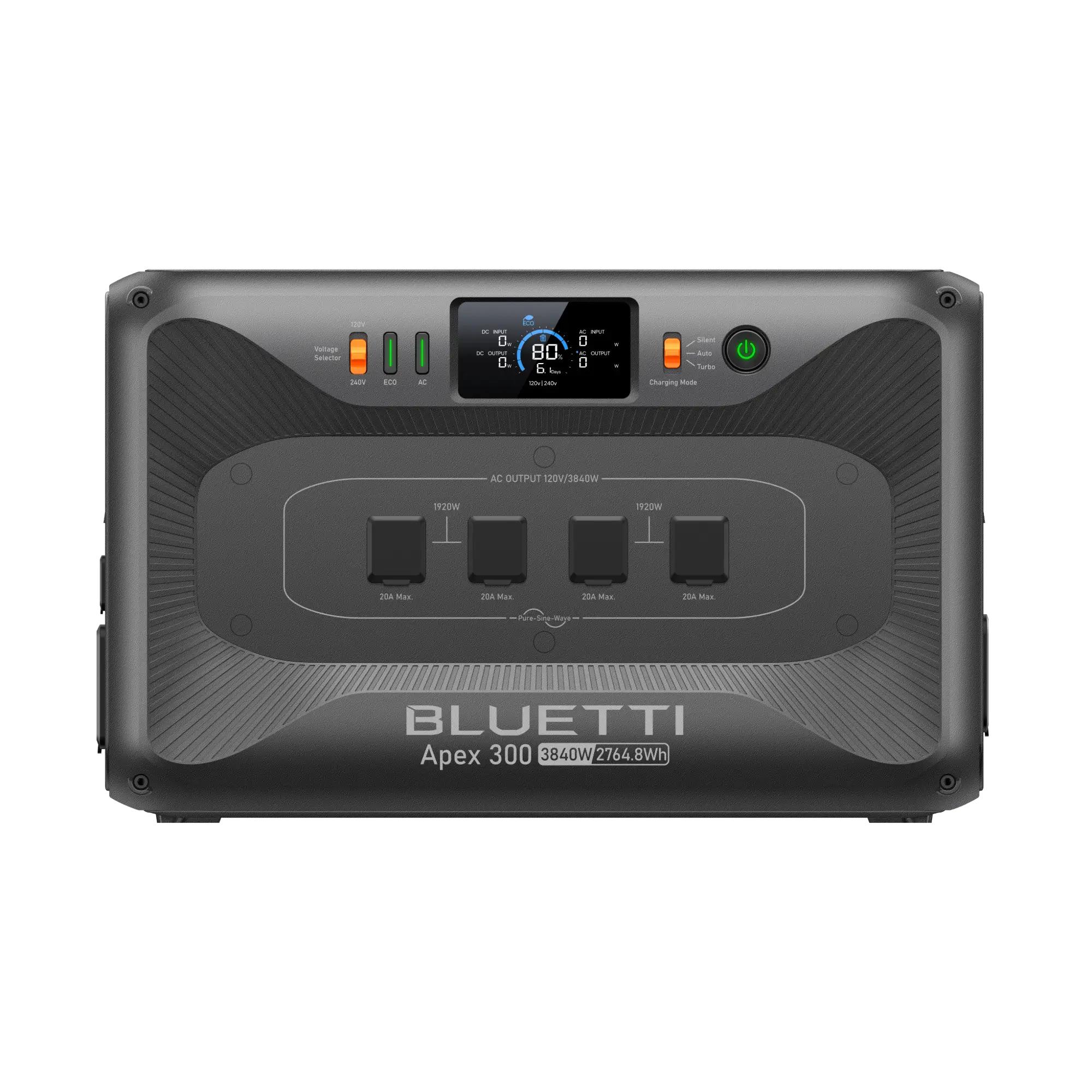
BLUETTI Apex 300
$1,499.00
$1,499.00 · direct from BLUETTI
down from $1,699 · 12% below usual
Last checked 16 days ago. Prices move — check before you buy.
Prices may vary by retailer and are subject to change.